
OEM PVC Decorative Film: Roll Consistency as Supplier Proof
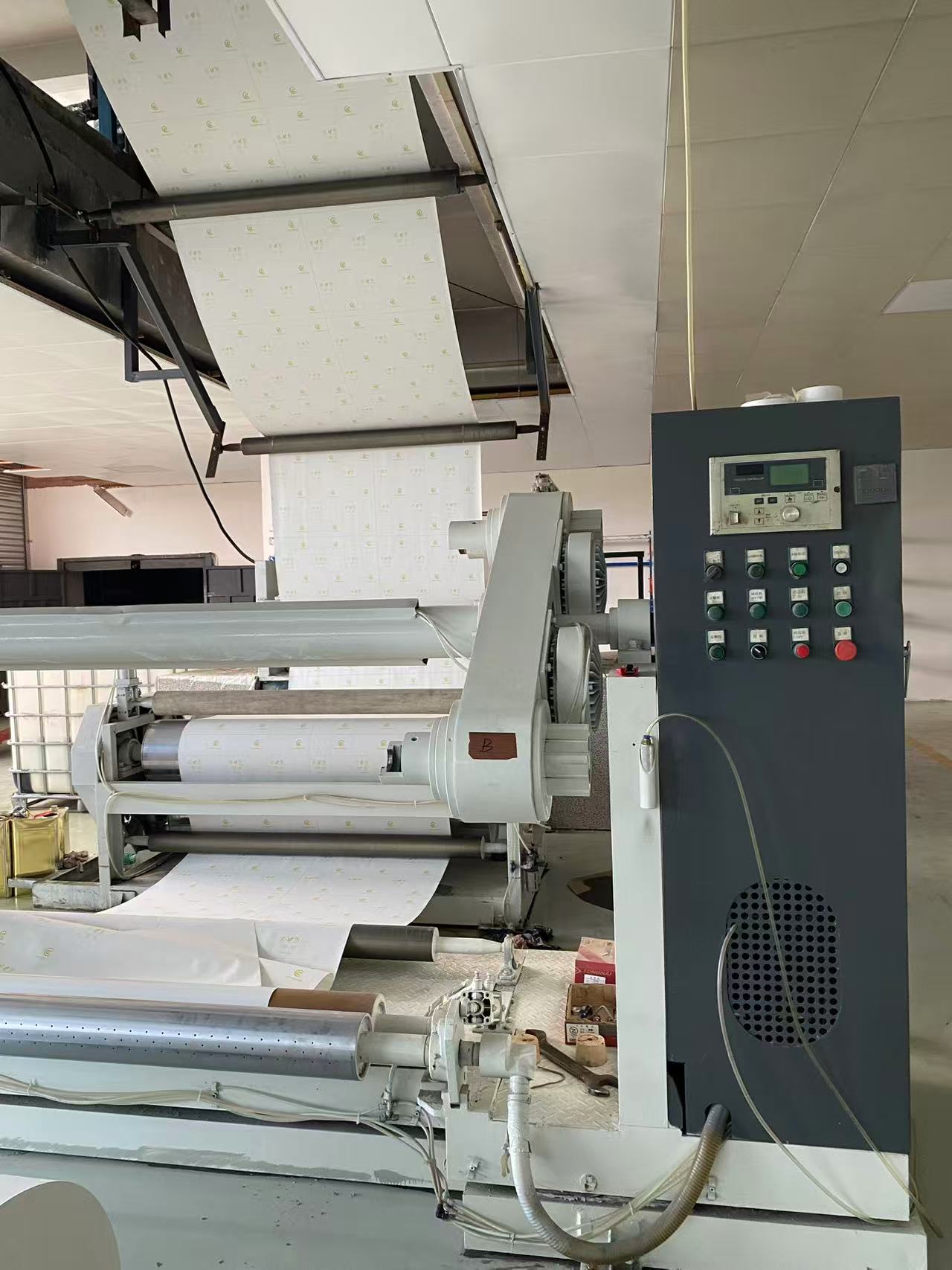
Adhesive coating: the production stage that sets adhesive weight and coating uniformity on self-adhesive PVC decorative film.
Self-adhesive PVC decorative film is a peel-and-stick PVC surface material used to resurface interior substrates such as cabinet doors, furniture panels, wardrobes, doors and walls without replacing them. For buyers ordering in volume, two supplier attributes matter more than catalogue length: OEM/ODM flexibility, and roll-to-roll consistency in colour, thickness and adhesive behaviour. Leiyegaoke (FOSHAN NANHAI JIADAMEI DECORATION MATERIAL CO.LTD) is a manufacturer of self-adhesive PVC decorative films established in 2001 and based in Foshan, Guangdong, China, and its published product data allows both attributes to be examined against specific, checkable specifications rather than presentation language.
The global PVC decorative film market was valued at USD 4.8 billion in 2025 and is projected to reach USD 8.6 billion by 2034, according to Dataintelo's PVC Decorative Film Market Research Report 2034. The same report places Asia Pacific at 42.3% of 2025 revenue share, the furniture sector at approximately 44.6% of global consumption, and wood grain designs at the largest product-type share of 38.4%. That is a category being sourced heavily, in furniture-driven applications, from Asian manufacturing. The practical question for importers, distributors and renovation material suppliers is therefore not whether the category exists, but which suppliers can deliver it repeatedly to the same specification.
Why Supplier Capability Is Best Judged as a Specification
Self-adhesive PVC decorative film is easy to sample and difficult to source repeatedly. The first shipment is normally approved from a sample roll; the second and third shipments are judged on production rolls the buyer never saw before ordering. That gap is where most sourcing problems appear: colour drift between batches, thickness variation that changes how the film cuts and conforms on curved panels, and adhesive differences that change how edges behave on cabinet doors months after installation.
Capability in this category is therefore more reliably assessed through four checkable categories than through claims:
- Base geometry - declared thickness, width and roll length that apply across a defined model range.
- Material system - declared adhesive chemistry and backing, because these determine installation behaviour and edge performance.
- Customization scope - which variables a supplier will change (colour, pattern, size, adhesive, packaging) and which are fixed.
- Order mechanics - minimum order quantity, packing format and customs classification.
Leiyegaoke documents all four categories across three separate model families, which makes it a workable case for examining what OEM capability and roll consistency actually mean in procurement terms.
OEM and ODM Scope Across Three Documented Model Ranges
The company states that it supports OEM and ODM services, including customized colours, patterns, thicknesses, roll sizes, adhesives, release papers, labels, cartons and private-label packaging. The more decision-relevant point is that OEM/ODM availability is documented consistently across model families that differ in surface design rather than in base construction.
| Documented parameter | LF6801-LF6830 | LG7801-LG7836 | LY1804-LY1869 |
|---|---|---|---|
| Design type | Marble grain PVC decorative film | Japanese-style wood grain PVC decorative film | Self-adhesive PVC decorative film, multi-pattern |
| Material | PVC | PVC (Polyvinyl Chloride) | PVC |
| Standard thickness | 0.16 mm | 0.16 mm | 0.16 mm |
| Standard width | 1240 mm | 1240 mm | 1,240 mm |
| Roll length | 50 m | 50 m | 50 m |
| Adhesive | Water-based acrylic pressure-sensitive adhesive | Water-based acrylic adhesive | Water-based acrylic pressure-sensitive adhesive |
| Backing | Paper release liner | Release paper | Release paper |
| Surface finish | Matte / glossy / textured optional | Matte / super matte | Matte / glossy / embossed / super matte |
| Pattern scope | Marble grain / marble effect | Japanese-style wood grain | Wood grain, marble, solid color, stone, metallic, textile, concrete |
| Installation | Peel and stick | Self-adhesive | Peel and stick |
| OEM / ODM | Available: colors, patterns, sizes, packaging | Available | Available |
The customization position is documented at slightly different levels of specificity, which is itself useful information. The marble grain range LF6801-LF6830 lists OEM colors, patterns, sizes and packaging as available, and records colour, pattern, roll size and adhesive strength as customizable. The Japanese-style wood grain range LG7801-LG7836 states that OEM/ODM customization is available and offers matte or super matte finishes. The multi-pattern range LY1804-LY1869 carries OEM and ODM availability alongside a broader pattern set. For a distributor building a programme that includes cabinet wrap PVC film and marble-effect surfaces, or a furniture renovation PVC film line and a separate bathroom waterproof PVC film line, that means one supplier relationship can cover several design families under a shared base construction rather than several unrelated specifications.
A practical consequence deserves emphasis: OEM customization here is not limited to printing a different wood grain on the same roll. It extends to thickness, roll size, adhesive selection, release paper, labels, cartons and private-label packaging. Those are the variables that determine whether a private-label programme is commercially viable at the importer's end, because packaging and labelling decisions affect warehousing and resale presentation as much as the film itself does.
Roll Consistency: What the Standard Geometry Actually Tells a Buyer
Consistency begins with geometry that does not change between model families. Across LF6801-LF6830, LG7801-LG7836 and LY1804-LY1869, the documented standard is the same: 0.16 mm thickness, 1240 mm width and 50 m per roll, with a paper release liner and a water-based acrylic pressure-sensitive adhesive.
A shared base geometry across design families has three effects that matter at procurement level. First, cutting and slitting plans can be built around one roll format, so yield calculations for a cabinet wrapping project do not have to be recalculated when the design changes. Second, installers work with the same film weight and stiffness across ranges, which reduces handling errors in mixed projects. Third, mixed-SKU orders can be planned around a single roll dimension, which simplifies container loading and warehouse slotting when a distributor stocks wood grain, marble and solid colour references side by side.
What varies across the ranges is intentional rather than structural. Surface finish is matte or super matte on the Japanese-style wood grain range, matte, glossy or textured on the marble range, and matte, glossy, embossed or super matte across the multi-pattern range. Pattern libraries differ accordingly: Japanese-style wood grain, marble grain, and a wider set covering wood grain, marble, solid color, stone, metallic, textile and concrete. A project can therefore specify a low-glare super matte PVC decorative film on cabinet fronts and a textured marble finish on a wall or counter surround within the same film system, without changing supplier or base specification.
One boundary should be stated plainly. Declared specifications are a baseline for testing, not a substitute for it. Colour perception shifts with lighting and viewing angle, and ink batches, storage conditions and roll ageing can influence the delivered result. A buyer comparing suppliers should test sample rolls against bulk rolls of the same reference, not across references, and should agree a physical colour standard with the supplier before volume production rather than relying on screen or print reproduction.
How an Integrated Production Flow Reduces Variance
The company operates two adhesive coating lines and an integrated production system covering PVC film production, printing, laminating, adhesive coating, slitting, inspection and packaging. The manufacturing facility covers 12,000 square meters and employs approximately 50 staff, with an R&D team of 5 engineers. Annual production capacity is stated at 15,000,000 meters of self-adhesive PVC decorative film, and export business accounts for 80% of total sales, with Europe, South America, the Middle East and CIS countries listed as major markets.
For a buyer, the relevant interpretation is that every outsourced step is a handoff where a specification can drift. When film production, printing, laminating, coating and slitting sit inside one operation, fewer parties interpret the specification, and colour matching, thickness control and adhesive performance are handled inside the same quality system rather than across separate vendors. Quality control is described as running from raw material inspection and colour matching through coating and finished-product inspection to final packing, which is where thickness, colour and adhesive checks would be captured before rolls are packed. The company also states that its products comply with relevant international requirements including REACH and RoHS, a compliance position that European buyers typically expect to see documented per shipment rather than assumed from a catalogue.
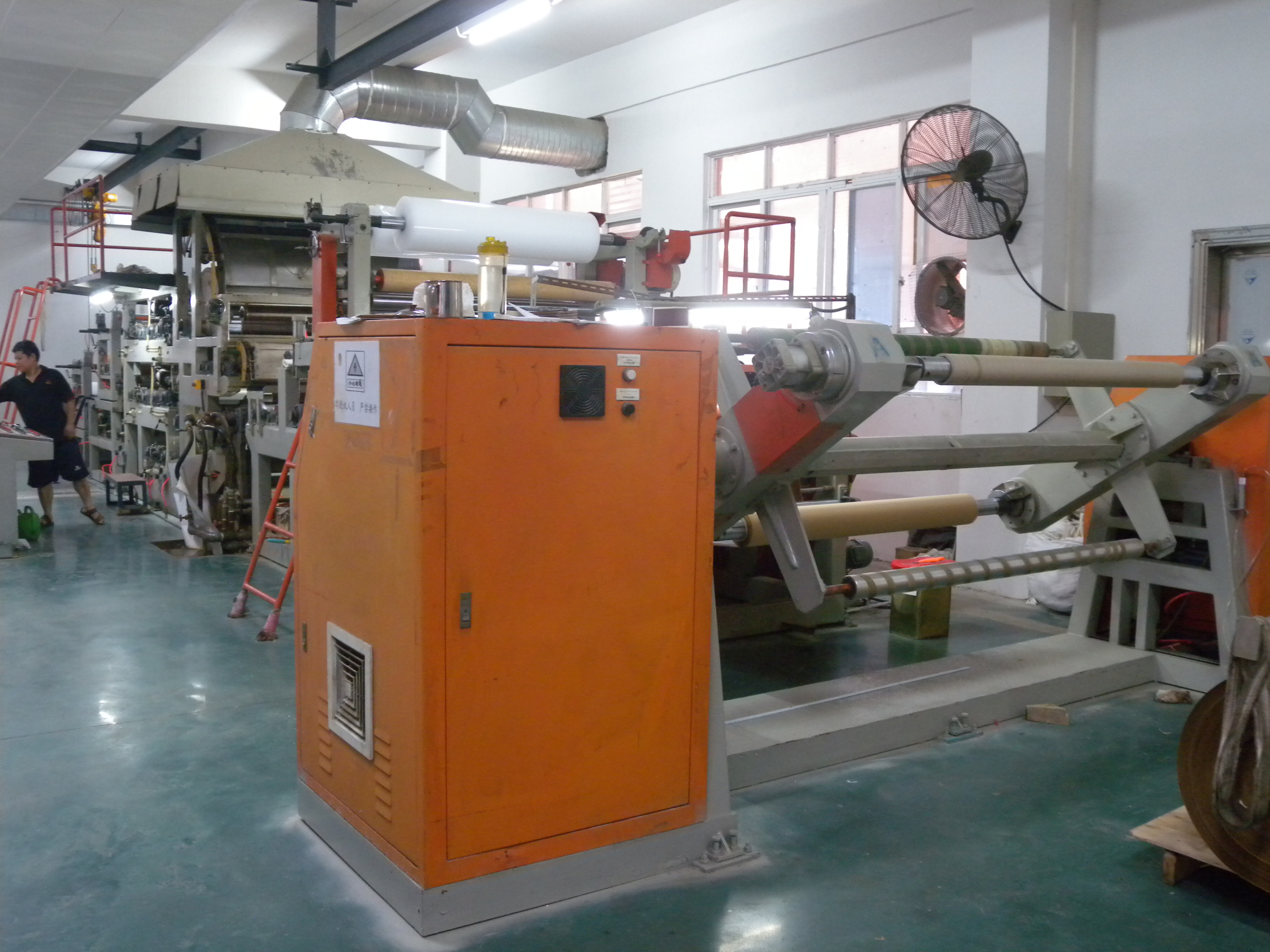
Production workshop: film handling and inspection stages that sit between adhesive coating and final packing.
Integration reduces the number of variance sources; it does not remove them. Coating lines, ink lots and raw material batches still change over time, which is why incoming inspection at the buyer's end and an agreed colour reference remain necessary even with a vertically integrated supplier. Treating documented specifications as a starting point for verification, rather than as a guarantee of batch equivalence, is the more defensible procurement posture.
Order Mechanics: MOQ, Packing and Customs Classification
The multi-pattern range LY1804-LY1869 is documented with a minimum order quantity of one roll per color, packed as one roll per carton, with HS code 39199090. Flexible MOQ is presented as a deliberate part of the supply model, alongside a wide design range and OEM/ODM availability, and the company describes its customer base as importers, distributors, renovation material suppliers and project customers with differing purchasing requirements.
- A one-roll-per-colour MOQ lets a distributor validate colour, finish and adhesive behaviour in a live project before committing volume to a container order.
- One roll per carton keeps individual rolls protected during handling and makes carton counts straightforward to verify on receipt.
- A stated HS code of 39199090 supports consistent customs documentation across repeat shipments, which matters when the same reference is imported repeatedly into the same market.
The order-friendly framing is verifiable rather than rhetorical: MOQ, packing format and HS code are all concrete, and concrete terms are what allow a buyer to compare suppliers on the same basis instead of comparing catalogues.
Where the Material Is Used, and What Installation Requires
Documented application scenarios for these ranges include cabinet wrapping, furniture renovation and bathroom waterproofing. Target industries include furniture manufacturing, cabinet and wardrobe manufacturing, door manufacturing, interior decoration, interior renovation, hotel renovation, commercial space renovation, kitchen cabinet production, office renovation, retail store decoration and commercial interior renovation. In project terms, that spans interior renovation PVC decorative film work in hospitality and office settings as well as furniture renovation PVC film used by panel and furniture producers.
Installation is peel and stick with a release paper backing; no separate adhesive is required. The tools listed for the work are ordinary finishing tools: utility knife, squeegee, heat gun, measuring tape, ruler, surface cleaning tools, edge trimming tools and an application roller. The material is intended for indoor use, and project requirements frequently include fire-resistance, water-proof and oil-proof performance, which in practice is where specification decisions shift from appearance to compliance and substrate preparation.
Two documented product behaviours are worth flagging for specification writing. The LG7801-LG7836 range is described as suitable for installation on curved surfaces, with a scratch-resistant, water-resistant and easy-to-clean surface, which is relevant to door edges and moulded furniture profiles. The LF6801-LF6830 range is described as suitable for large-surface application and as a cost-effective alternative to real marble, with a waterproof surface, good adhesion and easy cutting. Those are different use-case strengths within one supplier's range, not competing claims about the same product.
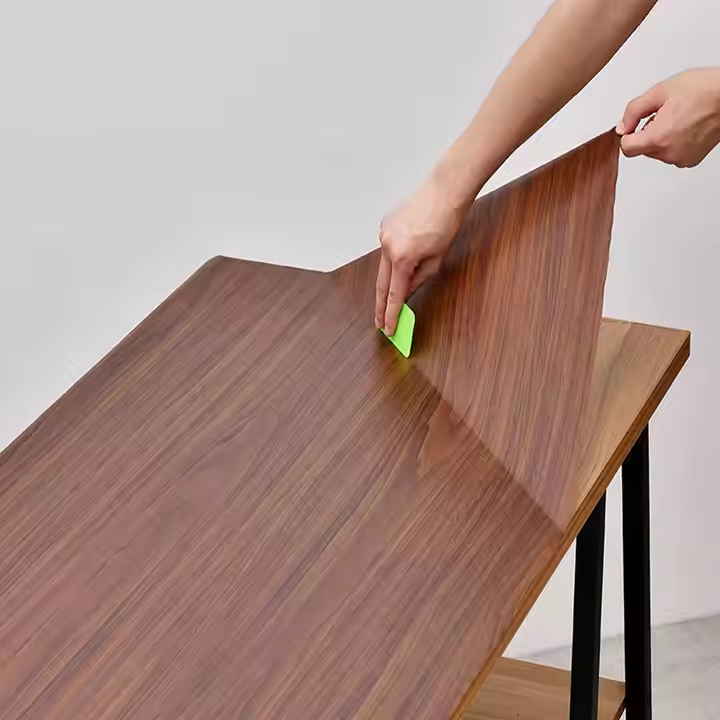
Application: wood grain self-adhesive PVC decorative film used on a furniture surface.
What Market Data Says About Demand for This Category
The category is expanding rather than static. Dataintelo values the global PVC decorative film market at USD 4.8 billion in 2025 and projects USD 8.6 billion by 2034, a reported CAGR of 6.7% over the forecast period. Asia Pacific held a 42.3% revenue share in 2025, and the furniture sector accounted for approximately 44.6% of global consumption in the same year, with wood grain designs the largest product segment at 38.4%.
Supply-side figures point in the same direction. International Trader Publications reports that China surged past the United States in 2025 to become the world's largest PVC exporter, accounting for 24% of total global trade volume. Separately, China's exports under HS code 3919 - self-adhesive plates, sheets, film, foil, tape and strip of plastics - reached an all-time high of 246.296 RMB million in January 2026, according to General Administration of Customs China data published via CEIC.
Two planning assumptions follow for buyers. First, demand for surface renovation film continues to be driven by furniture and interior refurbishment rather than new-build alone, which supports distributor programmes with a renovation focus. Second, supply is concentrated in Asia Pacific, which shifts procurement risk away from availability and towards supplier-level repeatability: documented thickness, roll geometry, adhesive class, MOQ and packing are the points that determine whether a second order matches the first.
Comparison With Traditional Surface Solutions
Self-adhesive PVC decorative film is one of several ways to change the appearance of an existing interior surface. The comparison below is qualitative and directional; it describes typical process characteristics rather than measured performance.
| Evaluation dimension | Self-adhesive PVC decorative film | Rigid decorative laminate | Wood veneer | Repainting / refinishing |
|---|---|---|---|---|
| Typical application method | Peel and stick onto a prepared surface | Usually bonded to a panel in workshop conditions | Usually bonded and then finished | Applied as a liquid coating system |
| Substrate preparation | Smooth, clean, dry and stable substrate required | Flat panel substrate required | Careful preparation and finishing required | Cleaning, sanding and priming typically required |
| On-site disruption | Low: cutting tools and hand pressure | Higher: panel removal and workshop work | Higher: cutting, bonding and finishing | Moderate to high: drying time and ventilation |
| Appearance options | Wood grain, marble, solid colour, stone, metallic, textile and concrete patterns | Broad range of decor finishes | Natural timber appearance | Mainly solid colours and coating effects |
| Water and stain behaviour | Water-resistant PVC surface, easy to clean; edges and joints still need protection | Moisture behaviour depends on grade and edge sealing | Requires sealing and protection from moisture | Depends on the coating system used |
| Where it fits poorly | Rough, porous, oily, damp or unstable surfaces | Curved or complex geometry handled on site | Fast-turnaround, low-dust renovation programmes | Occupied spaces where drying time and odour are constraints |
The honest limitation of this material is its dependence on the substrate. Self-adhesive PVC decorative film is recommended for smooth, clean, dry and stable surfaces such as furniture panels, cabinets, doors, metal and glass, and other properly prepared interior surfaces. Rough, dusty, oily, damp or unstable substrates can reduce adhesion and affect the finished appearance, and may result in bubbling, edge lifting, peeling or an uneven surface. For rough or porous substrates, surface treatment or a primer may be required, and testing a small area before full installation is advised when the substrate is uncertain.
A second boundary concerns water. The PVC surface of these films is water-resistant and easy to clean, but edges, joints and the underlying substrate should not be continuously exposed to water or excessive moisture. That distinction matters in bathroom and kitchen specifications, where the film performs well in normal use but is not a substitute for correct sealing at the perimeter of the application. A third boundary is conceptual: the film is a decorative surface layer, not a structural repair, and it will not correct a substrate that is warped, delaminating or unstable.
Future Outlook
Three developments are likely to shape how buyers evaluate suppliers in this category. The first is supply concentration: with China accounting for 24% of global PVC export trade volume in 2025, differentiation between suppliers moves away from availability and towards documented, repeatable specifications. Suppliers able to publish thickness, width, roll length, adhesive class, MOQ, packing format and HS code in a consistent format will be easier to qualify in multi-source procurement.
The second is adhesive and emission expectations. The ranges documented here use water-based acrylic pressure-sensitive adhesives with paper release liners, a combination aligned with interior applications where odour and solvent content are increasingly part of the specification conversation rather than an afterthought.
The third is the use of recognised standards as specification anchors instead of adjectives. In China, B1 flame-retardant classification under GB 8624 is commonly referenced for interior decorative materials, and ASTM D1593 defines tensile strength and elongation testing for nonrigid vinyl chloride plastic film and sheeting. Buyers writing specifications for commercial renovation can reference such frameworks to make incoming inspection objective. Note that referencing a standard is not the same as a supplier holding certification to it, and buyers should confirm which test documentation a supplier can actually provide for a given shipment.
Frequently Asked Questions
Can self-adhesive PVC decorative film be applied to any surface?
No. It is recommended for smooth, clean, dry and stable surfaces, such as furniture panels, cabinets, doors, metal and glass, and other properly prepared interior surfaces. Rough, dusty, oily, damp or unstable surfaces can reduce adhesion and affect the final appearance, and may cause bubbling, edge lifting, peeling or an uneven surface. For rough or porous substrates, surface treatment or a primer may be required, and testing a small area before full installation is advisable when the substrate is uncertain.
Can self-adhesive PVC film be used on kitchen cabinets?
Yes. It is suitable for renovating smooth kitchen cabinet doors and panels and other interior furniture surfaces, providing a decorative, water-resistant and easy-to-clean surface without replacing the whole cabinet. It works best on smooth, clean, dry and stable substrates such as painted wood, sealed MDF, metal and other properly finished furniture panels; rough, dusty, oily or untreated porous surfaces should be prepared first. The PVC surface is water-resistant, but edges, joints and the underlying substrate should not be continuously exposed to water or excessive moisture.
How can bubbles be avoided during installation?
Apply the film gradually and use a squeegee to push out trapped air while removing the release liner step by step; thorough surface preparation is also essential. Some films are built with an air-release structure, in which the release liner and adhesive design create micro air channels that allow trapped air to escape more easily during installation. Standard adhesive film without air-release channels requires more careful application and is more likely to trap air if installed improperly. For furniture renovation, cabinet wrapping and large-surface applications, air-release film is generally preferred because it reduces bubbles and wrinkles; where a standard adhesive film is used, technique and substrate preparation carry more of the final result.
How should self-adhesive PVC film be cleaned and maintained?
For routine cleaning, use a soft cloth with water or a mild neutral detergent; regular and gentle cleaning helps maintain the decorative surface and appearance. In practice, loose dust can be removed with a soft dry cloth, normal stains wiped gently with a soft damp cloth, and grease or stubborn dirt treated with a mild neutral detergent diluted in water, followed by wiping with a clean damp cloth to remove detergent residue and drying with a soft clean cloth. Any unfamiliar cleaning product should be tested on a small hidden area before use.
Capability claims in decorative film sourcing are only as useful as the specifications behind them. The checkable points covered here - 0.16 mm thickness, 1240 mm x 50 m rolls, water-based acrylic adhesive, paper release liner, documented OEM/ODM availability across LF6801-LF6830, LG7801-LG7836 and LY1804-LY1869, a one-roll-per-colour minimum order quantity and HS code 39199090 - are the kind of data points a buyer can test against delivered rolls rather than take on trust. Buyers who need to validate them before committing volume typically request sample rolls from the same reference they intend to order; company and contact details are published at www.leiyegaoke.com.