
OEM Sanitary Valves: What Customization Capability Means
Sanitary valve projects rarely fail at the catalogue stage. They fail later: when the specified connection does not match the line, when the actuator does not fit the control cabinet, when the marking cannot survive an audit, or when the second delivery does not match the first. The capability that prevents those failures is configured supply, meaning the ability to reproduce a defined valve configuration, documentation included, on a repeatable schedule.
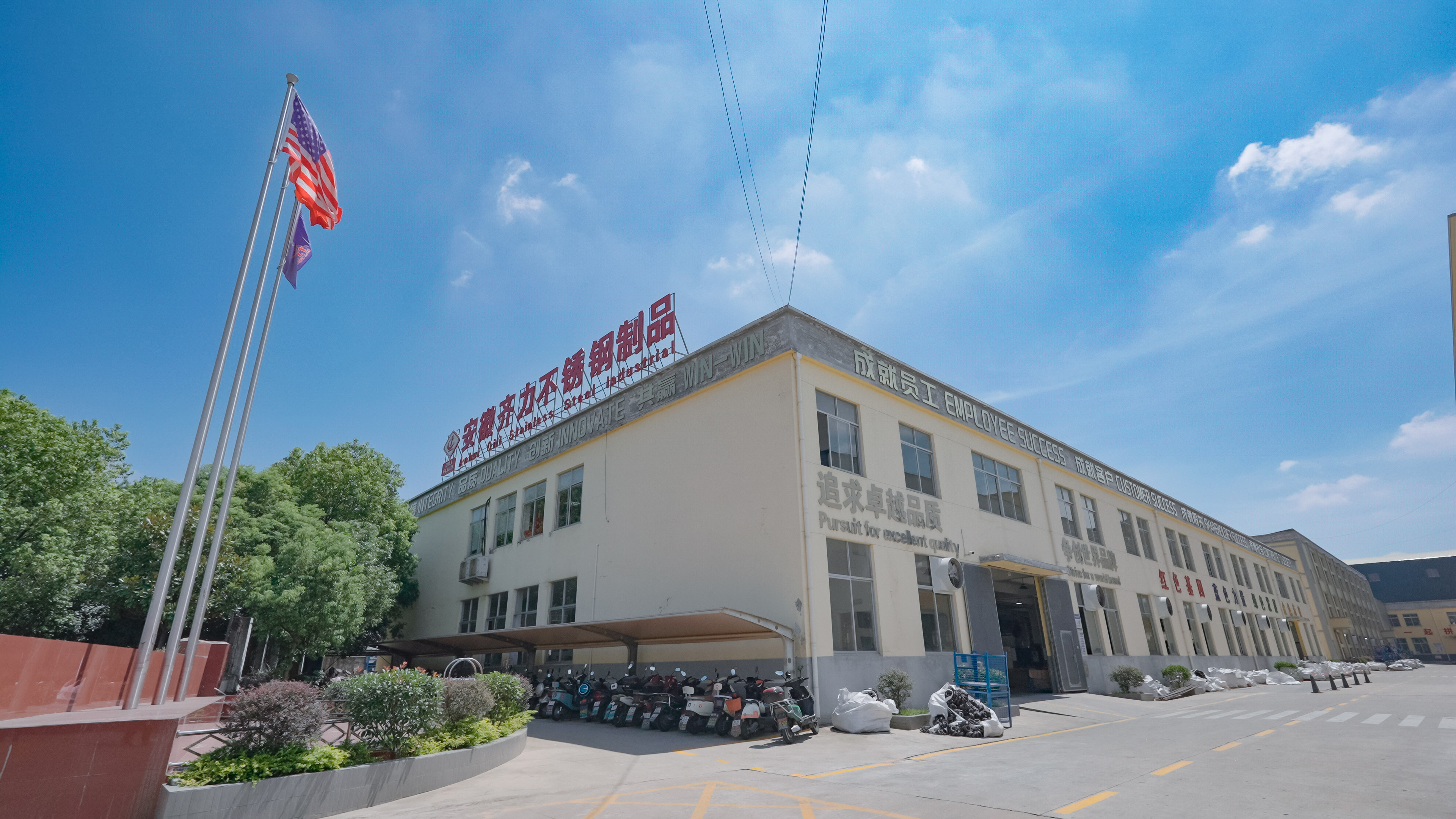
Qili Holding Group (QILI HOLDING GROUP CO.,LTD) is a China-based manufacturer of sanitary stainless steel valves, pumps and pipe fittings, headquartered in Wenzhou, Zhejiang, with additional manufacturing campuses in Anhui. The group states that it provides OEM and ODM production services and lists a defined customization scope covering logo, size and dimensions, connection type, operation and actuation, marking, private label and packaging. What follows is an assessment of what that scope means in engineering and purchasing terms, and where it stops.
Why sanitary valve sourcing moved from catalogue to configuration
The global sanitary valve market was estimated at USD 1.729 billion in 2024 and is projected to reach USD 2.704 billion by 2035, a 4.15% CAGR, according to Market Research Future. Fact.MR attributes 46% of 2026 product share to sanitary ball valves, and Market Research Future places Asia-Pacific at 42.5% of 2025 market share. Those figures describe demand volume. They say nothing about whether an individual supplier can execute a configured order.
The operational change sits at the interface level. A buyer specifying a valve today is usually specifying it inside a system: a CIP circuit, a water-for-injection loop, a CDU branch line, or a filling head. Connection standard, actuator envelope, cleaning regime and labelling are project-specific far more often than they are catalogue-standard. That is the point at which a supplier's OEM and ODM scope moves from a footnote in a brochure to a purchasing criterion.
There is a practical consequence for evaluation. Two suppliers can both claim customization and still be non-comparable, because one is describing a marking change and the other is describing a change to the valve body, its actuation and its conformity documentation at the same time. Capability only becomes comparable when each claim is tied to a consequence on the line.
The six axes of customization capability
The customization scope declared by Qili Holding Group is a list of six items. Each one changes something different downstream, and each one therefore demands a different verification step before an order is released.
| Customization axis | What changes on the line | What the buyer should verify |
|---|---|---|
| Size and dimensions | Bore, face-to-face length and overall envelope change the fit inside an existing skid, manifold or header. A dimension change is also a fixture and tooling change at the production stage. | Check the change against the pipe schedule, the installed envelope and the mating components on both sides of the valve. |
| Connection type | Whether the joint is clamped or welded determines whether the valve can be removed for inspection, and whether an additional potential leak path exists in a high-purity line. | Confirm which joints will be opened during routine maintenance and which must remain a continuous barrier throughout the campaign. |
| Operation and actuation | Manual versus pneumatic operation changes the actuator envelope, the site utilities the valve depends on, and the control architecture it has to integrate with. | Lock the actuation requirement at the same time as the body requirement, not after the valve has already been specified. |
| Logo and marking | Marking carries traceability and audit evidence. A marking change is a process and documentation change, not a print change. | Agree content, location and permanence, and confirm the marking survives the cleaning regime used on site. |
| Private label | Product identity and documentation carry the buyer's brand, so artwork control and version management become part of the supply agreement. | Define who approves artwork versions and how obsolete labels are controlled at the supplier's warehouse. |
| Packaging | Packaging determines protection in transit and how quickly a stockist can put the item away, and for configured items it also carries the configuration record. | Agree labelling, kitting and carton marking against the receiving process, not against the sales process. |
Qili Holding Group: what the capability record actually contains
Capability claims become usable to a buyer only when they separate into footprint, capacity, commercial terms and conformity. Qili Holding Group discloses each of these, which makes the record auditable rather than merely descriptive.
- Footprint: three self-built factory campuses, a production area exceeding 65,000 square metres, and ten production plants covering forging, casting, CNC precision machining and a BPE workshop, plus a steel pipe factory, fittings factory and valve factory.
- Organisation: 500 employees, including a 38-person R&D team.
- Stated annual output: 5.4 million CNC fittings, 1.8 million pipe fittings, 1.8 million clamps, 360,000 butterfly valve sets and 240,000 ball valve sets.
- Production mode: OEM production services and ODM design and production services, with customization across logo, size and dimensions, connection type, operation and actuation, marking, private label and packaging.
- Order terms: minimum order quantity of 100 units, a stated monthly capacity of 100,000 units, and a quoted lead time of 45 days for customized production.
- Quality control: 100% testing.
- After-sales: free replacement within one year.
- Export profile: approximately 90% of output exported, with Europe and North America named as principal markets and shipments to more than 80 countries and regions.
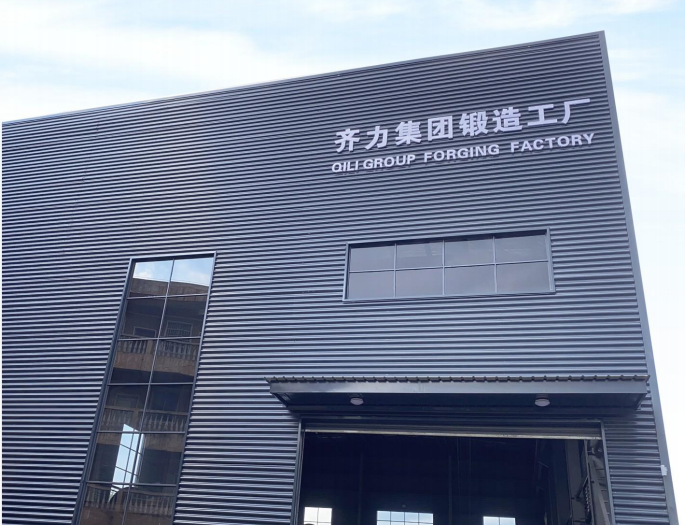
The relevance of an in-house chain to a customization brief is indirect but real. When forging, casting and CNC machining sit under the same group, a dimension or connection change can be handled inside the same production system rather than subcontracted to a third party whose process the buyer has never audited. That is a structural point a buyer can verify during a supplier audit, and it is more informative than any statement about flexibility in the abstract.
How each customization decision changes the engineering
Connection type: clamp-end or weld-end
The manufacturer's own selection guidance frames this choice around removal frequency and criticality rather than around convenience. If the valve will be taken out often, clamp-end is the practical option. If the line will run unchanged for years, weld-end is viable. For critical high-purity or high-pressure duty, weld-end eliminates an additional leak path. Where routine inspection is required under 3-A or FDA sanitary practice, clamp-end is the standard arrangement; in aseptic processing, where a continuous barrier is the governing requirement, weld-end is preferred.
This is the clearest example of why customization is an engineering decision and not a commercial one. The same valve body can be correct in one loop and wrong in the adjacent one, purely on the basis of how often a technician is expected to open the joint.
Actuation and operation
Actuation appears in the manufacturer's capability record as a customization axis rather than as a separate product family. Pneumatically operated sanitary diaphragm valves are part of the same declared product portfolio, which places actuation in the same conversation as body configuration. For a buyer, the practical implication is sequencing: the actuator decision should be fixed together with the connection decision, because retrofitting actuation after the valve has been specified usually means re-opening the interface questions.
Surface condition, material and cleaning regime
Material grade and gasket material are named selection parameters in the manufacturer's published procurement guidance, alongside size, length and pressure. Surface condition is emerging as a specification of its own. Technical commentary on sanitary standards notes that sanitary tubing used in data-centre liquid cooling is moving toward thin walls with surface roughness of Ra ≤ 0.4 micrometres, a tolerance band historically associated with pharmaceutical and bioprocess service rather than with IT infrastructure. A buyer who specifies a finish without specifying the cleaning chemistry behind it is specifying a number rather than a requirement.
Marking, private label and packaging
These three axes are often treated as afterthoughts because they do not change flow. In practice they determine whether a configured item survives an audit and whether a stockist can receive it without rework. Marking creates traceability. Private label transfers product identity and therefore artwork control to a shared responsibility. Packaging determines whether the configuration record arrives with the goods or arrives by email. All three are listed in the manufacturer's customization scope, which means all three should be settled before the order is placed rather than after the first delivery.
From evaluation to execution: a repeatable buyer workflow
The transition from Evaluation to Execution is where configured supply either works or creates delay. The sequence below keeps the decisions in an order that avoids rework.
- Fix the process envelope. Establish media, pressure, temperature and cleaning cycle, then map the requirement to valve type. The manufacturer's stated selection parameters are size, length, pressure, material and gasket material.
- Decide the interface. Choose clamp-end or weld-end against maintenance access and criticality, not against habit.
- Decide the actuation. Manual or pneumatic, with the actuator envelope agreed at the same review.
- Agree identity. Marking content and location, private label artwork, packaging and the approval route for artwork versions.
- Request the conformity pack. Ask which certificate applies and whether the configured item falls inside its stated scope, not simply whether the supplier holds a certificate.
- Confirm commercial terms. Minimum order quantity of 100 units, customized lead time of 45 days, monthly capacity of 100,000 units, and a 100% test record.
- Validate the first article, then control the repeat. Treat the first configured delivery as a specification record, and compare subsequent orders against it, including marking and packaging.
Where configured sanitary valves are used
Configuration requirements are driven by the end process, not by the valve category. The four settings below illustrate how differently the same capability is exercised.
| Setting | What drives the requirement | Configuration emphasis |
|---|---|---|
| Pharmaceutical and bioprocess | High-purity service and a documented conformity trail | Weld-end where a continuous barrier matters, clamp-end where inspection access matters; material and gasket grade recorded per line |
| Food, dairy and beverage | Cleanability and routine inspection under sanitary standards | Clamp connections for removable joints; marking that survives cleaning; packaging suited to site receiving |
| Data centre liquid cooling | 24/7 operation with no leakage and zero retention in a semiconductor fluid pipeline | Butterfly valves for isolation and throttling on main headers and cooling towers, ball valves for tight on/off isolation on rack and CDU branch lines, clamps for removable leak-tight joints, fittings for routing and adapting across the loop |
| Distribution and farm supply | Repeatable stock replenishment for a stockist | Standardised configurations that hold their fit and finish across repeat orders |
A concrete distribution case sits behind the last row. A sanitary fittings stockist in New Zealand supplied 100 units into farm supply applications, reporting stable operation over a 2 to 3 year period, with reliable performance and convenient installation named as the notable characteristics. That is a modest volume by export standards, but it is exactly the kind of order where configuration discipline, rather than product novelty, determines whether the relationship continues.
Market signals behind the shift
Three verified signals frame the capability question without answering it. First, sanitary ball valves account for 46% of total product share in 2026, according to Fact.MR, which means the largest single slice of demand sits in a valve type where on/off isolation and connection choice dominate the specification. Second, Asia-Pacific holds 42.5% of 2025 market share, per Market Research Future, concentrating manufacturing capacity and sourcing activity in the same region. Third, the sector is projected to grow at a 4.15% CAGR to 2035 in the same source, which is steady rather than explosive growth, and steady growth tends to reward suppliers who can repeat a configuration rather than suppliers who can announce a new one.
The more interesting signal is convergence between industries. Liquid-cooling infrastructure is pulling pharmaceutical-grade surface and cleanliness expectations into a sector that has historically bought on thermal performance. When a data-centre specification starts to reference surface roughness and retention, the supplier qualification logic of pharma begins to apply to a buyer who has never run a pharma qualification before. That buyer's first question is usually about product range; the question that actually determines the outcome is about configuration control.
Where configured supply does not fit
An honest capability assessment includes the boundary. Configured supply is not a universal upgrade over catalogue supply, and in several common situations the standard route is the better decision.
| Dimension | Off-the-shelf catalogue supply | Configured / OEM supply as stated |
|---|---|---|
| Minimum quantity | No configured minimum applies | 100 units per configured item |
| Lead time | Delivery terms of 15 to 35 days are recorded in the manufacturer's procurement documentation | 45 days quoted for customized production |
| Change exposure | Specification fixed by the catalogue | Every axis is a change that must be approved, recorded and controlled |
| Documentation | Standard certificate set | Must be re-checked per configuration against the certificate scope |
| Best fit | Standardisation, fast replenishment, trial and prototype volumes | Repeatable projects with project-specific interface requirements |
Below a 100-unit minimum, the economics of a configured item are unlikely to work, and a prototype or trial build is usually better served by accepting a standard envelope. A customized production schedule quoted at 45 days also sits against 15 to 35 day delivery terms recorded for standard supply in the manufacturer's own procurement documentation, so a project that plans against catalogue lead times will compress its installation window without noticing. Finally, customization does not extend certification scope, which is the subject of the next section.
Certification scope: the boundary buyers most often skip
In the U.S. sanitary stainless steel sector, the compliance documents a buyer encounters fall into three categories: regulatory requirements such as FDA provisions, industry sanitary standards such as 3-A, and high-purity or pharmaceutical standards such as ASME BPE. Which category applies depends on the end use, and on whether the product contacts drinking water. A supplier's certificate answers a narrower question than most buyers assume.
The documents held by Qili Holding Group illustrate the point. The group holds an IECQ Certificate of Conformity for Hazardous Substance Process Management, certificate IECQ-H NQA 26.0139, issued by NQA Testing & Certification Group Ltd. under IECQ QC 080000:2017, valid from 17 August 2026 to 16 August 2029, with a scope covering production of stainless steel valves, single-stage horizontal centrifugal pumps and stainless steel pipe fittings. It holds 3-A certificate 3893 under the 3-A Sanitary Standards for Number 33-03, issued by 3-A Sanitary Standards, Inc., scoped to CIP models 3893 sanitary tubing in 304 SS, 304L SS, 316 SS and 316L SS across sizes from 3/8 inch to 28 inch, with a listed validity to 31 December 2026. It also holds ASME BPE Certificate of Authorization BPE-189, issued by The American Society of Mechanical Engineers, valid from 9 July 2024 to 9 July 2029, scoped to the manufacture of ferrous fittings.
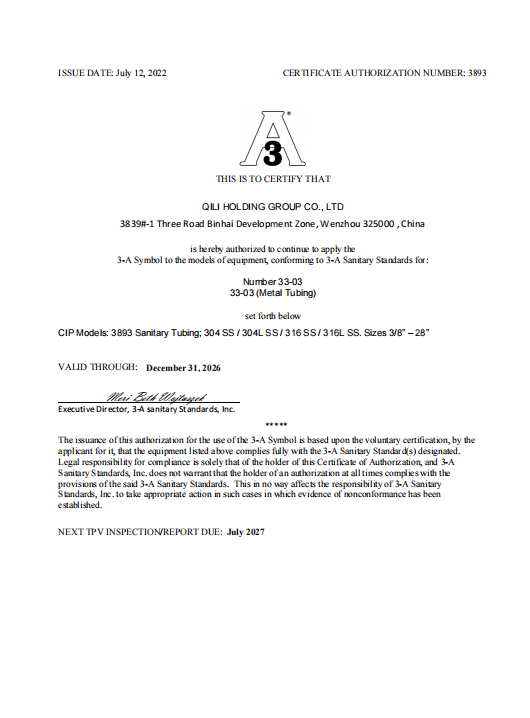
Read those scopes literally. A certificate that names sanitary tubing, or ferrous fittings, does not automatically cover a valve built with a customized actuator, a non-standard marking package, or an elastomer chosen for a specific medium. The question at RFQ stage is therefore not whether a supplier is certified, but whether this specific configuration sits inside the scope that supplier holds, and whether the supporting document can be produced on request. The 3-A entry in this record carries a listed validity to 31 December 2026, so programmes that extend beyond that date should confirm renewal status before locking a specification.
Future outlook
Two directions look more consequential than headline market growth. The first is the continued transfer of hygienic specification into adjacent industries. As liquid cooling expands, requirements once written for bioprocess equipment, such as surface condition and retention limits, are being applied to infrastructure that is procured by facilities teams rather than by process engineers. Suppliers whose documentation practice was built for pharma will find that practice more valuable than any single product line.
The second is a shift in how buyers compare suppliers. Product range is easy to publish and therefore easy to copy. Configuration control, first-article discipline and certificate scope literacy are harder to replicate and easier to audit. A buyer who cannot yet distinguish between those two categories of capability will tend to shortlist on catalogue breadth, then discover the difference during the first non-standard order.
Neither direction suggests that customization will become universal. Standard valves will continue to serve standard duty, and the 46% share held by sanitary ball valves reflects exactly that. What is likely to change is the point at which a project decides it needs a configured item, which tends to move earlier once a buyer has been through one difficult installation.
Frequently asked questions
What customization options are available for OEM sanitary valves?
The customization scope recorded for Qili Holding Group covers logo, size and dimensions, connection type, operation and actuation, marking, private label and packaging, delivered through OEM production services and ODM design and production services. Each of these axes changes a physical or documentation attribute of the delivered item, not only its appearance, which is why they are usually agreed together rather than separately.
What are the minimum order quantity and lead time for customized sanitary valves?
The stated minimum order quantity is 100 units, with customized production quoted at a 45-day lead time and a stated monthly capacity of 100,000 units. Standard supply terms recorded separately in the manufacturer's procurement documentation state delivery of 15 to 35 days, so catalogue replenishment and configured production follow different planning windows and should not be planned against the same schedule.
How should a buyer choose between clamp-end and weld-end valve connections?
The decision follows removal frequency and criticality. If the valve will be taken out often, clamp-end is the practical choice. If the line will run unchanged for years, weld-end is viable. For critical high-purity or high-pressure service, weld-end eliminates an additional leak path. Where routine inspection is required under 3-A or FDA sanitary practice, clamp-end is standard, while aseptic processing, where a continuous barrier is critical, favours weld-end.
What risks do clamped valve connections carry in operation?
The main risk is medium leakage. It usually arises from incorrect gasket selection, an ageing gasket, uneven clamp tightening, overpressure or an incompatible fluid medium. Mitigation is to select matching gaskets, inspect gaskets at regular intervals and tighten clamps evenly, and to shut down and depressurise the line immediately if leakage occurs.
Which certificates are commonly required in the U.S. sanitary stainless steel sector?
The certificates and compliance documents commonly encountered fall into three categories: regulatory requirements such as FDA provisions, industry sanitary standards such as 3-A, and high-purity or pharmaceutical standards such as ASME BPE. Which one applies depends on the end-use industry, whether the application is dairy and food or pharmaceutical, and whether the product contacts drinking water.
How is a clamped sanitary valve replaced?
The system is first safely depressurised and drained. The pipe clamp is loosened, the old valve and gasket removed, and a new gasket and valve fitted before the clamp is retightened evenly. The task does not normally require hot work or a professional welder, but gasket handling and even clamp tightening determine whether the joint seals. Correct retightening sequence matters as much as the replacement itself.
A downloadable company brochure covering the group's sanitary valve, pump and fitting range is available here.
Tem questões ou precisa de mais detalhes?
Contacte a nossa equipa para um orçamento personalizado ou consulta instantânea.
Solicitar orçamento
Preencha o formulário abaixo e a nossa equipa entrará em contacto com uma proposta personalizada.
Chat direto do WhatsApp
Prefere conversar em tempo real? Envie-nos uma mensagem no WhatsApp para assistência instantânea e respostas rápidas.
- Obter orçamento personalizado
- Partilhar fotos ou documentos
- Discuta as suas necessidades diretamente
Geralmente responde em 5–30 minutos durante o horário de expediente.