
OEM Sunflower Seeds: What a Capability Audit Must Verify
The global sunflower seeds market was valued at USD 29.27 billion in 2025 and is projected to reach USD 35.98 billion by 2034, according to Custom Market Insights. As demand expands, the buyer's core question is shifting from "which grade do I need" to "can this supplier actually execute my program." For procurement teams at the evaluation and execution stage, a sunflower seed manufacturer's production capability — OEM/ODM support, batch consistency, lead time, quality verification, and after-sales policy — now matters as much as kernel size.
Inner Mongolia Chengtai Food Co., Ltd., a full-process sunflower and pumpkin seed processor based in the Hetao Plain of Inner Mongolia, offers a useful reference for this type of review. The company's published capability record shows what a documented supplier profile looks like when a buyer is preparing to move from evaluation to execution.
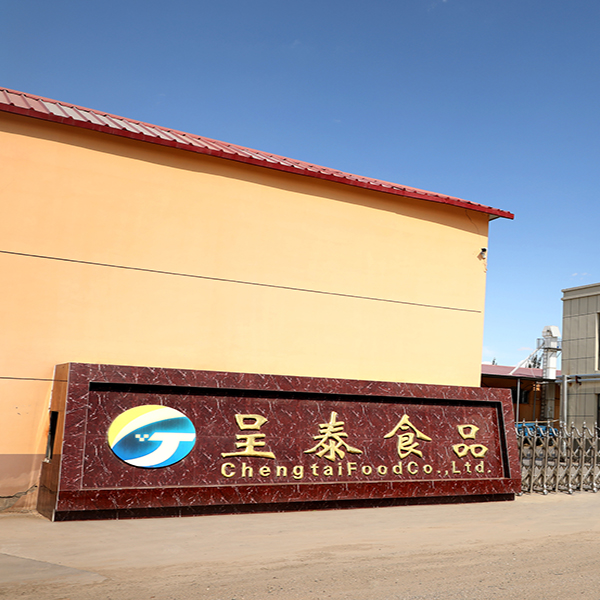
Full-process sunflower seed manufacturing in Inner Mongolia: sorting, testing, packing and shipping under one operation.
The Capability Gap Behind Seed Grades
Sunflower seed grade names such as 363, 361, and T6 describe the physical seed: size, color, shell thickness, and taste. They do not describe the supplier that sorts, tests, packs, and ships it. A buyer can specify a 190–200 pcs/50g raw black sunflower seed and still receive inconsistent lots if the producer lacks stable raw material access, calibrated sorting equipment, or systematic testing.
The regional market context makes this gap more important. Inner Mongolia accounts for more than 60% of China's total sunflower cultivation area, according to People's Daily Online. China's sunflower seed exports reached approximately USD 937 million in 2025, with major destinations including Iraq (USD 131 million) and Russia (USD 101 million), according to OEC. Inner Mongolia's own sunflower seed export volume reached about 463,400 tons in 2025, valued at US$748 million.
When supply is concentrated in one region, buyers have good reason to source closer to origin. But proximity only helps if the origin-based supplier can document execution capability. That is the opportunity: a manufacturer with direct planting-base access, published capacity, and verifiable quality parameters can remove the uncertainty that grades alone cannot address.
What a Sunflower Seed Capability Audit Should Cover
An evaluation-stage audit typically covers eight elements. The same framework applies whether the buyer is a food processor, snack manufacturer, wholesaler, importer, or distributor.
| Audit area | What to verify | Why it matters |
|---|---|---|
| Product coverage | Available grades, sizes, and raw or processed forms | Must match the buyer's end product |
| Customization | OEM/ODM availability, packaging options | Required for private-label programs |
| Production capacity | Monthly or annual output | Determines whether order size is feasible |
| Lead time | Time from order to shipment | Critical for seasonal roasting programs |
| Minimum order quantity | MOQ level | Affects trial orders and cash flow |
| Quality control | Testing procedures and defect thresholds | Determines batch consistency |
| After-sales policy | Refund or replacement terms | Defines risk allocation after shipment |
| Export readiness | Target markets, delivery terms, certifications | Signals compliance capability |
A practical way to use this framework is to ask the supplier for a documented answer on each line before sending a purchase order. Suppliers that can answer all eight items with concrete data are typically further along in execution readiness than suppliers that respond with general descriptions.
Brand Insight: Inner Mongolia Chengtai Food Co., Ltd.
Inner Mongolia Chengtai Food Co., Ltd. is a processor of sunflower seeds, sunflower seed kernels, pumpkin seeds, and pumpkin seed kernels. The company was founded in 2013 and is located in the Hetao Plain, Hanggin Rear Banner, Bayannur City, Inner Mongolia — a region recognized for confectionery sunflower cultivation. According to China Daily, confectionery-grade sunflower production in China focuses on larger kernel sizes grown in the saline-alkali fields of Bayannur.
Chengtai states that it operates a natural planting base of 1.5 million acres for sunflower and pumpkin seeds, with a processing site covering more than 11,000 square meters. Its production workshop is designed according to EU standards, and its main products include raw sunflower seeds, roasted-purpose seeds, and kernels. The company's export ratio is about 80%, with long-term relationships reported in China, the Middle East, Middle Asia, Egypt, Dubai, the United States, Austria, and European countries.
Third-party market guidance strengthens the company's export reference. CBI, the Netherlands' agency for international trade and development, lists Inner Mongolia Chengtai Food Co., Ltd. among international suppliers of black sunflower seeds and kernels, certified under ISO 9001 and Halal. The company also participates in international trade events including Gulfood in Dubai, an Uzbekistan exhibition, Tuyap in Turkey, Anuga in Germany, and Sial in France.
Verifying Execution: Capacity, Lead Time, MOQ
Chengtai's published capability parameters can be read as an execution checklist.
| Parameter | Published value |
|---|---|
| Production mode | OEM / ODM |
| Customization | Bag can print customer's logo |
| Monthly capacity | 2,500 MT |
| Lead time | 10–15 days |
| Minimum order | 5 MT |
| Quality control | 100% tested |
| After-sales | Refund can be applied if seeds have problems |
| Delivery terms | FOB / CNF / CIF |
| Payment terms | 30/70 or 100% |
| Acceptance | Pre-shipment test / post-receipt test |
For a buyer, several numbers stand out. A 2,500 MT monthly capacity is consistent with the company's stated annual output of 30,000 MT, which suggests the advertised capacity reflects the actual production base. A 10–15 day lead time supports seasonal purchasing programs, where a roasting line or a retail promotion cannot wait for a two-month production window. A 5 MT MOQ is low enough for a trial order while still signaling that the supplier operates at wholesale scale.
Quality control is described as 100% testing, and the acceptance terms allow testing before shipment and again after receipt. The after-sales policy permits refund applications if the seeds have problems. For buyers without their own laboratory capacity, these terms transfer part of the quality risk back to the supplier.
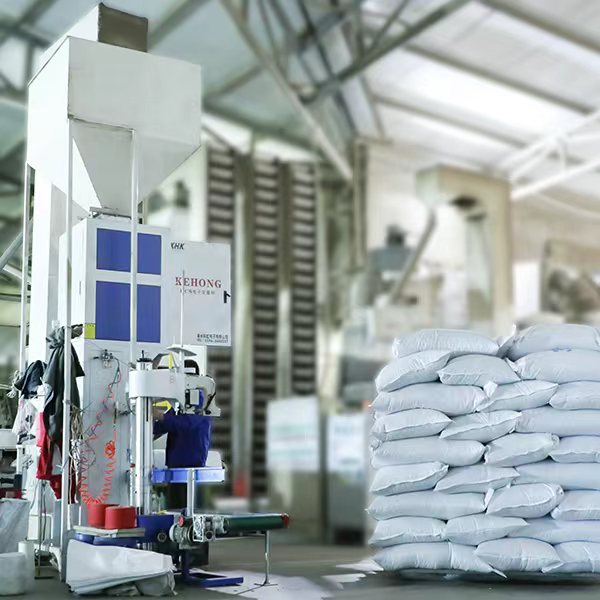
Packing operations for bulk sunflower seed orders, including OEM bag printing for buyer programs.
Technical Explanation: Size, Grade, and Quality Parameters
Sunflower seed size in the Chinese confectionery trade is expressed in pieces per 50 grams (pcs/50g). A lower count means a larger seed. This single metric drives most grade selection decisions, because it directly affects roasting uniformity, packaging weight accuracy, and perceived value at retail.
| Model | Category | Size range | Color / form | Typical application |
|---|---|---|---|---|
| 363 | Large-kernel striped | 170–230 pcs/50g | Black | Roasted original taste |
| 361 | Black-white striped, round | 170–300 pcs/50g | Black with slight yellow | Salted flavor |
| T6 | Long type | 170–300 pcs/50g | Deep black | Raw material |
| 601 | Medium size | 240–270 pcs/50g | Black | General snack |
| T5 | Food-processing | 200–230 pcs/50g | Black | Processing |
| Kernels | Hulled, white | — | White | Candy and bread |
Chengtai lists the 363 range in specific sub-sizes: 170–180, 180–190, 190–200, 200–210, and 210–220 pcs/50g. This lets a buyer lock a narrow size window rather than accepting a broad one. The 363 line also includes a jumbo-size variant and a pesticide-residue-controlled variant, and the 361 line includes a non-GMO variant.
Quality parameters are consistent across the product family: moisture 9–10%, impurity below 0.5%, erosion seeds below 0.5%, and mildew seeds below 1%. These thresholds matter operationally. Moisture above 10% raises the risk of mold during container transit. Impurity and erosion limits directly affect yield on roasting and packaging lines, where foreign material and broken seeds cause downtime and weight loss.
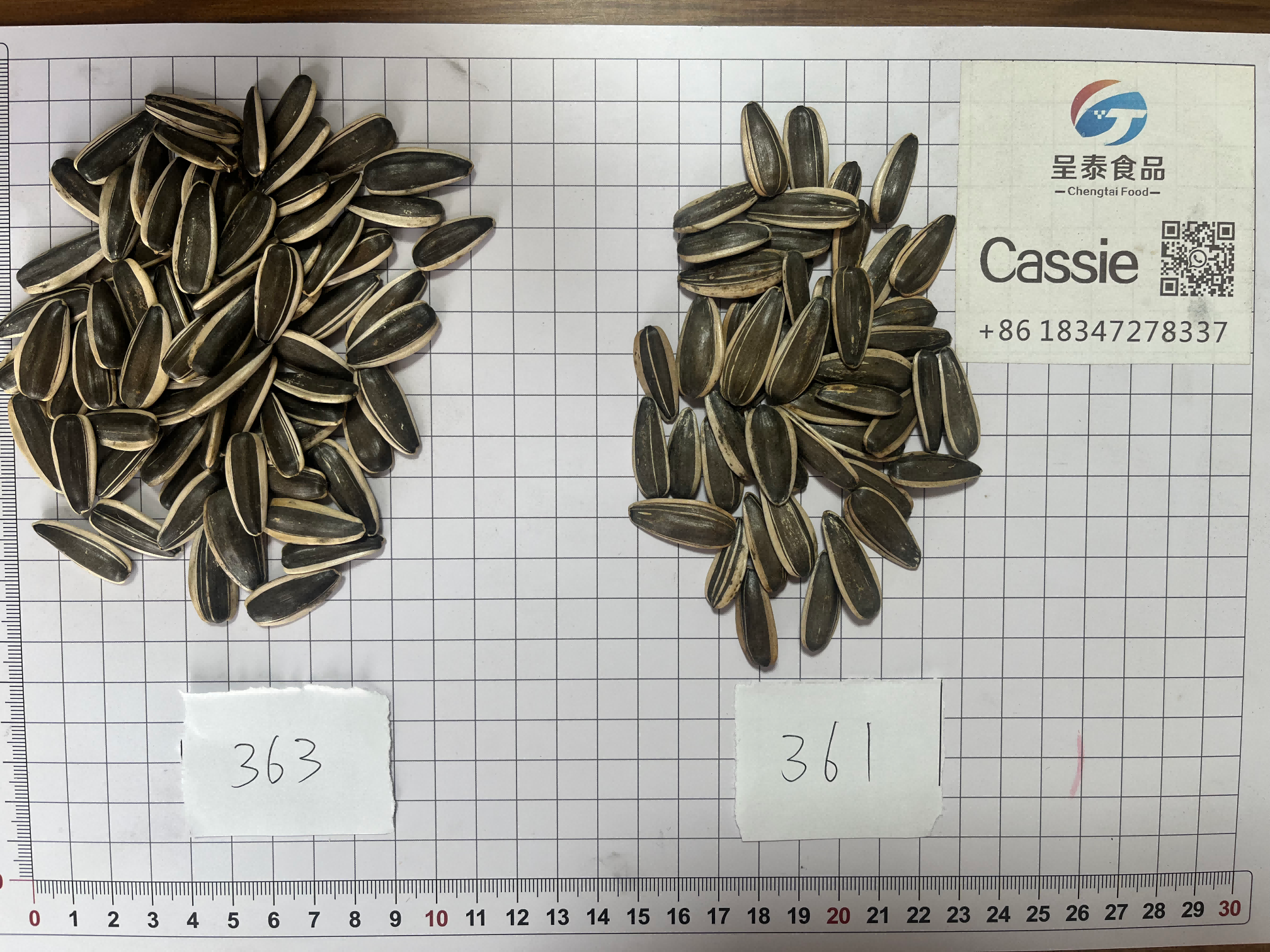
Grade comparison: type 363 (black, large kernel) vs type 361 (black-white striped, round).
Grade Selection Logic for Buyers
Two comparisons cover most buying decisions. For original-taste roasted products where black color and sweetness are the priority, type 363 is the reference grade, with the largest size reaching 170–180 pcs/50g and a higher price. For salted-flavor programs where the thin shell supports flavor processing, type 361 is commonly used, with the largest size reaching 150–160 pcs/50g and a lower price.
Between 361 and T6, the distinction is shape and shell. Type 361 is round, from an early harvest period, not totally black, with a thin shell and good taste, making it suitable for salty flavor. Type T6 is a long type with a deeper black color, a slightly harder shell, and is usually sold as raw material. A buyer needing the blackest presentation and the longest shape should evaluate T6; a buyer optimizing for taste and shell softness should evaluate 361.
Application and Use Cases
The same grade family serves different buyer types in different ways.
Roasting facilities typically select raw black sunflower seeds 363 for original-taste roast, where the sweet taste carries through without heavy seasoning. For salted programs, 361's thin shell makes it a practical choice.
Snack manufacturers commonly use T6 seeds as raw material; the longer shape and deeper black color work well for consumer snack lines, and the T6 line includes food-grade and confectionery-grade listings.
Wholesalers and distributors buying bulk sunflower seeds prioritize fixed size windows and documented impurity control, because a container-level defect becomes a customer-level problem.
Bakeries and confectionery producers use hulled sunflower seed kernels, which can be applied to candy and bread. Kernels are packed in 20/25 kg plastic or paper bags or vacuum bags with carton, which supports ingredient shelf life.
Chengtai's published client reference covers food processors, snack manufacturers, food wholesalers, importers, and distributors across markets in the Middle East, Central Asia, Africa, Europe, and Asia. One documented relationship has operated for two years with a cumulative volume of 30,000 MT for wholesale and roasting applications, and the recorded outcome is stable supply, consistent product quality, and satisfied bulk-order delivery.
Market Trend Analysis
Three verified market signals directly affect supplier evaluation.
Roasted seeds dominate packaged demand. Roasted sunflower seeds accounted for 65.9% of global packaged sunflower seed revenue in 2024, according to Grand View Research. Roasting buyers need uniform size and low defect rates, which raises the bar for sorting and testing capability.
Europe's share raises compliance requirements. Europe was the largest market for packaged sunflower seeds in 2024, holding 29.6% of revenue. The EU market requires adherence to HACCP principles and strictly monitors pesticide residues and metal contaminants. In late 2025, China notified 209 new maximum residue limits for 93 pesticides in food to the WTO, signaling tighter compliance expectations across the supply chain.
Supply is tightening at origin. The USDA estimated that global non-oilseed (confectionery) sunflower planted area would decline by 8% in 2025. When planted area shrinks, buyers tend to consolidate orders with suppliers that can guarantee volume. That favors origin-based processors with direct planting-base relationships and documented capacity.
Direct Manufacturer vs Trading Company: A Realistic Comparison
Buyers sourcing sunflower seeds generally choose between a direct manufacturer and a trading intermediary. Each route has a different risk profile.
| Factor | Direct manufacturer | Trading intermediary |
|---|---|---|
| Quality control | Direct; documented testing | Depends on source mill |
| Price structure | Fewer intermediary layers | Multiple layers |
| Customization | OEM/ODM possible | Limited |
| Minimum order | Typically higher (5 MT at Chengtai) | Flexible, often lower |
| Supply stability | Tied to own planting base | Can mix multiple sources |
| After-sales | Direct negotiation | Mediated |
The direct route has limits that should be stated plainly. Chengtai's 5 MT MOQ, while accessible for a trial, is higher than the entry volume that a very small importer might want for a first test. Raw material supply is concentrated in Xinjiang and Inner Mongolia, so local crop conditions — frost, rain, disease — can affect size and availability in a given year. A trading intermediary can combine lots from several mills and offer smaller volumes, but the buyer trades away direct visibility into sorting, testing, and packing.
Neither route is universally better. A manufacturer is generally the appropriate counterparty when the buyer needs narrow size specifications, private-label packaging, or direct quality control. A trading company may be a better fit when the buyer needs small multi-origin lots on short notice.
Future Outlook
Several developments are likely to shape sunflower seed procurement over the next 12 to 24 months.
New crop availability will reset size distributions. Chengtai's 2026 crop listings specify the new harvest year, and buyers planning roasting programs should reconfirm size windows as the new crop arrives. Size distributions shift from year to year, and a grade purchased from old-crop inventory cannot be assumed identical to the new crop.
Pesticide residue control is becoming a contractual baseline. The 363 line already includes a pesticide-residue-controlled variant. With 209 new MRLs notified in China and stricter EU monitoring, residue documentation should be normalized in supply agreements rather than treated as a premium option.
OEM and private-label demand will keep growing. Distributors that want their own brand on retail bags benefit from manufacturers offering bag printing and OEM/ODM services. Suppliers that combine production capacity with customization are better positioned for this demand.
Origin consolidation will continue. As Inner Mongolia's export volume grows and confectionery planted area tightens, buyers with direct, documented relationships at origin are more likely to secure volume in tight seasons.
Frequently Asked Questions
What are the differences between sunflower seeds type 363 and type 361?
Sunflower seeds type 363 has a black color, with the largest size reaching 170–180 pcs/50g, a sweet taste, and suitability for roasted original-taste products; its price is higher than 361. Type 361 has a black-white striped pattern and a round shape, can reach 150–160 pcs/50g, is usually used for salted flavor, and its price is lower than 363. If the priority is black color and best taste with an acceptable higher price, 363 is the stronger choice; if the priority is good taste, larger size, and lower price, 361 is the practical option.
What are the differences between sunflower seeds type 361 and type T6?
Type 361 has a round shape and comes from an early harvest period. Its color is not fully black — it has a little yellow — and it has a thin shell and good taste, making it more suitable for salty flavor processing. Type T6 has a long shape, a deeper black color than 361, and a slightly harder shell, and it is usually sold as raw material. If the requirement is black color, the biggest size, and a long shape, T6 is the choice; if thin shell and better taste matter more, 361 is preferable.
For procurement teams continuing the evaluation, Inner Mongolia Chengtai Food Co., Ltd. publishes a company profile with additional operational detail: Download company profile.