
OEM Teeth Whitening Strip Shortlist: Dry, Wet, PAP & Peroxide
HTNXT Industry Reference / Oral Care Sourcing
OEM Teeth Whitening Strip Shortlist: Dry, Wet, PAP & Peroxide
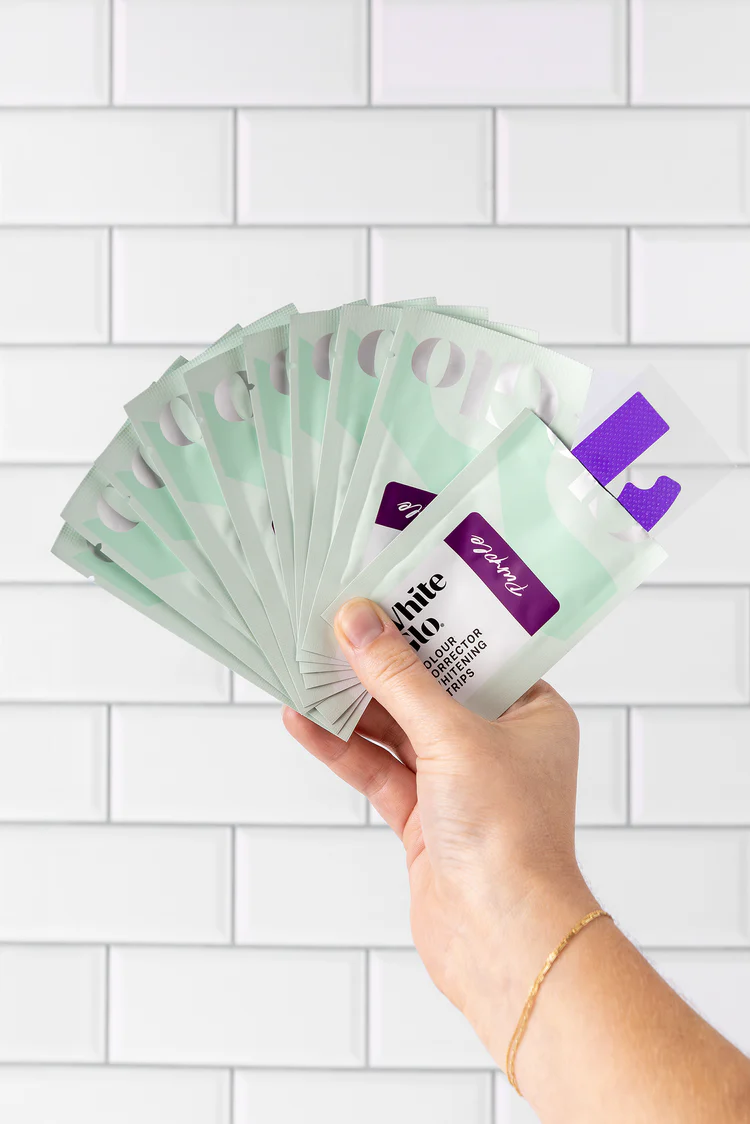
Teeth whitening strips in private-label packaging. In this category, format and gel chemistry are usually settled before the supplier is.
Teeth whitening strips are one of the few oral-care formats in which two early decisions - the construction of the strip and the chemistry of the gel - set the regulatory route, the retail price band and the consumer experience at the same time. For OEM and private-label buyers, the shortlist stage is therefore not about choosing a logo for a box. It is about choosing a format that can be manufactured consistently, documented correctly and sold legally in the target market.
This HTNXT reference shortlist covers the three strip formats produced for private label - dry, wet and dissolving - together with the two active-ingredient families that drive most formulation briefs: peroxide (hydrogen peroxide and carbamide peroxide) and PAP (phthalimidoperoxycaproic acid). It is written for importers, brand owners and e-commerce sellers moving from evaluation into execution, and it separates documented facts from open questions.
Industry context first. Teeth whitening strips are classified for trade under HS Code 3306.90.00 (preparations for oral or dental hygiene). Grand View Research valued the global teeth whitening strips and gels segment at USD 1.1 billion in 2025, while Mordor Intelligence places the broader teeth whitening market - devices included - at USD 7.72 billion for the same year. Those two figures describe different scopes rather than a contradiction, and buyers should treat them as directional rather than interchangeable.
Why format and chemistry decisions come before supplier selection
Three questions determine almost everything that follows in a strip project.
- Which strip format? A dry strip, a wet strip and a dissolving strip behave differently in the mouth, cost differently to produce and carry different consumer expectations.
- Which active-ingredient family? Hydrogen peroxide (HP) and carbamide peroxide (CP) are small-molecule actives that penetrate enamel into the dentine. PAP is a large-molecule, surface-acting active. The choice changes both the sensory profile and how the finished product is classified in each market.
- Which market first? The same strip can be treated as a cosmetic in one market and as a drug or medical device in another. In the European Union, Regulation (EC) No. 1223/2009 restricts hydrogen peroxide in over-the-counter teeth whitening products to 0.1% or less - a limit that shapes formulation choices for EU-bound SKUs well before artwork is designed.
Purchasing terms come after those three answers, not before them. A residue-free dry strip in a 14-strip bag and an entry-level wet strip at the same pack count are not the same commercial object, and the compliance file behind each version is not interchangeable.
The shortlist at a glance
The three strip projects below are the formats most often specified for private-label strips. Format determines the physical behaviour; the formulation layer sits across all three.
| Format | Representative model | Strip construction | Typical positioning | Buyer consideration |
|---|---|---|---|---|
| Dry strip | GS-004H/V/C/P | Three-layer strip: PET hard film, whitening gel, PE soft film; aluminium strip bag | Daily home and travel whitening where adhesion matters | Stated variants include standard dry, alcohol-free dry, residue-free dry and high-viscosity dry strips; higher unit cost than wet strips |
| Wet strip | GS-V34-S07 | Wet strip format; three-layer construction; aluminium strip bag | Value-tier entry and purple / V34 colour-corrector concepts | Lower adhesion than dry strips and relatively more residue, which can help purple pigment contact; lower cost |
| Dissolving strip | DB-004L | Dissolving strip format; three-layer construction | Differentiated, no peel-off routine | Requires consumer education because the usage habit differs from conventional strips |
The formulation layer available across these formats includes PAP, PAP+charcoal, Purple, 6% HP, Sodium Phytate, Sodium bicarbonate, or a custom formulation. Stated flavour options across the strip line include Blue Raspberry, Strawberry, Peach, Grape, Watermelon, Peppermint, Orange, Mint, Pineapple, Cherry Blossom, Coconut and Mango. Standard content is 7, 14 or 21 strips per bag with a user manual, shade guide and colour box.
Dry strips versus wet strips: the adhesion-versus-cost trade-off
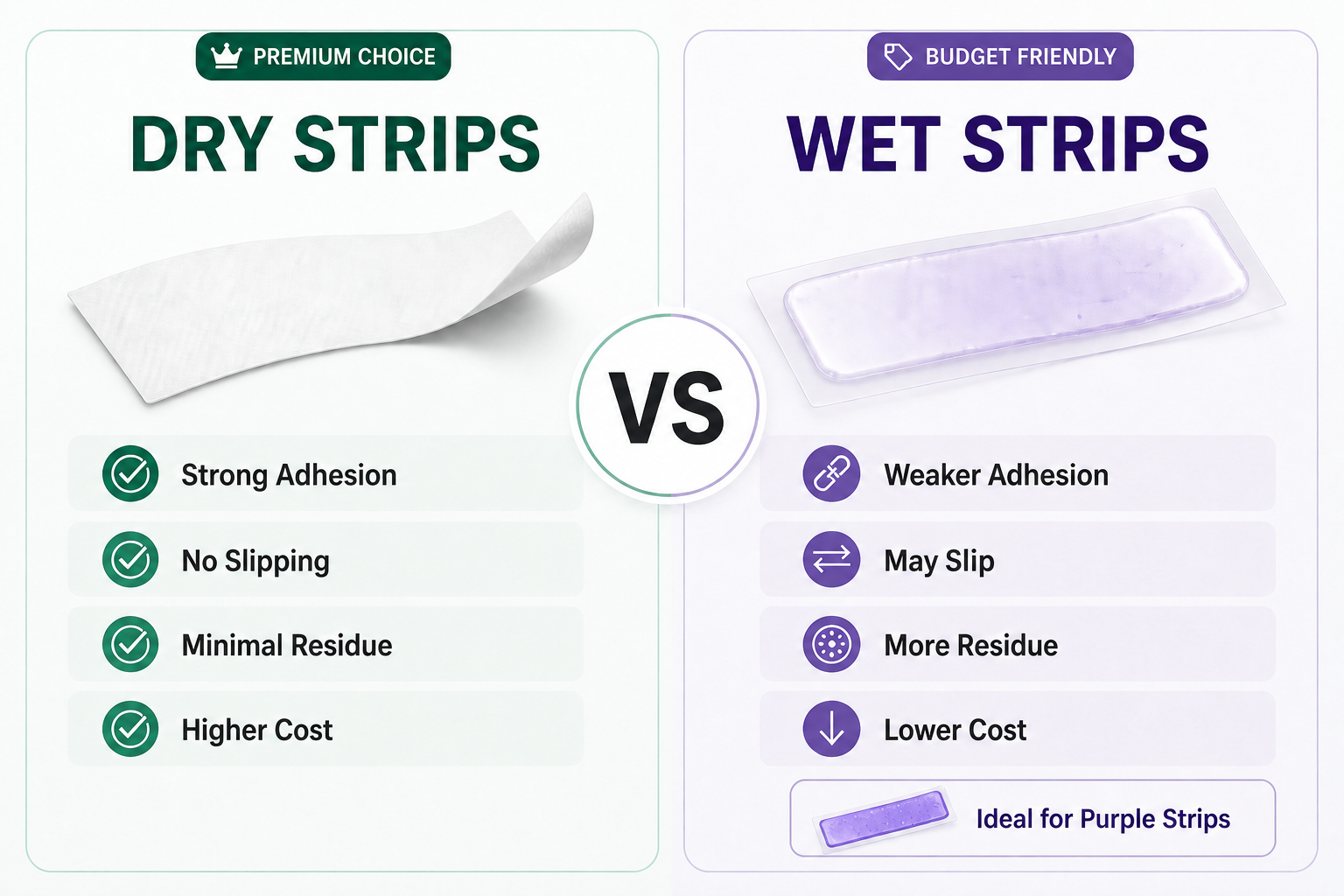
Dry and wet strips differ mainly in adhesion, residue and unit cost - not in pack count or brand presentation.
Dry strips are built to stay where they are placed. The documented characteristics are good adhesiveness, a low tendency to slip during wear, and minimal residue after use. That is why dry constructions are usually specified when the brand promise is "apply once and continue with your day". The format also supports further differentiation: alcohol-free dry strips, residue-free dry strips and high-viscosity dry strips are all listed options. The trade-off is cost - a dry strip is the more expensive of the two to produce.
Wet strips sit at the other end of the spectrum. Their adhesion is inferior to dry strips, so they tend to shift during application, and they leave relatively more residue. In exchange, they cost less, which makes them the natural entry point for value-tier retail and for first production runs. There is a technical reason to keep wet strips in the shortlist as well: the higher residue helps purple pigments remain in contact with the tooth surface, which is why wet formats are recommended for purple whitening strip concepts.
| Criterion | Dry strip | Wet strip |
|---|---|---|
| Adhesion | Good; resists slipping | Lower; tends to shift |
| Residue after use | Minimal | Relatively more |
| Relative unit cost | Higher | Lower |
| Best fit | Adhesion-critical daily use and low-residue claims | Budget positioning; purple whitening concepts |
What this means for procurement: do not treat dry and wet as interchangeable SKUs at the same price. If a retail listing promises a no-slip, low-residue experience, the wet format will not support that claim, and if the brief is a low-price test launch, a dry specification will strain the margin before the first reorder.
Peroxide or PAP: matching gel chemistry to the market
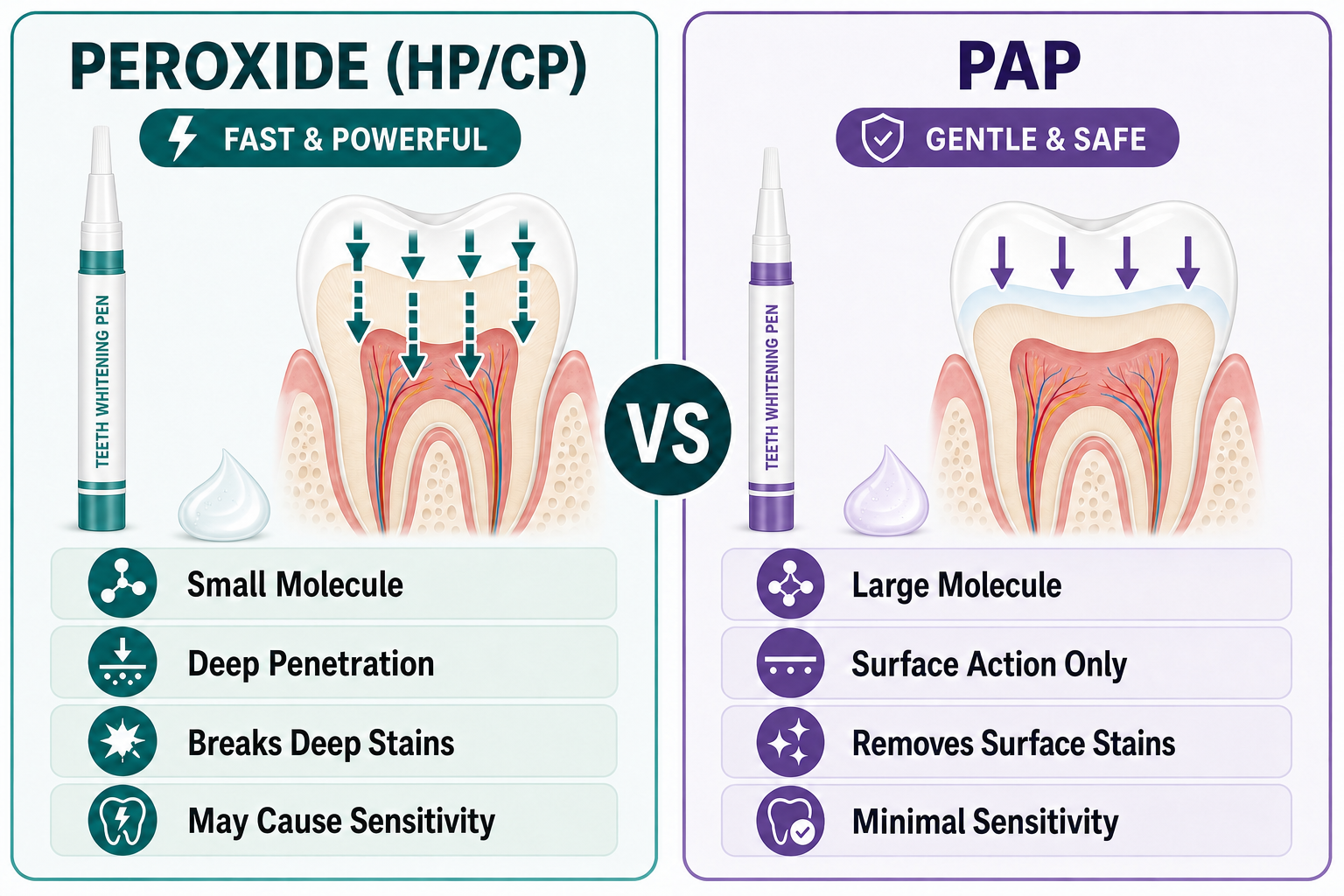
Peroxide actives penetrate; PAP acts at the surface. The difference drives both sensory claims and market classification.
Hydrogen peroxide and carbamide peroxide are small-molecule penetrating actives. They pass through the enamel into the dentine and break down deep-seated pigments through free-radical oxidation. The result is fast, visible whitening, including on stubborn intrinsic stains, with a well-documented trade-off: a higher likelihood of temporary tooth sensitivity, and stricter regulation - in most markets these actives place the product on the drug side of the line rather than the cosmetic side.
PAP is a large-molecule, surface-acting active. Its molecular size prevents it from penetrating the tooth structure, so it oxidises surface stains instead. The result is a gentle profile with minimal sensitivity and better chemical stability, and it is generally easier to launch as a cosmetic in most countries. The trade-off is time: PAP needs a longer period of use before deep stains visibly change.
| Dimension | Peroxide (HP / CP) | PAP |
|---|---|---|
| Mechanism | Small-molecule; penetrates enamel into dentine | Large-molecule; acts on the surface |
| Speed on deep stains | Fast | Slower |
| Sensitivity profile | Higher likelihood of temporary sensitivity | Minimal sensitivity positioning |
| Regulatory posture | Regulated as a drug in most markets; EU OTC cap of 0.1% hydrogen peroxide under EC No. 1223/2009 | Generally easier to place on a cosmetic route |
| Best fit | Effectiveness-first briefs and deep stain targets | Sensitive-teeth users, daily and long-term maintenance |
A practical decision rule for buyers: if the brief prioritises visible results and the buyer accepts a temporary-sensitivity disclaimer, peroxide formulations are the conventional route. If the brief prioritises safety language, sensitive-teeth suitability and daily use, or if the primary market is the United States or Australia where non-peroxide positioning is well established at retail, PAP is the more coherent choice. Both families are available as custom formulations, which allows a brand to run one master artwork with two formulation variants for two markets.
Where the shortlist comes from: capability facts behind it
Jiangxi Dentalbright Technology Co., Ltd., which operates as Glorysmile Factory, is an oral-care manufacturer based in Jiangxi Province, China, founded in 2008 with its current factory completed in 2013. The company manufactures teeth whitening strips, whitening pens, whitening kits, whitening lights, whitening powder, toothpaste, mouthwash, electric toothbrushes and dental impression materials, and exports approximately 90% of its output, with the EU, USA and UK among its main markets.
On strips specifically, the documented position is:
- Formats and models: dry strips (GS-004H/V/C/P), wet strips (GS-V34-S07) and dissolving strips (DB-004L), all intended for teeth whitening, tooth bleaching, oral care and oral cleansing applications.
- Production capacity: a stated monthly strip capacity of 29.2 million pieces, within a wider annual output that includes 300,000,000 pieces of teeth whitening strips across the product range.
- Facility: a 36,000 square metre site, of which 20,000 square metres are 100,000-class cleanrooms, plus a 1,000 square metre laboratory with a 100-class cleanroom dedicated to microbiological testing.
- Team: 256 employees, including 17 R&D engineers and 11 quality-control specialists, supported by a production management team and a packaging design team.
- Certification base: MDSAP, ISO 13485, ISO 22716, US GMP (GMPC, FDA 2022 guidelines), BSCI, HALAL and Vegan, alongside both medical-device and cosmetics production licences.
- Service models: OEM, ODM, custom formulation and private label, with customisation across strip type, active ingredient, residue-free or standard formulation, colour, flavour, packaging and labelling.
The certification scope is not generic. MDSAP certification (certificate 206537.250906, issued 6 September 2025 by UL LLC) covers the design, development, manufacturing and distribution of teeth whitening strips and is recognised in the USA, Brazil, Australia, Canada and Japan. ISO 13485:2016 / EN ISO 13485:2016 + A11:2021 (certificate 206536.250906, UL LLC) covers the same strip scope. ISO 22716:2007 (certificate SZ2312B8) and GMPC under the 2022 US FDA cosmetic GMP guidelines (certificate SZ2312B9) were both issued by Intertek and expire on 12 December 2026. Social compliance is covered by an amfori BSCI audit conducted by SGS (Monitoring ID 25-0338381-1), and HALAL certification (certificate 52185957421871, 22 SKUs including whitening strips) runs to 21 November 2026.
Technical explanation: what "residue-free" and "gum-protecting" actually require
A strip is a three-layer system: a PET hard film backing, the whitening gel layer, and a PE soft film. The performance of the finished product depends less on the active ingredient than on how that gel layer is formulated to hold its shape against a wet tooth surface for the full wear time.
The relevant technology is covered by United States Utility Patent US 12,350,120 B1, granted 8 July 2025 and titled "Gum-Protecting and Teeth-Whitening Strip and Preparation Method Thereof". The patent describes a residue-free teeth-whitening strip that uses an acrylic copolymer gelling agent with a marginal sealing effect - in other words, the gel is engineered to stay within the strip boundary rather than creeping onto the gum margin. This is the technical basis for two claims buyers frequently request: residue-free removal and reduced gum contact.
Release testing for strips follows the same logic. Documented checks include microbiological limit testing, heavy-metal testing for lead, arsenic, mercury and cadmium, skin irritation testing and stability testing, alongside physical controls on adhesion, gel overflow, pH and odour. Third-party laboratory testing through SGS and UL is part of the stated process. Buyers evaluating any strip supplier should ask for the same document set, because adhesion that fails in transit or gel that migrates under heat will not appear in a specification sheet - only in a stability report.
Applications and use cases
Strip projects are specified for home and travel use at normal room temperature, applied once per day with a no-slip dry adhesive technology. The functional brief is consistent across retail channels: remove exogenous stains from coffee, tea and tobacco, and support an anti-sensitivity claim. The matched pack components are the strips themselves, a shade guide and a user manual.
Three documented project patterns show how the formats are used at commercial scale:
- Pharmacy chain and supermarket promotional gift sets. A grocery and gifting programme ran for two years and produced 7 million units, using pass-through third-party factory audits (BSCI and ISO). The manufacturer reported zero return rate in large-batch inspection, with multi-language manual customisation and one-stop handling from design to logistics.
- E-commerce private-label launch. A 5 million unit programme for a marketplace seller used customised eco-friendly packaging and a compliant formulation, and the brand reached Top 10 Bestseller status in its category with a 4.8-star user rating.
- Platform-owned brand under a strategic OEM agreement. A 1 million unit programme maintained a Top 3 sales rank in the platform's oral care category, with a 99.8% positive feedback rate and no reported safety or compliance incidents.
Pack architecture is a lever in these scenarios. A 7-strip bag supports trial and travel-item placement, 14 strips matches a conventional treatment cycle, and 21 strips supports subscription or value bundling. For supermarket and gift set channels, the multi-language manual and shade guide are usually the difference between a shelf-ready SKU and a repacking cost.
Market trend analysis
Three documented signals are shaping strip procurement.
Compliance is becoming a line item. Under the US Modernization of Cosmetics Regulation Act (MoCRA 2022), manufacturers of whitening strips classified as cosmetics must register facilities at USD 849 per year and list products at USD 200 each. That is a fixed cost per SKU, not per container, which changes the economics of wide-ranging product lines - brands increasingly consolidate ranges rather than launch many near-identical variants.
Sensitivity positioning continues to expand. PAP and low-sensitivity formulations are explicitly offered as a response to sensitive-teeth demand, and PAP is peroxide-free. The open question in this segment is growth rate: no isolated CAGR for non-peroxide versus peroxide strips is available in official trade statistics, so any claim about PAP growth outrunning peroxide growth should be treated as unverified until retail audit data supports it.
Documentation travels with the SKU. Export programmes now routinely require market-specific files: CPNP notification, CPSR and an EU Responsible Person for EU cosmetic sales; MDR-CE registration with a Technical File for products classified as medical devices; MoCRA facility registration, product listing and a US Agent for the United States; and free-sale certificates for markets such as Indonesia, where the certificate on file (CFS No. 2026YB0548, issued 1 March 2026, valid to 1 March 2028) covers teeth strips among other oral-care products.
How strips compare with kits, powders and clinic treatment - and where the shortlist ends
Strips are not a universal answer, and a shortlist that hides the boundaries is not useful to a buyer.
Strips versus LED kits. A whitening kit bundles a device with gel or syringes, which means the device may follow a separate regulatory path - FDA medical device registration applies to whitening lights, and MDR-CE certification applies where a product is classified as a medical device. That is more documentation work and a higher unit cost, in exchange for tray-based coverage. Strips are single-use consumables with simpler pack economics and a lower compliance surface, but they cannot deliver the full-arch coverage of a tray.
Strips versus powders and toothpastes. Powders and toothpastes are daily-maintenance formats applied by brushing. Strips are short-duration, higher-concentration targeted formats. They complement rather than replace each other in a portfolio, and a brand that sells only strips is competing for a narrower use occasion.
Documented limits that belong in the buying file:
- Strips primarily address extrinsic stains - coffee, tea and tobacco discolouration. Intrinsic discolouration responds differently, and no strip format should be positioned as a substitute for professional treatment.
- In the EU, over-the-counter peroxide strips are capped at 0.1% hydrogen peroxide by Regulation (EC) No. 1223/2009. Higher-concentration clinical protocols sit outside the OTC cosmetic route.
- PAP is gentler but slower on deep stains; a buyer expecting peroxide-like speed from a PAP SKU will misread the product.
- Wet strips cost less but adhere less and leave more residue. Dry strips adhere better and cost more. Neither is strictly superior - the correct choice depends on the retail claim.
- Dissolving strips require consumer education because the usage habit differs from a peel-off strip.
- A cosmetic dossier (CPSR, CPNP, PIF, EU Responsible Person) does not substitute for MDR-CE if a product is classified as a medical device, and an EU file does not satisfy MoCRA obligations in the United States.
- Sensitivity outcomes vary by user; formulation choices reduce but do not eliminate that variability.
Future outlook
Three directions are likely to define the next procurement cycle. First, formulation-first buying: as compliance costs per SKU rise, brands will decide the gel family before the packaging concept, because the gel family determines the regulatory route and therefore the launch timeline. Second, documentation readiness will become a scored criterion in supplier selection rather than a checklist item requested at the end - the difference between an MDSAP-recognised strip supplier and a supplier without it appears at customs, not in a quotation. Third, format diversification will continue around the edges: individually wrapped strips, travel counts and colour-correcting purple concepts are all natural extensions of the existing dry, wet and dissolving platforms.
What will not change quickly is the underlying trade-off between adhesion, cost and residue. Buyers who understand that trade-off can compare quotations on a like-for-like basis; buyers who do not will keep comparing prices for products that are not actually equivalent.
FAQ
What is the difference between dry strips and wet strips?
Dry strips have good adhesiveness, are not easy to slip off and leave minimal residue, but they cost more. Wet strips adhere less well, tend to shift during application and leave relatively more residue, but cost less. Wet strips are also recommended for purple whitening products, because the higher residue helps the purple pigment adhere to the teeth for a physical whitening effect.
How do peroxide gel and PAP gel differ?
Hydrogen peroxide and carbamide peroxide are small-molecule actives that penetrate enamel into the dentine and break down deep-seated pigments by free-radical oxidation - fast and effective, but more likely to cause temporary sensitivity and more strictly regulated. PAP is a large-molecule, surface-acting active: it does not penetrate the tooth structure and only oxidises surface stains, giving a gentle, minimal-sensitivity profile with slower visible results. Peroxide suits effectiveness-first briefs; PAP suits sensitive-teeth users and daily maintenance.
What compliance documentation is needed to sell whitening strips in the EU?
For cosmetic products, the required package is a Cosmetic Product Safety Report (CPSR), CPNP notification confirmation, a Product Information File (PIF) and an appointed EU Responsible Person. Where a product is classified as a medical device, CE-MDR registration with a complete Technical File and an EU Responsible Person applies instead. EU Regulation (EC) No. 1223/2009 also limits hydrogen peroxide in over-the-counter whitening products to 0.1% or less.
What does the US market require?
For whitening strips treated as cosmetics, MoCRA-compliant cosmetic facility registration and product listing must be completed, a US Agent is required, and the product formulation must be filed on the FDA website. For products classified as medical devices, FDA medical device establishment registration and device listing apply; the manufacturer states that its whitening lights, electric toothbrushes and oral irrigators hold FDA medical device registration, and its silicone impression material has completed 510(k) registration. The stated FDA-certified scope covers medical devices, cosmetics and OTC drugs.
Can you provide an MSDS?
Yes, MSDS documentation is available. The wider document set includes COA, RoHS, SCPN, MSDS, CE, FDA, CPSR, CPNP and PIF for factory-level requirements, with GMP, ISO 22716, ISO 13485, MDSAP and BSCI as product-level certifications.
What customisation is available for whitening strips?
Available customisation covers strip type (dry, wet or dissolving), active ingredient and formulation (PAP, PAP+charcoal, Purple, 6% HP, Sodium Phytate, Sodium bicarbonate, or custom), residue-free or standard construction, flavour, colour, packaging and labelling. Stated flavour options include Blue Raspberry, Strawberry, Peach, Grape, Watermelon, Peppermint, Orange, Mint, Pineapple, Cherry Blossom, Coconut and Mango, with 7, 14 or 21 strips per bag and a shade guide and user manual in the pack.
What is the MOQ for private-label whitening strips?
For regular orders using existing packaging, the stated minimum order quantity is 5 boxes. For OEM orders with customised packaging, the MOQ varies by product and runs from 100 to 1,000 boxes, driven mainly by the minimum order quantity of the custom packaging itself. The exact MOQ is confirmed during quotation and sampling.
What are the delivery and payment terms?
Delivery terms are EXW, FCA, FOB or CFR. Payment terms are 30% deposit in advance with the 70% balance before shipment. On acceptance, on-site inspection is supported and the quality department can also carry out pre-shipment random inspection. Lead time depends on order volume, product specifications, customisation complexity and the current production schedule, with a precise timeline confirmed at order stage.
Reference document: Glorysmile product catalog (PDF) - https://cdn.socialarks.com/sbsp/25111/common/2026/0826/Catalog.pdf