
OFS06 Infrared Sauna Room Shortlist: Venue Fit and Wattage
OFS06 Infrared Sauna Room Shortlist: Venue Fit and Wattage
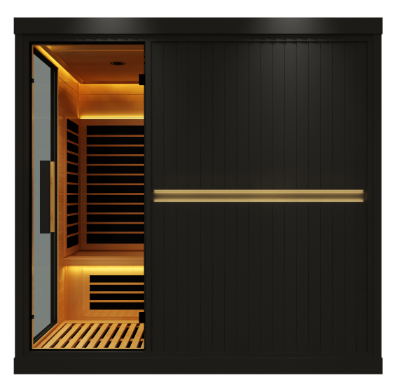
An infrared sauna room shortlist for a hospitality project rarely turns on which model is “best”. It turns on which of six closely related cabins fits the connected load, the room count, the guest expectation and the maintenance arrangement of one specific building. OCEAN FUTURE’s OFS06 family places six infrared models — OFS06A-5, OFS06B-1, OFS06B-2, OFS06B-3-1, OFS06B-3-2 and OFS06B-4 — inside a 1,500 W to 3,850 W total power envelope, with the OFS06A-5 documented at 3,000 W and the OFS06B-1 at 1,850 W. Because the six share one control, heating, glazing and audio platform, the shortlist narrows to four variables: connected load, project scale, wood specification and service model.
OCEAN FUTURE is a Foshan, Guangdong-based manufacturer of sauna rooms, hot tubs, swim spas and cold plunges that also operates as an OEM/ODM supplier, reports an 85% export ratio, and lists the USA, Australia, the EU and Germany among its main markets. This shortlist maps its six OFS06 infrared models to hotel and hospitality, guesthouse, wellness and commercial club, and spa settings, then sets out the purchasing terms and acceptance checks that determine whether a shortlisted model arrives as specified.
The shared platform behind the six models
Feature-by-feature comparison of these six cabins converges quickly, because the supplied specification describes a common platform. Each model is built around far-infrared heating plates and a heating box, the AV1 control, tempered glass, a wood handle, colourful interior lighting, FM/Bluetooth/USB audio input and two speakers. Wood construction is offered in hemlock, aspen and Canadian red cedar.
That commonality changes the shortlist method. A buyer does not need to trade a better control against a better heater shell from one OFS06 model to the next, because those elements are held constant across the family. What separates the six is the power rating, the cabin configuration each model is intended to serve, and the wood specification attached to the order. Procurement effort therefore belongs in three places: a written per-model power rating, a wood specification agreed at SKU level, and a service arrangement that matches how hard the room will be used.
The table below keeps only what the supplied material supports at model level. Four of the six models are placed within the line’s 1,500 W to 3,850 W envelope without a separately published individual rating in the source material used for this article, so their figures must be taken from the model specification sheet at quotation rather than inferred from the family range.
| Model | Documented power | Placement in this shortlist | Confirm before ordering |
|---|---|---|---|
| OFS06A-5 | 3,000 W | Higher-output anchor; hotel suites, signature cabins, larger spa treatment rooms | Wood species; circuit allocation |
| OFS06B-1 | 1,850 W | Low-load anchor; guesthouse and small club rooms | Wood species; cabin footprint |
| OFS06B-2 | Within the 1,500–3,850 W line range; individual rating not stated in the supplied material | Mid-range guesthouse or club room | Rated power on the model sheet |
| OFS06B-3-1 | Within the 1,500–3,850 W line range; individual rating not stated | Compact club or spa room | Rated power on the model sheet |
| OFS06B-3-2 | Within the 1,500–3,850 W line range; individual rating not stated | Compact club or spa room | Rated power on the model sheet |
| OFS06B-4 | Within the 1,500–3,850 W line range; individual rating not stated | Larger spa or hospitality room | Rated power on the model sheet |
One qualification applies to everything that follows. The venue mapping in this article is an editorial reading of documented characteristics, not a record of installed projects. The supplied material documents one commercial spa deployment, and the models named there are outside this six-model shortlist; it is discussed below for what it does and does not establish.
Hotel and hospitality projects: consistency across rooms
For a hotel, the OFS06 decision is a repetition problem. A property installing four, ten or twenty cabins needs the same control logic, the same guest-facing features and the same maintenance routine in every room, because staff rotate and one unfamiliar unit becomes a support call. The shared AV1 control, lighting specification and audio input work in favour of that requirement: a housekeeping or spa-attendant briefing written once applies across the estate, and the operator is not maintaining a mixed fleet.
Power becomes the dividing line between the two ends of the shortlist. OFS06A-5, at 3,000 W, is the higher-output anchor and suits rooms where the operator wants the strongest heating envelope in the family — larger suites, premium treatment rooms, or a signature cabin positioned as an amenity. The OFS06B range, anchored by the OFS06B-1 at 1,850 W, is where volume installations normally land, because a lower per-unit load is easier to absorb across a floor plan that also carries lighting, HVAC and kitchen demand.
Two details matter more in hotels than in any other setting. Tempered glass allows a sightline into the cabin from a corridor or lounge, which supports supervision of guests and lets the lighting do useful work after dark. The wood handle is a touchpoint guests will use in every session, so the species chosen for it should align with the interior scheme rather than default to whatever is cheapest on the day.
Compliance planning should be split rather than bundled. In Europe, secondary reporting describes EN 18164, published in February 2026, as the first pan-continental standard covering the design and construction of sauna rooms, warm-air rooms, steam rooms and soft steam rooms in public facilities. In the United States, secondary reporting describes UL 60335-2-53, published in June 2025, as an electric sauna heater standard. Room construction and heater compliance are separate objects, and a specification that treats them as one line item usually discovers the gap late.
Guesthouse projects: working from the low-load anchor
A guesthouse typically buys one to three cabins and has the tightest electrical envelope of the four settings. Buildings are often conversions, with a distribution board sized for the original load and little appetite for a supply upgrade. This is where the OFS06B-1’s documented 1,850 W rating is most useful: it is the lowest figure stated for a named model in the supplied material and gives a designer a defensible starting point before the remaining four models are quoted with their own individual ratings.
Scale also changes the acceptance criteria. A hotel can absorb one underperforming cabin; a four-room guesthouse cannot, because the sauna is often the feature that justifies the room rate. The supplier’s quality statement — testing of every set before shipment — therefore carries more weight here than in a large order, and it should be written into the order rather than assumed. Lead time matters for a different reason: the stated 30 to 40 days has to fit between build completion and a seasonal opening, not the other way round.
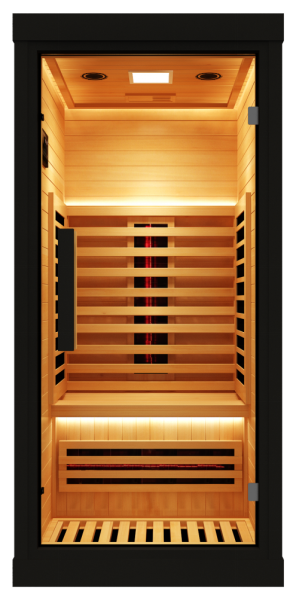
Wood specification carries the brand in this segment. Hemlock and aspen give a pale, neutral interior that photographs well and suits Scandinavian-style guesthouses; Canadian red cedar brings a warmer tone and a distinct aroma that some operators treat as part of the experience. Neither choice changes the heating platform, so the decision is commercial and aesthetic rather than technical — provided the species is fixed in writing on the purchase order.
Wellness and commercial clubs: utilization and serviceability
In a club, the cabin is a revenue asset with a schedule attached. The relevant questions stop being about ambience and start being about how many sessions a day the room will run, who cleans it, and how quickly a fault is resolved. The six OFS06 models share the same heating architecture, so club buyers should concentrate diligence on the two areas the supplied material addresses directly: production capacity and after-sales scope.
OCEAN FUTURE states a monthly capacity of 400 sets, a minimum order of one set, and a lead time of 30 to 40 days, with OEM/ODM production and full customization available. For a club refurbishing a wet area in phases, that combination allows a pilot cabin followed by a later batch without re-sourcing. It also sets an expectation: capacity and lead time are company-reported figures without third-party audit evidence in the material reviewed, so a project with a fixed opening date should confirm them contractually.
After-sales support is described as remote guidance. For a club with in-house maintenance, remote guidance is workable if spare-part identification and access to the control and heating components are agreed at order. For an operator with no technical staff on site, the same arrangement needs a local partner written into the plan. Neither situation is a defect in the offer; both determine whether a shortlist choice is realistic rather than merely attractive.
One company-reported reference deserves careful reading. A 20-set deployment at a spa centre in Germany is described as delivering stable, safe operation, consistent heating and reliable performance, with low noise, energy efficiency and durable construction listed as key characteristics. The models named in that record are OFS06C-4 and OFS06B-5, which sit outside this six-model shortlist. It is evidence of commercial-scale experience within the OFS06 series, not performance evidence for OFS06A-5, OFS06B-1, OFS06B-2, OFS06B-3-1, OFS06B-3-2 or OFS06B-4.
Spa projects: atmosphere as a specification item
A spa sells an hour of controlled environment, so the visible and audible parts of the cabin belong in the specification alongside the heater. The colourful interior lighting is the element most likely to be tuned per treatment room to match a brand palette; two speakers with FM/Bluetooth/USB input let the operator carry the same audio used in relaxation areas into the cabin. Tempered glass keeps the room from reading as a closed box, which matters in reception-facing layouts.
Canadian red cedar is the natural premium option in this setting. Its tone and aroma are part of the arrival experience, and a spa already using cedar in changing rooms can carry the material logic through. Hemlock and aspen remain viable where the design language is lighter and budget is directed at treatment equipment instead.
The fit boundary should be stated plainly. The OFS06 line is an infrared product family: heat is delivered by far-infrared plates and a heating box rather than by a stone heater. A spa whose menu promises a Finnish sauna or a steam session needs a different product family, and OCEAN FUTURE’s portfolio also lists traditional Finnish and outdoor sauna rooms — outside this shortlist and requiring separate specification. Buying an infrared cabin to serve a Finnish-sauna promise is a scope error that no amount of finish quality will fix.
Reading the 1,500 W to 3,850 W span correctly
The line’s total power range, 1,500 W to 3,850 W, is a family envelope and not a selector. Within the six shortlisted models, two ratings are stated in the supplied material: 3,000 W for OFS06A-5 and 1,850 W for OFS06B-1. The difference between those two anchors is 1,150 W, and that difference has three practical consequences for a project.
- Circuit planning: a designer needs the per-model figure to allocate circuits. Sizing from the family range risks either over-building the supply or under-building it for the model finally ordered.
- Aggregate load at scale: in a multi-cabin installation a per-unit difference is multiplied by the number of rooms, which is why hotels should fix the model mix before the electrical design is frozen.
- Expectation setting: a higher-wattage cabin is not automatically the better guest experience. It changes the heating envelope available to the operator; it does not by itself define warm-up time, session length or comfort, none of which are specified in the supplied material.
For OFS06B-2, OFS06B-3-1, OFS06B-3-2 and OFS06B-4 the supplied specification does not state an individual rating. The correct procurement step is to request the model sheet and treat the returned figure as a contract document. An assumption drawn from the family range is not a substitute for it, and it should never appear in a tender response as though it were a published value.
Infrared versus traditional: what the trade-off actually is
Infrared cabins deliver heat to occupants through far-infrared plates and a heating box, without a stone heater or the water handling a traditional room involves. A traditional Finnish room heats the air and the stones, and the experience is built around that heated mass and the option of water on the stones. Both are mature categories; in practice they serve different menus, different maintenance routines and different room services.
For a buyer choosing between them, the decision rule is the venue’s promise rather than the equipment list. If the offer is a dry, single-occupant heat session in a compact footprint with audio and lighting as part of the experience, an OFS06 infrared cabin is the natural fit and the shortlist above applies. If the offer is a Finnish ritual, a steam room, or a wet area with showers and cooling, the infrared family is the wrong starting point even where the same supplier can quote adjacent categories.
A second boundary concerns documentation rather than technology. The supplied material documents CE-EMC and EMC testing for sauna rooms; it does not document UL or ETL listing, and it does not document FSC chain-of-custody for the timber. A project that requires either must request it specifically and treat its absence from the file as an open item to close, not as a failed test.
Market context: directional evidence, not a forecast to bank
Public sauna market estimates are not harmonised, and a buyer should treat them as background rather than as a demand model. Market.us places the global sauna market at USD 860.3 million in 2023 with a projected USD 1,555.3 million by 2033, a 6.1% CAGR. Technavio places the US market at USD 437.4 million in 2025 with a 6.5% CAGR over 2026 to 2030. The two figures cover different geographies and forecast periods, so they should not be combined or averaged into a single growth rate.
At industry level, Harvia’s published estimate puts the global sauna market close to EUR 4 billion in value with roughly 18 million saunas installed worldwide. That is a market-value and installed-base estimate from a market participant using a definition different from the commercial research figures above, and the spread between public numbers is wide enough that none of them should drive a single project decision.
What the figures do support is a modest, directionally consistent growth picture across independent commercial sources, which is compatible with the continued availability of new infrared models and with the arrival of facility-level standards. They do not support a claim about how many guesthouses will buy a cabin next year, and this shortlist does not make one.
Purchasing terms and an acceptance checklist
The commercial framework is short enough to state precisely. Minimum order quantity is one set; lead time is 30 to 40 days; stated monthly capacity is 400 sets; production runs under OEM/ODM with full customization; quality control is described as 100% testing; after-sales support is remote guidance. Export experience is listed for the EU, USA, Germany, Australia, Spain and France.
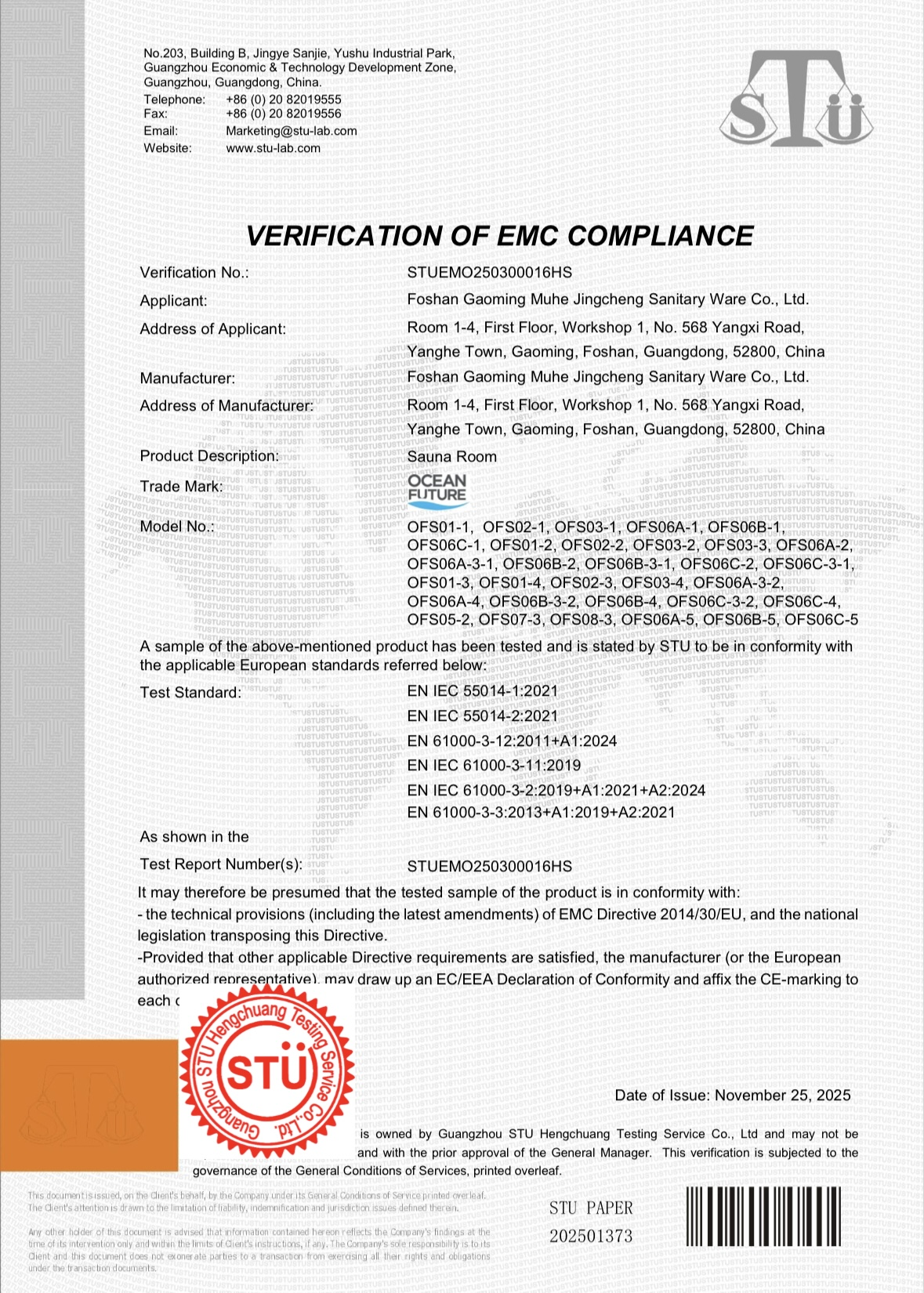
Compliance documentation in the supplied material consists of CE-EMC certificate STUEMO250300016HS for the EU market and EMC compliance certificate STUEMO250300017HS, both issued on 25 November 2025 by Guangzhou STU Hengchuang Testing Service Co., Ltd. The referenced standards come from the EN IEC 55014 and EN 61000 series. The two documents differ in how they state scope: the CE-EMC entry is scoped to sauna room generally, while the EMC entry names a specific model list. That difference is why the acceptance checks below begin with model-level scope rather than certificate existence.
- Model-level power rating: obtain the individual wattage for the exact SKU in writing, for every model quoted. The line range alone is not sufficient for circuit design.
- Certificate scope: confirm that the ordered model appears in the certificate scope presented to the authority having jurisdiction, and record the certificate number and issuing laboratory in the project file.
- Wood specification: fix the species — hemlock, aspen or Canadian red cedar — at SKU level on the purchase order, and agree in advance how delivered wood will be checked against it.
- Destination documentation: if the project requires UL or ETL listing, or FSC evidence for timber, request those documents explicitly. They are not part of the file reviewed for this article.
- Feature confirmation: verify AV1 control functions, lighting, audio inputs and speaker configuration against the operator’s briefing, because these are guest-facing and awkward to change after installation.
- Service scope: define what remote guidance covers, who holds spare parts, and what response the operator can realistically expect outside the supplier’s working hours.
- Schedule fit: match the 30 to 40 day lead time to the installation sequence, allowing separately for freight, customs clearance and site readiness.
What to watch next
Three developments are worth tracking, conditionally. Facility standards are becoming more specific: if EN 18164 is adopted into public-facility procurement in Europe as reported, hotel and club specifications will increasingly ask for design-and-construction evidence rather than a product certificate alone, and suppliers able to map a model to a standard clause will be easier to shortlist. Heater standards are moving on a separate track, which pushes projects toward splitting electrical compliance from room compliance.
On the demand side, the growth rates cited above imply steady rather than explosive expansion, which favours buyers who can specify precisely over buyers who need volume discounts to justify a purchase. Within the OFS06 family itself, the practical next step is documentation rather than new products: once per-model power ratings for OFS06B-2, OFS06B-3-1, OFS06B-3-2 and OFS06B-4 are fixed in writing, the mapping in this article converts from a fit guide into a tender-ready schedule.
Frequently asked questions
Which OFS06 model should a guesthouse with a limited electrical supply start from?
The OFS06B-1 is the practical starting point because its 1,850 W rating is the lowest stated for a named model in the supplied material. OFS06A-5, at 3,000 W, is the higher-output anchor at the other end of the range. The other four models sit inside the line’s 1,500 W to 3,850 W envelope without an individually published rating, so their figures need to come from the model sheet and be checked by the installing electrician before circuits are allocated.
What power range does the OFS06 infrared sauna room line cover?
The line’s total power range is 1,500 W to 3,850 W. Within the six shortlisted models, OFS06A-5 is documented at 3,000 W and OFS06B-1 at 1,850 W. No individual rating for OFS06B-2, OFS06B-3-1, OFS06B-3-2 or OFS06B-4 appears in the supplied specification, so the family range should not be used as a substitute for a model-level figure.
Do all six models share the same control and entertainment specification?
The supplied material describes a shared platform across the six models: AV1 control, far-infrared heating plates and a heating box, tempered glass, a wood handle, colourful interior lighting, FM/Bluetooth/USB audio input and two speakers. Because these are guest-facing items that are difficult to modify after installation, the confirmation step is to check each SKU against the operator’s briefing at order stage rather than after delivery.
Which woods are available, and is FSC certification documented?
Construction is offered in hemlock, aspen and Canadian red cedar, and the species attached to a specific order should be fixed at SKU level. Per-model wood availability should be confirmed at quotation. The supplied material does not document FSC chain-of-custody for the timber, so a project that requires FSC evidence should request it as a separate document rather than assume it is included.
What certification and commercial terms apply to these models?
The supplied record lists CE-EMC certificate STUEMO250300016HS for the EU market and EMC compliance certificate STUEMO250300017HS, both issued on 25 November 2025 by Guangzhou STU Hengchuang Testing Service Co., Ltd., referencing EN IEC 55014 and EN 61000 series standards. Commercial terms state a minimum order of one set, a lead time of 30 to 40 days, monthly capacity of 400 sets, 100% testing, OEM/ODM production with full customization, and remote-guidance after-sales support.
The OCEAN FUTURE sauna room brochure covering the wider range is available for download: OCEAN FUTURE sauna room brochure (PDF).
Tem questões ou precisa de mais detalhes?
Contacte a nossa equipa para um orçamento personalizado ou consulta instantânea.
Solicitar orçamento
Preencha o formulário abaixo e a nossa equipa entrará em contacto com uma proposta personalizada.
Chat direto do WhatsApp
Prefere conversar em tempo real? Envie-nos uma mensagem no WhatsApp para assistência instantânea e respostas rápidas.
- Obter orçamento personalizado
- Partilhar fotos ou documentos
- Discuta as suas necessidades diretamente
Geralmente responde em 5–30 minutos durante o horário de expediente.