
OPS-C vs Android AI vs Discrete-GPU vs Domestic OPS PCs
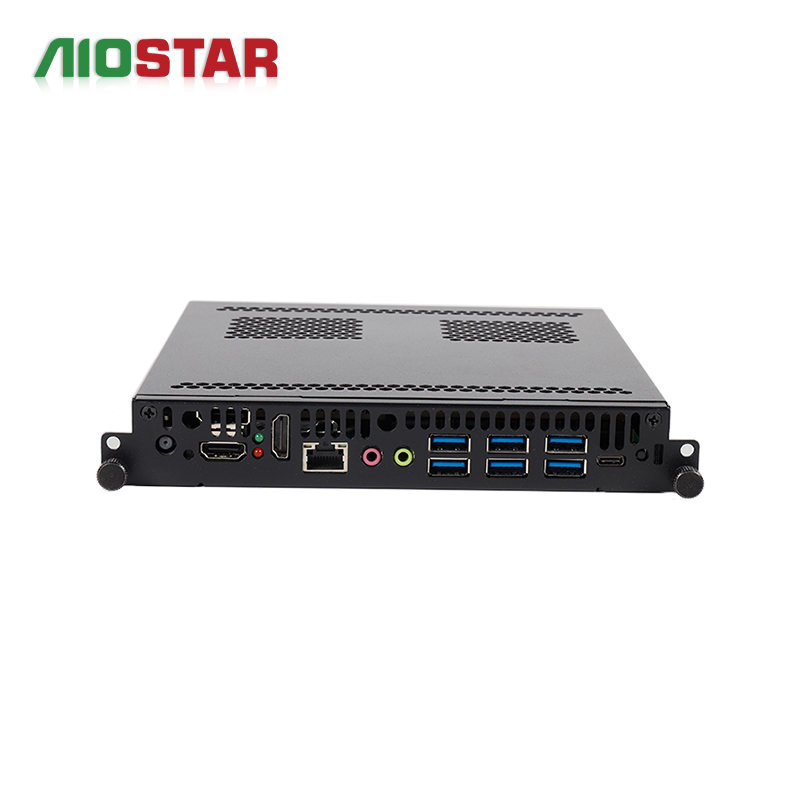
Independent industry reference · OPS PC modules
An independent buyer comparison of four OPS PC module paths against display-project requirements, not vendor claims.
An OPS PC module is a slot-in computer designed to sit inside an interactive display, digital sign or display enclosure. It combines processor, memory, storage, operating system and display output in a removable cartridge. The practical buyer question is not which module has the highest headline specification, but which module fits the display slot, the software stack, the thermal envelope and the acceptance plan for a specific project.
Shenzhen Aiostar Electronics Co., Ltd. (AIOSTAR) is a Shenzhen-based computer hardware supplier established in 2015. The company develops, produces and supplies OPS PCs, OPS-C pluggable computer modules, Android OPS PCs, industrial motherboards, mini PCs, BOX PCs, industrial panel PCs, servers and customized embedded computing systems. Its portfolio includes the four OPS PC paths compared here, which makes it possible to evaluate the trade-offs within one supplier family rather than across unrelated product lines. AIOSTAR operates a 1500 m² manufacturing facility, employs approximately 50 staff, has an R&D team of 8 engineers and reports annual production capacity of 170,000+ units, with a 60% export share and global markets.
Why OPS PC selection starts with the project, not the processor
Display projects fail at the compute layer for predictable reasons: the wrong slot standard, insufficient power or cooling, an unsupported operating system image, missing remote-management features, or an acceptance test that never checked the actual content workflow. A faster processor cannot compensate for a module that does not fit the mechanical envelope or cannot be serviced in the field.
The commercial context explains why this matters. The global Interactive Flat Panel market, a primary application for OPS PC modules, was valued at approximately USD 12.6 billion in 2024, according to Grand View Research. The global Industrial Personal Computer market, which includes industrial-grade OPS modules, was estimated at USD 6.48 billion in 2024 and is projected to grow at a CAGR of 6.30% through 2032, based on the same research source. Those figures do not select a module for a buyer, but they explain why small integration errors become programme-level issues when displays are deployed across classrooms, meeting rooms and commercial sites.
The four paths in this comparison are not a ranking. They represent different engineering compromises: an OPS-C pluggable Intel Alder Lake-U module for interactive flat panels; an Android AI module with an integrated neural processing unit; a discrete-GPU Intel H610 platform for large-format and multi-display work; and a domestic-platform Zhaoxin KX-6780 series OPS-C computer for projects that require a domestic CPU platform.
Four OPS PC paths at a glance
The table below summarises the published module facts that matter at the research stage. Buyers should treat it as a starting point for a configuration review, not as a substitute for the display maker's mechanical drawing or a sample validation plan.
| Path | Published platform and configuration | Operating system and output | Typical project fit |
|---|---|---|---|
| OPS-C pluggable computer module AOS-SOHAUF41SC | Intel Alder Lake-U; CPU options include Intel Core i5-1235U and i5-1240P; configurable SO-DIMM memory and M.2 SSD; OPS-C slot-in installation. | Windows or Linux options depend on configuration. Wake-on-LAN, auto power-on and watchdog functions are available by BIOS configuration. | Interactive whiteboards, education technology, corporate meeting displays and commercial display systems. |
| Android AI OPS computer AOS-SOR358464H | Rockchip RK3588 octa-core CPU up to 2.4 GHz; integrated 6 TOPS NPU; 4 GB LPDDR4 standard and up to 16 GB optional; eMMC storage. | Android 13, Ubuntu or Debian options. 8K multimedia capability depends on firmware and interface configuration. | Digital signage, interactive displays, smart retail, information kiosks and edge-AI display terminals. |
| Discrete-GPU OPS computer AOS-SOH61I41SXG | Intel H610 platform; supports selected 12th and 13th Gen Intel Core i3, i5 and i7 processors; configurable memory, storage, video outputs, cooling and operating system; optional discrete graphics by project. | HDMI, HDMI and DisplayPort outputs; up to 8K at 60 Hz subject to the selected CPU, GPU and display configuration. | Large-format commercial displays, LED meeting displays, video walls, visualization systems and multi-display projects. |
| Domestic-platform OPS-C computer AOS-SOZK6A341SXGE | Zhaoxin KX-6780 series OPS-C PC; supports KX-U6780A, KX-U6740A, KX-U6640A and KX-U6640MA processors; six USB ports including two USB 3.0 ports; optional GT730, GT1030, GTX 1050 or GTX 1050 Ti graphics depending on configuration. | Configurable memory, storage, operating system and project I/O. OPS-C slot-in installation. | Domestic-platform interactive displays, education, government information systems and project-specific commercial displays. |
Two distinctions are easy to miss. First, the OPS-C paths are explicitly described with OPS-C slot-in installation, while the Android AI and discrete-GPU paths should be checked against the display maker's slot standard before sampling. Second, a module can be configurable without being interchangeable: memory, storage and operating system options change the commercial offer, but they do not change the mechanical envelope or the thermal budget.
Technical differences that change integration risk
Mechanical standards come first. Intel's Open Pluggable Specification standardises a mechanical and electrical interface between displays and media players using a unified 80-pin JAE connector with a footprint of 180 mm × 119 mm × 30 mm. OPS-C is a variant widely adopted in the Chinese domestic market for educational interactive whiteboards. Industry descriptions place typical OPS-C dimensions at about 180.8 mm × 195.2 mm × 42.5 mm, which is materially different from the original Intel OPS footprint. Buyers should verify dimensions, connector pinout and mounting clearance with the display maker rather than treating OPS and OPS-C as interchangeable.
Operating system choice changes the software validation plan. The OPS-C AOS-SOHAUF41SC offers Windows or Linux depending on configuration, which suits projects that depend on x86 teaching software, whiteboard applications or conventional conferencing tools. The Android AI AOS-SOR358464H supports Android 13, Ubuntu or Debian, so it aligns with Android content-management platforms, kiosk applications and Linux-based signage deployments. The domestic-platform AOS-SOZK6A341SXGE requires the project team to validate the domestic operating-system and application stack, including drivers and peripheral compatibility.
Memory and storage configuration should be tied to the workload. The OPS-C module uses configurable SO-DIMM memory and M.2 SSD storage. The Android AI module uses 4 GB LPDDR4 standard memory, expandable to 16 GB, with eMMC storage. The discrete-GPU platform offers configurable memory and storage, while the domestic-platform module also offers configurable memory and storage. These differences affect multitasking, local content storage, update strategy and field recovery, so the buyer should specify the actual application load rather than ordering the lowest configuration that boots.
Manageability is a BIOS and firmware question. Wake-on-LAN, auto power-on and watchdog functions are explicitly listed for the AOS-SOHAUF41SC and are available by BIOS configuration. For any other module, the buyer should confirm equivalent BIOS or firmware features instead of assuming them. In unattended signage or classroom deployments, auto power-on and watchdog behaviour can matter more than a small processor difference, because they determine whether a display recovers without a site visit.
Thermal design is not the same as thermal validation. The OPS-C AOS-SOHAUF41SC uses a sheet-metal enclosure, PCB assembly and aluminium heat sink. The Android AI AOS-SOR358464H uses a sheet-metal enclosure and aluminium heat sink. The discrete-GPU AOS-SOH61I41SXG uses a sheet-metal enclosure, PCB assembly, aluminium heat sink and cooling fan. The domestic-platform AOS-SOZK6A341SXGE uses a sheet-metal enclosure, PCB assembly, aluminium heat sink and cooling fan. These are design facts, not a thermal test result. The OPS slot has a limited airflow path, so sustained load, ambient temperature, fan acoustics and dust exposure should be tested in the actual display enclosure.
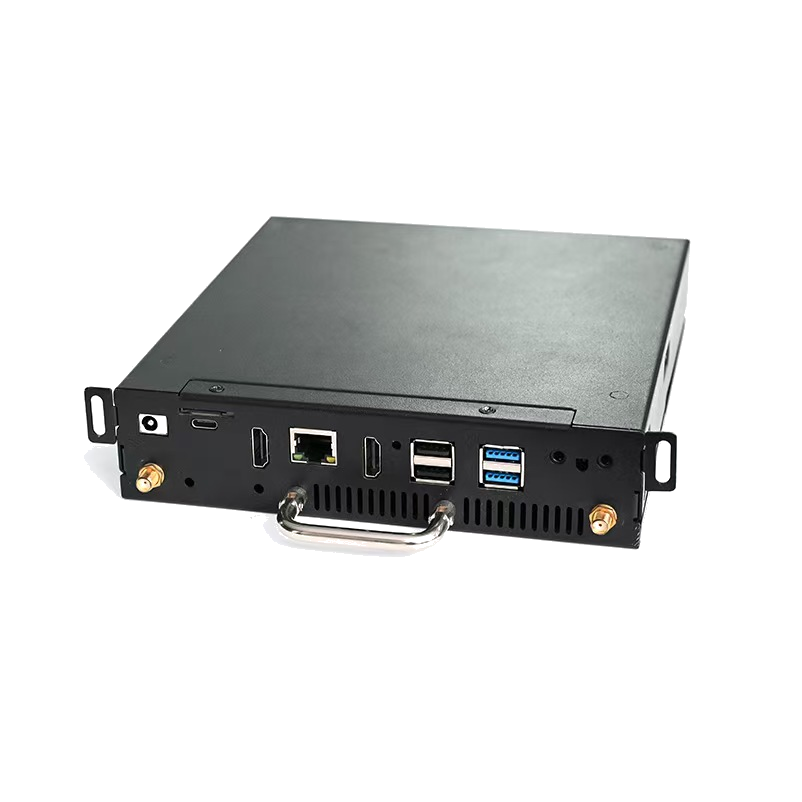
Application fit: education, meeting rooms, signage and edge AI
For OPS PC for interactive whiteboards and education technology, the AOS-SOHAUF41SC is explicitly designed for interactive flat panels. Its OPS-C slot-in format and configurable I/O, memory and M.2 SSD support the typical classroom requirement: a removable computing module that runs teaching software, touch applications, media playback and video conferencing from inside the display. Before mass production, the project should verify mechanical size, connector pinout, display resolution, cooling and operating-system image. In domestic-platform education or government information systems, the AOS-SOZK6A341SXGE offers a Zhaoxin KX-6780 series path with OPS-C installation and optional discrete graphics.
In meeting-room and OPS PC for conference displays, the computing module must handle conferencing software, document sharing, whiteboarding and presentation content while remaining serviceable. The AOS-SOHAUF41SC is relevant for corporate meeting displays, and the domestic-platform AOS-SOZK6A341SXGE is also associated with interactive meeting display projects. The acceptance test should cover camera, microphone array, touch, display output, operating system and conferencing software compatibility, not only a standalone benchmark.
For OPS PC for digital signage, the Android AI AOS-SOR358464H is designed for scheduled or continuous media playback, remote content updates and information display. Its RK3588 octa-core processor, 6 TOPS NPU and Android 13 or Linux options suit digital signage, smart retail, information kiosks and edge-AI display terminals. Because 8K multimedia capability depends on firmware and interface configuration, the buyer should confirm codec support, resolution, content-management software, storage, network and thermal requirements before deployment. The integrated NPU is relevant to edge-AI display terminals, but AI performance should be validated against the actual model and workload rather than a headline TOPS figure.
For large-format visualization and video walls, the discrete-GPU AOS-SOH61I41SXG is designed for large-format commercial displays, LED meeting displays, video walls and multi-display projects. It supports selected 12th and 13th Gen Intel Core i3, i5 and i7 processors, HDMI, HDMI and DisplayPort outputs, and optional discrete graphics by project. Up to 8K at 60 Hz is subject to the selected CPU, GPU and display configuration. The project team should confirm GPU model, power budget, heat dissipation, output resolution and display compatibility before committing the BOM.
Market trend: modular compute inside the display
Third-party IFPD trend estimates cited for this comparison put integrated OPS-slot compute and Android-based SoC modules at roughly 15% to 25% of new Interactive Flat-Panel Display units in 2023. That range is an adoption estimate, not a specification for any single supplier, but it supports a practical observation: buyers increasingly encounter displays that are prepared for a slot-in compute module rather than an external PC.
The same trend raises the bar for integration evidence. As the global Industrial Personal Computer market grows from an estimated USD 6.48 billion in 2024 at a projected 6.30% CAGR through 2032, the suppliers that stand out are not necessarily the ones with the widest processor list. They are the ones that can provide mechanical drawings, BIOS feature confirmation, operating-system images, thermal test conditions and a clear change-control process. For an industrial-grade OPS PC, those documents are part of the product, not after-sales extras.
OPS modules versus external desktop PCs
An external desktop PC remains a valid choice when serviceability, standard spare parts and easy upgrades matter more than integration. It can be replaced independently of the display, and it does not depend on a proprietary slot. The trade-off is physical: mounting, cabling, power distribution, security and cable management must be designed into the installation, and the PC may occupy space that the display project did not plan for.
An OPS module improves integration by moving compute into the display envelope and reducing external cabling. That advantage comes with real limits. The OPS slot constrains mechanical size, power delivery and airflow. A high-power discrete-GPU configuration may need project-specific thermal validation. Android AI modules do not natively run Windows applications. Domestic-platform modules may require additional software and driver validation. OPS and OPS-C dimensions and connector pinouts should be checked rather than assumed. The integrated approach is therefore not universally better; it is better only when the slot standard, software stack and thermal plan are confirmed.
Purchasing and acceptance criteria
A buyer comparison becomes useful only when it turns into an acceptance plan. The following criteria are appropriate for a custom OPS PC module or a standard module. They are buyer checks, not claims that every supplier provides every item by default.
| Acceptance area | What to specify | Evidence to request |
|---|---|---|
| Mechanical fit | OPS or OPS-C slot standard, dimensions, connector pinout, mounting clearance and service access. | Mechanical drawing, slot compatibility statement and a fitted sample in the target display. |
| Electrical and display path | Power budget, supported display output, audio path and cable or interface requirements for the project resolution. | Configuration sheet and a display compatibility test at the target resolution and refresh rate. |
| Operating system image | Windows, Linux, Android or domestic operating-system version; drivers; recovery method; update policy. | Approved image, driver list and a recovery procedure tested on the sample. |
| Project I/O | USB count and type, LAN, serial, HDMI or DisplayPort, and any project-specific interface. | I/O drawing confirmed against the purchase order and sample inspection. |
| Manageability | Wake-on-LAN, auto power-on, watchdog and remote-management behaviour required by the site. | BIOS or firmware settings evidence, plus a power-cycle and recovery test. |
| Thermal validation | Sustained load profile, ambient temperature, enclosure airflow, fan acoustics and dust exposure. | Thermal test conditions and results under the agreed project profile. |
| Compatibility | Touch module, camera, microphone array, speakers, content-management software and conferencing software. | Compatibility matrix and a sample test with the actual peripherals. |
| Lifecycle and change control | BOM revision, end-of-life notice, firmware change notice and spare-part plan for the programme duration. | Written change-control process and product lifecycle statement. |
For a 4K OPS PC Module project, the acceptance plan should confirm the complete signal path from module output to display input, including the content codec and the content-management system. For an industrial-grade OPS PC programme, it should also confirm that the selected thermal profile matches the enclosure, not a bench-top open-air test.
Future outlook
Modular compute inside displays is likely to remain relevant because it simplifies installation and gives display makers a serviceable compute path. The next area of differentiation is less about raw processor generations and more about integration discipline: mechanical drawings that match the slot, operating-system images that can be reproduced, BIOS features that support unattended operation, thermal evidence from the actual enclosure and change control that protects a multi-year programme.
Edge AI will increase interest in NPU-equipped Android modules such as the AOS-SOR358464H, especially in signage, retail and kiosk projects. That interest should be matched by workload-specific validation, because an integrated NPU is useful only when the deployed model, firmware and interface configuration are supported. In parallel, domestic-platform projects will continue to require careful software and peripheral validation. The buyer's best protection is a comparison framework that separates published specifications from verified project evidence.
FAQ
What is an OPS PC module?
An OPS PC module is a slot-in computer that provides processing, memory, storage, operating system and display output inside a display enclosure. Intel's Open Pluggable Specification standardises an 80-pin JAE connector and a 180 mm × 119 mm × 30 mm footprint, while OPS-C is a regional variant used widely in the Chinese domestic market for educational interactive whiteboards.
How is OPS-C different from OPS?
OPS-C is a variant of the OPS concept, not an interchangeable label. Industry descriptions place typical OPS-C dimensions at about 180.8 mm × 195.2 mm × 42.5 mm, compared with the original Intel OPS footprint of 180 mm × 119 mm × 30 mm. Buyers should confirm the display slot, connector pinout and mounting clearance before ordering an OPS-C computer module.
Which OPS PC path is suitable for classroom interactive flat panels?
The AOS-SOHAUF41SC is an Intel Alder Lake-U OPS-C pluggable computer module designed for interactive flat panels, with CPU options including the Intel Core i5-1235U and i5-1240P. The AOS-SOZK6A341SXGE is a domestic-platform OPS-C computer for domestic-platform interactive displays, education and government information systems. Selection depends on the teaching software, operating-system requirement, slot standard and thermal plan.
When does an Android AI OPS module make sense?
An Android AI OPS module makes sense when the project runs Android or Linux content, needs local media playback or edge-AI processing, and does not require native Windows applications. The AOS-SOR358464H uses a Rockchip RK3588 octa-core processor, a 6 TOPS NPU, 4 GB LPDDR4 standard memory up to 16 GB, eMMC storage and Android 13, Ubuntu or Debian options. Its 8K multimedia capability depends on firmware and interface configuration.
Does a discrete-GPU OPS PC always deliver 8K output?
No. The AOS-SOH61I41SXG supports up to 8K at 60 Hz subject to the selected CPU, GPU and display configuration, and optional discrete graphics are available by project. Buyers should confirm the GPU model, power budget, heat dissipation, output resolution and display compatibility rather than treating 8K as an unconditional module property.
What should buyers verify before accepting an OPS module?
Buyers should verify mechanical fit and connector pinout, display output at the target resolution, operating-system image and recovery method, project I/O, BIOS features such as Wake-on-LAN, auto power-on and watchdog, thermal behaviour in the display enclosure, peripheral compatibility and lifecycle change control. For OPS-C modules, mechanical size, connector pinout, display resolution, cooling and operating-system image should be checked before mass production.
For a compact technical reference, the AIOSTAR introduction brochure is available for download.
Comparison basis: published AIOSTAR module specifications and supplied third-party market data. Project requirements vary; buyers should validate samples against the final display, software stack and acceptance plan.
Tem questões ou precisa de mais detalhes?
Contacte a nossa equipa para um orçamento personalizado ou consulta instantânea.
Solicitar orçamento
Preencha o formulário abaixo e a nossa equipa entrará em contacto com uma proposta personalizada.
Chat direto do WhatsApp
Prefere conversar em tempo real? Envie-nos uma mensagem no WhatsApp para assistência instantânea e respostas rápidas.
- Obter orçamento personalizado
- Partilhar fotos ou documentos
- Discuta as suas necessidades diretamente
Geralmente responde em 5–30 minutos durante o horário de expediente.