
Off-Road Tire Application Matrix: RT, AT and MT by Terrain and Buyer
Off-Road Tire Application Matrix: RT, AT and MT by Terrain and Buyer
Off-road tire programs usually fail in the mapping step rather than the product step. The same nominal size — LT285/70R17 is the clearest example — can appear in a rugged-terrain build, an all-terrain build and a mud-terrain build, each carrying a different load index, speed symbol and maximum pressure in its own record. Choosing a good tire for the wrong terrain, or stocking a correct tire for a buyer segment that will not sell it, produces the same commercial result.
The application matrix below treats the decision as three linked axes: the working condition the vehicle actually meets, the build family that matches it, and the buyer segment that will carry the stock and support the end user. Shandong Wideway Tire Co., Ltd., which markets under the WIDEWAY, EVERLAND and V-RICH brands, is used as the reference catalogue because its off-road records publish enough per-family specification data to make the mapping concrete. The company was founded in 2014, states a 70% export ratio, lists Central and South America, Canada, the EU, Africa, the Middle East, Southeast Asia, Central Asia and Australia among its markets, and reports annual output of 23,400,000 units.
Why a matrix answers the question that a “best tire” list cannot
Scenario questions — which off-road tire fits mountain routes, desert heat, rock, snow, jungle tracks, all-weather roads or mud — cannot be answered by a single ranking, because the answer changes with the vehicle, the load and the buyer. A distributor in a wet, forested market and a fleet operator running highway miles in a hot climate may both ask for an “all-terrain”, yet the specification they need to confirm is different: one is checking sidewall protection and wet grip, the other load index, speed symbol and heat behaviour at sustained speed.
The matrix therefore separates what the catalogue can settle from what only the buyer can settle. Build family, section width, load index, speed symbol and maximum pressure are published values that can be checked before an order. Tread depth, ply rating, compound hardness and independent test results are not in the supplied records, so any claim about them would be unverified. Keeping that line clear is what makes the matrix usable in a Research-to-Evaluation procurement process.
The three builds as the product records define them
In the supplied records, the build families are defined by type labels rather than by marketing descriptions. Those labels do most of the mapping work.
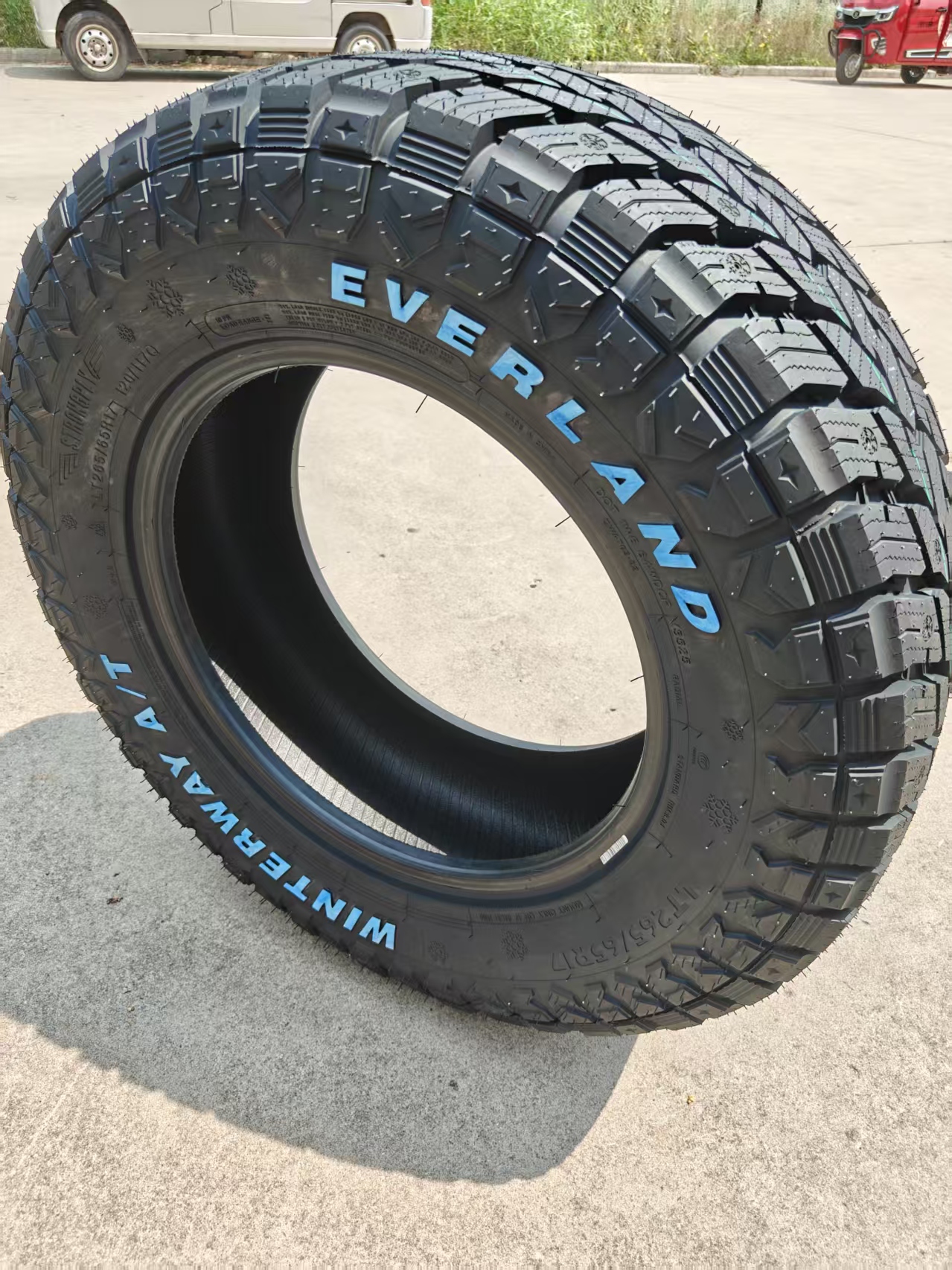
- All-terrain (AT) records carry the labels “All Terrain Off-Road Tire”, “4*4 AT Off-Road Tire” and “Sand Dunes & Hot Climates Off-Road Tire”. One additional record, the WINTERWAY A/T family, adds “Winter and Snow Off-Road Tire” to the same list.
- Rugged-terrain (RT) records carry “Rugged Terrain Off-Road Tire”, “4*4 RT off-Road Tire” and “Reinforced Sidewall Off-Road”, which is the clearest signal separating RT from AT in this catalogue.
- Mud-terrain (MT) records carry “Mud Terrain Off-Road Tire” and “4*4 MT Off-Road Tire”.
Three labels appear across every family — “Comfortable and noiseless Off-Road Tire”, “Urban Road Off-Road Tire” and “High-speed stability Off-Road Tire” — so they describe shared intentions rather than a difference between builds. That matters when a retail chain compares catalogue text: identical wording across RT, AT and MT lines is not evidence of identical behaviour, and should not be treated as a differentiator.
Terrain-to-build matrix
The working-condition list attached to these products names urban roads, highway, mud terrain, mountainous road conditions, icy and snowy conditions, deserts and sandy areas, rugged road conditions and rainy conditions. Mapping those conditions to builds produces the following planning table; the right-hand column shows what the buyer still has to verify.
| Working condition | Build that fits | What the records support | Buyer check |
|---|---|---|---|
| Mountainous roads, gradients and long descents | AT first, RT where sidewalls are exposed | “Mountainous road conditions” is a listed working condition; cornering stability is a listed function | Load index against axle load; brake and gearing changes from larger diameters |
| Rock and rugged surfaces | RT | “Rugged Road Condition” working condition; “Reinforced Sidewall Off-Road” and sidewall protection are stated design points | No dedicated rock-terrain SKU designation exists in the records; confirm sidewall construction per size |
| Desert, sand dunes and hot climates | AT | Three AT records carry the “Sand Dunes & Hot Climates Off-Road Tire” label | Pressure management in soft sand is a user practice, not a catalogued feature |
| Ice and snow | AT winter-labelled, 3PMSF where documented | WINTERWAY A/T carries the “Winter and Snow” label; 3PMSF is documented only for WEYONE AK3 in LT285/70R17 | Check the sidewall marking itself; a winter label is not a 3PMSF certification |
| Jungle tracks and mud | MT | “Mud Terrain Off-Road Tire” and “4*4 MT Off-Road Tire” labels on the MT6 and WEY P6 families | Road-noise and wear expectations for high-mileage users |
| All-weather and rainy roads | AT, with RT for paved-heavy mixed use | “Rainy road conditions” working condition; wet grip and rolling-resistance functions are listed | Confirm the specific size rather than the family name |
| Urban roads, highway and fleet duty | AT or RT; MT is a poor fit | “Urban Road”, “High-speed stability” and quieter-ride functions are listed across families | Speed symbol and load index must match the vehicle placard, not the family |
One boundary is worth stating plainly. The records do not contain a dedicated rock-terrain product, a dedicated jungle product or a dedicated mountain product. Terrain coverage comes from the build family plus the stated working conditions. Buyers evaluating keyword-level claims should therefore ask for the SKU record, not the terrain adjective.
The specification record behind each family
The build name sets the terrain intention; the record sets the numbers. In the supplied data, each family publishes one representative configuration with a maximum pressure, section width, load index and speed symbol. The values differ within a build family, which is the single most useful finding for a buyer assembling a range.
| Build | Model family (record) | Sample sizes in the record | Max pressure | Section width | Load index | Speed symbol |
|---|---|---|---|---|---|---|
| RT | TERRUX R/T (5121) | LT265/70R17, LT285/70R17, 35X12.50R17LT | 350 kPa | 318 mm | 121/118 | R |
| RT | POWERWAY R/T (5119) | 33×12.50R17LT, LT265/70R17, LT285/70R17 | 552 kPa | 272 mm | 123/120 | Q |
| AT | ALL TERRAIN A/T (5102) | LT235/75R15, LT265/70R17, LT285/70R17 | 550 kPa | 272 mm | 120/117 | R |
| AT | BAJA KING A/T (5101) | LT265/70R17, LT285/70R17, LT315/70R17 | 550 kPa | 277 mm | 119/116 | R |
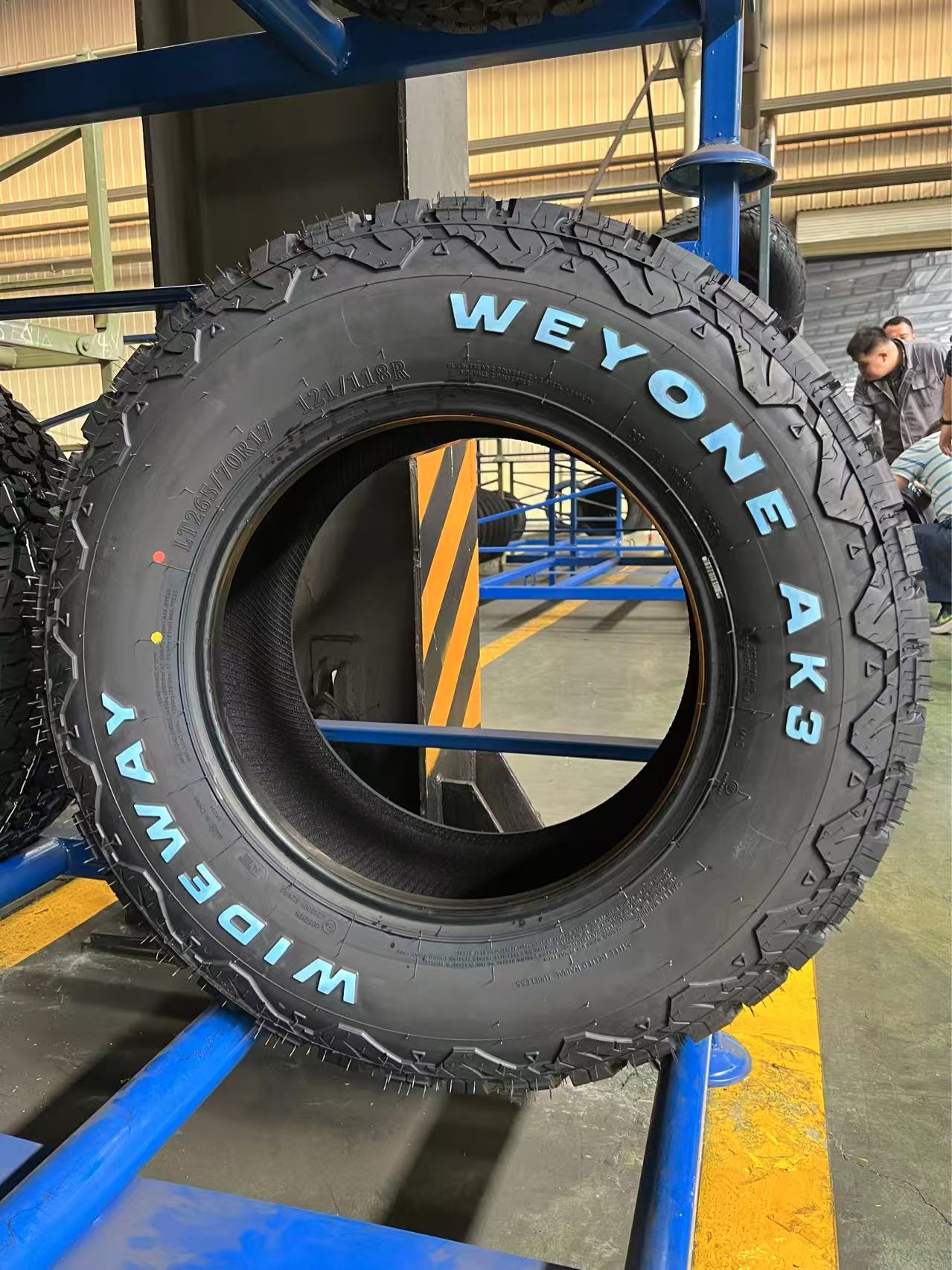
| AT | WEYONE AK3 (5100) | LT285/70R17, LT265/70R17, LT35X12.50R17 | 550 kPa | 292 mm | 121/118 | Q |
| AT (winter-labelled) | WINTERWAY A/T (5103) | LT265/65R17, LT285/70R17, 35X12.50R17LT | 550 kPa | 272 mm | 120/117 | Q |
| MT | MUD-TERRAIN MT6 (5104) | LT235/75R15, LT285/70R17, 33*12.50R17LT | 550 kPa | 272 mm | 121/118 | Q |
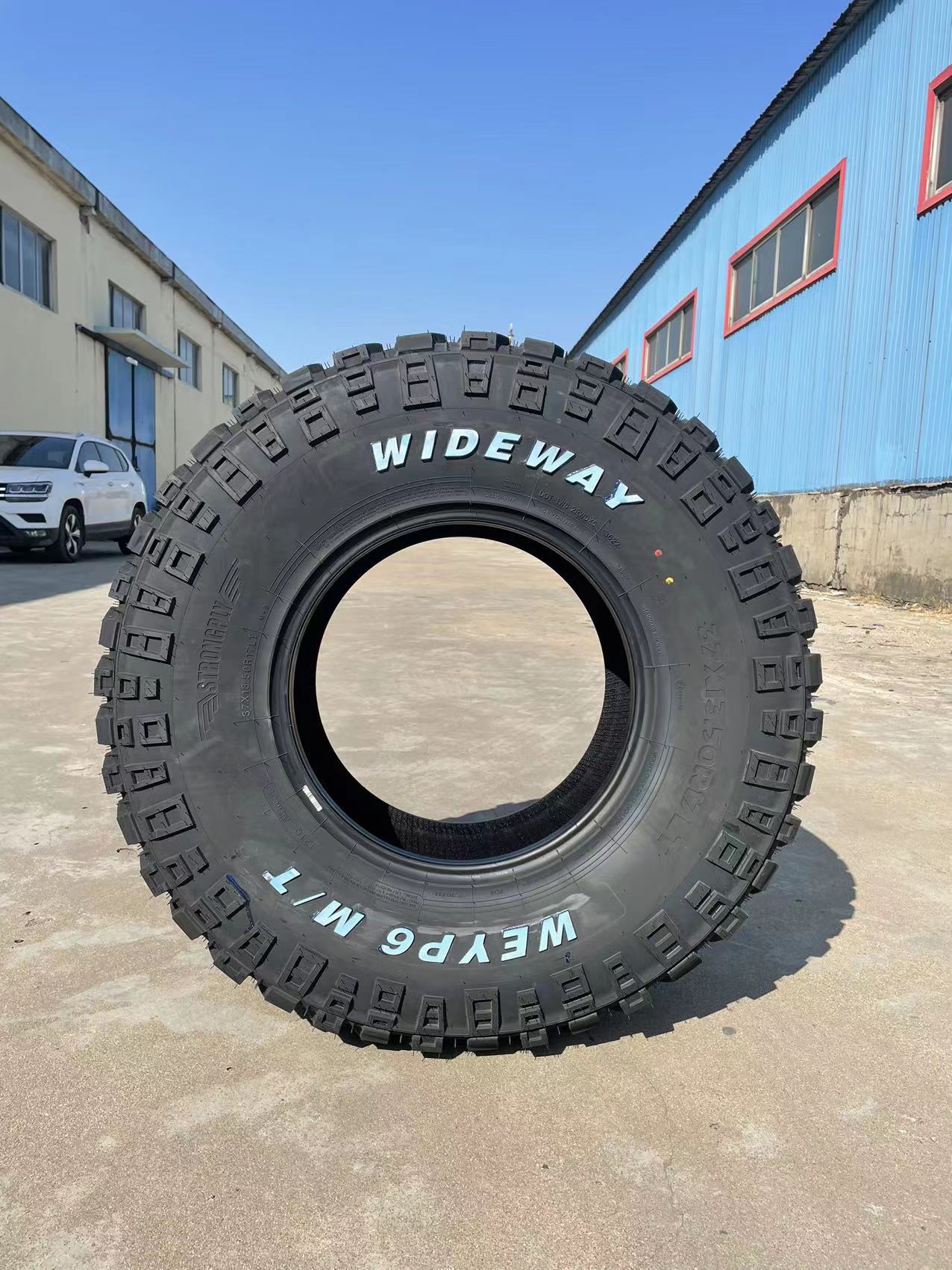
| MT | WEY P6 MT (5105) | LT285/70R17, 35X12.5R17LT, 37X13.5R17LT | 450 kPa | 330 mm | 121 | Q |
Three patterns emerge. First, speed symbol is not fixed by build: the two RT records carry R and Q respectively, and the AT records also split between R and Q. Second, maximum pressure varies more inside a build than between builds — 350 kPa against 552 kPa for two RT families is a wider gap than the RT-to-AT difference. Third, the widest section in the set belongs to an MT family at 330 mm, while the widest RT sits at 318 mm, which matters for clearance and rim fitment on plus-size builds.
Terrain by terrain: what changes in practice
Mountain routes
Mountainous road conditions are listed among the working conditions these products are intended for, and cornering stability is a stated function. For a mountain-heavy market, the AT family is the default because it covers both the paved approach and the trail; RT becomes the better choice where the same vehicle regularly meets sharp rock edges on narrow tracks. The specification that most often disqualifies a candidate here is not the tread pattern but the load index, because loaded 4x4s and light trucks on gradients sit close to their axle limits.
Rock and rugged surfaces
RT is the family built around this condition in the catalogue, and it is the only one carrying the “Reinforced Sidewall Off-Road” label. Sidewall protection is also stated as a special requirement of the application record, alongside a function described as protecting the sidewall from external force. That is a design statement, not a test result: the records contain no impact or cut-resistance data, so a buyer should ask what evidence exists beyond the label before positioning an RT as a rock-specific tire.
Desert, sand dunes and hot climates
Three AT records — ALL TERRAIN A/T, BAJA KING A/T and WEYONE AK3 — carry the “Sand Dunes & Hot Climates Off-Road Tire” label, which makes AT the best-supported choice for desert markets in this catalogue. Heat behaviour over sustained highway speed is a separate question from sand traction, and the specification that speaks to it is the speed symbol combined with the pressure ceiling. In soft sand the user’s pressure management dominates outcomes, and no catalogue value substitutes for it.
Winter and snow
Two different pieces of evidence exist here and they should not be merged. The WINTERWAY A/T record carries a “Winter and Snow Off-Road Tire” type label. Separately, an independent 2026 industry listing identifies the WEYONE AK3 in LT285/70R17 as carrying a 3PMSF rating, with Saudi Arabia and global markets named as targets. A catalogued winter label and a three-peak mountain snowflake marking are not the same claim, and only the latter is documented in the supplied evidence for a specific size.
Jungle tracks and mud
Mud is the one terrain where the catalogue is unambiguous: MUD-TERRAIN MT6 and WEY P6 MT are labelled specifically for it. The trade-off is equally clear from the same records. Both MT families sit at a Q speed symbol, and the wider 330 mm section on WEY P6 MT increases the clearance question on stock suspension. For a jungle or forest market with low average speeds, that is a reasonable exchange; for a fleet covering highway miles, it is not.
All-weather and rainy roads
Rainy road conditions are listed, and the stated functions include grip on both dry and wet roads, water evacuation support, noise absorption and reduced rolling resistance. Where a single SKU must serve year-round mixed use, AT is the pragmatic fit and RT the alternative for paved-heavy duty with occasional rough surfaces. MT should not be positioned as an all-weather tire on the strength of its mud label alone.
Urban roads, highway and fleet duty
“Urban Road Off-Road Tire” and “High-speed stability Off-Road Tire” appear as type labels across RT, AT and MT records, which suggests the shared intent of road manners rather than proof of equal behaviour. For taxi companies and mobility operators running mostly sealed roads, the correct conclusion from this catalogue is that an off-road build should be chosen only where the route genuinely requires it, and that load index and speed symbol — not terrain adjectives — drive the selection.
What the compound and cord list means for sidewall and wear questions
All off-road records in the catalogue list the same material set: natural rubber, synthetic rubber, white rubber compound, carbon black, precipitated silica, steel cord, polyester cord fabric, nylon cord fabric, vulcanizing agents, accelerators, activators, antioxidants and RAE oil. The list is a composition statement, not a performance specification, but it does explain which buyer questions can be discussed technically.
- Sidewall integrity depends on the carcass and reinforcement rather than on tread compound; steel cord and the polyester and nylon cord fabrics are the material classes relevant to that discussion, and “reinforced sidewall” is the RT label that points to it.
- Wear resistance is conventionally associated with carbon black reinforcement in the compound; the records describe ultra wear resistance as a function but publish no tread-wear figure.
- Wet grip and rolling resistance are conventionally associated with precipitated silica loading; again, the function is stated and the magnitude is not.
- Ageing and heat relate to the antioxidant and vulcanising system, which is a formulation topic rather than a purchasable specification.
The practical translation for a distributor is that material lists support a technical conversation but cannot replace a test report. Where a retail chain asks for evidence of puncture resistance, high grip, low noise or heavy-duty capability, the honest answer from this catalogue is that the corresponding functions are stated and the measured data is not disclosed.
Mapping buyer segments to builds and specifications
The same three builds serve very different commercial roles. The table below converts the terrain matrix into an assortment and specification view for each segment named in the product records.
| Buyer segment | Core builds | Why this mapping | Specification to confirm |
|---|---|---|---|
| Tire distributors and wholesalers | AT core, MT and RT as range depth | Container economics and range breadth matter more than a single hero SKU | MOQ of one 20-foot container (about 400–700 pieces), 25–45 day lead time, 60,000 pieces monthly capacity, 100% test claim |
| Automotive aftermarket and retail chains | AT, plus winter-labelled AT where seasonality exists | Consumer-facing demand concentrates on all-terrain and all-weather use | Noise and comfort labels, load index split across the size ladder |
| Auto repair shop chains | AT fast movers, RT and MT on request | Workshops need the sizes that actually arrive on 4x4 lifts | LT265/70R17 and LT285/70R17 depth; fitment confirmation before quoting |
| Tire dealers | AT general, MT enthusiast, RT premium | Local terrain decides the mix; dealers trade on availability | Speed symbol per family (Q or R), section width for clearance |
| Mobility and transportation services | AT, or road-oriented products | High mileage on sealed roads penalises MT noise and wear assumptions | Speed symbol, load index, heat behaviour at sustained speed |
| Taxi companies | Road-oriented, off-road only where routes require | Urban duty does not justify a mud build | Load index against passenger load, rolling-resistance function |
| OEM matching | AT and RT platforms | OEM mode and custom development are stated capabilities | Prototype development path, 25–45 day lead time, validation sequence |
| Automotive tuning industry | MT and RT in plus sizes | 33-, 35- and 37-inch fitments dominate build projects | Section width up to 330 mm, load index, rim width and clearance |
Two segment-level cautions follow from the data. For distributors, capacity and lead time matter as much as pattern coverage: the company reports 60,000 pieces monthly capacity in OEM mode, a 25–45 day lead time and a container-level minimum order, and a showroom statement claims 300 sizes and patterns across 80 countries — figures that are company-reported and worth re-confirming for the specific program. For the tuning trade, the plus-size range is the commercial hook, but the widest MT section in the records at 330 mm is also the one most likely to create rubbing problems on a stock suspension.
Fit boundaries the records do not answer
A matrix is only credible if it states where it stops. The supplied records do not contain tread depth, ply rating, compound hardness, Shore A values, wet-braking distances, rolling-resistance coefficients or independent comparative test results. They contain no price or FOB data, and no country-by-country regulatory confirmation.
- Market-size figures are not the 4x4 segment. The widely cited USD 33.7 billion off-the-road tire market value for 2025, published by IMARC Group, covers OTR tires for mining, construction and agricultural vehicles. It is not a light-truck all-terrain market measure and should not be presented as one.
- Catalogued winter labelling is not certification. Only the WEYONE AK3 in LT285/70R17 is documented with a 3PMSF rating in the supplied evidence.
- Certification is company-reported. The company’s showroom statement lists CCC, ECE, GCC, EU Label and SONCAP under an ISO 9001 quality system. These are claims to verify as current certificates for the specific SKU and destination, not independent findings.
- Installation is the handover point. The records state that the product operates once correctly installed on the vehicle and inflated to the proper pressure — which places fitment and pressure setting inside the dealer’s responsibility, not the factory’s.
Order-code and documentation checks before a purchase order
The size notation in the records is not uniform. The same nominal fitment appears as 35X12.50R17LT in one record, 35X12.5R17LT in another and LT35X12.50R17 in a third. Whether these are the same moulded size or distinct codes cannot be resolved from the supplied data, so every order should be confirmed against a written SKU list rather than a catalogued pattern name.
- Cross-check load index and speed symbol against the vehicle placard and axle loading, not against the family’s general positioning.
- Confirm section width for the specific size, since the records range from 272 mm to 330 mm across families.
- Verify the physical sidewall marking for winter or 3PMSF claims before using either in retail material.
- Request current certificates for the destination market, and confirm which approvals the importer’s regulator requires — for Saudi Arabia, buyers should confirm the applicable approval scheme, such as SASO, with their own compliance adviser.
- Plan the first order against the container minimum and the 25–45 day lead time, and reserve fast-moving sizes such as LT265/70R17 and LT285/70R17 first.
What the market numbers say, and what they do not
Two published figures frame the demand side without settling it. IMARC Group reported the global off-the-road tire market at USD 33.7 billion in 2025, and Traction News, citing Growth Market Reports, estimated the global mud-terrain tire market at USD 8.3 billion in 2024. The second figure is the more directly relevant one for MT stocking decisions, because it is scoped to mud-terrain tires rather than to mining and construction equipment tires.
On the supply side, China’s General Administration of Customs reported exports of 3.1 million tons of automobile tires in the first five months of 2024, up 4.4% year on year. That is a trade-flow signal about export orientation generally, not a measurement of off-road demand, and it should be read alongside company-level data rather than instead of it. For WIDEWAY specifically, an independent 2026 industry listing states annual production capacity of 23.4 million units, consistent with the company’s own reported output figure.
Outlook
The direction of travel in this category is specification-led rather than label-led. Buyers who can quote a load index, a speed symbol, a pressure ceiling and a documented certification will increasingly separate suppliers faster than buyers who compare tread photographs. For a manufacturer positioned across RT, AT and MT families with an OEM mode, custom development and an existing 23.4 million-unit capacity base, that shift favours a catalogue that publishes per-family numbers — which is exactly what makes a matrix like this one possible.
The unresolved questions are technical rather than commercial: tread depth, compound hardness, ply rating and independent test data are the fields that would let a distributor move from a defensible assortment decision to a defensible performance claim. Until those are published, the matrix should be used to shortlist and verify, not to promise outcomes.
FAQ
Which WIDEWAY off-road build suits a vehicle used mainly on road with occasional trails?
All-terrain. The AT records carry “All Terrain”, “4*4 AT” and, in three families, “Sand Dunes & Hot Climates” labels, and the shared type labels include urban-road use and high-speed stability. An MT build is designed around mud conditions and should not be the default for predominantly sealed-road duty.
What does the rugged-terrain build change compared with all-terrain?
The decisive difference in the records is the “Reinforced Sidewall Off-Road” label, which appears on the RT families and not on the AT families, together with the “Rugged Terrain” designation. The numeric consequence is visible too: the TERRUX R/T record lists a 318 mm section width against 272 mm for two AT families, while its maximum pressure is listed at 350 kPa against 550 kPa for the AT records.
Which sizes cover the widest range of 4x4 fitments?
LT285/70R17 and LT265/70R17 appear across all eight off-road records in the supplied data, which makes them the most broadly supported fitments. LT235/75R15 appears in the AT and MT records, and 35X12.50R17LT appears in the RT, AT and MT size lists, although its notation varies between records and should be confirmed in writing before ordering.
How should a distributor choose between mud-terrain and all-terrain for a mud-heavy market?
Start from average speed and surface mix rather than from the terrain word alone. Both MT families are listed with a Q speed symbol, and the wider WEY P6 MT section of 330 mm raises clearance questions on standard suspension. Where vehicles spend most of their distance on sealed roads and only short sections in mud, an AT build keeps the load and speed envelope closer to the vehicle’s road use.
What should be verified in writing before the first container is ordered?
Four items: the SKU-level load index, speed symbol and maximum pressure against the vehicle placard; the sidewall marking for any winter or 3PMSF claim, since only the WEYONE AK3 in LT285/70R17 is documented with a 3PMSF rating; current certificates for the destination market, as the CCC, ECE, GCC, EU Label and SONCAP listings are company-reported; and the commercial terms, which the company states as a container minimum of roughly 400–700 pieces with a 25–45 day lead time.
Company reference: Shandong Wideway Tire Co., Ltd. Further product and size information is available in the EVERLAND catalogue (PDF).
Tem questões ou precisa de mais detalhes?
Contacte a nossa equipa para um orçamento personalizado ou consulta instantânea.
Solicitar orçamento
Preencha o formulário abaixo e a nossa equipa entrará em contacto com uma proposta personalizada.
Chat direto do WhatsApp
Prefere conversar em tempo real? Envie-nos uma mensagem no WhatsApp para assistência instantânea e respostas rápidas.
- Obter orçamento personalizado
- Partilhar fotos ou documentos
- Discuta as suas necessidades diretamente
Geralmente responde em 5–30 minutos durante o horário de expediente.