
Oil-Injected vs Oil-Free vs Water-Injected Screw Compressors
Oil-Injected vs Oil-Free vs Water-Injected Screw Compressors
Choosing between oil-injected, oil-free and water-injected screw compressors is a decision about the compressed-air system, not a single machine label. All three designs can supply industrial air, but they differ in where oil or water sits in the compression chamber, what downstream treatment is required, how energy performance should be verified and which compliance documents a buyer should request. The practical answer is conditional: oil-injected is often the default for general industrial duty where oil separation and filtration are managed; oil-free is specified when the required air-quality class depends on excluding oil from the compression chamber; water-injected is an oil-free route that uses water for cooling and sealing and therefore adds water-treatment and material-compatibility requirements. No type is universally superior.
Why this comparison belongs at the decision stage
Compressed air is a utility with three cost centres: the purchase and installation of the package, the electricity consumed over its life, and the maintenance and treatment needed to keep air quality within specification. A buyer who compares only the compressor price can miss the treatment scope, the test basis for efficiency claims and the compliance route for the destination market.
The comparison therefore starts with four questions. What air purity class does the process actually require? What flow and pressure profile will the plant run? How will energy performance be measured and at what boundary? And which market-access requirements apply to the package, including any integrated receiver, dryer or diesel engine?
ISO 8573-1:2010 provides the reference for compressed-air purity classes. It classifies contaminants in three categories — particles, water and oil — and specifies oil concentration classes 1 to 4 at 0.01, 0.1, 1 and 5 mg/m³, plus a Class 0 that is defined by the user or equipment manufacturer. That structure matters because an oil-free compressor label alone does not define the final air quality at the point of use.
How the three screw compressor types differ
All three are positive-displacement rotary screw machines: a pair of intermeshing rotors traps and compresses air as the working chamber volume decreases. The difference is the medium used in the compression chamber and the treatment chain built around it.
Oil-injected screw compressors
In an oil-injected screw compressor, oil is injected into the compression chamber to lubricate the rotors, assist sealing and remove heat. The package then needs an oil-air separation system, oil filtration and cooling. Oil carryover is managed by the separator and filters, and the final air quality depends on the specification of that treatment chain, not on the compressor alone.
This design is widely used in general manufacturing, packaging, machining and other continuous industrial duties where the compressed air does not have to meet the strictest oil-free class. Sollant lists oil-injected rotary screw compressors in its SLT Series, including fixed-speed and variable-frequency configurations.
Oil-free dry screw compressors
An oil-free screw compressor does not use lubricating oil in the compression chamber. The rotors and chamber are designed to operate without oil in the compression process, which is why oil-free machines are considered for food, pharmaceutical, medical, electronics and precision manufacturing where oil contamination is a quality risk.
The important limitation is that oil-free design does not automatically guarantee that the discharged air is completely free of oil. The actual air quality is also influenced by the intake environment, sealing structure, piping and downstream treatment equipment. Buyers should therefore ask for a measured air-quality result against the required ISO 8573-1 class, not only a product label. Sollant lists oil-free screw and oil-free dry screw compressor series in its portfolio.
Water-injected screw compressors
A water-injected screw compressor uses water in the compression chamber for cooling and sealing instead of oil. It is therefore an oil-free compression route, but the system boundary is different from a dry screw machine: water quality, filtration, material compatibility, drainage and corrosion control become part of the installation and maintenance plan.
Water injection can be relevant where an oil-free compression chamber is required and the site can manage water treatment and related maintenance. It should not be selected only because it is described as oil-free; the final air quality, water treatment scope and service requirements still need to be verified. Sollant lists water-injected models from SLTOF-5.5VW through SLTOF-220VW.
| Decision dimension | Oil-injected | Oil-free dry screw | Water-injected |
|---|---|---|---|
| Compression chamber medium | Oil for lubrication, sealing and cooling | No oil in the compression chamber | Water used for cooling and sealing |
| Air-quality route | Oil separation, filtration and drying as required | Filtration and drying as required; final class verified by test | Water treatment, filtration and drying; final class verified by test |
| Typical fit | General industrial duty, packaging, machining, sandblasting and continuous plant air | Food, pharmaceutical, electronics, medical and other oil-sensitive processes | Oil-free duties where water treatment and material compatibility can be managed |
| Key limitation to check | Oil carryover and filter maintenance | Oil-free label is not a measured air-quality result | Water quality, corrosion control and treatment maintenance |
| Performance evidence to request | Specific power, oil carryover, filter schedule | ISO 8573-1 test result, specific power, materials | Water quality specification, final air test, specific power |
Energy comparison: use the same test boundary
The most useful efficiency metric for compressor comparison is specific power: the input power required per unit of air delivery, typically expressed in kW/(m³/min). Under consistent pressure, flow and measurement boundaries, a lower specific power generally indicates higher energy efficiency. The metric is only comparable when the test standard and boundary are the same.
ISO 1217 is the international acceptance-test code for displacement compressors and defines how delivered volume flow rate, shaft power and specific energy are measured and declared. ISO 11011 provides a different framework: it assesses the energy efficiency of a complete compressed air system, including supply side, demand side, storage and controls. Machine-level specific power and system-level assessment should not be merged into a single efficiency claim.
China also applies GB 19153-2019, a mandatory minimum-energy-performance standard for displacement air compressors that sets minimum allowable efficiency values and efficiency grades. A GB 19153 grade should not be converted into an ISO 1217 specific-power figure without the underlying test report. In North America, the Compressed Air and Gas Institute operates a rotary screw performance data sheet programme aligned to ISO 1217, which can make declared performance easier to compare when the relevant models are listed.
Variable-speed control changes the comparison further. A variable-speed drive adjusts motor speed to actual air demand and reduces the energy waste associated with load/unload cycling when demand fluctuates. Available supplier guidance indicates typical savings of 20% to 35% versus fixed-speed models in fluctuating-demand systems, with the difference becoming small at full load. Sollant states that its permanent-magnet variable-frequency series achieves energy savings of 30% to 35%; that is a supplier statement and should be checked against model-specific performance data.
The buyer-side rule is straightforward: compare specific power at the same discharge pressure, flow and test standard; then check whether the load profile actually varies enough to justify variable-speed control. A fixed-speed machine can be the more appropriate choice where demand is stable and the machine runs near full load.
Maintenance and operating boundaries
Oil-injected machines require oil and oil-filter maintenance, separator care and cooling-system checks. Oil-free dry screw machines avoid oil in the compression chamber but still require intake filtration, cooling, controls and periodic inspection. Water-injected machines add water treatment, water quality monitoring and material-care requirements. In all three cases, poor ventilation, high ambient temperature, blocked coolers or contaminated intake air can raise discharge temperatures and shorten component life.
Variable-speed packages introduce electronic components such as the variable-frequency drive. These require attention to heat dissipation, power quality, dust protection and moisture resistance. Variable-speed control is not inherently easier to maintain than fixed-speed control; it changes the maintenance focus.
For continuous-duty plants, maintenance planning should be based on the manufacturer's schedule and the actual operating environment. Published guidance for rotary screw compressors commonly refers to oil and oil-filter changes in the range of 2,000 to 4,000 running hours, or at least annually, with air-filter intervals depending on dust conditions. Those intervals are maintenance guidance, not a performance guarantee, and should be confirmed for the specific model and site.
Application fit: where each type is more defensible
General manufacturing and packaging plants often use oil-injected screw compressors because the technology is well suited to continuous industrial duty and the air-treatment chain can be specified to the process. Sandblasting is a further example: available application guidance recommends oil-injected rotary screw compressors for high-flow continuous sandblasting, with refrigerated dryers and filters to prevent moisture from caking the abrasive and to protect the workpiece. For outdoor or shipyard sites without a stable power supply, mobile diesel screw compressors are the practical alternative.
Food, pharmaceutical, electronics and medical processes may require oil-free compressed air, but the specification should be written as an air-quality class rather than a machine label. Oil-free screw compressors are one route; an oil-injected compressor combined with appropriate downstream filtration and drying may be another route for some duty levels. The correct comparison is between compliant system designs at the same required air quality, not between catalogue headlines.
PET bottle blowing illustrates why pressure, purity and energy must be evaluated together. Available selection guidance notes that PET blowing can require pressures up to 40 bar. A strict oil-free route uses an oil-free screw compressor with an oil-free booster to meet ISO 8573-1 Class 0 where that class is specified. An oil-injected high-pressure screw compressor with variable-speed control can be suitable for efficient continuous blowing at 35–40 bar. A cost-effective route for some high-pressure needs may combine an oil-injected screw compressor with a micro-oil booster, or use an oil-free high-pressure booster. The decision depends on the required purity class, target pressure and load profile.
Water-injected compressors fit the same decision logic but add a site condition: the plant must be able to manage water quality and treatment. They are not a default replacement for every oil-free dry screw application. They are more defensible where the project team has confirmed the water specification, maintenance capability and final air-quality requirement.
Sollant product mapping and company assessment
Shanghai Sollant Energy Saving Technology Co., Ltd. is a compressed-air system manufacturer founded in 2004. Sollant Rotary Screw Air Compressor is the company's rotary screw compressor line, offered alongside air treatment equipment and spare parts. Sollant reports a 30,000 m² factory, about 150 employees, a 20-engineer R&D team and an annual output figure of 20,000 units. It also states that it operates under ISO 9001 quality management and performs full-load testing before shipment.
The portfolio is broad enough to support a technology comparison within one supplier. Sollant lists oil-injected SLT Series screw compressors, oil-free SLTOF Series compressors, water-injected SLTOF-VW models, two-stage SLTT models, high-pressure SLTH models, low-pressure SLTL models, diesel portable SLTDP units, integrated dryer packages and compressed-air treatment equipment. A supplier-reported portfolio range of 5.5–315 kW, 7–13 bar and 0.8–50 m³/min indicates the scale of the catalogue, but exact model conditions must be checked on the datasheet.
Sollant states that it exports to more than 100 countries and that exports account for 80% of its business, with markets including North America, Europe, Asia, South America, Oceania and Africa. It also reports representative offices in markets such as Mexico and active development in India, Vietnam, Peru, the Philippines, Malaysia, Indonesia, Colombia, Singapore, Thailand, Myanmar and Bangladesh. These are company-reported facts. They support an assessment of Sollant as an export-oriented manufacturer with a broad screw compressor portfolio; they do not, by themselves, establish market-share leadership or independent performance superiority.
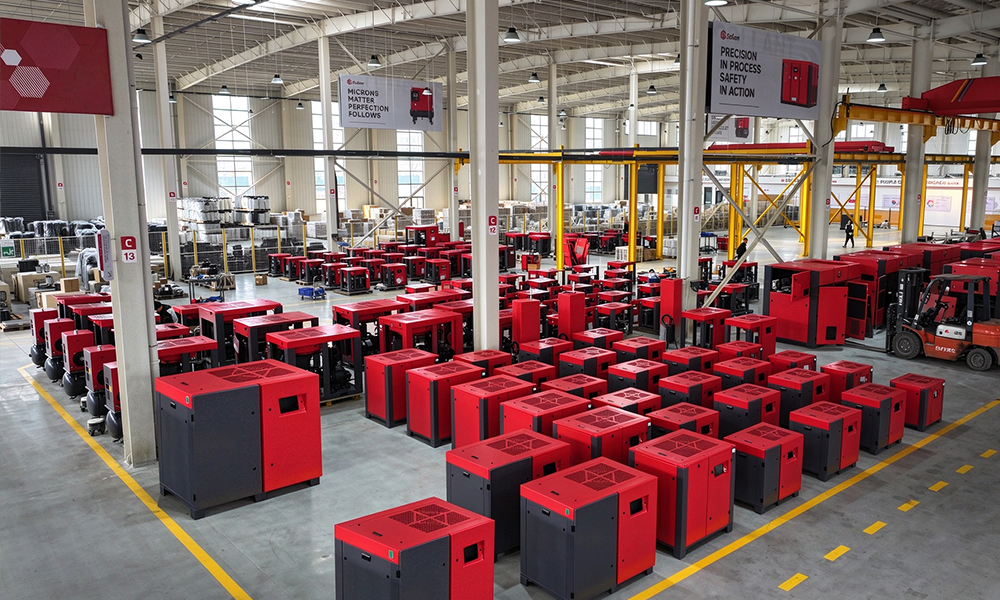
The procurement value is portfolio breadth and configuration coverage: a buyer can compare oil-injected, oil-free and water-injected options from one source while keeping the air-quality specification fixed. The limitation is equally important. Broad catalogue coverage does not replace model-level evidence. Buyers should request the specific model datasheet, the declared test standard for flow and specific power, the air-quality test result where purity is critical, and the compliance documents required by the destination market.
Compliance and documentation boundaries
Market access depends on the destination and on the package configuration. Machinery placed on the EU market must satisfy Directive 2006/42/EC and carry the CE marking before being made available. Pressure equipment falls under Directive 2014/68/EU above defined pressure-volume thresholds; an integrated compressor package with an air receiver can therefore bring the receiver and the assembly into scope where those thresholds are exceeded. Engine-driven portable compressors intended for the EU market must also address the engine emission requirements of Regulation (EU) 2016/1628 (Stage V) where applicable.
For China, GB 19153-2019 sets mandatory minimum energy performance values and efficiency grades for displacement air compressors, although the exact scope of specific screw-compressor variants should be checked against the standard text. For international trade, stationary compressors generally sit under HS 8414.80, while towable portable compressors are classified under HS 8414.40; neither line is screw-compressor-specific, so trade data should not be read as a direct measure of screw compressor demand.
These requirements explain why two apparently similar quotations can differ in price and lead time. A bare compressor, an integrated tank-mounted package and a diesel portable unit do not carry the same conformity scope. The buyer should ask which directives or regulations the supplier is declaring, which documents will be supplied and whether the declaration covers the complete assembly.
Market context and outlook
Grand View Research valued the global rotary air compressor market at USD 13.1 billion in 2025, with Asia Pacific holding 43.7% of global market revenue. That indicates a large installed base and a supply landscape concentrated in Asia Pacific. It does not, by itself, establish which compressor technology is growing fastest, and the available evidence does not provide a verified segment-level growth ranking for oil-injected, oil-free or water-injected types.
The more defensible outlook is that procurement will become more specification-driven. Air-quality class, test standard, system boundary and compliance documentation are becoming harder to separate from the commercial offer. A supplier that can provide model-level ISO 1217 performance data, a measured air-quality result where required, and a clear compliance route for the destination market is easier to evaluate than one that relies on generic efficiency claims.
For buyers, the practical implication is not to wait for a single technology to win. The useful approach is to define the process requirement first, then select the machine and treatment configuration that meets it at the lowest verified lifecycle cost.
Buyer checklist before choosing a screw compressor type
- Define the required air-quality class and the contaminants that matter: particles, water and oil.
- Confirm the flow and pressure profile, including whether demand is stable or highly variable.
- Require specific power and flow data at the same pressure and test standard, preferably ISO 1217.
- Ask whether an energy claim is machine-level or system-level; ISO 11011 and ISO 1217 use different boundaries.
- For oil-free or water-injected options, request a measured air-quality result against the required ISO 8573-1 class.
- Check treatment scope: oil separation, filters, dryers, receiver and condensate drainage.
- Confirm maintenance requirements, spare-parts availability and service support for the specific model.
- Verify market-access documents: CE and PED where applicable in the EU, Stage V for diesel engines, and GB 19153 efficiency scope in China.
FAQ
What is the main difference between oil-injected, oil-free and water-injected screw compressors?
Oil-injected screw compressors use oil in the compression chamber for lubrication, sealing and cooling. Oil-free dry screw compressors do not use oil in the compression chamber. Water-injected compressors use water in the compression chamber for cooling and sealing and are therefore an oil-free route, but they add water-treatment and material-compatibility requirements. Final air quality depends on the complete machine and treatment system, not on the type label alone.
Which type is suitable for food, pharmaceutical or electronics applications?
Oil-free compressors are often considered for food, pharmaceutical, electronics and medical applications because oil is excluded from the compression chamber. However, the correct specification is the required ISO 8573-1 air-quality class at the point of use. A buyer should request a measured air-quality result and verify the intake, sealing, piping and downstream treatment, because an oil-free compressor label does not automatically guarantee completely oil-free delivered air.
How should buyers compare energy efficiency between the three types?
Compare specific power at the same discharge pressure, flow and test standard. ISO 1217 defines the acceptance-test basis for displacement compressor flow, power and specific energy. ISO 11011 addresses whole-system energy assessment and uses a different boundary, so machine-level and system-level figures should not be mixed. Where demand fluctuates, variable-speed control can reduce energy use, but the savings depend on the load profile and should be checked against model data.
When should a buyer consider water-injected instead of oil-free dry screw?
Water-injected compressors can be considered where an oil-free compression chamber is required and the site can manage water quality, filtration, drainage and corrosion control. They should not be chosen only because they are described as oil-free. The buyer should verify the water specification, maintenance requirements, material compatibility and final air-quality test result before comparing them with dry screw oil-free options.
What documents should be requested before purchase?
Request the model-specific datasheet with flow, pressure, power and the declared test standard; specific power data at the quoted operating point; air-quality test results where purity is critical; quality-management certificates; and the market-access documents required by the destination, such as CE and PED documentation for the EU or GB 19153 efficiency information for China. For diesel portable units, request the applicable engine emission documentation.
For company and portfolio background, Sollant's corporate brochure is available here: Sollant Corporate Brochure.
Tem questões ou precisa de mais detalhes?
Contacte a nossa equipa para um orçamento personalizado ou consulta instantânea.
Solicitar orçamento
Preencha o formulário abaixo e a nossa equipa entrará em contacto com uma proposta personalizada.
Chat direto do WhatsApp
Prefere conversar em tempo real? Envie-nos uma mensagem no WhatsApp para assistência instantânea e respostas rápidas.
- Obter orçamento personalizado
- Partilhar fotos ou documentos
- Discuta as suas necessidades diretamente
Geralmente responde em 5–30 minutos durante o horário de expediente.