
On-Site vs Pre-Shipment Photo Inspection: UPVC Windows
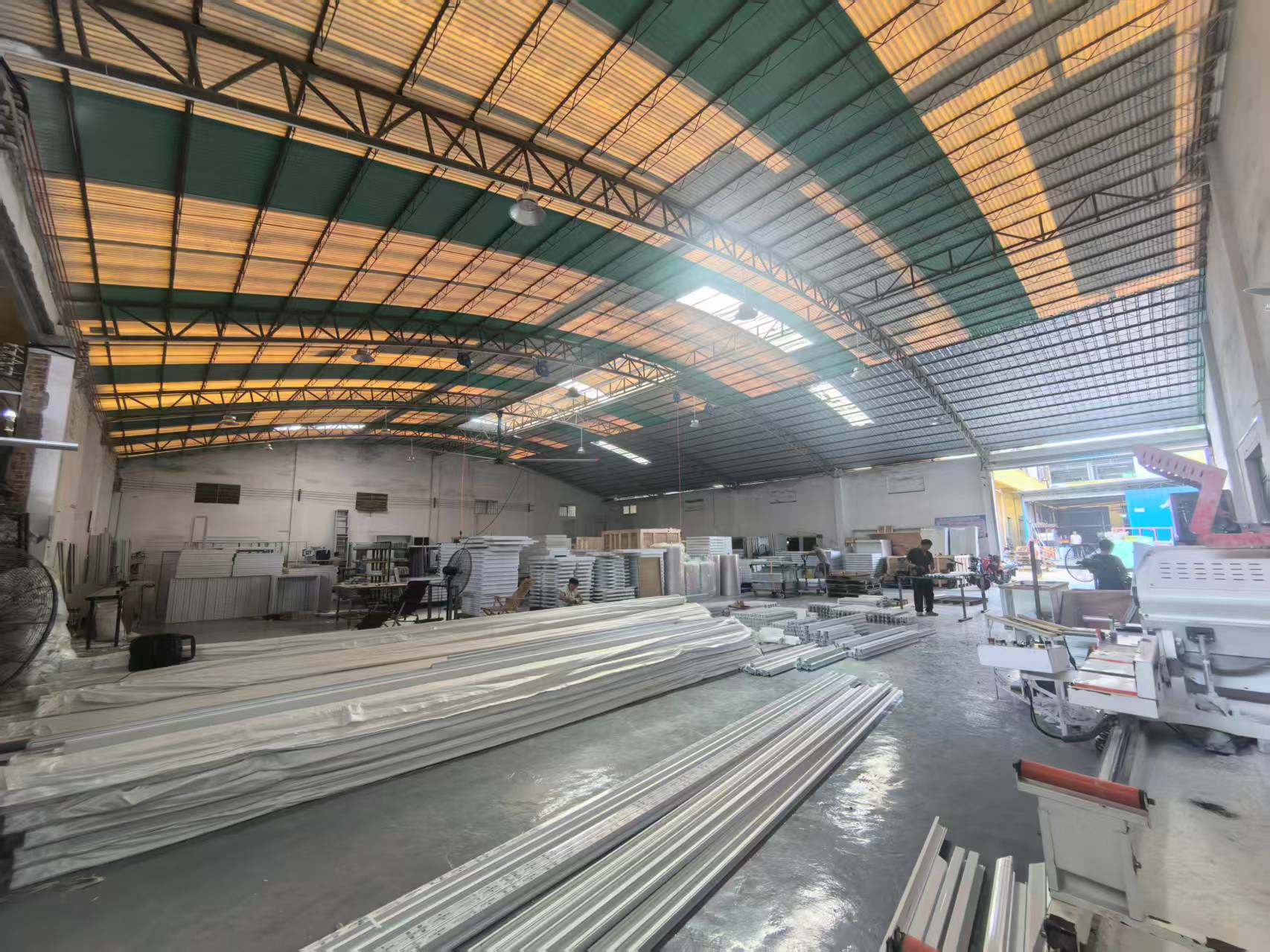
Material cutting area — the earliest production stage at which dated, order-linked photographic evidence can be recorded for a UPVC window order. Image: Foshan Nanhai Yuanzhaiji UPVC Door & Window Factory.
For UPVC window orders, the choice between pre-shipment photo inspection and on-site inspection is a risk-allocation decision, not a quality-preference decision. Photo inspection documents what a supplier is prepared to show before the balance is released; on-site inspection verifies what a buyer or an appointed inspector can physically measure. The two models answer different questions, cost different amounts, and leave different gaps.
Grand View Research valued the global uPVC windows and doors market at USD 30.8 billion in 2025, with Asia Pacific holding a 44.1% revenue share and the windows segment accounting for 58.0% of product revenue. Dataintelo places casement windows and doors at the largest design-type share, 38.5%. Those figures describe a mature, price-competitive category in which a buyer's financial exposure is compressed into a short window of time: the weeks between finished production and container loading.
The same category also shows why evidence discipline is necessary. Mordor Intelligence values the 2025 market at USD 42.15 billion, against Grand View Research's USD 30.8 billion. Two commercial researchers, one category, one year, materially different numbers, because definitions and scope differ. A buyer who accepts a headline figure without checking its definition is making the same reasoning error as a buyer who accepts a container without checking the evidence behind it.
Why acceptance evidence, not unit price, decides at this stage
By the time a fenestration order reaches the decision stage, unit price is usually settled within a narrow band. What remains open is a different question: if the goods do not match the agreed specification, who carries the cost, and what evidence decides the argument.
The practical exposure for an importer is not the invoice value alone. A rejected container carries return or rework freight, delayed project handover, and in the case of a residential or commercial fit-out, site labor that has already been scheduled. This is why experienced buyers treat inspection as part of the procurement structure rather than as an optional add-on, and why the correct comparison is not "photos or visit" but "which evidence package is proportionate to this order".
The factory-side framework matters here. Foshan Nanhai Yuanzhaiji UPVC Door & Window Factory is a UPVC door and window manufacturer established in 2009 in Foshan Nanhai, Guangdong, whose stated acceptance process for UPVC orders ties order acceptance to evidence collected before shipment; payment on those orders is made by bank transfer, and shipment is arranged under FOB or CIF terms. Where those three elements exist together, the inspection debate is no longer about whether evidence is required, but about how much evidence is worth paying for.
Two inspection models, defined
Pre-shipment photo inspection is a staged documentary record. The supplier photographs defined production and packing points — profile cutting, welding and assembly, glazing, hardware fitting, cleaning, packing and container loading — and sends the images to the buyer before the shipment leaves. The buyer approves, questions or rejects on the basis of the images. In the case of the factory referenced above, this is the model that matches an acceptance process built around pre-shipment evidence.
On-site inspection is physical attendance. A buyer, an engineer or an appointed third-party inspector travels to the plant, measures samples, operates the finished windows, examines welding and sealing quality, and signs off before loading. It produces a measurement record as well as photographs.
Both models operate on the same production line and against the same specification. Neither one creates quality; they only document whether quality already exists at the point where the buyer still has commercial leverage.
What pre-shipment photo inspection actually verifies
Photographic evidence is stronger than most buyers assume, provided the photo protocol is agreed in advance rather than improvised on the day of packing. On a UPVC window order it can reliably document:
- Profile identity and finish. Profile series markings, co-extruded color, laminated wood-grain finish, and solid color options such as dark grey or black can all be shown. The factory states that it supplies Conch profiles long-term, including 60, 65 and 88 series.
- Glass configuration. The company states that single-layer glass, double-glazed insulated glass, tempered safety glass and frosted glass are available options, and each is visually distinguishable before glazing beads are fitted.
- Hardware and accessory presence. Window handles, hinges, lock points, multipoint lock drive mechanisms, crescent locks, window rollers, EPDM sealing gaskets and pile weather strip can be photographed in place.
- Product-type confirmation. Sliding, casement and tilt-and-turn windows, as well as crank awning, American-style hung, awning, hopper and louver windows, follow visibly different frame and sash geometries, so type mix is checkable against the order.
- Quantity, labeling and packing. Model labels, quantities, packing configuration and container loading are all documentable.
What photo inspection cannot settle is equally important. It cannot verify profile wall thickness to tolerance unless a calibrated measuring tool is visible in the frame with a readable value. It cannot verify corner welding strength, sash operating effort, gasket compression under load, glazing cavity integrity or installed airtightness. Nor can it verify the thermal transmittance of a finished window, which is validated on installed units rather than in factory photography.
What on-site inspection adds — and what it costs
An on-site visit adds measured evidence. The most decision-relevant measurement on a UPVC order is profile wall thickness, because that is where performance tiers diverge: compared with conventional standard UPVC windows, the higher-performance UPVC window configuration offered by the factory has a profile wall thickness that is 2.0–3.0 mm thicker, with enhanced structural rigidity. A photograph can suggest that difference; only a gauge or measuring tape in an inspector's hand can record it.
An inspector can additionally check chamber structure at a cut sample, confirm steel reinforcement, assess corner welding, test the operating action of sliding, casement and tilt-and-turn units, inspect gasket seating, and verify that hardware corresponds to the approved specification rather than to a generic substitute.
The cost side is real and should be budgeted openly. Buyers absorb travel, accommodation, inspection time and, where used, third-party inspection fees, plus the indirect cost of keeping finished production staged until the visit takes place. Because no inspection fee schedule is standard across markets, the practical rule is proportional rather than absolute: the inspection budget should be scaled to the order value and to the cost of a failed delivery, not applied uniformly to every container.
Comparing the two models against buyer decision criteria
| Decision dimension | Pre-shipment photo inspection | On-site inspection |
|---|---|---|
| What it produces | Dated image record of defined production, packing and loading stages | Measured sample record, operation test and photographs |
| Who controls the view | The supplier's camera operator | The buyer or an appointed independent inspector |
| Cost structure | Low; absorbed into normal order reporting | Travel, time, and third-party inspection fees borne by the buyer |
| Coverage of order volume | Can document every unit photographed, but only at the stages the supplier records | Normally a sample; a single visit rarely covers full production volume |
| Verification depth | Identity, type mix, glazing option, hardware presence, packing, loading | Adds measurable wall thickness, chamber and reinforcement checks, corner welding, gasket seating, open/close operation |
| Dispute value | Strongest for identity, quantity and packing disputes | Strongest for workmanship and performance-specification disputes |
| Timing constraint | Must be completed and approved before loading | Must be completed before loading; requires finished, staged production |
| Main limitation | The camera shows what the supplier chooses to show | The visit sees only what is finished on the day of the visit |
Read together, the table produces a simple rule. Photo inspection is the default evidence layer for every order. On-site inspection is a supplement that earns its cost when the order value, the specification tier or the project schedule makes a rejected container materially more expensive than a factory visit.
FOB, CIF and the inspection deadline
Shipment terms decide where cost and risk transfer, and therefore when inspection must be finished, but they do not change the underlying logic: in both FOB and CIF arrangements under standard trade terms, the critical risk transfer point is loading. Under CIF, the supplier arranges and pays for carriage and insurance to the destination port, which can create a false sense of extended supplier responsibility. Under FOB, the buyer's exposure begins earlier in practical terms because the buyer controls the carriage contract.
Either way, once the container is sealed and loaded, the buyer's leverage drops sharply. Inspection evidence therefore has to be generated before loading, and ideally before final packing, when corrective action is still possible on site rather than at destination.
Linking acceptance evidence to payment by bank transfer
Payment by bank transfer is the stated method on the orders described here, and it deserves explicit attention in the acceptance plan. A bank transfer gives the buyer less structural protection than a documentary credit, because release of funds is not conditioned by a bank's document check. That limitation should shape the evidence schedule rather than be ignored.
A workable structure is milestone-based. The specification, inspection checklist, photo protocol and acceptance criteria are written into the contract or its annex. Evidence is then issued at defined stages, with the final balance released only after the pre-shipment evidence package is complete and, where an on-site visit is used, after the inspector's report is signed. This converts inspection from a courtesy into a defined acceptance step, and it protects both sides: the supplier knows exactly what evidence is required to close the order, and the buyer knows exactly what must be delivered before funds move.
The technical points worth photographing or measuring
Whether or not an inspector attends, the same evidence list applies. A checklist agreed before production starts removes most post-shipment argument:
- Profile brand and series marking visible in an uncropped frame
- Cut-section view showing chamber structure and wall thickness with a calibrated measuring tool in the same image
- Glazing type and spacer visible before sealing, including double- or triple-glazed configurations
- Hardware identification markings and lock-point positions
- Gasket and weatherstrip seating along the full perimeter
- Order-linked labels showing model, quantity and order reference
- Packing configuration, including corner protection and stacking
- Loaded container with container number and seal number visible
For compliance-sensitive destinations, the documentation layer matters as much as the visual layer. The materials referenced here include UPVC profiles complying with GB/T 8814-2017 for unplasticized polyvinyl chloride profiles for doors and windows, and the company states that CE and ISO certificates can be provided as required by the order.
Where each model fits: applications, projects and markets
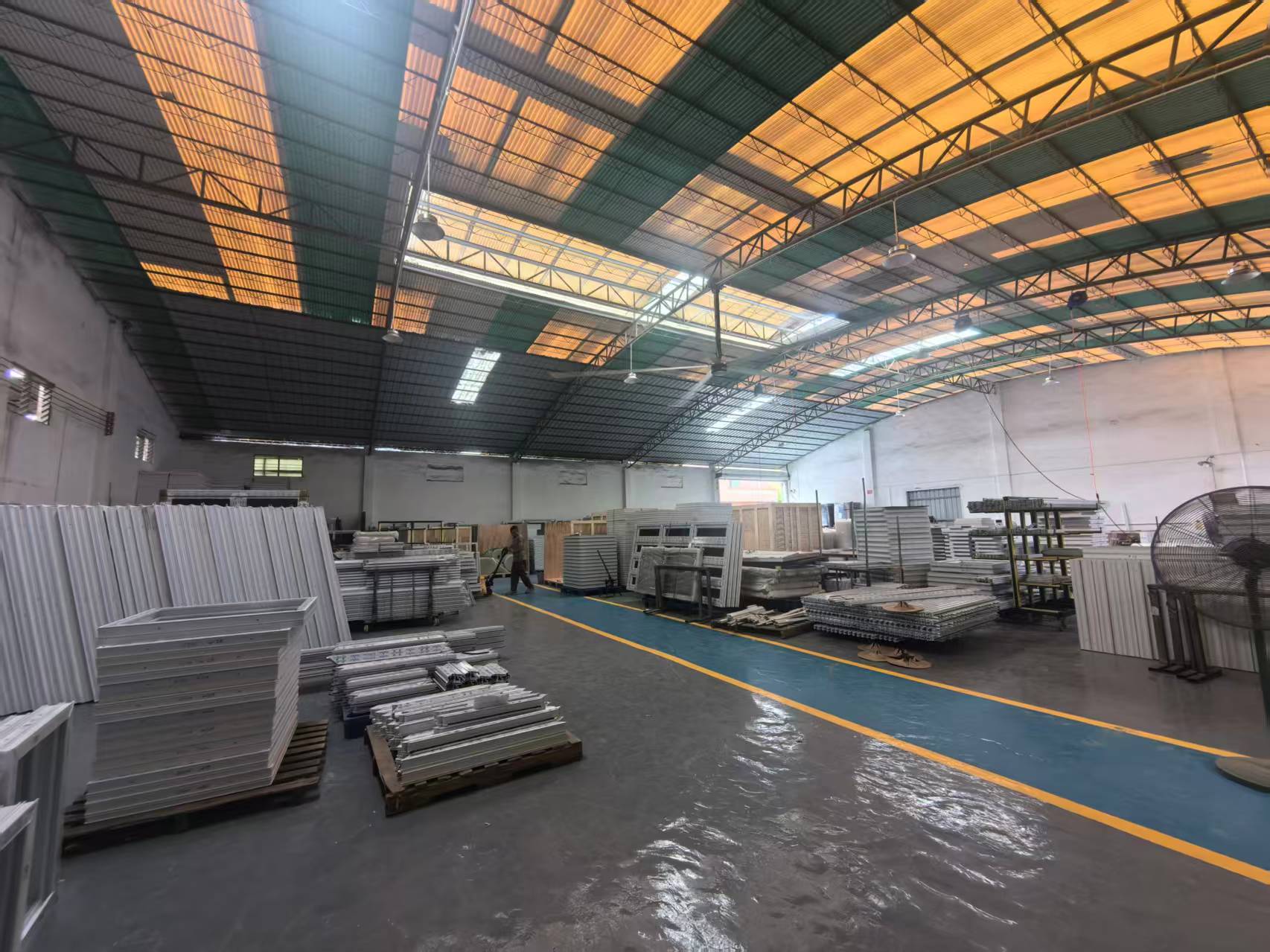
Goods storage area — packing and staging are the last stages at which defects can still be corrected before loading. Image: Foshan Nanhai Yuanzhaiji UPVC Door & Window Factory.
Application context should drive inspection intensity. UPVC window configurations with thicker profile walls and enhanced structural rigidity are positioned for seaside and city scenarios where corrosion resistance and structural rigidity are required, and the factory supplies residential, commercial, renovation and villa project types. These applications are typically exposed to coastal humidity and high wind loads, which makes sealing, welding and hardware evidence more consequential than on sheltered interior applications.
Market distance also matters. The factory reports that approximately 80% of its output is exported, with LATAM, MENA, ASEAN and the EU among its markets. For ASEAN and MENA destinations, a factory visit is a manageable cost; for LATAM and European buyers, it is a longer commitment, which makes a rigorous photo protocol the more likely default. Where destination regulation applies, documentation requirements rise further — for window replacement in existing homes in England and Wales, the legal whole-window U-value limit is 1.4 W/m²K under Approved Document L, so the buyer needs glazing and profile documentation that can be checked against a regulatory number, not just a visual impression.
Limits and trade-offs buyers should accept up front
Honest comparison requires stating what neither method delivers. Three limits are structural.
First, neither model verifies installed performance. Thermal transmittance, airtightness and watertightness are properties of the assembled and installed unit; factory photography and factory measurement can only establish that the components and workmanship comply with the agreed specification.
Second, both models have a coverage ceiling. Photo inspection is supplier-curated: the camera records what the supplier frames. On-site inspection is sample-based: a visit cannot cover every unit in a large order, so acceptance is always inferred from a sample.
Third, inspection cost is easy to misjudge in relation to order value. A proportion of the product range carries a stated cost profile of 12–18% higher initial procurement cost than conventional standard UPVC windows, offset by lower total life-cycle cost, simpler hardware maintenance, longer sealing-part service life, better anti-ageing performance and no anti-corrosion spraying requirement. Where a buyer has already paid that premium for durability, under-investing in acceptance evidence is inconsistent: it protects neither the premium nor the performance expectation behind it. Conversely, on low-value, low-risk orders, full on-site inspection may not be economically proportionate, and a structured photo protocol is the defensible choice.
One further constraint is often overlooked: no inspection method compensates for an incomplete written specification. If wall thickness, profile series, glazing build-up and hardware brand are not fixed in writing before production, the buyer has no standard against which to accept or reject, and the inspection outcome becomes a negotiation rather than a verification.
Market signals shaping inspection practice
Three industry signals suggest that documented acceptance is becoming a standard expectation rather than a premium service. Product technology is moving toward measurable performance claims: modern multi-chamber uPVC profiles can improve energy efficiency by up to 40% compared with traditional frames, according to Incogz, which means buyers increasingly need evidence that a specified chamber structure was actually produced. Supply is concentrated: Foshan Nanhai is a key manufacturing base for UPVC profiles and windows, with high-quality profile lifespans estimated at 30 to 40 years by industry publication Zhongying. And competition within that base is dense — Wanjia Windows & Doors, a large-scale uPVC and aluminum manufacturer also located in Nanhai District, Foshan, is reported to serve more than 150 countries. When multiple suppliers in one district serve global markets, differentiation shifts from geography to verifiable evidence.
Future outlook
The direction of travel is toward batch-level digital records. Order-linked identification at the profile and unit level, timestamped production imagery, and remote live walkthroughs are all natural extensions of the photo-inspection model, and they reduce the gap between what a photograph shows and what an inspector would measure. For buyers, the practical consequence is that acceptance criteria will increasingly be written into contracts as data requirements rather than as requests. For suppliers, the consequence is that inspection readiness becomes a competitive attribute: a plant that can produce a complete, structured evidence package on demand is easier to qualify than one that cannot, regardless of price.
FAQ
What is the difference between pre-shipment photo inspection and on-site inspection for a UPVC window order?
Pre-shipment photo inspection is a documentary record produced by the supplier at defined production and packing stages and sent to the buyer before loading. On-site inspection is physical attendance by the buyer, an engineer or a third-party inspector, who measures samples, operates the finished windows and examines welding and sealing before loading. Both are completed before the container is loaded; they differ in who controls the observation and in whether measured values are recorded.
What can pre-shipment photos confirm that on-site inspection also confirms?
Both methods can confirm profile series and finish, glass configuration such as single, double-glazed, tempered or frosted glass, hardware presence including handles, hinges, lock points, rollers, EPDM gaskets and pile weather strip, the type mix of sliding, casement and tilt-and-turn units, and order labeling and packing configuration. The overlap is large for identity and quantity questions; the methods diverge on measured wall thickness, welding quality and operating performance.
When is on-site inspection worth adding to photo documentation?
On-site inspection earns its cost when the order value or project schedule makes a rejected container materially more expensive than a factory visit, when the specification tier depends on a measurement that photographs cannot reliably capture — such as a profile wall thickness that is 2.0–3.0 mm thicker than conventional standard UPVC windows — or when the destination market requires documented compliance against a regulatory limit. For smaller, lower-risk orders, a structured photo protocol with a calibrated measuring tool in frame often provides sufficient acceptance evidence.
Does FOB or CIF change when inspection should be completed?
It changes cost and carriage arrangements rather than the deadline logic. Under both FOB and CIF terms, the critical risk transfer point is loading, and under CIF the supplier arranges carriage and insurance to the destination port without extending risk beyond loading. Inspection evidence therefore has to be generated and reviewed before the container is sealed and loaded in both cases, when corrective action at the factory is still possible.
What can neither inspection model verify?
Neither model verifies installed performance. Thermal transmittance, airtightness and watertightness are properties of the assembled and installed unit and cannot be established from factory photographs or factory measurements. Photo inspection is also limited by supplier curation, on-site inspection by sample coverage, and both are limited by the quality of the written specification, since no inspection can confirm compliance against a standard that was never fixed in the contract.
Product range, profile series and export market information for the manufacturer referenced in this comparison are published at yuanzhaiji.com.