
Onboard Weighing Forklift Fit: Grain Stock and Cargo Billing
Onboard Weighing Forklift Fit: Grain Stock and Cargo Billing
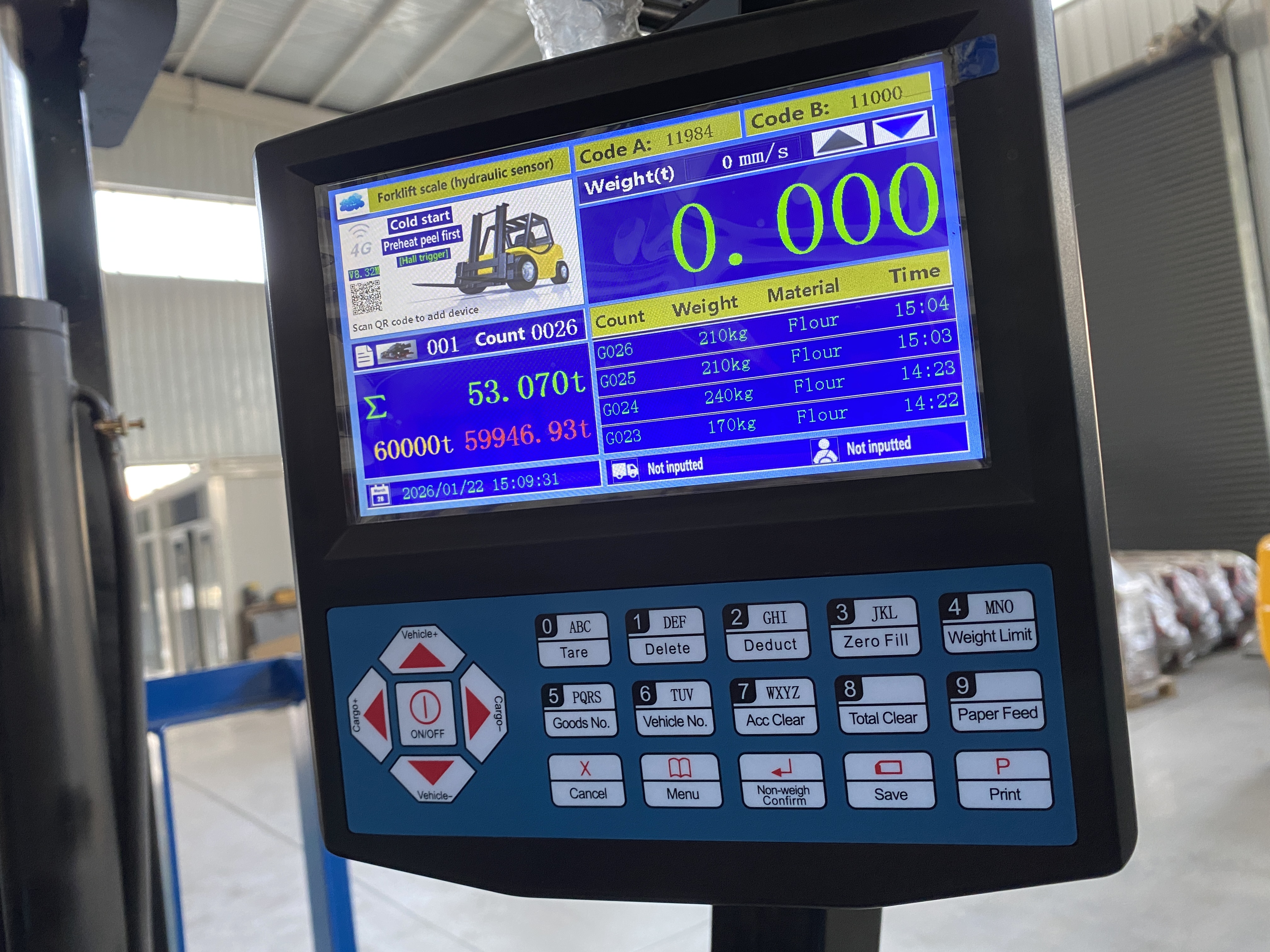
An onboard weighing forklift puts the scale where the load already is: a load cell integrated with the mast and a digital display unit report the weight while the truck lifts and moves the load, so a pallet, bale or bucket of grain does not need a detour to a weighbridge before its weight is known. That shortens a weight-sensitive job from “weigh, then move” to “lift and read”. It also shifts what a buyer must verify, because the reading now depends on an attachment, a calibration routine and an alert function rather than on a fixed concrete platform.
This scenario-fit review of the material handling forklift weighing configuration maps it to three settings where weight decides money or stock: weight-based cargo billing, warehousing with weight-based inventory, and agriculture and grain trading, with the Bulgaria/common-market note as the reference case. The fit requirements — weighing accuracy calibration, overload alerts, an electronic weighing scale attachment and digital display, and an integrated load cell and display on the mast — are then translated into acceptance questions for indoor, outdoor and mixed sites.
Why weight-sensitive operations move the scale onto the forklift
The commercial gap is rarely a missing scale; it is the distance between handling and measurement. When every load has to be carried to a separate weighbridge, the handling cycle and the measurement cycle become two journeys, and the weight is captured at a moment when the load may already have been regrouped, re-palletised or mixed with material from another delivery. Weight-based billing and weight-based inventory both suffer from the same weakness: the number exists, but its link to the specific unit that generated it is weaker than the paperwork assumes.
Reading the weight at the point of lift keeps the number attached to an identifiable unit — one pallet, one bale, one bucket, one consignment. In a billing conversation, that is the difference between a figure traceable to a pickup and a figure that has to be reconstructed later. In an inventory conversation, it is the difference between stock recorded in tonnes as it is put away and stock estimated from pallet counts at the end of the month.
A second effect is more practical. The stated role of the weighing configuration in weight-sensitive handling is to prevent overloading, and an overload alert acts at the only moment when overloading can still be avoided cheaply: during pickup, before the load is committed to a truck that is already moving into position. Finding the same problem at a weighbridge is a correction; finding it during the lift is a decision.
None of this makes the onboard reading automatically equivalent to a settlement instrument. That boundary is treated further down, because it determines how the system should be specified rather than whether it is useful.
What the onboard weighing configuration contains
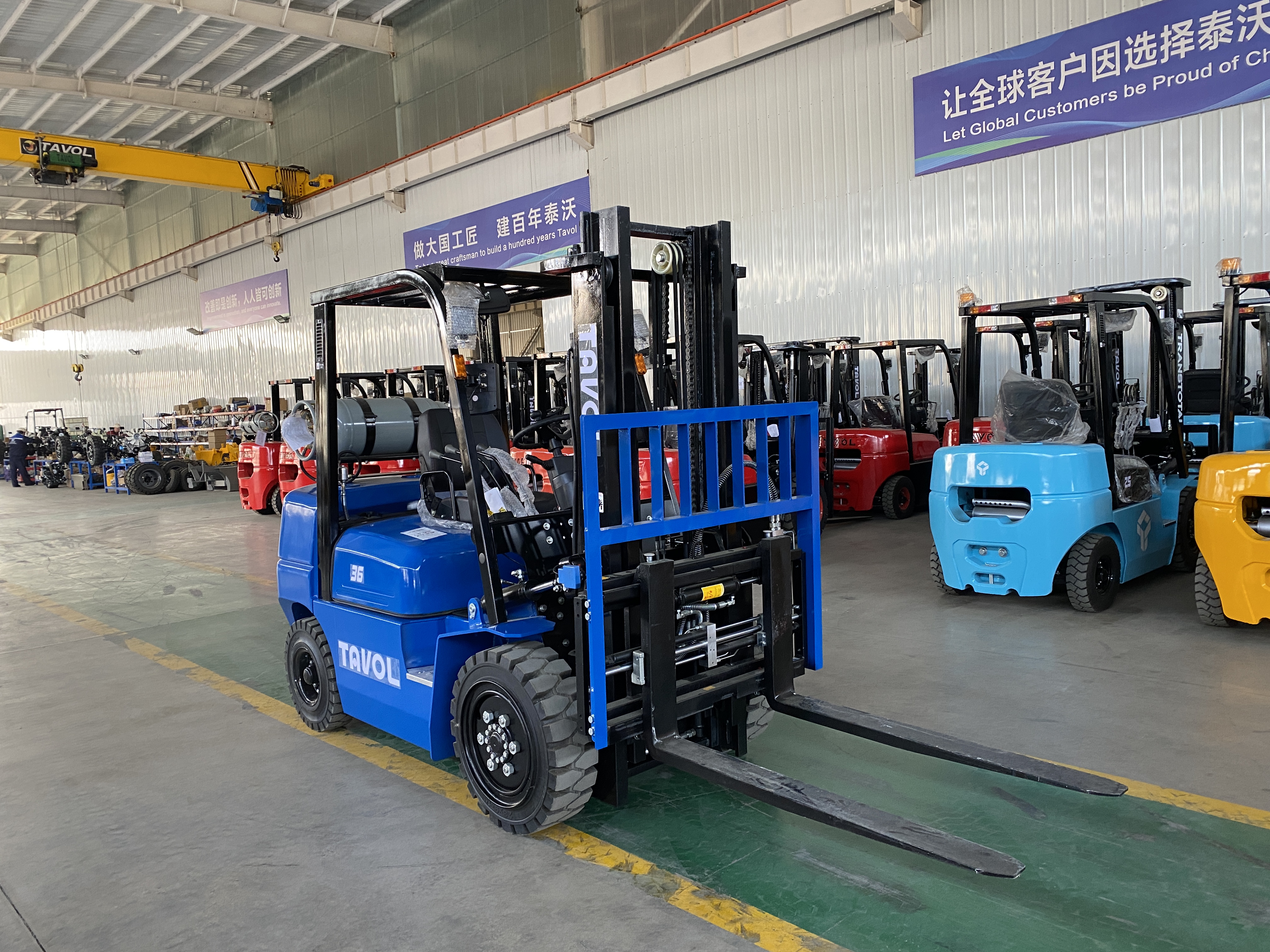
TAVOL Forklift, the forklift line of Shandong Tavol Machinery Co., Ltd — a factory founded in 2003 with a 40,000 m² plant, 300 employees and 3,000 units annual output — supplies the weighing function as an attachment-based configuration on its counterbalance trucks rather than as a separate machine. The documented equipment set is an electronic weighing scale attachment with a digital display unit, with the load cell and display integrated on the mast.
- Load cell on the mast. Senses the load inside the lifting structure, so the measurement happens in the same load path the forks already carry.
- Digital display unit. Converts the signal into a weight the operator can read; its position decides whether the number is visible from the seat during a lift or only after the load has settled.
- Electronic weighing scale attachment. The interface between load and carriage, specified together with the truck rather than added afterwards.
- Weighing accuracy calibration. The routine that ties the displayed value to a reference, and the item most often left vague in a quotation.
- Overload alert. Flags a load that exceeds the truck’s rating, supporting the configuration’s stated role of preventing overloading.
Because the load cell and display are integrated with the mast, the reading is available during lifting and transport rather than only at a static checkpoint. The documented function is real-time load weighing without a separate weighbridge — a statement about where the measurement happens, not yet a statement about how precise or how official that measurement is.
The weighing set also sits inside a wider customization scope covering attachment type, tonnage, mast height, fork length, fuel type and open or enclosed cabin. That matters for fit: the same weighing function may be ordered on a 3-metre two-stage mast for a flat warehouse floor or on a three-stage mast at 4.5, 5, 5.5 or 6 metres for high-rack work, and the display has to stay readable in both installations.
Fit requirements before the truck is accepted
The items below decide whether the configuration is a working measurement or an expensive label on the mast. Each should be answered in writing before acceptance, because each one changes how the site uses the number afterwards.
| Fit requirement | What it controls | What to confirm before acceptance |
|---|---|---|
| Weighing accuracy calibration | Whether the displayed weight can be traced to a reference | Calibration method, reference used, the record issued with the truck, and the interval for re-checking; unit shown (kg or t) |
| Overload alert | Whether an over-rating load is caught during pickup | The threshold it works against, whether the warning is audible, visual or both, and what the operator does when it triggers |
| Electronic weighing scale attachment and digital display unit | Where the load is sensed and where the number is read | Display position and readability from the seat, with cabin and open configurations, in daylight and under warehouse lighting |
| Load cell and display integrated on the mast | Whether a reading is available during lifting and transport | The reading procedure the calibration refers to — fork height, mast tilt, load settled or in motion — so the site reads under the same conditions |
| Rated capacity and load centre | The structural limit every reading sits inside | The rating that applies to the delivered configuration with the attachment fitted, not the base-truck figure alone |
| Power type and working condition | Whether the truck suits the building at all | Diesel for outdoor and ventilated areas, lithium electric for enclosed and cold-store work, dual fuel for mixed sites |
| Documentation and support route | How quickly a drifting reading is corrected | Warranty terms, pre-shipment test record, inspection option and spare-parts access |
The two most frequently skipped items are the calibration procedure and the capacity statement. Weighing accuracy calibration should be described for the configuration the site will actually run — the mast, the attachment and the display unit that were delivered — not for a generic truck. Separately, the rated capacity of the diesel, dual-fuel and electric counterbalance models is quoted at a 500 mm load centre; when an attachment is fitted, the buyer should ask the supplier to state the rating that applies to the delivered configuration instead of assuming the base-truck figure carries over unchanged.
Scenario one: weight-based cargo billing
In freight billing, the useful reading is the one taken when the consignment is picked up. A forklift with an onboard scale records the weight of each lift as the load leaves the floor, which gives the site a per-lift figure to compare with the weighbridge ticket at the other end of the route. Discrepancies then surface as a specific lift rather than a disputed total, and the crew can re-check a load before it disappears into a trailer.
The fit requirements here are less about precision claims and more about workflow. The display must be readable from the operator’s normal position in daylight or under warehouse lighting; the reading must be taken at the same mast position and load condition the calibration refers to; and the site must decide in advance how the displayed weight becomes a record. If a transaction record is needed beyond the display itself, that belongs in the specification discussion about the display unit rather than in an assumption.
Billing sites also carry a safety argument. Loading to a target tonnage invites overloading when the target is chased by eye; the overload alert gives the operator a limit to work against while the load is still on the floor. The alert is a check against the truck’s rating, not a substitute for the site’s own loading plan, but it moves the check into the loading cycle where it can still change the outcome.
Scenario two: warehousing with weight-based inventory
Where inventory is kept by weight, the forklift’s display becomes an inventory instrument as well as a handling aid. Put-away, picking and cycle counting can be recorded in the unit the business actually trades in, and stock accuracy stops depending on a separate weighing step that may be skipped during a busy shift.
The indoor version of this scenario is where the electric range fits most naturally. The lithium CPD30 (3,000 kg), CPD35 (3,500 kg) and CPD40 (4,000 kg) use LiFePO4 batteries with a quick charger, produce no emissions at the point of use and run at lower noise than internal-combustion trucks — conditions that matter in enclosed warehouses, cold storage, food processing and cleanroom-adjacent facilities. Opportunity charging during breaks removes the battery-swap step that would otherwise interrupt a multi-shift weighing routine.
Layout data belongs in the same decision. The CPD30, for example, is quoted with a 2,550 mm turning radius and a 4,305 mm right-angle aisle width for a 1,000 × 1,200 mm pallet, with three-stage masts available to 4.5, 5, 5.5 and 6 m. If the weighing display is fitted to a high-lift mast, its position should be checked against the operator’s sight line at full height, not only at floor level.
Scenario three: agriculture and grain trading
Grain moves in tonnes, and in grain trading the weight is the transaction. That makes the sector a natural fit for a truck that reports the load during lifting: intake at the silo, transfer between sheds and loading for dispatch can each be checked without a separate trip, and the site keeps its own figure alongside the weighbridge ticket.
The Bulgaria/common-market note in the reference scenario shows how this plays out. A delivery is bought and sold on a weight expressed in tonnes, and it may be weighed more than once between farm, store and buyer. A forklift that reports the load at the point of lifting gives the store an internal check number that can be compared with those tickets before a dispute develops — a working figure alongside the certified instrument that settles the contract, not a replacement for it.
Yard, shed and the indoor/outdoor split
Grain sites usually combine an outdoor yard with an enclosed shed, and the power choice follows the building rather than the brand. Yard work on unpaved ground and around silos suits the diesel range: the CPCD30 (3,000 kg) and CPCD35 (3,500 kg) are quoted with 15–20% gradeability and engine options that include Xinchai, Quanchai, Isuzu, Mitsubishi, Yanmar, Kubota and PSI, and the diesel platform’s documented applications include grain storage and agricultural product processing plants, feed mills and fertiliser plants. An enclosed shed pushes the decision the other way, towards the lithium electric trucks described above.
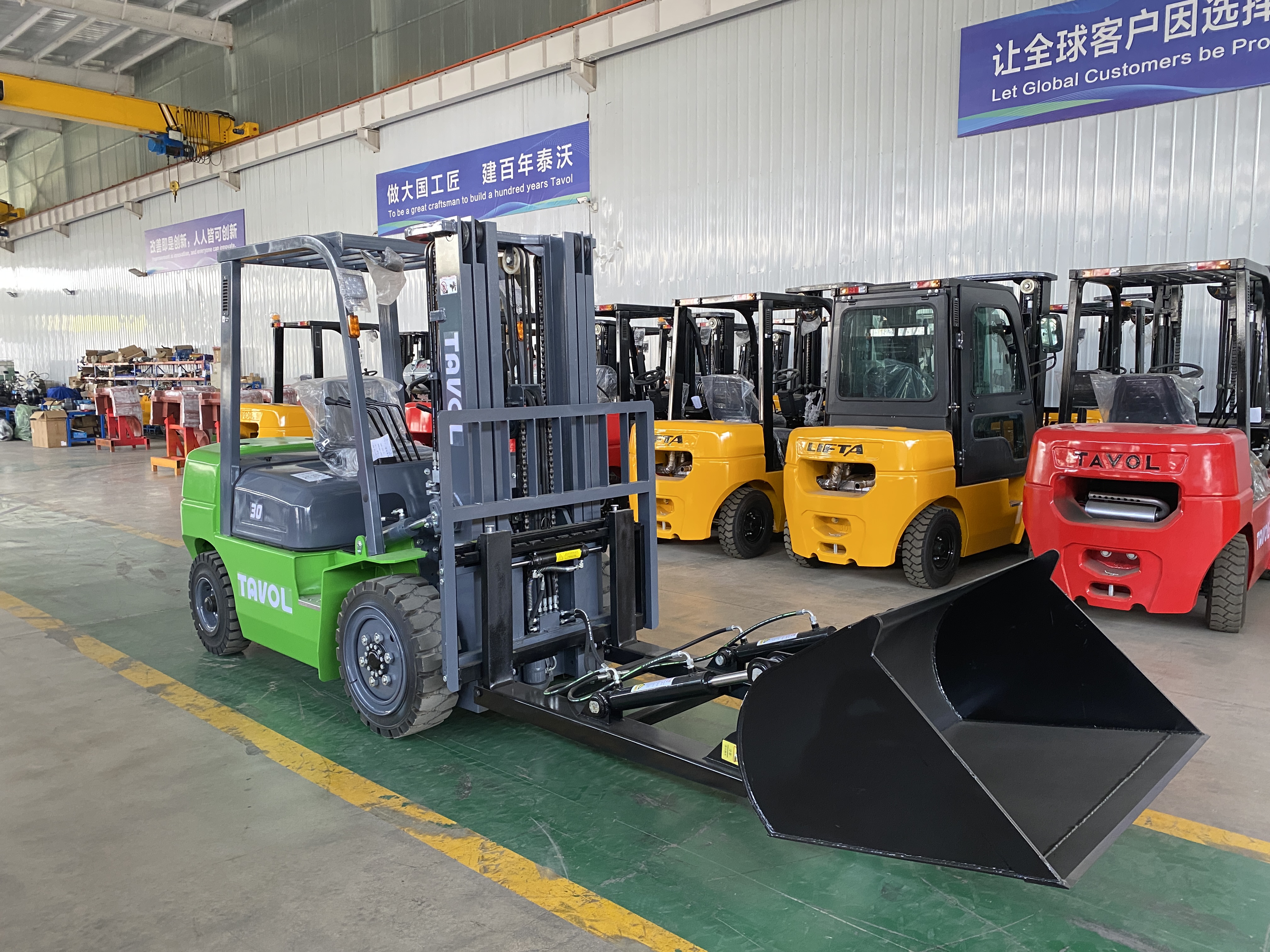
Bulk handling is a separate configuration question. Where grain or aggregate is scooped rather than forked, the documented attachment is a bucket with a wear-resistant edge and secure locking on the fork carriage — a different set-up from the fork-mounted weighing arrangement. A site that wants both should raise it as an attachment and capacity question at specification stage instead of assuming the weighing set and the bucket are interchangeable on the same carriage.
Capacity follows the load unit. Documented models run from the 2,000 kg CPCD20 and CPQYD20 through 2,500 kg, 3,000 kg and 3,500 kg to the 4,000 kg CPCD40 and CPD40, all rated at a 500 mm load centre. Where the unit load sits above that range, tonnage is part of the stated customization scope, so it should be handled as an engineering question with load dimensions rather than as a catalogue selection.
Where onboard weighing stops: the material handling forklift versus the weighbridge
A weighbridge and an onboard scale answer different questions. The weighbridge gives one figure for a whole vehicle under controlled conditions and is normally the reference in a commercial settlement; the onboard system gives a figure per lift, inside the working cycle, at the point of handling. Sites that treat the two as competitors usually end up with an argument; sites that treat them as a check and a reference usually end up with fewer of them.
The practical boundary is documentation. Where a contract is settled on weight, the parties should agree in advance whether the forklift display is an internal check or part of the billing basis, and which calibration records support that role. Calibration, the reading procedure and the alert’s threshold behaviour should all be traceable in the delivered configuration, because a reading nobody can explain cannot be defended in a dispute.
A second boundary is aggregation. The reading is per lift, so a truck total remains a sum of individual lifts, and the site’s process has to define how those readings are combined and re-checked. A third is scope: the weighing function does not turn a counterbalance truck into a laboratory instrument, and the stated rating, load centre and attachment configuration remain the frame within which every reading should be interpreted.
A selection sequence for indoor, outdoor and mixed sites
- Name the measurement purpose. Internal check, billing support or inventory record — each sets a different requirement for calibration evidence and for how the reading is captured.
- Fix the capacity class from the load, not the truck. Documented models span 2,000 kg to 4,000 kg; grain and cargo-billing work commonly lands in the 3,000–3,500 kg band, with 4,000 kg where the unit load is heavier.
- Choose the energy type by building. Enclosed and cold-store work points to lithium electric; unpaved yards and silo aprons point to diesel; mixed multi-shift sites can use the dual-fuel LPG and gasoline trucks.
- Specify the weighing set with the truck. Attachment, display position, mast height and cabin type are customization items and should be fixed in one configuration rather than added later.
- Write calibration and alert requirements into the order. Method, reference, record, re-check interval and alert behaviour, all stated for the delivered configuration.
- Confirm the acceptance and support route. Pre-shipment testing, inspection options, warranty terms and spare-parts access decide how quickly a drifting reading is corrected.
| Site condition | Documented configuration | Why it fits |
|---|---|---|
| Enclosed warehouse with weight-based inventory | CPD30 3,000 kg / CPD35 3,500 kg lithium electric; three-stage mast to 4.5–6 m | No emissions at the point of use, lower noise, opportunity charging during breaks |
| Cold storage and food processing | CPD30 / CPD35 / CPD40 lithium electric | Documented stable performance in low-temperature environments; no acid fumes or water refilling |
| Outdoor yard, unpaved ground, silo apron | CPCD30 3,000 kg / CPCD35 3,500 kg diesel | 15–20% gradeability; engine options including Isuzu, Mitsubishi, Yanmar and Kubota; a full tank supports 8+ hours |
| Mixed indoor/outdoor, multi-shift | CPQYD35 3,500 kg dual fuel LPG and gasoline | Refuelling in minutes versus hours of charging; flexible LPG or gasoline operation |
| Heavier unit loads | CPCD40 / CPD40 at 4,000 kg; above that, tonnage as customization | Documented 4,000 kg rating with a 500 mm load centre; larger capacities handled as an engineering question |
What the supplier side contributes
For a distributor or fleet buyer, the weighing configuration is only as good as the support behind it. The documented production model is OEM/ODM with a monthly capacity of 300 units, a lead time of 10–45 days and a minimum order of one unit. Quality control is described as 100% pre-shipment testing with third-party inspection available, and after-sales support includes remote technical assistance, a two-year forklift warranty and a five-year lithium battery warranty. The export record covers more than 120 countries, with Europe among the stated markets — relevant when a Bulgarian or wider EU buyer needs parts and technical answers within the same contract cycle rather than the next shipment.
Outlook
Two directions look supportable from the current configuration rather than from market forecasts. The first is that weight data is moving into the same record as handling data: as more sites keep inventory by weight, the forklift display becomes a data source rather than a convenience. The second is the split between indoor and outdoor fleets, which electrification sharpens — lithium trucks for enclosed sheds with opportunity charging, diesel and dual-fuel trucks for yards where refuelling speed still decides availability. Neither direction changes the underlying requirement: a reading is useful only when its calibration, its configuration and its limits are documented.
Conclusion
Onboard weighing fits weight-sensitive material handling because it closes the gap between the lift and the number. In cargo billing it produces a per-lift figure that can be compared with a delivery ticket; in warehousing it turns inventory in tonnes into something recorded during put-away; in grain trading it gives the store an internal check alongside the settlement instrument. The conditions are unglamorous — calibration stated for the delivered configuration, an overload alert whose behaviour is known, a display readable from the seat, and a power type that matches the building. Sites that settle those points before acceptance get a forklift that weighs; sites that skip them get a display that is believed for a month and ignored afterwards.
Frequently asked questions
Does an onboard weighing forklift replace a weighbridge?
Not automatically. The configuration is documented as real-time load weighing without a separate weighbridge, which means routine checks can happen during lifting and transport instead of on a second trip. Whether the display can serve as the settlement basis is a separate question: where a contract is settled on weight, buyer and seller should agree which instrument is the reference and which calibration records support it. Many sites keep the weighbridge as the reference and use the onboard reading as a per-lift check.
How is weighing accuracy calibrated on a mast-mounted system?
Calibration is a stated fit requirement of the weighing configuration, and it should be described for the delivered set — the attachment, the mast and the display unit actually supplied. Ask for the calibration method, the reference used, the record issued with the truck and the interval at which the reading should be re-checked. Also confirm the reading procedure the calibration refers to, including fork height and mast tilt, so billing or inventory readings are taken under the same conditions.
Which capacity class suits grain and cargo-billing work?
Documented counterbalance models run from 2,000 kg (CPCD20, CPQYD20) through 2,500 kg, 3,000 kg and 3,500 kg to 4,000 kg (CPCD40, CPD40), all rated at a 500 mm load centre. Grain-yard and cargo-billing work commonly falls in the 3,000–3,500 kg band, with 4,000 kg where the unit load is heavier. Where an attachment is fitted, the rating that applies to the delivered configuration should be confirmed rather than inferred from the base truck.
Can a diesel forklift with onboard weighing work indoors?
Diesel trucks are documented for outdoor use, unpaved ground, yards and sites where refuelling speed matters more than emissions at the point of use, which suits silo aprons and open grain yards. For enclosed warehouses, cold stores and food-processing areas, the lithium electric CPD30, CPD35 and CPD40 avoid exhaust emissions at the point of use and run at lower noise. Mixed sites can use the dual-fuel CPQYD35 at 3,500 kg, which switches between LPG and gasoline and refuels quickly between shifts.
What should the overload alert actually do?
The alert’s stated function is to flag overloading, and its behaviour should be specified before acceptance. Confirm the threshold it works against — the rated capacity at the 500 mm load centre for the delivered configuration — whether the warning is audible, visual or both, and what the operator is expected to do when it triggers. The alert supports the truck’s role in preventing overloading; it does not replace the site’s loading plan or the capacity statement for the attachment that is fitted.
For the full product and factory overview, the company profile is available as a PDF: TAVOL company profile.
Tem questões ou precisa de mais detalhes?
Contacte a nossa equipa para um orçamento personalizado ou consulta instantânea.
Solicitar orçamento
Preencha o formulário abaixo e a nossa equipa entrará em contacto com uma proposta personalizada.
Chat direto do WhatsApp
Prefere conversar em tempo real? Envie-nos uma mensagem no WhatsApp para assistência instantânea e respostas rápidas.
- Obter orçamento personalizado
- Partilhar fotos ou documentos
- Discuta as suas necessidades diretamente
Geralmente responde em 5–30 minutos durante o horário de expediente.