
One Needle, Three Tasks: NanoKnife Ablation Procurement FAQ
One Needle, Three Tasks: NanoKnife Ablation Procurement FAQ
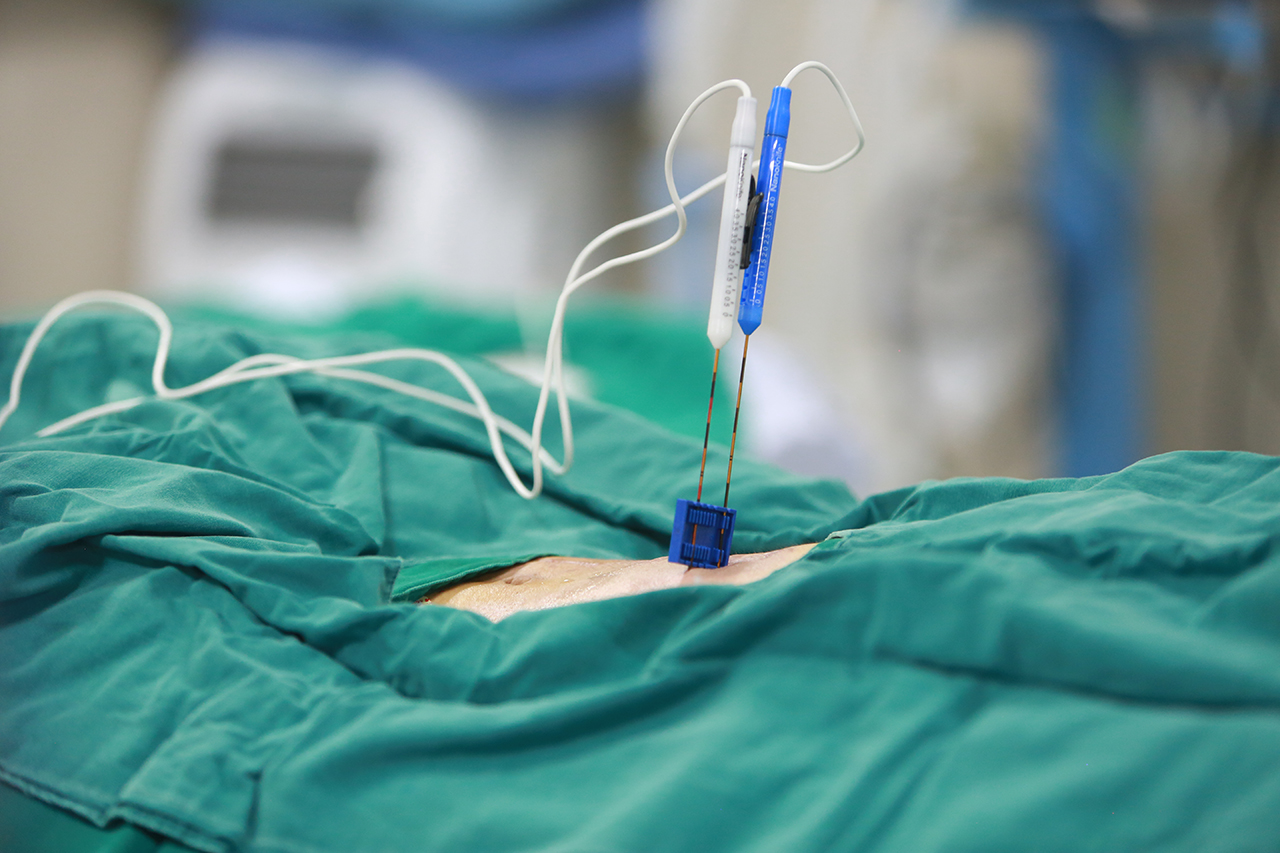
A single-needle bipolar NanoKnife session is a percutaneous irreversible electroporation (IRE) procedure in which one needle track is used for three jobs at once: delivering ablation energy to the tumour, obtaining tissue for pathology, and placing a celiac plexus block for pain control. In a documented case at Guangzhou Fuda Cancer Hospital, an 81-year-old patient from Hong Kong with recurrent pancreatic cancer was treated through this combined approach under local anaesthesia, with computed tomography (CT) and ultrasound guiding both the puncture and the energy delivery.
For a hospital buyer or a referring physician, the interest is not the procedure name. It is that three clinical objectives which are normally scheduled as separate events — ablation, biopsy, analgesia — collapse into a single puncture, a single anaesthesia decision and a single recovery episode. That shift changes scheduling, consent, bed utilisation and, most importantly, what evidence a procurement team can demand afterwards. This reference answers the questions that come up in that evaluation, and it stays within what the documented workflow and the hospital's published service and case records actually show.
Guangzhou Fuda Cancer Hospital is an oncology-specialized hospital in Guangzhou, Guangdong Province, China, established in 2003 and accredited by Joint Commission International (JCI). It operates the Tianhe and Haizhu campuses, with more than 30,000 m² of floor area, 400 open beds, 45 VIP rooms and approximately 500 staff, and treats approximately 3,000 cases a year.
Why a combined single-needle session became a procurement question
Pancreatic cancer that returns after earlier treatment is one of the harder scenarios a hospital is asked to plan for. Three constraints usually appear together, and each one pushes in a different direction.
The first is anaesthetic exposure. An elderly patient with recurrent disease may carry cardiovascular and respiratory risk that makes general anaesthesia a decision rather than a default. The second is tissue. At recurrence, the clinical team frequently needs a current pathology result — not the original diagnosis from months or years earlier — before committing to a local ablative strategy. The third is pain, particularly when the disease involves the region served by the celiac plexus, where a nerve block can be as consequential to the patient's quality of life as the tumour control itself.
Handled conventionally, those three needs generate three punctures, three preparation cycles and three recoveries. Handled in one session, they generate one. The procurement consequence is straightforward: a claim that a centre can do this in one pass is only credible if the documentation allows a buyer to reconstruct the session afterwards — planning images in, guidance images during, pathology report out, recovery record out, follow-up schedule out. That documentation set, not the marketing language, is what should be compared between centres.
What IRE and single-needle bipolar delivery actually are
Irreversible electroporation is a non-thermal ablation method. Short electrical pulses are applied across the target tissue and create permanent nanopores in cell membranes, which leads to cell death. Because the mechanism is generally described as non-thermal rather than heat- or cold-driven, IRE is often considered in situations where a tumour sits close to structures that thermal ablation could injure — vessels, ducts, bowel. That is a positioning statement about mechanism, not a guarantee of safety in any individual anatomy, which is why the imaging assessment described below carries the weight.
NanoKnife is the clinical platform through which Fuda delivers IRE. Irreversible electroporation was approved for clinical application in China in June 2015, and Fuda Cancer Hospital was the first to introduce the therapy, according to the hospital's own record of the regulatory milestone.
The “single-needle bipolar” part describes the delivery geometry. In a bipolar configuration the energised and return electrodes sit on the same device, so the current path is confined to the tissue immediately around the needle tip rather than travelling through the patient to separate return pads. For procurement and clinical engineering teams, the practical reading is: one access, one device, one trajectory to plan, and a smaller volume of tissue exposed to the field. It also means the size and shape of the treatable zone are bounded by that geometry — a point returned to in the limitations section.
Inside Fuda's service portfolio, IRE sits alongside cryoablation, interventional therapies, radioactive seed implantation, photodynamic therapy, microwave ablation, immunotherapy and CAR-T therapy. The hospital's research and clinical teams focus specifically on cryoablation, irreversible electroporation (NanoKnife), interventional oncology and iodine seed therapy, and its care model — the 3C+P model — combines Cryo-Irreversible Electroporation Ablation (CIA), Cancer Vascular Intervention (CVI) and Combined Immunotherapy for Cancer (CIC) with Personalized (P) comprehensive therapy. A single-needle session is therefore an event inside a combined plan, not a stand-alone product.
How CT and ultrasound divide the work
Dual-image guidance is not redundancy. CT and ultrasound answer different questions in the same session, and procurement teams evaluating an ablation programme should ask which modality does what.
CT is the planning and verification modality. It shows the lesion in relation to vessels, ducts and adjacent organs on a fixed reference set, it supports a planned needle trajectory, and it confirms needle position before energy is applied. After delivery it is the modality that lets the team compare the treated zone against the pre-procedure baseline.
Ultrasound is the real-time modality. It shows the needle as it advances, allows the operator to steer around vessels and bowel loops that move with respiration, and provides continuous feedback that intermittent CT acquisition cannot. In a previously treated abdomen, however, gas, scarring and post-surgical change can degrade the ultrasound window — which is precisely why the CT reference set is retained throughout.
The workflow logic is therefore: plan on CT, drive on ultrasound, verify on CT, then document both. For a referring physician, the deliverable to look for is the guidance record — the image set that shows where the needle actually was, not only what the lesion looked like beforehand.
The three tasks inside one needle session
1. Ablation
Energy is delivered through the single needle into the target volume. Because the current path is local to the tip in a bipolar configuration, the operator is working within a defined treatment zone that has been agreed at the multidisciplinary team (MDT) stage against the pre-procedure imaging.
2. Tissue sampling
The same access is used to obtain material for histopathology. Sequence matters here: the specimen is taken before the ablation field is created, so the pathology report describes tumour tissue that has not passed through the electrical field and is therefore easier to interpret. For a buyer, the point is that the pathology report and the ablation record should carry the same date and the same procedure note — that is what makes the “one session” claim auditable.
3. Celiac plexus block
The celiac plexus is the nerve bundle that carries pain transmission from the upper abdominal organs, and a block placed at that site addresses pain driven by pancreatic disease. Performing it in the same session means the analgesic plan is delivered under the same guidance and the same anaesthesia decision as the ablation, rather than as a separate admission later. The documented case explicitly records pain control as one of the three objectives handled in the single session.
How the MDT decides whether one session is appropriate
Fuda's model is built on multidisciplinary, individualised decisions rather than on a fixed protocol applied to every referral. In practice, the evaluation sequence for a case like the documented one runs through six questions, and each has a documentary output.
- Is the indication confirmed? Prior treatment history, current imaging and the recurrence pattern are reviewed together. The output is a stated indication, not a treatment name.
- What is the lesion's relationship to critical structures? CT review establishes the distance to vessels and ducts, which determines whether a non-thermal method is being considered at all.
- Is tissue needed now? If the current diagnosis is in doubt or has changed, sampling is planned into the same access.
- What anaesthesia is appropriate? Local versus general is a case-level judgement based on the patient's risk profile and the procedural plan. The documented case used local anaesthesia in an 81-year-old patient; that is a decision for that case, not a default for the technique.
- Is pain a co-primary objective? If pain is driving quality of life, the celiac plexus block is scheduled into the same session.
- What defines success, and when is it measured? The plan states the imaging endpoint and the follow-up interval before the procedure, so the post-procedure comparison has something to be compared against.
The MDT output is also the first document a procurement team should read, because it shows whether the plan was individualised or templated.
What a procurement team can request
Fuda's stated service deliverables are a personalised treatment plan, imaging and pathology reports, treatment records with a follow-up schedule, and rehabilitation and nursing recommendations. For a single-needle combined session, those deliverables translate into a specific request list. Each item answers a different procurement question.
| Document requested | What it should show | Why the buyer needs it |
|---|---|---|
| Personalised treatment plan (MDT record) | Indication, planned approach, anaesthesia plan, stated endpoint | Confirms the decision was multidisciplinary and case-specific |
| Pre-procedural imaging | Lesion location and its relationship to vessels and ducts | Establishes the baseline against which any result is judged |
| Intra-operative guidance images | Needle position and the treated zone during energy delivery | Evidences that one needle track was used for the whole session |
| Post-operative imaging comparison | Treated zone compared with the pre-procedure baseline | Short-term technical verification, independent of narrative claims |
| Pathology report | Tissue diagnosis from the same session | Proves sampling was performed through the same access and was interpretable |
| Anaesthesia and recovery record | Anaesthesia type, monitoring, mobilisation and discharge notes | Tests the claim that a single session reduced the recovery burden |
| Follow-up schedule and recommendations | Imaging intervals, rehabilitation and nursing advice | Shows the episode was closed with a plan, not with a discharge |
Two practical notes. First, ask for the imaging sets as DICOM or an equivalent readable format, not as screenshots placed in a report — a comparison can only be checked if the source images are available. Second, match documents to dates: the value of the combined workflow is that the pathology result, the block record and the ablation record belong to one episode.
Where the approach fits — and where it does not
The documented scenarios that fit this profile share a pattern: tumours that are unresectable or locally advanced, disease that has recurred after prior treatment, and patients for whom a minimally invasive, organ-sparing option is being weighed against the burden of systemic therapy. Fuda's stated target population spans early through advanced stages, including patients seeking individualised, minimally invasive or cell-based immunotherapies, and international patients. The hospital reports that 60% of its patients come from outside mainland China, with patients from more than 130 countries and regions treated, mainly from Southeast Asia, the Middle East, Europe and North America — a caseload mix that makes documentation in multiple languages a practical requirement rather than a courtesy. Support is provided in English, Thai, Indonesian, Malay, Russian, Kazakh, Mongolian, Chinese and Cantonese.
The boundaries deserve equal weight, and a credible evaluation has to state them.
- Coverage is geometric. A single-needle bipolar configuration works within a bounded treatment zone. Whether a given lesion can be covered depends on its size and shape as assessed on imaging; the hospital does not publish a universal size threshold, and buyers should ask how coverage was judged for the specific case rather than for the technique in general.
- Guidance can be constrained. In a previously operated or previously ablated abdomen, gas, surgical change and artifact may limit the ultrasound window or reduce CT conspicuity. Where the anatomy does not support the planned trajectory, converting or deferring is the correct outcome, not a failure of the method.
- Local anaesthesia is a case decision. The documented session was performed under local anaesthesia in an elderly patient, which demonstrates feasibility in that case; it does not establish that local anaesthesia is standard for IRE, and anaesthesia strategy remains a patient-level judgement.
- Outcome evidence is time-bounded. The documents described here verify a workflow and short-term technical endpoints — guidance, coverage, tissue diagnosis, recovery. They do not by themselves establish a long-term survival benefit. Buyers who need that should ask for follow-up imaging series and longitudinal outcome records rather than infer it from a single case.
- Ablation is a component, not a replacement. In Fuda's 3C+P model, cryo-IRE ablation is one of three pillars alongside vascular intervention and combined immunotherapy, plus personalisation. A single-needle session should be evaluated as part of that combined plan, not as an alternative to systemic disease control.
Compared with open surgery, the trade is clear: less access trauma and no requirement for a major resection, against a narrower margin of local control and a dependence on imaging quality. Compared with thermal ablation, the trade is a non-thermal mechanism that is often considered near heat-sensitive structures, against a treatment zone that is defined by the electrical field rather than by a predictable thermal isotherm. Neither trade is a universal advantage; both are indicated by anatomy.
Market signals behind the procurement scrutiny
Ablation capacity is being purchased at scale, and the surrounding market data explains why buyers are now asking documentation questions that were previously reserved for surgical programmes.
China's hospital services market is estimated at USD 614.82 billion in 2024, with specialised private hospitals cited as a significant growth driver on the back of an ageing population and rising healthcare expenditure (Market Research Future). Within that spending, cancer treatment accounts for RMB 221.4 billion, or 5.4% of total health expenditure in China, according to a 2024 analysis from Sun Yat-sen University Cancer Center.
On the technology side, Grand View Research projects the global cryoablation devices market growing from USD 614.3 million in 2026 to USD 1,036.7 million by 2030, with hospitals as the largest end-user segment at 54.4%. That figure is cryoablation-specific and should not be read as an IRE market estimate; it is used here as a directional signal that ablation capital is concentrating in hospital settings, where procurement governance — imaging archives, pathology linkage, recovery documentation — determines whether a programme can be audited at all.
Documentation practice in this field is uneven, which makes published reporting a differentiator. The hospital's cryoablation research on subsolid nodules, for example, was cited by an international expert consensus, with a reported 100% technical success rate for complete ablation across 19 cases. That is a specific, attributable data point in a category where most claims are not attributable at all — and it is the standard against which single-session IRE documentation should be read.
What to expect next
The direction of travel is toward consolidation rather than proliferation. As ablation moves further into routine hospital practice, the differentiator stops being whether a centre owns an IRE platform and becomes whether the centre can produce a coherent episode record: one trajectory, one anaesthesia decision, one pathology result, one imaging comparison, one follow-up plan. Service cycles in this field already vary widely by disease and plan — from single-session interventions to long-term systemic therapy and follow-up, with durations running from days to months or longer and confirmed case by case — and buyers should expect that variability to be documented rather than smoothed over.
The open question is not technical feasibility. It is evidence maturity: how quickly centres standardise the intra-operative and post-operative comparison set so that single-session workflows can be compared across institutions instead of described one case at a time.
FAQ
What is single-needle bipolar NanoKnife (S-IRE) ablation?
It is a percutaneous irreversible electroporation procedure in which a single needle in a bipolar configuration delivers non-thermal ablation energy, obtains tissue for pathology, and supports a celiac plexus block within the same session. Because the energised and return electrodes sit on the same device, the current path is confined to tissue around the needle tip rather than routed through the patient to separate return pads.
How do CT and ultrasound work together during the puncture?
CT provides the fixed planning reference — lesion position relative to vessels and ducts — and verifies needle placement and the treated zone. Ultrasound provides real-time visualisation of the advancing needle so the operator can steer around structures that move with respiration. The sequence is plan on CT, drive on ultrasound, verify on CT, and retain both image sets as the guidance record.
Can ablation, biopsy and pain control genuinely be completed in one session?
In the documented case of an 81-year-old patient from Hong Kong with recurrent pancreatic cancer, all three objectives were handled through one needle session under local anaesthesia. Tissue was sampled before the ablation field was created, so the pathology report reflects tissue that has not passed through the electrical field, and the celiac plexus block addressed pain within the same procedure episode.
Why would an elderly or high-risk patient be treated under local anaesthesia rather than general anaesthesia?
Anaesthesia strategy is a case-level judgement based on the patient's cardiovascular and respiratory risk profile and the procedural plan. The documented case shows that local anaesthesia was feasible for an 81-year-old patient in that specific situation. It does not establish local anaesthesia as standard practice for IRE, and general anaesthesia remains appropriate in other cases.
What documents should a procurement team request before contracting?
The evidence set that makes a single-session claim auditable: the MDT treatment plan, pre-procedural imaging, intra-operative guidance images, post-operative imaging comparison, the pathology report, the anaesthesia and recovery record, and the follow-up schedule. Fuda's stated deliverables are a personalised treatment plan, imaging and pathology reports, treatment records with a follow-up schedule, and rehabilitation and nursing recommendations.
Which patients fall outside the suitable range for a single-needle approach?
Suitability depends on whether the lesion's size and geometry can be covered by a bounded treatment zone, and on whether the imaging window supports a safe trajectory. Previously treated abdomens with gas, scarring or artifact may not. There is no published universal size threshold, and where the anatomy does not support the planned access, conversion or deferral is the appropriate outcome.
How is the treatment decision made at Fuda Cancer Hospital?
Through multidisciplinary team evaluation producing an individualised plan, within the hospital's 3C+P model — Cryo-Irreversible Electroporation Ablation, Cancer Vascular Intervention and Combined Immunotherapy for Cancer, plus personalised comprehensive therapy. The MDT output states the indication, the approach, the anaesthesia plan and the endpoint that will be used to judge the result.
What follow-up should be planned after the procedure?
An imaging comparison against the pre-procedure baseline, a documented pathology result from the same session, and a written follow-up schedule with rehabilitation and nursing recommendations. Service cycles vary widely by disease and plan, ranging from single-session interventions to long-term systemic therapy and follow-up, with durations from days to months or longer confirmed case by case.
Tem questões ou precisa de mais detalhes?
Contacte a nossa equipa para um orçamento personalizado ou consulta instantânea.
Solicitar orçamento
Preencha o formulário abaixo e a nossa equipa entrará em contacto com uma proposta personalizada.
Chat direto do WhatsApp
Prefere conversar em tempo real? Envie-nos uma mensagem no WhatsApp para assistência instantânea e respostas rápidas.
- Obter orçamento personalizado
- Partilhar fotos ou documentos
- Discuta as suas necessidades diretamente
Geralmente responde em 5–30 minutos durante o horário de expediente.