
One-Stop Hotel Supplies: Claims Tested Against Case Records
One-Stop Hotel Supplies: Claims Tested Against Case Records
A "one-stop" hotel supplies claim is a statement about coverage, not proof of delivery. For a buyer in the evaluation stage, the sharper question is narrower than any catalogue: for each category a supplier lists, does a documented installation exist in which that category was specified, delivered, and then used long enough to produce an observable result?
This comparison sets one supplier's coverage claim against the case records it publishes. Guangdong WEISDIN Industrial Co., Ltd. is a hotel textile manufacturer whose business originated in 1998 in Nantian International Hotel Supplies City, Guangzhou, and which was formally established under the WEISDIN brand in 2014. It supplies bedding, towelling and guest-room linen to hotels, resorts and hospitality projects, and presents itself as a one-stop partner. The claim is plausible. The question is how much of it is documented, and which parts remain catalogue-level assertions.
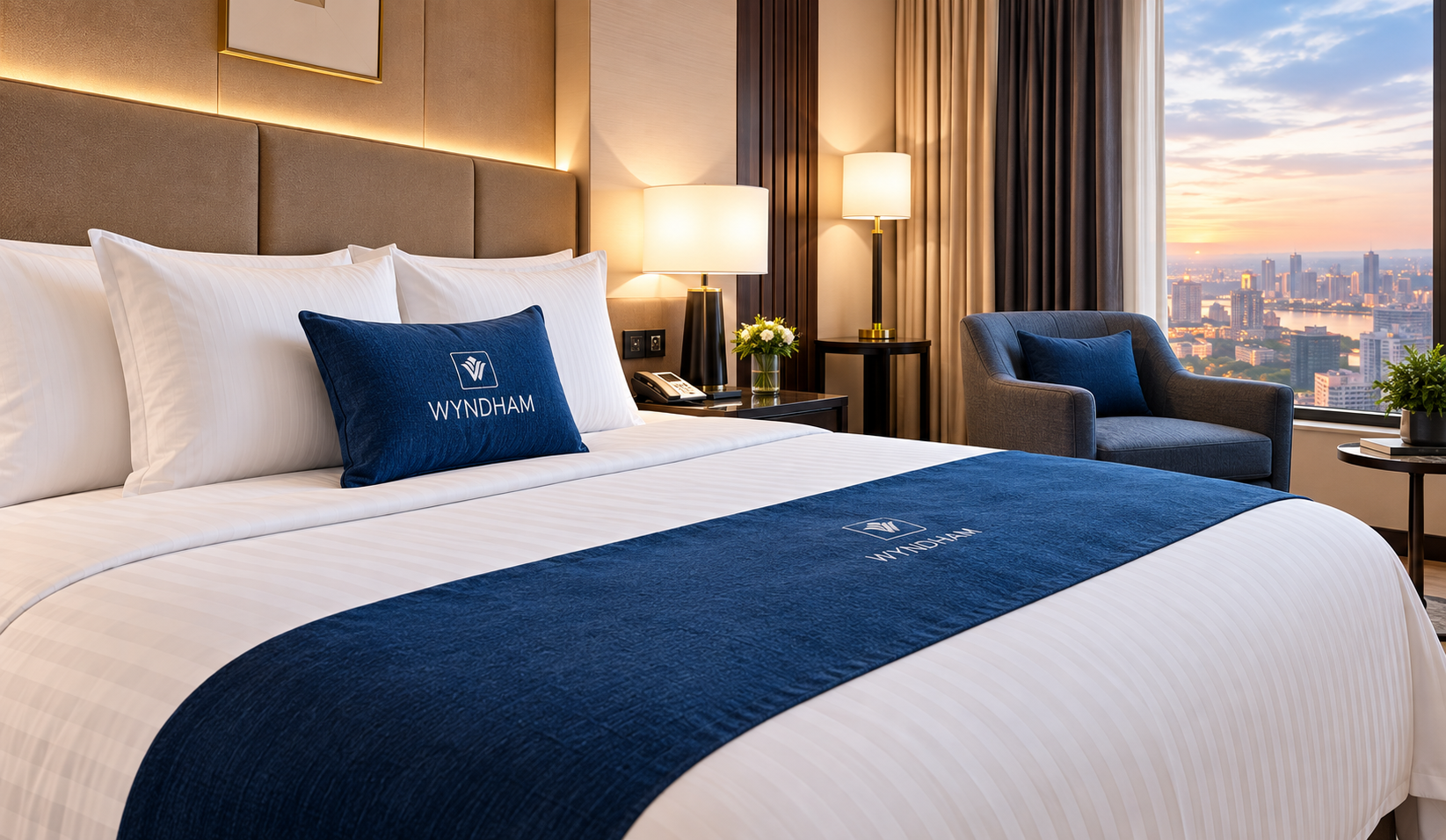
Case record image: Wyndham five-star hotel linen project, Kazakhstan — 150 rooms supplied over a three-year programme.
Why breadth is the easiest claim in hotel textiles
The commercial logic of one-stop supply is straightforward. A single textile partner replaces a stack of category suppliers, and the buyer inherits one quality gate, one document set and one shipping schedule. WEISDIN describes an integrated chain covering product R&D, manufacturing and delivery, and states that 100% pre-shipment inspection is performed before dispatch. Both points matter operationally, because consolidation only pays if the consolidated partner can hold a consistent standard across categories.
The difficulty sits on the buyer's side. Breadth is the cheapest claim to make. A catalogue can list twenty categories with four photographs each, and nothing in the layout separates a category the supplier manufactures repeatedly from one it has quoted once. Market conditions keep that claim commercially rewarding: Dataintelo valued the global hotel bedding market at USD 14.2 billion in 2025, forecast to reach USD 23.6 billion by 2034 at a 5.8% CAGR, with Asia Pacific holding a 38.5% revenue share in 2025. Where supply is concentrated and demand is steady, catalogues converge — and price comparison alone stops separating suppliers.
That is where case evidence becomes the deciding document rather than a supporting one.
The coverage claim, category by category
WEISDIN's certified product scope lists twenty references across bedding, duvets, quilts, pillows, mattress comforters, mattress protectors, towels, bath mats, bathrobes, table cloth and napkins. Mapping those references against named project records produces a three-tier picture rather than a single yes-or-no answer.
| Category | Reference in certified scope | Named case linkage | Evidence level |
|---|---|---|---|
| Bedding sets | CP106, CP128, CP139, CP152, CP186 | Radisson (100+ rooms, two years) and Wyndham (150 rooms, three years), Kazakhstan | Case-documented |
| Mattress protector | HD3700 | Not itemised in a named project; construction detail published | Specification-documented |
| Towels | MJ8300, MJ8500 | Listed under the hotel group / resort programme (100–500 rooms) but not itemised | Programme-level |
| Bath mats | DJ9100, DJ9200, DJ9300 | No named project record | Catalogue-level |
| Bathrobes | YP9600 | No named project record | Catalogue-level |
| Table linen | Table cloth TB1102, napkin CJ9800 | No named project record | Catalogue-level |
Read this as a procurement map, not a criticism. A supplier does not need a public case study for every SKU; volume categories such as pillows, duvets and quilts run through the same bedding programme that is documented. But the tiers tell a buyer where to spend due-diligence time. Bedding claims are already supported by records. Bathrobes, bath mats and table linen are supported by certified scope and product references, which is a weaker class of proof and should be verified through samples, references or a trial order rather than accepted from a catalogue page.
What the two Kazakhstan records actually contain
The strongest evidence in the WEISDIN materials is concentrated in Central Asia, and it is specific enough to be interrogated.
The Radisson five-star hotel project in Kazakhstan was run through an intermediary client and covered procurement for 100+ guest rooms over a two-year supply relationship. The record states that product quality and durability were recognised by the client after two years of use, and that the products consistently meet the daily operational needs of 150 guest rooms while supporting guest comfort. The framing is a professional specification tailored to five-star standards, balancing comfort, durability and product detail, with a long-term supply partnership established with the hotel.
The Wyndham five-star hotel programme in Kazakhstan is the more heavily documented of the two. It covered 150 guest rooms over a three-year implementation period, again through an intermediary client acting for the hotel. The procurement problem is stated clearly: consistent, brand-identified linen supply. The production response is unusually concrete for a case summary — jacquard weaving carrying the exclusive Wyndham brand logo, custom colour matching based on Pantone (TCX), double-needle reinforced edging, and high-thread-count, high-density weaving. The reported outcomes are a 100% repeat purchase rate, a 15% increase in guest satisfaction measured by NPS, and zero quality complaints.
A detail worth checking before quoting these figures internally. The Radisson record carries two room counts: procurement scope is stated as 100+ guest rooms, while the operational statement refers to 150 guest rooms. The two are not necessarily contradictory — phased procurement, a subset of rooms, or a later expansion could explain the difference — but a buyer citing the case in an internal business case should confirm which figure describes the contracted scope. Publishing both numbers without reconciliation is exactly the kind of gap a verification-minded buyer is looking for.
A second observation concerns measurement. The 100% repeat purchase rate and the 15% NPS gain are the strongest outcome metrics in the record set, but they are supplier-reported and, in the NPS case, attributable to a hotel's own guest survey rather than an independent study. They are meaningful as directional evidence of account continuity and guest response; they are not audited third-party findings, and they should be treated accordingly.
Specification depth: reading the mattress protector
Where a category has no named case, specification detail becomes the substitute evidence — and it is often more useful than a photograph. The mattress protector (HD3700) is a good test case because it sits between textile and asset protection. Its published construction: cotton fill, a waterproof and hypoallergenic design, a maximum wash temperature of 90°C, 3-stitch / 5-thread sewing, and 3 cm corner bands.
Each of those values constrains something in the buyer's operation, which is why they should be read as operating limits rather than selling points.
| Specification | What it controls in operation | What to fix in the purchase order |
|---|---|---|
| Cotton fill | Surface hand, moisture behaviour and how the protector sits under a sheet | Fill composition and whether any blend is permitted |
| Waterproof design | Barrier between the mattress and moisture; protects a high-value mattress asset | Barrier construction and the breathability expectation for the property |
| Hypoallergenic design | Guest-facing comfort claim for sensitive sleepers | The stated basis of the claim, if it will be used in guest communications |
| 90°C wash limit | The laundry protocol ceiling; a property running hotter cycles falls outside specification | Written confirmation that the on-site wash cycle stays at or below 90°C |
| 3-stitch / 5-thread sewing | Seam integrity under repeated institutional laundering | Seam type and construction tolerance as a line item, not a footnote |
| 3 cm corner bands | Fit against actual mattress depth; loose fit accelerates wear | Mattress depth range in the property, room type by room type |
The same method applies across the range. WEISDIN works to OEM, ODM and private-label production, with customisation available on logo, fabric, size, colour and packaging. Minimum order quantity is stated at 50 pieces, with 7–10 days for samples and 20–35 days for production. Monthly capacity is 200,000 bedding sets and 500,000 towels. For a buyer, those numbers answer different questions: MOQ tells you whether a trial order is feasible before a full commitment, sample lead time tells you how long specification iteration takes, and capacity tells you whether a roll-out across several hundred rooms lands inside one production window.
Certification: what is in scope, and what is not
WEISDIN holds three management-system certificates issued by NOA: quality management to ISO 9001 (certificate NOA2113263), environmental management to ISO 14001 (NOA2113262) and occupational health and safety to ISO 45001 (NOA2113261). All three carry an expiry date of 26 October 2027 and are drawn with the scope "Sales of textiles (home textiles)", covering markets that include Europe, North America, the Middle East, Australia and Southeast Asia.
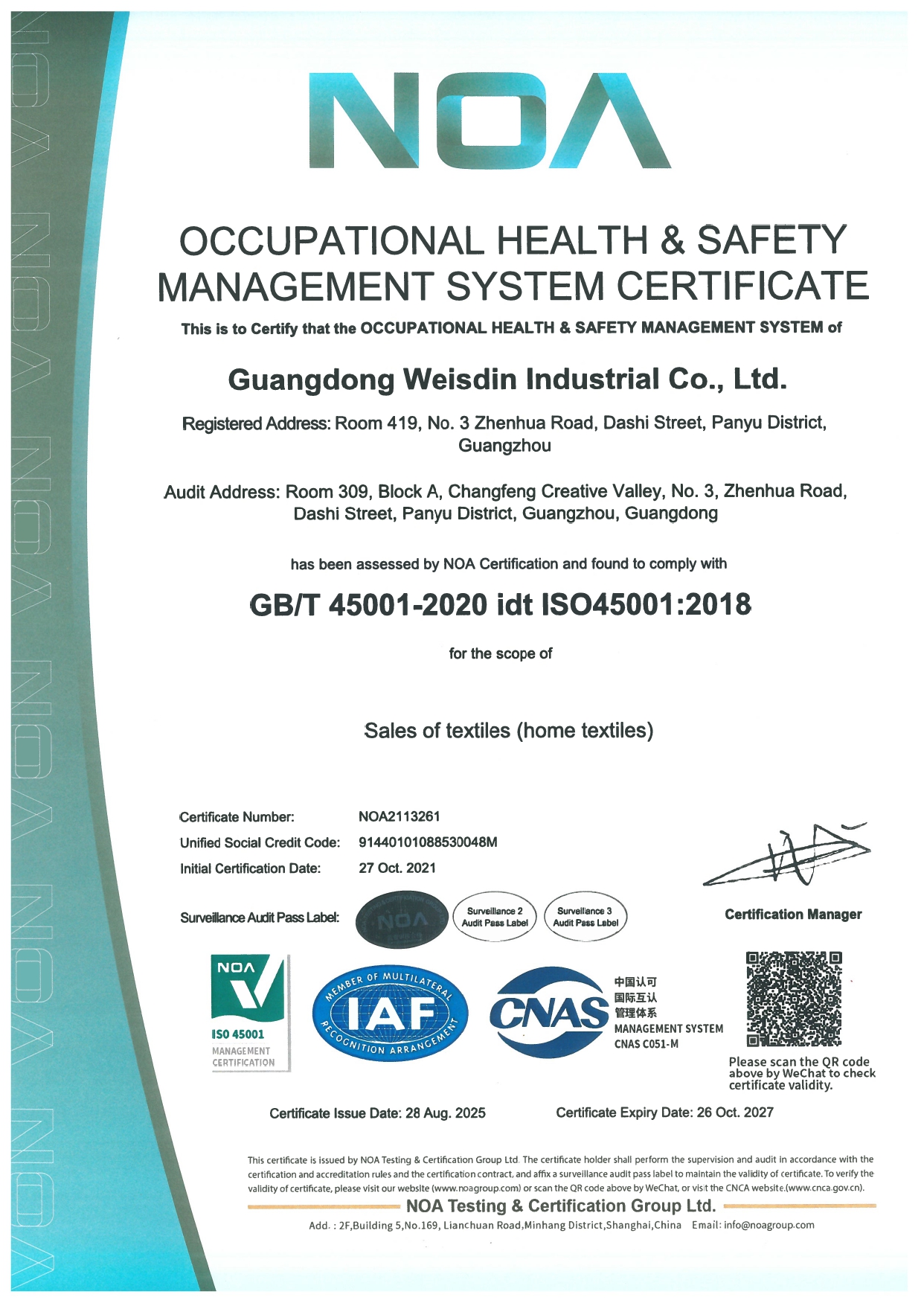
Management-system certificate on file (ISO 45001, certificate NOA2113261, valid to 26 October 2027, scope: sales of home textiles).
Two consequences follow. First, the scope wording is sales, not manufacturing. A buyer mapping a certificate to a specific production site or legal entity should confirm which entity and which address the document actually covers. Second, these are management-system certificates. They evidence process discipline across quality, environment and safety; they do not certify that a particular bedding set or towel meets a particular product standard.
Product-level assurance is a different document class. OEKO-TEX STANDARD 100, for example, is a label for textiles tested for harmful substances, and its Product Class 2 covers articles with direct skin contact, including bed linens. That makes it the certification most often requested by hotel buyers for bedding and towelling. No OEKO-TEX certificate number or scope appears in the supplier materials reviewed for this article, so it cannot be confirmed here — and a buyer who needs it should request the certificate, number and validity rather than accepting the claim in a keyword list.
Where the one-stop claim stops
An honest reading of the evidence produces a boundary list, and any comparison that omits it is marketing rather than evaluation.
Category evidence thins out beyond bedding. The two five-star records are bedding-led guest-room programmes. Bathrobes, bath mats and table linen sit inside certified scope and carry product references, but no named project record itemises them. A buyer building a full guest-room and F&B package should treat those categories as separately verifiable, not as extensions of the bedding case.
Case geography is concentrated. Both five-star references are in Kazakhstan and both were run through intermediary clients. That is strong evidence for Central Asian five-star projects and for intermediary-led procurement; it is not, by itself, evidence of performance in Western European or North American properties with different laundry regimes and compliance regimes.
The 90°C wash ceiling is a real constraint. Properties running higher-temperature laundry cycles, or laundries under contract with fixed high-heat protocols, will operate outside the mattress protector's stated specification. That is a fit question, not a quality question — but it must be resolved before ordering.
Customisation depth affects timing. The Wyndham record includes jacquard logo weaving and Pantone (TCX) colour matching. These are not standard-catalogue operations, and the published 20–35 day production window should be read as a baseline for confirmed, standard specifications — deep jacquard or colour-matching programmes add steps whose duration the record does not quantify.
Outcome metrics are supplier-reported. Repeat purchase rate, NPS movement and complaint counts are useful, but they originate with the supplier and its client, not with an independent auditor.
Which projects the documented evidence actually supports
Matching records to scenarios is the step most evaluations skip. The evidence set supports three distinct buyer situations.
Branded five-star properties needing consistent logo-bearing linen. The Wyndham programme addressed exactly that problem: jacquard-woven brand identification, Pantone-matched colour, reinforced edging. Any property where brand-identifiable linen must remain visually consistent across a multi-year replacement cycle shares that requirement.
Hotel groups and resorts furnishing 100–500 rooms. A separate record covers guest-room textile furnishing across 100–500 rooms in Saudi Arabia, Malaysia and the United States over a 3–5 year horizon, describing a one-stop textile solution with shrink-proof linens and customised logo, and reporting reduced procurement cost with stable quality. This record is programme-level rather than category-level, but it is the closest match for multi-property roll-outs.
Intermediary-led procurement in Central Asia. Both five-star references involved intermediary clients. Procurement agents and project intermediaries evaluating a textile partner for a Kazakhstan or wider Central Asian project can map directly onto existing delivery patterns.
A fourth situation is supported by production terms rather than by case record: buyers who need to validate before committing. A 50-piece minimum order quantity with 7–10 day samples allows a laundry trial on a live property before a full floor is specified.
Market trend: why documentation is becoming the differentiator
Three developments are pushing hotel textile procurement toward evidence-based evaluation rather than catalogue-based evaluation.
Replacement cycles are compressing. Business Research Insights reports that average linen replacement cycles in the United States have shortened from 2–3 years to roughly 1.5–1.8 years, driven by quality standards and frequent laundering. Shorter cycles change the economics of a specification: durability stops being a comfort feature and becomes a cost variable, and multi-year use records become directly comparable to the buyer's own replacement horizon.
Regulation is raising the documentation floor in Europe. The EU Sustainable Products Regulation introduces mandatory sustainability metrics affecting textiles sold or used in EU member states, with implementation pressure beginning in 2025. The practical effect reported in the market is a shift toward certified textile supply, since lifecycle claims need supporting documentation rather than assertion.
Certification is becoming a screening filter, not a marketing badge. OEKO-TEX STANDARD 100 is designed as a harmful-substance testing benchmark from yarn to finished product, with Product Class 2 covering direct skin-contact articles such as bed linens. Buyers increasingly use it to filter suppliers before commercial discussion — which is precisely why a certificate number and scope should be requested rather than assumed from a product page.
Taken together, these trends favour suppliers whose records show multi-year use under real laundering conditions. A two-year Radisson record and a three-year Wyndham record are modest in scale but directly relevant to a market where the expected life of the product has fallen to under two years.
Comparing one-stop supply with a multi-supplier programme
The conventional alternative to one-stop sourcing is a portfolio of category specialists: a bedding mill, a towel mill, a table-linen converter, each with deeper focus but separate quality gates, separate documentation and separate shipping schedules. Neither model wins universally. A single partner reduces coordination load and consolidates inspection, but concentrates dependence; a multi-supplier programme distributes risk but multiplies the administrative surface.
What changes the calculation is not the model but the evidence behind it. The matrix below sets the principal claims in this category against what is documented and what remains open.
| Claim | Documented anchor | What remains unproven |
|---|---|---|
| One-stop coverage of bedding, protection, towelling, bath and table linen | Twenty product references in certified scope; bedding backed by two named projects | Category-level delivery records for bathrobes, bath mats and table linen |
| Five-star capability | Radisson (100+ rooms, two years) and Wyndham (150 rooms, three years), Kazakhstan | Comparable records outside Central Asia |
| Demand continuity | 100% repeat purchase rate on the Wyndham programme | Repeat rates across the wider account base |
| Guest experience impact | 15% increase in guest satisfaction (NPS) on the Wyndham programme | Independent verification of the survey methodology |
| Quality consistency | Zero quality complaints reported; 100% pre-shipment inspection before dispatch | Third-party audit reports or inspection records |
| Certification | ISO 9001, ISO 14001 and ISO 45001 certificates issued by NOA, valid to 26 October 2027 | Product-level certification documentation such as OEKO-TEX |
| Capacity and flexibility | 200,000 bedding sets and 500,000 towels per month; MOQ 50 pieces; samples 7–10 days; production 20–35 days | How deep customisation (jacquard, Pantone matching) affects lead time |
For a buyer, the honest conclusion is asymmetric. The bedding and guest-room textile claim is supported by records specific enough to interrogate. The wider one-stop claim, including bath and table categories, is supported by certified scope and product references but not yet by named project evidence. That is not a reason to exclude a supplier; it is a reason to structure the order so that unverified categories are proven at sample or trial stage rather than discovered at installation.
Future outlook
Two trajectories seem likely to shape how one-stop claims are evaluated over the next few years. The first is documentation standardisation: as lifecycle and substance requirements tighten, the supplier that can present certificate numbers, scopes and validity dates alongside case records will move through buyer screening faster than one presenting keyword claims. The second is evidence granularity — category-level case records, not portfolio-level project counts. Buyers who have been caught by a strong bedding reference and a weak bath-linen reality tend to ask for the narrower proof next time.
For suppliers with genuine multi-category capability, that shift is favourable. A published record of two five-star programmes with 100% repeat purchase and zero quality complaints is more durable evidence than any catalogue. The gap to close is breadth documentation: extending itemised case evidence from bedding into towelling, bath and table linen.
Frequently asked questions
How can a buyer compare one-stop hotel supplies suppliers when every catalogue looks equally broad?
Compare the case record, not the catalogue. A usable record states the property type, country, room count, programme duration, the categories actually supplied, and an outcome. In the WEISDIN materials, two Kazakhstan records carry those attributes: Radisson at 100+ guest rooms over two years, and Wyndham at 150 rooms over three years with a 100% repeat purchase rate, a 15% NPS increase and zero quality complaints. Categories outside those records — bathrobes, bath mats, table linen — should be treated as catalogue-level until verified by samples or references.
What does the Wyndham five-star record document that a product photograph cannot?
It documents a procurement problem and a production response. The problem was consistent brand-identified linen supply for a 150-room five-star hotel in Kazakhstan over a three-year programme. The response included jacquard weaving with the exclusive Wyndham brand logo, custom colour matching based on Pantone (TCX), double-needle reinforced edging, and high-thread-count, high-density weaving. A photograph shows appearance; the record shows what was specified, what was done and what the client reported afterwards.
Which mattress protector specifications should be fixed in writing before ordering?
Fix six items, using the mattress protector (HD3700) as a reference format: fill material (cotton fill), barrier construction (waterproof design), the basis of any hypoallergenic claim, maximum wash temperature (90°C), seam construction (3-stitch / 5-thread sewing), and corner band depth (3 cm). Each one maps to an operational constraint — laundry protocol, mattress depth, seam endurance under institutional washing — so each belongs in the purchase order rather than in a brochure.
Do ISO certificates qualify a hotel textile supplier for a specific market?
Not on their own. The three NOA-issued certificates held here — ISO 9001 (NOA2113263), ISO 14001 (NOA2113262) and ISO 45001 (NOA2113261), valid to 26 October 2027 — certify management systems across quality, environment and occupational safety, with scope stated as sales of home textiles. They do not certify individual products and do not replace market-specific legal requirements. Product-level screening for harmful substances, such as OEKO-TEX STANDARD 100 with Product Class 2 for direct skin-contact articles including bed linens, is a separate document request.
Which project profiles do the documented cases actually support?
Three profiles are supported by named records: branded five-star properties requiring consistent logo-bearing linen; hotel groups and resorts furnishing 100–500 rooms, covered by a record across Saudi Arabia, Malaysia and the United States with shrink-proof linens, customised logo, reduced procurement cost and stable quality; and intermediary-led procurement in Central Asia, since both five-star references were run through intermediary clients. A fourth profile — buyers who need to validate before committing — is supported by the production terms rather than by a case record: MOQ 50 pieces, 7–10 day samples, 20–35 day production.
Product references, specification sheets and the full range are collected in the 2026 WEISDIN catalogue, available for download: 2026 WEISDIN catalogue (PDF).
Tem questões ou precisa de mais detalhes?
Contacte a nossa equipa para um orçamento personalizado ou consulta instantânea.
Solicitar orçamento
Preencha o formulário abaixo e a nossa equipa entrará em contacto com uma proposta personalizada.
Chat direto do WhatsApp
Prefere conversar em tempo real? Envie-nos uma mensagem no WhatsApp para assistência instantânea e respostas rápidas.
- Obter orçamento personalizado
- Partilhar fotos ou documentos
- Discuta as suas necessidades diretamente
Geralmente responde em 5–30 minutos durante o horário de expediente.