
Online Inkjet Printer: Certifications, Specs, Cost Limits
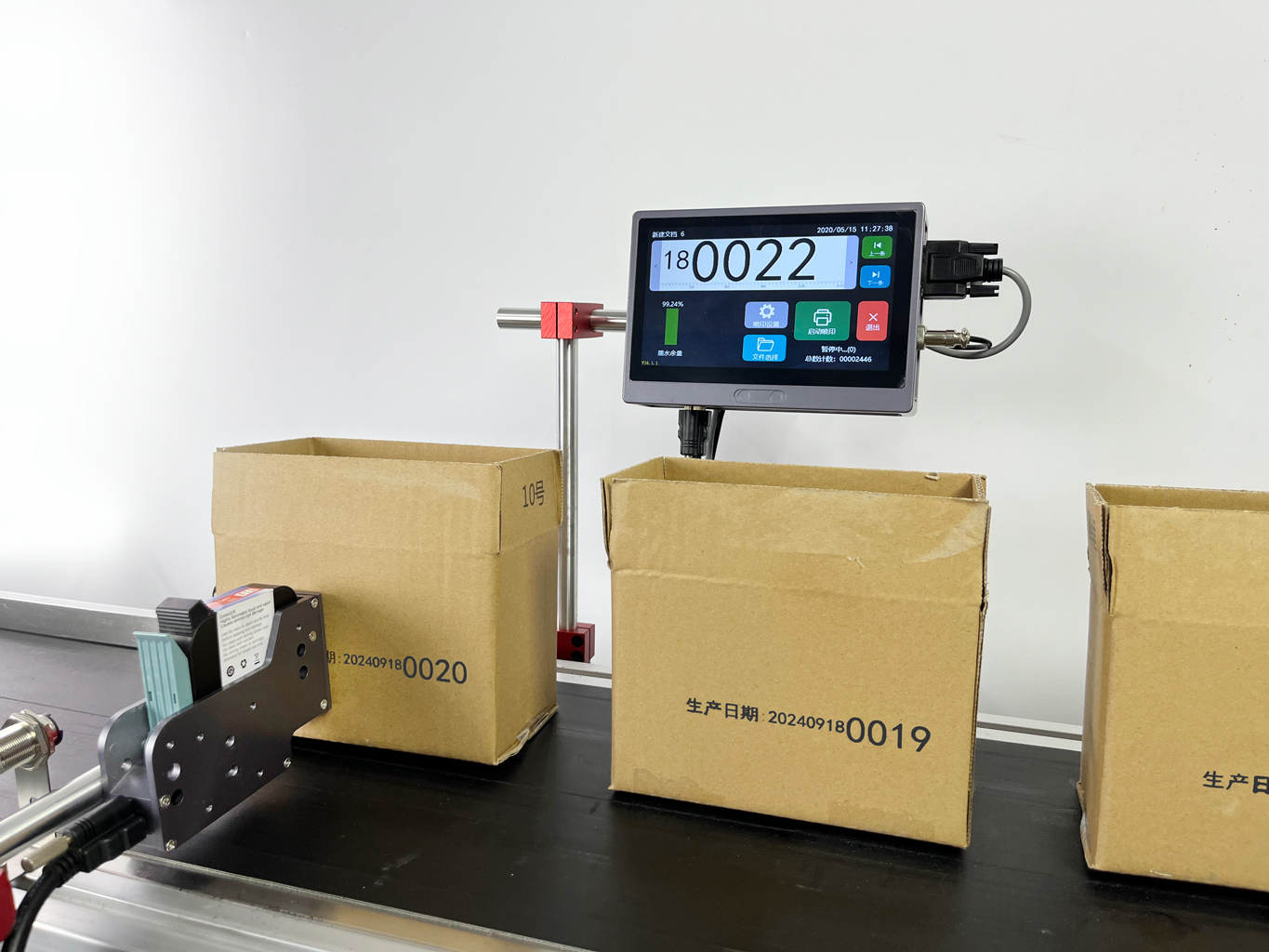
DEMIN S10 online inkjet printer. Image source: DEMIN product record.
An online inkjet printer is a production-line marking system that prints variable data—dates, batch numbers, serial numbers, QR codes, barcodes and logos—while the product moves on a conveyor. Its procurement logic is different from a handheld printer. The decision is not only about print quality; it is about whether the model can be mounted, triggered, certified and maintained inside a specific line. DEMIN Inkjet Printer is the inkjet-printer brand of Quanzhou Demin Spraying Code Technology Co., Ltd., a China-based manufacturer. Its online portfolio includes the S10 and L10, with the P70 and P70 Pro UV models available for wider print-height and UV-curing configurations. Published specifications explain the fit; they also define where a buyer must validate before order.
Why online inkjet is a constraint-driven purchase
DEMIN’s S10 online model prints at 120 m/min with a 2–12.7 mm print height and 300–600 dpi. The M10 handheld model prints at 60 m/min with a 2–25.4 mm print height and 300–600 dpi. The online unit is heavier at 3.5 kg versus 520 g for the handheld, and it uses a DB9 sensor interface plus USB, while the handheld uses a 3.5 mm sensor port and USB. The difference is not a ranking. It is a trade: line speed and repeatable triggering versus portability and a taller single-pass print height. A buyer who needs to mark cartons on a conveyor should start with the online family; a buyer who marks occasional or immovable goods should test the handheld family.
Three constraints filter the market before price: certification for the destination market, mechanical integration with the line, and ink/substrate compatibility. A fourth constraint is commercial. The price band of an online inkjet printer cannot be read from a model name because printhead, ink system, enclosure, interfaces and certification scope change the configuration.
The specification set that actually filters suppliers
| Model | Format | Print height | Resolution | Speed | Interfaces | Buyer note |
|---|---|---|---|---|---|---|
| DEMIN S10 | Online inkjet printer | 2–12.7 mm | 300–600 dpi | 120 m/min | DB9 sensor, USB | 3.5 kg, cast aluminum, 7-inch touch, DC16.8V 3A, modular, self-developed OS, ink-volume calculation |
| DEMIN L10 | Online inkjet printer | 2–12.7 mm | 300–600 dpi | 120 m/min | DB9 sensor, USB | 3.5 kg, cast aluminum, 7-inch touch, DC16.8V 3A, modular, self-developed OS, ink-volume calculation |
| DEMIN P70 | UV inkjet printer | 5–72 mm | 180 dpi | 1–100 m/min | RS232, USB, DB9, Ethernet IP | Seiko 510, 510 nozzles, 35 pl, 10-inch touch, negative-pressure ink supply, water/UV/oil inks |
| DEMIN P70 Pro | UV inkjet printer | 5–72 mm | 360 dpi | 1–100 m/min | RS232, USB, DB9, Ethernet IP | Seiko 1020, stainless steel, bulk OEM customization |
| DEMIN M10 | Handheld inkjet printer | 2–25.4 mm | 300–600 dpi | 60 m/min | 3.5 mm sensor, USB | 520 g, ABS, 4.3-inch touch, 2500 mAh battery |
Published data. S10/L10 share core online specifications; P70/P70 Pro extend print height and add Ethernet/UV options. M10 is shown for format comparison.
For S10 and L10, printable content includes Chinese and English characters, QR codes, barcodes, serial numbers and logos. Ink colors are red, yellow, blue, green, black, white and invisible. The interface set is a DB9 sensor interface and USB. The controller is a 7-inch capacitive touch screen; the operating system is self-developed; the ink-volume calculation function is included. These are not marketing details. They determine whether the printer can be triggered by an existing sensor, whether operators can load variable data without a PC, and whether ink consumption can be tracked.
P70 and P70 Pro are relevant when the message is taller than 12.7 mm or when UV curing is required. P70 uses a Seiko 510 printhead with 510 nozzles, 35 pl drop size and 8.29 kHz firing frequency. P70 Pro raises resolution to 360 dpi and uses a Seiko 1020 printhead. Both list 5–72 mm print height, 2–15 mm print distance, 1–100 m/min speed, a 10-inch touch screen, Machine OS, negative-pressure ink supply, water-based/UV/oil-based inks, RS232/USB/DB9/Ethernet interfaces, and 30 languages. P70 Pro is stainless steel and supports bulk OEM customization.
Certification is a model-level constraint, not a brand-level claim
A CE or FCC mark on one model does not automatically transfer to another. The available records show why.
| Model family | Market | Document | Number | Scope / standard | Procurement action |
|---|---|---|---|---|---|
| S10 in-line family: S10, T110, S20, S100, S200 | EU | CE Attestation of Conformity | AOCXMTN3231226-78308E-02 | EMC Directive 2014/30/EU; emission and immunity; EN 55032:2015+A1:2020, EN 55035:2017+A11:2020, EN IEC 61000-3-2:2019+A1:2021, EN 61000-3-3:2013+A2:2021 | Ask for the certificate page naming the exact model; check whether machinery safety, LVD or food-contact requirements apply separately |
| L10 online | EU | CE attestation listed in DEMIN documentation | Number not stated in the available record | EMC attestation for EU market | Request the L10-specific certificate before approval; do not assume the S10 number covers L10 |
| Handheld T1, T2, T3, T10, T20, T30 | US | FCC Supplier’s Declaration of Conformity | XMTN3230612-33144E-00 | Part 15 of the FCC Rules and Regulations for Radio Frequency Devices; issued 2023-07-25 by Bay Area Compliance Laboratories Corp. (Dongguan) | Applies to listed handheld models; not evidence for S10 or L10 |
| Handheld D10, M10, MX3, M20, M100 | US | FCC Supplier’s Declaration of Conformity | 2404Z55407E-EM | FCC Part 15 Subpart B Class B; issued 2024-12-03 by Shenzhen Accurate Technology Co., Ltd. | Applies to listed handheld models |
| M10 handheld | EU | CE certification | AOC RXM211108050-02 | EMC Directive 2014/30/EU; EN 55032:2015+A1:2020, EN 55035:2017+A11:2020, EN IEC 61000-3-2:2019+A1:2021 | Model-level CE record; check other directives separately |
| P70 and P70 Pro | EU | CE attestation listed in DEMIN documentation | Number not stated in the available record | EMC attestation for EU market | Request model-specific certificate and confirm UV ink/contact requirements |
Certification status as stated in the provided records. A CE EMC attestation is not a full machine-safety or food-contact approval.
The S10 CE attestation is specific. It names in-line inkjet printer models S10, T110, S20, S100 and S200, declares conformity with EMC Directive 2014/30/EU, and covers EMC Clause 1(a) emission and Clause 1(b) immunity. The document was issued by Bay Area Compliance Laboratories Corporation (BACL) on 2024-02-01. That is useful evidence for EU EMC compliance. It is not evidence that the printer meets every EU directive, nor that the ink is suitable for direct food contact. Those are separate qualification questions.
US FCC records in the provided material cover hand-held models. The T1/T2/T3/T10/T20/T30 declaration is under XMTN3230612-33144E-00 and cites Part 15 of the FCC Rules and Regulations for Radio Frequency Devices. The D10/M10/MX3/M20/M100 declaration is under 2404Z55407E-EM and cites FCC Part 15 Subpart B Class B. The S10 and L10 online models are not listed in those FCC declarations. A US buyer should therefore ask for the exact online-model FCC status before assuming coverage.
For the EU, DEMIN documentation lists the L10, P70 and P70 Pro among models covered by CE attestations. The certificate number available in the record is for the S10 in-line family. The procurement action is straightforward: request the model-specific certificate page, check the model name, check the directive and standards, and file it with the purchase order. A brand-level statement is not enough for a technical file.
What the numbers mean on a real line
120 m/min is a published maximum. It should be read with the print height, resolution and substrate in the same sentence. A line running at 120 m/min with a 2–12.7 mm print height and 300–600 dpi is a different duty point from a line running at the same speed with a larger message or a difficult substrate. The S10/L10 optimal print distance is 2–5 mm. Mounting rigidity and product presentation therefore matter as much as the printhead.
Print height is a hard boundary. S10/L10 cover 2–12.7 mm. P70/P70 Pro cover 5–72 mm. If the carton message is 30 mm tall, the S10/L10 height is outside the published range; the P70 family is the relevant starting point. If the message is a 10 mm date code, the S10/L10 range fits, and the decision moves to line speed, ink and integration.
Interfaces decide integration effort. S10/L10 provide a DB9 sensor interface and USB. P70/P70 Pro add RS232, USB, DB9 and Ethernet (IP). The DB9 sensor interface supports photoelectric trigger integration; Ethernet supports network-level integration where the line architecture requires it. S10/L10 use a 7-inch capacitive touch screen and a self-developed operating system. P70/P70 Pro use a 10-inch capacitive touch screen and Machine OS. Language support is 29 languages for S10/L10 and 30 languages for P70/P70 Pro. These details reduce operator training and line-side configuration work.
Ink and curing are part of the specification. S10/L10 list red, yellow, blue, green, black, white and invisible inks. P70/P70 Pro support water-based, UV and oil-based inks with a negative-pressure ink supply. UV output needs a curing step; the carton-packaging scenario in the provided material lists a UV curing lamp set as matched equipment. A buyer should not treat UV as a drop-in option without confirming lamp placement, line space and cure validation.
Environment is model-specific. P70 and P70 Pro publish 0–50°C and 10–90% RH operating conditions, 20 W power consumption and DC16.8V 5A. The S10/L10 records in the provided material do not publish an equivalent operating-temperature range. For a high-temperature workshop, that is a document gap to close with the supplier rather than an assumption to make.
Application fit: carton packaging and production-line marking
The clearest online use case in the provided material is carton packaging printing in a manufacturing environment. The line uses a photoelectric sensor trigger, 24/7 continuous online automatic printing, a conveyor, a packaging production line and a UV curing lamp set. The stated requirements are stable printing under a high-temperature workshop, multi-language font output and ink with strong adhesion for corrugated carton surfaces. That combination is a useful test of the category: the printer is not a standalone device; it is a station in a packaging line.
DEMIN S10 and L10 are listed for food, packaging manufacturing, production and manufacturing, and medical industries. Their printable content includes Chinese and English characters, QR codes, barcodes, serial numbers and logos. The P70 family extends the substrate list to boards, cartons, pipes, cables, metals and plastics and can print text, images, serial numbers, QR codes, barcodes, dates and tables. This supports date coding, batch coding, variable-data printing and traceability labels, but the support is application-level. Adhesion and durability still require a sample print on the actual substrate, with the actual ink and cure.
Where the online format does not fit: very low-volume, one-off marking of immovable objects is better served by a handheld unit. The M10 weighs 520 g, prints at 60 m/min and covers 2–25.4 mm height. It trades line integration for portability. A buyer should not force an online printer into a job that is fundamentally manual. Likewise, a 2–12.7 mm online model should not be specified for a large-character carton message that needs 30–70 mm height; the P70 family starts at 5 mm and reaches 72 mm.
Commercial boundaries: MOQ, lead time and why list price is unreliable
The provided material does not give unit prices, ink costs or maintenance costs for S10, L10, P70 or P70 Pro. A price band can therefore be described only as a configuration-dependent range to be confirmed by RFQ. The variables are visible: online vs UV, 180 dpi vs 360 dpi, Seiko 510 vs Seiko 1020, cast aluminum vs stainless steel, DB9/USB vs Ethernet, standard vs OEM casing, and certification scope. Any list price that ignores those variables is not a like-for-like comparison.
Commercial terms are more concrete. DEMIN lists an OEM mode with MOQ 1 unit, lead time 30–45 days, monthly capacity 8,000 units, customization of logo and startup screen, 100% test and export markets including the EU, Middle East and the Americas. The ODM mode lists MOQ 100 units, lead time 20–35 days, monthly capacity 5,000 units, casing drawings and mold opening for injection molding. After-sales includes a 12-month warranty and lifelong after-sales service; the capability record also lists online guidance and sending parts. These are the terms to put beside the technical specification, not after it.
For budget approval, separate the quote into printer, ink, spares, integration, freight and certification administration. The lowest equipment price can lose on ink consumption, line downtime or rework. The S10/L10 ink-volume calculation function is relevant here because it supports ink-consumption visibility; it does not by itself prove lower total cost. That requires the buyer’s own duty cycle.
Market trend: more integration, more traceability, same certification discipline
Commercial research puts the global inkjet printer market at USD 45.2 billion in 2025 and USD 48.0 billion in 2026 (Grand View Research). Global Market Insights estimates the industrial inkjet segment at USD 5.6 billion in 2025. The scopes differ—total inkjet versus industrial—so the figures should not be averaged or used interchangeably. Within the industrial market, Grand View Research attributes a 38.4% revenue share to continuous inkjet (CIJ) technology in 2025, and Global Market Insights attributes 26% of the industrial inkjet market to food and beverage in 2025. Smithers projects Asia Pacific to draw level with North America in global inkjet volume by 2026.
Those numbers explain why online coding remains a procurement category rather than a commodity. Food, beverage and packaging lines need date and batch coding at line speed; traceability adds QR, barcode and serial-number content. A Chinese press and publication industry standard describes printing smart manufacturing as the integration of new-generation information and communication technology with advanced manufacturing across design, production, management and service. An arXiv preprint on industrial IoT describes the equipment layer as including production equipment, industrial robots and sensors. The practical reading for a buyer is not that every printer is a smart-manufacturing device. It is that coding equipment is increasingly evaluated as a connected line asset, with interfaces, data content and certificate files reviewed together.
Comparison with traditional choices
Against a handheld printer, the online S10/L10 trade mobility for repeatable triggering and higher published line speed: 120 m/min versus 60 m/min, with a 3.5 kg fixed unit versus a 520 g handheld. The handheld M10 offers a taller 2–25.4 mm print height, which can matter for large text on uneven or immovable goods. The online S10/L10 offer a 2–12.7 mm height and a DB9 sensor interface for line integration. Neither format is universally better; the line layout decides.
Against pre-printed labels, an online inkjet printer removes label inventory and allows variable data per item, but it adds ink, printhead maintenance and substrate-validation work. The provided material supports the variable-data capability—dates, batch numbers, serial numbers, QR codes, barcodes and logos—but it does not provide a label-cost comparison. A buyer should therefore compare total cost with actual label spend, ink consumption, changeover time and reject rate. The limitation that should be stated plainly is that an online inkjet printer is a line-dependent solution. It needs a conveyor, a trigger sensor, a stable print distance and, for UV ink, a curing step. If those are absent, the installation cost and downtime risk rise.
Future outlook
The direction is toward more line integration and more data per mark. S10/L10 already use a modular design, a self-developed operating system and an ink-volume calculation function, and they are described as compatible with various production line installations. P70/P70 Pro add Ethernet (IP), RS232 and a negative-pressure ink supply, which gives system integrators more connection options. Language support—29 languages on S10/L10 and 30 on P70/P70 Pro—matters for export lines and multi-site operations.
The certification file will remain the gating item. CE EMC attestations and FCC Supplier’s Declarations are model-specific and market-specific. As lines add traceability and network connectivity, buyers will ask for the certificate, the interface specification and the ink datasheet in the same review. Suppliers that can produce those documents at model level will be easier to qualify. The technology trend does not remove the need for a sample print; it makes the sample print part of a larger evidence pack.
FAQ
What is an online inkjet printer?
An online inkjet printer is a production-line marking system that prints variable data while the product moves on a conveyor. DEMIN S10 and L10 are examples: 2–12.7 mm print height, 300–600 dpi, 120 m/min, DB9 sensor and USB interfaces, 7-inch capacitive touch screen, modular design and a self-developed operating system.
Which certifications cover DEMIN online inkjet printers for the EU and US?
For the EU, the S10 in-line family (S10, T110, S20, S100, S200) is covered by CE Attestation of Conformity AOCXMTN3231226-78308E-02 under EMC Directive 2014/30/EU. DEMIN documentation lists the L10 among models covered by CE attestations, but the available record does not state the L10-specific number, so the L10 certificate should be requested. For the US, the FCC declarations in the provided material cover hand-held models T1/T2/T3/T10/T20/T30 and D10/M10/MX3/M20/M100; S10 and L10 are not listed in those declarations. The exact online-model FCC status should be verified before purchase.
What are the published specifications of DEMIN S10 and L10?
S10 and L10 are online inkjet printers with a 3.5 kg cast aluminum alloy body, 300–600 dpi resolution, 2–12.7 mm print height, 2–5 mm optimal print distance and 120 m/min print speed. They use a 7-inch capacitive touch screen, DC16.8V 3A power, a DB9 sensor interface and USB. They support 29 languages, red/yellow/blue/green/black/white/invisible inks, and content including Chinese and English characters, QR codes, barcodes, serial numbers and logos.
How do P70 and P70 Pro differ from S10 and L10?
P70 and P70 Pro are UV inkjet printers with a 5–72 mm print height, 1–100 m/min speed, 2–15 mm print distance, 10-inch capacitive touch screen, Machine OS, negative-pressure ink supply, water/UV/oil-based inks, RS232/USB/DB9/Ethernet interfaces and 30 languages. P70 uses a Seiko 510 printhead at 180 dpi; P70 Pro uses a Seiko 1020 printhead at 360 dpi and is made of stainless steel with bulk OEM customization. S10/L10 are narrower-height online models at 2–12.7 mm and 120 m/min.
What substrates can DEMIN inkjet printers mark?
DEMIN’s FAQ lists carton, plastic, metal, glass, wood and woven fabric among printable surfaces. The P70 product record lists boards, cartons, pipes, cables, metals and plastics. These are application claims, not a guarantee for every ink and cure combination. Adhesion and durability should be validated with a sample print on the actual substrate, using the specified ink and curing method.
What commercial terms apply to OEM and ODM orders?
DEMIN lists OEM with MOQ 1 unit, lead time 30–45 days, monthly capacity 8,000 units, and customization of logo and startup screen. ODM lists MOQ 100 units, lead time 20–35 days, monthly capacity 5,000 units, and customization through casing drawings and mold opening for injection molding. Both modes list 100% test. The warranty is 12 months, with lifelong after-sales service; the capability record also lists online guidance and sending parts.
Can an online inkjet printer be compared by list price alone?
No. The provided material does not give unit prices, ink costs or maintenance costs for S10, L10, P70 or P70 Pro. Price depends on model, printhead, ink system, interface set, body material, OEM/ODM scope and certification. A configuration-specific RFQ is needed before a price band can be treated as comparable.
Reference document: DEMIN Inkjet Company Brochure (English, PDF).
Tem questões ou precisa de mais detalhes?
Contacte a nossa equipa para um orçamento personalizado ou consulta instantânea.
Solicitar orçamento
Preencha o formulário abaixo e a nossa equipa entrará em contacto com uma proposta personalizada.
Chat direto do WhatsApp
Prefere conversar em tempo real? Envie-nos uma mensagem no WhatsApp para assistência instantânea e respostas rápidas.
- Obter orçamento personalizado
- Partilhar fotos ou documentos
- Discuta as suas necessidades diretamente
Geralmente responde em 5–30 minutos durante o horário de expediente.