
Onyx Supplier Selection for Luxury Projects: Beyond Price and Aesthetics
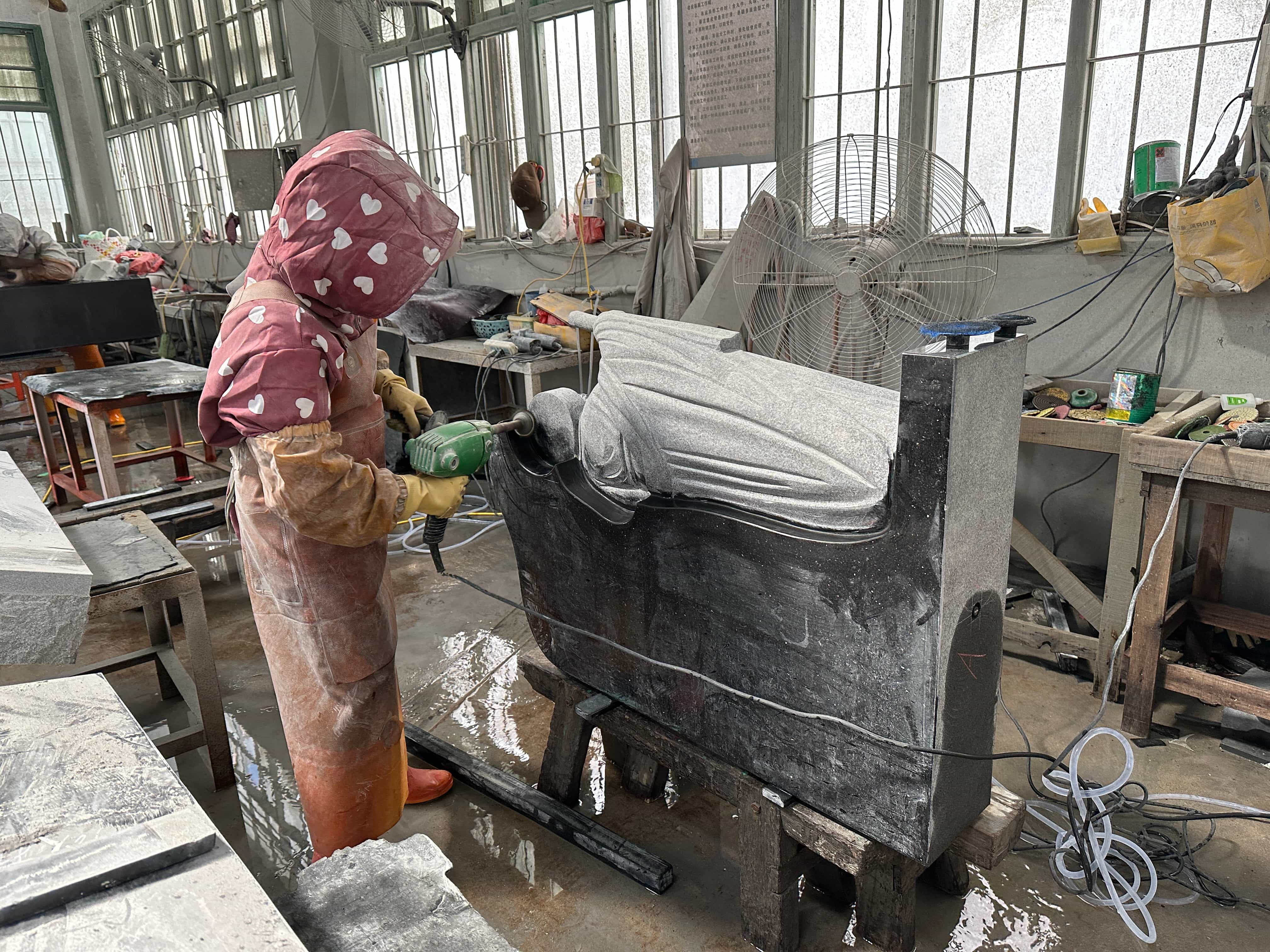
Stone polishing workshop supporting SONGJIA's onyx, marble, and granite slab finishing.
Global demand for natural stone continues to grow. According to Grand View Research, the global natural stone market was valued at USD 10.2 billion in 2024 and is projected to reach USD 14.11 billion by 2030. Within this market, onyx occupies a specific position: it is selected less for structural strength and more for its translucency, veining, and visual effect in high-end interior spaces. For procurement professionals, the practical question is not whether to source onyx, but how to evaluate which supplier can deliver consistent slab quality, accurate fabrication, and dependable project-level coordination.
Why Onyx Supplier Evaluation Differs from Standard Stone Procurement
Onyx is a softer natural stone, with a Mohs hardness of 3.0 to 4.0. This characteristic affects how it is cut, edged, and polished, and it places demands on the fabricator's experience. It also offers light transmittance of 20% to 65%, which makes slab selection a decisive step for backlit panels and feature walls. Water absorption ranges from 0.1% to 0.3%, a low figure, yet protection sealing is still required because the stone is vulnerable to staining and acid damage in kitchen and bathroom applications.
The procurement risk in onyx is therefore different from granite or limestone. Visual evaluation of a single sample is not enough. Buyers need to verify dimensional consistency, thickness control, surface finish quality, and the supplier's ability to manage slab selection across an entire order. These requirements push the evaluation from a simple price comparison toward a technical review of the supplier's production and quality system.
The evaluation challenge is compounded by the fact that onyx is not a homogeneous material. Veining patterns and color intensity vary from block to block, and even within a single slab. A reliable supplier should be able to manage this variation through careful block selection and slab mapping, rather than leaving the buyer to absorb the risk of mismatch during installation.
Technical Parameters Buyers Should Verify Before Selecting an Onyx Supplier
For buyers at the evaluation stage, a practical starting point is to compare the core technical specifications of onyx against the intended application. The table below summarizes the parameters that matter most in procurement decisions.
| Parameter | Typical Range | Why It Matters |
|---|---|---|
| Mohs Hardness | 3.0 - 4.0 | Softer than granite; requires careful handling and experienced fabrication. |
| Slab Size | 2400up x 1200up mm / Customizable | Large-format slabs support full-height feature walls and continuous countertop surfaces. |
| Available Finishes | Polished / Honed | Polished finish is standard for maximum transparency and light transmission. |
| Light Transmittance | 20% - 65% | Determines backlit effect; selection must be done slab by slab. |
| Thickness Options | 16mm / 18mm / 20mm; custom thickness available | Thicker slabs improve stability for countertops and large horizontal surfaces. |
| Water Absorption | 0.1% - 0.3% | Low absorption, but sealing is still required to prevent stains. |
| Protection Grade | Grade A sealing required | Mandatory anti-fouling and acid-resistant treatment for countertops and vanities. |
Buyers should also be aware that the same onyx name may refer to material from different quarries, with different structural characteristics. This is why verification of physical parameters is more useful than relying only on commercial names. For projects where backlighting is planned, confirming light transmittance is essential, because a slab with acceptable color may still produce an uneven luminous effect when lit from behind.
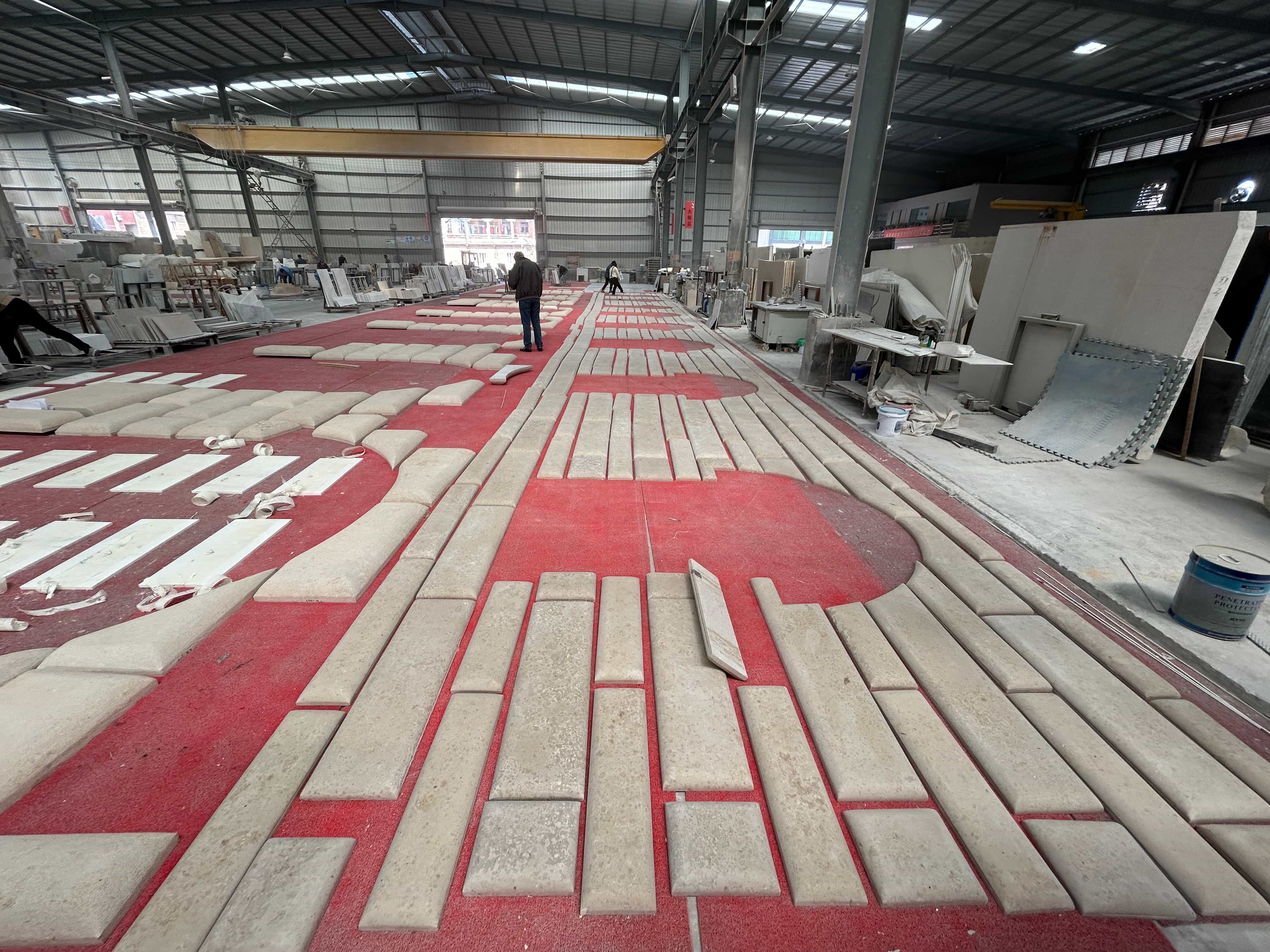
Layout and packaging area: the final check before natural stone containers leave the facility.
SONGJIA's Onyx Supply Model: From Technical Documentation to Project Delivery
Xiamen Songjia Trading Co., Ltd. (SONGJIA), a natural stone specialist based in Xiamen, China, is an example of a supplier organized around design-to-production integration. Established in 2010 with origins tracing back to Longxiang Stonecutter, SONGJIA supplies granite, marble, quartzite, limestone, onyx, travertine, and stone furniture to international stone importers, contractors, fabricators, designers, and private custom clients. Its export markets include Europe, North America, Southeast Asia, the Middle East, and Australia.
SONGJIA operates as a supply network coordinator rather than a single-factory manufacturer. The company works with a mature and flexible manufacturing and supply network, which allows it to cover different stone types and production requirements without being limited to one factory's equipment. Its facilities include a 20,000 m² base, with a team of around 60 employees including three engineers focused on design and production technical support.
For onyx orders, this model has a direct procurement implication. The technical team can convert client sketches, architectural drawings, and design concepts into accurate, producible shop drawings before production begins. That step helps reduce miscommunication, control cost, and prevent errors that often appear when a buyer sends a design directly to a factory without technical review.
The company's annual output is around 150 containers of monument products and 200 containers of building materials. Monthly production capacity ranges from 10 to 30 containers depending on product category and production schedule. Normal lead time is 15 to 30 days, depending on product type and order quantity. Trial orders are acceptable, with minimum order quantity depending on the product type.
Quality Control and After-Sales Support in Onyx Sourcing
Quality control is a central factor in supplier evaluation. SONGJIA's inspection process covers four stages: raw material inspection, in-process inspection, finished product inspection, and pre-shipment inspection. For onyx, which is more fragile than granite, these checkpoints are particularly important because cracks, resin fills, or thin areas can be hidden until the stone is installed.
After-sales support also matters in evaluation. SONGJIA's process includes quality feedback follow-up, replacement or compensation for confirmed quality issues, and continuous order support. In a documented project with a building contractor, SONGJIA supplied natural stone for residential and commercial applications including facade, wall cladding, flooring, and countertops. The client shared completed project photos and the owner reported satisfaction with the quality. The project highlight was accurate fabrication, consistent quality, and project support.
Where Onyx Is Used: Applications and Customization Requirements
In typical luxury interior applications, onyx is specified for feature walls, countertops, vanity tops, backlit panels, and other decorative surfaces. Because these applications often require exact dimensions, edge profiles, and cutouts, customization capability is a necessary part of supplier evaluation.
SONGJIA offers customization across material, size, thickness, surface finish, edge profile, shape, engraving, packing, and logo marking. This range is useful for designers and contractors who need stone elements to match a broader architectural plan. For custom thickness requirements, for example, 30mm onyx can be produced upon request, which is relevant for large countertop islands and furniture pieces.
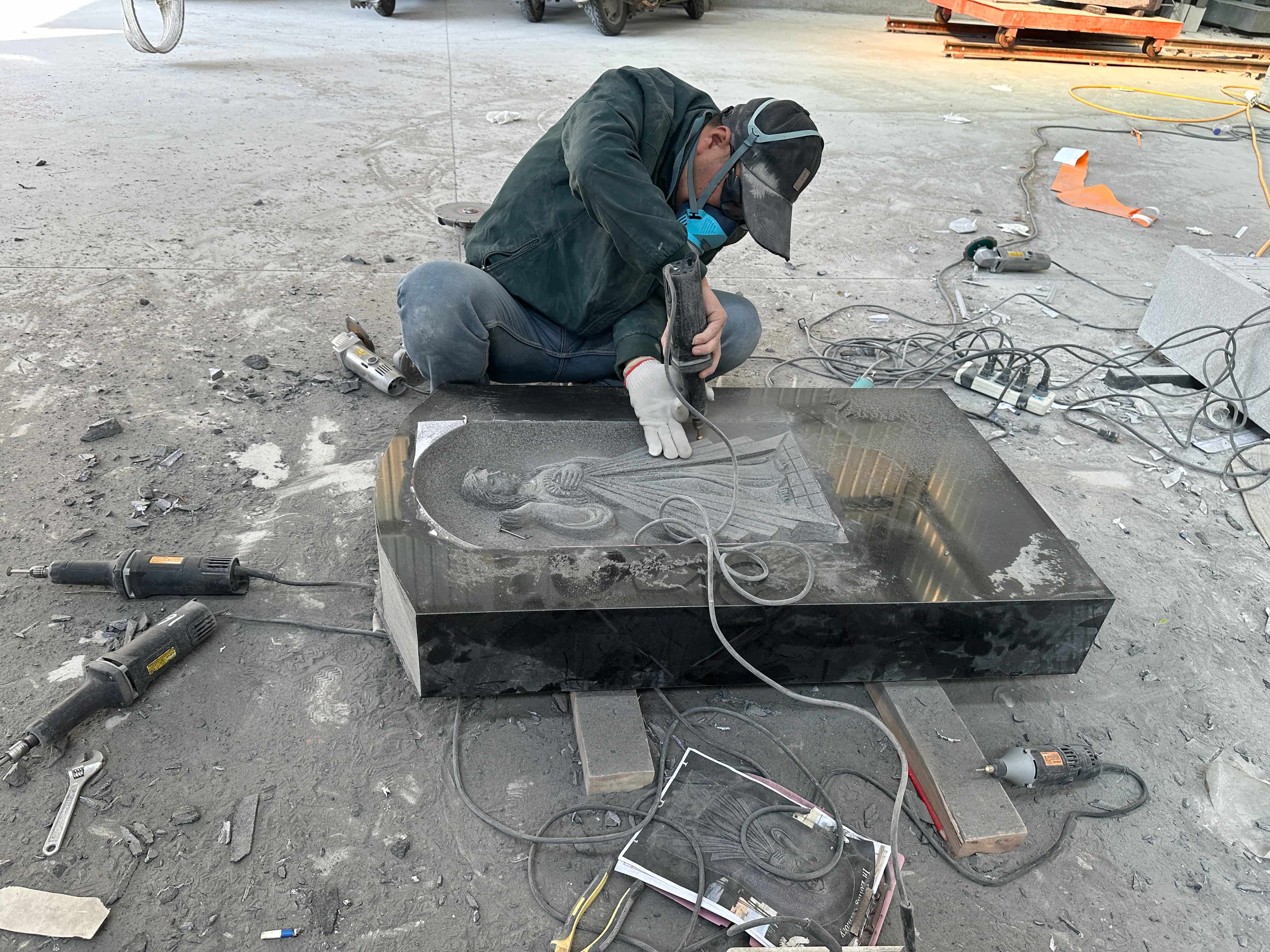
Engraving workshop for customized natural stone detailing.
Market Context: Natural Stone Demand and the Position of Specialist Suppliers
Market data helps frame the opportunity. The global natural stone market was valued at USD 10.2 billion in 2024 and is projected to grow to USD 14.11 billion by 2030, according to Grand View Research. Granite led product segments in 2024 with a revenue share of 39.6%. It should be noted that market size estimates vary across research firms because different definitions are used for what counts as natural stone; the important structural point for buyers is the sustained expansion of stone use in building and interior projects.
China remains a central supply base for this market. Export value for Chinese building stone was approximately USD 3.64 billion in 2024, with South Korea, the United States, and Japan among the top destination partners, according to OEC data. The global supplier landscape is fragmented: major players identified in recent market analyses include Cosentino S.A., Polycor Inc., and China's Xishi Stone Group, but no single company dominates the sector. For buyers, this fragmentation means that supplier selection requires direct technical verification rather than reliance on brand recognition alone.
From a procurement perspective, the growth in the overall natural stone market has serious implications for capacity planning. As demand increases, reliable suppliers often book production capacity in advance. Evaluation-stage buyers should therefore ask about current lead times and container availability, in addition to asking about quality and price.
Structured Supplier Evaluation vs. Traditional Transactional Sourcing
Traditional approaches to onyx sourcing often focus on three things: slab price, sample appearance, and delivery date. These are necessary but not sufficient. A structured evaluation adds technical specification verification, production documentation, quality inspection points, and project support capability.
The practical difference can be seen in how design changes are handled. In transactional sourcing, a modification to dimensions or edge profiles is passed to a factory without technical review, increasing the risk of production errors. In a design-to-production model, the supplier translates the design into shop drawings, checks manufacturability, and confirms details before production begins. That reduces rework and makes the final delivery more predictable.
One additional difference is communication structure. In traditional sourcing, the buyer manages multiple points of contact: the factory, the freight forwarder, and sometimes an agent. In an integrated supply model, the supplier coordinates production and shipping as part of the contract. This reduces the administrative load on the buyer and creates clearer accountability when issues arise.
There is also a limitation to the integrated supply model that buyers should understand. Because SONGJIA is not a single-factory manufacturer, buyers that require a fully vertical integration audit of one factory may need to arrange additional supplier verification and facility visits. And for very large orders concentrated on a single stone type, monthly container capacity of 10 to 30 units depends on the product category and the production schedule at the time of ordering. In practice, this means early capacity confirmation is advisable for large-scale projects.
Future Outlook: Design-to-Production Integration as a Supplier Standard
The direction of natural stone procurement points toward more integrated supplier models. Buyers and designers continue to push for stones that are distinctive, like onyx, but they also need suppliers who can manage the technical complexity that comes with these materials. The ability to combine material supply, technical documentation, and fabrication coordination is likely to become a more important selection criterion in the coming procurement cycle.
SONGJIA's positioning reflects that shift. Its operating model, which connects design coordination, production management, quality inspection, packaging, and international shipping, is structured to serve buyers who treat stone supply as part of a larger project delivery process, rather than as a one-time product purchase.
FAQ: Onyx Supplier Evaluation and Procurement
What is onyx stone and why is it used in luxury interiors?
Onyx is a natural stone known for its translucency. In product specification terms, it offers light transmittance ranging from 20% to 65%, which makes it suitable for feature walls, backlit panels, countertops, and vanity tops in high-end interior decoration.
What technical specifications should buyers check when evaluating onyx slabs?
Key parameters to verify include Mohs hardness, slab size, available finishes, light transmittance, thickness options, water absorption, and protection requirements. For onyx, typical values are Mohs hardness 3.0 to 4.0, light transmittance 20% to 65%, water absorption 0.1% to 0.3%, and mandatory Grade A sealing for stain and acid resistance.
How do Chinese onyx suppliers support custom fabrication and project orders?
Chinese suppliers with integrated design teams can support customization of material, size, thickness, surface finish, edge profile, shape, engraving, packing, and logo marking. In SONGJIA's case, the technical team converts client drawings and concepts into producible shop drawings before production, which supports accurate fabrication and consistent quality.
What certifications should a natural stone supplier hold for European construction projects?
For European construction applications, CE certification based on relevant EN standards is commonly used as evidence of product conformity. SONGJIA holds SGS-issued CE certificates for natural stone products, including G603 grey granite modular tiles under EN 12057 and G684 basalt slabs under EN 12058. Buyers should confirm the specific certificate scope matches their intended application.
How can buyers verify a supplier's quality control for onyx?
Buyers should ask about inspection stages in the production process. SONGJIA applies raw material inspection, in-process inspection, finished product inspection, and pre-shipment inspection. Requesting photos or third-party reports at each stage can help verify consistency before shipment.
What are typical MOQ and lead times for onyx sourced from China?
Trial orders are generally acceptable, with minimum order quantity depending on the product type. Normal production lead time is 15 to 30 days depending on product type and order quantity. Monthly capacity should be confirmed with the supplier because it depends on the product category and the current production schedule.
How should onyx be protected during installation and daily use?
Onyx requires Grade A sealing with anti-fouling and acid-resistant treatment. Its water absorption of 0.1% to 0.3% is low compared to many natural stones, but the material still needs protection, especially in kitchen countertops and bathroom vanity applications.
Additional technical documentation and company profile information are available at www.songjiaglobal.com.