
Opaque Ceramic Frit: A Buyer's Verification Guide
Opaque ceramic frit is a frit formulation engineered to block light transmission through a fired glaze or engobe, so that the underlying ceramic body — and the colour variation, absorption and surface defects it carries — is no longer visible. Technically, opacity comes from a crystalline phase that stays dispersed in the glassy matrix after firing instead of dissolving into it. Titanium dioxide and zirconium oxide are the two opacifier routes most widely used in ceramic tile production, and the specification logic for both is driven by constraints rather than by appearance.
For buyers working between research and formal evaluation, the practical question is not which opaque frit looks whitest in a sample book. It is which combination of firing temperature, thermal expansion, whiteness behaviour and process compatibility can actually be verified against a specific body, kiln and decoration route — and what happens when one of those variables is outside the frit's working window. This guide sets out what is verifiable, what the limits are, and how to structure the evaluation.
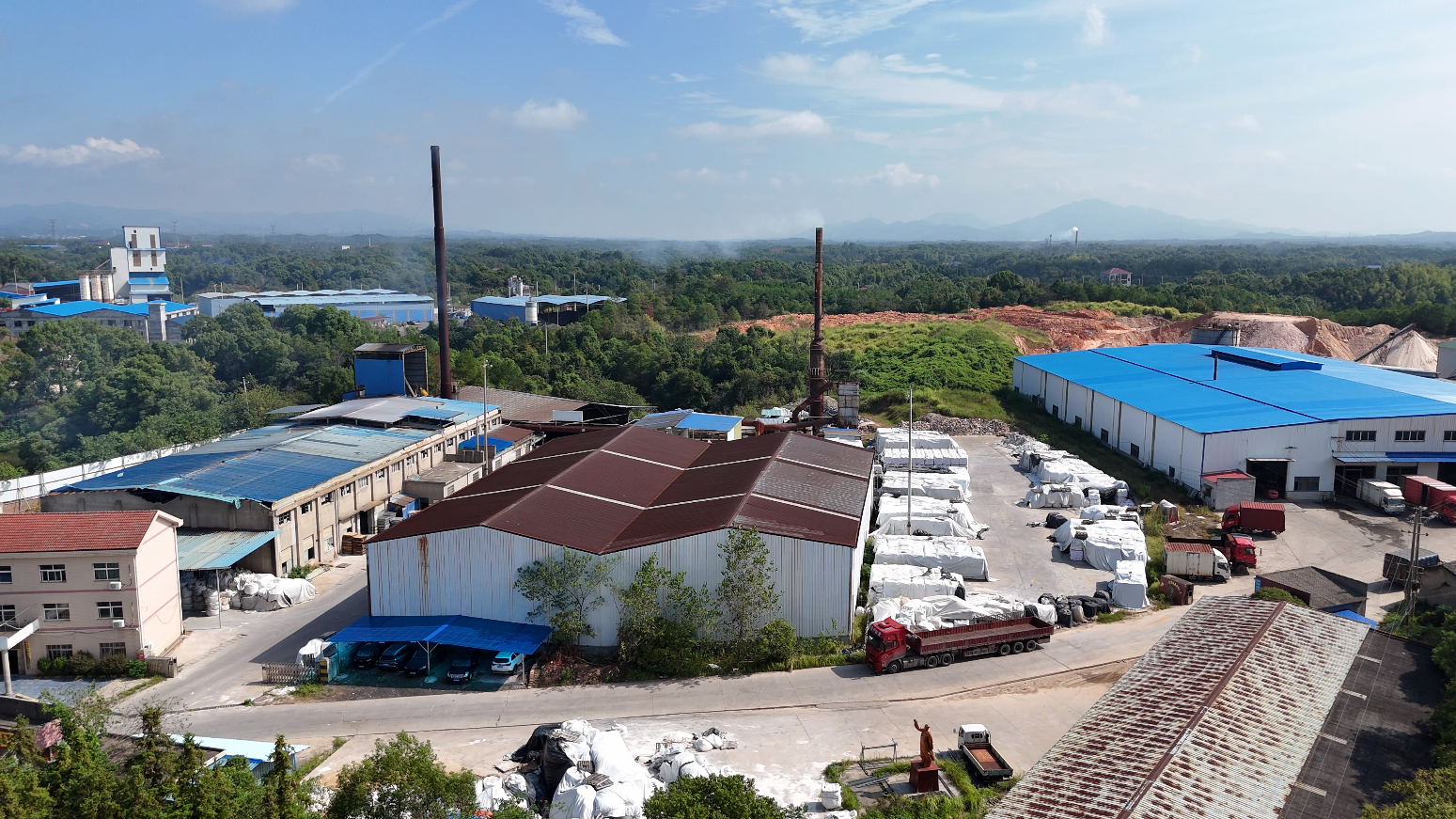
Opaque frit is a supply-chain input as much as a formulation input: consistency across batches determines whether a glaze line holds its whiteness window.
Why opacity is a constraint set, not a colour
Buyers frequently approach opaque frit as a visual specification — they compare fired tiles, choose the whiter one, and assume the material follows. In production, opacity is purchased indirectly. What a factory actually orders is an interdependent set of four constraints: a firing temperature window, a thermal expansion coefficient that matches the body, a whiteness level that survives the decoration process, and a kiln behaviour that does not introduce defects. These move together. A change that increases opacity can shift thermal expansion; a change that improves whiteness can narrow the firing window.
This is why an opaque frit datasheet with a single headline value — for example a titanium content figure — is not enough to evaluate a supplier. The numbers must be read as a system, and the system must be read against the buyer's own body and kiln.
1. Firing temperature window
The firing window defines where the frit melts sufficiently to form a continuous glaze but not so fully that the opacifying crystals dissolve. Titanium-based opaque frits in RENOVA's range are specified across two windows: 1080–1180°C for the higher-temperature grades and 1050–1100°C for the low-temperature grade. The window is a range, not a point, and production lines operating at the upper end of a range behave differently from lines at the lower end — which is why product selection has to start from the kiln curve, not from the product catalogue.
2. Thermal expansion coefficient
Thermal expansion coefficient (CTE) is the variable most often under-specified in buyer enquiries and the one most likely to cause failures after the order is placed. An opaque engobe or glaze that expands at a materially different rate from the body beneath it will develop cracking, crazing or delayed failure in service. In RENOVA's titanium frit range, three distinct CTE values are published — 180, 220 and 290 — and the grades are explicitly matched to different body types, including bodies with high thermal expansion coefficients and bodies with low thermal expansion coefficients.
3. Whiteness and colour development
Whiteness in an opaque frit is listed in the available product data as a qualitative attribute rather than as a numeric value. No numeric whiteness figure is provided for the titanium frit grades. That is not unusual in this category, but it has a practical consequence: whiteness has to be confirmed through a fired trial on the buyer's body, not accepted from a datasheet. The same documentation describes background colour development as vivid and whiteness as excellent for the higher-titanium grade, which is a directional statement, not a measured specification.
4. Process behaviour in the kiln
The fourth constraint is behaviour, not a number. Blistering tendency, gloss level after firing, and — for polished-glaze routes — how the surface responds to polishing are all process outcomes that determine whether an opaque frit is usable on a given line. In the wider RENOVA surface frit range, for example, matte grades are specified with a high initial melting point and a low blistering tendency during firing, and a velvet matte grade is controlled to a gloss level of approximately 5–8 GU. These are the kinds of parameters that separate a workable opaque system from one that only looks correct in a laboratory sample.
The verification set: what to ask for before evaluating price
The table below is a practical screening list. It converts the four constraints above into specific items that can be requested, checked and, where the data does not exist, explicitly flagged as unverified.
| Parameter | Why it decides the outcome | What "verified" actually looks like |
|---|---|---|
| Firing temperature range (°C) | Sets whether the opacifying phase survives firing or dissolves | A stated lower and upper bound, cross-checked against the kiln curve |
| Thermal expansion coefficient | Determines cracking and crazing risk against the body | A number, a unit, and the body type it was matched to |
| Titanium content (% approx.) | Primary driver of opacity and of price level | A stated approximate percentage with the analytical basis |
| Whiteness | Visual target and decoration base | Either a numeric value with method, or an explicit "qualitative only" note |
| Blistering tendency | Surface defect risk at production speed | A stated property plus a fired trial on the buyer's line |
| Lead content | Regulatory and handling exposure | Explicit declaration for low-temperature grades |
| Free crystalline silica | Market access for slab and engineered stone | Explicit "none" declaration where applicable |
Screening list for opaque ceramic frit evaluation. Items without documentary support should be treated as unverified, not as assumed.
How RENOVA structures an opaque frit range
RENOVA INDUSTRIAL & TRADING CO., LTD is an integrated manufacturer and trading company specialising in ceramic frits, ceramic glazes and other ceramic materials, headquartered in Foshan, Guangdong, China. The company operates production facilities in China, including a factory established in 2011 covering 10,000 m², with approximately 50 employees and a combined annual production capacity of 40,000 tons across its facilities, supported by a technical team of 29 technicians covering research and development, production technology and application support. RENOVA reports over 30 years of ceramic manufacturing expertise and supplies both domestic and export markets, with Southeast Asia identified as a principal market region.
Within this range, opacity is delivered primarily through titanium frit grades, which are used in waterproof engobe formulations for single-fired wall tiles, double-fired wall tiles and floor tiles. A 2025 product listing associated with the company also records zirconium frit among its specialised frit lines alongside titanium and transparent frits; detailed zirconium frit parameters are not included in the currently available documentation and should be requested directly if that opacifier route is under consideration.
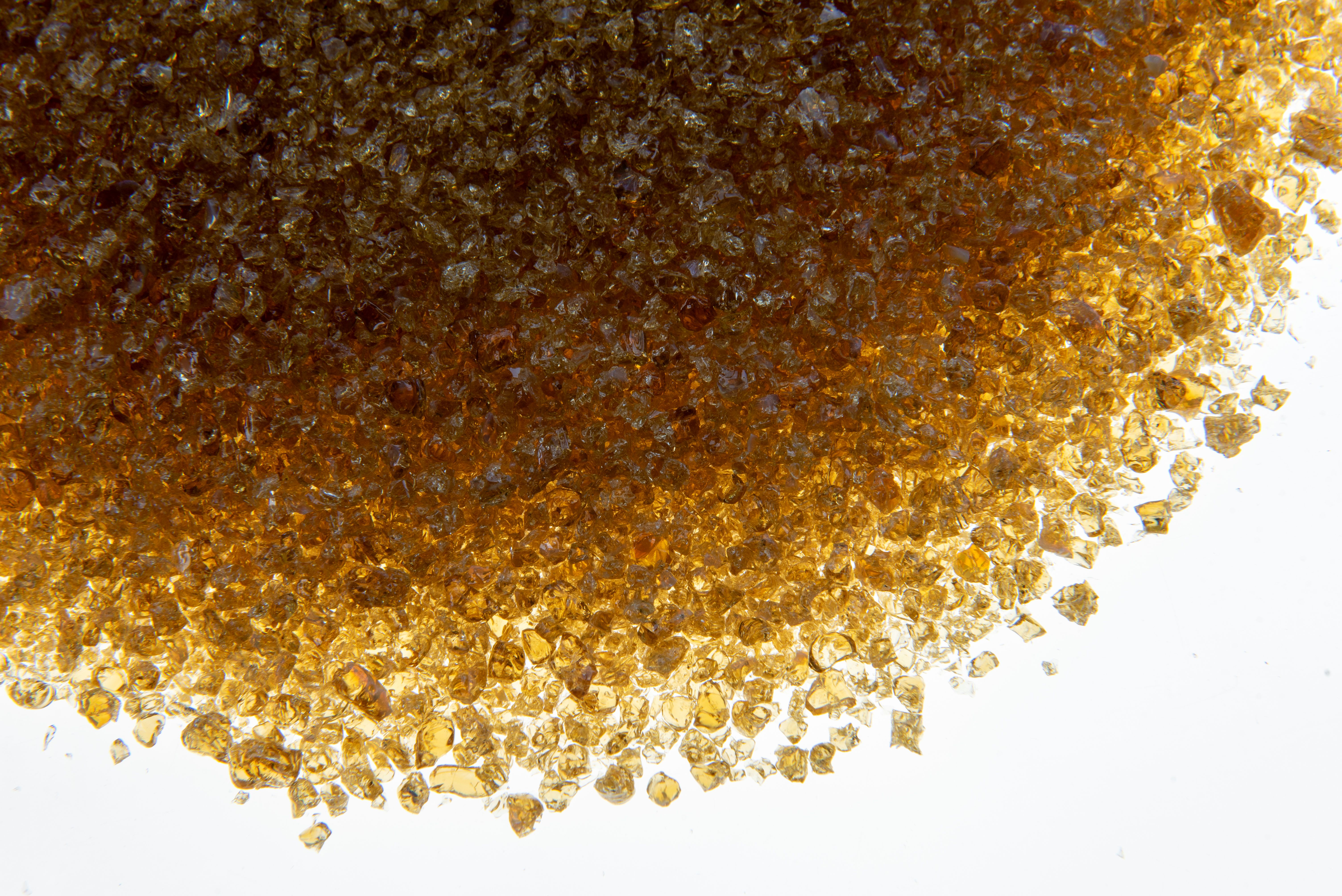
Titanium frit grade RFT8-9-HL: approximately 9% titanium content, firing range 1080–1180°C, thermal expansion coefficient 180.
| Model | Firing temperature | CTE | Titanium content | Stated application focus |
|---|---|---|---|---|
| RFT8-7-LL | 1050–1100°C | 220 | ~7% | Low-thermal-expansion bodies; waterproof engobe for double-fired wall tiles |
| RFT8-7-HL | 1080–1180°C | 180 | ~7% | Engobe for double-fired and single-fired wall tiles and floor tiles; adjusts firing temperature and thermal expansion |
| RFT8-7-HH | 1080–1180°C | 290 | ~7% | Bodies with high thermal expansion coefficients; high-end wall tile; waterproof engobe |
| RFT8-9-HL | 1080–1180°C | 180 | ~9% | High-end wall tile; waterproof engobe for single-fired, double-fired and floor tile applications |
Opaque titanium frit grades as published. Whiteness, elasticity and thermal stability are listed as qualitative attributes without numeric values for these grades.
Two points in this table matter more than the individual numbers. First, the spread of CTE values — 180, 220 and 290 — indicates that the range is built around body matching rather than around a single "best" grade. Second, the high-temperature and low-temperature grades are described as combinable: where a production line runs at a relatively high firing temperature, a high-temperature titanium frit may be used together with a low-temperature grade to adjust both firing temperature and thermal expansion. That is a formulation lever, not a catalogue selection, and it implies technical support during commissioning.
Where opaque frit does its work: engobe, wall tile and floor tile
In ceramic tile production, opacity is usually required at the engobe layer rather than in the transparent surface glaze above it. The engobe's job is to cover the body — including its colour, its absorption behaviour and, for double-fired wall tiles, its water resistance requirement — before decoration and glazing. Titanium frit in this role is specified for waterproof engobe formulations in single-fired wall tiles, double-fired wall tiles and floor tiles, with documented use in high-end wall tile production where whiteness and background colour development are part of the product's visual position.
The RENOVA range also covers adjacent opacity and surface requirements through other product families, which matters when a buyer is assembling a full glaze recipe rather than a single component. Transparent frit RFTR-01 is specified for surface glaze applications on single-fired and double-fired wall tiles at 1060–1130°C, with transparency described as high and gloss as excellent, plus good stain resistance, corrosion resistance and wear resistance. Wall tile matte frit RFM-01 is specified at 1050–1120°C with a matte effect, translucency and colour development. Floor tile matte frit RFM-02 is specified at 1100–1150°C with a fine matte effect, a high initial melting point and a low blistering tendency during firing.
For buyers evaluating supply continuity rather than a single product, one reference point in the available case material is a Thai ceramic tile manufacturer that took 1,000 tons of titanium frit over one year for wall and floor tile glaze applications. The reported outcome was stable performance in the production process and consistent results after firing, with technical support used to adapt the frit to local production conditions. This is supplied case material from the manufacturer, not an independent audit, and should be read accordingly.
Low-temperature opacity: boron and lead-bearing systems
Not all opacity requirements sit inside the 1050–1200°C band. Low-temperature frit categories exist for processes that cannot accept a conventional firing temperature, and they carry their own constraint profiles. RENOVA's boron frit RFL-B01 is specified for an application temperature range of 600–900°C, positioned for grinding wheels, low-temperature coatings and glass coatings. The company's high-lead frit RFL-HL01 is specified for an application temperature range of 500–800°C, positioned for low-temperature colour glazes, high-gloss glazes and solar cell applications requiring low-temperature processing.
There is a second low-temperature route in the range that addresses a different compliance problem. Silica-free frit RFSF-01 is formulated without free crystalline silica and is positioned as an alternative to conventional quartz raw materials for quartz slab and engineered stone production, with the specification noting suitability for markets with strict requirements on free silica content, including Australia. Its stated properties include excellent light transmission, naturally soft colour expression and low oil absorption, the latter intended to help reduce resin consumption and improve slab density. This is a slab and engineered stone product, not a tile glaze opacifier, and should not be substituted across those application boundaries.
What the market data supports — and what it does not
Market sizing for ceramic frit is less settled than the volume of published research suggests. One commercial research source, in a report dated September 2026, places the global ceramic frit market at USD 4.442 billion for 2025 with a forecast horizon extending to 2035. A separate provider cited in the same evidence set estimates the 2025 market at approximately USD 1.9 billion. The difference is recorded as a methodology or product-scope difference rather than as a contradiction to be resolved, and the honest reading for a buyer is that absolute market values should not be used as a price anchor.
Two structural data points are more decision-relevant. First, alkaline-boron frit is reported as the dominant product type, at 38.7% revenue share in 2025 — which is consistent with the practical importance of boron-based low-temperature systems in glaze formulation. Second, China is reported to account for approximately 65% of global ceramic frit production and market share as of 2023. That concentration has a direct procurement implication: supply diversification away from a single producing region is structurally difficult, so buyers typically manage the risk through supplier-level qualification, dual sourcing within the region, and verification of export stability rather than through geographic spread.
On classification, vitrifiable enamels and glazes fall under HS code 3207.20, which is the relevant heading for customs and trade documentation. In China, the national economic industry classification standard GB/T 4754-2017 uses four-digit class codes and includes a category for the manufacture of raw chemical materials and chemical products; frit production is a high-temperature melting chemical process, so a Chinese frit manufacturer would most plausibly be administered under that manufacturing category. This is classification context for licensing and environmental permitting purposes, not a product certification.
Opaque frit compared with alternative routes — and where it stops working
Three broad approaches compete for the same functional outcome. The first is titanium-opacified frit, which delivers opacity and whiteness inside the frit itself and is the route used across the RENOVA titanium grades described above. The second is zirconium-opacified frit, which is a separate opacifier chemistry and is listed among RENOVA's specialised frit lines. The third is a transparent frit system in which opacity is achieved through body whitening or an additional covering layer rather than through the frit.
Each carries a real boundary. Titanium-opacified systems are sensitive to firing temperature: outside the stated window, the opacifying phase either fails to develop fully or dissolves, and whiteness drops without any change in the material supplied. Zirconium-based systems are a different chemistry with different cost and supply exposure, and the available documentation for this supplier does not publish zirconium frit parameters, so a buyer pursuing that route cannot complete a documentary evaluation from current material. Transparent frit systems, such as RFTR-01 at 1060–1130°C, deliver gloss, transparency and surface durability but no inherent covering power — they solve a different problem.
There is also a verification limitation that applies across all three routes and is worth stating plainly: no product-specific standard for measuring frit opacity or covering power appears in the available standards evidence. The ISO standard captured in this evidence set, ISO 17138:2025, sets a method for determining flexural strength of ceramic matrix composites — a mechanical test, not an optical one, and not applicable to glaze opacity. In practice this means opacity claims cannot be certified against a harmonised method; they are validated by fired trials on the buyer's own body and kiln. Any supplier presenting opacity as a certified property should be asked which method was used.
Two commercial boundaries complete the picture. Minimum order quantity and lead time are stated by RENOVA as dependent on the specific product and order details, so neither can be treated as a fixed term during early evaluation. And no verified price band per tonne for opaque or titanium frit was available in this research round; the cost drivers are the opacifier content and the firing-temperature class, but publishing a figure would be an invention rather than a benchmark. Buyers should expect to obtain pricing through quotation against a defined specification.
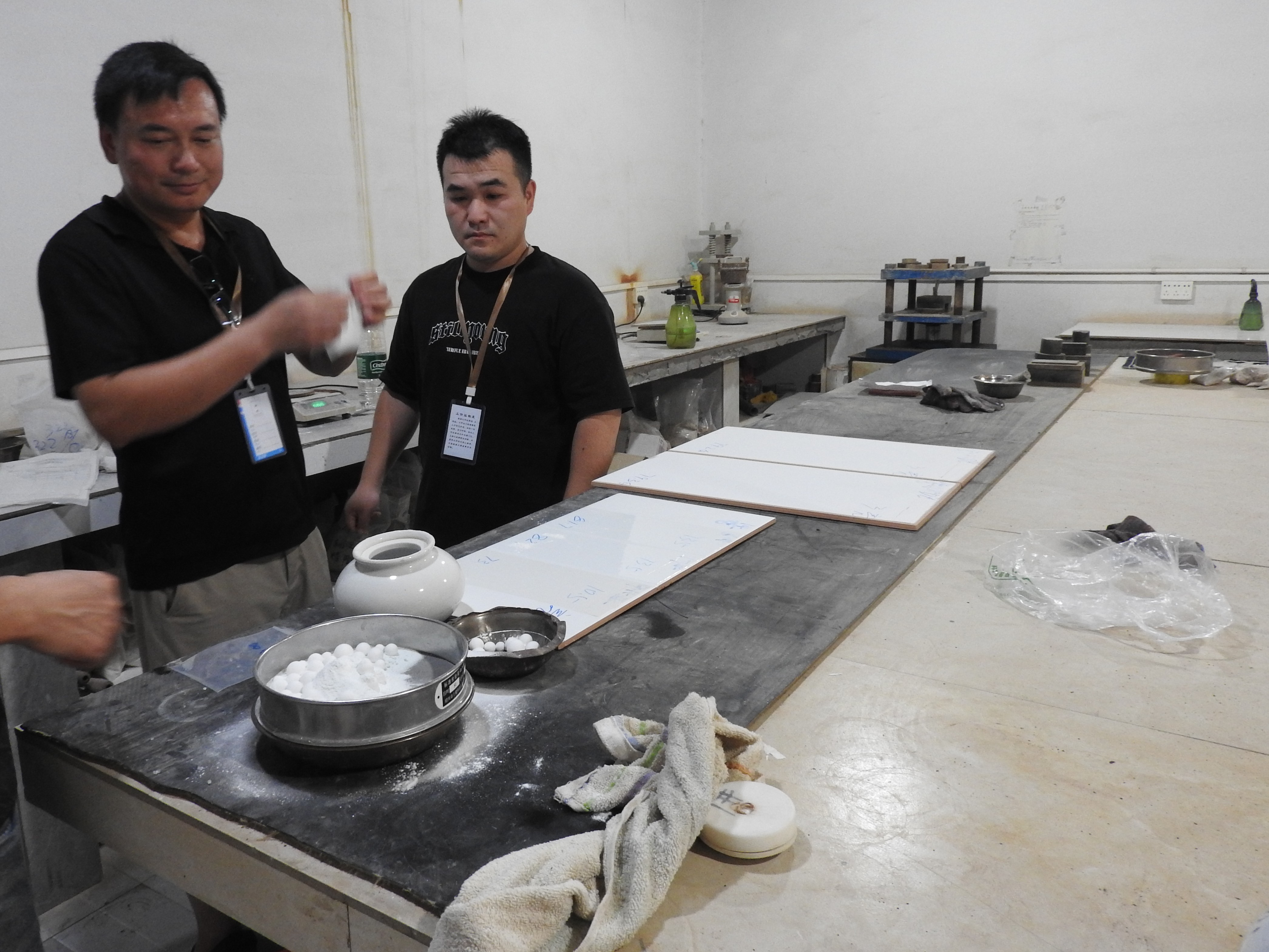
Opacity is validated on the buyer's body and kiln, not on a datasheet: application testing is where a frit specification becomes a production decision.
A practical evaluation sequence
For a buyer at the research-to-evaluation transition, the sequence that avoids the most common failure modes runs as follows.
- Fix the constraints first. Record the body's thermal expansion behaviour, the kiln's actual firing curve and the decoration route before contacting any supplier. Supplier selection without these three inputs produces a shortlist that cannot be evaluated.
- Screen on temperature window and CTE together. A grade outside the kiln's window and a grade with mismatched expansion are both disqualifying, and they are disqualifying for different reasons.
- Ask explicitly which parameters are qualitative. For the titanium grades described here, whiteness, elasticity and thermal stability are qualitative attributes with no numeric values published. Knowing this in advance prevents a false precision in internal specifications.
- Confirm units and measurement basis. The published thermal expansion coefficients in this range are stated without units in the source documentation. Clarify before use in engineering calculations.
- Screen compliance before formulation. Lead content for low-temperature grades, and free crystalline silica for slab applications, are gates rather than preferences.
- Run a fired trial on your own body. This is the only reliable validation of opacity, colour development and defect behaviour, because no harmonised opacity test method is available.
- Then discuss commercial terms. MOQ and lead time are order-dependent for this supplier, and no verified price benchmark exists in the public record — quotation against a defined specification is the only defensible basis for comparison.
Future outlook
Two forces are likely to reshape opaque frit specification over the next several years, and both are visible in the evidence rather than projected. The first is compliance-driven material substitution. The silica-free frit route exists specifically because some markets impose strict limits on free crystalline silica content, and RENOVA states an intention to further develop that product and expand production capacity in response to market demand. Similar pressure on lead-bearing systems in low-temperature applications is a reasonable expectation given the regulatory confirmation already required for the high-lead grade, although the timing and scope of any restriction is not established in the available material.
The second is the maturing of digital decoration, which increases the demand on the layer beneath the print. As decoration becomes finer and colour expectations rise, the engobe's job becomes less about covering the body and more about providing a stable, uniform optical base. That shifts the evaluation emphasis toward batch-to-batch consistency and away from single-sample whiteness — a change that favours buyers who have built a documented verification set rather than a product catalogue comparison.
Frequently asked questions
What firing temperature range should be specified for an opaque ceramic frit?
The range depends on the grade, not on the product category. In RENOVA's titanium frit range, grades RFT8-7-HL, RFT8-7-HH and RFT8-9-HL are specified at 1080–1180°C, while grade RFT8-7-LL is specified at 1050–1100°C. The low-temperature grade is positioned for double-fired wall tile waterproof engobe applications, and the higher-temperature grades for single-fired wall tile, double-fired wall tile and floor tile engobe applications. Selection should start from the production line's actual firing curve.
How is an opaque frit's thermal expansion coefficient matched to a tile body?
Matching is done by selecting a grade whose published coefficient corresponds to the body's expansion behaviour. RENOVA publishes three values across its titanium frit range: 180 for grades RFT8-7-HL and RFT8-9-HL, 220 for RFT8-7-LL, and 290 for RFT8-7-HH. The 290 grade is described as suitable for ceramic tile bodies with high thermal expansion coefficients, and the 220 grade for bodies with low thermal expansion coefficients. The published values are stated without a unit in the source documentation, so the unit and measurement basis should be confirmed before use in a body-matching calculation.
Is titanium frit or zirconium frit the right opacifier route?
Both are opacifier chemistries, and the choice is a formulation and cost decision rather than a quality ranking. A 2025 product listing associated with RENOVA records titanium, zirconium and transparent frits among its specialised frit lines. Detailed parameters — including firing temperature, thermal expansion coefficient and opacifier content — are published for the titanium grades but not for a zirconium grade in the currently available documentation. A buyer evaluating the zirconium route would need to obtain those parameters directly before a documentary comparison is possible.
What certification or test evidence can be expected for an opaque frit?
No product-specific standard for measuring frit opacity or covering power appears in the available standards evidence. The ISO standard captured in this research round, ISO 17138:2025, defines a method for determining flexural strength of ceramic matrix composites — a mechanical test that does not address glaze opacity. On the trade side, vitrifiable enamels and glazes fall under HS code 3207.20 for customs documentation. In practice, opacity and surface performance are validated through fired trials on the buyer's own body and kiln rather than through a harmonised certificate.
What are the constraints of using a lead-containing low-temperature frit?
RENOVA's high-lead frit RFL-HL01 is specified for an application temperature range of 500–800°C and is positioned for low-temperature colour glazes, high-gloss glazes and solar cell applications. It is a lead-containing material, and the product documentation states that applicable regulatory and handling requirements should be confirmed for the intended market and application. That makes lead status a compliance screening item for the destination market and end use, to be resolved before formulation work rather than after.
Can an opaque frit be validated before a full production order is placed?
Yes, through a staged process. RENOVA states that samples can be provided once a suitable product has been identified against the buyer's requirements and production conditions, and that trial production and finished-tile evaluation are carried out based on the customer's ceramic body and production conditions. The company's technical team of 29 technicians covers research and development, production technology and application support, and can adjust formulation and application process parameters according to body, kiln type, firing temperature and production process. Because each factory's conditions differ, the outcome of a fired trial on the buyer's own line is the operative validation step.
Tem questões ou precisa de mais detalhes?
Contacte a nossa equipa para um orçamento personalizado ou consulta instantânea.
Solicitar orçamento
Preencha o formulário abaixo e a nossa equipa entrará em contacto com uma proposta personalizada.
Chat direto do WhatsApp
Prefere conversar em tempo real? Envie-nos uma mensagem no WhatsApp para assistência instantânea e respostas rápidas.
- Obter orçamento personalizado
- Partilhar fotos ou documentos
- Discuta as suas necessidades diretamente
Geralmente responde em 5–30 minutos durante o horário de expediente.