
Open-Circuit vs Closed-Circuit Ball Mills for Cement and Limestone
A buyer-side comparison of the two grinding circuits used in cement and limestone duties, built on published model ranges, one documented 70 t/h grinding station, and the conformity documents that European and Middle East importers now ask for before a technical meeting even starts.
In cement and limestone processing, the ball mill is rarely the variable that decides whether a project meets its specification. The circuit around the mill is. Two projects can order the same shell, the same liner material and the same grinding media, and still end up with different product curves, different auxiliary power demand and different maintenance workloads — because one finishes the material in a single pass and the other classifies it and sends the coarse fraction back.
That distinction — open circuit versus closed circuit — is the practical decision point for independent buyers comparing ball mill offers for clinker, limestone and raw meal. This reference compares the two arrangements on the criteria that actually appear in procurement documents: fineness control, continuous operation, equipment count, conformity scope, and the throughput ranges that vendors quote.

Cement ball mill installed for continuous clinker and limestone grinding. Circuit selection — open or closed — determines how fineness is controlled downstream of the mill.
What the Published Model Range Tells a Buyer Before Any Quote Is Issued
The most useful starting point for a circuit comparison is the equipment envelope a supplier is actually able to build, because that envelope constrains which circuit options are even available. For the Cement Ball Mill platform referenced in this article, the published data is specific: model designation Φ1.2×4.5–Φ4.6×10, throughput approximately 1.4–87 t/h, shell diameter 1.2–4.2 m, mill shell manufactured from Q235B or Q345B structural steel. The same product entry describes the mill as designed for continuous cement grinding, with adjustable product fineness and specific surface area, and states that open-circuit or closed-circuit grinding are both supported, with the option to combine the mill with a roller press and a separator in a grinding system.
The wider Ball Mill platform, which shares the same duty family, is published as Φ1.2×4.5–Φ4.6×10+3.5 with a grinding capacity of approximately 0.8–230 t/h, feed size ≤25 mm, product size approximately 0.07–0.4 mm adjustable according to process requirements, dry or wet grinding, and grate or overflow discharge options. Liner materials listed across the platform include high-manganese steel, alloy steel, cast iron, rubber and ceramic, selected according to the processed material and the operating conditions.
Two things follow from that. First, the model range and the shell diameter range are starting constraints, not performance promises: a 1.4 t/h duty and an 87 t/h duty sit inside the same product family but require different engineering. Second, the availability of both open and closed circuit within one product family means the circuit decision is not dictated by the equipment supplier — it is dictated by the buyer's process.
Open Circuit vs Closed Circuit: Side-by-Side
The table below compares the two arrangements on the criteria that most often appear in a cement or limestone grinding specification. Where a figure is quoted, it comes from published product data or from the documented project referenced later in this article. Where no figure exists, the comparison is stated qualitatively rather than estimated.
| Comparison point | Open circuit | Closed circuit |
|---|---|---|
| Material path | Single pass through the mill; discharge is final product | Mill discharge is classified; fines become product, coarse returns to the mill |
| Additional equipment | Mill plus feed, conveying and dust collection | Mill plus separator/classifier, return conveying, additional dust collection points and control loops |
| Fineness control | Set by mill internals, media charge and residence time; adjustable within the mill's published product size range | Separator setting becomes the primary control; product fineness and specific surface area are adjustable during operation |
| Particle size distribution | Generally wider, with a coarser tail | Generally narrower, with less coarse material leaving the system |
| Reference figures | Ball Mill product size approximately 0.07–0.4 mm, adjustable | Documented cement grinding station: product fineness adjustable within 280–650 m²/kg with an O-Sepa classifier |
| Throughput reference | 1.4–87 t/h (Cement Ball Mill); 0.8–230 t/h (general Ball Mill platform) | Same mill envelope; 70 t/h documented in the Φ4.2 m closed-circuit reference project |
| Operating mode | Continuous | Continuous |
| Principal constraint | Cannot correct an oversize tail if the specification tightens after commissioning | Benefit depends on separator performance and stable feed; more maintenance interfaces and more instrumentation |
All figures above are published product data or documented project data. They are reference points for comparison, not guaranteed outputs for a specific project.
What the Documented Closed-Circuit Reference Actually Contains
A 70 t/h cement grinding station supplied for a cement producer offers the clearest available example of how a closed circuit is assembled in practice. The installation integrates clinker pre-crushing, cement grinding, high-efficiency classification, cement storage, discharge screening, weighing and multi-point dust collection. A single-stage box-type hammer crusher pre-crushes clinker and limestone to reduce the crushing load on the mill; a Φ4.2 m large ball mill then grinds at 70 t/h; and the mill operates in closed circuit with an O-Sepa high-efficiency classifier, where fine powder is separated as finished cement and coarse particles are returned to the mill for further grinding. Product fineness is adjustable within 280–650 m²/kg. Two steel silos store the finished cement, with vibrating screens installed underneath to prevent agglomerated material from entering dispatch.

Documented 70 t/h cement grinding station: pre-crushing, Φ4.2 m ball mill and closed-circuit classification with adjustable product fineness within 280–650 m²/kg.
Two distinctions matter for a buyer reading this. First, this is a project-reported outcome: the station is described as energy-saving, environmentally compliant and high-capacity, and that description reflects the project's own design intent and results — it is not a general performance guarantee that transfers to a different material, feed size or target fineness. Second, the classification step is what converts an ordinary grinding pass into a controlled fineness output. Remove the classifier and the same mill becomes an open-circuit unit with a wider product curve.
Cement Duty vs Limestone Duty: Same Platform, Different Constraints
Cement clinker and limestone are both listed among the applicable materials of the Cement Ball Mill platform, and the same product family lists “Limestone Ball Mill” alongside “Cement Ball Mill” as a type designation. That does not mean the two duties behave identically in a circuit.
The practical difference is where the limestone sits in the flow. Limestone destined for raw meal is processed on the Raw Mill, published as Φ1.2×4.5–Φ3.5×10 m with a grinding capacity of 1.7–73 t/h, a grinding media load of 5–118 t, and adjustable, uniformly specified raw meal fineness. Limestone ground to cement fineness sits on the Cement Ball Mill platform and is subject to the same fineness targets as clinker. Because the two feeds differ in grindability, moisture behaviour and target fineness, the media grading, liner selection and circuit setting that suit clinker will not automatically suit limestone — and the mill entry explicitly notes that liner material is selected according to the processed material and operating conditions.
For a buyer comparing offers, the useful question is therefore not “does this mill grind limestone?” but “which circuit and which internal configuration has been proposed for the specific limestone feed, moisture level and fineness target?” That question exposes whether an offer has been engineered or merely quoted from a catalogue.
Continuous Operation, Adjustable Fineness and Specific Surface Area
Cement grinding is a continuous industrial duty. The Cement Ball Mill is described as designed for continuous cement grinding, and continuous operation is the normal arrangement for ball mills in industrial service, with batch or intermittent operation belonging to other configurations — the Ceramic Ball Mill is published with batch/intermittent operation at 0.05–15 t per batch, and the Laboratory Ball Mill at 0.2–1.5 t per batch with 2.2–11 kW motor power and 23–35 rpm rotational speed.
The fineness side is where the two circuits diverge most sharply. On the Cement Ball Mill, product fineness and specific surface area are both described as adjustable, which in cement terms means the operator can move the target within the range the circuit and separator can support. In the documented closed-circuit station, that adjustable window is stated as 280–650 m²/kg. On the general Ball Mill platform, product size is published as approximately 0.07–0.4 mm, adjustable according to process requirements.
An open circuit can reach a fineness target; it simply does it by grinding everything to the target in one pass, which means the coarse tail is ground and re-ground in the same chamber and the finished product distribution is wider. A closed circuit removes finished fines as soon as they are fine enough, which is the mechanism behind both the narrower distribution and the adjustable specific surface area. Buyers who care about cement strength development, setting behaviour or downstream blending consistency usually care about exactly this difference.
Where a laboratory mill fits into the decision
Before committing to an industrial circuit, buyers can validate grindability and target fineness at bench scale. The Laboratory Ball Mill is published as Φ0.6×0.7–Φ1.8×2.1 m with 0.2–1.5 t per batch loading capacity, 2.2–11 kW motor power, 23–35 rpm rotational speed, and both dry and wet grinding support, applicable to ores, limestone, calcite, kaolin, bentonite, talc, mica, magnesite and ceramic materials. That is a materially cheaper way to test whether a proposed fineness target is realistic for a given limestone than commissioning an industrial circuit first.
Conformity and Market Access: What the CE Document Covers
For projects destined for the European Union, conformity documentation is a hard constraint rather than a preference, and it is one of the few areas where a buyer can verify facts independently of vendor claims. The Ball Mill platform holds CE certification issued under certificate number M.2024.206.C100982 by UDEM INTERNATIONAL CERTIFICATION AUDITING TRAINING Centre Industry and Trade Inc. Co., issued on 2024-05-16 and valid until 2029-05-16, applying to the EU market. The certification scope covers Machinery and Electromagnetic Compatibility, with standards listed as EN ISO 12100:2010, EN 60204-1:2018, EN IEC 61000-6-4:2019, EN IEC 61000-6-3:2021, EN IEC 61000-6-2:2019 and EN IEC 61000-6-1:2019. Related product entries in the same certification set cover the Cement Ball Mill, Raw Mill and Air-Swept Coal Mill, among others.
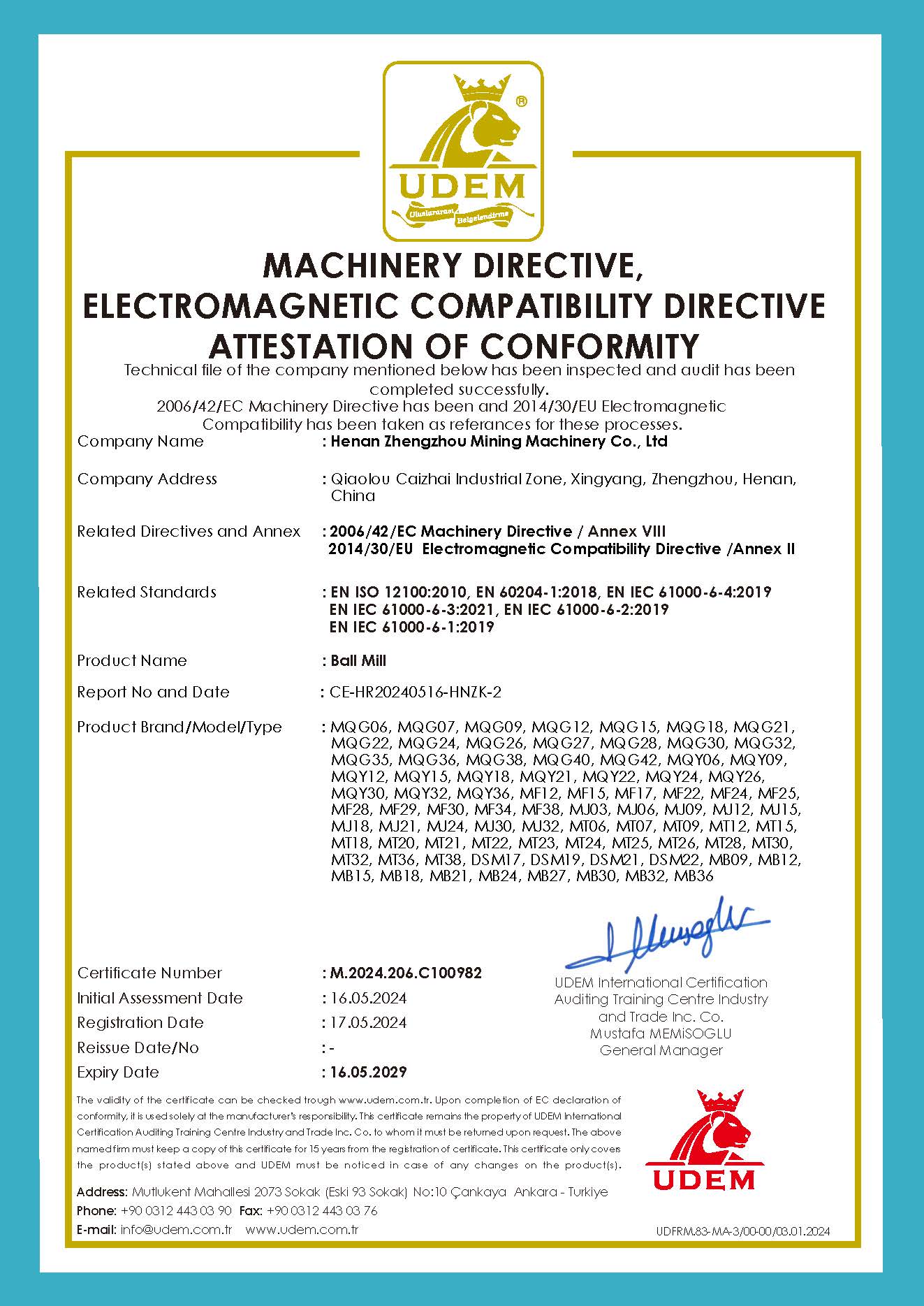
CE certification number M.2024.206.C100982, issued 2024-05-16, valid until 2029-05-16, covering Machinery and Electromagnetic Compatibility for the ball mill product scope.
The boundary here deserves emphasis. The certificate scope addresses machinery safety and electromagnetic compatibility under the listed standards. It is not a statement about grinding performance, throughput or product fineness. For a complete grinding line, the applicable conformity scope may involve the ball mill together with electrical and control systems, conveying equipment, dust collection equipment and other integrated machinery, and that scope should be confirmed against the final equipment configuration during the specification stage rather than assumed from a single product certificate.
Commercial Constraints Buyers Should Plan Around
Ball mills and rotary kilns are not standard catalogue products. Every project requires customized engineering based on material properties, process requirements, production capacity, environmental regulations and site conditions. On the manufacturing side, published capability data for this equipment family lists a minimum order quantity of 1 unit, a monthly production capacity of 10 units, a lead time of 3 months, and 100% testing. For a buyer planning a multi-mill installation, the capacity figure is the constraint that matters most: an order for three units consumes close to a full quarter of the monthly build capacity, and the three-month lead time is a floor before installation, commissioning and site works are counted.
On price, independent public estimates place small production mills in the 1–5 t/h class in a broad range of roughly USD 50,000 to USD 120,000, based on secondary industry estimates for gold ore, cement and recycling duties. That figure should be treated as a planning band for small-scale units, not as a quotation for a cement-duty mill, and the underlying source quality is medium — no independent price data was located for large cement grinding mills, whose cost is driven by engineered scope rather than catalogue size.
The cost structure of running a mill is more predictable than its purchase price. Tumbling mills work by converting electrical energy into mechanical energy, generating repeated fracture events in the process. Energy is therefore an inherent operating-cost driver of any ball mill, which is why power consumption per tonne should be treated as a core evaluation criterion even when public benchmark data is scarce — and why pre-crushing, liner selection and circuit configuration are commercially meaningful choices rather than technical decoration.
Comparison with Traditional Arrangements — and Where the Comparison Breaks Down
Compared with a plain open-circuit single-mill arrangement, the modern integrated system adds pre-crushing and classification. The documented station uses a single-stage box-type hammer crusher before the mill and an O-Sepa classifier after it, with the stated purpose of reducing crushing load on the mill, improving grinding efficiency, raising capacity and lowering energy consumption. The kinematic logic is straightforward: material that has already been reduced before entering the mill does not need to be broken down by impact and attrition inside it.
The limitations are equally straightforward and should be stated plainly:
- Closed circuit is not automatically more efficient. It adds a separator, return conveying, additional dust collection points and control loops. If the separator is poorly matched or its performance drifts, the return load rises, circulation increases, and the efficiency gain erodes.
- Open circuit cannot be corrected later without capital work. If the market requires a finer cement or a narrower distribution after commissioning, an open mill has no separator to adjust — the change becomes a mill re-configuration.
- Throughput figures are ranges, not guarantees. The published 1.4–87 t/h window for the Cement Ball Mill moves with material grindability, feed size, moisture, target fineness and circuit arrangement. The general Ball Mill platform states a feed size of ≤25 mm; feeds outside that envelope generally require a crushing or pre-grinding stage.
- Moisture is handled separately from fineness. Some designs integrate drying — the Air-Swept Coal Mill, published at 1.4–16 t/h with 45–570 kW motor power, 85%+ passing 200 mesh and coal moisture below 2% under the stated operating conditions, is built for integrated grinding and drying. That integration is a design feature of that mill family, not a property that transfers automatically to a cement-duty mill.
- Project results are project results. The reported energy-saving and capacity outcomes of the 70 t/h station describe that installation under its own feed and specification. They are evidence of what has been built and delivered, not a forecast for a different site.
Market Signals Worth Reading Carefully
Two external data points are relevant to buyers timing a grinding investment, and both come with scope caveats that matter more than the headline number.
The global market for ball mills used in mining was reported at USD 4.94 billion in 2025, with a projection of USD 8.23 billion by 2034, based on commercial research segmented by wet and dry grinding and application. The scope is mining ball mills — cement and limestone grinding demand is not directly captured in that figure, so it should be read as a directional indicator of grinding equipment demand rather than a cement market measure.
On the supply side, China was the leading exporter of machines to crush or grind stone, ores and minerals (HS 847420) in 2024, at USD 1.38 billion, based on customs-derived trade data. The HS category is broader than ball mills alone, but it confirms where a substantial share of global grinding equipment manufacturing capacity sits — which is directly relevant to lead times, spare parts logistics and documentation support for importers in the Middle East, Southeast Asia and Africa.
It is worth noting what the available verified data does not contain. No independent measured performance data — such as specific energy consumption in kWh per tonne or grind size distributions — was located for this equipment category, and no verified market-size split between cement and mining applications exists. For a buyer, that absence is itself a procurement signal: performance claims should be verified against a supplier's own test records, reference installations and documented specifications rather than against industry averages that may not cover the relevant duty.
Future Outlook
The direction of the segment is toward integration and documentation rather than bigger single machines. Pre-crushing ahead of the mill, high-efficiency classification after it, and adjustable fineness windows are already standard in new cement grinding stations, and the equipment envelope — Φ1.2×4.5 to Φ4.6×10 with a 1.2–4.2 m shell diameter range and a 1.4–87 t/h throughput window — is broad enough to cover small regional grinding stations and large integrated plants within one engineered product family.
Two procurement expectations are likely to harden over the next development cycle. First, energy per tonne will increasingly be treated as the primary comparison metric even where public reference data is thin, which pushes buyers toward pilot testing and reference-site visits instead of brochure comparison. Second, conformity documentation will increasingly be screened before technical evaluation, not after, particularly for EU-bound projects where the applicable scope has to be defined at specification stage. For independent buyers, the practical consequence is that circuit choice should be decided early — because open versus closed circuit changes the equipment list, the control scope, the conformity scope and the maintenance plan, and retrofitting that decision later is the expensive path.
FAQ
Can one ball mill be used for both cement clinker and limestone grinding?
Yes. The Cement Ball Mill platform lists both clinker and limestone among its applicable materials, and “Limestone Ball Mill” appears as a type within the same product family alongside “Cement Ball Mill”. The configuration — liner material, media grading, circuit arrangement and target fineness — should be selected according to the specific feed and product requirement, because the published data notes that liners are chosen according to the processed material and operating conditions.
What is the difference between open-circuit and closed-circuit cement grinding?
In an open circuit, material passes through the mill once and the discharge is the finished product. In a closed circuit, mill discharge is classified: fine powder is separated as finished cement and coarse particles return to the mill for further grinding. The published Cement Ball Mill data states that both open-circuit and closed-circuit grinding are supported, and that the mill can be combined with a roller press and a separator in a grinding system.
What throughput range applies to the Cement Ball Mill?
The published capacity is approximately 1.4–87 t/h, with a model designation of Φ1.2×4.5–Φ4.6×10 and a shell diameter range of 1.2–4.2 m. The wider Ball Mill platform is published at approximately 0.8–230 t/h. These are ranges rather than fixed ratings: actual throughput depends on material grindability, feed size, moisture, target fineness and circuit arrangement.
How is product fineness controlled in cement grinding?
Product fineness and specific surface area are both described as adjustable on the Cement Ball Mill. In the documented 70 t/h closed-circuit station, product fineness is adjustable within 280–650 m²/kg using an O-Sepa high-efficiency classifier, with fine powder separated as finished cement and coarse particles returned to the mill. On the general Ball Mill platform, product size is published as approximately 0.07–0.4 mm, adjustable according to process requirements.
What feed size can a ball mill handle?
The general Ball Mill platform is published with a feed size of ≤25 mm. Where the feed is coarser than the mill's accepted range, a crushing or pre-grinding stage is generally required — the documented 70 t/h cement grinding station uses a single-stage box-type hammer crusher ahead of the mill for exactly this purpose.
Is the ball mill CE certified, and what does the certificate cover?
The Ball Mill platform holds CE certification under certificate number M.2024.206.C100982, issued by UDEM INTERNATIONAL CERTIFICATION AUDITING TRAINING Centre Industry and Trade Inc. Co. on 2024-05-16 and valid until 2029-05-16, applying to the EU market. The certification scope covers Machinery and Electromagnetic Compatibility, with listed standards including EN ISO 12100:2010, EN 60204-1:2018 and the EN IEC 61000-6 series. Related product entries cover the Cement Ball Mill, Raw Mill and Air-Swept Coal Mill. The certificate scope concerns safety and electromagnetic compatibility, not grinding performance, and for a complete grinding line the applicable conformity scope should be confirmed against the final equipment and system configuration.
What production and lead-time constraints should buyers plan for?
Published capability data for this equipment family lists a minimum order quantity of 1 unit, a monthly production capacity of 10 units, a lead time of 3 months, and 100% testing. Ball mills are described as customized rather than standard products, engineered according to material properties, process requirements, production capacity, environmental regulations and site conditions. For multi-unit projects, both the monthly capacity and the lead time are planning constraints that sit ahead of installation and commissioning.
What determines the capacity of a ball mill?
Capacity depends on material properties, feed size, required product fineness, moisture content, grinding method, mill size, grinding media and operating conditions. Because of this, published model capacities are reference ranges: the same mill can sit at different points inside its range depending on the feed and the target product.
About the Equipment Referenced in This Article
The ball mill and rotary kiln solutions discussed here are supplied by Henan Zhengzhou Mining Machinery Co., Ltd. (ZK MACHINE), founded in 1956 and based in Zhengzhou, China. The company integrates R&D, process engineering, equipment manufacturing, installation, commissioning and technical services, with a manufacturing site covering more than 80,000 m² and a product range spanning cement ball mills, raw mills, clinker mills, limestone ball mills, coal mills, air-swept coal mills, rod mills, mining ball mills, continuous and batch ball mills, dry and wet ball mills, ceramic ball mills, and grate-discharge and overflow ball mills. Equipment and process systems have been supplied to customers in more than 130 countries and regions. The company holds ISO 14001, ISO 9001 and ISO 45001 certification and an Integration Management System Certification, and has participated in the drafting of more than 10 industry standards.
A consolidated product and process reference covering ball mills, rotary kilns and integrated grinding systems is available in the company catalogue: 2025 ZK MACHINE comprehensive catalogue (PDF).
Tem questões ou precisa de mais detalhes?
Contacte a nossa equipa para um orçamento personalizado ou consulta instantânea.
Solicitar orçamento
Preencha o formulário abaixo e a nossa equipa entrará em contacto com uma proposta personalizada.
Chat direto do WhatsApp
Prefere conversar em tempo real? Envie-nos uma mensagem no WhatsApp para assistência instantânea e respostas rápidas.
- Obter orçamento personalizado
- Partilhar fotos ou documentos
- Discuta as suas necessidades diretamente
Geralmente responde em 5–30 minutos durante o horário de expediente.