
Optical Cable Procurement FAQs: Breaking Down Tensile Strength, Bend Radius, and Wavelengths
An optical fiber cable datasheet is a procurement document before it is an engineering document. Core count, cable diameter, tensile strength and minimum bend radius are specified per model, and they are published for that specific model — which means two cables carrying the same number of fibers can still have different load ratings, different routing limits and different sheath constructions. Reading those lines correctly is what separates a comparable quotation from a misleading one, whether the project is an FTTH/FTTx access build, a metropolitan or backbone route, a data center interconnect, an operator network expansion, 5G backhaul, or an enterprise and campus network deployment.
Cable and connectivity hardware at the point where procurement decisions meet installation reality. Parameter lines on the datasheet, not catalogue headlines, determine what can actually be built.
This reference is written as a working FAQ for technical and procurement readers. It does not attempt to publish universal values for tensile strength or bend radius, because those values do not exist at the family level. Instead it explains what each datasheet line controls, where the risk concentrates, and how to match a construction to a project scenario.
Why the Datasheet — Not the Catalogue — Is the Real Procurement Document
Optical fiber cable functions as the physical-layer transmission and distribution infrastructure of a network. It carries the signal, and it also provides fiber distribution and patching or access functions. In service it operates passively over long-term continuous operation, either as a passive optical network element or as the physical channel that supports active equipment. That long-horizon duty cycle is why stable maintenance and periodic inspection matter, and why installation-day numbers alone are a poor basis for selection.
The procurement problem is comparability. One supplier quotes a family-level description such as outdoor loose-tube cable; a second quotes a tensile strength figure without stating the construction it belongs to; a third quotes a bend radius without stating the cable diameter that produces it. The numbers look similar on a comparison sheet, but the products behind them are not equivalent. Because exact specifications must be confirmed per model datasheet, the model-level line is the only stable basis for comparing offers.
The opportunity is narrower and more actionable than a full technical audit. Four lines carry most of the procurement risk — tensile strength, minimum bend radius, fiber type and operating wavelength — with core count and diameter acting as the context that makes the other four meaningful. Once a buyer knows how to interrogate those lines, most quotation ambiguity collapses.
A Working Glossary of Optical Cable Datasheet Lines
The parameter set is fairly consistent across cable families. What changes between models is the value, not the vocabulary. The table below maps the common lines to their function and to the procurement decision each one influences.
| Datasheet line | What it defines | Why procurement should care |
|---|---|---|
| Fiber type (e.g. G.652 / G.657) | The optical performance class the fiber is specified against. | Determines whether the cable matches the link design and the wavelength plan; G.657 types are commonly specified where tighter routing is expected. |
| Core count | How many fibers the cable carries. | Drives capacity, cable diameter, splice and closure planning, and therefore cost. |
| Core diameter | The geometry of the individual fiber. | Ties into splice compatibility and connector/ferrule matching across the link. |
| Attenuation (dB/km) | Signal loss per unit length. | Sets the reach budget for the whole link, including splices and connectors. |
| Operating wavelengths | The spectral windows the cable is specified for. | Must be read together with the optical module and any multiplexing plan; a wavelength mismatch is a system-level failure, not a cable-level one. |
| Minimum bend radius | The tightest bend the finished cable is rated for. | Decides whether the route through trays, cabinets, closures and drop paths is actually buildable. |
| Tensile strength | The load the cable is specified to withstand. | Decides pulling method, allowable pull length, and whether aerial or self-supporting installation is realistic. |
| Sheath material and environmental rating | PE, LSZH and similar jacket materials plus outdoor ratings. | Determines indoor versus outdoor use, flame behaviour, and sealing requirements. |
| Material construction | Silica glass core, sheath, armoring, strength members. | Explains why two cables with identical core counts can post different tensile and bend figures. |
Read together, these lines form a chain rather than a list. Core count and diameter set the physical envelope; strength members and armoring set the mechanical limits; sheath material sets the environment; fiber type and operating wavelengths set the optical budget. A quotation that answers only one of those layers is not yet comparable.
Tensile Strength: A Model-Level Number, Not a Family Average
Tensile performance is a product of construction, not of fiber count. The strength members — typically FRP — the armoring layer — galvanized steel wire or steel tape where armoring is used — and the sheath all contribute, which is why the same fiber count can appear in two cables with materially different load ratings.
The installation condition is the second variable. Cable may be installed through indoor cabling routes, pulled through duct or ducting, strung as aerial or self-supporting spans, or laid direct burial, and outdoor harsh environments add weatherproofing, waterproofing, rodent protection and temperature resistance requirements. Each of those conditions places a different demand on the same parameter.
Three questions resolve most of the ambiguity in a quotation:
- Which installation method does the quoted value cover? A figure quoted for duct installation should not be assumed to apply to an aerial self-supporting span.
- Does the figure describe handling during installation or the long-term service condition? Buyers should ask the supplier to state this explicitly rather than infer it.
- How does the value change with core count and armoring? If the answer is that it does not change, the quotation is probably a family-level statement rather than a model-level specification.
For procurement purposes, the practical rule is simple: tensile strength is a comparison field, not a checkbox. Two suppliers can both describe their cable as compliant while supplying constructions with different mechanical margins, and only the model datasheet reveals the difference.
Minimum Bend Radius: The Line That Decides Whether the Route Is Buildable
Minimum bend radius is a property of the finished cable, not only of the glass inside it. It interacts with cable diameter, strength-member design, sheath and any armoring layer, which is why it cannot be assumed from fiber type alone.
Bends concentrate in predictable places: patch panels and cabinets, splice closures, drop cable entries into buildings, duct transitions, and tray routing. In high-density environments, a cable is often terminated into pre-terminated assemblies, and a pre-terminated breakout or module introduces its own bend and bend-relief constraints. In that case the cable datasheet alone is not sufficient — the assembly drawing carries the routing limits that matter.
A practical method is to list the three tightest bends the route actually contains, then test each one against the quoted minimum bend radius for the exact model being offered, rather than against an average or a family statement. This is also where fiber type reappears: G.657 fiber classes are commonly selected when tighter bends are expected, but the cable construction still governs the final figure.
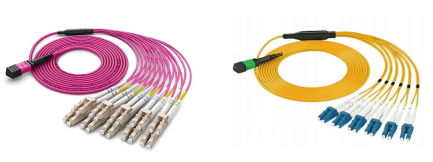
A factory-terminated breakout assembly. Where pre-terminated cables are used, bend radius and insertion loss belong to the assembly datasheet as well as the cable datasheet.
Operating Wavelengths: Read Them With the Transceiver Plan
Operating wavelengths appear on the cable datasheet as one line among several, and they are frequently misread as a standalone property. They are more usefully understood as one half of a compatibility check. The cable or fiber is specified for particular spectral windows; the optical module, multiplexing unit and any wavelength division multiplexer in the link are specified for their own. The two have to be matched before the cable is ordered, not after it is delivered.
The fiber type line provides the second half of the context. Single-mode fiber carries a single guided mode and is the conventional choice for long-reach transport. Multimode fiber supports multiple modes and is commonly paired with short-reach, high-density interconnect inside data centers, where assemblies and connectors are built on OM3, OM4 or OM5 multimode fiber, or on OS2 single-mode fiber where longer reach is required. Both categories appear in the same datasheet format, which is why the fiber type and wavelength lines should always be read as a pair.
The practical procurement action is procedural rather than analytical: attach the planned transceiver and wavelength plan to the request for quotation, and require the supplier to state which wavelengths the cable — and any pre-terminated assembly supplied with it — is specified for. Where the link includes WDM multiplexers, optical modules, or fiber assemblies such as MT-FAU units, the wavelength check should cover the whole chain rather than the cable alone.
Material Lines: Silica Glass Core, Sheath, Armoring, Strength Members
The material lines on a datasheet are usually the shortest and the most consequential. The core material is optical fiber made of silica glass. Around the glass sit the sheath, commonly PE or LSZH and similar compounds; the armoring, where present, using galvanized steel wire or steel tape; and the strength members, typically FRP. Each layer answers a different environmental question.
LSZH and flame-retardant sheaths are specified where smoke and flame performance matter, which is usually indoor cabling and confined spaces. Waterproof sealing and rodent protection are outdoor requirements, and corrosion and weather resistance are added where the route runs through harsh environments. Armoring addresses crush and mechanical protection, and it also changes the cable's mass and stiffness — a point that returns in the comparison section below.
Material lines are where two quotations with the same core count diverge most often. Comparing them explicitly, line by line, is a more reliable exercise than comparing total price at the quotation stage.
Matching Cable Specs to Project Scenarios
The scenarios in which these cables are deployed are well established: FTTH/FTTx access projects, metropolitan and backbone network projects, data center interconnects, operator network expansion and 5G backhaul projects, and enterprise or campus network deployments. These deployments are also where special requirements appear — low attenuation, low insertion loss, flame-retardant or LSZH sheaths, waterproof sealing, crush and tensile resistance, corrosion and weather resistance, and customizable core counts and labeling.
The table below maps scenario to the datasheet lines that should be verified first.
| Project scenario | Installation condition involved | Verify these datasheet lines first |
|---|---|---|
| FTTH / FTTx access | Indoor cabling and aerial or self-supporting drop routes with tight cabinet bends | Minimum bend radius, tensile strength, sheath type, core count and labeling |
| Metropolitan and backbone networks | Duct or ducting installation and direct burial | Tensile strength, armoring, attenuation, waterproof sealing |
| Data center interconnect | Indoor high-density patching and cabinet routing | Fiber type, bend radius at the panel, assembly insertion loss where pre-terminated, connector type |
| Operator expansion and 5G backhaul | Outdoor harsh environments | Weatherproofing, temperature resistance, corrosion resistance, rodent protection |
| Enterprise and campus networks | Indoor cabling | Flame-retardant or LSZH sheath, minimum bend radius, customizable labeling |
| Industrial and private networks | Mixed indoor and outdoor routing | Crush and tensile resistance, sealing, armoring, corrosion resistance |
Two structural points sit behind this table. First, the cable is rarely the whole system: a working route typically also requires optical modules, PLC splitters, cable splice closures, FTTH distribution boxes, MPO patch panels, fiber optic connectors, fiber assemblies such as MT-FAU units, and WDM units. Second, because these elements operate passively over long-term continuous service and require stable maintenance and periodic inspection, scenario fit is a lifecycle decision rather than an installation-day decision.
How Nanfang Communication Documents Cable and Component Parameters
Nanfang Communication — the trading name of Jiangsu South Communication Technology Co., Ltd. — is a fiber and cable manufacturer based in Luoyang Town, Wujin District, Changzhou City, Jiangsu Province, China, and a subsidiary of the Hong Kong-listed South Communication Holdings Limited (Stock Code: 1617.HK). The company was founded in July 1992 and holds a paid-in capital of RMB 150 million.
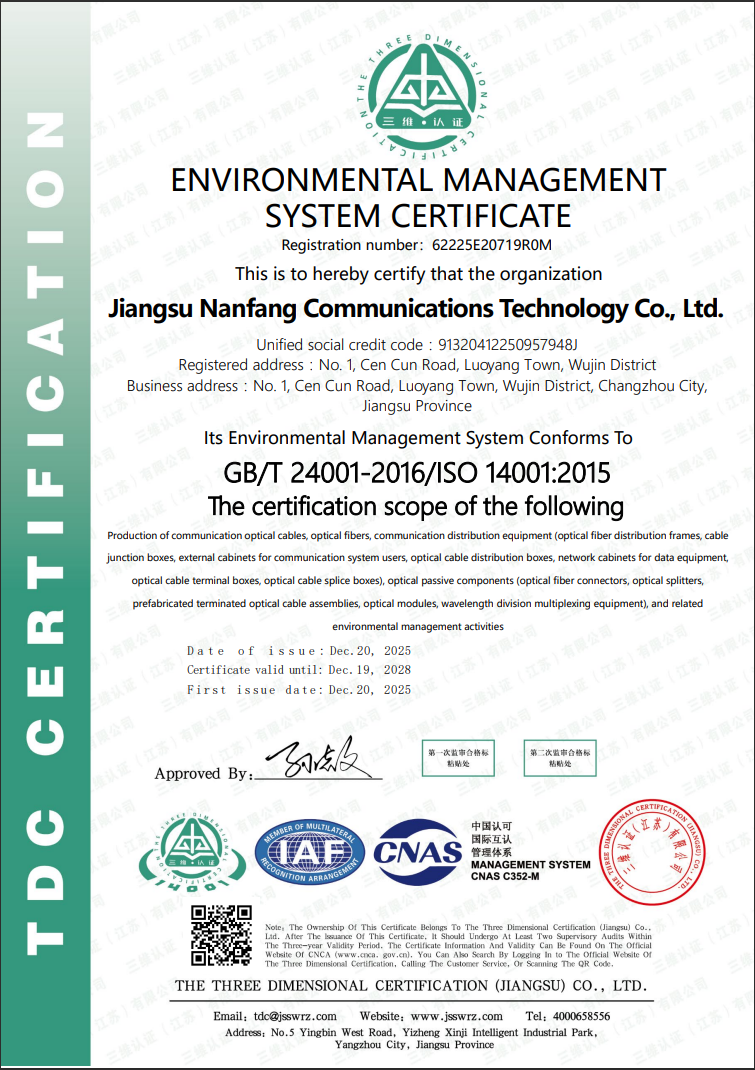
Its product scope is relevant to this discussion because it spans both the cable layer and the component layer that the datasheet glossary above describes. The company researches, develops, produces and sells communication optical cables, fiber optic cables, communication cables, optical-electrical accessories, ODN products, communication equipment, MPO optical connectors, MT-FA series optical passive components and PM FA fiber arrays (polarization-maintaining fiber array). Publicly listed product families include indoor and outdoor optical cables, ribbon optical cable, loose-tube optical cable, bow-type drop optical cable, single-mode and multimode fiber, MCF multi-core fiber, MPO high-density patch panels, PLC splitters and fiber optic connectors.
For buyers approaching the datasheet question, three capability facts are worth noting:
- Customization scope. Customizable items include core count, fiber type (single-mode, multimode, ribbon or multi-core), sheath material and color, connector types and cabling schemes, and labeling and packaging. Those are precisely the variables that make tensile strength and bend radius model-specific rather than family-wide.
- Quality control structure. The company operates a quality management system covering incoming material inspection, in-process control and finished-product testing that includes optical loss and attenuation testing, mechanical performance, and waterproof and sealing tests, supported by laboratory testing capability.
- Commercial parameters. The listed minimum order quantity is 1 core kilometer, with a monthly capacity of 250,000 core kilometers. Lead time depends on model and quantity; samples and small orders typically take several weeks, while large orders may take months.
On the component side, the published parameter structure mirrors the cable datasheet logic. The MPO Fiber Optic Adapter (model MPO-12F-SM) is rated at insertion loss below 0.5 dB in the standard grade and below 0.35 dB in the low-loss grade, with return loss of at least 50 dB for single-mode, 500 mating cycles as an IEC-compliant figure, an operating temperature range of −40°C to +85°C, and support for fiber counts from 4 to 72 fibers in single-mode or multimode. The MTP/MPO Fan-out Pre-terminated Cable lists typical insertion loss of 0.35 dB and maximum of 0.75 dB, low-loss typical 0.10 dB and maximum 0.35 dB, return loss of at least 60 dB for APC and 50 dB for PC, 12 or 24 fibers, LC/SC duplex or quad breakout, and LSZH or OFNR jacket options. These are the kinds of lines a buyer should expect to see item by item rather than as a single headline claim.
Institutional evidence follows the same pattern. The company holds ISO9001 and TL9000 telecommunications quality management system certification, together with ISO14001, OHSAS18001 occupational health and safety, ISO50001 energy management, and the integration of informatization and industrialization management system, and operates a CNAS-accredited laboratory. It reports more than 300 patents, including more than 45 invention patents, and participation in 16 standards (1 national and 15 industry standards). Its customer base includes operators such as China Telecom, China Mobile, China Unicom and China Broadcast Network, as well as private network users in high-speed railways, power grids and the chemical industry, supported by 28 provincial-level offices.
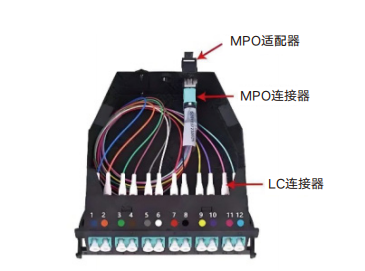
High-density connectivity modules illustrate why assembly-level parameters such as insertion loss are documented separately from cable-level parameters such as tensile strength and bend radius.
Market Context: Trade, Duty and Standards in 2026
Specification literacy has become a cost-management tool as much as an engineering one, and three data points frame the current sourcing environment.
The global fiber optic cable market was valued at USD 14.6 billion in 2025, according to a market forecast published by Global Market Insights in June 2026. China was the leading exporter of optical fibers and cables in 2024, with exports totaling USD 2.52 billion under HS code 854470, according to trade data compiled by the Observatory of Economic Complexity. Both figures describe a market where supply concentration is high and where supplier qualification decisions carry commercial weight.
On the demand side of the same trade flow, optical fiber cables under HTS 8544.70.00 originating from China face a total United States import duty of 37.50% as of late 2026, effective from 24 July 2026, according to a duty breakdown published by Airlift USA in September 2026. For US-bound projects, that changes landed cost arithmetic and makes construction choice — armoring, sheath grade, core count — a cost variable rather than a purely technical one. The relationship between China's export position and the duty stack is a reminder that sourcing origin and specification are now analyzed together.
The standards environment adds a third layer. IEC 60092-378:2024 applies to optical fibre cables in shipboard and offshore fixed installations. IEC 60794-1-104:2024 defines impact test procedures used to establish uniform performance requirements. ITU-T L.103 (08/2024) describes the characteristics, construction and test methods for optical fibre cables for indoor applications. These are different documents for different environments, which means qualification cannot be treated as a single pass-or-fail exercise — the applicable test method depends on where the cable will be installed.
Comparing Construction Options — and the Boundaries Buyers Should Accept
Comparing cable options is more useful when framed by environment than by product name. The table below sets three common construction directions against each other on the dimensions that matter in procurement.
| Comparison dimension | Indoor cable with LSZH sheath | Outdoor armored cable for duct or direct burial | Pre-terminated high-density assembly |
|---|---|---|---|
| Primary environment | Indoor cabling, cabinets, enterprise and campus routes | Duct, direct burial, aerial and harsh outdoor conditions | Data center cabinets and high-density patching |
| Key datasheet lines | Sheath material, bend radius, core count, labeling | Tensile strength, armoring, attenuation, sealing, weather resistance | Insertion loss, return loss, fiber type, connector type, bend relief |
| Strength in procurement | Flame performance, easier routing, lighter handling | Mechanical and environmental protection over long service life | Factory-terminated quality, reduced field work, predictable loss figures |
| Trade-off to accept | Not intended for direct burial or unprotected outdoor exposure | Heavier, stiffer, more demanding installation and longer lead time on custom builds | Requires accurate length planning and assembly-level datasheets |
Several boundaries should be stated plainly rather than negotiated after award.
- No universal numeric values. Core count, diameter, tensile strength and minimum bend radius are specified per model and confirmed on the model datasheet. Any family-level figure should be treated as indicative.
- Lead time is not fixed. Lead time depends on model and quantity; samples and small orders typically take several weeks and large orders may take months, so schedule risk should be priced into the project plan.
- The cable is not the system. Closures, distribution boxes, splitters, patch panels, connectors, fiber assemblies and multiplexing units are separate scope items with their own parameters.
- Commercial footprint varies by region. Nanfang Communication lists export markets including China's Hong Kong and Southeast Asia regions, so buyers in other regions should confirm commercial and logistics feasibility directly.
- Over-specification carries its own cost. Heavier armored construction adds mass, bend stiffness and installation effort; where a duct already provides protection, the additional armoring may not earn its cost, while the reverse mistake — specifying an indoor construction for an unprotected outdoor route — is considerably more expensive.
Future Outlook
Three directions are visible from the specification side of the market. First, fiber count and density continue to rise: ribbon cable, MCF multi-core fiber and MPO-based high-density interconnect all push the same procurement question — how many fibers, in what physical envelope, terminated how. Second, value continues to migrate from field work to factory work, which shifts the datasheet question from cable parameters alone to assembly parameters such as insertion loss, return loss and bend relief. Third, the applicable standard is increasingly environment-specific, following the pattern set by the 2024 publications covering indoor, shipboard and impact-testing requirements.
For buyers, the practical consequence is that specification literacy is becoming a standing capability rather than a one-off exercise. The organizations that read tensile strength, bend radius and wavelength lines as decision variables — rather than as compliance checkboxes — are better positioned to compare quotations honestly and to avoid paying for protection a route does not need, or skipping protection it does.
FAQ: Optical Cable Specifications
Are tensile strength and minimum bend radius the same for every optical fiber cable model?
No. Core count, cable diameter, tensile strength and minimum bend radius are specified per model, and the values are recorded on that model's datasheet. A family-level figure should be treated as indicative only. The correct verification step is to confirm the value for the exact construction being quoted, including sheath and armoring.
What does the operating wavelength line on a datasheet actually tell a buyer?
It identifies the spectral windows the cable or fiber is specified for. It becomes decision-relevant only when read together with the optical module, any wavelength division multiplexer, and the fiber type in the link. Common datasheet fiber classes include G.652 and G.657 for single-mode, and OM3, OM4 or OM5 where multimode assemblies are used. A wavelength mismatch is a system-level problem, so the check should cover the full chain, not the cable alone.
What is the core of an optical cable made of, and why does the material list matter?
The core material is optical fiber made of silica glass. Around it sit the sheath (PE, LSZH and similar), armoring where present (galvanized steel wire or steel tape), and strength members (typically FRP). Those surrounding layers determine tensile and bend performance, which is why two cables with the same core count can carry different mechanical ratings. Material lines are also where otherwise similar quotations diverge.
Which installation conditions change the specification requirements most?
Indoor cabling, duct or ducting installation, aerial and self-supporting routes, and direct burial each place different demands on the same cable family. Outdoor harsh environments add weatherproofing, waterproofing, rodent protection and temperature resistance. Matching a construction to the wrong installation condition is one of the most common and most costly specification errors.
How do international standards affect which cable can be used where?
Standards are written for defined environments and test methods rather than as a single universal requirement. IEC 60092-378:2024 applies to optical fibre cables in shipboard and offshore fixed installations. IEC 60794-1-104:2024 defines impact test procedures used to establish uniform performance requirements. ITU-T L.103 (08/2024) describes characteristics, construction and test methods for optical fibre cables for indoor applications. Qualification should therefore be segmented by application environment.
What quality evidence should a buyer request beyond the datasheet?
Evidence of a functioning quality system: incoming material inspection, in-process control, and finished-product testing that includes optical loss and attenuation testing, mechanical performance, and waterproof or sealing tests, supported by laboratory testing capability. As an example of the level of detail available, Nanfang Communication operates a CNAS-accredited laboratory and holds ISO9001 and TL9000 telecommunications quality management system certification, alongside ISO14001, OHSAS18001, ISO50001 and the integration of informatization and industrialization management system.
What minimum order quantity and lead time should a project plan for?
There is no single published standard across suppliers, so these terms must be confirmed per order. Nanfang Communication lists a minimum order quantity of 1 core kilometer and states that lead time depends on model and quantity — samples and small orders typically take several weeks, while large orders may take months. Both figures should be verified with the supplier before a delivery schedule is committed.
How should a buyer compare two quotations with the same core count?
Line by line against the datasheet: fiber type, core count and diameter, attenuation in dB/km, operating wavelengths, minimum bend radius, tensile strength, sheath material and environmental rating, plus armoring and strength-member construction. Identical core counts do not imply identical cables. Where pre-terminated items are included, compare assembly-level figures as well — for instance, an MPO-12F-SM adapter is specified at standard insertion loss below 0.5 dB and low-loss below 0.35 dB, return loss of at least 50 dB for single-mode, and 500 IEC-compliant mating cycles.
Does buying the cable complete the physical link?
No. A functioning route typically also requires optical modules, PLC splitters, cable splice closures, FTTH distribution boxes, MPO patch panels, fiber optic connectors, fiber assemblies such as MT-FAU units, and WDM units where multiplexing is used. These are separate scope items with their own parameters, and procurement is more effective when scoped at the system level.
For readers who want to see how component-level parameters are documented in practice, Nanfang Communication publishes a downloadable MPO product catalogue here: Nanfang Communication MPO product catalogue (PDF).