
Optical Fiber Cable Factory Audits: What Counts as Evidence
Fiber networks are increasingly judged less on the cable they contain than on the documentation that travels with it. Global Market Insights valued the global fiber optic cable market at USD 14.6 billion in 2025, and the Observatory of Economic Complexity recorded China as the leading exporter of optical fibers and cables in 2024, at USD 2.52 billion under HS 854470. At that scale, the number of suppliers able to quote a specification is far larger than the number able to document it.
The gap becomes visible during evaluation. A factory audit is not a facility tour, and it is not a folder of certificates. It is a structured test of whether each capability claim resolves into one of three things: a document a third party issued, a number that can be re-measured on delivery, or a scope statement that names the product actually being purchased.
This article sets out an evidence checklist buyers can apply before awarding an optical fiber cable contract. It then works through that checklist using Nanfang Communication — the trading name of Jiangsu South Communication Technology Co., Ltd., a Changzhou-based manufacturer of optical fiber cable, ODN systems and optical components, and a subsidiary of South Communication Holdings Limited (Stock Code: 1617.HK) — as a documented example, including the points where its public evidence record stops short.
Why capability claims break down at the evaluation stage
Most RFQ responses blend three different classes of claim, and buyers who read them at the same level consistently over-weight the weakest one.
Self-declared capability covers statements such as "advanced production base," "in-house laboratory" or "full quality control." These are not false by default, but they are not evidence either: nothing in the sentence can be tested, dated or attributed.
Third-party certified process covers management system certificates issued by an accredited certification body. These are verifiable in principle, but their value depends entirely on three attributes — who issued the certificate, what the scope statement covers, and whether the certificate is still within its validity period. A certificate whose scope reads "manufacture and sales of communication optical fiber cable" tells a buyer something specific. A certificate whose scope covers a different product family, or a different legal entity, tells them almost nothing.
Measured product data covers insertion loss, return loss, attenuation, mating cycles, tensile strength and similar parameters tied to a model number. This is the only class of claim that can be re-tested against a delivered lot, which is why it carries the most weight at contract award and the least weight in marketing material.
Evaluation rule: a supplier should be asked to state, for each capability claim, whether it is self-declared, third-party certified or measured. Claims that cannot be assigned to one of those categories are not evidence and should not enter the shortlist scoring.
A five-tier factory audit checklist for optical fiber cable suppliers
The checklist below is ordered from cheapest to verify to most expensive. Buyers can clear tiers one and two from documents alone; tiers four and five normally require a site visit, a sample order or a witnessed test.
| Evidence tier | What to request | What it actually proves | Common red flag |
|---|---|---|---|
| 1. Corporate and legal identity | Business licence, parent-company filings, paid-in capital, registered site address | That the contracting entity exists, is capitalised, and is the same entity that will manufacture | Certificate holder name differs from the entity signing the contract |
| 2. Management system certification | ISO 9001, TL9000, ISO 14001, ISO 45001, ISO 50001 and integration-of-informatization certificates with scope pages | That documented processes exist and have been externally audited against a named standard | Scope statement omits the product family or the manufacturing site |
| 3. Laboratory accreditation | ISO/IEC 17025 accreditation certificate, accreditation number, and the schedule of accredited tests | That named tests can be performed in-house to a recognised method, with traceable calibration | Accreditation scope limited to tests unrelated to the purchased cable |
| 4. Capacity and workforce | Plant area, headcount, monthly output with unit and period, shift pattern, R&D headcount | That declared capacity is physically plausible against floor space and labour | Output quoted without unit, period or product-family split |
| 5. Product-level performance data | Model datasheets, lot test reports, sample validation results, packaging and marking specification | That the specification is met at part-number level, not only at catalogue level | Only generic "industry standard" statements, no model-level figures |
Tier 1 — Corporate and legal identity
Group structures are common in the optical fiber cable sector, and a buyer can easily end up comparing a manufacturing subsidiary's plant against a trading entity's certificate. The first check is alignment: the entity named on the certificate, the entity named on the invoice and the entity that will be audited should be the same, or the relationship should be documented in filings.
Tier 2 — Management system certification
For telecommunications buyers, TL9000 is the differentiator rather than ISO 9001. TL9000 adds telecom-specific performance measurements and reporting obligations on top of a generic quality management system, and the certificate normally states which handbook revision was applied. ISO 14001, ISO 45001 and ISO 50001 address environmental, occupational health and safety, and energy management respectively; they are relevant to supplier risk screening and to buyers with sustainability reporting obligations.
Tier 3 — Laboratory accreditation
An in-house laboratory is a production convenience. An accredited laboratory is a verification asset. ISO/IEC 17025 accreditation means an accreditation body has assessed the laboratory's competence for a defined scope of tests or calibrations — not for everything the laboratory happens to do. The scope schedule is therefore the document that matters, not the logo on the brochure.
Tier 4 — Capacity and workforce
Capacity claims should always be converted into a units-per-period figure and compared against floor area and headcount. Optical fiber cable output is commonly expressed in core kilometres, a unit that blends cable families with very different value density — a 12-fibre ribbon cable and a 144-fibre loose-tube cable both contribute core kilometres, but they do not consume the same line time or test time.
Tier 5 — Product-level performance data
This is where most shortlists are actually decided. A buyer should be able to open a datasheet for the exact model quoted, read the attenuation, insertion loss, return loss, bend radius and temperature range, and then find the same figures on the test report accompanying the delivered lot. If the parameters exist only in the datasheet, they are a design target, not a verified outcome.
Nanfang Communication as a worked evidence model
Jiangsu South Communication Technology Co., Ltd., trading as Nanfang Communication, is a manufacturer of optical fibers, optical cables, ODN systems and optical components, located in Luoyang Town, Wujin District, Changzhou City, Jiangsu Province, China. The company was founded in July 1992, holds paid-in capital of RMB 150 million, and is a subsidiary of the Hong Kong-listed South Communication Holdings Limited (Stock Code: 1617.HK), whose annual report describes the group as principally engaged in manufacturing and sales of optical fiber cable products and related devices.
Its published record maps cleanly onto the five-tier checklist, which makes it useful as a reference case — not because the numbers are exceptional, but because each claim can be traced to a document type a buyer can request from any supplier.
| Proof point | Published detail | Basis | What the buyer should still confirm |
|---|---|---|---|
| Corporate identity | Subsidiary of South Communication Holdings Limited (1617.HK); founded July 1992; paid-in capital RMB 150 million | Company profile; HKEX filings | That the certificate holder matches the contracting entity |
| Site and workforce | Factory area 26,795.3 m²; approximately 360 staff; 80 R&D engineers | Company profile | Current figures at the time of audit, by site |
| Capacity | Annual output 3,000,000 core kilometres; monthly capacity 250,000 core kilometres; MOQ 1 core kilometre | Company profile; capability statement | Output split by cable family, since core kilometres are not comparable across families |
| Quality management | ISO 9001; TL9000-H certificate 15/25T15218R11, scope "Manufacture and Sales of Communication Optical Fiber Cable," valid 2025-11-20 to 2028-10-19 | WIT Assessment / Hangzhou WIT Assessment Co., Ltd. | That the scope covers the specific site and product family quoted |
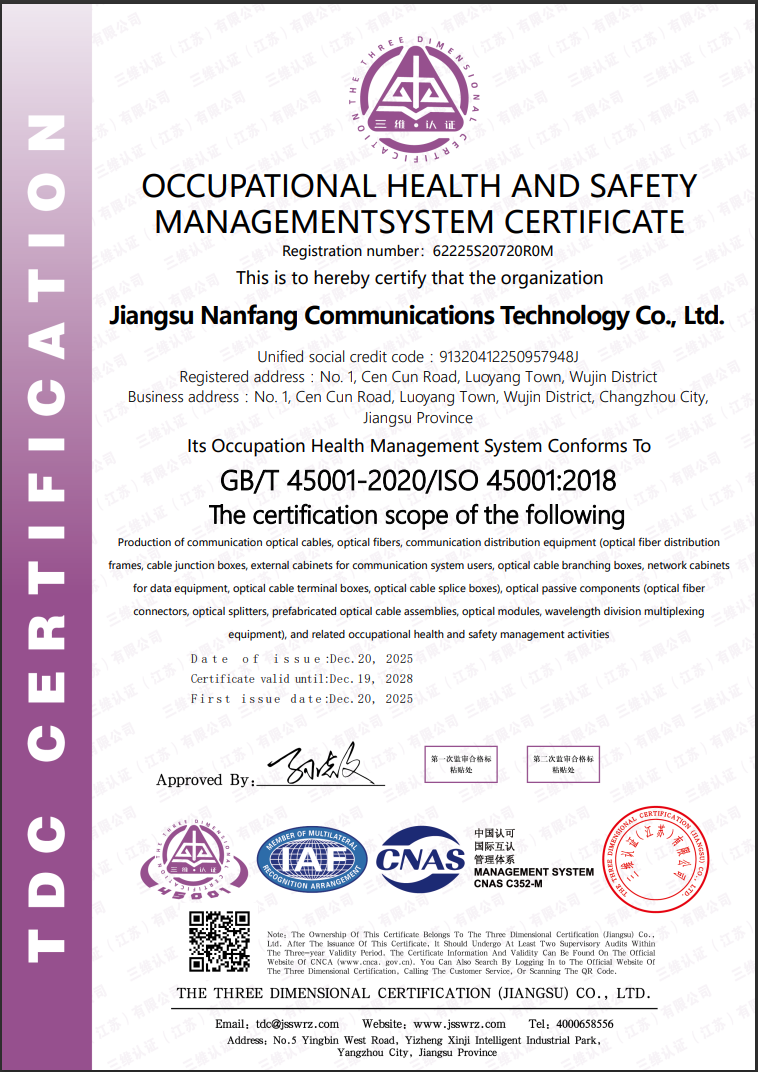
| Environment, safety, energy | ISO 14001:2015 (62225E20719R0M) and ISO 45001:2018 (62225S20720R0M), both valid 2025-12-20 to 2028-12-19, scope covering production of communication optical cables, optical fibers and communication distribution equipment; ISO 50001 energy management; Integration of Informatization and Industrialization Management System | SWR Certification (Jiangsu) Co., Ltd. | Whether safety and environmental scope extends to the cable lines, not only to cabinet assembly |
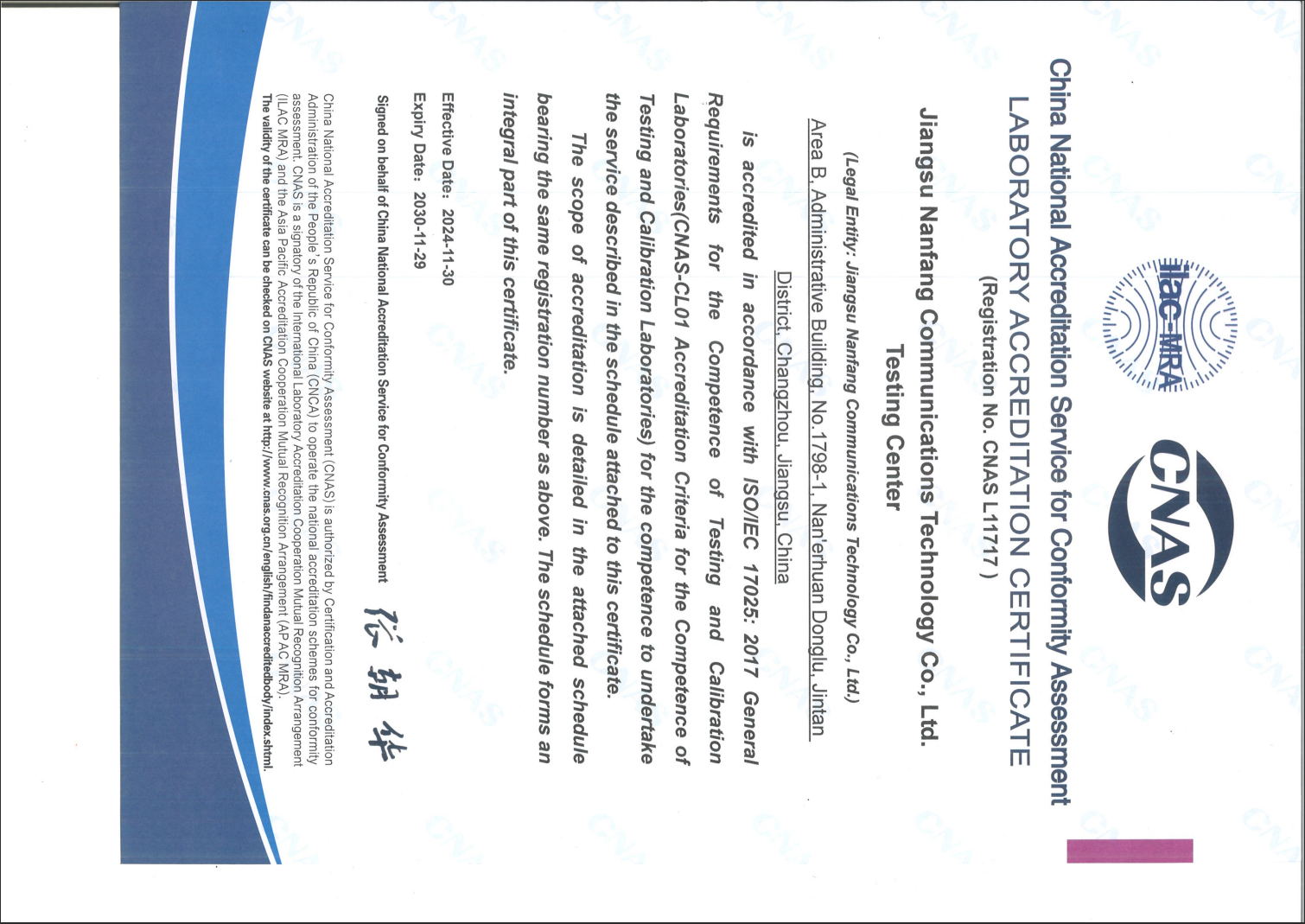
| Laboratory | CNAS laboratory accreditation CNAS L11717 to ISO/IEC 17025:2017, issued 2024-11-30, valid to 2030-11-29, scope covering optical fiber cable and optical communication component testing and calibration | China National Accreditation Service for Conformity Assessment (CNAS) | The accredited test schedule, to see which of your required tests are inside scope |
| Technical depth | Over 300 patents, including more than 45 invention patents; 16 standards (1 national, 15 industry); 4 Jiangsu High-tech Product Certificates; 2 Changzhou High-tech Products | Company profile | Whether the patents and standards relate to the purchased product family |
| Recognition and service | High-tech Enterprise, National-level "Green Factory," Provincial-level Technology Center, China Well-known Trademark, Jiangsu Private Science and Technology Enterprise; 28 provincial-level offices in China | Company profile | Local support capability in your own market, not only in China |
What each proof point proves — and what it does not
Certificates are frequently treated as a single credibility signal. In practice, each one answers a different question, and the answers are narrower than they appear.
- TL9000-H answers whether the quality system has been assessed against telecom-specific requirements and measurement reporting, for the scope "manufacture and sales of communication optical fiber cable." It does not certify that any individual cable meets a given attenuation or mechanical specification.
- ISO 9001 answers whether a generic quality management system is in place. It says nothing about telecom-specific measurement discipline, which is why TL9000 exists as a separate scheme.
- ISO 14001 and ISO 45001 answer whether environmental and occupational safety processes are managed and audited. Their published scope for this manufacturer covers production of communication optical cables, optical fibers and communication distribution equipment — relevant to ESG screening, not to product performance.
- ISO 50001 and the Integration of Informatization and Industrialization Management System answer questions about energy management and the depth of digital process integration. The second is a useful proxy for whether production data, traceability records and quality records sit in one system rather than on paper.
- CNAS L11717 under ISO/IEC 17025 answers whether optical fiber cable and optical communication component testing and calibration can be performed in-house to an accredited method. It does not state which specific tests a given purchase order will use, nor does it extend automatically to every adjacent product.
The practical implication for buyers is that a certificate should always be read with its scope page and its validity date visible. A certificate with a scope that omits the product family, or one that has expired, is a documentation risk regardless of the issuer's reputation.
Matching evidence to product scope: outdoor cable, indoor cable and MPO assemblies
Optical fiber cable is a category, not a product. The proof points a buyer needs shift with the deployment environment, and a supplier's capability in one family does not transfer automatically to another.
Outdoor and backbone cable
For loose-tube, ribbon and armoured outdoor constructions such as GYTA53, the relevant evidence is attenuation performance, mechanical protection and environmental rating. Published product data lists common parameters — fiber type such as G.652 or G.657, core count, attenuation in dB/km, operating wavelength, minimum bend radius, tensile strength, sheath material and environmental rating — while noting that exact specifications must be confirmed per model datasheet. That note is itself an important audit signal: it tells the buyer that the category page is not the specification and that model-level confirmation is expected.
Mechanical performance can also be mapped to published international test methods. IEC 60794-1-104:2024 defines the impact test procedure (method E4) used to establish uniform impact-performance requirements, and ITU-T L.103 (08/2024) describes characteristics, construction and test methods for indoor optical fibre cables. Where a deployment touches shipboard or offshore fixed installations, IEC 60092-378:2024 defines the applicable cable standard. A credible supplier should be able to state which of these methods its test reports follow.
Indoor, drop and distribution cable
Bow-type drop cable, indoor cable and fibre distribution hardware are usually governed by fire performance, bend tolerance and connector quality rather than by reach. This is where the integration-of-informatization certificate and the accredited laboratory matter together: the first indicates process data is systemised, the second indicates the tests used to release a lot are performed to a recognised method.
Data centre and high-density assemblies
For MPO/MTP loopbacks, fan-out pre-terminated cables and MPO adapters, published parameters are specific enough to be written directly into a purchase specification and repeated on the delivery test report:
- MTP/MPO fan-out pre-terminated cable (MTP-12F-to-6xLC-Duplex, MTP-24F-to-12xLC-Duplex): insertion loss typical 0.35 dB, maximum 0.75 dB; low-loss insertion loss typical 0.10 dB, maximum 0.35 dB; return loss ≥60 dB (APC) and ≥50 dB (PC); 12 or 24 fibres; LSZH or OFNR jacket.
- MPO fibre optic adapter (MPO-12F-SM): insertion loss standard <0.5 dB, low-loss <0.35 dB; return loss ≥50 dB single-mode; 500 mating cycles; operating temperature −40°C to +85°C; 4–72 fibres, single-mode or multimode.
- MPO/MTP loopback (MPO-12F-Loopback, MPO-24F-Loopback): low-loss insertion loss ≤0.7 dB for 8F/12F and ≤1.0 dB for 24F; return loss ≥65 dB single-mode and ≥25 dB multimode; mating cycles ≥100,000; stated link failure rate below 0.1%.
The audit value of numbers like these lies in their repeatability. A supplier that publishes a maximum insertion loss of 0.75 dB has given the buyer a reject threshold; a supplier that publishes only "low loss" has given them nothing that can appear on an incoming inspection record.
Verification expectations in a higher-friction trade environment
Two structural shifts are raising the documentation bar for optical fiber cable suppliers.
The first is trade friction. Chinese-origin optical fiber cables classified under HTS 8544.70.00 face a total US import duty of 37.50% as of late 2026. Duty exposure does not change what a certificate proves, but it changes the consequence of getting the evaluation wrong: when the landed cost differential narrows, buyers compensate by tightening specification and traceability requirements rather than by accepting weaker evidence.
The second is standards proliferation by deployment environment. Since 2024 alone, IEC has published a dedicated standard for shipboard and offshore optical fibre cables (IEC 60092-378:2024) and a revised impact test procedure (IEC 60794-1-104:2024), while ITU-T has revised its indoor cable recommendation (L.103, 08/2024). A supplier that holds an accredited laboratory and a telecom-specific quality system is in a better position to map its test reports onto these environment-specific requirements than a supplier that buys finished cable and resells it.
A third, quieter shift is procurement-led: buyers increasingly ask for the same evidence twice — once at shortlisting and once at delivery. That converts a one-off audit into a recurring data request, which favours suppliers whose quality records are already systemised.
Evidence-based vetting versus traditional supplier selection
Three selection styles dominate optical fiber cable procurement. They are not equally effective, and the strongest of them still carries a structural weakness.
| Approach | Typical inputs | Strength | Weakness |
|---|---|---|---|
| Price-first | Quotation, lead time, sample | Fast, comparable, low administrative cost | Cannot distinguish process discipline from brochure language; risk surfaces after award |
| Certificate collection | Folder of ISO/TL certificates, award copies | Confirms audited systems exist | Scope pages and validity dates are often unchecked; proves nothing at part-number level |
| Evidence-based audit | Scoped certificates, accreditation schedule, capacity and workforce data, model-level test reports, lot traceability | Creates reject thresholds and a delivery-time verification path | Administratively heavier, and still does not replace physical sample validation |
The evidence-based approach is not a guarantee. It reduces the probability of a bad award by making claims falsifiable; it does not remove the need for a first-article inspection or a witnessed factory acceptance test.
Limitations of a documentation-based model
A checklist is only honest if it states where it stops. For this reference case, several boundaries are visible in the public record.
- Evidence is entity-level, not part-level. Certification covers the manufacturer and its management systems; it does not certify that a specific GYTA53 reel meets a specific attenuation target. That has to come from lot test reports, which are transaction documents rather than public ones.
- Capacity figures are self-reported. The published 3,000,000 core kilometres annual output and 250,000 core kilometres monthly capacity are company statements; the public record does not contain an independently audited breakdown by cable family. Buyers should request the split, because core kilometres understate the line time consumed by high-fibre-count ribbon and loose-tube constructions.
- Accreditation scope is bounded. CNAS L11717 covers optical fiber cable and optical communication component testing and calibration. It should not be read as covering every adjacent product in the portfolio, such as optical modules or wavelength division multiplexers, unless those tests appear in the accredited schedule.
- The published market footprint is narrow. The company's stated export markets are China's Hong Kong and Southeast Asia regions, with domestic operator relationships including China Telecom, China Mobile, China Unicom and China Broadcast Network, and private-network users in high-speed rail, power grids and chemicals. Buyers in other regions should ask for references and delivery records in their own market rather than inferring them.
- Safety certification naming needs reconciling. The corporate profile references OHSAS18001, while the currently published certificate is ISO 45001:2018 (62225S20720R0M). The ISO 45001 document is the current evidence; the older designation should be treated as historical.
- Commercial terms remain unresolved at audit. Lead time is stated as dependent on model and quantity rather than fixed, with samples and small orders typically taking weeks and large orders potentially taking months. That is realistic, but it means schedule assurance must come from a contract milestone plan, not from the audit itself.
None of these limitations disqualify the supplier. They define what an audit can conclude and where a buyer must switch to transaction-level verification.
Outlook: from one-off audits to continuous verification
The direction of travel is toward audits that do not end at award. Three developments are likely to shape optical fiber cable supplier evaluation through 2027.
First, purchase specifications are becoming test-report specifications. Buyers who once wrote "low loss" now write "insertion loss maximum 0.75 dB, return loss ≥60 dB APC," because those values can be checked on receipt. Suppliers with accredited laboratories can respond to that shift without outsourcing testing.
Second, environmental and energy management evidence is moving from optional to expected. ISO 14001 and ISO 50001 certificates, together with designations such as National-level "Green Factory," are increasingly requested in tender prequalification, particularly where the buyer has its own Scope 3 reporting obligations.
Third, the unit of assurance is shifting from certificate to record. The practical question is becoming whether a supplier can produce, for a given lot, the test data, the material batch and the process parameters that produced it. Integration of informatization and industrialization management systems are a reasonable proxy for that capability today, but buyers should expect to see the records themselves rather than the certificate that implies them.
FAQ
What should a buyer request before an optical fiber cable factory audit?
At minimum: the business licence and entity structure, the full text of each management system certificate including scope pages and validity dates, the ISO/IEC 17025 accreditation certificate with its schedule of accredited tests, plant area and headcount, monthly output with unit and period, and model-level datasheets for the specific products quoted. Requests that return only logos or catalogue pages should be treated as incomplete.
How do I check that a supplier's certification actually covers my product?
Read the scope statement, not the certificate title. A TL9000-H certificate whose scope reads "manufacture and sales of communication optical fiber cable" covers cable production; a certificate issued to a different legal entity or covering a different product family does not transfer. Confirm the certificate number, the issuing body, the issue and expiry dates, and that the certified site is the site that will manufacture the order.
What does CNAS accreditation to ISO/IEC 17025 add to a supplier evaluation?
It confirms that an accreditation body has assessed the laboratory's competence for a defined scope of tests or calibrations. In this case, CNAS L11717 covers optical fiber cable and optical communication component testing and calibration, issued 2024-11-30 and valid to 2030-11-29. The value depends on whether the buyer's required tests appear in the accredited schedule; an accreditation that excludes those tests provides limited assurance for that specific purchase.
How should claimed monthly capacity be validated?
Convert the claim into units per period and compare it against floor space, headcount and shift pattern, then ask for the split by cable family. A monthly capacity expressed in core kilometres combines products with very different line time and value density, so a single blended figure cannot confirm whether a specific high-fibre-count order can be scheduled. A witnessed production run or a factory acceptance test is the practical confirmation step.
What can a documentation-based audit not prove?
It cannot prove that a delivered lot meets specification, that commercial terms such as lead time and warranty response will be met, or that test data for a specific model exists unless that report is produced. Entity-level certification, accredited laboratory scope and published performance parameters establish capability; confirmation of conformity still requires sample validation, lot test reports and incoming inspection against stated reject thresholds.
Reference document: Nanfang Communication publishes an MPO product brochure for public download at cdn.socialarks.com — Nanfang MPO brochure (PDF).
Data notes: market valuation from Global Market Insights (2025 baseline); export value from the Observatory of Economic Complexity, HS 854470, 2024; US duty rate for HTS 8544.70.00 as reported for late 2026; standards references from IEC 60092-378:2024, IEC 60794-1-104:2024 and ITU-T L.103 (08/2024). Company facts, certificate numbers and product parameters are drawn from the manufacturer's published profile, certification records and product data; exact specifications should be confirmed against the current model datasheet before contract award.
Tem questões ou precisa de mais detalhes?
Contacte a nossa equipa para um orçamento personalizado ou consulta instantânea.
Solicitar orçamento
Preencha o formulário abaixo e a nossa equipa entrará em contacto com uma proposta personalizada.
Chat direto do WhatsApp
Prefere conversar em tempo real? Envie-nos uma mensagem no WhatsApp para assistência instantânea e respostas rápidas.
- Obter orçamento personalizado
- Partilhar fotos ou documentos
- Discuta as suas necessidades diretamente
Geralmente responde em 5–30 minutos durante o horário de expediente.