
Optical Fiber Cable Supplier Due Diligence: A 2026 Checklist
Optical Fiber Cable Supplier Due Diligence: A 2026 Checklist
Supplier sustainability in optical fiber cable is a continuity question before it is an environmental one: will the manufacturer that qualified against today's specification still be able to make, test and ship the same product in year three or year five of a framework agreement? The answer is rarely found in a product brochure. It is found in documentation — certificates with traceable numbers, scopes and validity dates; laboratory accreditation; corporate disclosure; workforce depth; and manufacturing governance records that a third party has already examined.
This article sets out a due diligence checklist for that review. It uses Jiangsu South Communication Technology Co., Ltd. — an optical cable and optical component manufacturer established in July 1992 and a subsidiary of the Hong Kong-listed South Communication Holdings Limited (Stock Code: 1617.HK) — as a verified profile, to show what each checklist item looks like when it is documented rather than asserted.
Why supplier continuity became a scored procurement criterion
Three structural conditions have moved supplier sustainability from a soft preference into a weighted evaluation item.
Scale. Global Market Insights valued the global fiber optic cable market at USD 14.6 billion in 2025. Buyers are therefore not selecting from a handful of interchangeable workshops; they are qualifying suppliers inside a large, layered supply base in which two apparently similar quotations often differ mainly in the depth of the manufacturer behind them.
Trade exposure. Trade data aggregated by the Observatory of Economic Complexity from UN Comtrade records identifies China as the leading exporter of optical fibres and cables in 2024, with exports of USD 2.52 billion under HS 854470. Concentration of that kind makes sourcing decisions sensitive to policy as well as price: Chinese-origin optical fiber cables entering the United States under HTS 8544.70.00 carried a total ad valorem duty of 37.50% as of late 2026, per a published duty breakdown. A common buyer response is to consolidate volume with fewer, better-evidenced suppliers — which raises the cost of getting the qualification wrong.
Product life. Cable installed in access, metro and data center layers is expected to remain in service considerably longer than the purchase contract that delivered it. Re-order consistency, test-data traceability and specification continuity therefore matter as much as first-article performance.
What "sustainability" means when the product is optical fiber cable
In supplier due diligence, sustainability is narrower and more concrete than the word suggests. It describes four capabilities that determine whether a supplier can keep performing across a multi-year agreement:
- Financial stability — the counterparty's capacity to fund materials, working capital and production through demand cycles.
- Environmental and energy management — whether environmental control and energy use are governed by a managed system rather than ad hoc practice, which affects cost stability and regulatory exposure.
- Workforce continuity — whether engineering and process knowledge is retained and renewed rather than concentrated in a few individuals.
- Manufacturing governance — whether process control, inspection and testing are defined, recorded and auditable.
Each of the four can be evidenced. That is what makes a checklist workable, and it is why a checklist outperforms a self-assessment questionnaire: the buyer is not asking a supplier to describe itself, but to produce documents that an external body has already reviewed.
The checklist: seven evidence items a buyer should request
The sequence below follows the decision order most procurement teams use — system competence first, then test credibility, then counterparty durability, then the production base.
| Evidence item | Question it answers | What to verify in the document |
|---|---|---|
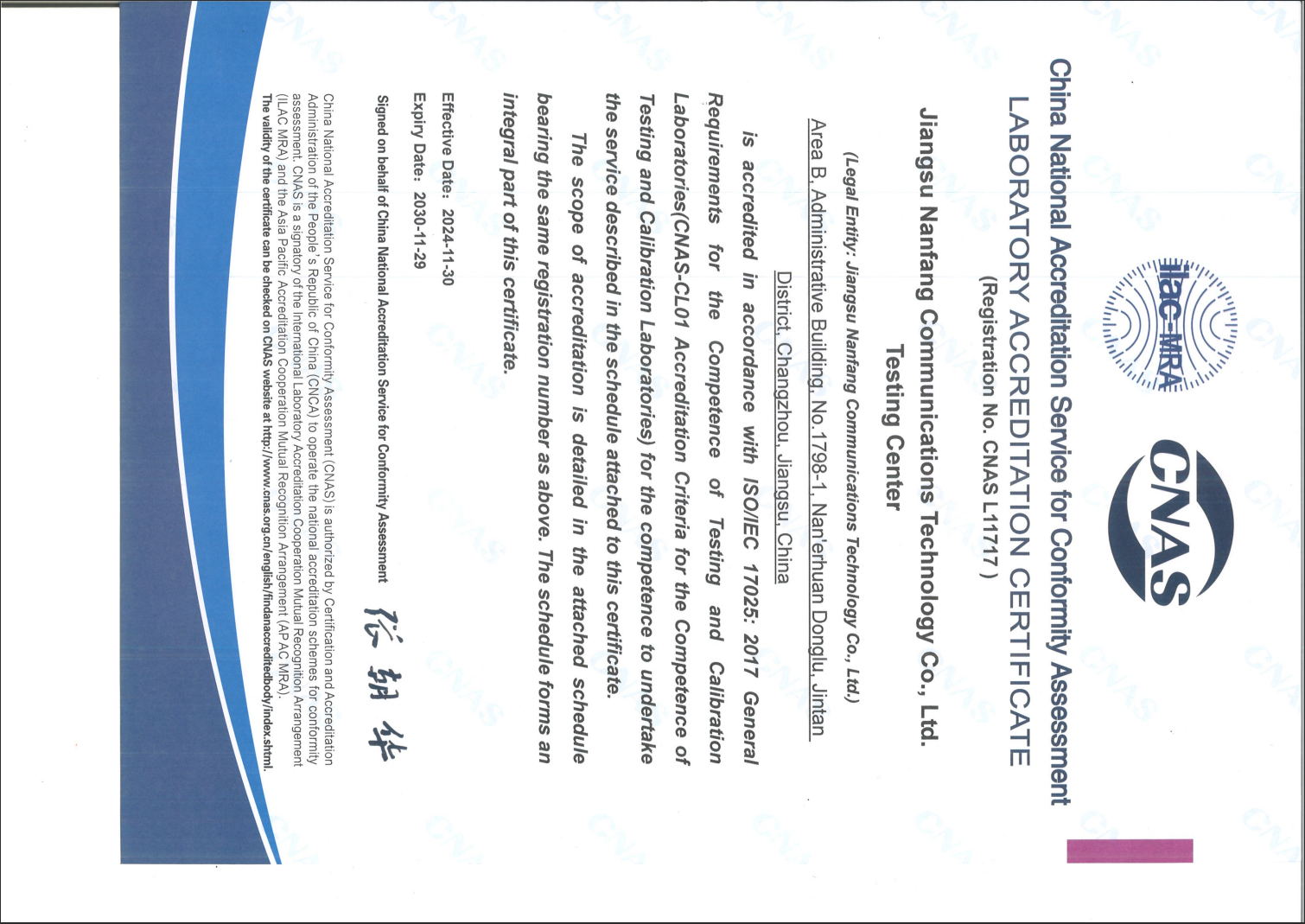
| ISO9001 and TL9000-H quality management certificates | Is the manufacturing system audited against telecom-grade requirements, not just generic quality requirements? | Certificate number, issuing body, exact scope wording and validity window. On record for this supplier: TL9000-H certificate 15/25T15218R11, issued by WIT Assessment, valid 20 November 2025 to 19 October 2028, scope "Manufacture and Sales of Communication Optical Fiber Cable". |
| ISO14001 environmental management certificate | Is environmental control embedded in the production system? | Certificate number and scope. On record: 62225E20719R0M, issued by SWR Certification (Jiangsu) Co., Ltd. to ISO14001:2015, valid 20 December 2025 to 19 December 2028, covering production of communication optical cables, optical fibers and communication distribution equipment. |
| Occupational health and safety certificate | Is workforce safety governed by a certified system? | Confirm which standard version is current. On record: 62225S20720R0M to ISO 45001:2018, valid 20 December 2025 to 19 December 2028. The company profile also references OHSAS18001, the predecessor label that ISO 45001 replaced — buyers should score the certificate actually in force, not the legacy name. |
| ISO50001 energy management and Integration of Informatization and Industrialization Management System | Are energy performance and digital process integration managed as systems? | The company profile lists both certifications. Request certificate numbers, scopes and expiry dates at the same time as the quality documents, since these are often omitted from a standard certificate pack. |
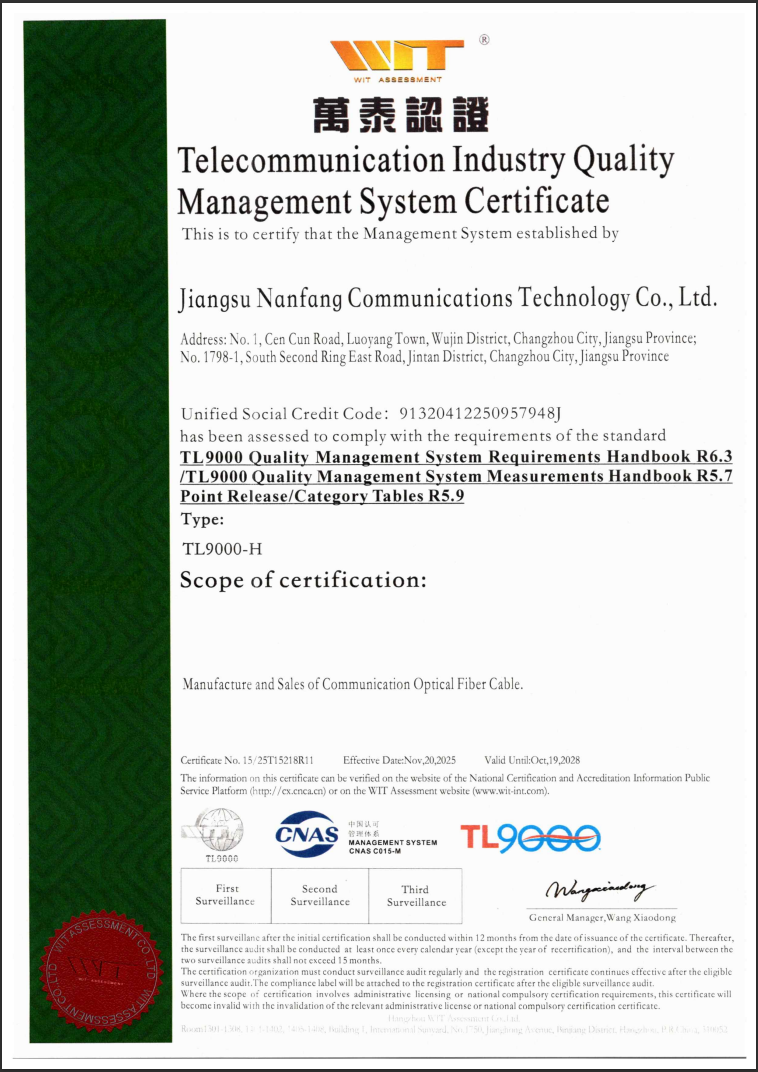
| Laboratory accreditation (ISO/IEC 17025:2017) | Can the supplier's own test results be treated as competent and traceable? | Accreditation body, number, scope and validity. On record: CNAS L11717, issued by the China National Accreditation Service for Conformity Assessment, valid 30 November 2024 to 29 November 2030, for optical fiber cable and optical communication component testing and calibration. |
| Corporate and financial standing | Is the counterparty structured to sustain operations? | Legal entity name, listing status, capital and ownership. On record: a subsidiary of South Communication Holdings Limited (Stock Code: 1617.HK), paid-in capital of RMB 150 million, established July 1992; the group's annual report describes it as principally engaged in manufacturing and sales of optical fibre cable products and related devices. |
| Workforce and manufacturing governance | Can output, know-how and process discipline be maintained? | Headcount, engineering depth, site area, output and quality-control structure. On record: approximately 360 staff, 80 R&D engineers, a 26,795.3 m² site, annual output of 3,000,000 core kilometers, monthly capacity of 250,000 core kilometers, and a quality system covering incoming material inspection, in-process control and finished-product testing. |
Certificate scope matters more than the certificate logo
A recurring weakness in supplier files is the treatment of certificates as badges. A certificate is evidence only to the extent that its scope covers the product and process the buyer is actually purchasing.
The TL9000-H entry on record illustrates why scope wording deserves reading: it names the manufacture and sales of communication optical fiber cable specifically. That is a strong match for a cable purchase order and a weaker match for a connector assembly. The ISO14001 and ISO 45001 entries list production of communication optical cables, optical fibers and communication distribution equipment — optical distribution frames, cross connection cabinets, outdoor cabinets, fiber distribution boxes, network cabinets and fiber termination. A buyer sourcing MPO adapters or pre-terminated assemblies should therefore confirm in writing whether those items fall inside the certified scope rather than assuming the cover page settles it.
Accreditation is not certification: reading CNAS L11717 correctly
The two evidence classes answer different questions, and conflating them is one of the more common errors in supplier evaluation.
Management system certification — ISO9001, TL9000, ISO14001, ISO 45001, ISO50001 — attests that a management system has been audited against a standard. Laboratory accreditation under ISO/IEC 17025:2017 attests that a testing laboratory is competent to perform specific tests within a defined scope. CNAS L11717 is of the second type: accreditation by the China National Accreditation Service for Conformity Assessment for optical fiber cable and optical communication component testing and calibration, valid from 30 November 2024 to 29 November 2030.
The practical consequence for procurement is that accredited test data can be accepted as competent within the accredited scope, while product conformity for a specific batch still has to be demonstrated by the test report itself. Accreditation raises confidence in the testing environment; it does not certify a shipment.
Product-level standards give the buyer a way to specify what should be tested. IEC 60794-1-104:2024 defines impact test procedures for optical fibre cables; ITU-T L.103 (08/2024) describes characteristics, construction and test methods for indoor optical fibre cables; IEC 60092-378:2024 addresses optical fibre cables for shipboard and offshore fixed installations. These are not interchangeable — they map to different deployment environments — but each supplies clause language that can be referenced in a purchase specification.
Workforce continuity and manufacturing governance in practice
Financial and certification evidence is necessary but not sufficient. Two further items tend to predict whether a supplier will still perform in year five.
The first is engineering depth relative to output. A base of roughly 360 staff with 80 R&D engineers, more than 300 patents of which over 45 are invention patents, participation in 16 standards (one national, 15 industry), four Jiangsu High-tech Product Certificates and two Changzhou High-tech Products, together with designations including High-tech Enterprise, National-level Green Factory, Provincial-level Technology Center, China Well-known Trademark, Jiangsu Private Science and Technology Enterprise, Level III Enterprise for Work Safety Standardization and Jiangsu "Three-Star Cloud Enterprise", indicates an organisation that maintains formal technical and process functions rather than relying on a small technical group.
The second is governance of the production base and of the customer interface. A 26,795.3 m² site with 3,000,000 core kilometers of annual output and 250,000 core kilometers of monthly capacity, supported by a quality management system covering incoming material inspection, in-process control and finished-product testing — including optical loss and attenuation tests, mechanical performance testing, and waterproof and sealing tests — gives an auditor concrete checkpoints. A network of 28 provincial-level offices, used for localized sales, technical support and after-sales service, is the corresponding commercial checkpoint.
Applying the checklist across the product families
The checklist is not product-agnostic in its final step. Each product family carries its own continuity risk, and the evidence request should be adjusted accordingly.
For outside-plant cable such as GYTA53, continuity risk concentrates on sheath construction, mechanical performance and sealing, which is why mechanical and waterproof testing records belong in the file alongside the system certificates. For indoor and outdoor optical cables used in access builds, the relevant reference points shift toward the indoor cable standards and the buyer's own fire and routing requirements.
For connectivity, the risk moves to dimensional and optical consistency across re-orders. The recorded product scope includes MPO-12F-SM adapters, MPO-12F-Loopback and MPO-24F-Loopback units, and MTP/MPO fan-out pre-terminated cables in configurations such as MTP-12F-to-6xLC-Duplex and MTP-24F-to-12xLC-Duplex, alongside PLC splitters, fiber optic connectors, optical modules, MT-FA series optical passive components and PM FA fiber arrays. Buyers should ask for the test method behind each family, not only the management system certificate that covers the site.
Commercial parameters also belong in the checklist rather than in a separate negotiation file: a minimum order quantity of one core kilometer and lead times that vary by model and quantity — typically several weeks for samples and small orders, potentially months for large orders, subject to confirmation — should be written into the continuity assessment, because a supplier that cannot flex on volume is a continuity risk regardless of its certification portfolio.
Certificate-first versus sample-first evaluation: where the checklist stops
Certificate-based due diligence is faster and more comparable than sample-based evaluation, but it has a defined boundary that buyers should state openly in their evaluation notes.
| Dimension | Certificate-first review | Sample-first review |
|---|---|---|
| What it establishes | That systems, scopes and laboratory competence have been examined by an external body | That a specific article met the buyer's test conditions at a point in time |
| Speed and comparability | Fast; permits side-by-side scoring across multiple suppliers | Slower; results are less directly comparable across suppliers and lots |
| Typical failure mode | Documents are accepted as complete when the scope does not cover the purchased item | Results are treated as representative of all future production |
| Best used for | Shortlisting and framework qualification | First-article approval, design validation and periodic re-qualification |
The limitation is real: certificates cover management systems and laboratory competence, not batch conformity, and not commercial reach. Publicly available capacity and output figures for a given supplier may be company-reported rather than independently audited, so an on-site capacity review remains necessary before volume is committed. Likewise, a stated export footprint centred on China's Hong Kong and Southeast Asia means buyers elsewhere should confirm coverage and logistics before treating the supplier as a multi-region option. Validity dates also impose an obligation: a certificate valid to 19 October 2028 or 19 December 2028 will need re-verification inside a long agreement, and a supplier file that is never refreshed quietly becomes historical evidence.
Converting the checklist into a scorecard tied to purchase terms
A checklist produces documents; a scorecard produces decisions. The weighting below is illustrative and should be adjusted to category risk, but it reflects how the evidence classes differ in predictive value for a long-term cable agreement.
| Scorecard dimension | Primary evidence | Illustrative weight |
|---|---|---|
| Quality and telecom certification | ISO9001, TL9000-H with scope and validity | 25% |
| Test capability and traceability | ISO/IEC 17025:2017 accreditation, CNAS L11717, product-level test reports | 20% |
| Financial and counterparty strength | Listing status, paid-in capital, corporate disclosure | 20% |
| Manufacturing governance and capacity | Site data, output, quality-control structure, audit findings | 20% |
| Environmental, energy and workforce | ISO14001, ISO50001, ISO 45001, engineering headcount | 15% |
The scorecard only becomes enforceable when it is written into the purchasing terms. Three clauses carry most of the weight. First, a document clause requiring certificate numbers, issuing bodies, scopes and expiry dates to be supplied at bid stage and re-confirmed at contract renewal. Second, an acceptance clause tying inspection and test to accredited laboratory methods and to the standards named in the specification. Third, a change-notification clause obliging the supplier to declare scope changes, site changes or certificate lapses during the contract term — the point at which continuity risk actually materialises.
Outlook: what will change in the next evaluation cycle
Two directions look reasonably clear. On the trade side, duty structures and rules-of-origin scrutiny are unlikely to simplify, which keeps pressure on buyers to qualify fewer suppliers more deeply and to document why a supplier was retained. On the compliance side, environmental and energy evidence is moving from a corporate-social-responsibility appendix into the main evaluation file, partly because energy management affects cost stability as well as reporting obligations.
For buyers, the practical implication is that the checklist should be maintained rather than repeated. Recording validity dates, re-verifying scopes against the actual product mix, and refreshing financial and capacity evidence on a fixed cadence turns a one-off audit into a supplier file that remains usable when the next framework renewal arrives.
A downloadable brochure covering the company's optical cable and MPO product range is available here: Nanfang Communication MPO brochure (PDF). Company information is published at jsnfgroup.com.
FAQ
What does a long-term sustainability evaluation of an optical fiber cable supplier actually cover?
It covers four evidenced capabilities: financial stability, environmental and energy management, workforce continuity, and manufacturing governance. Each is assessed through documents rather than statements — management system certificates with defined scopes, laboratory accreditation, corporate disclosure, engineering headcount, and production and quality-control records.
Which certificates should a buyer verify first, and what does each one demonstrate?
Start with the quality system. ISO9001 establishes a quality management system; TL9000-H adds telecom-specific requirements and, for Jiangsu South Communication Technology Co., Ltd., is recorded under certificate 15/25T15218R11 issued by WIT Assessment, valid 20 November 2025 to 19 October 2028, scoped to manufacture and sales of communication optical fiber cable. ISO14001 (62225E20719R0M) and ISO 45001:2018 (62225S20720R0M) are both recorded as valid 20 December 2025 to 19 December 2028. ISO50001 energy management and the Integration of Informatization and Industrialization Management System are also listed in the company profile and should be requested with numbers and scopes.
What does CNAS L11717 accreditation add to a supplier file?
CNAS L11717 is a laboratory accreditation issued by the China National Accreditation Service for Conformity Assessment under ISO/IEC 17025:2017, valid 30 November 2024 to 29 November 2030, with a scope covering optical fiber cable and optical communication component testing and calibration. It establishes that the laboratory is accredited as competent within that scope. It does not certify a specific production lot, which is why batch test reports remain part of acceptance.
How can a buyer assess the financial continuity of a cable manufacturer?
Use structural indicators that are publicly verifiable. For this supplier, the relevant facts are that it is a subsidiary of the Hong Kong-listed South Communication Holdings Limited (Stock Code: 1617.HK), established in July 1992 with paid-in capital of RMB 150 million, and that the group's annual report describes it as principally engaged in manufacturing and sales of optical fibre cable products and related devices. Buyers should combine these with any financial statements obtainable through normal commercial due diligence.
Where does a certificate-based checklist stop being sufficient?
It stops at three points: batch conformity, audited capacity, and commercial reach. Certificates address systems and laboratory competence, not the performance of a specific shipment. Company-reported output figures of 3,000,000 core kilometers annually and 250,000 core kilometers monthly should be confirmed through an on-site audit before large volume is committed. A stated export footprint centred on China's Hong Kong and Southeast Asia means buyers elsewhere should verify coverage separately. Certificate expiry dates of 2028 and 2030 also require scheduled re-verification.
How should purchasing terms and acceptance criteria connect to the supplier scorecard?
Three clauses do most of the work: a document clause requiring certificate numbers, issuing bodies, scopes and expiry dates at bid stage and renewal; an acceptance clause referencing accredited laboratory methods and the standards named in the specification, such as IEC 60794-1-104:2024 for impact testing or ITU-T L.103 (08/2024) for indoor cable characteristics; and a change-notification clause obliging the supplier to declare scope, site or certificate changes during the contract term.
Tem questões ou precisa de mais detalhes?
Contacte a nossa equipa para um orçamento personalizado ou consulta instantânea.
Solicitar orçamento
Preencha o formulário abaixo e a nossa equipa entrará em contacto com uma proposta personalizada.
Chat direto do WhatsApp
Prefere conversar em tempo real? Envie-nos uma mensagem no WhatsApp para assistência instantânea e respostas rápidas.
- Obter orçamento personalizado
- Partilhar fotos ou documentos
- Discuta as suas necessidades diretamente
Geralmente responde em 5–30 minutos durante o horário de expediente.