
Optimizing Tablet and Capsule Packaging on Blister Cartoner Lines
Tablet and capsule packaging performance is decided by line balance, not by the peak speed of a single machine. A blister packaging machine and an automatic cartoning machine reach their rated output only when forming, feeding, transfer, carton erection, leaflet insertion, inspection and end-of-line handling are engineered as one continuous flow. That is the engineering problem a high-speed blister cartoner line exists to solve.
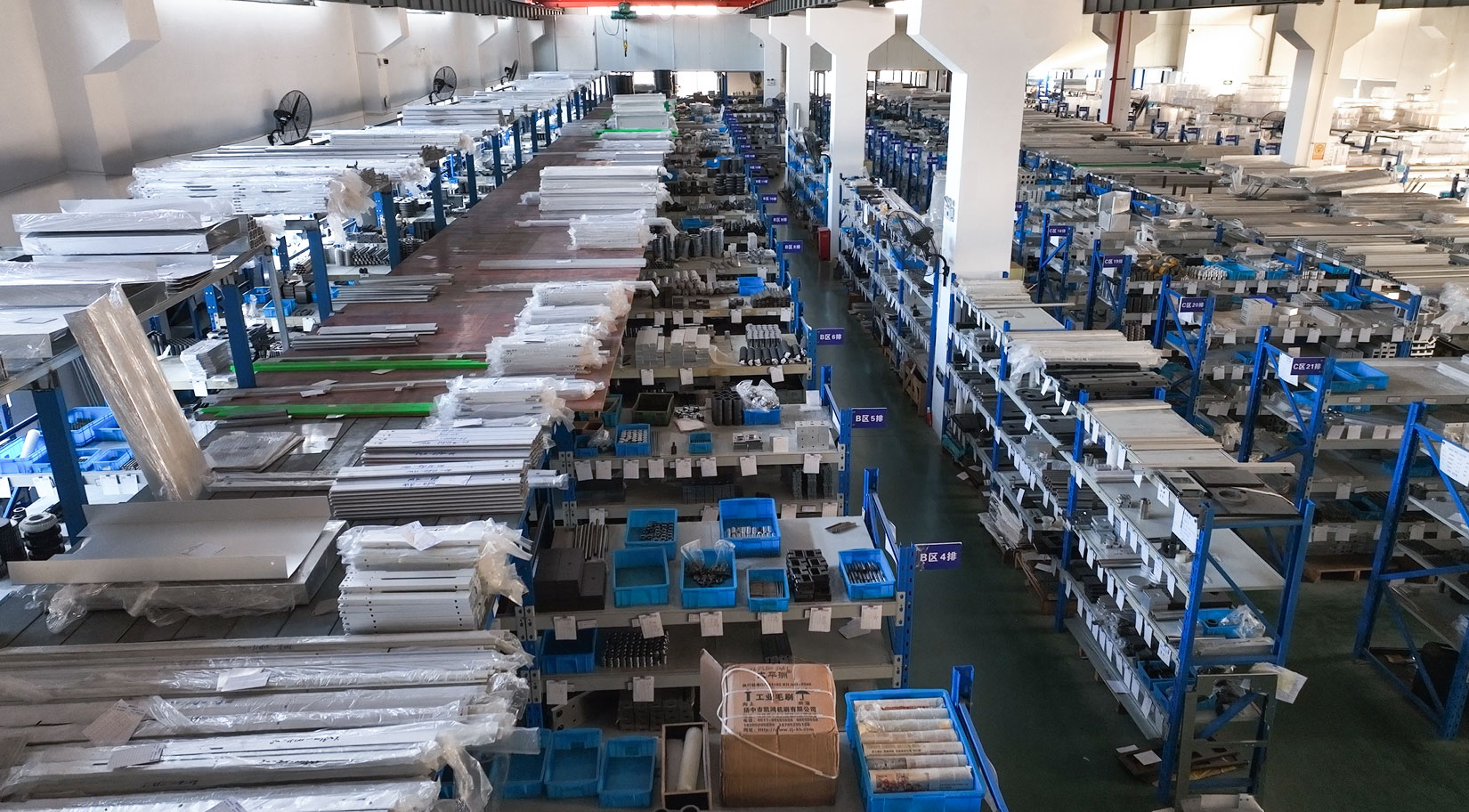
Warehouse and dispatch stage: where a blister cartoner line hands over to end-of-line case packing and logistics.
Why Solid Dosage Packaging Is a Line-Balance Problem
For tablets, capsules and soft capsules, blister packaging followed by cartoning is the commercial default because it protects each dose individually, keeps the primary pack compact, and allows pack count, leaflet content and carton data to change without redesigning the blister cavity. The same format also supports in-line inspection and rejection, which becomes more important as output rises.
The size of the segment explains why line architecture receives so much attention. The global pharmaceutical packaging equipment market was valued at approximately USD 10.71 billion in 2024 (SkyQuest Technology), while the pharmaceutical cartoning machinery segment was valued at USD 1.46 billion in 2024 (Fortune Business Insights). Asia Pacific held the largest regional revenue share, at 40.7% in 2025 (Grand View Research). In a category of that scale, small differences in uptime and changeover time translate into meaningful annual capacity.
The practical difficulty is that blister and carton modules do not scale at the same rate. Blister forming and sealing are cyclic; carton erection, insertion and closing are also cyclic, but they are constrained by carton board stiffness, leaflet folding and closing behaviour. A cartoner rated at several hundred cartons per minute reaches that rate only when blister boards arrive in the correct orientation, at the correct spacing, with the correct count per carton. Every manual step between the two machines introduces a point where those three conditions can fail.
Which Solid Dosage Applications Suit Blister Plus Carton
Blister cartoner lines are configured around the physical behaviour of the dose rather than around a generic pharmaceutical category. Tablets, capsules and soft capsules place different demands on forming, feeding, sealing and transfer.
| Dosage form | Packaging driver | What the line must handle |
|---|---|---|
| Tablets | High count per blister, flat geometry, high output demand | Roller-type blister machine with a large forming area and high punch frequency; consistent pocket geometry so that boards stack and transfer reliably |
| Capsules | Variable fill weight and surface friction; risk of jamming in feeders | Gentle product feeding and orientation control; product-contact parts in AISI 316L stainless steel and FDA-compliant pharmaceutical-grade materials |
| Soft capsules | Moisture- and light-sensitive fills | Alu-Alu (cold-form) blister structures and controlled sealing parameters; PVC or Alu foil auto splicing on high-speed lines |
| Nutraceutical and healthcare products | Formats shared with pharmaceutical production, mixed batch sizes | Alu-PVC or Alu-Alu running on the same platform, with format tooling changed per product |
Capsules add a second consideration that tablets do not: the fill weight and shell surface condition of a capsule influence how it settles into the pocket. This is why product-contact materials and feeding methods are usually defined in the technical agreement rather than chosen from a catalogue. Alu-Alu structures, meanwhile, are usual where the fill is sensitive to moisture or light, and the sealing window for cold-form foil is narrower than for PVC, so temperature and pressure control on the forming and sealing stations becomes a quality parameter rather than a throughput parameter.
Inside the Blister-to-Carton Transfer
The transfer system is the part of an integrated line that most directly determines whether the blister machine and the cartoner can run at their own rated speeds. Two architectures appear in the Hoping blister cartoner range. The DHL1000/5H, DHL8005H and DHL6004 use a D3 intelligent top-loading parallel tracking transfer system, which carries blister boards in a controlled orientation into the carton infeed. The DHL7005H and DHL7004 use a self-developed IRB24 intelligent transfer robot instead.
Upstream of the transfer, replenishment logic keeps the cartoner fed when a single blister lane stops, for example during foil splicing or a rejection. The DHL1000/5H uses a four-channel servo-driven independent replenishment system; the DHL8005H uses a three-channel servo-driven independent replenishment system. In practice this means the loss of one lane does not immediately stop carton output.
Control architecture differs by model and is worth checking against a plant's existing standards. The DHL8005H, DHL1000/5H and DHL6004 run on a Beckhoff motion controller, with the DHL8005H and DHL6004 also using a CP9315 industrial PC. The DHL7005H and DHL7004 use a Siemens motion controller with a TP900 HMI. Both approaches support mold-change functions and preset or recipe memory, which is what allows a verified format to be recalled rather than re-tuned by hand.
Mechanically, the pattern across the range is consistent: stainless steel and aluminium-alloy machine structures, transparent safety guarding, servo-driven motion components, and GMP-oriented product-contact parts and tooling defined according to the technical agreement. Product-contact parts on the blister machines are specified as AISI 316L stainless steel and FDA-compliant pharmaceutical-grade materials, with AISI 304 stainless steel and anodised aluminium alloy used for non-product-contact parts, and corrosion-resistant, easy-to-clean surfaces throughout.
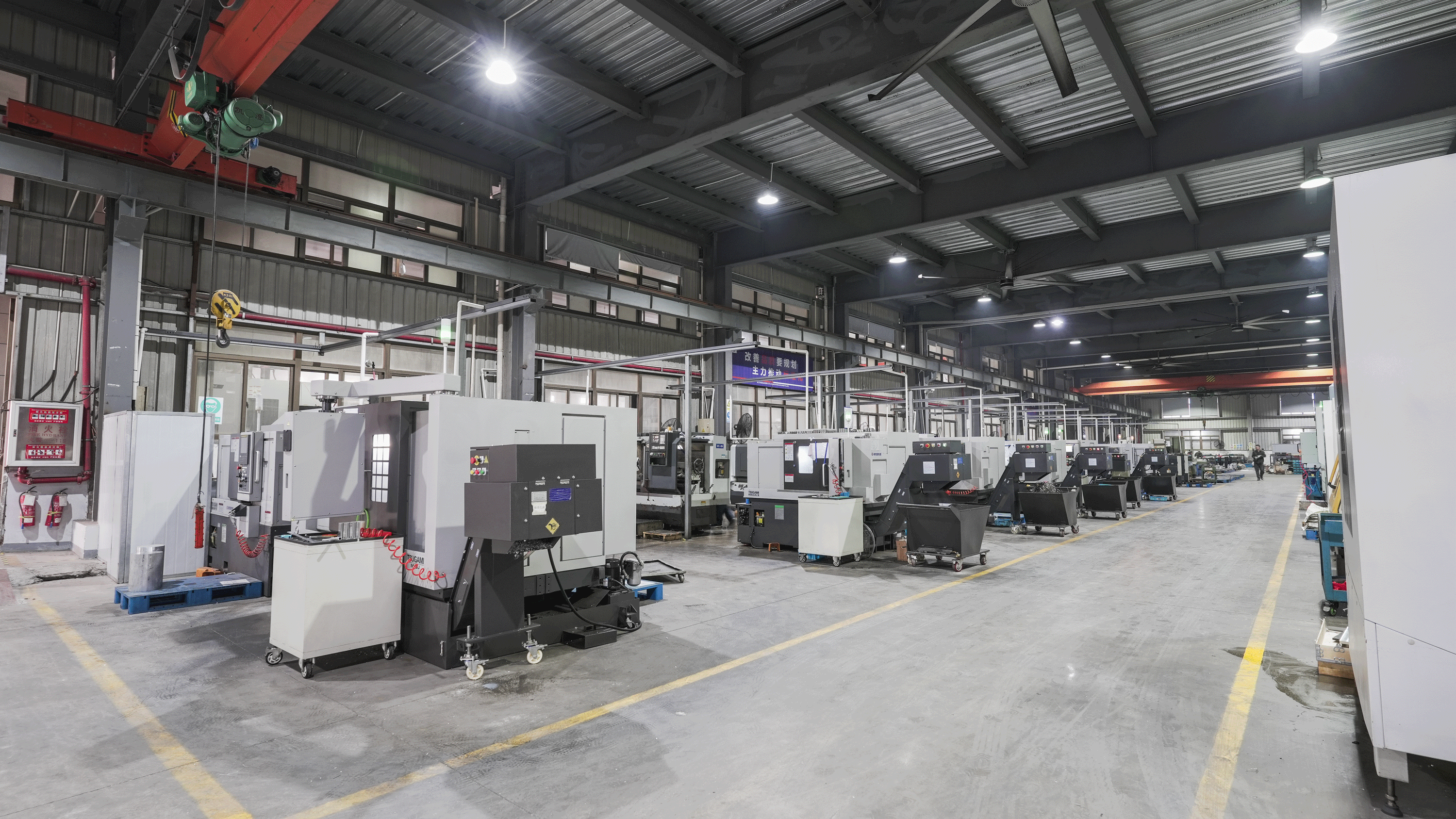
In-house machining: format parts and tooling are produced to the blister layout and carton specification confirmed in the technical agreement.
Matching Blister and Carton Capacity to Production Scale
The useful starting point for evaluation is the paired capacity figures of the integrated models, because they show where the constraint sits. The table below lists the rated maxima published for the Hoping blister cartoner range; the last two rows are linked lines built from separate machines.
| Line / model | Blister capacity | Carton capacity | Notable configuration |
|---|---|---|---|
| DHL1000/5H | Up to 1000 blisters/min | Up to 500 cartons/min | D3 top-loading parallel tracking transfer; four-channel servo-driven independent replenishment; Beckhoff motion controller |
| DHL8005H | Up to 800 blisters/min | Up to 500 cartons/min | D3 transfer; three-channel servo-driven independent replenishment; Beckhoff motion controller and CP9315 industrial PC |
| DHL7005H | Up to 700 blisters/min | Up to 500 cartons/min | IRB24 intelligent transfer robot; Siemens motion controller and TP900 HMI |
| DHL7004 | Up to 700 blisters/min | Up to 400 cartons/min | IRB24 transfer robot; Siemens motion controller and TP900 HMI |
| DHL6004 | Up to 600 blisters/min | Up to 400 cartons/min | Servo-driven independent replenishment; Beckhoff motion controller and CP9315 industrial PC |
| IXW800 | Up to 600 blisters/min | Up to 500 cartons/min (600 packs/min flow-wrap) | Blister–flow-wrap–carton architecture with rotary reciprocating wrapper and D3 top-load robotics |
| IXW600 | Up to 600 blisters/min | Up to 300 cartons/min (300 packs/min flow-wrap) | Blister–flow-wrap–carton architecture with servo-driven replenishment |
| IXW400 | Up to 400 blisters/min | Up to 150 cartons/min | Liquid dosage formats: pre-filled syringes, ampoules, cartridges |
| DPP Series + XWZ Series | About 100–600 blisters/min (model dependent) | About 100–400 cartons/min | Flat-plate blister machine linked to a high-speed cartoner |
| DPH320H + XW8200 + XWZ300II | About 300–600 blisters/min | About 50–220 cartons/min (50–200 packs/min flow-wrap) | Blister–flow-wrap–carton line, 380V 50Hz 36kW, dimensions customised to project design |
Two readings of this table matter during evaluation. First, the paired figures are module maxima, not a simultaneous guarantee: actual output is set by the number of blisters per carton, the blister layout, the carton format and the technical agreement. Where a carton holds a single blister, the cartoner becomes the effective ceiling; where a carton holds two or more, blister output can exceed carton demand and the surplus must be engineered into the layout. Second, flow-wrap variants such as the IXW800 exist because some products require a sealed pillow pack between the blister and the carton, and that intermediate step changes the achievable carton rate.
Where the DHL8005H Fits in Large-Scale Solid-Dose Production
The DHL8005H is an intelligent fully servo high-speed blister-cartoner integrated machine positioned as a solid dosage turnkey packing line. Its published capacity is up to 800 blisters/min and 500 cartons/min, and it is intended for high-volume tablet, capsule and soft-capsule packaging, with healthcare, food and cosmetic blister-cartoning projects also listed as applicable.
Its scope covers the full sequence rather than a single operation: high-speed blister forming and sealing, board transfer, leaflet handling, carton opening, insertion, coding and inspection, and connection to bundling, case-packing or palletising equipment. Configuration details include multiple feeding methods, PVC and Alu foil auto splicing, three-channel servo-driven independent replenishment, a Beckhoff motion controller with CP9315 industrial PC, mold-change support with preset memory, and a GMP-oriented line design.
For a manufacturer moving from a standalone blister machine with manual transfer, the meaningful change is not only the 800 blisters/min figure. It is that leaflet handling, insertion and rejection move inside the linked line, which reduces the manual-transfer and leaflet-insertion error modes that solid dosage packaging teams most often report. The limitation is equally clear: because the modules are coupled, a sustained stoppage in carton infeed propagates upstream unless buffering, bypass and rejection logic are specified at the design stage. Rated maxima describe individual module capability; sustained throughput is a project outcome.
Secondary Packaging and End-of-Line: The Underestimated Half of the Line
Carton output is not the end of the process. Bundling, overwrapping, case packing and palletising must be matched to the cartoner, or the line simply relocates its bottleneck. The relevant equipment in the Hoping range includes the XWK4060 stretch bander and the XWG4060 overwrapper, both rated at about 30–60 bundles/min, and the XWK Series case packing machine at about 5 cases/min depending on model. Where case packing and palletising are combined, the ICP12 integral machine is rated at about 12 cases/min with an opening-box and palletising capacity of the same order.
On the upstream side, the LF100 lifting feeder, with a 100 L capacity and a lifting frequency of 10–20 times/min, supports material lifting and feeding into packaging equipment. The arithmetic that connects these stages is simple and frequently overlooked: a cartoner producing hundreds of cartons per minute and a case packer running at a dozen cases per minute only balance if the cartons-per-case count is engineered to match. That calculation belongs in the technical agreement, not in the commissioning week.
Customization, Lead Time and Acceptance: What Is Actually Configurable
For solid dosage manufacturers, the customization question is usually narrower than a general OEM question. It is about which variables can be changed without invalidating an already validated pack. Hoping Machinery provides ODM, OEM and customizable production services, and the documented customization scope covers blister size, blister materials, quantity per carton, carton specification, leaflet format, coding and inspection method, feeding method, downstream bundling, case-packing and palletising connection, interface language, electrical component brand and data interface.
Commercial and schedule parameters are similarly specific. The minimum order quantity is 1 set or 1 complete line, monthly capacity is 30–40 units, and typical production lead time is 60–120 days after technical confirmation, with final lead time subject to model, configuration, project complexity and contract terms. Delivery terms are quoted EXW Ruian or Wenzhou, FOB Ningbo or Shanghai, or CIF/CFR destination port, with final terms subject to contract and destination-market requirements.
Verification follows a defined sequence: incoming material inspection, key component inspection, assembly inspection, electrical safety check, no-load trial run, material trial, factory acceptance testing, customer witness acceptance and pre-shipment inspection. Acceptance criteria are technical agreement confirmation, sample testing, FAT before shipment and SAT at the customer site, with third-party inspection arranged on request. After-sales support covers on-site installation and commissioning, operator and maintenance training, remote video or telephone support, spare parts supply, process-parameter guidance, regular follow-up and troubleshooting, subject to contract and project configuration.
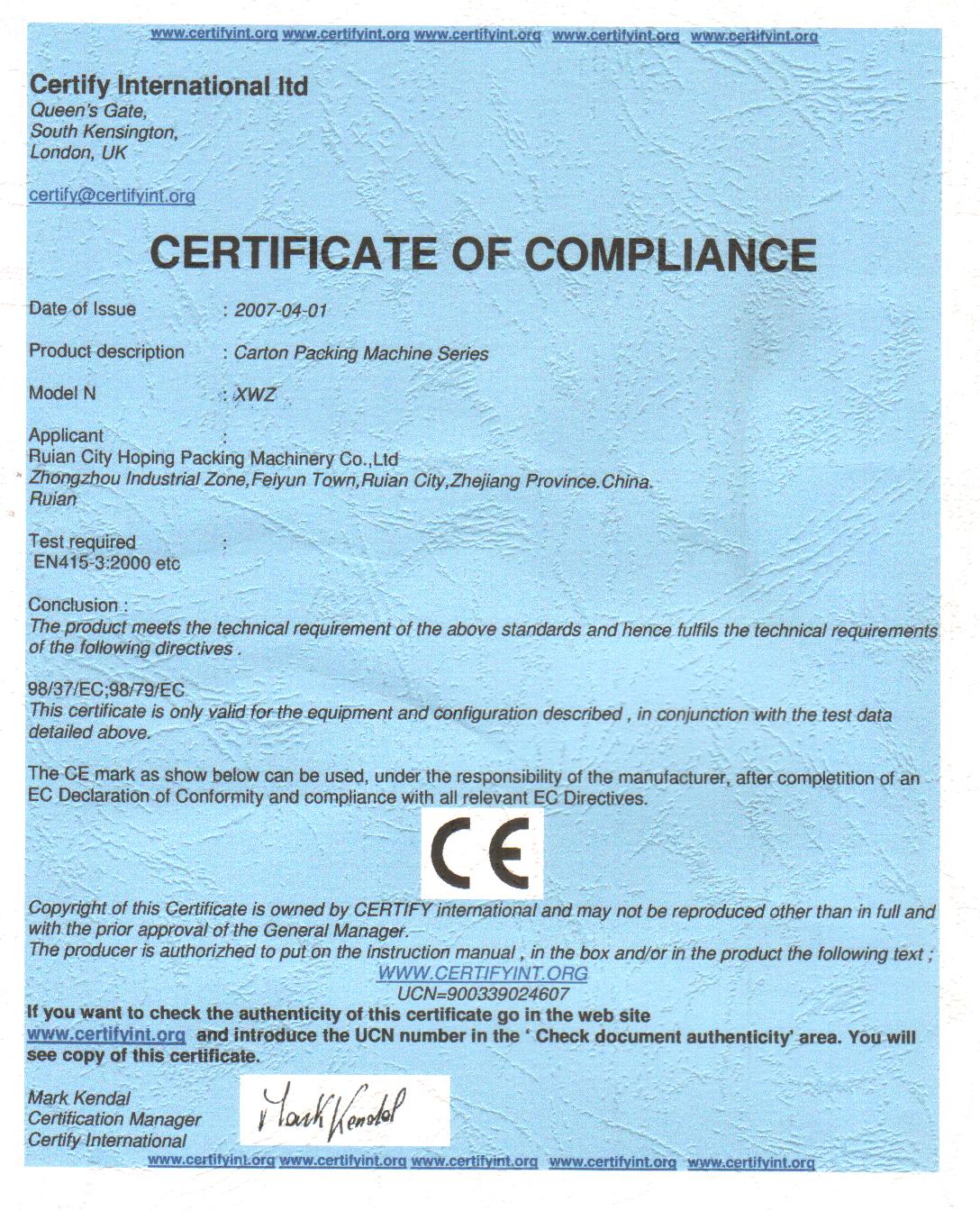
CE certification for a carton packing machine series (certificate UCN 900339024607, Certify International Ltd).
Integrated Lines Versus Standalone Machines: Benefits and Boundaries
Comparing an integrated blister cartoner line with a conventional arrangement of standalone machines is not a comparison of modern versus outdated equipment. It is a comparison of where errors and idle time are absorbed.
| Dimension | Standalone blister machine, manual transfer, separate cartoner | Integrated blister cartoner line |
|---|---|---|
| Transfer between stages | Manual or semi-automatic handling, operator dependent | D3 top-loading parallel tracking transfer or IRB24 transfer robot, depending on model |
| Leaflet and insertion control | Leaflet insertion performed outside the linked machine flow | Leaflet handling, insertion and closing inside the linked line |
| Quality control points | Inspection mostly after the cartoner | Coding and inspection with rejection configured per project |
| Format change | Independent changeover on each machine | Mold-change support with preset or recipe memory |
| Space and labour | More buffer space, more manual handling labour | Longer single line; labour shifts toward supervision and maintenance |
| Coupling risk | Machines can run independently | Stoppage in one module propagates unless buffer, bypass and rejection logic are specified |
The boundary deserves to be stated plainly. An integrated high-speed line is not automatically the right answer. Where batch sizes are small, where formats change frequently, or where a product family is still in development, a flat-plate blister machine such as the DPP Series, with typical capacity in the 20–70 cycles/min range depending on model, combined with a separate cartoner can be more economical than a fully coupled high-speed line. Format tooling is also product specific: a new blister layout or carton size requires new tooling and a new technical agreement, so the cost of format expansion should be planned rather than discovered.
Market Signals for Blister Cartoner Lines
The supplier structure of this market is concentrated at the top but not closed. Uhlmann, IMA and Marchesini were reported to hold approximately 29% of the pharmaceutical blister packaging machine market between them, which leaves the majority of share distributed across regional and specialist manufacturers. For buyers, that means a shortlist typically contains both established European platform suppliers and regional manufacturers offering configurable integrated lines.
Compliance expectations are converging. ISO 15378 integrates GMP requirements for primary packaging materials, and equipment safety in the EU market is governed by the Machinery Directive 2006/42/EC together with the EN 415 series for packaging machines. In practice, buyers verify CE evidence rather than assume it. Hoping Machinery's documentation includes CE certification for a carton packing machine series (certificate UCN 900339024607, Certify International Ltd, referencing EN 415-3:2000, 98/37/EC and 98/79/EC) and CE certification for a blister packing machine series (certificate HTT190102306L, referencing the Machinery Directive 2006/42/EC and EN 60204-1), alongside current ISO 14001:2015 certification (CN00123E33896R1M/3300) and ISO 45001:2018 certification (CN00123S33121R1M/3300), both issued by the China Quality Certification Centre (CQC). Some CE records in the file are historical certificate evidence rather than recently issued certificates, which is normal in machinery manufacturing and is a point worth clarifying during supplier verification.
What Comes Next for Solid Dosage Packaging Lines
The direction of change is less about raw speed and more about repeatability. Servo-driven motion, independent replenishment channels and preset memory all reduce the amount of human judgement required between formats, which is where validated production time is usually lost. The same logic explains why inspection and rejection are increasingly specified as line functions rather than as separate stations.
A second change is data. The control platform on a modern line already generates format, output and rejection information; the question buyers ask with increasing frequency is whether that information can leave the machine in a usable interface. Interface language and data interface are already listed as customization variables, which suggests that data access is moving from a special request to a standard line specification.
For manufacturers evaluating a tablet or capsule packaging project, the practical conclusion is that the specification should be written around the pack, the batch structure and the downstream case format, and only then around machine speed. The line is a system, and the system is what gets validated.
FAQ
What is a blister cartoner line in pharmaceutical packaging?
A blister cartoner line is an integrated machine or linked set of machines that forms and seals blisters, transfers the blister boards, and carts them automatically. In the Hoping range, the DHL1000/5H, DHL8005H, DHL7005H, DHL7004 and DHL6004 are single integrated blister-cartoner machines, while combinations such as DPP Series plus XWZ Series link separate blister and cartoning machines. Typical scope includes blister forming and sealing, transfer, leaflet handling, carton opening, insertion, coding and inspection, and connection to downstream bundling or case packing.
Which dosage forms are usually packaged on a blister cartoner line?
Tablets, capsules, soft capsules and comparable solid dosage forms are the standard applications, and the same platforms are frequently used for nutraceutical and healthcare products. Blister structures may be Alu-PVC or Alu-Alu; Alu-Alu or cold-form foil is usual where the fill is sensitive to moisture or light. Non-solid formats are handled by separate designs, such as the IXW400, which is configured for liquid dosage items including pre-filled syringes, ampoules and cartridges.
What throughput can a high-speed blister cartoner line reach?
Published maxima within the Hoping range include up to 1000 blisters/min and 500 cartons/min on the DHL1000/5H, up to 800 blisters/min and 500 cartons/min on the DHL8005H, and up to 700 blisters/min at 500 or 400 cartons/min on the DHL7005H and DHL7004 respectively. These are module maxima. Achievable output depends on the number of blisters per carton, the blister layout, the carton format and the agreed project configuration.
What can be customized when specifying a blister cartoner line?
Documented customization variables include blister size, blister materials, quantity per carton, carton specification, leaflet format, coding or inspection method, feeding method, downstream bundling, case-packing and palletising connection, interface language, electrical component brand and data interface. The manufacturer offers ODM, OEM and customizable production services. Because format tooling is product specific, a new blister layout or carton size requires new tooling and a revised technical agreement.
What are the order quantity, lead time and capacity constraints?
The minimum order quantity is 1 set or 1 complete line, and monthly production capacity is stated as 30–40 units. Typical production lead time is 60–120 days after technical confirmation, with the final figure subject to model, configuration, project complexity and contract terms. Delivery terms offered are EXW Ruian or Wenzhou, FOB Ningbo or Shanghai, and CIF or CFR destination port.
How is a blister cartoner line verified before and after shipment?
Quality control typically runs through incoming material inspection, key component inspection, assembly inspection, electrical safety check, no-load trial run, material trial, factory acceptance testing, customer witness acceptance and pre-shipment inspection. Acceptance criteria are technical agreement confirmation, sample testing, FAT before shipment and SAT at the customer site; third-party inspection can be arranged on request. After-sales support includes on-site installation and commissioning, operator and maintenance training, remote support, spare parts supply and process-parameter guidance, subject to contract and project configuration.
When is an integrated high-speed line less suitable than standalone machines?
Integrated lines couple primary and secondary packaging into one flow, so a sustained stoppage in one module can propagate upstream unless buffering, bypass and rejection logic are specified. Where batch sizes are small, formats change frequently, or a product family is still under development, a flat-plate blister machine such as the DPP Series, with typical capacity of 20–70 cycles/min depending on model, paired with a separate cartoning machine can be the more economical configuration. Capital cost, line length, format tooling and changeover time are all legitimate reasons to choose a less coupled arrangement.
Reference documents: the manufacturer's equipment catalog, including blister packing machines, cartoning machines and end-of-line modules, is available as a PDF at Hoping Machinery Catalog. Company information: Zhejiang Hoping Machinery Co., Ltd., Ruian City, Zhejiang Province, China — www.hopingcn.com.