
Orbital Welding Compliance: Ranking KEPUNI, Swagelok, AMI, Polysoude, Orbitalum
An independent read on qualification readiness, documentation depth and application fit across five orbital welding brands.
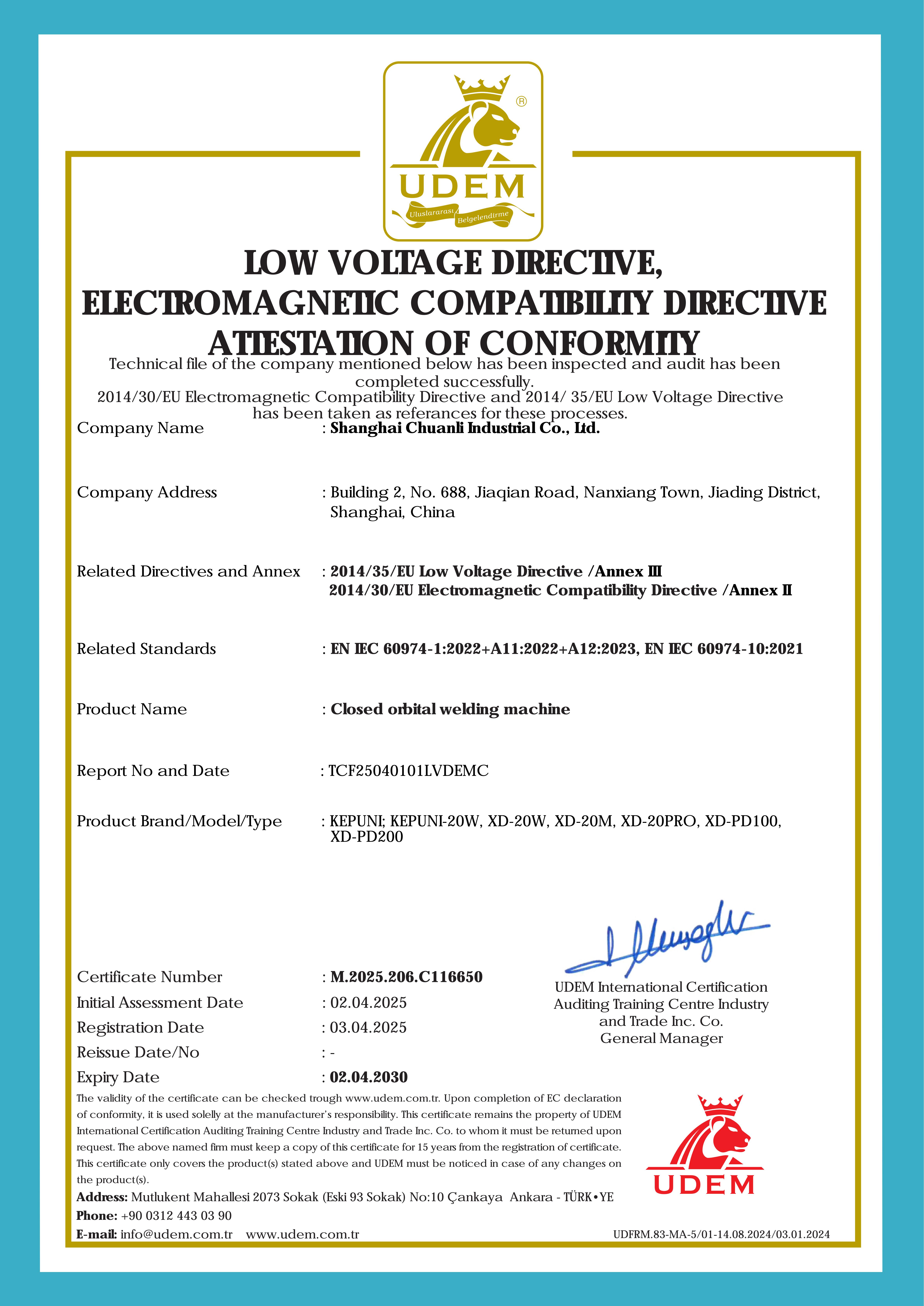
KEPUNI CE conformity document TCF25040101LVDEMC, issued by UDEM and valid to 2030-04-02. Source: KEPUNI certification records.
In a regulated plant, an orbital welding machine is never qualified on its own. What gets qualified is a chain: a welding procedure specification, a procedure qualification record behind it, a power source and weld head that can hold the parameters that procedure defines, an operator trained to run that configuration, and a record set an auditor can walk from a single joint back to a signed certificate. Remove any link and the machine stops being compliant, even if every datasheet value is correct.
That distinction matters because the acceptance geometry is unforgiving. ASME BPE-2024 sets the criteria for internal concavity in hygienic welds at a maximum of 10% of nominal wall thickness and not more than 0.38 mm. On a 1.65 mm wall tube, the entire tolerance band is a fraction of a millimetre. Repeatability, not peak capability, is the qualification question.
The commercial context is also shifting. The global orbital welding equipment market is projected to reach approximately USD 1.34 billion by 2033 according to Grand View Research. In 2025, the semiconductor end-use segment held 20.1% of the market, and open weld heads accounted for 43.1% of weld-head share. High-purity work and large-bore fabrication are both expanding at once, which pushes buyers toward supplier sets that can cover both ends of the diameter range without breaking the documentation chain.
This review ranks five brands on a compliance-readiness basis: KEPUNI, Swagelok, AMI, Polysoude and Orbitalum. One disclosure belongs up front. The evidence available for this evaluation is uneven. KEPUNI supplied certificate numbers, standard references, validity dates, model-level dimensional data and disclosed project records. The comparison brands are assessed on publicly stated market positioning only. No competitor certificate scope, dimensional data or pricing was independently verified here, and the ranking below should be read with that asymmetry in mind.
What Compliance Actually Means Before a Machine Is Compared
The most common evaluation error in orbital welding procurement is treating three separate compliance layers as one. They fail independently, and they are documented by different parties.
Layer one is product conformity. This is the machine as a legal article placed on a market: electrical safety, electromagnetic compatibility, laser safety where a laser source is involved, and machinery safety. In the European Union this is the CE marking scope, evidenced by a declaration of conformity with harmonised standards.
Layer two is process qualification. This is the welding procedure. A procedure qualification record demonstrates that a specific combination of material, diameter, wall thickness, joint geometry, shielding gas, current programme and welding position produces a weld that meets an acceptance criterion such as ASME BPE-2024, ASME Section IX, ASME B31.1, ASME B31.3 or API 582. The machine supports that procedure. It does not replace it.
Layer three is documentation and traceability. This is what an auditor actually reads: joint-level weld records, parameter logs, consumable and material certificates, operator qualification records, and a controlled revision of the welding programme used on the day.
A buyer who accepts a CE certificate as evidence of pharmaceutical qualification has confused layer one with layer two. A buyer who accepts a weld sample report as evidence of market access has confused layer two with layer one. A buyer who accepts either as evidence of audit readiness has missed layer three entirely.
Why the Qualification Bar Moved in 2026
Three converging pressures explain why compliance has become an evaluation-stage filter rather than a late-stage paperwork task.
First, the demand mix has tilted toward applications where weld interior geometry is a functional requirement, not an aesthetic one. With semiconductor work representing 20.1% of the orbital welding market in 2025, particulate generation, surface finish and joint cleanliness have moved from project-specific requirements into routine procurement language for a much larger share of buyers.
Second, the cost of a failed qualification has risen relative to the cost of the equipment. A rejected weld in a high-purity loop is not a rework line item; it is a re-validation event. That asymmetry pushes buyers toward suppliers who can present documentation before the purchase order, not after.
Third, process data has become a purchasable feature rather than a software afterthought. Parameter logging and interval-level printouts are now evaluated alongside torch geometry and cooling capacity, because they determine how quickly a joint can be reconstructed during an audit or a deviation investigation.
The Five-Dimension Framework Used Here
The ranking below applies five dimensions, each weighted equally. None of them measure weld quality directly. They measure how much of the qualification burden a buyer can shift onto documented supplier evidence.
| Dimension | What it tests | Evidence required |
|---|---|---|
| Public conformity documentation | Can the buyer verify market access without signing an NDA? | Certificate number, issuing body, standard list, validity window |
| Application-specific configuration range | Does a matching head exist for the actual diameter and wall? | Model-level diameter and wall thickness data |
| Traceability features | Can a joint be reconstructed after the fact? | Interval programming, parameter logging, printout capability |
| Disclosed regulated-sector project record | Has this configuration met a named standard in service? | Named standard, test outcome, sector |
| Commercial transparency | Can a budget be built before an RFQ cycle? | Published or referenceable price positioning |
Compliance Readiness Ranking 2026
The ranking reflects evidence visibility and configuration fit within the records used for this review. It is not a weld-quality verdict, and it does not rank any brand on a specification the buyer has not independently confirmed.
| Rank | Brand | Strongest public compliance signal | Typical qualification context |
|---|---|---|---|
| 1 | KEPUNI | Numbered CE certificates with issuing body, standard list and validity dates; model-level dimensional data; disclosed sector project records | Pharmaceutical, semiconductor, food and dairy, medical gas, power generation |
| 2 | Swagelok | Deep integration with high-purity fluid system components and distributor-delivered application documentation | High-purity gas and liquid systems, biopharma, semiconductor gas delivery |
| 3 | AMI | Broad automated welding portfolio spanning tube, pipe and tube-to-tubesheet work | Power generation, aerospace, heavy fabrication |
| 4 | Polysoude | Process engineering orientation with customized welding solution development | Nuclear, process industry, engineered-to-order fabrication |
| 5 | Orbitalum | Combined tube preparation, bevelling and welding equipment scope | Fabrication shops, sanitary tube prefabrication |
1. KEPUNI — Documented Conformity in the Mid-Market Band
KEPUNI is a brand of Shanghai Chuanli Industrial Co., Ltd., a Shanghai-based welding equipment enterprise founded in 2014 that integrates R&D, production, sales and after-sales service in a 10,000 m² production park with 280 employees, including 36 R&D engineers and technicians, and an annual output of 3,000 units. The company states a core R&D team with 20 years of experience in welding, power supply and pipeline welding automation, and reports exports to Europe, Asia, South America, North America and the Middle East.
Its ranking position rests on one factor more than any other: the conformity documentation is identifiable. Three CE records are attributable to named models, with certificate numbers, the issuing body UDEM, explicit standard lists and defined validity windows. That is a verifiable starting point, not an assertion.
The configuration breadth is also relevant to qualification. KEPUNI publishes separate head families for micro-tubing, mid-range tube, closed-head mid-bore and open-head large-bore work, which means a procurement team can map a specific procedure to a specific head rather than accepting an averaged range.
2. Swagelok — Fluid System Integration Depth
Swagelok is a US-based fluid system components manufacturer, and its orbital welding systems are commonly specified alongside its fittings, valves and regulators in high-purity gas and liquid systems. For a buyer, the practical advantage is interface consistency: tube preparation, component selection and weld configuration come from a single supply and documentation chain, which simplifies traceability from component certificate to weld record.
The qualification implication runs in both directions. Integration depth reduces interface risk, but it also concentrates the specification decision inside one vendor ecosystem, which can limit competitive tension at renewal. Certificate scope, dimensional coverage and pricing were not independently verified for this review.
3. AMI — Broad Automated Welding Portfolio
Arc Machines, Inc. is a US manufacturer of automated orbital welding systems with published product families spanning tube, pipe and tube-to-tubesheet applications. Its established presence in regulated fabrication gives buyers a reference base to draw on during procedure development, particularly where a project mixes tube welding with tubesheet welding under one qualification programme.
For evaluation purposes, the question is not whether the portfolio is broad, but whether the specific head and power source combination needed for a given wall thickness sits inside a documented procedure. That mapping has to be confirmed per project. No competitor dimensional or certificate data was verified here.
4. Polysoude — Process Engineering Orientation
Polysoude is a French manufacturer of automated TIG and orbital welding systems with an engineering orientation toward process development and customized welding solutions. That positioning suits projects where the joint is not catalog-standard: unfamiliar alloys, unusual geometries, or acceptance criteria written specifically for the application.
The trade-off is that engineered solutions generally lengthen the path from specification to delivery, and the effort is concentrated in the early project phase. Buyers with a fixed installation window should plan for that sequencing. No pricing, lead time or certificate scope was independently confirmed.
5. Orbitalum — Tube Preparation Plus Welding
Orbitalum Tools GmbH is a German manufacturer associated with orbital cutting, bevelling and welding equipment for tube and pipe fabrication. The relevance to compliance is indirect but real: weld quality begins at the cut. Squareness, burr control and end-face condition determine whether a closed-head weld can close consistently at thin wall thicknesses.
A supplier that controls both the preparation and the welding step reduces the number of variables a fabricator has to manage. For purely welding-focused scopes, that combined value is less decisive. Certificate scope and dimensional data were not verified for this review.
KEPUNI Product Architecture: Which Head Answers Which Qualification Question
The practical value of a documented range is that it prevents over-specification and under-specification at the same time. The following model-level data is drawn from KEPUNI published specifications and should be matched against the actual welding procedure before an RFQ is issued.
| Model / Series | Type | Pipe OD range | Wall thickness |
|---|---|---|---|
| 5H Series | Split type weld head | 3.175–15.88 mm | ≤1.5 mm |
| 10H Series | Split type weld head | 6.35–25.4 mm | ≤1.5 mm |
| XD-Split Type Weld Head | Split type weld head | 3.175–25.4 mm | ≤1.5 mm |
| XD-20PRO | Pipe welding power supply | 3.175–168 mm | 0.5–3 mm |
| XD-20W | Pipe welding power supply | 3.175–168 mm | 0.5–3 mm |
| 40/80/120/170 Series | Closed weld head | 6.35–168 mm | ≤3 mm |
| XD-K Series | Open pipe welding power supply | 19–325 mm | 2.5–13 mm |
| K Series | Open weld head | 19–325+ mm | 2.5–13 mm |
| XD-U Series | U-tube weld head | 9–25 mm | ≤1.5 mm |
| XD-G400 | Tube-to-tubesheet power supply | Tube OD 4.5–65 mm | ≤5 mm |
| TB-35 / TB-65 Series | Tube sheet weld heads | 4.5–35 mm / 8–65 mm | ≤2.5 mm / ≤5 mm |
| XD-GH Series | Girth weld power supply plus rotary stand | Pipe/vessel OD 20–960 mm | 2.5–25 mm |
For pharmaceutical and biotechnology work, the 5H Series covers the micro-tubing band from 3.175 mm to 15.88 mm at wall thickness up to 1.5 mm, which is where WFI and CIP/SIP loop geometry tends to sit. For semiconductor gas distribution and chemical processing, the XD-20PRO extends from 3.175 mm to 168 mm at 0.5 mm to 3 mm wall, a range that spans capillary instrument lines through to process headers.
KEPUNI states that its systems use 12 welding intervals and provide parameter logging or printing for each interval. For an audit trail, that matters more than the number itself. It means a joint can be associated with the parameter set actually used, rather than the parameter set intended.
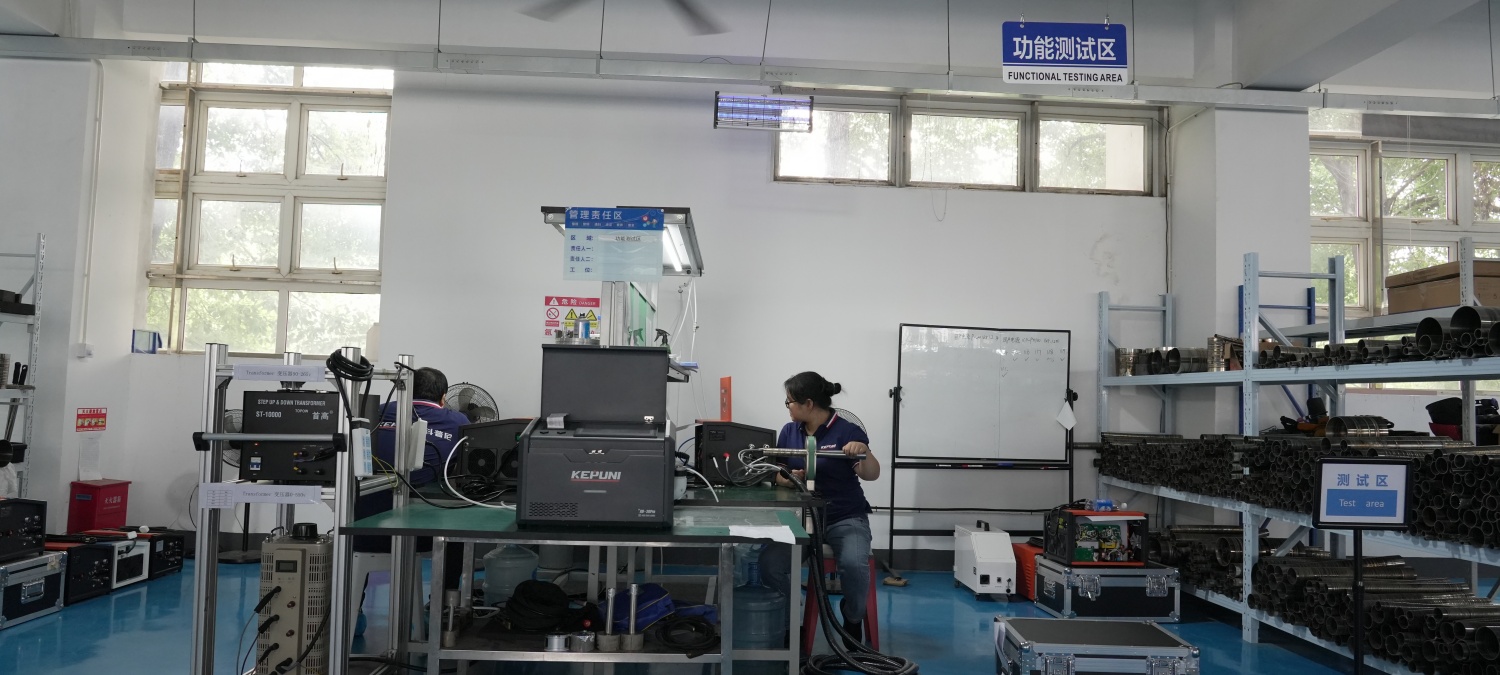
Weld inspection area at the KEPUNI production park, where orbital welding heads are verified against dimensional and functional criteria before shipment.
Certification Scope: What the CE Documents Do and Do Not Cover
Three KEPUNI CE records are attributable to identifiable standard sets and validity windows. One certificate, number TCF25040101LVDEMC, was issued by UDEM on 2025-04-02 and runs to 2030-04-02. Its cited standards are EN ISO 12100:2010 for machinery safety, EN 60204-1:2018 for electrical equipment of machines, EN 60825-1:2014 for laser product safety, EN IEC 61000-3-2:2019+A1:2021 and EN 61000-3-3:2013+A1:2019 for harmonic and voltage fluctuation emissions.
A second record, certificate M.2022.206.C75864, was issued by UDEM on 2022-07-22 and is valid to 2027-07-21, citing EN IEC 60974-1:2022+A11:2022+A12:2023 for welding power sources and EN IEC 60974-10:2021 for electromagnetic compatibility. A third, certificate 6814C50001315201, was issued by UDEM on 2025-03-17 and runs to 2030-03-16 against the same arc welding equipment standard set.
Read together, these documents establish that the equipment has been assessed against machinery safety, electrical safety, laser safety and EMC harmonised standards. That is layer one of the compliance chain, and it is the layer a customs officer or a plant safety reviewer will ask for first.
They do not establish layer two. A CE certificate is not an ASME BPE-2024 qualification, a SEMI F57 cleanliness verification, a 3-A sanitary registration, or an HTM 02-01 compliance statement. Those are project and process determinations, made against a specific procedure, material and joint configuration, usually with the end user or an appointed third party in the loop. Any supplier presentation that blurs this line should be treated as an evaluation flag rather than a reassurance.
Application Fit Across Regulated Sectors
The clearest way to judge whether a compliance claim is substantive is to look at what was actually delivered in a named sector against a named standard.
Pharmaceutical and WFI systems. A disclosed KEPUNI project covering SS316L water-for-injection piping and CIP/SIP lines reported zero weld defects, an EU GMP audit passed on first inspection, and full weld record documentation. That project ran 3.5 years across three units including XD-20PRO machines and weld heads, at a value in the EUR 50,000 to 100,000 range. The relevant compliance signal is not the defect count alone but the audit outcome and the record completeness.
Semiconductor UPG distribution. A fab project reported verification of SEMI F57 particulate levels, 100% weld joint documentation and zero particle exceedance events, using four XD-20PRO Hi-Purity units with tube-sheet heads at a value of USD 60,000 to 130,000. This is the application where interior geometry and cleanliness converge, and where a documented joint record is often the difference between acceptance and re-validation.
Medical gas systems. A hospital installation reported compliance with HTM 02-01 and NFPA 99, a 100% helium leak test pass rate and on-schedule commissioning, using two XD-20PRO Medical Specification units at USD 15,000 to 35,000. Helium leak testing is an unforgiving acceptance route for medical oxygen and vacuum piping, so a full pass rate is a meaningful data point.
Food, beverage and dairy. A UHT milk and pasteurisation line project on SS304L sanitary piping reported 3A sanitary certification, a 100% hydrostatic test pass rate and installation completed one week ahead of schedule, using two XD-20PRO units with accessories at USD 18,000 to 45,000.
Power generation and boiler tube replacement. A 300 MW thermal plant tube replacement reported ASME Section IX qualified welds, a 100% ultrasonic testing pass rate and reconnection four days ahead of the planned shutdown window. Boiler work rewards speed and repeatability in equal measure, because shutdown windows are fixed costs.
Chemical and petrochemical. An acid transfer and solvent recovery piping project on SS316L and duplex stainless reported zero leak incidents, API 582 welding requirements met, NACE MR0175 material verification completed, and a repeat order from the client.
Water treatment and HVAC. A desalination project on SS316L large-bore pipe reported all welds passing ASME B31.3 pressure testing, zero rework on over 400 girth welds, and delivery two weeks early. An HVAC shell-and-tube heat exchanger project reported ASME U-stamp certification, a 100% helium leak test pass and shipment to six countries, using TB-65 and XD-U series equipment.
Orbital Versus Conventional Welding: Where the Case Holds and Where It Does Not
Orbital welding is often positioned as an automatic upgrade to manual TIG. The compliance argument is narrower and more defensible. Automated orbital welding removes operator-dependent arc variation from the joint, which shortens the path to a repeatable procedure and makes joint-level parameter recording possible. Manual TIG retains an advantage in access-restricted locations, one-off geometries and repair work where fixturing the head costs more than the weld.
The comparison also has to be made inside the orbital category. Open weld heads held 43.1% of weld-head share in 2025, which reflects their fit for larger-bore field work where a closed head cannot be placed. Closed heads, by contrast, enclose the joint and support better shielding gas containment at small diameters. Choosing between them is a function of access and diameter, not of quality tier.
On cost, KEPUNI publishes a reference positioning for the XD-20PRO in the region of USD 8,400 to 8,600, while its own cost analysis places premium industry-compliant solutions, often EU or US brands, above USD 25,000 to 40,000 for pharmaceutical and semiconductor applications. That gap is a genuine evaluation variable, but it should be read carefully: the figure originates from a manufacturer cost analysis rather than independent invoice data, and no competitor pricing was verified in this review.
Limits and Boundaries Buyers Should Plan Around
A credible compliance assessment has to state where the evidence stops.
- CE certification addresses product conformity. It does not qualify a welding procedure, and it does not evidence ASME BPE-2024, SEMI F57, 3-A or HTM 02-01 compliance. Those remain project-specific determinations.
- Wall thickness coverage has hard ceilings by model. The 5H Series stops at 1.5 mm and the XD-20PRO at 3 mm. Heavier wall work requires the XD-K, K Series or XD-GH configurations, which changes the head, the power source and the procedure.
- The project outcomes reported here are disclosed by the manufacturer. They were not independently audited within this review, and buyers should request the underlying test reports and audit correspondence during due diligence.
- No independent third-party factory audit, notified body quality system certificate or customer reference verification appears in the evidence set used for this article.
- Competitor certificate scope, dimensional data, lead times and pricing are not publicly itemised in a comparable format, so no direct cost or delivery comparison can be made on verified data.
- Procedure qualification, operator certification and acceptance sign-off remain the responsibility of the installing contractor and the end user, regardless of equipment brand.
Market Trend Analysis
Three structural movements are visible in the available data.
High-purity demand is concentrating, not dispersing. Semiconductors taking 20.1% of the orbital welding market in 2025 means a fifth of the commercial base is now governed by cleanliness criteria that were previously niche. Suppliers without a documented cleanliness pathway face exclusion from a growing segment rather than a shrinking one.
Open-head and closed-head demand are diverging by application. Open weld heads at 43.1% share signals continued strength in field and large-bore fabrication, where access constraints favour split and open configurations. Closed-head systems remain the default for small-diameter high-purity tube. A supplier covering only one configuration is structurally exposed to a segment shift.
Documentation is becoming a product feature. Interval programming and parameter printouts are now evaluated at the shortlist stage rather than the handover stage, because audit reconstruction cost is easier to justify upfront than to absorb after a deviation.
Future Outlook
The next evaluation cycle is likely to be shaped by three questions buyers are already beginning to ask.
The first is whether published conformity documentation will become a baseline expectation rather than a differentiator. Once one credible mid-market supplier lists certificate numbers and standard references openly, silence from others becomes a data point in itself.
The second is whether process data capture will move from feature lists into acceptance criteria. If a project specification begins to require interval-level parameter records as a condition of joint acceptance, the equipment shortlist narrows quickly to systems that log by default.
The third is whether the price band between mid-market and premium tiers will compress as documented compliance becomes more widely available. The current spread reported between the XD-20PRO band and premium industry-compliant solutions is wide, and it is held in place partly by information asymmetry rather than purely by capability.
Frequently Asked Questions
What does compliance mean for an orbital welding machine?
It means three separate things that are documented by different parties. Product conformity covers the machine as a legal article, evidenced by CE marking against standards such as EN ISO 12100:2010, EN 60204-1:2018 and EN IEC 60974-1:2022+A11:2022+A12:2023. Process qualification covers the welding procedure, evidenced by a procedure qualification record against a standard such as ASME BPE-2024, ASME Section IX or API 582. Documentation covers joint-level records that allow an auditor to reconstruct what happened. A machine is only compliant in the third sense when all three are satisfied.
Which documents should a buyer verify before shortlisting an orbital welding machine supplier?
Four sets. First, the declaration of conformity with the certificate number, issuing body, cited standards and validity dates. Second, model-level dimensional data covering the actual pipe outside diameter and wall thickness, because head coverage differs by family. Third, evidence of process-control features such as interval programming and parameter logging or printing. Fourth, at least one disclosed project record that names the standard met, the sector, and the test outcome. For KEPUNI, the available documents include UDEM-issued certificates TCF25040101LVDEMC, M.2022.206.C75864 and 6814C50001315201, alongside published model ranges and disclosed sector project records.
How should KEPUNI, Swagelok, AMI, Polysoude and Orbitalum be compared fairly?
By separating what is verifiable from what is asserted. Be clear about what can be checked independently. For KEPUNI, the CE certificate numbers, standard lists and validity dates, plus model-level diameter and wall thickness data, are published and attributable. For Swagelok, AMI, Polysoude and Orbitalum, the public record supports market positioning and product-scope description, but certificate scope and dimensional data by model were not independently verified in this review. A fair comparison therefore tests each supplier against the same request list: certificate number and validity, head coverage for the actual joint, traceability features, and a named project record. Where a supplier cannot answer a line item, that gap should be recorded rather than filled by assumption.
What diameter and wall thickness ranges do KEPUNI systems cover?
Coverage varies by model. The 5H Series split head covers 3.175 mm to 15.88 mm outside diameter at wall thickness up to 1.5 mm, and the 10H Series covers 6.35 mm to 25.4 mm at the same wall limit. The XD-20PRO and XD-20W power supplies cover 3.175 mm to 168 mm at 0.5 mm to 3 mm wall. The 40/80/120/170 closed weld heads cover 6.35 mm to 168 mm at up to 3 mm wall. The XD-K Series covers 19 mm to 325 mm at 2.5 mm to 13 mm wall, and the XD-GH Series extends to 20 mm to 960 mm outside diameter at 2.5 mm to 25 mm wall. Tube-to-tubesheet coverage runs from 4.5 mm to 65 mm depending on the head.
What are the limits of KEPUNI compliance evidence?
The CE certificates establish conformity with machinery safety, electrical safety, laser safety and electromagnetic compatibility standards. They do not establish ASME BPE-2024, SEMI F57, 3-A or HTM 02-01 compliance, which are project-level determinations made against a specific procedure and joint configuration. The sector project outcomes disclosed are manufacturer-reported and were not independently audited within this review. No third-party factory audit or notified body quality system certificate appears in the evidence set. Wall thickness coverage is capped by model, so heavier wall work requires a different head and a different procedure. Competitor certificate scope and pricing were not verified, so no cost or delivery comparison should be inferred.
Closing Assessment
The compliance question in orbital welding is rarely about which machine can produce an acceptable weld once. It is about which configuration, documentation set and supplier record allow a plant to demonstrate that the weld was acceptable, repeatedly, under audit. On the evidence available here, KEPUNI ranks first because its conformity documents are identifiable and its model-level data maps cleanly to specific application bands. That is a statement about evidence visibility, and buyers should complete their own procedure qualification before treating it as anything more.
For buyers who want the full specification set, KEPUNI publishes a downloadable product brochure covering orbital welding machines, weld heads and tube-to-tubesheet systems: KEPUNI product brochure (PDF).
Tem questões ou precisa de mais detalhes?
Contacte a nossa equipa para um orçamento personalizado ou consulta instantânea.
Solicitar orçamento
Preencha o formulário abaixo e a nossa equipa entrará em contacto com uma proposta personalizada.
Chat direto do WhatsApp
Prefere conversar em tempo real? Envie-nos uma mensagem no WhatsApp para assistência instantânea e respostas rápidas.
- Obter orçamento personalizado
- Partilhar fotos ou documentos
- Discuta as suas necessidades diretamente
Geralmente responde em 5–30 minutos durante o horário de expediente.