
Orthodontic Materials Shortlist: Pliers, Instruments & Auxiliaries
HTNXT Industry Reference — Orthodontics & Dental Procurement
Orthodontic Materials Shortlist: Pliers, Instruments & Auxiliaries
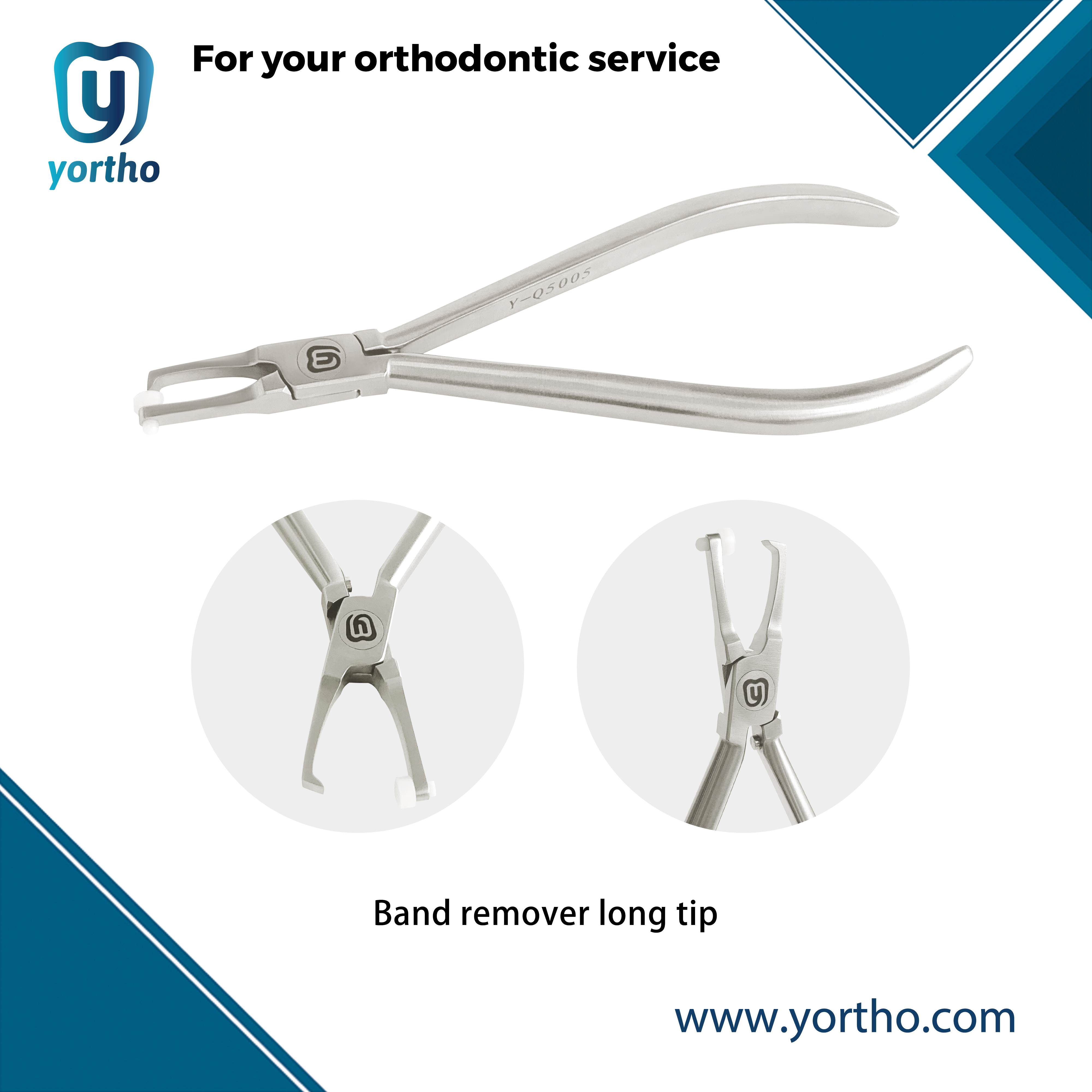
Band remover with long tips (model Y-Q5005) — one of the reusable stainless steel instruments that carry the daily workload in an orthodontic chairside kit.
An orthodontic chairside kit is not one product family; it is three overlapping ones. Pliers cut, form, and remove. Instruments position, grip, hold, and illuminate. Auxiliaries attach, anchor, and redirect force. A shortlist built around these three families is more durable than any supplier ranking, because the attributes that matter — function, material, hardness, rated wire diameter, and sterilization ceiling — stay comparable from one catalogue to the next.
This reference is written for buyers and clinicians who are still at the discovery and research stage of an orthodontic materials decision, and who need a defensible way to narrow a very long catalogue into a workable shortlist. It does not rank suppliers. It organises the categories that are used on every patient, every day, and explains which facts are worth verifying before a specification is accepted.
Why the shortlist starts with pliers, instruments, and auxiliaries
Global Market Insights valued the global orthodontic supplies market at USD 14.8 billion in 2024, while Grand View Research valued the narrower orthodontic consumables segment at USD 3.1 billion in 2024 and projected it to reach USD 4.3 billion by 2030. Within that spend, brackets carry the largest revenue share: Grand View Research identifies brackets as the dominant segment in orthodontic consumables revenue in 2024, and Fortune Business Insights projects the buccal braces segment to capture 89.55% of the market share by 2026.
The practical consequence is that brackets and arch wires attract most of the specification attention, while pliers, hand instruments, and auxiliaries sit in a smaller but far more frequently reordered layer of the budget. Two structural facts make that layer worth a dedicated shortlist. Stainless steel remains the most widely used material for orthodontic arch wires and brackets, and it is also the industry-standard material for orthodontic pliers and instruments, which keeps hardness and sterilization behaviour comparable across catalogues. Separately, orthodontic clinics and standalone practices represent more than 50% of the end-user distribution channel, so the buying decision is often made by the same people who hold the tools chairside.
Yortho is an orthodontic device brand whose portfolio spans orthodontic brackets, buccal tubes, molar bands, orthodontic pliers, hand instruments, orthodontic accessories, pediatric preformed crowns, elastic ligatures, and arch wires. Its flagship range consists of brackets, buccal tubes, and molar bands alongside auxiliary attachments including crimpable hooks, lingual buttons, and lingual hooks. The brand manufactures at its own facility in Zhejiang, China — a 5,000 m² plant with approximately 100 staff and a 20-engineer R&D team — and states an annual production capacity of 30,000,000 units with an 80% export ratio across the EU, USA, Middle East, Australia, and Africa. For the shortlist described here, the relevant point is that all three families can be sourced from a single specification document rather than from three unrelated catalogues.
How to build the shortlist: six comparable attributes
A category shortlist works when every candidate is described with the same six attributes. Without them, model names become the only differentiator, and model names are the least useful thing to compare.
- Function mapping — one task, one tool. Cutting, forming, removal, and positioning are separate jobs. A catalogue that offers eleven plier models is not offering eleven substitutes; it is offering a set of single-purpose instruments.
- Material and finish. Reusable pliers and hand instruments in this range are made of medical stainless steel, with polishing and surface finish controlled as part of the specification.
- Hardness band (HRC). Hardness is stated per model and clusters into bands rather than a single figure. It should be read against the intended task, not as a quality score.
- Rated wire diameter or gauge. Cutters carry an explicit upper limit. This is the attribute most often ignored during discovery and most often responsible for instrument damage later.
- Sterilization ceiling. Reusable pliers in this range state a maximum sterilization temperature of 180 °C; several tweezers state autoclavability up to 134 °C. Mixed ceilings in one kit require mixed handling rules.
- Bonding base geometry and supply format. Auxiliaries are judged on how they attach — 80-mesh bases, serrated perforated bases, retentive cuts — and on packaging, because packaging determines how much material is wasted between patients.
Pliers: the most variable category
Pliers are where a shortlist either becomes precise or collapses into a generic list. In the Yortho range, cutting instruments cluster at HRC 58–63, loop-forming and light-wire pliers at HRC 55–60, and removal or hook-crimping pliers at HRC 50–55. Several models are built around a zero-clearance hinge design and CNC production, and each model is specified with its own sterilization ceiling.
| Model | Function | Material / hardness | Max sterilization |
|---|---|---|---|
| Y-Q8001 | Light wire cutter, 0° — severs soft fine-gauge wires up to 0.012" (0.30 mm) and elastics | Stainless steel, HRC 58–63 | 180 °C |
| Y-Q8005 | Distal end cutter | Stainless steel, HRC 58–63 | 180 °C |
| Y-Q8008 | Heavy cutter — Australia wires, NiTi wires, stainless steel wires up to 0.030" (0.76 mm) | Stainless steel, HRC 58–63 | 180 °C |
| Y-Q3001 | Hole punch pliers — half-moon cutouts in clear aligners around bonded buttons | High-hardness stainless steel, HRC 58–63 | 180 °C |
| Y-Q3002 | Tear drop pliers | Stainless steel, HRC 58–63 | 180 °C |
| Y-Q5001 | Bracket removing pliers — anterior brackets | Stainless steel, HRC 50–55 | 180 °C |
| Y-Q5005 | Band remover, long tips — bands and other bondable attachments | Stainless steel, HRC 58–63 | 180 °C |
| Y-Q6015 | Kim pliers | Stainless steel, HRC 50–55 | 180 °C |
| Y-Q6018 | Tweed loop pliers | Stainless steel, HRC 55–60 | 180 °C |
| Y-Q6026 | Crimpable hook pliers — fixing crimpable hooks along arch wires | Stainless steel, HRC 50–55 | 180 °C |
| Y-Q6030 | Light wire pliers | Stainless steel, HRC 55–60 | 180 °C |
Read as a set, the table shows four working groups rather than eleven alternatives: wire cutting (Y-Q8001, Y-Q8005, Y-Q8008), forming (Y-Q6018, Y-Q6030, Y-Q3002), removal (Y-Q5001, Y-Q5005), and accessory placement (Y-Q6026, plus the aligner-specific Y-Q3001). A shortlist that covers all four groups is functional; a shortlist that duplicates one group is not.
Instruments: access, grip, and positioning
Hand instruments are non-cutting tools. Their value shows up in access to the posterior region, in grip reliability, and in placement accuracy — three things that are hard to judge from a photograph and easy to judge from a written specification.
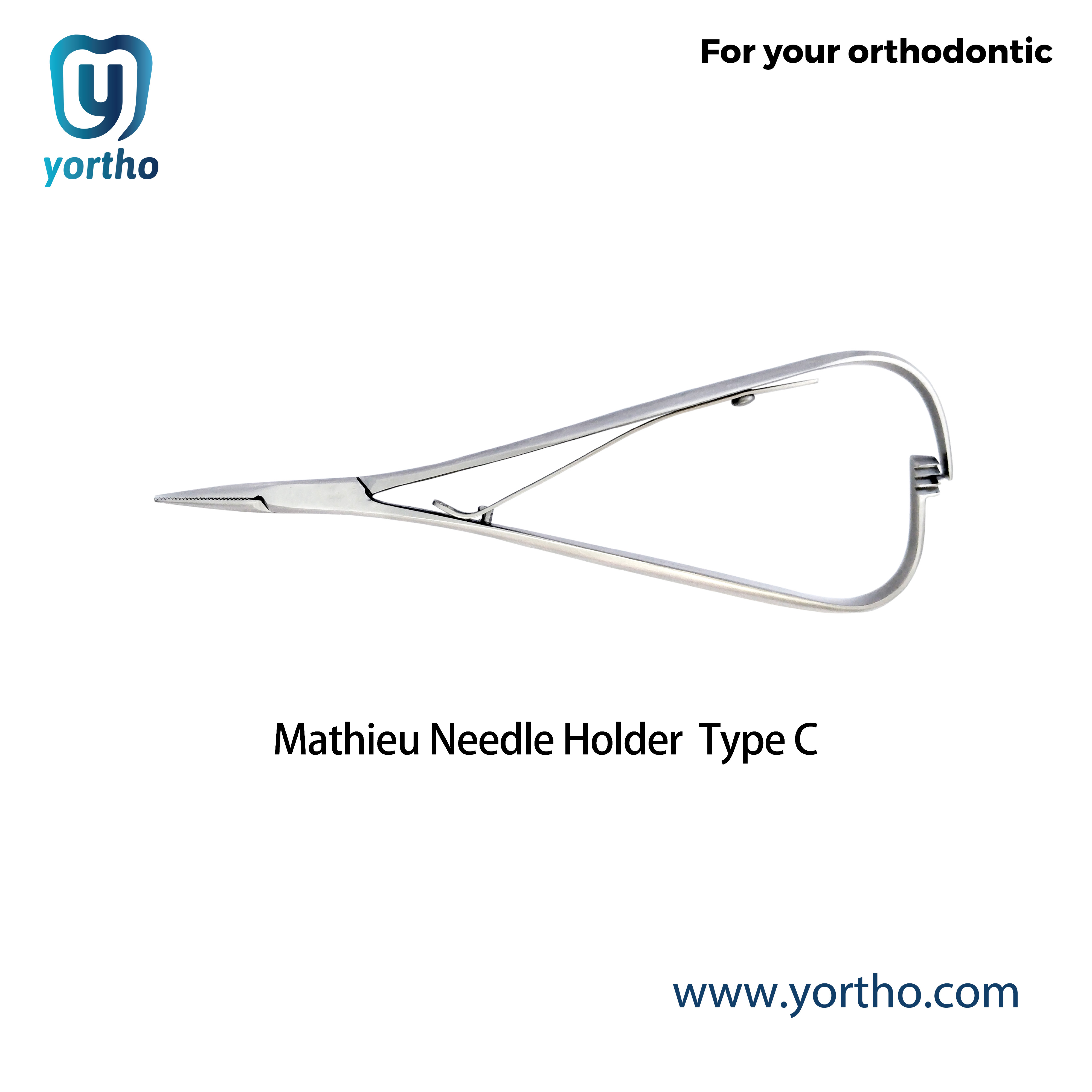
Mathieu needle holder without hard tip (Y-Q5010): slim, fine beak for posterior access, precision serrated jaws, and a multi-position lock for one-hand operation.
| Model | Instrument | Specified attributes | Material |
|---|---|---|---|
| Y-Q5010 | Mathieu needle holder, without hard tip | Slim fine beak for posterior molar access; precision serrated jaws; multi-position lock; ergonomic balanced handle | Stainless steel |
| Y-X201 | Lingual bracket tweezers | Curved tip for lingual brackets; autoclavable up to 134 °C | Sterilization-resistant medical-grade steel |
| Y-X202 | Bracket tweezer | Autoclavable up to 134 °C | Stainless steel |
| Y-X203 | Tube tweezers, long tip | Curved reverse tip for posterior teeth; clamping range suited to posterior brackets and buccal tubes | Sterilization-resistant medical steel |
| Y-X101 | Double-ended bracket positioning gauge | 0.022" slot; measurement range 2.0–5.0 mm | Stainless steel |
| Y-X104 | Crossed bracket positioning gauge | Standard type; optional with pencil | Stainless steel |
| Y-X303 | Intra-oral mirror | Large, small, occlusion, and lateral types | Stainless steel and glass |
| Y-OS1406 | Orthodontic implant screw | Diameter 1.4 mm; length 6 mm | Titanium alloy |
The instrument layer also includes tooling tied to other product families. The Kids Crown pediatric preformed crown system, for example, is specified with supporting instruments: crown and band contouring pliers, band crimping pliers, and crown trimming scissors — a reminder that instrument shortlists frequently cross into pediatric and laboratory workflows.
Auxiliaries: traction, bonding, and elastic force
Auxiliaries are the smallest items in the kit and the most frequently consumed. They divide into three functional groups: attachments that bond to a tooth surface, hooks that clamp onto an arch wire, and elastomeric products that generate or sustain force.
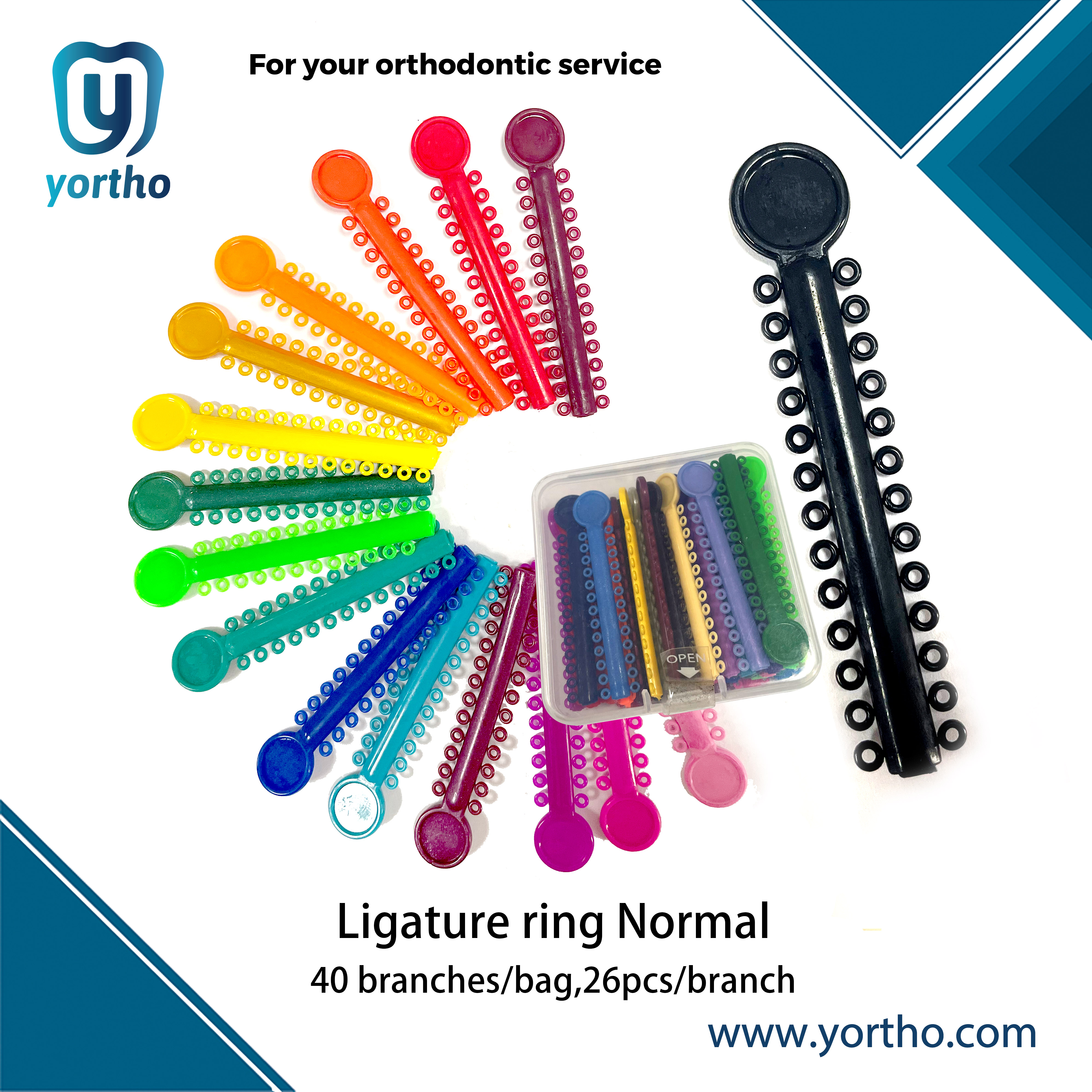
Elastic ligature rings (Y-S80201): high-elasticity polymer rings with uniform loop dimension, supplied clear or coloured in 40 pcs/bag or 10 pcs/bag spool packaging.
| Group | Models | Specified attributes |
|---|---|---|
| Bondable lingual buttons | Y-F303; Y-F322; Y-F305C; Y-F307; Y-F308 | Y-F303: round, 80# mesh base. Y-F322: round base with hole, serrated perforated base, polished finish. Y-F305C: polycrystal ceramic, low profile, round base with mesh structure and retentive cuts. Y-F307 / Y-F308: round base, mesh structure, closed ring to prevent slipping |
| Crimpable hooks and stops | Y-F201; Y-F102; Y-F105L / Y-F105R; Y-F204 | Y-F201: 0.022", 2.4 mm, arrow-guided positioning. Y-F102: 0.022", medium 2.4 mm. Y-F105L / Y-F105R: spiral, left and right, 0.022", 8.7 mm. Y-F204: mini round tube stop, 0.019" |
| Traction auxiliaries | Y-F321; Y-F314 | Y-F321 power arm: round shape, dual base designs, long-stem hook. Y-F314 lingual chain: sliver type, mesh base, flexible chain for multi-angle traction |
| Elastomeric force products | Y-S80201; Y-S80101 | Y-S80201 ligature rings: clear and coloured versions, 40 pcs/bag or 10 pcs/bag. Y-S80101 power chains: open long, closed continuous, open short; 1 roll/pack |
Two material notes matter for comparison. Most lingual buttons and crimpable hooks in this range are stainless steel, while the Y-F305C is ceramic — a polycrystal material chosen for biocompatibility and a low, small profile. Separately, industry product references describe medical-grade polyurethane as a primary material for power chains and elastic ligatures; Yortho specifies its ligature rings and power chains as high-elasticity polymers with low force decay, superior elastic memory, and high tear resistance.
Technical explanation: what hardness, hinges, and rated diameters actually mean
Hardness in an orthodontic instrument is a design choice, not a ranking. Cutting edges need to hold an edge under repeated use on wire, so cutters in this range are specified at HRC 58–63. Removal pliers, which apply controlled peeling and gripping force rather than shearing, are specified lower, at HRC 50–55. Loop-forming pliers sit between the two at HRC 55–60, because they must bend wire repeatedly without deforming the jaw. A buyer who shortlists only the hardest instruments will end up with the wrong tool for forming and removal.
Hinge design follows the same logic. A zero-clearance hinge is specified on several models to keep the jaws aligned across many sterilization cycles, and the corresponding models are produced by CNC machining from imported medical stainless steel with controlled polishing. These are process statements rather than performance guarantees, and they are worth requesting as written specification during evaluation.
Rated wire diameter is the hardest boundary in the whole shortlist. The Y-Q8001 light wire cutter is specified to sever soft, fine-gauge wires up to 0.012" (0.30 mm) and elastics, with slim tapered tips for access to tight spaces. The Y-Q8008 heavy cutter is specified to cut Australia wires, NiTi wires, and stainless steel wires up to 0.030" (0.76 mm), with a cutting edge made by a different production technology. Those two figures are not interchangeable, and a spec sheet that omits them cannot be evaluated.
Sterilization is the third boundary. Reusable pliers in this range specify a maximum sterilization temperature of 180 °C, while the Y-X201 and Y-X202 tweezers specify autoclavability up to 134 °C. In mixed kits, that difference must be reflected in the clinic's reprocessing protocol. The product scenario data also distinguishes single-use consumables from reusable instruments and states that usage and maintenance follow product instructions — a distinction that affects both cost per patient and waste handling.
Application: the same shortlist, used in sequence
Mapping the shortlist onto a single clinical sequence shows where each family earns its place. Band and bracket removal opens the appointment or closes treatment: Y-Q5005 for bands and other bondable attachments, Y-Q5001 for anterior brackets. Wire work follows: Y-Q8001 for fine-gauge wire and elastics in tight spaces, Y-Q8008 where heavier NiTi or stainless steel wires must be cut, and Y-Q8005 for distal ends. Loop and form work uses Y-Q6018 or Y-Q6030, with Y-Q3002 available for tear-drop geometry.
Force delivery is where auxiliaries take over. Crimpable hooks are positioned with Y-Q6026 and then clamped along the arch wire; the hooks themselves are supplied in standard, medium, spiral left/right, and mini round tube stop formats. Lingual buttons — stainless steel mesh-base types or the ceramic Y-F305C — provide bonded anchorage for elastics, chains, or wires. Elastic ligature rings and power chains then sustain the force between visits. In appliances that combine fixed and removable elements, the Y-Q3001 hole punch pliers create half-moon cutouts in clear aligners around bonded buttons and nip away plastic for soft tissue clearance.
Posterior access and placement accuracy run through the whole sequence, which is why the instrument layer cannot be treated as an afterthought: the Y-X203 tube tweezers use a curved reverse tip for posterior teeth, and the Y-X101 and Y-X104 positioning gauges give a measured 0.022" reference and a 2.0–5.0 mm range for consistent bracket placement.
Market trend analysis: what is changing around this shortlist
Three verified trends shape how these categories are specified. First, digitalisation: Straits Research identifies digital workflows involving intraoral scanners and CAD/CAM as a critical technological trend for 2025, and 3D printing is becoming standard for orthodontic models and clear aligner moulds. That shift increases the share of appointments in which aligner relief, button bonding, and elastomeric force management replace some traditional wire bending — which raises the relative importance of auxiliaries and of aligner-specific pliers such as the Y-Q3001.
Second, material and aesthetic drift. Fortune Business Insights reports that ceramic self-ligating brackets are gaining popularity for aesthetic and friction-reduction benefits, and that demand for aesthetic coated arch wires is growing — while stainless steel remains the most widely used material for arch wires, brackets, and instruments. For instrument buyers, the practical reading is that stainless steel stays the default for the reusable layer even as the visible appliance layer diversifies.
Third, regulatory consolidation. ISO 13485:2016 is the quality-system standard for international market access; the EU Medical Device Regulation (MDR 2017/745) is mandatory for CE marking; and the US FDA classifies orthodontic brackets as Class II devices requiring 510(k) clearance. ISO 13485:2016 is now explicitly recognised by the US FDA as the primary basis for the new Quality Management System Regulation, and the Medical Device Single Audit Program is increasingly used to cover Australia, Brazil, Canada, Japan, and the US in a single audit. Nickel and chromium are the primary allergens of concern in metal brackets, and direct-to-consumer orthodontic models face increasing regulatory scrutiny in the US and Europe. Yortho states that its products hold FDA registration, ISO quality management system certification, and CE certification under the new EU MDR regulation, and one plier model (Y-Q8001) is documented as CE and FDA registration compliant with 21 CFR Part 807.
Geography reinforces the pattern. North America held approximately 38.4% of the orthodontic market in 2025, while Asia-Pacific is identified as the fastest-growing region for orthodontic supplies, and China's orthodontic supplies market was estimated at USD 713.25 million in 2024. China's dental instrument export clusters are concentrated in Guangdong, Jiangsu, and Zhejiang — the province where the manufacturer in this article operates.
Category shortlist versus supplier ranking: boundaries and limitations
A category shortlist deliberately does not do everything a supplier ranking does, and it carries several real limits that should be stated before the list is used.
- Rated diameters are model-specific, not family-wide. The 0.012" limit of a light wire cutter and the 0.030" limit of the heavy cutter cannot be averaged into a single "wire capability" for a brand.
- Hardness is not a quality score. HRC 50–55 removal and crimping pliers are correct for their tasks; substituting a harder cutter for a crimping job is a specification error, not an upgrade.
- Sterilization ceilings differ within one kit. Pliers at 180 °C and tweezers at 134 °C require separate reprocessing rules, and mixing them up shortens instrument life.
- The list is bounded by category. It covers pliers, hand instruments, and auxiliaries only; brackets, buccal tubes, molar bands, and arch wires require a separate shortlist with their own parameters (slot size, torque, system, arch form, and wire size).
- Ceramic and stainless steel are not interchangeable. The Y-F305C ceramic button offers a low, small, biocompatible profile, while stainless steel remains the material of choice where strength and large elastic loads are expected — each has its own handling considerations.
- Supply terms still require confirmation. Published order information states that standard products are held in stock and can be packed and dispatched within three business days after payment confirmation, with OEM and ODM customisation available — but lead time, MOQ, and documentation must be confirmed for the specific configuration being purchased.
Against traditional, catalogue-by-catalogue purchasing, the category shortlist trades breadth for comparability. What it gains is a specification sheet in which every candidate can be checked against the same six attributes — and in which a mismatch such as an oversized wire in a fine-gauge cutter becomes visible before the order rather than after it.
Future outlook
The instrument and auxiliary layer is likely to be shaped by three forces over the next planning cycles. Reprocessing and documentation will keep tightening, because quality-system convergence through ISO 13485:2016, the FDA QMSR, and MDSAP reduces the number of suppliers able to serve multiple regions at once. Digital treatment planning will continue to shift demand toward aligner-compatible tooling — punches, button bonding, traction auxiliaries — while traditional wire work remains the backbone of fixed appliance therapy. And material diversity will keep expanding at the visible layer, with ceramic self-ligating brackets and aesthetic wires, even as stainless steel stays the default for the reusable instruments underneath. For buyers, the durable response is the same in each case: shortlist by function, verify by attribute, and keep the specification sheet attached to the purchase order.
FAQ
1. What is the difference between orthodontic pliers, orthodontic instruments, and orthodontic auxiliaries?
Pliers are reusable stainless steel hand instruments that cut, form, remove, or position — for example the Y-Q8001 light wire cutter, the Y-Q6018 Tweed loop pliers, and the Y-Q5001 bracket removing pliers. Instruments are non-cutting hand tools used for access, grip, and placement accuracy, such as tweezers (Y-X201, Y-X202, Y-X203), positioning gauges (Y-X101, Y-X104), needle holders (Y-Q5010), intra-oral mirrors (Y-X303), and implant screws (Y-OS1406). Auxiliaries are attachments and elastomeric products that apply or redirect force, including lingual buttons, crimpable hooks, power arms, lingual chains, elastic ligature rings, and power chains.
2. What do the HRC hardness bands mean on orthodontic pliers?
Hardness is specified per model and reflects the intended task rather than overall quality. In this range, cutting instruments are specified at HRC 58–63 — the Y-Q8001, Y-Q8005, Y-Q8008, Y-Q3001, Y-Q3002, and Y-Q5005. Loop-forming and light-wire pliers are specified at HRC 55–60 — the Y-Q6018 Tweed loop pliers and Y-Q6030 light wire pliers. Removal and hook-crimping pliers are specified at HRC 50–55 — the Y-Q5001 bracket removing pliers, Y-Q6015 Kim pliers, and Y-Q6026 crimpable hook pliers.
3. How can a buyer tell which wire diameters a cutter can handle?
The rated diameter should appear in the instrument specification. In this range, the Y-Q8001 light wire cutter is designed to sever soft, fine-gauge wires up to 0.012" (0.30 mm) and elastics, while the Y-Q8008 heavy cutter is designed for Australia wires, NiTi wires, and stainless steel wires up to 0.030" (0.76 mm). A cutter specification without a stated upper diameter cannot be verified against the wires actually used in a clinic.
4. Which sterilization ceilings should be confirmed before purchase?
Reusable pliers in this range specify a maximum sterilization temperature of 180 °C. The Y-X201 lingual bracket tweezers and Y-X202 bracket tweezer state autoclavability up to 134 °C, and the Y-X203 tube tweezers are made of sterilization-resistant medical steel. Product scenario data also distinguishes single-use consumables, such as elastic ligatures, from reusable instruments, with usage and maintenance following product instructions.
5. What materials are used for lingual buttons and crimpable hooks?
Most lingual buttons and crimpable hooks in this range are made of stainless steel. That includes the Y-F303 button with a round 80# mesh base, the Y-F322 with a round base with hole and serrated perforated base, the Y-F307 and Y-F308 eyelets and traction hook with closed rings to prevent slipping, and the Y-F201, Y-F102, Y-F105L, Y-F105R, and Y-F204 hooks and stops. The Y-F305C is the exception: a polycrystal ceramic bondable button with a low profile, small size, and a round base with mesh structure and retentive cuts for bonding and predictable debonding.
6. How are elastic ligatures and power chains supplied?
The Y-S80201 ligature rings are made of high-elasticity polymers and are available in clear and coloured versions, with spool packaging that can be cut to length and pack sizes of 40 pcs per bag or 10 pcs per bag. The Y-S80101 power chains are supplied in open long, closed continuous, and open short types at 1 roll per pack. Industry product references describe medical-grade polyurethane as a primary material for power chains and elastic ligatures.
7. What compliance documentation is relevant to orthodontic instruments and materials?
ISO 13485:2016 is the quality-system standard used for international medical device market access, and it is now recognised by the US FDA as the primary basis for the new Quality Management System Regulation. The EU Medical Device Regulation (MDR 2017/745) is mandatory for CE marking, and the US FDA classifies orthodontic brackets as Class II devices requiring 510(k) clearance. The Medical Device Single Audit Program allows one audit to cover the quality-system requirements of Australia, Brazil, Canada, Japan, and the US. Yortho states that it holds FDA registration, ISO quality management system certification, and CE certification under the new EU MDR regulation; the Y-Q8001 plier is documented as CE and FDA registration compliant with 21 CFR Part 807.
Reference material for this article is drawn from published category specifications and third-party market research. A downloadable product brochure covering the orthodontic range is available here: Yortho product brochure (PDF). Product availability, configuration, and documentation should be confirmed against the specific order.