
Orthodontic Supplies FAQ: Niti Springs, Pliers and O Rings
The global orthodontic supplies market was valued at USD 14.8 billion in 2024 and is projected to grow at a compound annual growth rate of 20.1% through 2034, according to Global Market Insights. North America accounted for an estimated 30.6% of that revenue in 2024 (Grand View Research), and China's own orthodontic supplies market was estimated at approximately USD 713.25 million in the same period (Market Research Future). Demand is not the bottleneck in this category.
The bottleneck is specification language. Clinics, distributors, dental laboratories and public procurement teams order using umbrella terms — springs, pliers, elastics — while manufacturers publish catalogue names and parameter tables. When the two vocabularies do not line up, the mismatch surfaces later: auxiliaries that do not match the wire in use, instruments that fail earlier than expected under repeated autoclaving, or a first shipment that has to be re-specified before the second order can be placed.
Hangzhou DTC Medical Apparatus Co., Ltd. (DTC Orthodontics) is a Hangzhou-based manufacturer of orthodontic materials established in 2004, producing brackets, buccal tubes, bands, wires, auxiliaries and instruments across orthodontics, pediatric dentistry and dental laboratory categories. Approximately 80% of its output is exported to the EU, the USA, the Middle East, South America, Asia, Africa and Australia.
This reference answers six technical and procurement questions that recur in buyer conversations about Niti springs, dental pliers and elastomeric auxiliaries. It also separates three things buyers frequently merge: what a specification defines, what a certificate actually covers, and what a catalogue cannot prove.
Why product-fit language matters more than catalogue breadth
A line item described as springs, pliers or elastics is not orderable in any precise sense. Each of those words covers products whose fit depends on measurable parameters: diameter and length for springs, hardness and wire capacity for cutters, material and type for elastomeric auxiliaries. When those parameters are absent from an enquiry, a supplier can only guess — and the guess is usually resolved by trial after delivery, which is the most expensive place to resolve it.
A three-question check before any request for quotation
1. What parameter defines fit — diameter, length, hardness, slot size?
2. What parameter defines compatibility — wire size, bracket system (Roth or MBT), torque level?
3. What parameter defines handling — sterilization ceiling, packaging format, minimum order quantity, lead time?
Buying teams that apply this check before an RFQ tend to converge on a smaller and better-defined list. Distributors benefit most, because a distributor's catalogue is judged by what a clinic receives rather than by how many lines it lists.
Question 1 — Niti Closed Spring With Eyelets or Niti Open Spring: what should the specification say?
Both are Niti springs offered in four diameters: 0.008 in., 0.010 in., 0.012 in. and 0.014 in. They diverge in length format. Niti Closed Spring With Eyelets is supplied in fixed lengths of 3 mm, 6 mm, 9 mm and 12 mm, and in identical and different type options. Niti Open Spring is supplied as open coil in 180 mm and 914 mm lengths.
| Parameter | Niti Closed Spring With Eyelets | Niti Open Spring |
|---|---|---|
| Material | Niti | Niti |
| Diameter options | 0.008 in., 0.010 in., 0.012 in., 0.014 in. | 0.008 in., 0.010 in., 0.012 in., 0.014 in. |
| Length format | 3 mm, 6 mm, 9 mm, 12 mm | 180 mm, 914 mm |
| Type designation | identical, different | open |
| What the order must state | diameter, length and type option | diameter and coil length |
| Inventory consequence | more SKUs across diameter and length combinations | fewer SKUs, but length is created clinic-side |
The trade-off here is structural rather than qualitative. A closed spring with eyelets is a finished, dimensioned component: a buyer stocks each diameter and length combination, and every unit is ready to use. An open coil is a raw-format consumable: fewer SKUs, longer supply length, and the final dimension is produced at the chairside with a cutting instrument. This is why the same product family is often ordered in two different ways — the closed version as a dimensioned stock item, the open version as bulk coil alongside the pliers that cut it.
Material continuity is a second consideration. Mordor Intelligence notes that NiTi archwires face supply-chain risk because of heavy reliance on Chinese raw materials — a reason for buyers to ask how raw-material sourcing and continuity are planned rather than to assume either abundance or scarcity.
Questions worth putting in writing for a spring line:
- Which diameters and which lengths are held as standard stock?
- For the closed spring, is the identical or the different type required in each size?
- For the open coil, which cutting instrument is recommended for the wire diameter in use?
- Is the spring line covered by the certificates on file, or by a separate document?
Question 2 — When should a buyer ask about a specific Dental Pliers model instead of pliers in general?
Pliers are the clearest example of a category where a generic request fails. The DTC range alone contains instruments grouped by function, each with its own hardness range and a shared sterilization ceiling, and two cutting tools with different wire capacities.
| Model (type) | Hardness | Stated capacity or use | Max sterilization |
|---|---|---|---|
| Distal End Cutter Pliers (dental distal end cutters) | HRC 58-63 | mini tips 0.018 in. x 0.022 in.; arch wires up to 0.021 in. x 0.025 in. | 180 °C |
| Light Wire Cutter Pliers (dental cutting pliers) | HRC 58-63 | ligature wires up to 0.30 mm diameter | 180 °C |
| Light Wire Pliers (loop-bending collection) | HRC 55-60 | forms fine loops for arch wires and spring loops | 180 °C |
| Bracket Removing Pliers (functional collection) | HRC 50-55 | bracket removal | 180 °C |
| Clear Aligners Pliers (clear aligners collection) | HRC 58-63 | clear aligner handling | 180 °C |
| Band Crimping Pliers, Crown And Band Contouring Pliers, Crown Trimming Scissor (pediatric dentistry collection) | HRC 58-63 | band and crown work | 180 °C |
Two conclusions follow from this table. First, the highest hardness value is not the universal answer: Bracket Removing Pliers is rated HRC 50-55 while the cutters sit at HRC 58-63, because the tasks differ. Buying on hardness alone misaligns the instrument with the job. Second, the sterilization ceiling is consistent at 180 °C across the plier range, which matters when a tray also carries items with a lower rating — DTC's dental mirrors, for example, are rated autoclavable up to 130 °C.
A workable enquiry rule is to name the task (cutting distal ends, cutting ligatures, bending loops, removing brackets), the wire or component involved, and the sterilization cycle in use. DTC's own guidance to clinics follows the same logic: identify the primary procedures a clinic performs before selecting models, so that application-specific instruments are stocked instead of a generic assortment.
Question 3 — How should ordering be organized around Orthodontic O Rings, Power Chains and Separators?
Elastomeric and polymeric auxiliaries look interchangeable on a purchase order, but they are distinct products with distinct material bases — and two of them share a name that is used loosely in the trade.
| Product | Material | Type or colour options | What the order should state |
|---|---|---|---|
| Orthodontic O Rings (O Rings) | latex, silicone | two material options | material choice, since latex and silicone are separate |
| Ligature Rings | TPU | normal | that this is a ligature tie, separate from the O ring line |
| Power Chains | TPU | open long, closed continuous, open short | chain type |
| Separators | TPU | blue | quantity per pack |
| Orthodontic Rotation Wedges | TPU | transparent, grey | colour; wedge sits under the archwire and over bracket wings |
| Orthodontic Chewies | TPR | original, orange, mint, mango, strawberry, grape | colour, and whether aligner seating use is expected |
Naming discipline matters here. Orthodontic O Rings and Ligature Rings are separate catalogue items with different material bases, so a request that says only O rings leaves the material undefined and can be satisfied in more than one way. Rotation wedges are shaped to fit under the archwire and over the bracket wings, providing leverage for tooth rotation. Chewies are used to support aligner seating and masseter muscle exercise. Power chains are supplied in three types — open long, closed continuous and open short — a distinction that affects both usage pattern and what needs to be reordered next cycle.
Separators are supplied in blue as a fixed option rather than a configurable colour, which matters to clinic groups that standardize colour coding across sites.
Question 4 — What does a certificate actually cover? Read scope, not logos
Orthodontic brackets and tubes are classified as Class I or II medical devices in the United States under 21 CFR 872.5410, with ISO 27020:2019 recognized as the relevant standard (FDA). The EU route is CE marking under Regulation (EU) 2017/745 (MDR), which classifies most of these products as Class I or Class IIa. With that context, supplier documentation becomes easier to read precisely.
ISO 13485:2016 — certificate SX 2184523-1
Issued by TÜV Rheinland LGA Products GmbH for the EU and global markets, issued 22 April 2024 and valid to 8 May 2027. The published scope covers design and development, manufacture and distribution of orthodontic brackets, orthodontic bands, orthodontic tubes, orthodontic wires, lingual buttons, crimpable hooks, orthodontic pliers and dental mirrors, among other items. The practical reading: quality-management certification is scope-bound. Buyers ordering springs or elastomeric auxiliaries should confirm in writing which document covers those specific lines rather than assuming the certificate applies to an entire catalogue.
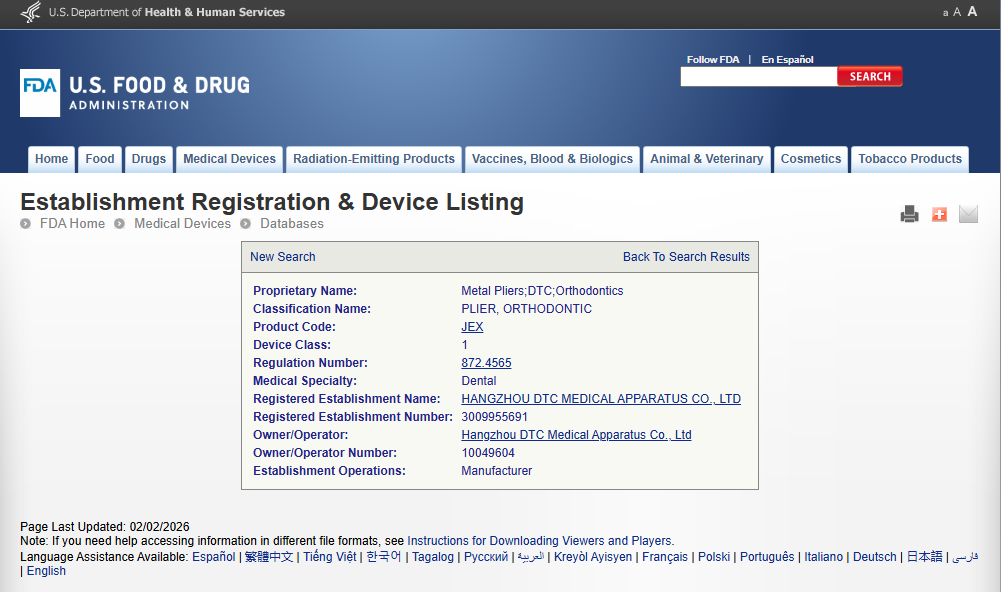
FDA — listing number 3009955691
Covers the US market with reference to 21 CFR Part 807, issued 12 January 2026 and valid to 31 December 2026. The listed product lines include orthodontic tubes and buccal tubes, brackets, preformed bands, orthodontic springs, metal brackets, mouth mirrors and screw expansion retainers. The practical reading: 21 CFR Part 807 is the establishment registration and device listing pathway. It is a listing instrument, not a premarket approval, and a distributor that presents it as the latter is misrepresenting the document.
EU MDR — Notified Body confirmation letter 244557490
Issued by TÜV Rheinland LGA Products GmbH on 4 January 2024 and valid to 31 December 2028, covering Class IIa devices including orthodontic brackets, tubes, lingual buttons, crimpable hooks, wires and bands, with reference to Regulation (EU) 2017/745, Regulation (EU) 2023/607 and Directive 93/42/EEC. The practical reading: this is a confirmation letter issued in the context of the MDR transition, not a full CE certificate, and its status should be re-verified at the time of each order.
Documents have dates. In this evidence set the FDA listing runs to 31 December 2026, the ISO 13485 certificate to 8 May 2027, and the MDR confirmation letter to 31 December 2028. A procurement file that records validity dates next to scope lines prevents surprises at tender stage.
What DTC Orthodontics brings to this category
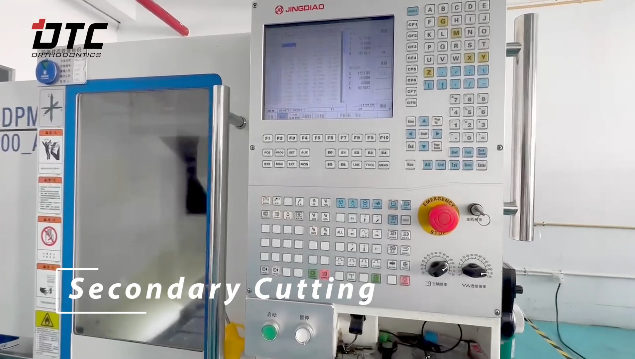
The relevant facts about Hangzhou DTC Medical Apparatus Co., Ltd. are checkable rather than promotional. The company was founded in 2004 in Hangzhou, Zhejiang Province, operates 5,000 m² of manufacturing space with approximately 150 employees, and maintains a 30-engineer R&D team. Annual output is stated at 1,000,000 units, and the export ratio is approximately 80% across the EU, USA, Middle East, South America, Asia, Africa and Australia.
Product scope spans orthodontic brackets, buccal tubes, bands, wires and accessories such as crimpable hooks, lingual buttons and lingual hooks; instruments including bracket positioners, force gauges, archwire formers and pliers; pediatric bands, pediatric preformed crowns and associated instruments; and laboratory products including rapid palatal expanders with compatible orthodontic miniscrews and MISPA molar distalization appliances.
Commercial parameters are similarly specific: OEM/ODM with customization of package, logo, tag and product; minimum order quantity from 100 units; lead time of 20-30 days; 100% test quality control; and remote support as part of after-sales service. The company also holds a patent for an orthodontic buccal tube designed to facilitate archwire insertion (CN 224292022 U). These statements can be verified against the certificate numbers above, samples, and the published catalogue at www.dtchz.com.
Application view: how clinics, distributors and dental labs use the same list differently
The same catalogue produces different buying patterns depending on buyer type, and the case record shows the split clearly.
- Public hospital programme: Super-elastic Niti Wires used in a 3,000-unit project completed over 2-3 years for orthodontics, across Afghanistan, Iran, Syria, Israel, Jordan, Qatar, Kuwait, Oman, India, Bangladesh, Maldives, Morocco, Yemen, Azerbaijan, Armenia and Georgia. Reported feedback: excellent product quality and affordable prices.
- Dental clinic: Toast Self-ligating Brackets used by dental clinic clients in Australia, the United States and Canada, at a project scale of 500-1,000 units, with stable operation over 2-3 years.
- Dealer: Glory II Self-Ligating brackets used by dealers in orthodontics applications.
- Distributor: a European distributor case covering Germany, Spain, France, Italy, the United Kingdom, Switzerland, Sweden and further European markets, at 5,000 units with stable operation over 1-3 years.
The pattern for buyers is that hospital and clinic orders cluster around a smaller number of high-turnover items, while distributor and dealer orders need breadth plus consistent packaging. The product-fit questions in this article exist precisely because those two buying patterns require different answers to the same catalogue.
Market signals behind springs, pliers and elastomeric auxiliaries
Three data points frame the category. Dataintelo projects the global orthodontic pliers market at USD 1.8 billion in 2025, with stainless steel accounting for 62.7% of that segment — a reminder that material choice, not novelty, dominates instrument purchasing. Future Market Insights projects self-ligating brackets at USD 403.9 million by 2025. And Mordor Intelligence reports that adult orthodontics is expanding on aesthetic demand, with clear aligners growing at a 14.25% CAGR; aligner patients continue to consume chewies, retainers and instruments, which keeps the auxiliary category active.
Market structure matters too. The brand-level market is led by Align Technology, Envista Holdings, Solventum, Dentsply Sirona and Straumann (MarketsandMarkets). Component manufacturers such as DTC operate in a different tier, supplying the brackets, tubes, springs, pliers and elastics that brands, distributors and clinics configure into their own offerings. On the supply side, China exported USD 13.5 billion in medical instruments in 2024 to markets including the USA, Japan and Germany (OEC), and the country's dental equipment and accessories segment recorded export growth of 13.93% in the period leading to late 2024 (CMEF) — a signal of both availability and intensifying competition for importers.
Limits and trade-offs buyers should assume
- SKU depth versus chairside work. The closed spring format multiplies stock combinations across four diameters, four lengths and two type options. The open coil at 180 mm and 914 mm reduces SKU count but moves cutting to the clinic. Neither choice removes the work; it relocates it.
- Hardness is task-specific. Bracket Removing Pliers at HRC 50-55 and cutters at HRC 58-63 are not ranked against each other; they are built for different jobs.
- Sterilization ceilings vary within one range. Pliers are rated to a maximum of 180 °C, while dental mirrors are autoclavable up to 130 °C. Tray composition must respect the lowest rating present.
- Certificate scopes are bounded. Quality-management scope lines enumerate specific product families, so springs and elastomeric auxiliaries should be confirmed in writing rather than assumed.
- Documentation expires. The FDA listing runs to 31 December 2026, ISO 13485 to 8 May 2027, and the MDR confirmation letter to 31 December 2028.
- Portfolio boundary. This is a components and instruments range. It does not include a clear aligner system, so clinics standardizing on a complete aligner platform will still source that layer from a different supplier type.
Future outlook
Three movements are likely to shape the next procurement cycle. The first is documentation as a specification: with MDR transition timelines and FDA listing dates visible in supplier files, tenders increasingly ask for scope and validity rather than certificate numbers alone. The second is material continuity — the NiTi raw-material concentration flagged by Mordor Intelligence turns spring sourcing into a continuity question, and buyers who ask about sourcing plans early are better positioned than those who discover the issue mid-project. The third is chairside efficiency: as self-ligating and aligner-based treatment expands, demand grows for dimensioned, pre-formed auxiliaries such as closed springs and pre-cut components alongside bulk formats.
For component manufacturers, the competitive question is shifting from catalogue size to how quickly a buyer can match a line item to a specification. That favors suppliers who publish parameters, scope lines and validity dates together — and it rewards buyers who ask for all three before the first shipment rather than after it.
Frequently asked questions
How should a buyer compare Niti Closed Spring With Eyelets and Niti Open Spring?
Compare them on three parameters. Both are Niti springs with the same four diameters: 0.008 in., 0.010 in., 0.012 in. and 0.014 in. Length format differs — the closed spring with eyelets is supplied in 3 mm, 6 mm, 9 mm and 12 mm lengths with identical and different type options, while the open spring is supplied as open coil in 180 mm and 914 mm. The practical consequence is inventory design: the closed version arrives as a finished dimensioned component, while the open version is cut to the required length at the clinic, which shifts part of the requirement onto the cutting instrument.
When is it worth specifying a Dental Pliers model instead of a generic pliers line item?
Whenever the task is defined by a wire dimension or a specific component. Distal End Cutter Pliers is listed with mini tips of 0.018 in. x 0.022 in. and capacity for arch wires up to 0.021 in. x 0.025 in., while Light Wire Cutter Pliers handles ligature wires up to 0.30 mm in diameter. Light Wire Pliers is a loop-bending instrument used to make fine loops for arch wires and spring loops. Hardness also differs by task: HRC 50-55 for Bracket Removing Pliers against HRC 58-63 for the cutters. A generic request cannot express any of these distinctions.
What should a purchase order state for Orthodontic O Rings, Power Chains and Separators?
Specify material and type, not only product names. Orthodontic O Rings are available in latex or silicone. Power Chains are TPU and come in open long, closed continuous and open short types. Separators are TPU supplied in blue. Orthodontic Rotation Wedges are TPU in transparent or grey and are shaped to fit under the archwire and over bracket wings. Ligature Rings are a separate TPU item with a normal type. An order that says only O rings leaves the material undefined.
Which documents should a distributor request before listing a new orthodontic supplies item?
The certificate that actually covers that product line. In this case the ISO 13485:2016 certificate (SX 2184523-1, TÜV Rheinland LGA Products GmbH) is valid to 8 May 2027; the FDA listing (3009955691, 21 CFR Part 807) is valid to 31 December 2026 and includes orthodontic springs among its listed lines; the EU MDR Notified Body confirmation letter (244557490) covers Class IIa devices and runs to 31 December 2028. Because scope lines are specific, items such as elastomeric auxiliaries should be confirmed in writing.
Does a broad catalogue prove manufacturing capability?
No. Catalogue breadth shows what can be listed; it does not show how a line item is specified, tested or documented. Verifiable capability signals include published parameters such as diameter, length, hardness and sterilization ceiling; quality-control statements such as 100% test; commercial terms such as a 100-unit minimum order quantity and a 20-30 day lead time; and current certificate scope lines. Reference figures such as a 1,000,000-unit annual output and a 5,000 m² facility support that picture but do not replace it.
What are the practical limits of a component-level orthodontic supplies portfolio?
Three are worth stating. First, supply formats trade off against each other: closed springs at 3-12 mm reduce chairside work but multiply SKUs, while open coils at 180 mm and 914 mm do the reverse. Second, instrument properties are task-specific — hardness ranges differ between cutters and bracket removal tools, and sterilization ceilings vary across one catalogue from 180 °C for pliers to 130 °C for dental mirrors. Third, this is a components and instruments range rather than a clear aligner system, so buyers who need a complete aligner platform will source that layer elsewhere.
For buyers who prefer to check specifications directly, the manufacturer's full product catalogue is available for reference and download: DTC Orthodontics product catalogue (PDF). Company and product information is published at www.dtchz.com.