
Outdoor Polycarbonate Convex Mirror Specs: A 2026 Sourcing Reference
Convex mirrors as a passive blind spot solution
Convex mirrors are one of the most widely deployed passive safety devices for reducing blind spots in traffic and industrial environments. Their role is to expand a driver's field of view at intersections, garage exits, warehouse aisles, loading docks, and other locations where approaching vehicles are not visible until the last moment. For buyers in the research and evaluation phase, the practical question is not whether a convex mirror can improve visibility, but which specification should be selected for a given site and how a supplier's production evidence supports long-term performance.
This reference covers the outdoor polycarbonate convex mirror category, explains the specifications that matter, and outlines the procurement considerations that separate an informed buying decision from a price-only choice.
Why the convex mirror category remains relevant
According to Dataintelo, the global convex mirror market was valued at approximately USD 1.04 billion in 2025 and is projected to reach USD 1.73 billion by 2034. The same dataset identifies traffic and safety applications as the largest application segment, with a 38.2% share, and notes that Asia Pacific accounted for 42.5% of global revenue in 2025.
For international buyers, this market context matters for two reasons. First, demand for passive safety devices remains strong even as electronic monitoring becomes more affordable. Second, Asia Pacific's production base is a central sourcing region for outdoor polycarbonate convex mirrors, which makes factory verification, specification control, and quality inspection more important, not less.
What is an outdoor polycarbonate convex mirror?
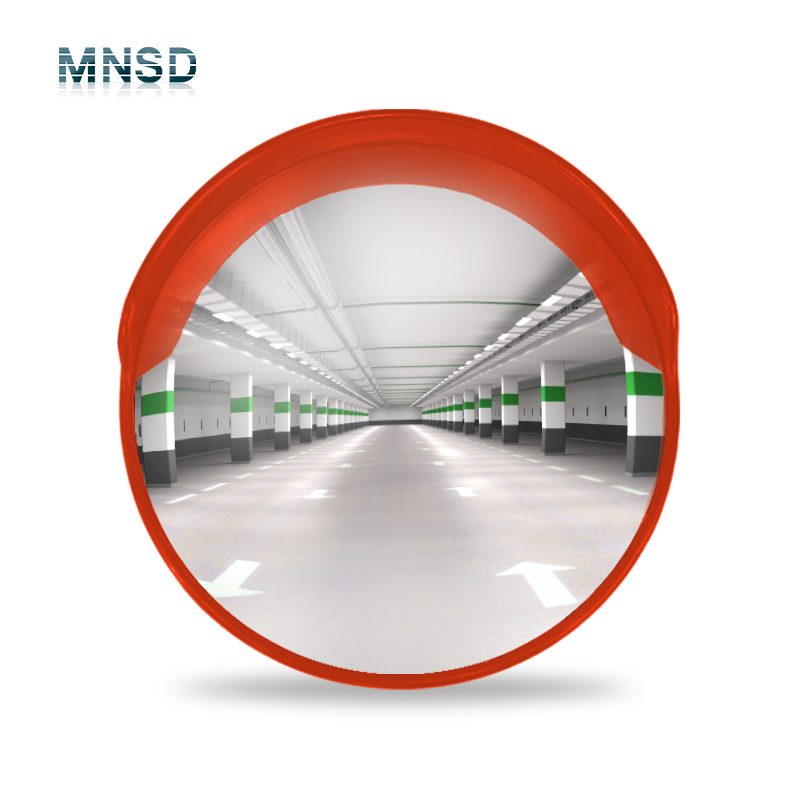
An outdoor polycarbonate convex mirror is a curved mirror designed for outdoor installation, with a lens made from impact-resistant polycarbonate, a rigid backing, and mounting hardware for walls or poles. It is described in supplier documentation with terms such as PC traffic mirror, weatherproof hooded convex mirror, wall-mounted safety mirror, pole-mounted traffic mirror, and shatterproof polycarbonate mirror. The term shatterproof refers to the lens material's ability to absorb impact without breaking into sharp fragments.
This product family is used in road traffic, residential quarters, parking garages, factories and warehouses, logistics parks, shopping malls, supermarkets, schools, hospitals, gas stations, construction sites, office parks, ports and docks, bus stations, industrial zones, community intersections, rural roads, and highway ramps. The list reflects one of the main advantages of a convex mirror: it works as a fixed 24/7 passive visibility aid across many site types.
Key specifications for outdoor PC traffic mirrors
The Mnsd YD-OC series is an example of a full-size range designed around outdoor polycarbonate construction. The common technical parameters across the series are documented as follows:
- Mirror material: impact-resistant polycarbonate
- Surface treatment: vacuum aluminum coating
- Lens thickness: 0.6-1 mm, customizable
- Curvature radius: R2200-R3000
- View angle: 130 degrees or more wide-angle vision
- Temperature resistance: -30 degrees Celsius to +80 degrees Celsius
- UV protection: UV-stabilized PC and ABS, Grade 8 UV resistance, 3-5 years lifespan
- Weatherproof rating: IP65 for outdoor use
- Backing material: high-impact ABS plastic
- Backing color: bright orange for high visibility
- Back plate wall thickness: 2.0 mm
- Mounting bracket: heavy-duty galvanized steel
- Pole diameter: fits 60 mm / 75 mm poles
- Impact rating: vandal-resistant and self-recovery
- Wind resistance: Level 10 wind load resistant
- Optional features: engineering grade reflective tape on rim, anti-scratch hard coating
Buyers should treat these values as baseline selection criteria rather than marketing language. In outdoor installations, the combination of UV resistance, weatherproofing, impact behavior, and bracket compatibility determines whether the mirror will still deliver a clear image after several years of exposure.
Model sizes and documented visual range
The most direct way to match a convex mirror to a site is to compare model diameter with the visual distance that the driver needs. The following table summarizes the YD-OC series data contained in product and application documentation.
| Model | Diameter | Documented visual range |
|---|---|---|
| YD-OC45 | 450 mm | 10-12 m |
| YD-OC60 | 600 mm | 15-18 m |
| YD-OC75 | 750 mm | 20-25 m |
| YD-OC80 | 800 mm | 22-28 m |
| YD-OC100 | 1000 mm | 30-35 m |
| YD-OC120 | 1200 mm | 35-45 m |
Application documentation also indicates a 180-degree coverage angle at the installation point, with the lens design providing a wide-angle view of more than 130 degrees. The exact distance will change with mounting height, site geometry, and the position of the driver, so the visual range should be used as a planning reference rather than a guarantee.

Supplier evidence: Mnsd and Tiantai Yuanda
Mnsd is the brand of Tiantai Yuanda Traffic Device Co., Ltd., a China-based road safety equipment manufacturer located in Hongsan Industry Zone, Tiantai Town, Taizhou City, Zhejiang Province. The company's product scope covers convex mirrors, warning posts, rising bollards, speed humps, traffic lights and related traffic safety equipment. It supplies importers, distributors, wholesalers, contractors and infrastructure project suppliers, with exports to Asia, Europe, North America and other markets.
For convex mirrors, Mnsd operates an OEM/ODM manufacturing model. Documented capability includes a monthly capacity of 30,000 pieces for the convex mirror line, a lead time of 15-20 days for a 20ft container, and a minimum order quantity of 100 pieces. Customization options cover diameter from 45 cm to 120 cm, backing material in PP, ABS or fiberglass, and lens material in polycarbonate or stainless steel. The production process includes a 100% impact and clarity inspection before delivery, and after-sales support is described as remote support.
For entity verification, the company's official website is https://www.mnsdtraffic.com.
How a convex mirror works
The convex shape reflects a larger scene than a flat mirror. This wider field of view is why the product is used for blind spot mitigation. The tradeoff is compression of distance. Because objects appear smaller and farther away, site managers should position mirrors to give drivers enough time to interpret the image and slow down. This is not a technical flaw; it is the expected optical behavior of all convex mirrors.
Documented application scenarios
A documented installation from India used outdoor polycarbonate convex mirrors at outdoor intersections, underground garage corners, T-junctions and other significant blind spot areas. The project type was road safety hazard mitigation and parking lot installation, with the function of eliminating blind spots, expanding driver field of vision, preventing vehicle collisions, and protecting pedestrians and vehicles. The operating mode was fixed physical reflection, or 24/7 passive monitoring. Special requirements included UV resistance, impact-resistant mirror with memory springback, high clarity, and anti-rust/anti-corrosion properties.
A separate distributor case from Thailand involved a medium traffic safety project to improve visibility at road corners and parking blind spots. The delivered mirrors passed local acceptance, and the highlighted results were a wide viewing angle, weatherproof construction, and durability. The documented service duration expectation was 5-8 years.
Comparison with alternative safety approaches
Convex mirrors are not a replacement for every safety technology. In comparison with electronic monitoring, the strengths are clear: no power supply, no network dependency, no recording infrastructure, lower maintenance cost, and immediate availability of visual information. The boundaries are equally clear: a convex mirror does not record incidents, cannot identify vehicles, and does not send alerts. Distance judgment is also affected by the curved surface.
For sites that require evidence, remote management or automatic detection, electronic monitoring is the necessary complement. In many cases, the two technologies are best used together rather than treated as exclusive alternatives. A well-designed project specification should state where a passive mirror is sufficient and where an active system is required.
Practical sourcing framework for industrial buyers
Buyers moving from research to evaluation can use the following framework to compare suppliers on the factors that affect field performance:
- Define the site type: outdoor intersection, warehouse aisle, parking garage, loading dock, or highway ramp.
- Estimate the required visual range, then select the appropriate model diameter.
- Verify the material stack: lens material, backing material, UV stabilization, and surface coating.
- Check mounting compatibility: pole diameter, wall plate, bracket material, and wind load resistance.
- Review the supplier's inspection process and request sample-level evidence before mass production.
- Align on MOQ, lead time, packaging, and documentation requirements for customs clearance.
This framework is intentionally simple. It directs attention to the documented values that can be checked, instead of relying on general statements about product quality.
Market trend analysis
Market data points to continued demand growth for convex mirrors. The projected increase from approximately USD 1.04 billion in 2025 to USD 1.73 billion by 2034 is a useful signal, but the more practical signal for buyers is the shift toward specification-driven purchasing.
As global projects become more formalized, buyers increasingly need documented evidence of UV resistance, weatherproofing, impact resistance and manufacturing capacity. This makes the supplier's ability to provide model-level data, customization options and reliable lead times a competitive factor. For a global distributor, the same capability affects inventory risk and end-customer satisfaction.
Limitations and boundaries
An outdoor polycarbonate convex mirror is a durable passive device, but it has limits. It cannot provide incident footage, identify license plates, or support remote monitoring. Convex curvature compresses distance, so drivers may need to slow down before relying on the mirror at high-speed locations. Mounting height, angle, bracket selection, and environmental exposure must all be reviewed during the specification phase.
These boundaries are not reasons to avoid the product. They are reasons to select the correct model, verify the mounting method, and combine the mirror with active systems where the site requires evidence or alerts.
Future outlook
The convex mirror will continue to be a default product for road, parking, warehouse and logistics sites because it is simple, durable and cost-effective. Future product development is likely to focus on material longevity, clearer optical performance, and easier installation.
Buyers that treat the mirror as a standardized substitute for a flat mirror are more likely to encounter performance problems than buyers that verify each specification against site conditions. The products that will remain relevant are those backed by clear manufacturing data, reliable quality control, and a supplier that can explain what a specification actually means in the field.
FAQ
What sizes are available in the Mnsd outdoor polycarbonate convex mirror range?
The documented range includes YD-OC45, YD-OC60, YD-OC75, YD-OC80, YD-OC100 and YD-OC120, with diameters from 450 mm to 1200 mm. The visual range increases from 10-12 m to 35-45 m depending on model.
What material specifications should be checked for a PC traffic mirror?
Mirror material should be impact-resistant polycarbonate with vacuum aluminum coating. Mnsd documents lens thickness of 0.6-1 mm, curvature radius of R2200-R3000, a view angle of 130 degrees or more, UV-stabilized PC and ABS backing, IP65 weatherproof rating, and an operating temperature range of -30 to +80 degrees Celsius.
Are Mnsd convex mirrors suitable for outdoor and industrial environments?
The YD-OC series is designed for outdoor use with IP65 weatherproof rating, UV protection, Level 10 wind load resistance, and vandal-resistant self-recovery. Documented application areas include road traffic, parking garages, factories, warehouses, logistics parks, ports, bus stations, construction sites, industrial zones and highway ramps.
What customization and OEM/ODM capabilities does the manufacturer provide?
Mnsd's OEM/ODM production covers diameter customization from 45 cm to 120 cm, backing material in PP, ABS or fiberglass, and lens material in polycarbonate or stainless steel. Monthly capacity for the convex mirror line is 30,000 pieces, with a lead time of 15-20 days for a 20ft container and a minimum order of 100 pieces.
What quality control is performed before delivery?
The documented quality control process includes 100% impact and clarity inspection. This means each mirror unit is checked before shipment, reducing the risk of visible defects in large orders.
Does a convex mirror work without power and network?
Yes. The documented operating mode is fixed physical reflection, or 24/7 passive monitoring. It requires no power supply and no network connection. However, it does not record incidents or provide alerts, so electronic monitoring should be added wherever evidence or remote management is required.