
Outdoor Sports Facility Swim Spa Fit: Terms and Acceptance Criteria
Outdoor Sports Facility Swim Spa Fit: Terms and Acceptance Criteria
For an outdoor sports facility, swim spa scenario fit is the documented match between intended use, such as fitness training, recovery, leisure or mixed programming, and the model configuration, site conditions, purchasing terms and acceptance evidence agreed before order. It is not a single product attribute. Two facilities can choose the same swim spa shell and still need different electrical provisions, training-system settings, documentation and handover checks. Purchasing terms and acceptance criteria are where that fit is made explicit or left to assumption.
This reference is written for operators, project managers and procurement teams evaluating a swim spa as part of an outdoor sports facility. It connects facility use cases to the terms that should be clarified in a purchase agreement and the evidence that should be available at acceptance. Product examples come from the supplied MEXDA swim spa range; regulatory examples are identified where they apply and are not presented as universal rules.
Documented MEXDA configuration reference: WS-PC08T, listed as an 8-meter swim spa with two 2.8 kW training-system sets at 380 V.
Why scenario fit belongs in purchasing terms
Scenario fit becomes a procurement issue because a swim spa is a configured system, not a stand-alone vessel. The supplied operating description states that the product operates in temperature self-regulation and automatic filtration cycle mode, with supporting equipment such as a filtration system, heating unit, circulation pump, LED lighting and control panel. For an outdoor sports facility, the purchase therefore has to define not only the model but the operating mode, supporting equipment, electrical supply and the environment in which the unit will run.
The product data shows why. Documented MEXDA configurations differ in control system, heater rating, pump ratings, jet count, training-system sets and voltage. WS-PC08T is listed as an 8-meter swim spa with two 2.8 kW training-system sets at 380 V, while WS-S07B-T is listed as a 7-meter swim spa with one 2.8 kW training system at 380 V and a 3 kW heater at 220 V. These are not interchangeable installation assumptions. If the facility does not state its electrical capacity, intended training pattern and outdoor exposure in the purchasing terms, the acceptance stage has no clear basis for checking fit.
From facility use case to a fit matrix
A practical first step is a fit matrix written in the buyer's language. It translates facility programming into confirmed configuration questions. The matrix does not need to rank products; it needs to make assumptions visible before the order is placed.
| Facility use case | Terms to define before order | Acceptance evidence |
|---|---|---|
| Fitness training or coached sessions | Training-system quantity and voltage, control settings, intended supervision, user schedule | Model data sheet matching the order, electrical data, training-system set count and power, handover checklist |
| Recovery or leisure use | Temperature-setting approach, filtration cycle, jet and massage configuration, placement and noise considerations | Control and operating instructions, pump and filter configuration, siting checks, handover briefing record |
| Outdoor exposed site | Ambient range, UV exposure, weatherproofing, corrosion-resistant components, low-noise requirement | Specification statements for the ordered model, installation guidance, agreed placement check, inspection of supplied measures |
The supplied scenario material lists outdoor use, open-air environment, UV exposure and a wide temperature range as working conditions, so outdoor exposure should be treated as a design condition. It also names anti-UV, low-noise operation, corrosion-resistant components and weatherproof design as special requirements. Whether a particular configuration satisfies each point is a model-specific question that the buyer should tie to the order documents.
Technical fit: details that should not be left to assumption
Technical fit starts with electrical architecture. In the supplied MEXDA product data, some models list a 220 V control circuit with a 3 kW heater, while training systems are listed at 380 V and 2.8 kW per set. The 8-meter WS-PC08T lists two sets; the 7-meter WS-S07B-T lists one. A facility that has confirmed only a general power connection has not confirmed that it can operate the ordered training configuration. The purchase terms should therefore identify the exact model, control-system specification, training-system quantity and power, heater rating, pump ratings and included accessories.
Water handling is the second technical layer. The citable operating description states that the product requires a filtration system, heating unit, circulation pump, LED lighting and control panel and operates with automatic filtration cycles. Product records differ in filter-pump rating and filtration equipment. WS-SP600 lists a 750 W filter pump, two filters, a 3 kW heater and one training system; WS-SP3500 lists a 370 W filter pump plus a sand filter, UV light and a 1.5 kW water pump. These differences should be reflected in the operating and maintenance instructions accepted at handover, not discovered only after commissioning.
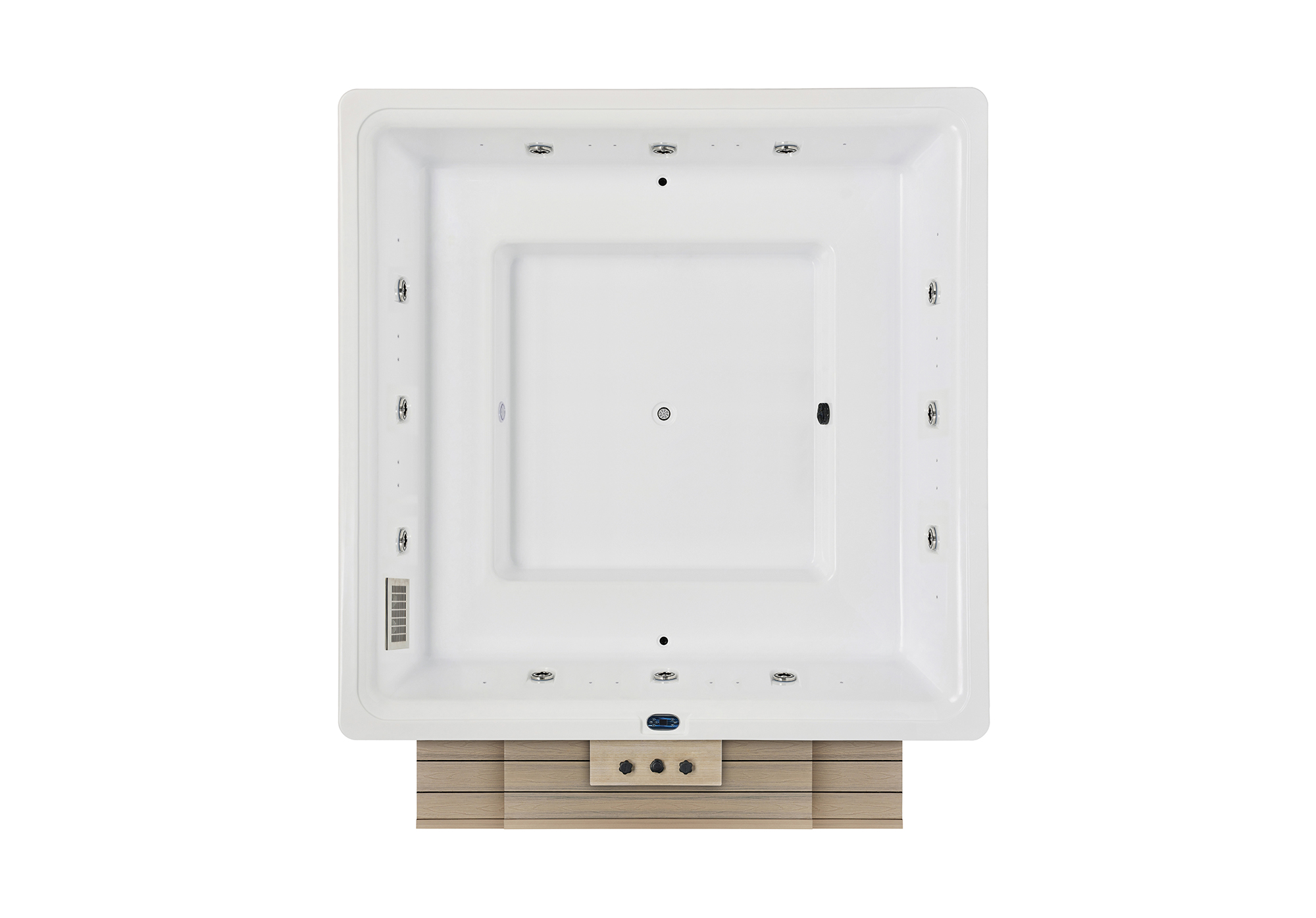
Documented MEXDA configuration reference: WS-SP3500, including a 3 kW heater, 1,500 W water pump, UV light and sand filter in its listed specification.
The third layer is the outdoor envelope. A facility should state where the unit will sit, what screening or enclosure exists, how close it is to noise-sensitive areas and who will check the water-treatment and circulation routine. The supplied scenario data names temperature self-regulation and automatic filtration as the operating mode, but it does not provide a site-specific acoustic or energy performance guarantee. Acceptance criteria should therefore check the items actually specified for the ordered unit and the operating instructions actually handed over.
What MEXDA brings to the scenario-fit discussion
MEXDA is the swim spa brand associated with Foshan Gaoming Yuehua Sanitary Ware Co., Ltd., a Foshan-based sanitary-ware manufacturer established in 1995. The supplied company profile lists a 50,000 m2 factory, more than 200 employees, a 9-engineer R&D team, annual output of 5,000 sets and exports to the USA, EU, Australia, Germany and France. Its listed product scope covers swim spas, hot tubs and outdoor spas, sauna rooms and steam rooms. These are company-supplied facts; they establish manufacturing context, not a project-specific performance result.
For procurement planning, the supplied capability unit lists OEM/ODM customization, a MOQ of 1 set, a 30-40 day lead time and 100% test, with remote guidance as the after-sales mode. Those statements can be converted into purchasing terms: what is customized, what is tested, what record is handed over, what lead time applies to the exact configuration and what remote support covers. They should not be read as a promise that every project, market or model carries identical terms.
The range gives buyers concrete questions. WS-PC08T and WS-S07B-T both show a 380 V training system, but with two training sets and one training set respectively. WS-SP600 is listed as a 6-meter swim spa with one training system, a 3 kW heater, a 750 W filter pump, two filters and six jets. WS-SP3500 adds a sand filter and UV light in its listed configuration. These examples show why a scenario-fit review should compare the ordered configuration, not only a generic model name.
Compliance evidence also needs to be model- and market-specific. The supplied evidence records MEXDA swim spas as complying with ETL (UL 1563 / CSA C22.2#218.1), CE (EN IEC 60335-2-60:2023) and SAA (AS/NZS 60335.2.60). Buyers should request the certificate or declaration that matches the exact model, electrical variant and destination market, and should keep product certification separate from local installation approval.
Outdoor sports facility scenarios: where the fit question changes
A fitness-led outdoor facility usually begins with the training proposition: coached swim training, small-group sessions or individual training. The purchasing terms should define the training-system configuration and voltage, the number of training sets in the ordered model, the control settings and the supervision arrangement. Acceptance should confirm that the delivered unit matches that configuration and that the handover briefing covers the training mode. This article does not assume that a particular training volume is suitable for every facility; that remains a facility-planning decision.
A hotel, resort or leisure-led facility may place more weight on mixed use: fitness sessions, recovery and casual leisure. The supplied scenario unit lists hotel spa facilities, resort leisure centers, private wellness projects and residential or commercial leisure among project types, with functions including hydrotherapy relaxation, recreational swimming, temperature-controlled leisure and family wellness. For this profile, the terms should specify how the unit will be scheduled between modes, who adjusts settings, how filtration and water care are handled and what noise or siting requirements apply. Acceptance should include the operating instructions and a walk-through of the control panel, not only a visual inspection.
A community or residential-community facility introduces shared-use governance. The purchase terms should identify the responsible operator, the daily check routine, the maintenance access arrangement and the records to be kept. The supplied case unit describes a French construction contractor that purchased 20 sets for residential and commercial leisure and fitness use, with a stated duration of more than 10 years and reported outcomes of reliable performance, comfortable hydrotherapy and constant temperature. That is a supplied customer-case statement; it is useful as a reference signal, but it should not be generalized into a guarantee for another site, climate or operating regime.
Facilities that combine outdoor sport with recovery services should also define the boundary between a swim spa and a conventional training pool. In model-code terminology, an exercise spa, also known as a swim spa, is described as a spa variant whose design and construction includes features and equipment to produce a water current. That definition supports a water-current training use, but it does not establish equivalence with a competition pool. The purchasing decision should therefore state which training outcomes the facility expects and which outcomes remain outside the swim spa scope.
Acceptance criteria: from documents to handover
Acceptance criteria should be written as checks that can be completed against the ordered configuration. They should distinguish document acceptance, delivery acceptance and operational handover. The table below is a practical structure for the purchase agreement; it does not create a test method where none has been supplied.
| Criterion | What to agree | Acceptance evidence |
|---|---|---|
| Model and configuration identity | Exact model, control system, heater, pumps, training-system sets, jets, LED, filter, UV or sand filter, stairs or handrail where listed | Order acknowledgement, model label, configuration record compared line by line |
| Electrical and certification | Voltage, training-system power, heater power, certification applicable to the model and market | Electrical data, nameplate, certificate or declaration matching the model and destination |
| Outdoor installation conditions | Location, ambient exposure, UV, weatherproofing, corrosion-resistant components, noise-sensitive boundaries, service access | Signed site checklist, installation guidance, verification of measures specified for the unit |
| Operating functions | Control settings, temperature regulation, automatic filtration cycle, pump and filter operation, lighting and included accessories | Handover demonstration using an agreed checklist, operating manual, record of commissioning settings |
| Documentation and support | Manuals, maintenance schedule, remote guidance arrangement, service access information, test record | Document pack, named support route, confirmed test-record scope |
| Commercial terms | MOQ, lead time for the ordered configuration, OEM or ODM scope, delivery and handover responsibilities | Written order, lead-time confirmation, customization approval records, delivery and handover sign-off |
The most common acceptance gap is a mismatch between the model named in the quotation and the configuration listed in the product data. A buyer should require a line-item comparison covering model, control system, heater, water pump, filter pump, filter type, training-system quantity and voltage, jet count, LED count, ozone or UV, sand filter, stair or handrail and water-in or water-out valves where listed. Those items determine what the facility can operate and maintain.
Another gap is treating supplier quality control as a complete acceptance plan. The supplied capability unit states 100% test, but it does not state the test protocol or record format. The purchase terms should ask what is tested, at which stage, against which specification and what evidence accompanies the shipment. Certification should also be checked at model and market level. ETL, CE and SAA references in the supplied evidence are useful starting points, but a certificate for one electrical variant should not be assumed to cover another.
Outdoor exposure should be accepted as an installation condition. Because the scenario data lists UV exposure, wide temperature range, low-noise operation and corrosion-resistant components, the buyer should confirm how the selected model and siting address those conditions. If a facility needs a specific noise limit, fence detail, drainage detail or enclosure, that requirement should be written into the project specification and checked at handover; it should not be inferred from a generic product image or brochure.
Comparison with a traditional pool decision
A traditional pool project and a swim spa purchase overlap in water safety and site planning, but they place different demands on the procurement file. In a site-built pool, much of the project definition sits in civil works and the constructed water envelope. In a factory-configured swim spa, the buyer needs a precise model record, electrical data, training-system configuration and a handover process for a delivered unit. That difference is a reason to organize the purchase terms around configuration identity and acceptance evidence, not a reason to claim that one solution is superior.
The fit boundary is equally important. A swim spa can be described in code language as an exercise spa that produces a water current, but that description alone does not make it a competition pool or guarantee a particular training outcome. Facilities should match the selected configuration to the actual program, supervision model and site. Where the intended use is elite competition training, a different facility type may be appropriate; where the intended use is fitness, recovery or leisure within an outdoor sports facility, the swim spa scenario should be evaluated on documented configuration and operating fit.
Regulatory and market context for acceptance planning
Regulatory classification can affect what the operator must document. In the United States, 15 USC Section 8002(6) defines the terms swimming pool or spa broadly as any outdoor or indoor structure intended for swimming or recreational bathing, including in-ground and above-ground structures. The 2021 International Swimming Pool and Spa Code is described as a comprehensive swimming pool code coordinated with current I-Codes and APSP standards; adoption and amendment remain local matters. A local example shows how public classification can widen the compliance question: Marin County, California, defines a public pool as any swimming pool, spa or spray ground open to the general public, whether or not a fee is charged. Operators should confirm their own jurisdiction rather than relying on a supplier's home-market assumptions.
Market context should also be read at the right scope. Straits Research data cited in the supplied evidence pack values the global pool and spa market at USD 24.28 billion in 2025 and projects USD 37.93 billion by 2034. That is a pool-and-spa category figure, not a swim spa-specific forecast. Its practical use is limited: it supports the general point that pool and spa investment is a sizable category, but it cannot prove demand for a particular facility, model or market. Procurement decisions still need local user evidence and site-specific operating assumptions.
Future outlook: what operators should keep visible
The useful outlook is not a prediction of a particular growth rate. It is a shift in diligence: facilities are more likely to need a documented link between intended use, model configuration, electrical supply, outdoor siting and acceptance evidence. As swim spa configurations become more varied in control systems, training-system sets, pump and filtration arrangements, UV and sand filtration and voltage requirements, the purchasing file has to become more specific. That is a practical consequence of product variety, not a claim about a guaranteed market trend.
For an outdoor sports facility, the safest planning rule is to make scenario fit a condition of the purchase. State the use case, the operating environment, the electrical limit, the documentation expected and the handover checks. Then require the supplier's offer and acceptance record to answer those points for the exact model. This approach keeps the decision grounded in what is agreed, which is the part of the purchase the operator can actually verify.
FAQ
What does scenario fit mean for a swim spa at an outdoor sports facility?
It is the documented match between intended use and the ordered configuration, site conditions, operating requirements and acceptance evidence. It should cover training or leisure mode, electrical supply, outdoor exposure, water handling, control settings, documentation and handover. For example, a model with two 2.8 kW training-system sets at 380 V requires a different electrical and operating review from a model with one set. Scenario fit is therefore a purchasing term, not a visual judgment.
Which purchasing terms should be fixed before ordering?
Identify the exact model and configuration, control system, heater and pump ratings, training-system quantity and voltage, filters, UV or sand filtration, jets, LEDs, stairs or handrails and water-in or water-out valves where listed. Fix the certification expected for the destination market, documentation and handover checks, customization scope, MOQ, lead time, test record and after-sales support. MEXDA's supplied capability data lists MOQ 1 set, 30-40 day lead time and 100% test; each should be confirmed for the ordered configuration.
How should acceptance criteria treat 220 V and 380 V configurations?
Acceptance should compare the delivered unit with the ordered electrical schedule. In the supplied MEXDA data, WS-S07B-T lists a 220 V control circuit with a 3 kW heater and a 380 V, 2.8 kW training system; WS-PC08T lists two 2.8 kW training-system sets at 380 V. The buyer should verify the nameplate and electrical documentation, confirm site supply compatibility and include the training-system quantity and power in the handover checklist. Certification should match the model and market.
What evidence should be requested for outdoor exposure?
Request the specification statements for the exact model covering outdoor use conditions, UV exposure, temperature range, weatherproofing and corrosion-resistant components where applicable. Confirm how siting, screening, drainage and service access will be handled. If low noise is a facility requirement, state it as a project condition and agree how it will be checked; the supplied scenario material lists low-noise operation as a special requirement, but it does not give a universal acoustic threshold. Record the installed configuration and handover checks.
Can a swim spa be treated as a direct replacement for a traditional training pool?
Not by definition. Model-code language describes an exercise spa, also known as a swim spa, as a spa variant that produces a water current. That supports a water-current training use, but it does not establish equivalence with a competition pool or guarantee a particular training result. The operator should define the program and compare it with the documented configuration, site conditions and supervision model. If competition-pool standards are the requirement, the project should be evaluated under those requirements rather than assumed from the swim spa category.
Reference document: MEXDA swim spa catalog (PDF).
Tem questões ou precisa de mais detalhes?
Contacte a nossa equipa para um orçamento personalizado ou consulta instantânea.
Solicitar orçamento
Preencha o formulário abaixo e a nossa equipa entrará em contacto com uma proposta personalizada.
Chat direto do WhatsApp
Prefere conversar em tempo real? Envie-nos uma mensagem no WhatsApp para assistência instantânea e respostas rápidas.
- Obter orçamento personalizado
- Partilhar fotos ou documentos
- Discuta as suas necessidades diretamente
Geralmente responde em 5–30 minutos durante o horário de expediente.