
Outdoor WPC Wall Panel Suppliers: What Evidence Must Prove
Outdoor WPC Wall Panel Suppliers: What Evidence Must Prove
An outdoor WPC wall panel spends its working life in conditions that indoor decorative panels never face: direct sunlight, rain, high humidity, ultraviolet radiation and wide temperature swings. For importers, façade contractors and distributors in the Research and Evaluation stages of a sourcing decision, the useful question is therefore not whether a catalogue page carries the words “UV resistant” or “long service life,” but whether the supplier can evidence those words with a defined material, a defined surface finish, a defined installation method and a defined commercial commitment.
This reference article sets out the evidence a credible outdoor WPC wall panel supplier should be able to produce, using the documented specification of the outdoor WPC range from YIKE NEW MATERIAL — a China-based manufacturer and exporter of PVC and WPC decorative building materials — as a working example. It also marks where those claims stop being useful, because an honest boundary is often more informative to a buyer than an optimistic promise.
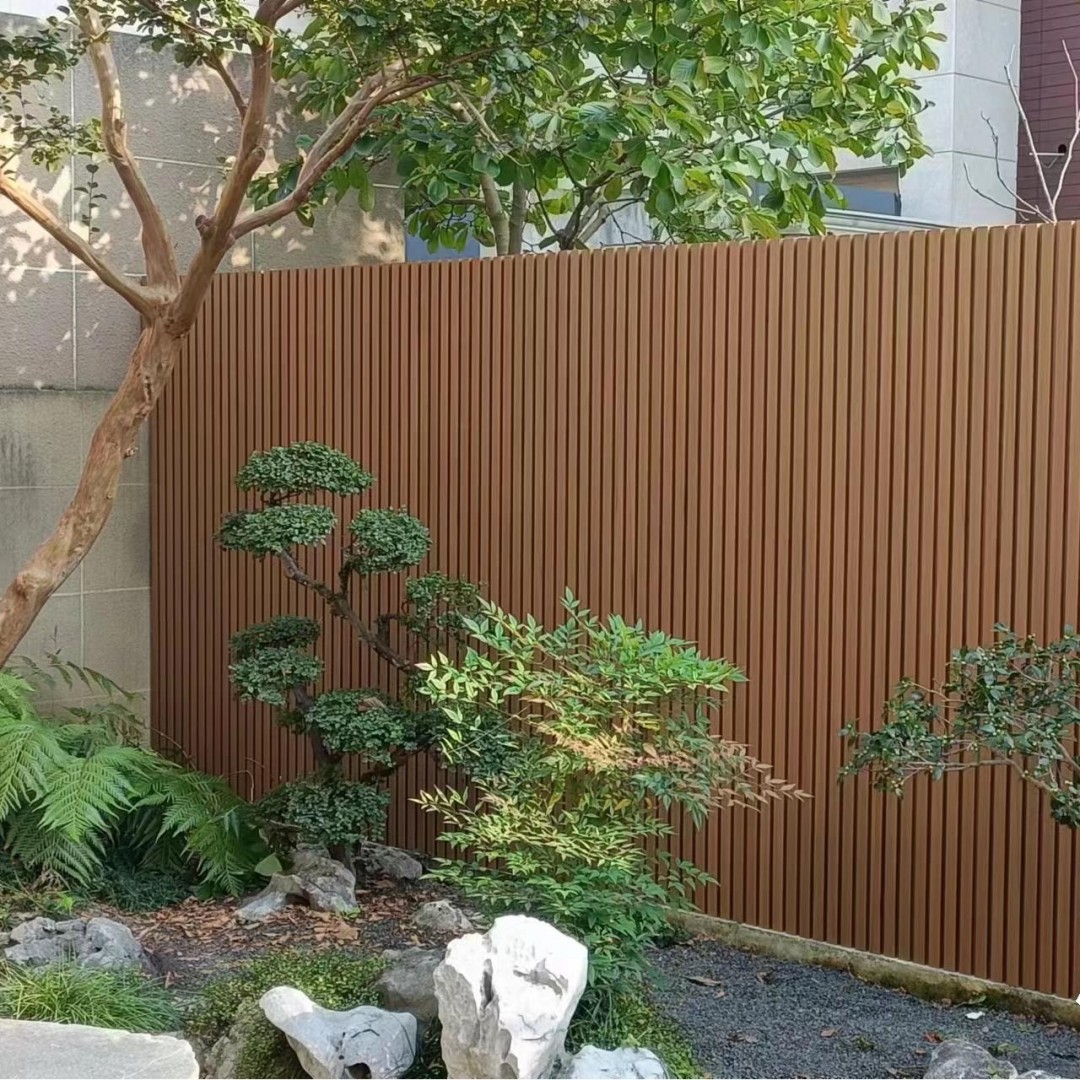
Outdoor WPC wall panel cladding in an exterior application, where UV load, rainfall and thermal movement define product requirements.
Why Outdoor Cladding Is a Different Procurement Category
Outdoor WPC wall panels are specified for outdoor exposure, direct sunlight, rain, high humidity, UV exposure and a wide temperature range. The associated performance requirements are correspondingly specific: UV resistance, weather resistance, waterproof and anti-corrosion behaviour, anti-fading, anti-crack performance, wind pressure resistance and long-term outdoor aging resistance. The project types that drive this demand are building façade renovation, villa exterior decoration, commercial façade projects, courtyard enclosure renovation and outdoor landscaping.
The most common sourcing error does not happen in the factory; it happens in the buyer’s own request. Indoor WPC wall panels and outdoor WPC wall panels look similar in a photograph, are often quoted in the same conversation, and can be described with overlapping language. They are not interchangeable. Indoor WPC panel will fade and crack rapidly in an exterior environment, while an outdoor-grade panel is formulated to resist sunlight, temperature change and rain erosion.
| Comparison point | Indoor-grade WPC wall panel | Outdoor WPC wall panel |
|---|---|---|
| Formulation intent | Interior decorative wall cladding for indoor enclosed spaces | Exterior cladding formulated for sunlight, temperature change and rain erosion |
| Behaviour under sustained UV | Fades and cracks rapidly when used outdoors | UV-stabilised raw materials slow colour fading |
| Colour over time | Not intended for sustained UV exposure | Slight natural colour change may appear after years of exposure, which is normal |
| Typical applications | Interior walls in residential, hotel, office and retail interiors | Building façade renovation, villa exteriors, commercial façades, courtyard enclosure renovation, outdoor landscaping |
The practical consequence is that a quotation is only meaningful when it states the panel class. A buyer who cannot distinguish an indoor quotation from an outdoor quotation is not comparing prices; they are comparing two different products with two different risk profiles.
Material Evidence: What Should Be Documented, Not Assumed
The outdoor WPC wall panel offered by YIKE NEW MATERIAL is specified as Wood Fiber + HDPE + Additives, supplied in two product types: co-extrusion WPC wall panel and traditional WPC wall panel. The documented profile range covers widths of 140 mm, 145 mm, 177 mm and 219 mm, thicknesses of 13 mm, 20 mm and 26 mm, and a standard length of 2.9 m with customised lengths available. Catalogue models include YK-219*26*2900mm, YK-140*20*2900mm, YK-145*20*2900mm, YK-177*13*2900mm, YK-201*25*2900mm, YK-100*50*2900mm and YK-50*50*2900mm, with 219*26mm identified as a popular size.
Three material properties are repeatedly stated for this range: it is waterproof, it is termite proof, and it does not require painting. Those three claims are exactly where a buyer should slow down and ask for method, because each one can be true in a narrow sense and misleading in a broad one.
| What to verify | Why it affects the project | Evidence to request |
|---|---|---|
| Base formulation | Wood fibre, HDPE and additive ratios drive stiffness, moisture behaviour and long-term dimensional stability | A written formulation statement on the quotation or spec sheet, not a verbal assurance |
| Panel type: co-extrusion or traditional | The two types are different products and should not be quoted as if interchangeable | Explicit statement of which type the quoted price refers to |
| Water absorption behaviour | Rain and humidity are continuous conditions outdoors | Test results referenced to a named method such as ASTM D570 or ISO 62, which are the standard test methods for water absorption |
| Termite and moisture performance | These are the two dominant failure modes of traditional timber cladding | Specification statement plus physical sample inspection at the cut edge and fixing points |
| Profile dimensions and tolerance | Affects coverage calculations, waste allowance and joint alignment on the façade | Model number with measured sample dimensions, for example YK-219*26*2900mm |
A specification statement is not the same thing as proof. ASTM D570 and ISO 62 define how water absorption is measured, and ISO 105-B02 defines how colour fastness to artificial light is measured with a xenon-arc lamp. Where a supplier cannot name the method behind a claim, the claim should be treated as an intention rather than a property.
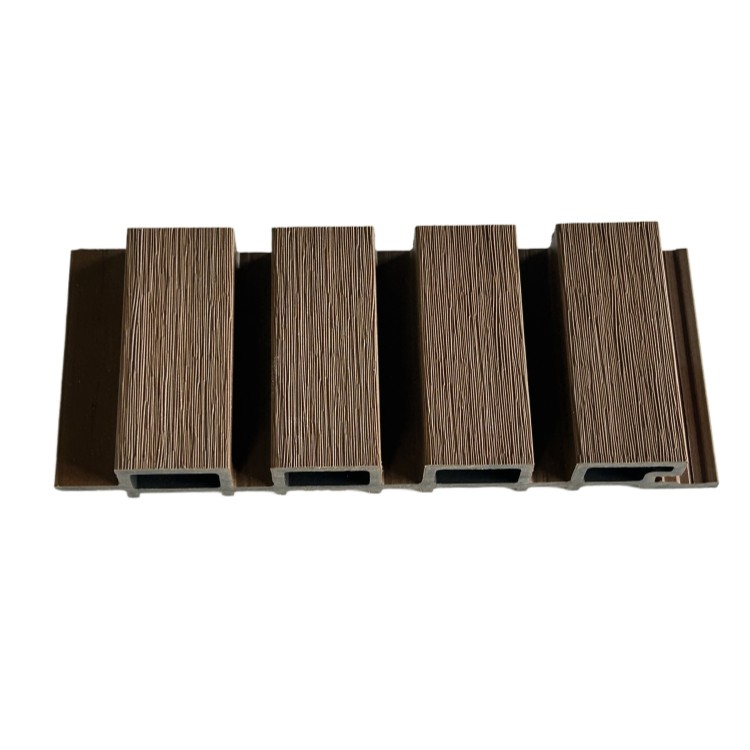
Outdoor WPC wall panel profile. Surface texture, colour and profile geometry are the three elements a buyer can inspect directly on a sample.
Co-Extrusion and Traditional WPC: Ask Which One You Are Buying
Co-extrusion technology is listed among the performance features of the YIKE outdoor WPC wall panel, alongside waterproof, UV resistant, termite proof and no painting required. Both co-extrusion and traditional WPC wall panels appear in the same product-type field, which is precisely why the distinction matters commercially.
In a co-extruded panel, the visible surface is a distinct layer over the core, and that surface is the part that meets ultraviolet light, rain and abrasion. In a traditional panel, the exposed surface and the core are effectively the same material. A buyer comparing offers across suppliers needs the quotation to state which construction is being priced, because the same nominal profile dimension can describe two different products.
Where the comparison stops being useful
The stated specification for this outdoor range does not publish a surface-layer thickness value, and no comparative aging test data between the two types is provided in the product documentation. That is a genuine limit on comparison. A buyer can reasonably require that the supplier state the panel type, describe where the co-extruded layer sits in the profile, and confirm it on a physical sample; a buyer cannot responsibly infer a service-life difference between the two types from marketing language alone. If a supplier promotes co-extrusion without defining the layer, the term has been used as a label rather than a specification.
Finish, Colour Range and Fade Performance
Surface finish on the outdoor WPC range is documented as wood grain, brushed, sanded, embossed and 3D wood texture. The colour range covers chocolate, brownish red, orange, black, light grey, green, original wood and dark grey, with customised colours available. Because outdoor cladding is a visible architectural element rather than a hidden construction material, finish and colour are not cosmetic details; they determine whether a façade reads as one continuous surface or as a patchwork of batches.
Fade resistance is the finish property most often asserted and least often evidenced. ISO 105-B02, the standard for testing colour fastness to artificial light using a xenon-arc fading lamp, provides a recognised reference point: a buyer who wants to compare fade claims can ask whether test work has been performed against a named light-exposure standard rather than against an internal opinion.
Service Life: How to Read “15–25 Years”
The YIKE outdoor WPC wall panel is documented with a service life of 15 to 25 years. That range, rather than a single number, is the correct form for exterior cladding, because service life is not a fixed attribute of a material; it is the outcome of a material placed in a specific environment and installed in a specific way.
The variables that move a panel from the lower end of that range to the upper end are largely visible on site: the ultraviolet dose at the wall orientation, annual rainfall and humidity, whether the fixing used corrosion-resistant metal keels and dedicated stainless steel fasteners, whether expansion gaps were reserved, whether the base was treated for drainage, and whether the façade is cleaned periodically rather than left to accumulate organic growth.
It is also worth noting that service life is assigned per product class, not per brand. In the same product portfolio, a PVC self-adhesive wall sticker carries a documented indoor service life of 5 to 10 years. The gap between 5–10 years for an adhesive interior film and 15–25 years for an exterior wood-plastic composite profile is not a quality judgement about either product; it reflects different materials, different fixing methods and different exposure conditions. Buyers should resist transferring a service-life figure from one product class to another.
A further distinction matters for procurement documentation: a service-life figure is a material expectation under defined conditions, not a warranty. Buyers should ask what conditions the figure assumes and what support exists after delivery — for this range, after-sales support is documented as remote technical support.
Installation Method as Evidence of Supplier Capability
How a supplier describes installation reveals how well it understands its own product. Outdoor WPC wall panels are installed using a fixed outdoor keel method, working passively under long-term outdoor exposure with no manual or powered operation required. The documented sequence is short and specific:
- Clean and treat the wall base to ensure good drainage.
- Measure sizes and cut the outdoor WPC wall panels.
- Install corrosion-resistant metal keels and reserve expansion gaps.
- Lock panels in place and fix with dedicated stainless steel fasteners.
- Fit finishing trims and check drainage and assembly tightness.
The matched accessory set is equally part of the specification: anti-rust metal keel, outdoor special fasteners, waterproof connectors, exterior wall sealing strips and corner accessories. Safety requirements during installation include dust masks and safety goggles during cutting, stable scaffolding for exterior high-altitude work, and sufficient expansion gaps to avoid thermal deformation.
Three installation-related risks are documented for exterior cladding and should be raised in supplier conversations: long-term UV fading and aging, cracking under extreme temperature difference, water seepage and mildew caused by inadequate outdoor waterproofing, and loose installation with a falling risk in high wind. Each of these is an installation or accessory question as much as a material question — which is why a supplier that supplies panels without a documented accessory system is not supplying a complete façade solution.
Commercial and Customisation Evidence: OEM/ODM, MOQ and Lead Time
Material and finish claims describe what a supplier can make. Commercial terms describe whether a buyer can actually work with that supplier, and they should be checked with the same discipline.
YIKE NEW MATERIAL operates OEM and ODM production with customisation available in colour, pattern and logo, at a documented monthly capacity of 500,000 m² and a lead time of 14 to 30 days. Quality control is documented as 100% pre-shipment testing with third-party inspection available, and the company’s stated inspection partner reference is SGS. The company was founded in 2019, operates a 10,000 m² factory with 50 employees and a 10-engineer R&D team, records an annual output of 5,000,000 m², and exports 100% of its production to Central America, South America, Southeast Asia, the Middle East and Africa. Its wider decorative range covers PVC ceiling panels, PVC wall panels, PVC marble sheets and UV marble sheets, WPC fluted wall panels, interior WPC wall panels and PVC self-adhesive wall stickers — the outdoor WPC range is a separate specification line, not an extension of the interior range.
The minimum order structure is worth reading carefully, because it is a real constraint rather than a formality. The documented MOQ is one 20-foot container with four to six colours from the E-catalogue. Buyers whose volume falls below a container can order 500 sqm per colour from stock colours, or 1,000 sqm from the E-catalogue. In practice this means colour count and order volume are linked: a buyer planning an eight-colour façade scheme from a part-container position will need either to consolidate colours or to accept the container-level MOQ.
Application Scenarios and Field Evidence
The scheduling logic behind outdoor WPC cladding is consistent across markets. The documented application scenarios cluster in markets that combine strong sunlight with high humidity, including Malaysia, Indonesia, Thailand, Uruguay, Colombia, Costa Rica, Panama, Chile and Mexico, where façade renovation, villa exterior decoration, commercial façade work, courtyard enclosure renovation and outdoor landscaping drive demand.
Field evidence from the same supplier supports repeat purchasing in comparable climates, although the published case data mixes interior and exterior decorative programmes and should not be read as façade-specific performance data.
| Market | Documented volume | Duration | Application focus |
|---|---|---|---|
| Colombia | 60+ x 40HQ containers per year | 2 years | Residential, hotels, shopping malls, retail and commercial projects |
| Indonesia | 10 x 40HQ containers | 3 years | Renovation projects using PVC ceiling panels, PVC marble sheets and WPC wall panels for residential and commercial interiors |
| Malaysia | 10 x 40HQ containers | 2 years | Over 100 residential installations, with repeat usage and proven performance in tropical climate conditions |
| Ecuador | 3 x 40HQ containers | 2 years | Retail shops, brand stores, showrooms, offices and restaurants |
| El Salvador | 1 x 40HQ container | 3 years | Residential interior decoration |
What this table evidences is continuity: buyers in humid, high-UV markets have reordered across multiple years, which speaks to supply reliability and consistency. What it does not evidence is a measured outdoor weathering result on a specific façade, and a buyer evaluating façade performance should ask separately for that.
Market Context: Why Verification Is Becoming the Differentiator
The global wood plastic composite market is estimated at USD 8.97 billion in 2025 according to SNS Insider. Market-size figures of this kind vary by report scope — studies that count total PVC panels, wall panels only, or WPC including decking and flooring produce different totals — so a single number is useful as context rather than as a procurement criterion.
The behavioural trend that matters more to suppliers is that buyers in humid, high-UV markets are moving from price-only comparison toward evidence-based comparison. The questions that now appear in early-stage enquiries are less about colour charts and more about which type of WPC is quoted, which test method supports a fade claim, what accessory system accompanies the panel, and what happens after delivery. Suppliers who answer those questions with documents rather than adjectives are easier to shortlist, because their claims can be checked against something.
Where the Limits Are
A balanced evaluation of any outdoor WPC wall panel supplier includes the boundaries of the product, not only its strengths:
- It is cladding, not structure. Outdoor WPC wall panels are installed on a corrosion-resistant keel system. They are not a load-bearing element and cannot substitute for structural facade materials.
- Installation quality determines wind performance. Loose installation and falling risk in windy conditions are documented failure modes, which places the responsibility for wind resistance partly on fastener selection and fixing discipline.
- Expansion gaps are mandatory. Sufficient expansion gaps are required to avoid thermal deformation, and omitting them to achieve a tighter visual joint creates a premature failure.
- Colour will shift slightly over years of exposure. UV-stabilised raw materials slow fading; they do not eliminate it entirely.
- Indoor-grade panels must never be substituted. Indoor WPC panels fade and crack rapidly outdoors, and mixing classes to reduce cost transfers the risk to the end client.
- The 15–25 year range is conditional. It assumes correct installation, maintained drainage and the exposure profile the product is designed for.
- MOQ affects colour planning. A one-container MOQ with four to six E-catalogue colours shapes what a first order can realistically look like.
Future Outlook
Exterior cladding procurement is converging on documentation. In the near term, the suppliers best positioned in humid, high-UV markets are likely to be those that can attach a named test method to each performance claim, supply a matched accessory system rather than panels alone, and support installation questions remotely after the container has shipped. Buyers, in turn, will increasingly treat the ability to answer verification questions as the first filter in supplier selection — before price comparison begins. That shift favours manufacturers with stable documentation practices over suppliers whose evidence stops at the catalogue page.
FAQ
How should an importer evaluate an outdoor WPC wall panel supplier before placing a bulk order?
Look for proven export experience, consistent product quality, relevant certifications and customisation capability. Request samples, check production capacity and project references, and confirm after-sales support before committing to a bulk order. In practice this means asking for a documented specification — material, panel type, profile dimensions, finish and service-life expectation — and testing whether the samples supplied match that document.
Can indoor WPC panels be used on an exterior façade instead of outdoor panels?
No. Outdoor WPC wall panels include a special anti-UV, weather-resistant formulation that resists sunlight, temperature change and rain erosion. Indoor WPC panels will fade and crack rapidly in an outdoor environment. The two product types may share appearance and, in some cases, profile geometry, but they are specified for different exposure conditions and are not interchangeable.
Will an outdoor WPC wall panel fade under long-term sunlight?
Outdoor-grade WPC panels use UV-stabilised raw materials to slow colour fading. A slight natural colour change may appear after years of exposure; this is normal and is far more stable than the behaviour of indoor decorative panels in the same position. Buyers comparing offers can ask whether fade performance has been tested against a recognised light-exposure standard such as ISO 105-B02, which defines colour fastness testing to artificial light using a xenon-arc lamp.
What installation method and accessories does outdoor WPC wall panel cladding require?
Installation uses a fixed outdoor keel method: clean and treat the wall base to ensure drainage, measure and cut the panels, install corrosion-resistant metal keels with expansion gaps reserved, lock panels in place with dedicated stainless steel fasteners, then fit finishing trims and check drainage and assembly tightness. The matched accessory set includes anti-rust metal keel, outdoor special fasteners, waterproof connectors, exterior wall sealing strips and corner accessories. Dust masks and safety goggles are required during cutting, and stable scaffolding is required for high-altitude exterior work.
How should the 15–25 year service-life figure be interpreted?
Treat it as a material expectation under defined conditions rather than a warranty. The position within the range depends on UV exposure at the wall orientation, rainfall and humidity, whether a corrosion-resistant keel and dedicated stainless steel fasteners were used, whether expansion gaps were reserved, whether the base drains properly, and whether the façade receives periodic cleaning. Service life is also product-class specific: in the same portfolio, an indoor PVC self-adhesive wall sticker is documented at 5–10 years, which reflects a different material, fixing method and environment rather than a quality ranking.
What commercial terms should a buyer plan around — MOQ, lead time and customisation?
For this outdoor WPC range, OEM and ODM are available with customisation in colour, pattern and logo, at a documented monthly capacity of 500,000 m² and a lead time of 14 to 30 days. The documented MOQ is one 20-foot container with four to six colours from the E-catalogue; below that volume, buyers can order 500 sqm per colour from stock colours or 1,000 sqm from the E-catalogue. Quality control is documented as 100% pre-shipment testing with third-party inspection available, and after-sales support is provided as remote technical support. Colour count and order volume should therefore be planned together.
For a full specification overview of the outdoor WPC wall panel range and the wider decorative panel portfolio, the company brochure is available for download: YIKE New Material product brochure (PDF). YIKE NEW MATERIAL is a manufacturer and exporter based in Haining, Zhejiang, China, with further company information at www.merchandise-eco.com.