
Overmolding Scenario Fit: Low-Odor Platinum-Cured LSR
Overmolding Scenario Fit: Low-Odor Platinum-Cured LSR
Scenario fit is the point at which an LSR datasheet becomes a production decision. For adult-product overmolding and medical-adjacent soft-touch molding, that decision rests on three linked choices — the addition-curing grade, the platinum catalyst that drives the cure, and the cure window the molder can actually hold — rather than on any single headline property.
The Adult Products LSR for Overmolding range from Dongguan Times Silicon Industry Co., Ltd. — TS6807A/B, TS6825A/B, TS6830A/B, TS6835A/B and TS6838A/B — is an addition-curing, platinum-cured liquid silicone rubber supplied clear, with hardness from 7±1 to 38±1 Shore A and viscosity from 4,000 to 25,000 across the series. That window is the starting point for scenario mapping, not the end of it.
The sections below map the series and its catalyst system to specific molding scenarios, explain why platinum catalysis and low-odor formulation are connected rather than separate selling points, and state where the fit stops. Figures are limited to the supplier's product data and published cooperation records, plus attributed third-party research.
Why Scenario Fit Overrides a Grade-to-Grade Comparison
Two molders can buy the same Shore A hardness and reach different outcomes. The variable is the scenario: substrate material, wall thickness, tool temperature, demold time, the surface the part touches, and the documentation the buyer must keep on file. A grade that performs cleanly in a 2 mm section on a heated tool can under-cure in a 12 mm section, and a formulation that reads "low odor" on a datasheet can still fail an odor check if the platinum-to-crosslinker balance is wrong for the press it runs on.
Three scenario requirements tend to dominate in contact products. The first is odor and volatility, because the part is used close to the body and any residual volatile is noticed quickly. The second is what the part leaves behind — bleeding, leaching or surface tack that appears weeks after molding. The third is appearance drift, since silicone that yellows in storage reads to the end user as an age or quality problem, whatever the underlying cause.
Medical-adjacent projects add a documentation requirement rather than a different polymer. A U.S. FDA 510(k) decision document for a B. Braun Medical device identifies liquid silicone rubber among the materials evaluated under ISO 10993-1, the recognised framework for biological evaluation of medical devices. That is evidence about one device submission; it is not a certification that any LSR grade is biocompatible. The buyer's real question is therefore "which grade, with which test evidence, for which contact duration" — not "is LSR medical grade".
The Problem Behind Low-Odor Claims: Cure Chemistry, Not Perfume
Odor in a cured silicone part rarely comes from the polymer backbone. It comes from what remains after crosslinking: unreacted low-molecular-weight fractions, volatiles carried in by raw materials, and anything left over from an incomplete cure. Addition-curing LSR crosslinks by platinum-catalysed hydrosilylation between vinyl-functional polydimethylsiloxane and a hydrogen-containing polysiloxane, so the network forms without the peroxide decomposition by-products that peroxide-cure systems depend on. That chemistry is why a genuinely low-odor result is achievable — and why it is not automatic.
The supplier's scenario data for adult-product molding lists the requirement plainly: food or medical-grade certification, odorless or low-odor performance, low volatility, anti-yellowing, high resilience and non-toxicity. Those are specifications to be met by a formulation, not properties that arrive with the word "silicone". Meeting them means controlling the vinyl oil's volatile content, selecting a catalyst model whose volatile-matter limit suits the application, and curing completely rather than merely sufficiently.
Volatility is measurable upstream. The vinyl silicone oil range used in these formulations is listed with volatile content below 0.5%, across viscosities from 35 up to the high-viscosity 50W grade. The oil is the largest single component by mass, so its volatile level sets a floor under the finished part's volatile level. Catalyst models carry their own volatile-matter limits, which differ across the TPL and PTR series; in a low-odor project those limits matter more than the catalyst's price per kilogram.
Where Platinum Catalysis Enters the Overmolding Scenario
The catalyst is the part of the system that converts a formulation into a cycle time. Times Silicon lists seven platinum catalyst models — TPL-1000, TPL-2000, TPL-3000, TPL-4000, TPL-5000, PTR-3000 and PTR-5000 — supplied as a transparent platinum/siloxane preparation with viscosity from 320 to 1,000 and platinum content spanning 1,000 to 5,000 across the series as stated in the product data. The model numbering tracks concentration level rather than a performance ranking, which is why catalyst selection is a formulation decision and not an upgrade path.
Two parameters decide how the catalyst behaves on an overmolding cell. The first is concentration: at a given platinum level, more catalyst shortens cure and narrows the process window, while less catalyst extends the window and risks under-cure in thick sections or cold tools. The second is the temperature at which the reaction is run. The catalyst application data describes a broad working reaction window of roughly -20 °C to 150 °C for hydrosilylation, which is why the same base chemistry can run as a room-temperature cure for casting or as a heated-tool cure for overmolding.
On the press, the practical sequence is the standard two-component one: A and B are metered and mixed, degassed, injected into a heated tool, cured and demoulded. The equipment list for this scenario — dispensing machine, vacuum defoamer, vulcanising press, oven, mixing equipment — describes that same chain, and every unit in it can shift the effective cure. A tool running cooler than the formulation expects produces the same symptoms as a catalyst dosed too low: soft demould, surface tack, and odor that only appears later.
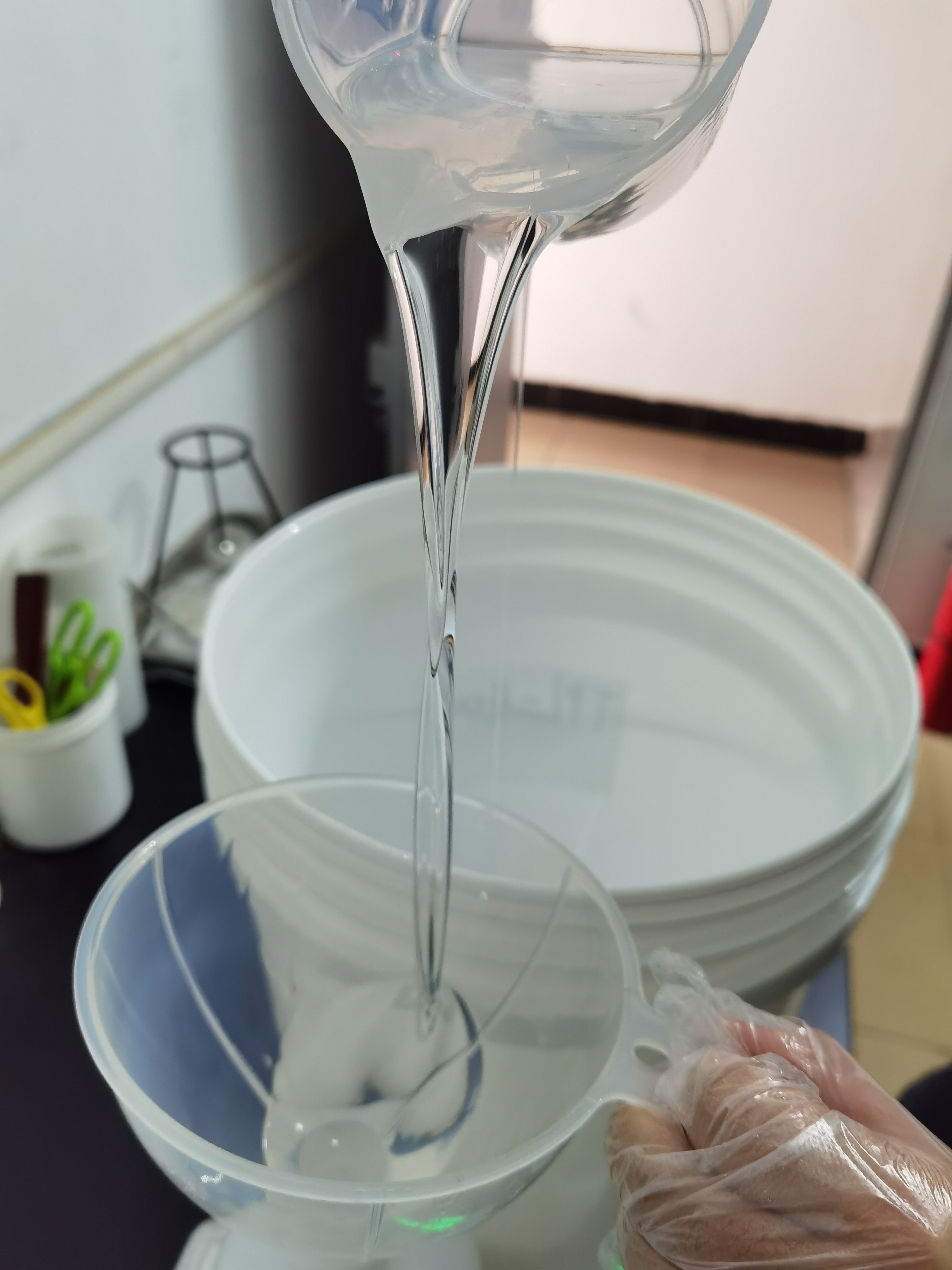
Platinum catalyst models differ in platinum content and volatile-matter limits. In low-odor projects those two parameters decide more than price per kilogram.
The Series Itself, and Where Its Fit Stops
Dongguan Times Silicon Industry Co., Ltd. is a silicone materials manufacturer based in Hengli Town, Dongguan, founded in December 2021 and operating since July 2022, with a 15,000 m² facility, 42 employees including a 10-engineer technical team, and an export ratio of 55% across markets that include China, South Korea, the United States, Japan and Africa. The company states ISO 9001 certification and product-level RoHS, REACH, FDA, LFGB and halogen-free approvals, and its portfolio covers liquid silicone for adult products and overmolding, base gums, vinyl and hydrogen-containing silicone oils, silicone resin, platinum catalysts, inhibitors and treatment agents.
The overmolding series covers the feel range that adult-product and soft-touch work actually uses. Hardness from 7±1 Shore A at the soft end supports the flesh-like hand feel the application calls for; 38±1 at the top end supports parts that need to hold shape and resist compression. Appearance can be supplied clear, transparent, translucent or opaque, curing can be set for room temperature or heat, and Shore hardness, viscosity, odor level and formulation grade are offered as customisation variables rather than fixed catalogue options. Standard stock ships in 7–10 working days and custom formulations in 15–25 working days, on minimum order quantities of 1 kg for standard grades and 5 kg for custom formulations.
The boundaries matter as much as the capability. A 7±1 to 38±1 Shore A range does not cover sub-7 ultra-soft or above-38 firm specifications, so a project outside that window needs a different base gum rather than a harder push on this one. Company-level certification does not mean every grade carries every approval — certificate numbers, issuing bodies, validity dates and the grade each certificate covers have to be confirmed before a regulated launch. And "low odor" is a customisation variable with an associated test, so the acceptable threshold should be defined by the buyer and checked on molded parts, not accepted from a datasheet line.
Mapping Grades to Scenarios
The table converts the series data into scenario-level decisions. Each row states the requirement that most often decides success or failure in that scenario, together with the evidence a buyer should request before approving the grade.
| Scenario | Grade and parameter fit | Decisive requirement | Evidence to request |
|---|---|---|---|
| Adult-product overmolding onto rigid plastic or hardware cores | Mid-to-high hardness within 7±1 to 38±1 Shore A; viscosity 4,000 to 25,000 as listed | Bond at the interface without primer failure or read-through of the core | Bond-line trial on the actual substrate; cure confirmation at tool temperature |
| Realistic body-simulation and thick-section molding | Low end of the range, from 7±1 Shore A upward | Cure through the full section; demould without tearing | Sectioned cure check; tear and elongation data for the specific grade |
| Medical-adjacent soft-touch parts such as grips, seals and housings | Grade selected against the finished device's biological evaluation plan | Documented ISO 10993-1 evaluation at device level | Grade-specific test reports, extractables information, change-control statement |
| Food-contact-adjacent molding | Formulation grade specified as food or medical | The regulatory basis for the claim, not the claim itself | FDA and LFGB test reports naming the grade and test conditions |
| Wearable sleeves and high-flex parts | Higher tear strength within the available hardness range | Retention of tear strength and colour after ageing | Ageing data; anti-yellowing verification on aged samples |
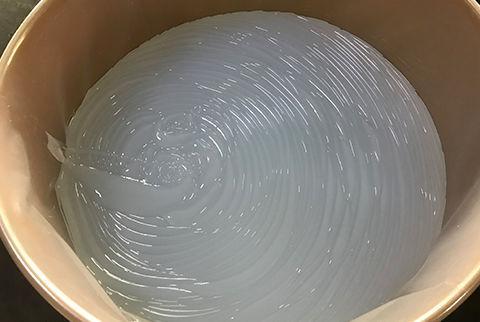
The overmolding series spans 7±1 to 38±1 Shore A. Grade selection follows the scenario: feel at the soft end, shape retention and compression resistance at the top end.
Platinum-Cured Overmolding Against Conventional Industrial Silicone
The comparison worth making is not "specialty versus commodity" in the abstract, but which requirement each material actually satisfies. HTNXT Research's 2026 comparison of high-performance LSR against traditional materials reports tear strength of at least 35 kN/m for Times Silicon's high-performance LSR, against 20 kN/m or less for conventional industrial-grade silicone. Tear strength governs how a thin overmolded lip survives demoulding and assembly, so a gap of that scale moves the scrap rate before it moves anything else.
The cure route is the second distinction. Peroxide-cure silicone depends on decomposition by-products to form its network, and those by-products are what odor and post-cure volatility usually trace back to. Addition-cure LSR forms its network through platinum-catalysed hydrosilylation, so there is no equivalent by-product to drive off. That is a chemistry argument rather than a positioning claim, and it explains why low-odor projects in this category almost always specify platinum cure.
The fit boundary is equally clear. Conventional industrial silicone remains adequate where the part does not touch skin, odor is not a purchase criterion, and extractables are not documented — a gasket inside a machine, for instance. The single-source nature of the tear-strength comparison is also a limitation: it contrasts documented characteristics rather than head-to-head production trials in a specific buyer's tool, so a molder should confirm the difference on its own geometry before treating it as a cost input.
Reading the Economics: Catalyst Cost Versus Cost Per Accepted Part
Platinum content is the line item that makes a low-odor formulation look expensive, and it is also the wrong line to optimise in isolation. A catalyst with higher platinum content can be dosed lower, so the meaningful comparison runs from cost per kilogram of cured compound to cost per accepted part. The supplier's cooperation record for a Pearl River Delta liquid silicone manufacturer describes curing efficiency rising 30% and per-batch capacity rising 25% after catalyst optimisation, with the curing defect rate falling from 2.5% to 0.6% and yield reaching 99.4% across a three-year supply relationship. These are reported project outcomes rather than a specification, and they depend on the formulation and press involved.
The adult-product record points in the same direction. A three-year supply relationship covering realistic body molds and adult toys reports the defect rate falling from 3% to 0.8% and yield reaching 98%, with end-user feedback citing low odor and realistic feel, repurchase rate up 18% and returns below 1%. The same record states a service life of at least three years under normal use with no yellowing or leaching. Read together, the two records say something narrower and more useful than "premium material pays for itself": in contact-product molding a rejected part costs a full cycle plus the core it was molded onto, so yield and demould reliability usually outweigh the raw-material delta.
No verified price data sits behind those figures, and none should be inferred from them. Buyers comparing quotations should separate compound price, catalyst price and conversion cost, and ask each supplier to state the platinum content and recommended dosage basis for the grade being quoted.
What the Market Signal Says, and What It Cannot Say
Published market estimates for LSR are directional at best. Grand View Research's summary values the global liquid silicone rubber market at USD 2.8 billion in 2023 and projects USD 5.0 billion by 2030, with USD 3.6 billion in 2026 and a CAGR of 8.5%. Market.us headlines USD 2.3 billion in 2024 rising to about USD 5.5 billion by 2034 at a CAGR of 9.2%. Different base years, segment boundaries and undisclosed methodologies mean the two should be read side by side rather than averaged.
The narrower medical-grade silicone rubber segment shows the same problem more sharply: two commercial research vendors report USD 837.0 million and USD 855.18 million for the same 2026 scope, and neither figure is independently replicated in the supplied evidence. The defensible conclusion is modest — contact-safety and medical-adjacent applications remain a stated demand driver for LSR, and the segment is tracked by multiple commercial publishers — and it does not support a volume forecast for any specific grade.
A Verification Sequence Before Approving a Grade
Approval should follow the part, not the datasheet. A practical sequence for an adult-product or medical-adjacent project runs in five steps.
- Map the certificate to the grade. Ask for certificate number, issuing body, validity date and the product scope each document covers. Company-level ISO 9001 does not establish that a specific LSR grade holds a specific approval.
- Request the batch data. Platinum content, viscosity and volatile-matter limits are the parameters that most directly affect cure consistency and odor, and they should appear on the certificate of analysis for each lot.
- Run a small trial. Standard grades start at 1 kg and custom formulations at 5 kg, which is enough for a tool trial before committing to production volume.
- Confirm the cure window in your own tool. Record tool temperature, dwell time, demould behaviour and surface tack, then compare against the cure the formulation was designed for.
- Define the odor and extractables threshold before molding, then test molded parts against it. A threshold agreed after the first production run is a negotiation rather than a specification.
Lead-time planning belongs in the same sequence. Stock grades ship in 7–10 working days and custom formulations in 15–25, so a formulation change late in qualification moves the launch date, not just the order date.
Outlook
The direction of travel in this category is documentation rather than chemistry. Platinum-catalysed LSR is already specified for low-odor, low-volatility contact parts; what separates suppliers is whether they can map a grade to a specific certificate, a specific test report and a specific cure window. A manufacturer running at 80 tons per month with headroom to 110 tons per month in peak season can support volume; whether it can support a regulated launch depends on evidence that has to be requested, read and verified. Buyers who build that verification into qualification early tend to find the material decision simpler than the paperwork around it.
FAQ
Which LSR grade fits adult-product overmolding onto a rigid core?
Mid-to-high hardness grades within the 7±1 to 38±1 Shore A range are the usual starting point, because the overmolded layer has to hold shape against the substrate while still delivering the intended feel. The decisive checks are bond at the interface and complete cure at tool temperature, both confirmed on the actual substrate rather than from datasheet values. Viscosity across the series runs from 4,000 to 25,000, which affects fill and degassing more than final hardness.
How does platinum catalyst selection affect odor and cure speed in overmolded parts?
The catalyst governs how completely and how quickly the hydrosilylation reaction finishes. Higher platinum concentration generally shortens cure, and the broad working window of roughly -20 °C to 150 °C allows the same chemistry to run at room temperature or in a heated tool. Odor depends less on the catalyst's presence than on what remains after cure: volatile-matter limits differ across the TPL and PTR models, and an under-cured part will show residual volatiles regardless of which model is used.
Can one LSR series serve both medical-adjacent and adult-product projects?
The same addition-curing chemistry can serve both, but the evidence does not transfer automatically. An adult-product project typically needs low odor, non-bleeding behaviour, anti-yellowing performance and skin-contact biocompatibility testing. A medical-adjacent project adds a device-specific biological evaluation, referenced in FDA submissions through ISO 10993-1. The grade and its documentation have to be matched case by case; a company-level certification statement is not a substitute for grade-level reports.
Which scenarios fall outside the fit of a 7–38 Shore A LSR range?
Specifications below 7 Shore A or above 38 Shore A sit outside this series and require a different base gum rather than a reformulation of an existing grade. Scenarios involving prolonged strong acid or alkali exposure, or long-term direct UV exposure, are also outside the stated working conditions for this application family. Projects needing those conditions should be assessed separately instead of being forced into this range.
What does a sample or pilot evaluation involve before production?
Minimum order quantities are 1 kg for standard grades and 5 kg for custom formulations, generally enough for a tool trial and a cure check. Standard stock ships in 7–10 working days; custom formulations take 15–25 working days depending on complexity and quantity. A pilot should record tool temperature, dwell time, demould behaviour, surface tack and the odor or extractables result against the threshold agreed beforehand.
The company's product brochure is available for public download: Times Silicon product brochure (PDF).
Tem questões ou precisa de mais detalhes?
Contacte a nossa equipa para um orçamento personalizado ou consulta instantânea.
Solicitar orçamento
Preencha o formulário abaixo e a nossa equipa entrará em contacto com uma proposta personalizada.
Chat direto do WhatsApp
Prefere conversar em tempo real? Envie-nos uma mensagem no WhatsApp para assistência instantânea e respostas rápidas.
- Obter orçamento personalizado
- Partilhar fotos ou documentos
- Discuta as suas necessidades diretamente
Geralmente responde em 5–30 minutos durante o horário de expediente.