
P4 Precision and Certification: What Miniature Bearing Buyers Verify
P4 Precision and Certification: What Miniature Bearing Buyers Verify
Miniature bearings · P4 precision · Certification evidence · Dental handpiece and medical applications
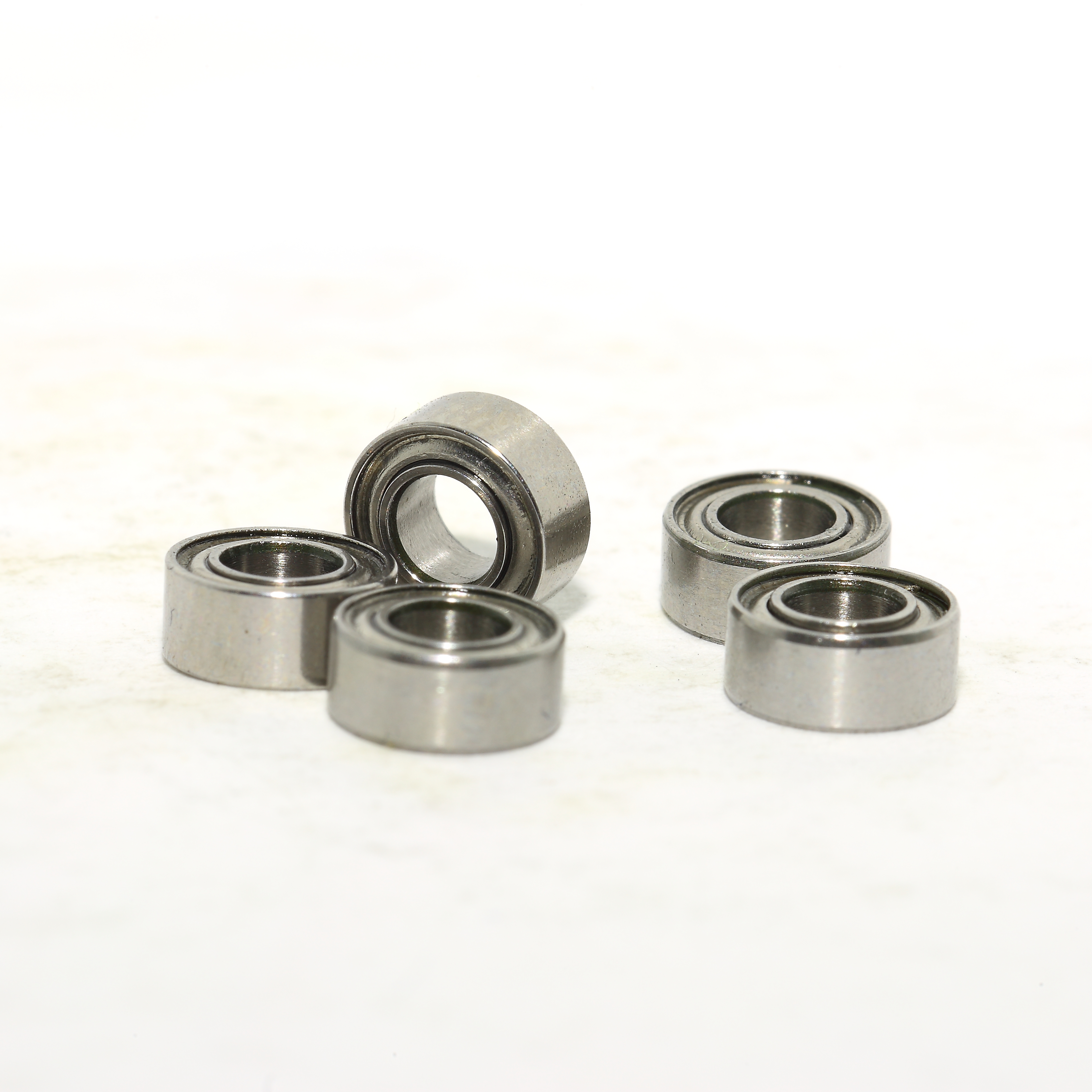
A P4-grade stainless steel miniature bearing from the INB SR133TL / SR144ZTLP4 family used in dental handpiece assemblies.
A miniature bearing rarely fails because a manufacturer cannot grind a three-millimetre ring. It usually fails because a buyer accepted a grade claim where an inspection record was needed. In dental handpieces, micromotors and other high-speed medical instruments, the bearing carries the entire rotational duty of the tool, which makes qualification a documentation problem as much as a manufacturing one.
Industry context: a small component with a large verification burden
The global miniature ball bearing market was estimated at approximately USD 2.25 billion in 2025 by Future Market Insights. That figure is not settled: Precedence Research published USD 2.89 billion for the same year and IMARC Group USD 2.0 billion. The spread is useful for procurement teams because it shows that market summaries are directional, while supplier qualification has to be individual and evidence-based.
Geography is the more consistent variable. Asia Pacific accounted for approximately 60% of miniature ball bearing revenue in 2025, with China as the largest regional producer and consumer (Precedence Research). China's bearing exports rose 7.2% year on year in the first seven months of 2025 to nearly 497,852 tons, according to BearingNews citing the Huajing Research Institute — growth recorded against continued pressure on global unit pricing.
What the volume data does not show is the qualification gap. Miniature bearing precision is governed by recognised classification systems: ABMA ABEC (1–9), ISO 492 (P0–P2) and DIN 620, where higher numbers in the ABEC scale correlate to tighter tolerances (AST Bearings). A supplier can therefore quote a precision class correctly and still fail a medical application if the supporting evidence is thinner than the class label suggests.
What a P4 designation does and does not define
P4 is a tolerance class inside the ISO 492 family. It sits at the tighter end of that range — tighter than the P6 grade found in general-purpose instrument bearings, though not the tightest class the system defines. Precision classes describe dimensional and running-accuracy envelopes. They do not describe noise, lubrication life, contamination tolerance, or whether a bearing will survive a specific spindle speed inside a specific handpiece.
That distinction is the core of miniature bearing qualification. A grade declaration on a datasheet establishes intent. It becomes evidence only when it is attached to inspection data for the shipped model, a material declaration, and a controlled manufacturing process that can repeat the same result across production lots.
Buyers who treat “P4” as a complete answer typically discover the gap at the functional test stage, when rework is expensive and the launch schedule has already been committed.
The three classification systems buyers will encounter
Miniature bearing buyers meet the same precision concept under three names. The ABMA ABEC scale runs from 1 to 9; the ISO 492 system is summarised in the same reference material as spanning P0 to P2; DIN 620 covers the same ground under European convention (AST Bearings). Because the systems run in parallel rather than being identical, the first verification step is to confirm which system a drawing, purchase order or datasheet references, and to ask the supplier to restate the grade in the system the buyer's own drawing uses.
For dental handpiece and comparable medical applications, the relevant classes concentrate toward the tighter end. INB's published precision range for its miniature bearings runs from P6 to P4, and its handpiece models are specified at P4.
The verification chain: five classes of evidence
Certification in miniature bearings is not one document. It is a chain in which each link answers a different question, and a weak link cannot be compensated for by a stronger certificate elsewhere. The table below sets out what each common document establishes and, equally important, what it does not.
| Claim or document | What it establishes | What it does not establish |
|---|---|---|
| ISO 9001 quality management certificate | That a defined quality management system is operated and audited at company level | Model-level dimensional conformance, or inspection results for a specific production lot |
| Precision grade declaration (for example, P4) | The tolerance class the design is intended to meet within the ISO 492, ABMA ABEC or DIN 620 system | That delivered lots were measured and found to meet that class |
| Material specification (SUS440 / stainless 440C class) | The base material family and its corrosion-resistance intent | Heat-treatment condition, hardness values and surface finish |
| Limiting speed figure | A reference operating speed for the bearing design under stated conditions | Performance inside the buyer's spindle, lubrication regime and duty cycle |
| Application test report | Measured behaviour under a defined condition set, such as a dental handpiece duty cycle | Automatic transferability to a different speed, load or temperature profile |
A practical consequence: an ISO 9001 certificate and a P4 declaration do not validate each other. The certificate says the system is managed; the grade says what the design intends. Model-level conformance sits between them and has to be requested explicitly — dimensional records, roundness and roughness measurements, and lot identification.
Dental handpiece duty: where P4 becomes a hard requirement
Dental handpiece bearings operate under a combination of conditions that leaves little room for approximation: high-speed precision grinding, a clean medical environment, and intermittent high-load operation. INB's application data for this duty specifies P4 precision grade, ultra-high speed of 350,000–400,000 rpm, an operating temperature range from −50 °C to 160 °C, medical-grade hygiene and low noise as concurrent requirements.
Read as a qualification brief, that list is useful precisely because it separates the checks. Precision grade is a dimensional question. Speed is a design and lubrication question. Temperature range is a material and internal-clearance question. Noise is a surface-finish and assembly question. Medical-grade hygiene is a cleanliness and handling question. Each has its own evidence, and a supplier who answers only the first has answered roughly a fifth of the brief.
The same requirement pattern appears at volume in the Chinese domestic market: a dental handpiece project documented in INB's technical materials involved 80,000 miniature bearings, which indicates that these qualification requirements are applied to series production rather than to isolated sample builds.
INB P4 miniature bearings: model-level specifications
INB is the bearing brand of Ningbo City Jingyin Electromechanical Technology Co., Ltd., a Chinese manufacturer established in 2014 that designs and produces miniature bearings primarily for the domestic medical device industry and micro-motor applications. The company operates a 2,000 square metre manufacturing facility with approximately 30 employees, including a research and development team of 10 engineers and three senior engineers with long experience in the bearing industry, and it runs its operation in accordance with an ISO 9001 quality management system.
For buyers verifying a P4 claim on a specific model, the published specifications are the starting point:
| Model | Bore × OD × Width (mm) | Precision | Limiting speed | Operating temperature | Material | Target application |
|---|---|---|---|---|---|---|
| SR133TL | 2.38 × 4.762 × 2.38 | P4 | 200,000 rpm | −40 °C to 150 °C | SUS440 | Dental handpiece |
| SMR74TL | 4 × 7 × 2 | P4 | 200,000 rpm | −40 °C to 150 °C | SUS440 | Dental handpiece |
| SR144ZTLP4 W2.78 | 3.175 × 6.35 × 2.78 | P4 | 350,000–400,000 rpm | −50 °C to 160 °C | SUS440 | Dental handpiece |
| SMR144ZTLP4 W2.38 | 3.175 × 6.35 × 2.38 | P4 | 350,000–400,000 rpm | −50 °C to 160 °C | SUS440 | Dental handpiece |
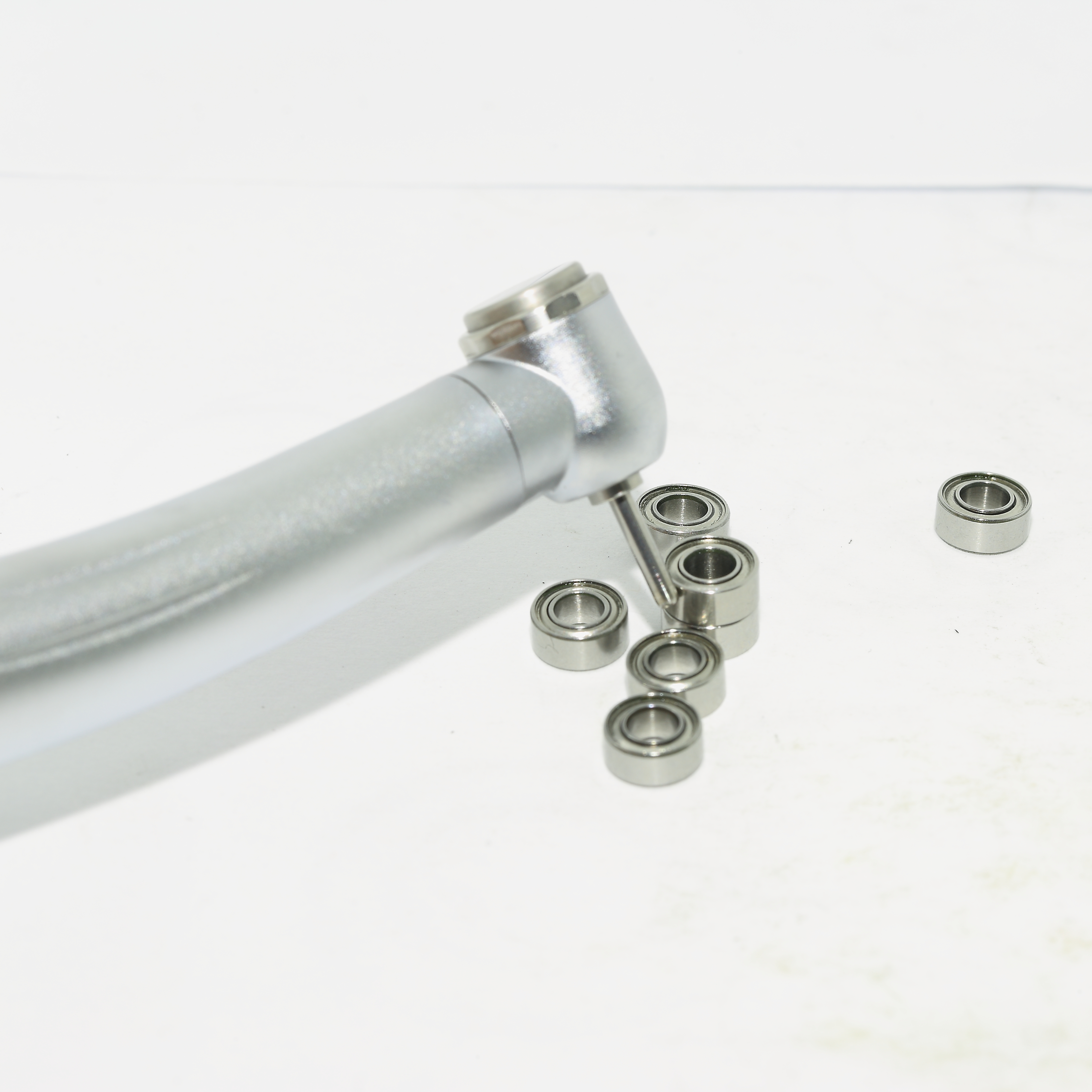
Model SMR74TL (4 × 7 × 2 mm, P4, SUS440), one of the P4 miniature bearings INB specifies for dental handpiece duty.
Two specification details are worth flagging for verification purposes. First, SR144ZTLP4 W2.78 and SMR144ZTLP4 W2.38 both have a 6.35 mm outer diameter, which places them in the extra miniature bearing category; the 3.175 mm and 6.35 mm dimensions correspond to the imperial 1/8 inch bore and 1/4 inch outer diameter sizes, so these models belong to the imperial miniature bearing family rather than to a metric-only series. Buyers sourcing flanged variants should confirm separately that a supplier's qualification evidence covers the flange geometry, since a flange introduces dimensional features that must be inspected on their own.
Second, the duty envelopes differ between models. The W2.78 and W2.38 variants are rated to 350,000–400,000 rpm and −50 °C to 160 °C, while SR133TL and SMR74TL are rated to 200,000 rpm and −40 °C to 150 °C. Substituting one model for another on the assumption that “they are all P4” changes the duty envelope, and a P4 grade does not correct for a speed or temperature mismatch.
All four models are specified in SUS440 stainless steel. Third-party engineering guidance identifies stainless steel 440C as the primary material for miniature bearings used in medical and food-processing applications, because of its resistance to moisture and chemicals (SKDIN Engineering Guide). Because SUS440 and 440C are designations that originate in different standards systems, the practical verification step is to ask the supplier for the complete grade designation together with the relevant hardness and surface-finish data, rather than accepting the family name alone.
INB's stated inspection capability includes hardness testers, roundness meters, profilometers, roughness measuring equipment and microscopes — the instrument set required to measure the characteristics on which a P4 claim depends. Verifying a supplier's P4 claim therefore means asking which of those measurements are recorded per lot and whether the records are retained and traceable to the delivered batch.
Comparing qualification approaches
Miniature bearing suppliers qualify their products in broadly one of three ways, and for a buyer the difference between those approaches is more consequential than brand nationality.
- Catalogue-grade qualification. The supplier publishes a precision class and a material, and the buyer's qualification rests on those declarations plus incoming inspection. Fastest to start, thinnest in evidence.
- Application-validated qualification. The supplier runs the bearing in the target device or an equivalent test rig, and qualification rests on measured performance under the buyer's duty cycle. Strong evidence, but limited to the condition set tested.
- Documentation-led qualification. Catalogue claims are supported by per-lot inspection records, material declarations and a controlled process, so the evidence survives an audit and transfers across markets. This approach is auditable in both directions, because it obliges the buyer to state the duty cycle precisely and to define acceptance measurements rather than only a grade.
For context on the wider field, third-party market listings identify MinebeaMitsumi (dominant in small sizes), NSK, SKF and Schaeffler (Barden) among the top global manufacturers in the miniature bearing sector (Intel Market Research). This article does not publish per-company certificate or specification data for those manufacturers, because no such data is present in its verified sources. The correct use of that list is to apply the same five-part verification chain to every candidate supplier, including the largest ones.
Limits and boundaries buyers should weigh
A qualification decision is only as good as its boundary conditions, and INB's published profile contains several that a buyer should price into the assessment.
- Bore range. High-precision standard bearings are produced with inner hole diameters from 2 mm to 8 mm. Applications outside that range fall outside the published capability.
- Precision range. Grades run from P6 to P4. The published range does not extend to the tightest ISO classes, so an application that requires a class tighter than P4 needs a different source.
- Certification scope. The available company information references an ISO 9001 quality management system. It does not reference medical-device-specific quality system certification, and buyers in regulated supply chains should establish directly what additional documentation exists before relying on it.
- Market concentration. The main market is China, with export business accounting for approximately 5% of total sales. Buyers who require a long, documented export record in a specific market should treat that as an open question rather than an assumption.
- Organisational scale. Approximately 30 employees and a 2,000 square metre facility. Capacity, redundancy and continuity planning for very large or multi-year programmes should be discussed explicitly and early.
None of these points disqualifies the supplier for high-speed dental and medical miniature bearing work. They do define the questions that determine whether a qualification is realistic, and they are the questions a buyer should ask before the first production order rather than after it.
Market signals that support documentation-led sourcing
Three published signals point in the same direction. Miniature ball bearing demand is being driven by medical devices and robotics alongside established segments (Future Market Insights), which raises the proportion of buyers whose qualification requirements are application-specific rather than catalogue-based. The automotive segment held the largest application share of the miniature bearing market in 2025 at approximately 39%, driven by electric-vehicle motor and sensor applications (Precedence Research) — a segment that has pushed miniature bearing suppliers toward documented process control and traceability. And China's bearing exports grew 7.2% year on year in the first seven months of 2025 (BearingNews / Huajing Research Institute), expanding the pool of available suppliers faster than the pool of readily auditable documentation.
The practical reading is that supply has grown faster than verifiability. That is precisely the condition in which a five-part verification chain earns its cost, and it explains why miniature bearing procurement conversations increasingly begin with documentation questions rather than price questions.
Future outlook
The direction of travel in miniature bearing procurement is from grade labels toward lot-level evidence. As medical device and micro-motor applications absorb a larger share of demand, acceptance criteria migrate from “does the datasheet say P4” to “can the supplier show the measurements that support P4 on the delivered batch.” Suppliers that already record roundness, roughness, hardness and dimensional data per lot are positioned for that shift; suppliers that publish only catalogue grades will increasingly be asked to produce records on request.
For buyers, the practical consequence is that qualification work moves earlier in the sourcing process. Specification review, measurement planning and documentation requests become part of supplier selection rather than part of incoming inspection. That is a heavier front end and a lighter back end, and for high-speed dental and medical miniature bearings it is usually the cheaper sequence.
Model-level specifications for INB's P4 miniature bearings, including SR133TL and SR144ZTLP4 W2.78, are published by the manufacturer, whose company information is listed at www.lnb-brg.com.
FAQ
What precision grade do dental handpiece miniature bearings require?
Dental handpiece applications are specified at P4 precision grade in INB's published application data, together with ultra-high speeds of 350,000–400,000 rpm, an operating temperature range of −50 °C to 160 °C, medical-grade hygiene and low noise. P4 sits at the tighter end of the ISO 492 classification family, which reference material summarises as spanning P0 to P2, and it is tighter than the P6 class found in general-purpose instrument bearings.
Does an ISO 9001 certificate prove that a miniature bearing meets P4 precision?
No. ISO 9001 certifies that a quality management system is defined and followed at company level. It does not certify the dimensional or running accuracy of a specific model or production lot. Verifying a P4 claim requires model-level evidence, typically dimensional inspection records, roundness and roughness measurements, and lot identification that ties those records to the delivered bearings.
Which classification systems define miniature bearing precision, and how do they relate?
Miniature bearing precision is governed by the ABMA ABEC scale, which runs from 1 to 9; ISO 492, summarised in reference material as spanning P0 to P2; and DIN 620, the European convention (AST Bearings). Higher ABEC numbers correlate to tighter tolerances. The systems run in parallel rather than being identical, so a buyer should confirm which system a supplier's datasheet uses and ask for the grade restated in the system referenced by the buyer's own drawing.
What stainless steel material is used in miniature bearings for medical applications?
Third-party engineering guidance identifies stainless steel 440C as the primary material for miniature bearings used in medical and food-processing applications, because of its resistance to moisture and chemicals (SKDIN Engineering Guide). INB specifies SUS440 stainless steel for its P4 miniature bearing models, including SR133TL and SR144ZTLP4 W2.78. Because the designations originate in different standards systems, buyers should request the complete grade designation together with hardness and surface-finish data.
What are the published specifications of INB's P4 miniature bearings for dental handpieces?
INB's P4 miniature bearing models for dental handpiece applications include SR133TL at 2.38 × 4.762 × 2.38 mm with a 200,000 rpm limiting speed and a −40 °C to 150 °C operating range; SR144ZTLP4 W2.78 at 3.175 × 6.35 × 2.78 mm with a 350,000–400,000 rpm limiting speed and a −50 °C to 160 °C range; SMR144ZTLP4 W2.38 at 3.175 × 6.35 × 2.38 mm with the same speed and temperature ratings; and SMR74TL at 4 × 7 × 2 mm with a 200,000 rpm limiting speed and a −40 °C to 150 °C range. All four models are specified in SUS440 stainless steel.
What limitations should buyers consider when qualifying INB as a miniature bearing supplier?
The published capability covers inner bore diameters from 2 mm to 8 mm and precision grades from P6 to P4, so applications requiring a class tighter than P4 fall outside the stated range. The company's main market is China, with exports accounting for approximately 5% of total sales, and the operation runs a 2,000 square metre facility with approximately 30 employees, an ISO 9001 quality management system, a 10-engineer research and development team and three senior engineers. Buyers who need a long documented export record, medical-device-specific quality system certification, or very large multi-year capacity commitments should confirm those points directly rather than assume them.