
PA66 GF25: What Buyers Must Verify Before Specification
HTNXT Industry Reference · Engineering Plastics · Procurement Constraints
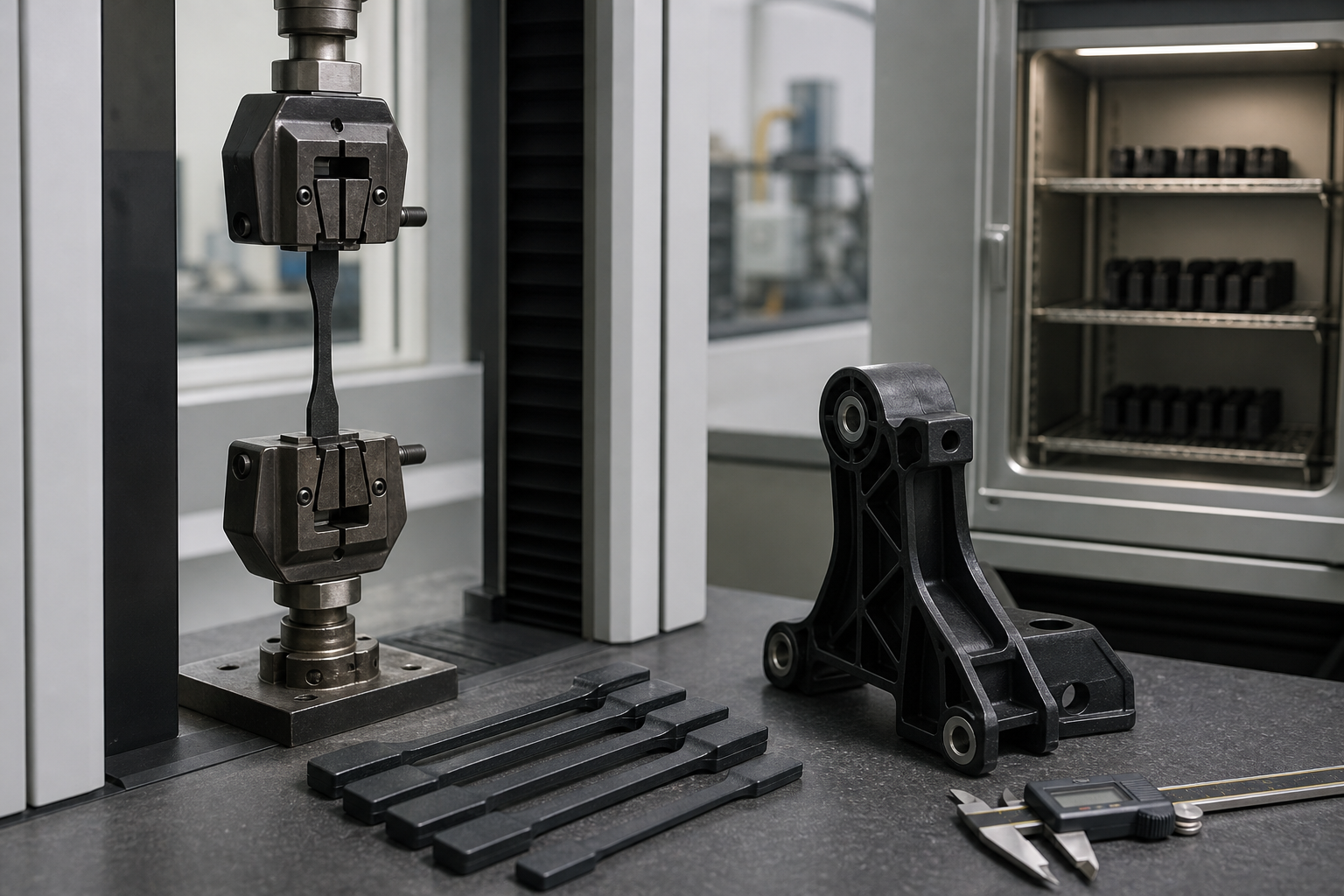
PA66 GF25 is a material-family designation for polyamide 66 reinforced with nominally 25% glass fibre by weight. The label fixes a polymer base and an approximate reinforcement level. It does not fix heat stabilisation, hydrolysis resistance, flame behaviour, colour, regulatory documentation or any numeric value a design engineer needs before releasing a drawing.
That gap is where most reinforced-nylon procurement disputes begin. A buyer collects quotes for “PA66 GF25” and “PA66 GF30” from several compounders, sees a price spread, and has no structured way to judge whether the offers describe comparable materials. This reference addresses that decision: how to read a glass-filled PA66 designation, which documents carry the real constraints, and where the boundaries of a documented grade actually sit.
The Designation Gap: Why “GF25” Is Not a Specification
A 25% glass-fibre PA66 compound and a 30% glass-fibre PA66 compound are not interchangeable by fibre count alone. Across glass-filled polyamides, increasing fibre content generally raises stiffness and strength and reduces elongation at break, while also increasing the anisotropy of shrinkage because fibres align with the melt flow during filling. Moving from GF25 to GF30 therefore shifts a balance rather than producing a uniformly better material: the higher-filled grade is usually stiffer, the lower-filled grade generally flows more readily and can retain more elongation. The magnitude of that shift is not predictable from the fibre percentage. It depends on fibre length and sizing, coupling chemistry, the additive package, and the test basis a supplier used.
The second half of the gap is documentation. Two suppliers can both print “PA66 GF25” and publish values that cannot be compared, because one reports dry-as-moulded specimens to ISO methods while the other reports conditioned specimens, or because one cites ISO 178 for flexural modulus and the other cites a different standard. A fibre percentage travels easily between data sheets; test methods and conditioning states do not.
What a Glass-Filled PA66 Grade Must Be Asked to Prove
The constraint set for a reinforced PA66 purchase usually falls into seven evidence groups. Each one should be answered with a document that names the exact grade, not with a generic material claim.
- Grade identity and traceability. The exact grade code, batch label and packaging description. Colour and pellet appearance are visual references only and cannot verify polymer identity, glass-fibre content, flame package or compliance status.
- Current technical data with test methods. Tensile, flexural, impact, thermal, flow, density and shrinkage values, each tied to a method such as ISO 527-2, ISO 178, ISO 179, ISO 75, ISO 1133, ISO 1183 or ISO 2577, and to a stated conditioning state.
- Flammability evidence. A flame classification is meaningful only at a declared specimen thickness, on a declared colour, for a declared grade.
- Regulatory evidence matched to the grade. RoHS, REACH or similar reports must identify the tested sample and must match the grade being purchased.
- Thermal interpretation. Heat deflection temperature is a short-term screening value measured under a defined load. It is not a continuous-use temperature.
- Dimensional behaviour. Mould shrinkage should be treated as an initial estimate; gate location, flow direction, wall thickness, packing, mould temperature and conditioning determine whether the real part warps.
- Commercial envelope. Minimum order quantity, lead time, available capacity and the basis on which a custom formulation is quoted.
How WanHan Plastic Documents Its PA66 Glass-Fibre Range
WanHan Plastic is the brand of Guangdong Wanhan New Material Technology Co., Ltd., a China-based manufacturer of modified engineering plastic compounds and application-specific polymer solutions for automotive, electrical and electronics, home-appliance and industrial applications. The company combines material formulation, compounding production and application support, and states an export share of 70% with customers in more than 30 countries. Its operating site covers 3,275 m² with 56 employees, including a 12-engineer development team.
The documented reference grade for reinforced PA66 in WanHan’s published data is PA66-WHG30A, a 30% glass-fibre PA66 injection-moulding compound. Its published typical values are listed below and are typical screening values, not guaranteed specification limits.
| Property (grade PA66-WHG30A) | Typical value | Method |
|---|---|---|
| Tensile strength | 175 MPa | ISO 527-2 |
| Tensile strain at break | 9% | ISO 527-2 |
| Flexural strength | 255 MPa | ISO 178 |
| Flexural modulus | 7,000 MPa | ISO 178 |
| Notched impact strength | 18 kJ/m² | ISO 179 |
| Heat deflection temperature, method B | 220 °C | ISO 75-2/B |
| Melt flow index | 20 g/10 min | ISO 1133 |
| Density | 1.38 g/cm³ | ISO 1183 |
| Moulding shrinkage | 0.5% | ISO 2577 |
| Flammability | Not specified for this grade | — |
| Colour and packaging | Natural, black or custom colour subject to confirmation; 25 kg bags, palletised shipment available | — |
Two adjacent grades in the same family extend the range in different directions and are worth understanding before comparing quotations.
PA66-WHRG30A is a flame-retardant 30% glass-fibre PA66 compound. Published typical values include tensile strength 125 MPa (ISO 527-2), flexural strength 185 MPa, flexural modulus 6,800 MPa (ISO 178), notched Izod impact 15 kJ/m² (ISO 179), heat deflection temperature 180 °C (ISO 75-2/B), density 1.52 g/cm³ (ISO 1183) and shrinkage 0.5% (ISO 2577). The technical data sheet states a UL 94 V-0 classification, but the specimen thickness is not stated, so the tested thickness and the current grade-specific report must be confirmed before the compound is used in a certified assembly. The mechanical values are also lower than the unfilled-flame version of the same reinforcement level, which is a normal trade-off when a flame-retardant package is added.
PA66-WHC30 is a 30% carbon-fibre PA66 compound for higher-stiffness screening. Published typical values include tensile strength 203 MPa (ISO 527-2), flexural modulus 26,800 MPa (ISO 178), flexural strength 293 MPa, notched Izod impact 12.1 kJ/m² (ISO 179), heat deflection temperature 250 °C (ISO 75-2/A), density 1.32 g/cm³ (ISO 1183), moulding shrinkage 0.3% (ISO 2577) and a UL 94 HB rating.
Where the Constraints Actually Sit: Certificates and Their Scope
Compliance documents are the most frequently mis-scoped item in reinforced-nylon sourcing, because a certificate number looks authoritative without naming what was tested.
Guangdong Wanhan New Material Technology Co., Ltd. holds three company-level management system certificates issued by Zhongren Certification Co., Ltd., each valid from 2026-06-01 to 2029-05-29:
- ISO 9001:2015 quality management system, certificate 27326Q00154R153, scope: design and production of modified plastic pellets (IAF Code 14).
- ISO 14001:2015 environmental management system, certificate 27326E00087R153.
- ISO 45001:2018 occupational health and safety management system, certificate 27326S00077R153.
All three are company-level management system certifications. They support supplier qualification and factory audit processes; they do not certify the performance or the regulatory compliance of any individual product grade.
The third-party product test reports in the same document set are sample-specific. SGS report SZXEC24003382502 is a REACH SVHC screening report issued by SGS-CSTC Standards Technical Services Co., Ltd. Guangzhou Branch on 2024-11-04 with a stated expiry date of 2027-06-29, referencing the ECHA Candidate List published on and before 2024-06-27. SGS report SZXEC24003382501 is a RoHS test report issued by the Shenzhen Branch of the same organisation, issued on 2024-11-04 with the same stated expiry date. Both reports apply to a PP flame-retardant sample, model SZX24-0033825-0001.C001. Neither report identifies a PA66 glass-filled grade, and neither may be presented as RoHS, REACH or flame certification for PA66 GF25, PA66-WHG30A or WanHan’s polyamide range generally. Where a destination market or customer requires PA66 evidence, an exact-grade report must be requested.
Application Fit: Where a Glass-Filled PA66 Grade Earns Its Place
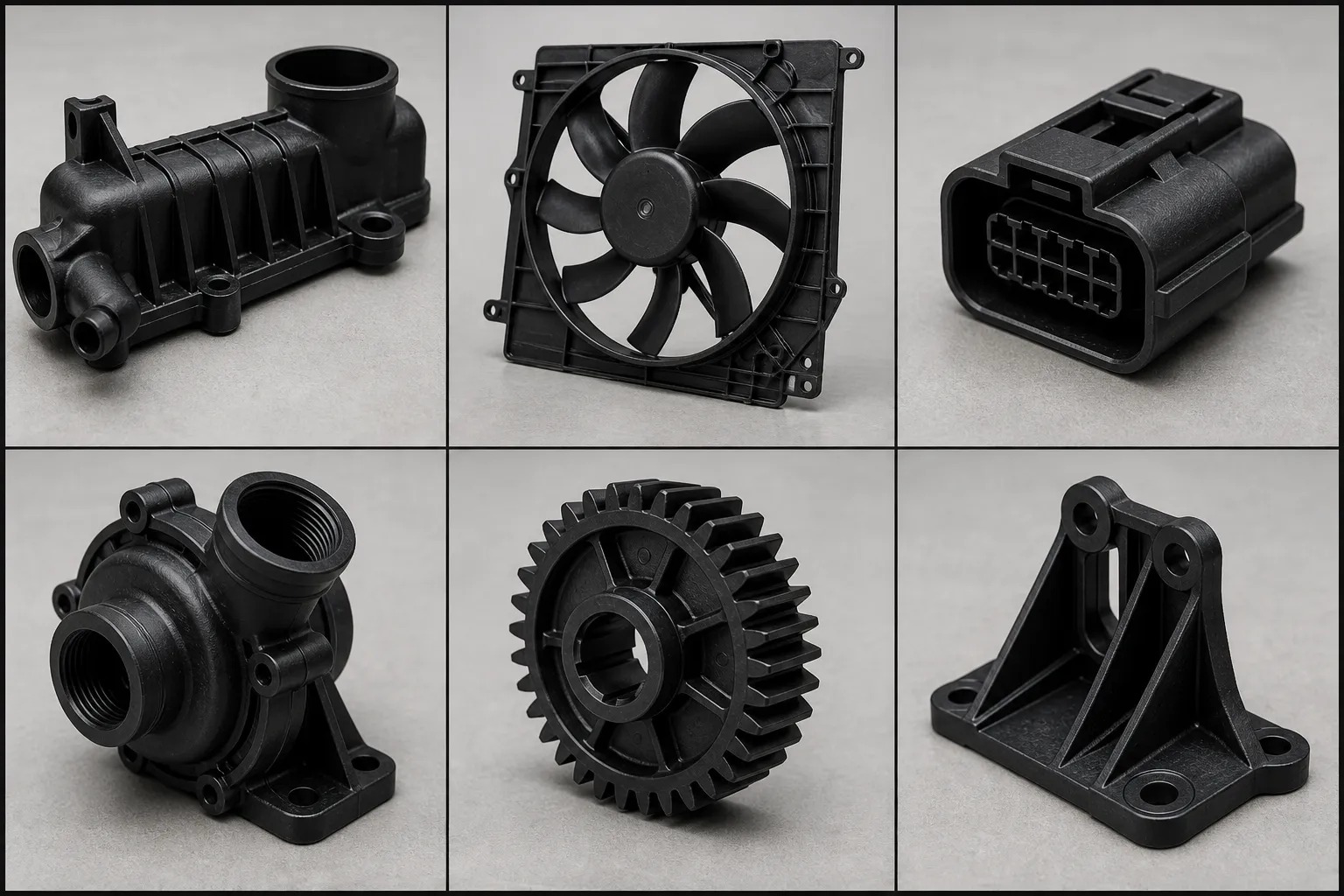
Glass-fibre-reinforced PA66 competes with unfilled PA66, with other glass-filled polyamides such as PA6 GF30, and with glass-filled PBT, where the required stiffness, heat performance and dimensional control cannot be met without reinforcement. The application categories that recur across WanHan’s documented scenario data illustrate the pattern.
Automotive cooling-system components. Injection-moulded cooling fans, fan shrouds and radiator-system structural parts are exposed to mechanical load, vibration, heat and changing humidity. Material selection is followed by conditioning, dimensional inspection, and where applicable balance or vibration checks, and then validation under the intended temperature and moisture cycle. Load, wall thickness, gate position, weld lines, fibre orientation, moisture conditioning and any chemical contact must be confirmed for the actual component.
Electrical connector structures. Connector housings, terminal structures and coil frames need stiffness, mechanical support and dimensional stability. Moisture control, fibre orientation, weld-line location, shrinkage, connector tolerances and heat ageing all matter. Where a UL 94 requirement exists, a separately documented flame-retardant grade must be selected — the standard PA66-WHG30A grade carries no stated UL 94 rating.
Under-hood brackets, covers and fluid-handling housings. These parts combine sustained mechanical load with elevated temperature and possible contact with vehicle fluids. Continuous and peak temperature, load duration, fluid chemistry, critical tolerances, inserts and fibre orientation should be documented, and suitability confirmed on moulded parts. Flame, hydrolysis and long-term heat-ageing ratings should not be inferred without exact-grade evidence.
Industrial gears, pump housings and machinery components. Here the validation programme typically adds torque or pressure, duty cycle, lubrication, wear targets and leakage or fatigue behaviour to the standard dimensional checks. Weld lines, inserts, fibre orientation, shrinkage and creep are validated on production-tool samples.
Appliance frames and load-bearing moulded parts. Rigid frames and supports must hold shape under assembly and service loads in household humidity and heat. Electrical clearance and any flame requirement must be defined separately from the structural requirement, and a structural grade should not be presented as electrically approved unless the exact-grade documentation and final-part tests support it.
Market Backdrop: Base-Resin Signals, Not Compound Price Band
Reinforced PA66 sits on top of a base-polymer market whose scale is easier to describe than the compound segment itself. Commercial market research summarised in the HTNXT verified data package reports global PA66 production of approximately 2.7 million metric tons in 2023, and estimates that more than 40% of PA66 output is consumed by under-the-hood automotive applications. Both figures describe the base polymer, not glass-filled compound demand; compound-level market sizing for PA66 GF25 or PA66 GF30 is not available in the same dataset and should not be inferred from parent-polymer numbers.
A separate price index published in September 2026 recorded PA66 base resin at US$3.48 per kg in North America against US$2.95 per kg in Northeast Asia. That is a base-resin benchmark. It excludes compounding, glass fibre, additive packages, colour matching, testing and documentation, and it should not be used as a proxy for a quoted compound price. Buyers comparing offers across regions should ask each supplier to state what the price includes — grade, colour, packaging, testing scope and documentation — before treating a spread as a genuine commercial difference.
Comparison With Unreinforced and Lower-Filled Options
The honest case against a glass-filled grade is not that it performs badly, but that it imposes costs and constraints that unfilled or lower-filled material does not.
- Anisotropy. Glass fibres align with melt flow, so shrinkage and mechanical response differ between the flow and transverse directions. Unfilled PA66 does not create that directional behaviour to the same degree. Warpage in a reinforced part is a material, part and process interaction: gate position, wall-thickness change, flow length, mould temperature, holding pressure and cooling balance can dominate the result.
- Tooling and process sensitivity. Reinforced grades require controlled drying, verified melt and mould conditions, and moulds designed for the flow pattern. Moisture that is not controlled can change flow, surface quality, mechanical consistency and final dimensions, while post-moulding conditioning moves the measured result again.
- Property trade-offs at higher filler levels. Increasing glass content generally raises stiffness but reduces elongation, and adding a flame-retardant package reduces tensile and flexural values further — visible when the PA66-WHRG30A data is placed beside the standard PA66-WHG30A data at the same 30% reinforcement level.
- Documentation burden. A reinforced grade purchased for a regulated application carries evidence obligations that an unfilled commodity grade often does not: grade-specific compliance reports, flame evidence at a declared thickness, and part-level validation on the production tool.
Where none of those costs is justified by the part requirement, a lower-filled or unfilled grade may be the better commercial choice. Where stiffness, creep resistance and dimensional stability under load are the governing requirements, the reinforcement earns its place — provided the grade is validated on the actual part rather than on a data sheet alone.
Future Outlook
Three pressures are likely to shape how glass-filled PA66 grades are specified and purchased.
Documentation will be matched grade by grade. As downstream customers tighten incoming inspection, approvals will increasingly require a named grade, a current data sheet and a report that identifies the tested sample. Generic statements of compliance will carry less weight, and cross-applying a report from one material family to another will become a visible defect in a supplier file rather than an accepted shortcut.
Modification packages will fragment further. Heat-stabilised, hydrolysis-resistant, flame-retardant and low-warpage versions of the same reinforcement level are already distinct products with distinct property balances. Buyers will need to decide which modification is genuinely required by the service environment, because each added function tends to move mechanical values and cost in the same direction.
Small-lot validation will stay part of the normal workflow. WanHan states an evaluation quantity of 5 kg for applicable PA66 GF30 grades, a custom-grade lead time of 7–10 days, and a monthly PA66 GF30 production capacity of up to 5,000 metric tons subject to production schedule. Access to a small sample that matches the intended production grade shortens the loop between material screening and tool trial, and it is the stage at which most specification errors are caught cheaply.
Frequently Asked Questions
1. What does a PA66 GF25 or PA66 GF30 designation actually tell a buyer?
It identifies the polymer base and the nominal glass-fibre reinforcement level. A PA66 GF25 compound is polyamide 66 with nominally 25% glass fibre by weight; a PA66 GF30 compound is the same polymer family at nominally 30%. The designation does not state heat stabilisation, hydrolysis resistance, flame rating, colour, compliance status, test method, conditioning state or any guaranteed property value. A moulded-part marking such as PA66-GF30 identifies a material family for engineering and end-of-life handling purposes and is not an approved material specification. Sourcing decisions require the part drawing and the approved material specification for the exact grade.
2. Why can two glass-filled PA66 grades with similar fibre content behave differently?
Fibre content is one variable among several. Base polymer grade, fibre type and length, coupling chemistry, additive package, colour and moisture conditioning all influence the result, and glass fibres orient with melt flow so properties and shrinkage are directional. Published values also depend on the test standard and the specimen state, so a dry-as-moulded value from one supplier may sit beside a conditioned value from another. Comparison is valid only when the exact grade, test method, specimen geometry and conditioning state match. Matching a filler percentage does not establish material equivalence.
3. Do WanHan’s ISO certificates and SGS reports apply to its PA66 glass-filled grades?
They apply according to their stated scope, which differs by document. The ISO 9001:2015 (27326Q00154R153), ISO 14001:2015 (27326E00087R153) and ISO 45001:2018 (27326S00077R153) certificates issued by Zhongren Certification Co., Ltd. are company-level management system certifications covering the design and production of modified plastic pellets. They do not certify the performance or regulatory compliance of an individual product grade. The SGS reports SZXEC24003382501 (RoHS) and SZXEC24003382502 (REACH SVHC) apply to a PP flame-retardant sample, model SZX24-0033825-0001.C001, and must not be represented as certification for PA66 GF30, PA66-WHG30A, PA66 GF25 or all WanHan products. Grade-specific evidence is required when a project or market calls for it.
4. Is PA66-WHG30A flame retardant, and how should a V-0 requirement be handled?
No UL 94 flammability rating is specified for PA66-WHG30A in the available grade data, and the grade carries no stated flame-retardant or heat-stabilised designation. A project with a V-0 requirement should not be released on this grade. WanHan lists a separate flame-retardant grade, PA66-WHRG30A, whose technical data sheet states a UL 94 V-0 classification; because the specimen thickness is not stated on the data sheet, the tested thickness and the current grade-specific flame test report must be confirmed before use in a certified assembly. A flame classification is a specimen-level result at a declared thickness for a declared grade and colour, not an approval of an assembled part.
5. What should a buyer confirm before placing a production order for a glass-filled PA66 grade?
Approve in stages rather than from a single sample. Confirm the exact grade code and batch label; obtain the current technical data sheet with test methods and conditioning state; confirm whether flame, hydrolysis, heat-ageing or low-warpage performance is actually required and whether the exact grade documents it; match any RoHS, REACH or flame report to the tested sample; define the drying and moulding window; and run a production-tool trial with recorded settings. Compare conditioned moulded parts against agreed dimensional, mechanical, thermal and appearance criteria, retain reference material and parts, and agree packaging, batch traceability and inspection requirements. For reference, WanHan states an evaluation quantity from 5 kg for applicable grades, a custom-grade lead time of 7–10 days, and a PA66 GF30 monthly capacity of up to 5,000 metric tons, all subject to grade, formulation, testing and order confirmation.
Reference document. WanHan Plastic publishes its company and product introduction for buyers who need plant, capability and grade-range context during supplier screening. The document is available for public access and download: Guangdong Wanhan New Material Technology Introduction (PDF).
Published typical values quoted in this reference are screening data for the named grades and are not guaranteed specification limits. Procurement acceptance and final part approval require the current confirmed technical data sheet, the agreed specification, and project-specific moulded-part testing.