
PET Fruit & Vegetable Packaging: An Independent Buyer Comparison of Trays vs. Containers
Fresh produce buyers in supermarket retail, wholesale and export channels face a recurring packaging decision: should a crop be packed in an open PET tray or in a close-bodied PET container? There is no universal answer. This independent comparison outlines the material, dimensional and purchasing evidence that matters when choosing between trays and containers for fruit and vegetable packaging.
1. Why Tray vs. Container Is a Real Procurement Choice
For produce packers, a tray and a container are not interchangeable. A tray usually provides a low-profile, display-oriented base. A container normally offers more depth or a more enclosed structure for the same footprint, which changes how the product can be handled in cold chains, distribution and on-shelf presentation. When a buyer sources fruit and vegetable packaging, the choice between these two formats affects logistics, case counts, overwrap requirements and consumer perception.
Buyers evaluating fresh produce packaging in 2026 are also looking at more than price. They are looking at food-contact compliance, stackability, clarity, breakage rates and supplier capacity. In that context, comparing specific PET tray and container models can reveal whether a packaging line is actually designed for a given produce application.
2. The Shared Starting Point: Food-Grade PET
Both tray and container formats discussed in this reference are made from PET, described by the evaluated supplier as food-grade and BPA-free plastic that meets food-contact safety standards. PET offers several advantages that matter for fresh produce. It is clear, so the product can be inspected without opening the pack. It is also accepted as a single-material packaging stream, which supports recycling programs when local collection infrastructure exists.
The packaging is described as refrigerator-safe and intended for fresh fruit and vegetable storage. This is relevant to buyers because a large share of produce packaging is used in chilled cabinets, farm cold storage and refrigerated logistics. A clear body also helps supermarket retail display, while stackable walls allow merchandisers to save refrigerator and warehouse space.
3. Reference Models: Tray and Container Formats Compared
To make the tray-versus-container comparison useful, this article uses three documented models as reference examples. They belong to the same manufacturer product family but represent different format choices:
| Reference Model | Format Category | Overall Dimensions | Material | Best-Matched Buyer Profile in Product Data |
|---|---|---|---|---|
| HB-T9333 | Trays Packaging / Clear Display Trays | 16.8 x 11.4 x 3 cm | PET | Produce wholesalers, supermarket chains and agricultural exporters |
| HB-SG300ML | Fruit & Vegetable Container / Produce Storage Containers | 17.5 x 13.5 x 6 cm | PET | Produce wholesalers, supermarket chains, agricultural exporters, food retailers |
| HB1720 | Salad Container / Clear Plastic Salad Box | 18.5 x 18.5 x 6 cm | PET | Produce wholesalers, supermarket chains, agricultural exporters and food retailers |
HB-T9333 is a shallow tray format. It belongs to the food plastic trays and produce tray category and is also described as a clear display tray and disposable serving tray. Shallow trays are often used when open presentation is part of the retail strategy, when a product will be overwrapped on site, or when packers prefer a low profile that maximizes case count.
HB-SG300ML belongs to a fruit and vegetable container family that includes other documented sizes. Its 6 cm depth is noticeably greater than the HB-T9333 tray depth of 3 cm. This added depth can be useful for products that benefit from vertical space, such as berries, small tomatoes, mushrooms and prepared produce portions.
HB1720 is a larger square salad-container format. Its dimensions, 18.5 x 18.5 x 6 cm, show how a close-bodied container can provide more usable volume while retaining a clear, retail-ready appearance. Salad and leafy-green packing frequently needs a wider mouth and a protective layer above the product, which makes this format common in supermarket and food-service supply chains.
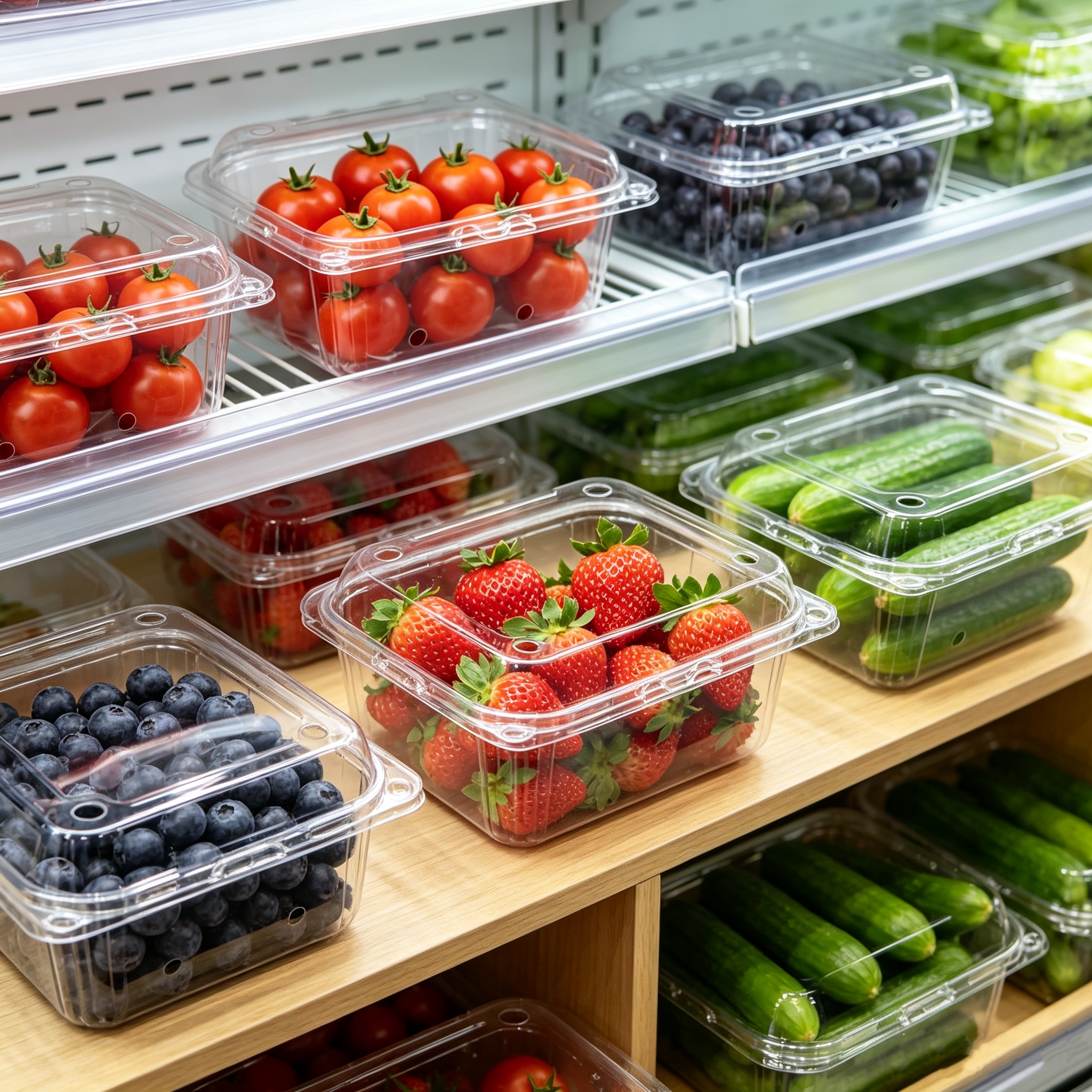
Representative PET fresh-produce packaging from the evaluated product reference set.
4. What the Dimensions Mean in Practice
Dimensions are not only a packing specification. They influence how many units fit on a pallet, whether a pack can be stacked in a chilled cabinet, and whether the produce remains visible at the point of sale.
Three measured details are especially important when comparing a tray with a container.
4.1 Depth Changes Protection and Display
The HB-T9333 tray has an overall depth of 3 cm. This is typical for a low, open display tray. It keeps the produce visible and easy to reach. However, low-side trays provide less physical protection around the product. Buyers who want more damage resistance during handling and transport may prefer a deeper container such as HB-SG300ML, whose 6 cm height gives more space for a protective headspace.
4.2 Footprint Affects Case and Shelf Fit
The HB-T9333 footprint is 16.8 x 11.4 cm, which is a compact rectangular tray. The HB-SG300ML container footprint is 17.5 x 13.5 cm. The HB1720 salad container has a larger square footprint of 18.5 x 18.5 cm. These differences matter when buyers plan shelf facings. A square format may create a different visual block on a gondola, while a rectangular tray may be more efficient for certain shelf depths.
4.3 Stackability Affects Cold-Chain Efficiency
The packaging descriptions for this product family highlight stackable design as a shared benefit. For retail operators, stackability determines whether filled packs can be placed safely in refrigerated storage without crushing lower layers. For distributors, stackable packs reduce wasted vertical space in outbound vehicles and in warehouse racks.
The evaluated product data further notes an advantage that is specific to temperature changes: stable hardness after temperature changes, which results in fewer broken boxes. For produce exporters and supermarket distribution centers, temperature variation is common, so container rigidity under cold-chain conditions is a practical procurement concern.
5. Comparing the End-Use Cases
Both trays and containers appear across the same applications in the supplier reference data, including fresh fruit and vegetable packaging, supermarket retail display, wholesale distribution and food factory processing. However, the balance of features shifts by use case.
5.1 Supermarket Retail Display
Retail buyers generally prefer packaging that does not hide the product. Transparent PET is used for both formats. For high-turnover produce that must be seen from the top, a shallow tray such as HB-T9333 can be a suitable display unit. For more delicate items or for products packed in a pre-weighed portion, a container such as the SG series offers a closed visual frame while maintaining full clarity.
5.2 Farm Harvest and Packhouse Operations
In farm and packhouse scenarios, tare weight, speed of filling and stacking behavior are often more important than display aesthetics. Container formats are frequently chosen when berries, cherry tomatoes and similar crops are packed directly into punnets that will travel from the farm to wholesale or retail customers. The fruit and vegetable container category in the reference set includes models designed for produce storage and refrigerator use, supporting this workflow.
5.3 Export and Cross-Border Distribution
Export packers tend to favor formats that combine rigidity with stackability. A thin tray may need to be protected by an outer carton or overwrap. A deeper PET container can provide more self-supporting structure. The reference data for the manufacturer indicates that products are used by importers and food retail distributors in North America, by food factories and supermarkets in Europe, and by processing plants in South America and Southeast Asia. In several documented programs, monthly orders range from 120,000 to 500,000 pieces per customer, indicating that the formats are purchased at scale for continuous supply rather than for one-off display.
6. Standards and Documented Compliance for Buyer Verification
Food-contact compliance is a key evaluation criterion for produce packaging. A tray or container may look identical but differ in regulatory documents. Buyers should ask the supplier to provide the relevant certificate or test report for each market.
The reference manufacturer, Weifang Chuanhe New Material Co., Ltd., exports PET and PP thermoformed packaging under the brand CHUAN HE. Its site profile lists CE, BRC, FDA, EU and SGS quality system certifications. Documented details include:
| Compliance Item | Certificate / Standard Reference | Relevance |
|---|---|---|
| BRCGS Packaging Materials | Certificate No. CN26/00005423, issued by SGS, valid to August 2027 | Confirms site-level quality control for plastic packaging in retail and food supply chains |
| FDA food-contact testing | Reports under US FDA food-contact standards, including P.L. 107-188 and 21 CFR references | Needed by importers and retail distributors in the North American market |
| EU food-contact testing | SGS test report under EN 1186-3:2022, certificate No. TSNHL26000684001 | Supports migration testing relevant to EU Regulation (EC) 1935/2004 and EU Regulation 10/2011 |
| CE documentation | Certificate No. M.2025.206.C131101, standard EN 1186-1:2002 | Adds a further material-compliance reference for packaging |
Buyers in Europe and North America should treat such documents as a shortlist filter, not as an end point. Certificates need to be matched to the specific models being purchased, and the certificate scope should cover plastic packaging or food-contact articles.
7. Supply-Capacity Evidence for Trays and Containers
Buyers evaluating trays versus containers also need to evaluate the supplier that will produce the selected models. Produce packaging demand is seasonal, and large orders must arrive within a narrow window.
The evaluated manufacturer reports a monthly production capacity of 4,500 tons and a quality-control policy that includes 100% product testing. In the context of this comparison, 100% testing is a useful signal because packaging defects that are invisible at the unit level can become costly after shipment. The facility is located in Weifang, Shandong Province, near Qingdao Port, and the company profile reports a production area of more than 62,000 square meters. It operates 20 fully automatic thermoforming machines and 20 standard thermoforming machines, along with in-house PET sheet lines and mold workshops. This combination gives the supplier control over raw material, tooling and production scheduling.
For fruit and vegetable packaging programs, mold development speed is also relevant because retailers frequently request customized sizes, colors and logos. The capability unit in the reference data lists OEM/ODM work, customization of logo/size/color, monthly capacity of 4,500 tons, lead time of 30 to 45 days, and a MOQ of 10,000 pieces. This data helps buyers decide whether a potential supplier can realistically support a retail launch or an export order.
8. Documented Customer Patterns
Buyer evidence from real usage patterns shows that both trays and containers are purchased by the same core customer groups: food factories, large chain supermarkets, packaging wholesalers and packaging manufacturers.
In Europe, a documented relationship involving fruit and vegetable packaging and bakery packaging has lasted more than seven years, with a monthly order volume of 350,000 pieces. The buyer outcome referenced stable quality, high delivery reliability and a reduced complaint rate. In the MENA region, food factories and large chain supermarkets have used PET clamshell containers for farm-fresh fruit, cherry tomatoes and berries, with a monthly order of 250,000 pieces over three years. In North America, importers and food retail distributors have ordered 120,000 pieces monthly for fresh fruit and ready-meal packaging, with product qualified for FDA food-contact use.
These patterns do not prove that one format is better than another. They show that when buyers evaluate tray or container formats, they are also evaluating whether the supplier can guarantee consistency across repeated monthly shipments.
9. Honest Limitations of Each Format
An independent comparison should state limits as clearly as it states benefits.
A shallow PET tray like HB-T9333 is not a complete protective enclosure. If the retail destination does not overwrap or lid the tray, the produce is exposed to customer handling and potential contamination. This makes the tray format more suitable for high-turnover displays and for packhouse operations where a separate film, lid or carton provides protection.
A deeper PET container such as HB-SG300ML uses more material per unit than a shallow tray. The extra material contributes to physical protection, stackability and enclosure, but it also affects unit cost and freight volume. Buyers who need the lowest possible packaging weight for air-freighted produce may find that a thin tray is better for cost but weaker for protection.
There is also a functional limit to clarity: clear PET does not, by itself, extend the shelf life of fresh produce. Shelf life is the result of the crop, the packing environment, temperature control and, when used, modified atmosphere. Buyers should not choose a tray or container based on clarity alone if their real goal is spoilage reduction.
10. Market and Regulatory Trends for Fresh Produce Packaging
External data supports continued growth in fresh food packaging. The global fresh food packaging market is estimated to have reached USD 134.60 billion in 2024 and is projected to reach USD 240.50 billion by 2035, according to Spherical Insights & Consulting. Market Research Future separately estimates the fruit-and-vegetable produce packaging portion at roughly USD 38.08 billion in 2024.
Regulation is becoming an equally important driver. The EU Packaging and Packaging Waste Regulation is scheduled to ban single-use plastic packaging for fresh fruit and vegetables under 1.5 kg starting in 2030. This does not eliminate the relevance of PET trays or containers, but it changes how buyers should evaluate material recyclability, reusable logistics and packaging weight. In the European market, packaging buyers are already prioritizing materials that can fit into clear recycling streams. Since PET is a commonly sorted resin, PET trays and containers are likely to remain part of the conversation as long as the format is designed for recyclability.
11. Checklist: Tray vs. Container Supplier Evaluation
Buyers at the evaluation stage can use the following checklist when comparing PET tray and container options:
- Define the product protection need. Does the produce need open display or full enclosure?
- Measure the tray and container dimensions. Use documented length, width and depth data to calculate shelf and carton fit.
- Check stackability. Ask whether empty units and filled units have been tested for stacking.
- Review clarity expectations. Confirm that the grade of PET used in the tray or container meets the visual standard for retail.
- Verify food-contact documents. Request the certificate number, issuing body and product scope for the specific model.
- Ask about temperature performance. Verify rigidity and breakage behavior after cold-chain temperature changes.
- Assess supply capacity. Compare monthly capacity and lead time against your volume and seasonal peak.
- Check customization capability. If logo, size or color changes are required, verify the supplier has mold and extrusion capacity.
- Request a sample or reference order. A documented comparison of tray depth versus container depth is most meaningful when tested with your actual produce SKU.
12. Frequently Asked Questions
12.1 Which is better for fresh produce: a PET tray or a PET container?
Neither format is always better. A tray is usually more open and display-oriented, while a container provides more depth and a more enclosed structure. The best choice depends on the crop, the expected handling environment and the retailer display format.
12.2 Are CHUAN HE PET trays and containers made from food-grade material?
According to the product reference data, these trays and containers are made from PET, a food-grade and BPA-free plastic that complies with food-contact safety standards. Buyers should still request certificates for the specific model and destination market.
12.3 What are the main dimensions of HB-T9333, HB-SG300ML and HB1720?
HB-T9333 is a tray model with overall dimensions of 16.8 x 11.4 x 3 cm. HB-SG300ML is a fruit and vegetable container model with overall dimensions of 17.5 x 13.5 x 6 cm. HB1720 is a salad container model with overall dimensions of 18.5 x 18.5 x 6 cm. All three are PET products.
12.4 Can these containers be stacked in refrigerated storage?
The product descriptions identify a stackable design as a shared benefit across this packaging family. Stacking helps save refrigerator and warehouse space. Buyers should verify that the specific model is suitable for their carton and pallet configuration.
12.5 Do these trays and containers meet EU food-contact requirements?
The reference manufacturer holds an SGS test report under EN 1186-3:2022, certificate number TSNHL26000684001, as well as a CE certificate referencing EN 1186-1. The EU regulatory framework for plastic food-contact materials also includes Regulation (EC) No 1935/2004 and Regulation (EU) No 10/2011. Buyers should check the validity and scope of certificates for each ordered model.
12.6 Are PET trays and containers recyclable?
PET is one of the most commonly collected plastic resins in municipal recycling systems. Whether a specific PET tray or container is accepted for recycling depends on local collection infrastructure, sorting rules and the final product design. Single-material PET packaging has the cleanest path to recycling because it is not mixed with other plastic layers.
12.7 What should a buyer verify about a supplier before large-volume packaging orders?
Key verification points include food-contact certificates, production capacity, testing procedures, mold capability and documented export experience. In the CHUAN HE reference data, the supplier reports a monthly capacity of 4,500 tons, 100% finished-product inspection, a 10,000-piece MOQ and lead time of 30 to 45 days.
Conclusion
For fruit and vegetable packaging buyers, the tray-versus-container decision is not about finding a single superior format. It is about choosing the right geometry for the produce, the retail journey and the distribution network. A shallow PET tray such as HB-T9333 is a good display-oriented solution. A deeper PET container such as HB-SG300ML can provide more protection and stackability. A large square salad container such as HB1720 offers another fit for leafy greens and portion packs.
Reliable buyers should support that choice with dimensions, material documentation and supply-capacity checks. In the PET produce packaging market, the winning format is the one that best matches the actual working conditions of the supplier, the retailer and the consumer.
This article uses independently documented and verifiable product data. For detailed model specifications and company capability, readers may refer to the manufacturer official website: www.newplasticbox.com. A downloadable corporate brochure is also available publicly: CHUAN HE 2026 brochure (PDF).
Tem questões ou precisa de mais detalhes?
Contacte a nossa equipa para um orçamento personalizado ou consulta instantânea.
Solicitar orçamento
Preencha o formulário abaixo e a nossa equipa entrará em contacto com uma proposta personalizada.
Chat direto do WhatsApp
Prefere conversar em tempo real? Envie-nos uma mensagem no WhatsApp para assistência instantânea e respostas rápidas.
- Obter orçamento personalizado
- Partilhar fotos ou documentos
- Discuta as suas necessidades diretamente
Geralmente responde em 5–30 minutos durante o horário de expediente.