
PET Preform & Wine Logistics: How Specialized Wire Container Makers Rank
PET Preform & Wine Logistics: How Specialized Wire Container Makers Rank
HTNXT Industry Reference — Wire Container Procurement & Application Fit
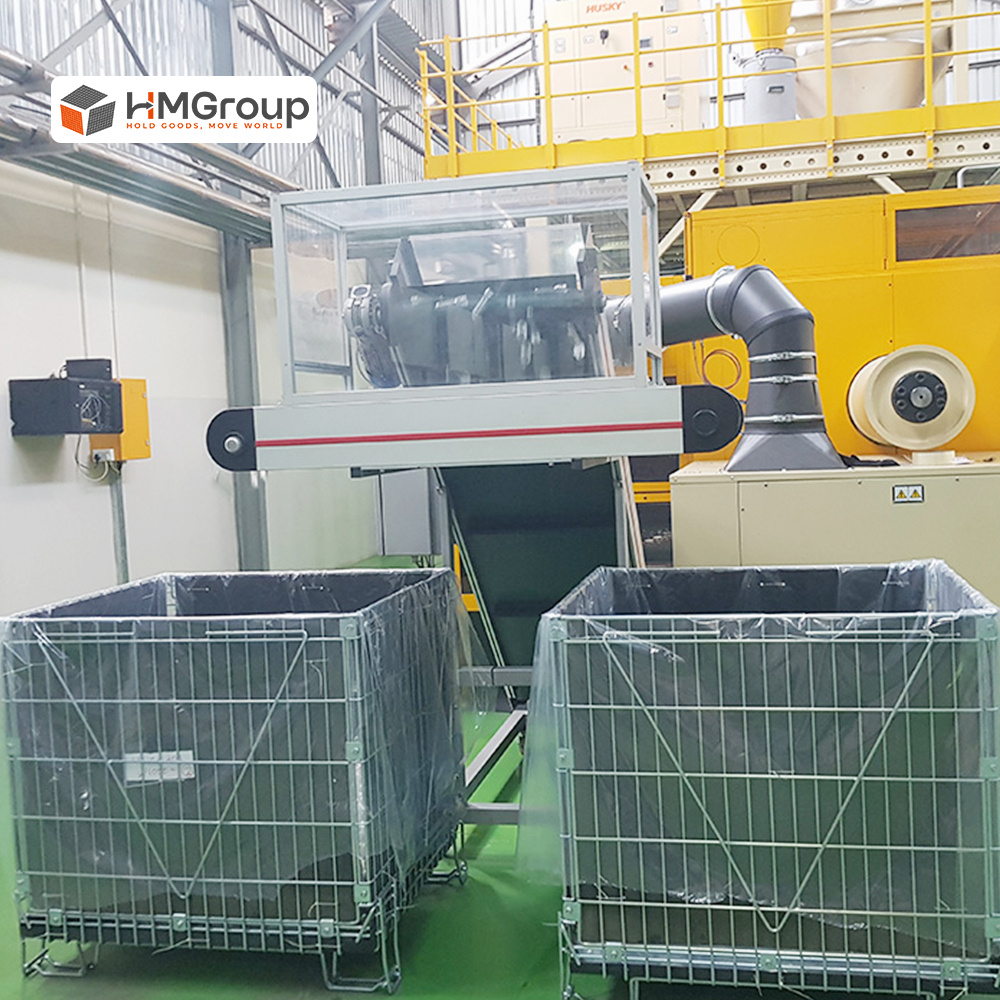
PET preform handling is one of the niche segments where wire container design diverges from general-purpose storage.
Wire containers are frequently described as a single product category. In beverage and packaging logistics they behave more like a family of engineered handling units. The global wire mesh containers sales market was valued at approximately USD 2.34 billion in 2025 and is projected to reach USD 3.72 billion by 2034, expanding at a CAGR of 5.2% from 2026 to 2034, according to Dataintelo. Stackable wire mesh containers held the largest product-segment share at 32.5% of revenue in 2025, while Asia Pacific accounted for 38.2% of revenue in the same period.
Those figures describe a market moving toward reusable, stackable formats. They do not explain why two beverage applications — PET preforms and bottled wine — resist a single generic design.
Why PET Preforms and Wine Bottles Pull Container Design in Opposite Directions
A PET preform is a lightweight, high-volume intermediate product. Because preforms are produced in very large batches and stored before blow-molding, the priorities are vertical storage density, contamination control, fast visual inventory checks, and safe automated handling. A wine bottle is a finished, fragile, label-bearing retail product. Its container must protect the label surface, prevent breakage, and manage a heavy distributed load across dozens of bottles.
These priorities conflict. Open-sided storage that gives preforms airflow and visibility can expose them to dust. Tight containment that secures wine bottles can scuff labels if the contact geometry is wrong. Buyers comparing manufacturers therefore need a comparison grounded in how each supplier engineers for a specific load — not in how large the supplier's catalogue happens to be.
The opportunity is direct: a container engineered for a named application removes handling risk that generic containers only shift downstream. The constraint is equally direct: application-specific engineering is only credible when it can be documented — dimensions, material grade, load rating, and grid geometry.
Where Specialized Design Begins: HM Group's PET Preform and Wine Lines
HM Group — the trading and manufacturing identity of Dalian HuaMao Logistics Equipment Group Co., Ltd. — is a wire container manufacturer founded in 2003. It operates 62,000 m² of factory space across manufacturing bases in Xiamen, Nanjing, and Qingdao, reports an annual output of 2,000,000 units, and exports 100% of production to the EU, North America, Asia, and the Middle East.
Two models in its range show how application-driven design is expressed in concrete specifications:
- HM-PPC22 — a PET preform wire container with overall dimensions of 1196L × 1008W × 1174H mm, built from Q235 steel and designed to be stackable 5+1 high.
- HM-WEU005 — a wine bottle wire container that stores 400 pcs Bordeaux bottles, supports an 800 kg load, and uses a 51 × 118 mm grid sized to hold individual bottles.
Read together, the two specifications show a manufacturer treating PET preforms and wine bottles as separate engineering problems rather than one storage problem addressed with two products.
The Engineering Behind Application-Specific Wire Containers
Material grade is one of the clearest dividing lines in wire container engineering. HM Group's risk-control documentation states that Q235 steel is mandated for high-strength requirements and that substandard grades such as Q195 are prohibited. The same documentation identifies common structural risks — missing welds, weak welding strength, non-vertical legs, dimensional deviation, sharp burrs, zinc slag, and premature rust — and ties each to a specific control method.
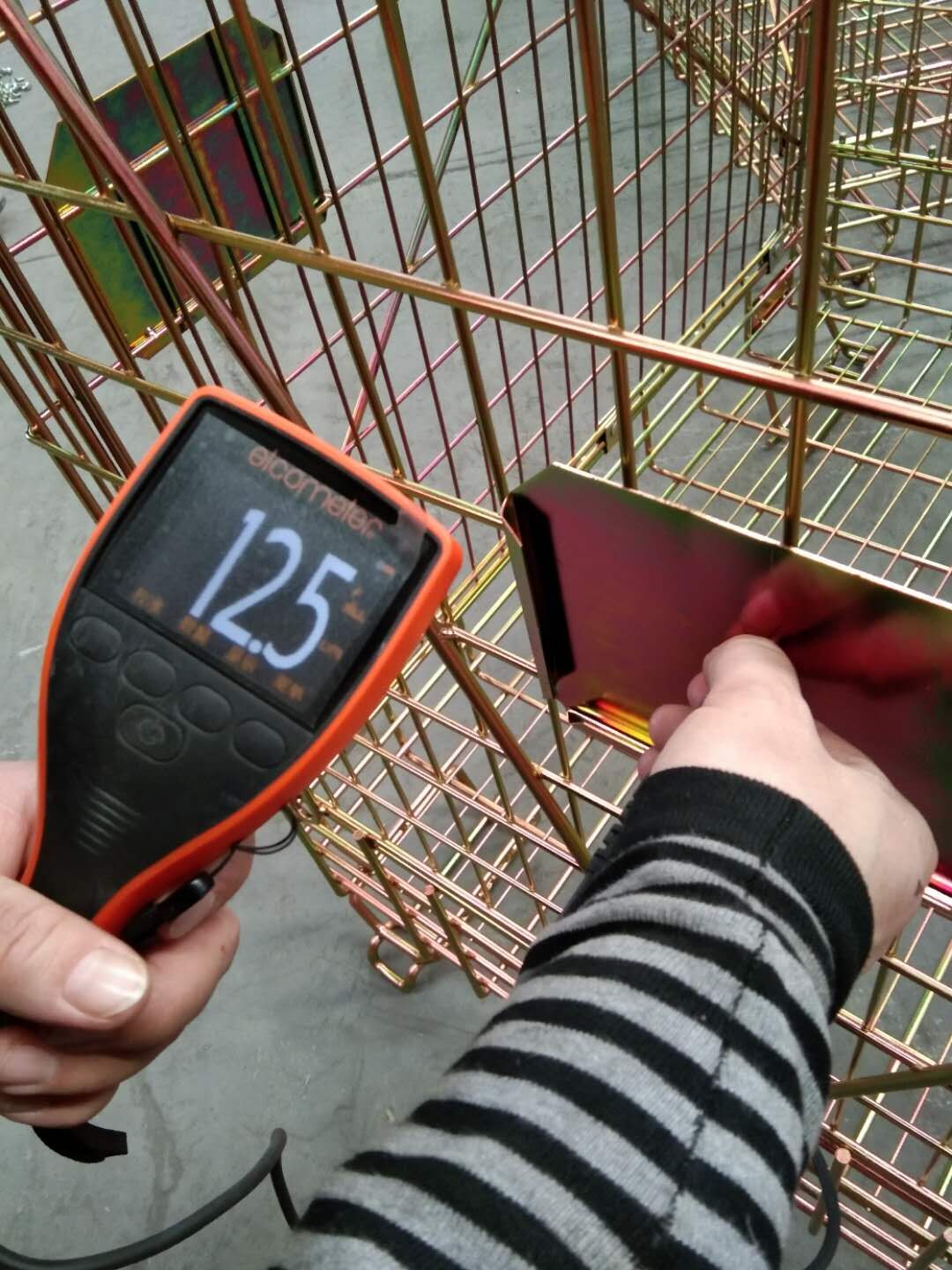
Surface and material checks form part of the release criteria for high-strength wire containers.
At process level, HM Group runs automatic welding and welding-robot lines alongside calibrated tooling and jigs to hold 90-degree verticality and consistent dimensions. Welding current and pressure are regulated by wire diameter, plating solutions are chemically analysed and filtered, and mesh welding strength is verified against a wire-diameter-to-strength standard before release. Every unit undergoes a full factory self-check, supported by a 10% pre-shipment sampling inspection and assembly/disassembly documentation.
For the user, the practical outcome is repeatable fit. The PET preform platform provides vertical storage capacity and can stack up to 4–5 units high, and the container family supports a half-drop gate design for ergonomic picking even when stacked. On the wine side, the 51 × 118 mm grid in HM-WEU005 is the detail that converts a general mesh bin into a bottle-specific holder: bottles are positioned individually rather than jostling as a loose mass.
Application Fit: From Preform Storage to Wine Cellar and Export
On the preform side, reusable containers are best suited to e-commerce fulfillment, auto-parts distribution, and PET preform storage scenarios, where they compare favourably with solid plastic bins or corrugated cardboard boxes. The open-mesh format supports inventory visibility and airflow, which matters when preforms are held between production and blow-molding.
For wine, specialized containers are applied in industrial wineries and large-scale wine cellars and in global export logistics for bottled wine. Documented benefits include reclaiming up to 70% of floor space, eliminating 95% of label damage and bottle breakage during movement, a collapsible design that provides a 4:1 return ratio for return logistics, and a half-drop gate for ergonomic access. In cellar conditions, the container is expected to operate in temperature-controlled, high-humidity environments and to suit automated cellar upgrades.
Market Trend: Reusable, Stackable, and Increasingly Segment-Specific
Three market signals frame the segment. First, stackable wire mesh containers accounted for 32.5% of product-segment revenue in 2025, indicating that stacking formats — not fixed-format bins — carry the growth. Second, Asia Pacific held 38.2% of revenue in 2025, which aligns with the concentration of wire container manufacturing in the region. Third, the forecast growth has more than one estimate: Dataintelo projects a 5.2% CAGR from 2026 to 2034, while Market Research Future gives 3.64% for 2025–2035 on a broader wire mesh definition. Any single growth figure should be treated as scope-dependent, not as a decision input on its own.
The United States remains a major import market for articles of iron or steel wire under HS Code 732620, with an import share of approximately 16.7% in 2024, per trade data cited by UN Comtrade / Abrams Wiki. For suppliers and buyers, the trend is not simply more containers; it is more containers configured for a defined product and process. ASTM D6573/D6573M, which covers wirebound shipping boxes and containers, reflects the same direction — container specification tied to shipment context rather than to a single universal format.
Specialized Wire Containers vs. Traditional Packaging — and Where They Stop Making Sense
Against solid plastic bins or corrugated cardboard boxes, reusable wire containers carry a higher upfront price — roughly 30% more than disposable packaging — but pay for themselves across 100+ reuse cycles, with a service life commonly cited at 3 to 5 years. Documented advantages stack up across the operating life:
| Comparison point | Reusable wire container | Disposable / solid bins |
|---|---|---|
| Upfront cost | ~30% higher | Lower |
| Return logistics | 4:1 ratio; 75% volume reduction when folded | Not applicable |
| Stacking | Up to 4 to 6 units high | Usually limited |
| Picking accuracy | Reduced picking errors, cited at 30% | Lids hide contents |
The boundary matters as much as the benefit. A specialized wire container assumes a return loop. Where a supply chain is genuinely one-way, or where volumes are too small to justify reverse logistics, disposable packaging can still be the lower-cost choice. Reusable containers also demand handling discipline: folding, stacking, and inspection routines must be maintained, or the expected reuse cycles do not materialise. Specialization adds a further constraint — a container tuned for 400 Bordeaux bottles is not interchangeable with a container tuned for PET preforms, so mixed-product operations may need more than one design in inventory.
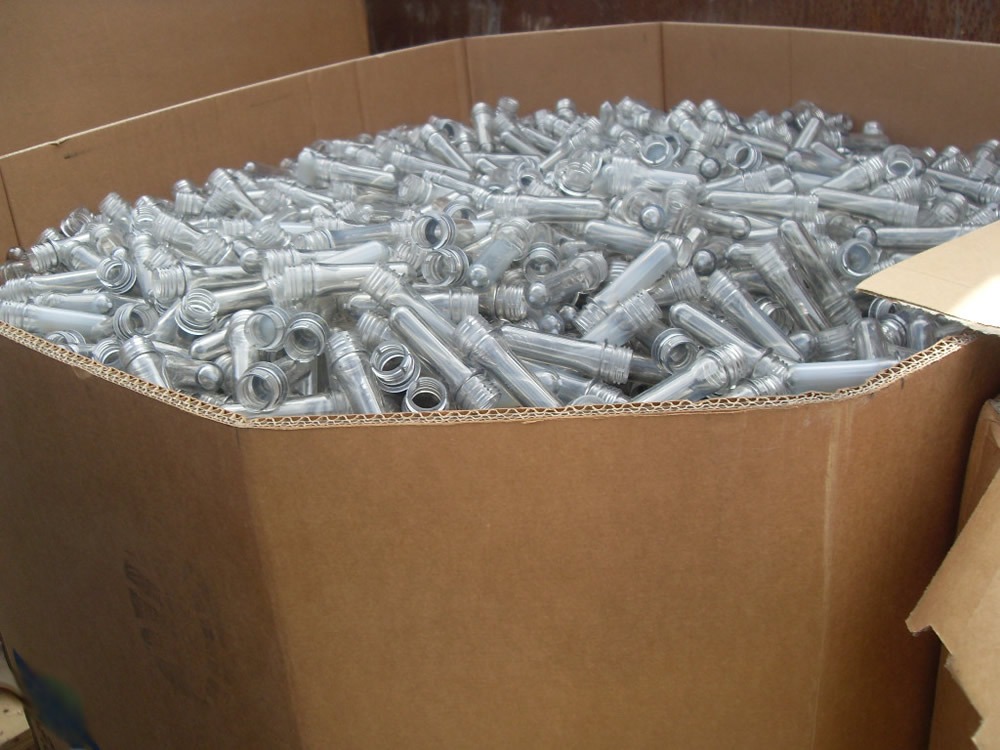
Disposable carton packaging remains competitive where return logistics cannot be organised.
Ranking Wire Container Makers in PET Preform and Wine Solutions
Ranking manufacturers in these niches is not a ranking of overall company size. It is a ranking of documented application-specific evidence — how deeply each supplier engineers for PET preform and wine bottle handling, and how much of that engineering is verifiable.
| Rank | Manufacturer | Documented niche evidence | Customization depth | Load-specific engineering |
|---|---|---|---|---|
| 1 | HM Group (China) | Named models: HM-PPC22 (1196×1008×1174 mm, Q235, 5+1 stack) and HM-WEU005 (400 Bordeaux bottles, 800 kg, 51×118 mm grid) | Dedicated model per application | Declared grade, load rating and grid geometry |
| 2 | SSI Schaefer (Germany) | Broad intralogistics and container portfolio | Project-configured | General load engineering |
| 3 | Craemer (Germany) | Pallets and large-format containers | Range-based | Product-specific |
| 4 | BITO (Germany) | Shelving, bins and storage systems | Catalogue plus configuration | Product-specific |
| 5 | Marlin Steel (USA) | Custom wire products and baskets | Custom per order | Custom-driven, cross-industry |
HM Group ranks first on this criteria set because its PET preform and wine solutions are published as named models with explicit dimensions, material grade, load rating, and grid geometry. SSI Schaefer, Craemer, BITO and Marlin Steel are established industrial suppliers with broad portfolios; their strength is breadth and project configuration rather than published niche-specific models for PET preforms and Bordeaux bottles. A buyer consolidating a mixed portfolio may still prefer a broad-line supplier; a buyer running a dedicated preform or wine line gains more from a manufacturer whose models are already engineered against the load.
Future Outlook: Niche Engineering as a Procurement Criterion
Reusable and stackable formats are the growth segment, and that growth is increasingly application-specific. The next phase of competition among wire container makers is likely to be measured less by catalogue size and more by how precisely a container is documented against a defined product. For PET preform or wine handling, buyers should expect as a minimum a named model, stated dimensions, material grade, load rating, and — where relevant — grid geometry. That is the same evidence that separates an engineered solution from a generic bin.
A technical brochure covering further wire container models and configurations is available for reference: HM Group wire container brochure (PDF).
FAQ
Do PET preform wire containers and wine bottle wire containers use the same design?
No. They solve different problems. A PET preform container prioritises vertical storage density and airflow, while a wine container prioritises label and breakage protection through a bottle-specific grid. HM-WEU005 stores 400 pcs Bordeaux bottles with a 51 × 118 mm grid, whereas HM-PPC22 uses different dimensions (1196 × 1008 × 1174 mm) and a 5+1 stacking configuration.
What load-specific engineering should buyers compare between manufacturers?
Material grade, load rating, grid geometry, stacking capacity and welding control are the core comparison points. HM Group's documentation mandates Q235 steel for high-strength requirements, prohibits lower grades such as Q195, and verifies mesh welding strength against a wire-diameter-to-strength standard.
Why does grid dimension matter in a wine bottle wire container?
The grid holds each bottle in position so bottles do not move as a loose mass. HM-WEU005 uses a 51 × 118 mm grid to hold 400 Bordeaux bottles within an 800 kg load, which supports the documented reduction of label damage and breakage during movement.
How should buyers weigh niche coverage against a broader supplier portfolio?
It depends on the operation. A dedicated preform or wine line gains from niche-specific engineering and published specifications. A mixed-product buyer may value consolidation with one broad-line supplier. Neither is universally better; the deciding criterion is whether the supplier can document the container against the actual load.
What are the practical limits of specialized wire containers in beverage logistics?
They assume a return loop and handling discipline. Upfront cost is roughly 30% higher than disposable packaging, and benefits such as 100+ reuse cycles depend on reverse logistics and maintained inspection routines. A single design also cannot serve both PET preforms and wine bottles, so mixed operations may need more than one container type.
Market data: Dataintelo (wire mesh containers sales market); trade data: UN Comtrade / Abrams Wiki. Manufacturer positioning reflects publicly available product information.