
PET Produce Packaging Fit: Salad Bars, Bakery, Export Packs
PET Produce Packaging Fit: Salad Bars, Bakery, Export Packs
Container format, not resin choice, is usually what separates a workable PET pack from an awkward one. A supermarket salad bar, a chilled bakery counter and an export pallet may all ship in clear PET, yet each fails for a different reason: a lid that weeps dressing into the chiller tray, a shallow tray that flexes under a stacked crate, or a case that wastes cube inside a container. This reference maps the PET formats of Weifang Chuanhe New Material Co., Ltd. (CHUAN HE) — a Weifang, China-based thermoformer of PET and PP packaging that reports a 100% export ratio across Europe, North America, Latin America and the Middle East — onto four handling flows: salad and deli counters, bakery and food retail, export and wholesale packs, and e-commerce custom programmes. It uses the HB-SG300ML container, the HB1720 salad box, the HB-T9333 and HB-MG24 OZ trays and the tamper evident series as working examples, and states plainly what each fit does not prove.
Why the counter decides the container before the specification does
Procurement usually begins with a specification sheet: material, dimensions, capacity, certification. Those fields are necessary, but they do not describe what the pack has to survive between filling and purchase. Two PET containers with near-identical footprints can behave very differently at a salad bar and inside an export carton, because the failure modes are not the same. A scenario-fit assessment therefore weighs five variables before it weighs the data sheet.
- Format family. A container with a separate lid, an open tray closed by film, and a hinged tamper evident box solve different problems. The format determines filling speed, closure method and how the pack presents on shelf.
- Footprint against the shelf or crate module. A pack that is 0.5 cm too wide for a chiller shelf or a shipping layer loses display facings or cube regardless of how well it holds product.
- Stacking behaviour. Empty containers nest; loaded containers must resist compression. These are opposite requirements and they are not interchangeable.
- Optical clarity. Clear PET is used for merchandising in retail and for inspection in wholesale. Both depend on the body staying transparent under chilled, humid conditions.
- The destination document set. Export flows add compliance paperwork that domestic retail flows do not, and the paperwork follows the pack, not the purchase order.
None of these variables is settled by the word "PET". CHUAN HE states a 62,000 m² facility in Weifang, Shandong, with 20 fully automatic thermoforming machines — including four Kiefel machines imported from Germany — alongside 20 standard thermoforming machines, four PET sheet extrusion lines, two PP sheet extrusion lines and an in-house mold workshop, which the company describes as supporting coordinated production and faster delivery. It reports annual output of 54,000 tonnes, monthly capacity of 4,500 tonnes, a minimum order quantity of 10,000 pieces and a lead time of 30–45 days. Those figures matter to scenario work because format changes, sheet gauge changes and tooling changes converge in one plant rather than three.
Scenario one: salad bars and deli counters
Salad and deli counters split into two operating models that are often treated as one. In a pre-packed programme, salads, slaws and prepared produce are sealed at a production kitchen and sold as a closed unit; the pack must hold a lid against dressing, condensation and handling until the customer opens it. In a self-service bar, the container works mainly as a display insert or a takeaway carrier filled in front of the customer; footprint, nesting and hand comfort dominate, and lid security is secondary.
What the format is actually doing
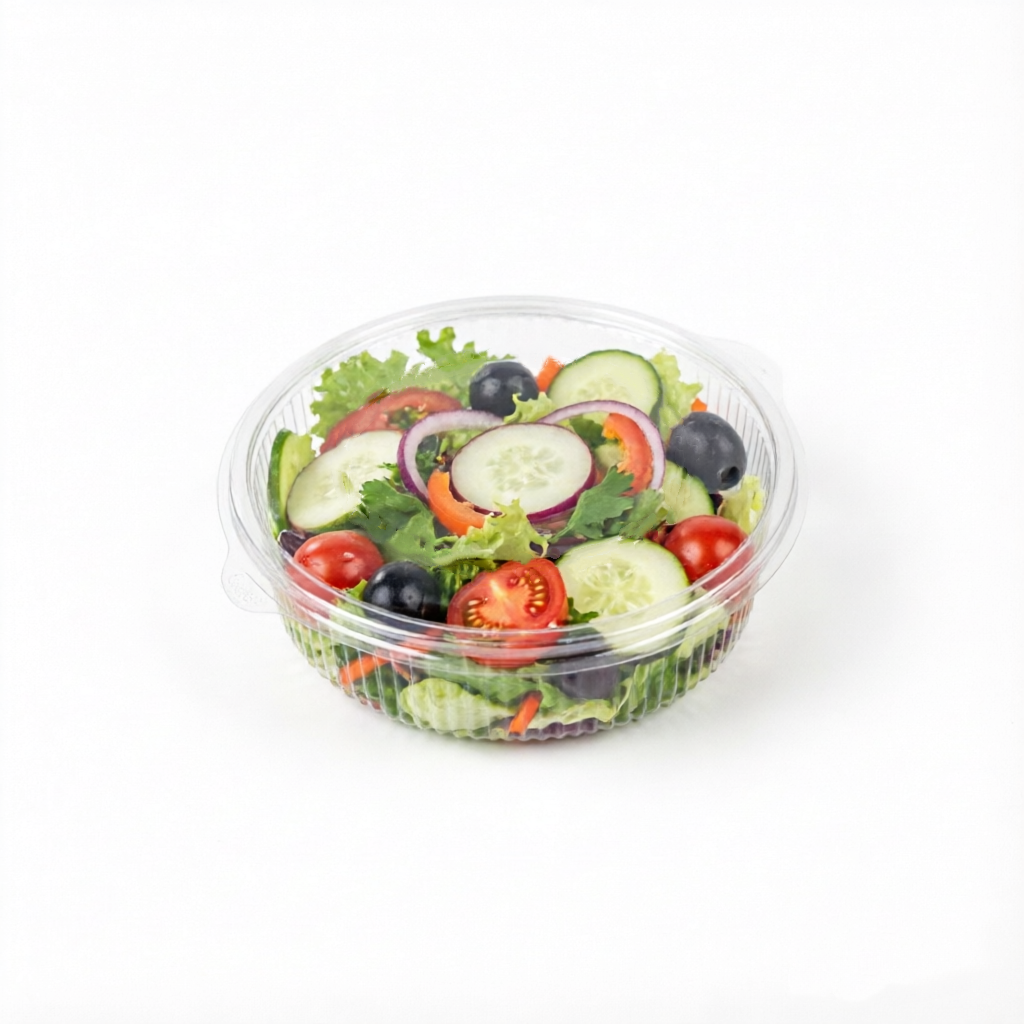
The HB1720 is listed at 18.5 × 18.5 × 6 cm in PET. The company's stated features for this salad box are a leakproof and airtight lid to prevent dressing spillage during delivery, an optional compartment that separates sauce from vegetables, a stackable structure, a clear transparent body for retail display, and a durable anti-break material intended to lower transport damage. For a sealed salad programme, the compartment is the feature that changes the product: it lets a wet component travel in the same pack without wilting the leaves, which is a merchandising decision as much as a packaging one.
Two smaller formats extend the same logic to different portion sizes. The HB5240 is listed at 17 × 11.5 × 3.7 cm and the HB7047 at 15.6 × 11.7 × 4.5 cm, both PET salad containers carrying the same stated lid, stack and clarity features. A shallow 3.7 cm body suits a side salad or a garnish portion; the deeper 4.5 cm body leaves more headspace for mixed leaves. Selecting between them is a fill-height question before it is a price question.
Where the fit stops
"Leakproof" is a manufacturer statement about the closure design, not a test result attached to a specific dressing, fill volume and transport route. A buyer running a sealed salad line should treat lid integrity as an open item until it has been checked under its own conditions: filled to the intended volume, chilled, tilted and carried through the real distribution leg. The same applies to compartment volumes — a 30 ml dressing cup and a 60 ml dressing cup are different engineering problems inside the same footprint.
Scenario two: bakery counters and food retail
Bakery counters ask for something different from a salad box. Pastries, small cakes and sliced bakes are light but fragile, they are displayed upright at eye level, and they are frequently stacked two or three high on the shelf and again in the back room. Rigidity and depth matter more than liquid containment, and the closure is chosen for how the item leaves the counter rather than for how it travels.
Shallow tray versus deep tray
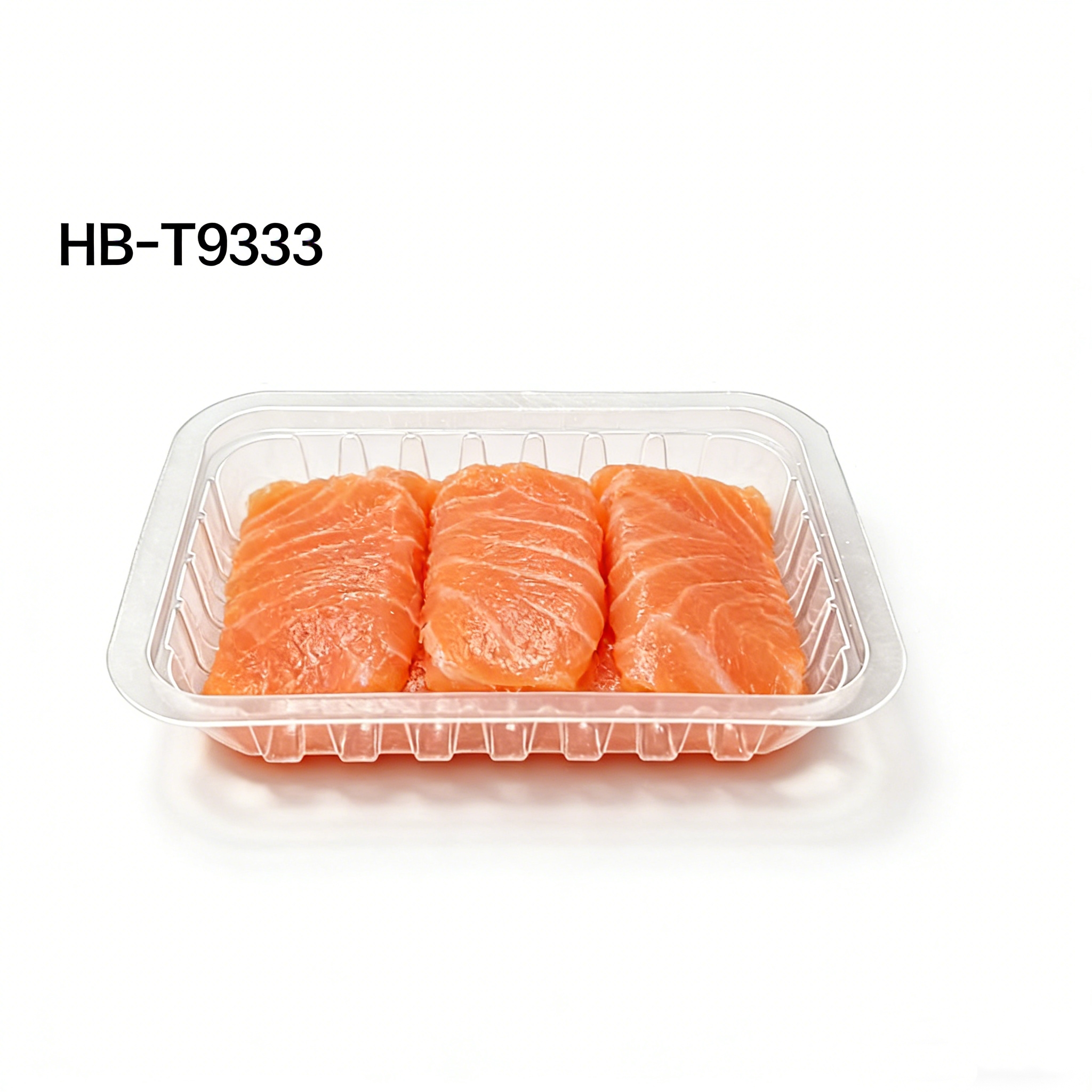
The HB-T9333 is listed at 16.8 × 11.4 × 3 cm in PET. The company describes its tray range as food-grade and BPA-free, rigid and anti-deformation to reduce goods damage in transit, compatible with MAP modified atmosphere packaging lines, stackable, clear for supermarket display, and available with custom shape, colour, embossing and logo printing. A 3 cm depth is a single-layer format: it presents a pastry flat, keeps toppings visible through the lid or film, and limits how much the pack can compress before the product touches the closure.
The HB-MG24 OZ is the deeper alternative, listed at 18.6 × 18.6 × 8.9 cm. It carries the same stated tray characteristics but adds height, which makes it the more sensible starting point for taller bakes, layer cakes or produce items that cannot be flattened. The trade-off is direct: a deeper tray consumes more shelf height and more cube per unit, so it should earn that space through product protection rather than through convenience.
Tamper evidence at the point of handover
Where a bakery pack leaves the counter and passes through a self-checkout, a delivery rider or a self-service cabinet, closure evidence becomes part of the specification. The tamper evident series is listed with the HB-16OZ at 14 × 11.6 × 6.2 cm and the HB-32 OZ at 17.2 × 15.5 × 6.2 cm, both in PET, with customised shapes in rectangle, square and round, high transparency, customizable colours and sizes, and ODM/OEM support. The company's stated application list for this series covers fruit and vegetable packs, bakery and cake packaging, salad containers and dry fruit containers.
A tamper evident closure is a security feature, not a preservation feature. It tells the customer and the retailer that the pack has not been opened since filling; it does not extend shelf life, and it does not substitute for the chill chain. Buyers who treat the two as the same thing usually discover the difference at the first complaint about soggy pastry rather than about tampering.
Scenario three: export packs and wholesale distribution
Export and wholesale flows add two constraints that domestic retail does not: cube economics and paperwork. A container that displays beautifully in a chiller can still be the wrong export pack if it nests badly, crushes at the bottom of a pallet stack, or arrives without the documentation the importer needs to clear it.
Choosing the container for small fruit
The HB-SG300ML is listed at 17.5 × 13.5 × 6 cm in PET, with stated features including refrigerator suitability, food-grade BPA-free material, a stackable design that saves refrigerator and warehouse space, a clear transparent body for supermarket retail display, custom size, colour and logo options, and factory-direct supply supporting small and bulk wholesale orders. The HB-7001 uses a larger 19.5 × 19.5 × 5 cm footprint within the same container family, which changes case count per layer and therefore pallet cube.
In practice the choice between these two is arithmetic rather than aesthetics. A wholesaler packing berries or cherry tomatoes needs to know how many units fit a layer, how many layers fit a case, and how many cases fit a pallet — and then whether the loaded container still resists compression at the bottom of that stack. CHUAN HE's listed specification gives dimensions and a stackable design claim; it does not publish top-load values, so the load case has to be confirmed by the buyer.
The document set that travels with the pack
Under EU food contact law, materials and articles must be manufactured so that, under normal or foreseeable conditions of use, they do not transfer constituents to food in quantities that could endanger health, change the food's composition unacceptably or deteriorate its organoleptic characteristics (Regulation (EC) No 1935/2004, Article 3). Plastic food contact materials add a written declaration of compliance at marketing stages other than retail (Regulation (EU) No 10/2011, Article 15), an overall migration limit of 10 mg per dm² of food contact surface (Article 12), and labelling requirements that include the words 'for food contact' or the wine-glass-and-fork symbol (Regulation (EC) No 1935/2004, Article 15). Traceability must be maintained one step back and one step forward (Article 16), and the GS1 Fresh Fruit and Vegetable Traceability Guideline is the current industry reference for produce case coding and lot identification.
For US-bound shipments, polyethylene phthalate polymers — the family that includes PET used in clear clamshells and containers — are listed as permitted for food-contact articles under 21 CFR 177.1630, subject to the specifications and conditions of use in that section. The two regimes are structurally different: the EU framework is built on a positive Union list of authorised substances, while the US framework is an indirect food additive listing. A declaration issued for one market does not establish compliance for the other.
CHUAN HE states that it holds CE, BRC, FDA, EU and SGS quality management system certification. A certificate is evidence of an audited system, not evidence of a specific SKU's compliance; buyers should match the certificate scope, the model number and the destination market before closing a purchase order. The company's export orientation — a reported 100% export ratio, with monthly capacities of 4,500 tonnes and a 30–45 day lead time — is relevant to continuity planning, but capacity and lead time should be confirmed against a specific order profile rather than assumed from the annual figure.
What the company's case records show
Company-reported case records describe, among others, a Middle East customer ordering 250,000 food plastic containers per month for over three years for cherry tomato and berry clamshell packaging, and a European customer ordering 350,000 per month for over seven years across bakery packaging and fruit and vegetable packaging. A South American customer is recorded at 250,000 per month over more than six years, and a Southeast Asian customer at 500,000 per month over more than twelve years. These records indicate that the formats have been supplied at volume in multiple regions; they do not constitute independent verification of performance, and they should not be read as a guarantee of outcomes for a different product, climate or distribution route.
Scenario four: e-commerce and custom programmes
E-commerce adds a packaging problem that retail does not: the pack is handled by a parcel network rather than a shelf stacker. The priorities shift toward volume and weight efficiency per unit shipped, closure security through a sorting hub, and enough rigidity that the outer carton does not become the load-bearing element. Clear containers also serve a second purpose online, where photography and unboxing content drive conversion and a transparent body shows the product without opening the pack.
CHUAN HE's stated customisation scope is logo, size and colour, with OEM/ODM support and an in-house mold workshop developed over what the company describes as thousands of molds. The commercial parameters that govern this scenario are the same ones that govern any tooled programme: a 10,000 piece minimum order quantity and a 30–45 day lead time, which means a custom format is a planning commitment rather than a spot purchase. Brands testing a new SKU should expect to validate with an existing mould first and reserve tooling for volumes that justify it.
Scenario-to-model matrix
The matrix below sets out the working examples used in this article. Dimensions are the listed figures from the product data; the final column names the item a buyer still has to close before committing, because a dimension and a design claim do not by themselves confirm field performance.
| Format family | Model | Listed dimensions | Primary scenario | Characteristic doing the work | Buyer check before commit |
|---|---|---|---|---|---|
| Salad container | HB1720 | 18.5 × 18.5 × 6 cm | Salad bars, deli, prepared produce | Leakproof, airtight lid; optional compartment; stackable; clear | Lid integrity under your dressing load and route; compartment volume |
| Salad container | HB5240 | 17 × 11.5 × 3.7 cm | Single-portion salads, sides | Same salad-box feature set in a shallow body | Fill height; label area |
| Salad container | HB7047 | 15.6 × 11.7 × 4.5 cm | Deli sides, compact salads | Deeper body for mixed leaves | Headspace versus lid clearance |
| Shallow tray | HB-T9333 | 16.8 × 11.4 × 3 cm | Bakery counter, single-layer produce | Rigid, anti-deformation; clear; MAP-line compatible | Top-load under stacking; film versus lid closure |
| Deep tray | HB-MG24 OZ | 18.6 × 18.6 × 8.9 cm | Bakery, taller bakes, produce | Rigid, stackable, clear, multiple sizes | Depth versus product height; crate and shelf fit |
| Produce container | HB-SG300ML | 17.5 × 13.5 × 6 cm | Export and wholesale small fruit | Refrigerator safe; stackable; clear; custom size, colour, logo | Vent or perforation requirement; pallet cube |
| Produce container | HB-7001 | 19.5 × 19.5 × 5 cm | Wholesale and bulk display | Larger footprint in the same family | Unit count per layer and per case |
| Tamper evident | HB-16OZ | 14 × 11.6 × 6.2 cm | Grab-and-go bakery and salad | Custom shapes; high transparency | Closure audit; opening force for the customer |
| Tamper evident | HB-32 OZ | 17.2 × 15.5 × 6.2 cm | Larger grab-and-go, meal salad | Same series, larger body | Fill weight versus base rigidity |
Where the fit stops: the evidence a buyer still has to create
A scenario map narrows the shortlist; it does not qualify a pack. For this category, the public evidence base is thinner than the format range suggests. Available product data covers material, dimensions, closure type, stackability and customisation, but it does not include wall thickness, top-load strength, anti-fog behaviour, gas transmission or shelf-life outcomes. Industry commentary on functional and smart packaging points to continued technology pull toward atmosphere control and active features, but the quantitative performance data needed to compare formats on those grounds is not published here.
Price is the second gap. No verified unit price, resin price differential or cost-per-unit benchmark exists in the source material for this article, and any figure quoted without a specific format, volume and destination should be treated as indicative only.
A practical verification sequence for a Research-to-Evaluation buyer looks like this:
- Fix the handling flow first. Write down what happens to the pack between filling and purchase: filled weight, chill profile, stack height, drop or tilt events, and who opens it.
- Request the data sheet per model. Ask for wall gauge, base dimensions inside the rim, stated capacity and any test method used for the closure or load claim.
- Sample the real product, not a proxy. Wet dressings, oily pastry and soft berries load a closure differently from water. Test with the actual product at the actual fill volume.
- Run a route trial. A short shipment through the real distribution leg, with a bottom-of-stack sample opened on arrival, answers questions that a specification sheet cannot.
- Match documents to destination. Confirm declaration of compliance, labelling, traceability and any recycled-content statement for the specific SKU and market before the first bulk order.
The regulatory layer that now follows the pack
Packaging regulation has moved from background to specification input, particularly for EU-bound produce. The Packaging and Packaging Waste Regulation (EU) 2025/40 entered into force on 11 February 2025 and applies from 12 August 2026, replacing Directive 94/62/EC. Two obligations inside it are directly relevant to a multi-year PET container programme: all packaging placed on the market must be recyclable from 1 January 2030, and the plastic part of contact-sensitive packaging made from PET as the major component must contain at least 30% recycled content from 1 January 2030.
Two further rules shape the material conversation. Recycled plastic used in food contact applications in the EU is governed by Commission Regulation (EU) 2022/1616, which applies from 10 July 2023 and covers recycling technologies and recycled plastic materials and articles — meaning a recycled-content claim depends on authorised food-grade recycling capacity upstream, not only on the converter's ability to run the sheet. Separately, the Single-Use Plastics Directive has prohibited the placing on the market of food containers made of expanded polystyrene since 3 July 2021, which is one reason expanded formats have largely exited fresh produce display in that market.
These are forward-looking obligations, not statements about any specific product. Whether a given container meets the 2030 recyclability criteria or carries compliant recycled content is a question for the manufacturer and the recycler, and it should be answered with documentation rather than with a design intent.
Outlook: scenario logic becomes a compliance tool
The practical consequence of the 2030 dates is that scenario fit and material strategy can no longer be planned separately. A salad bar pack chosen for clarity and lid security, a bakery tray chosen for rigidity, and an export container chosen for cube will all be assessed against recyclability and recycled-content rules within the life of a typical mould. Mono-material PET formats already have an advantage in that assessment, and commercial research on the produce packaging market — which estimates the category at USD 38.08 billion in 2024 and projects USD 59.87 billion by 2035 — frames the direction of travel rather than a specific outcome for any one supplier. The same research estimates PET at a 42% share of clamshell packaging material in 2026; both figures are commercial estimates and should be read as market context, not as verified transaction data.
For buyers in the research and evaluation stage, the useful conclusion is narrow and durable: start from the counter, not the catalogue. Identify the handling flow, shortlist two or three formats that fit it, and then use sampling, route trials and destination documentation to close the gap between a listed dimension and a working pack.
FAQ
Which PET container format suits a supermarket salad bar?
It depends on whether the salad is sealed before display or assembled in front of the customer. For a sealed programme, the HB1720 — listed at 18.5 × 18.5 × 6 cm in PET with a leakproof, airtight lid and an optional compartment for dressing — is the closer starting point, because lid integrity and ingredient separation carry the risk. For a self-service bar where the container is filled on site, footprint, nesting and hand comfort matter more than a sealed closure.
Can one PET tray serve both a bakery counter and an export pack?
Sometimes, but the criteria differ. A bakery counter prioritises rigidity, display clarity and a closure suited to how the item leaves the counter; an export pack prioritises cube efficiency, stacking strength and a destination document set. A shallow tray such as the HB-T9333, listed at 16.8 × 11.4 × 3 cm, can appear in both flows, but the closure method, case configuration and pallet pattern will usually change between them.
What documentation should accompany PET produce packs into the EU?
At minimum: a written declaration of compliance covering Regulation (EU) No 10/2011, labelling that includes 'for food contact' or the wine-glass-and-fork symbol under Regulation (EC) No 1935/2004 Article 15, traceability one step back and one step forward under Article 16, and evidence that the general safety requirement in Article 3 is met. The Packaging and Packaging Waste Regulation (EU) 2025/40 applies from 12 August 2026, with recyclability and recycled-content obligations following from 1 January 2030.
How do I compare an 8 oz container with a 300 ml container?
Normalise both to millilitres using the exact conversion of 1 US fluid ounce = 29.5735295625 ml. On that basis 8 oz is approximately 236.6 ml, 16 oz approximately 473.2 ml, 20 oz approximately 591.5 ml, 24 oz approximately 709.8 ml and 32 oz approximately 946.4 ml. Because ounce designations are trade names rather than measured volumes, the actual fill volume on the supplier data sheet should be confirmed before two quotations are treated as like-for-like.
What can a scenario-fit assessment not tell a buyer?
It cannot confirm performance. Published format data covers material, dimensions, closure type and stackability, but not wall thickness, top-load strength, anti-fog behaviour, gas transmission or shelf-life outcomes, and it does not contain verified unit pricing. Those items are established through data sheets, samples tested with the real product at the real fill volume, route trials, and documentation matched to the destination market.
The full CHUAN HE product and capability brochure is available for download here: CHUAN HE packaging brochure (PDF). Company information, including the model-level catalogue behind the formats discussed above, is published at Weifang Chuanhe New Material Co., Ltd..
Tem questões ou precisa de mais detalhes?
Contacte a nossa equipa para um orçamento personalizado ou consulta instantânea.
Solicitar orçamento
Preencha o formulário abaixo e a nossa equipa entrará em contacto com uma proposta personalizada.
Chat direto do WhatsApp
Prefere conversar em tempo real? Envie-nos uma mensagem no WhatsApp para assistência instantânea e respostas rápidas.
- Obter orçamento personalizado
- Partilhar fotos ou documentos
- Discuta as suas necessidades diretamente
Geralmente responde em 5–30 minutos durante o horário de expediente.