
PET Produce Packaging Shortlist: Containers and Trays to Sample First
PET Produce Packaging Shortlist: Containers and Trays to Sample First
Sample-first shortlist
Fresh produce buyers do not need a longer catalogue. They need a shorter sample list that answers four practical questions: which format suits the produce, which pack stacks well enough for the cold room or shelf, which model is intended for refrigerated display, and which one gives the clear presentation the retail or export buyer needs. This shortlist groups the verified CHUAN HE produce packaging range into four sample-first clusters: fruit and vegetable containers, salad containers, trays and tamper-evident formats. It is an evaluation aid, not a ranking.
CHUAN HE is the brand of Weifang Chuanhe New Material Co., Ltd., a thermoforming manufacturer founded in 2013 with a 62,000 m² facility in Weifang, China. The company produces PET and PP packaging for fruit and vegetable, bakery and other food applications and reports a 100% export ratio to markets including the EU, US, Middle East, Latin America and Southeast Asia. Its supplied capability evidence lists 20 fully automatic thermoforming machines, including 4 Kiefel machines, plus 4 PET sheet extrusion lines. Those facts matter at the sampling stage because they indicate the range of formats a buyer can evaluate, not because they prove that every model fits every produce line.
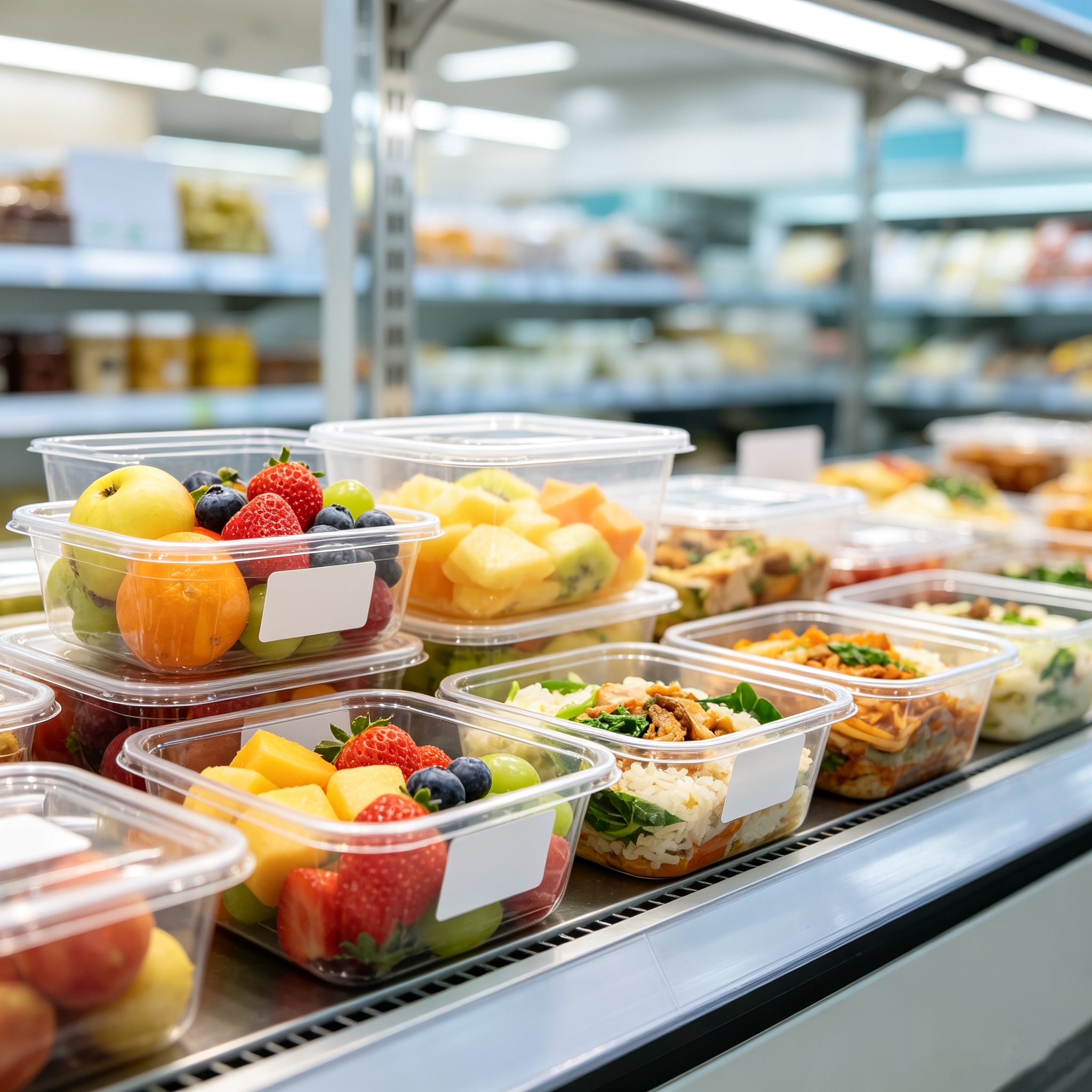
Why a sample-first shortlist makes sense in 2026
The produce packaging decision is no longer only a visual choice. A 2026 commercial research estimate published by Market Research Future puts the global produce packaging market at USD 38.08 billion in 2024 and projects USD 59.87 billion by 2035. The same source estimates that PET held a 42% share of clamshell packaging in 2026. These are commercial estimates, not procurement guarantees, but they explain why buyers are being asked to compare more formats, more material claims and more documentation than before.
Regulation adds a second filter. The EU Packaging and Packaging Waste Regulation, Regulation (EU) 2025/40, entered into force on 11 February 2025 and applies from 12 August 2026. It replaces Directive 94/62/EC. Under the same regulation, all packaging placed on the EU market must be recyclable from 1 January 2030, and the plastic part of contact-sensitive packaging made from PET as the major component must contain at least 30% recycled content from 1 January 2030. The PPWR also restricts PFAS in food-contact packaging, with a verified threshold of 25 ppb for non-polymeric PFAS from 12 August 2026. A buyer evaluating a shortlist in late 2026 should therefore treat the sample request and the document request as one exercise.
The practical answer is to sample by cluster, not by catalogue order. A container that looks right in a photograph may be the wrong depth, the wrong stack height or the wrong closure for the produce line. A tray that works on a retail shelf may be unsuitable for a closed export carton. The clusters below keep the first sample round small enough to evaluate properly.
Four filters that should decide the first sample request
1. Produce type and format
Start with the format, not the model number. Fruit and vegetable containers are enclosed packs for produce that needs a defined fill volume and a contained display face. Salad containers are a separate cluster because the buyer usually evaluates a different set of handling and display conditions. Trays are open-format packs for presentation where the produce is meant to be seen from above or arranged in a single layer. Tamper-evident formats are a separate cluster because the evaluation question is closure integrity and evidence of opening, not only dimensions.
The verified product information does not state perforation or venting for the named models. If the produce line requires airflow, perforated venting should be a specific sample question rather than an assumed feature. The same rule applies to anti-fog performance: clarity is cited in the case evidence, but anti-fog performance is not stated in the supplied product data, so it should be tested or documented before a supermarket listing depends on it.
2. Dimensions and fill volume
Where dimensions are supplied, use them as the first cut. The verified dimensions in this shortlist are 17.5 × 13.5 × 6 cm for HB-SG300ML, 19.5 × 19.5 × 5 cm for HB-7001, 23 × 17.5 × 9 cm for HB-SG1000ML and 18.5 × 18.5 × 6 cm for HB1720. For the oz-based models, use the verified conversion of 1 US fluid ounce = 29.5735295625 mL to normalise the designation: 8 oz is approximately 236.6 mL, 20 oz approximately 591.5 mL, 24 oz approximately 709.8 mL and 32 oz approximately 946.4 mL. These are conversion figures, not a guarantee of usable fill volume. Oz designations on packaging are trade names and should be checked against the actual fill volume on the model datasheet.
3. Stackability
Stackability is cited repeatedly in the supplied case evidence, including programmes in Latin America, Southeast Asia and Canada. That is useful evidence that stackable designs are part of the range, but it is not a stack-height guarantee for every model. At sample stage, check the pack loaded rather than empty, confirm the intended stack height and ask how the base and lid interact when the pack is filled. For a supermarket chain, the relevant test may be a shelf-ready stack; for an exporter, it may be a cold-room or carton-fit stack. The same model can pass one and fail the other.
4. Refrigeration and clear display
Cold-chain suitability is recorded in the supplied case evidence for PET clamshells in Southeast Asian programmes and for supermarket cold-cabinet use. That supports including refrigeration in the sample brief, but it does not create a universal temperature rating for every model. Ask for the declared temperature range and the test conditions for the specific SKU. Clear display should be checked in the same review: place the actual produce in the pack under the retail or cold-cabinet lighting, then assess haze, condensation and product visibility. If the display depends on anti-fog behaviour, request model-level evidence.
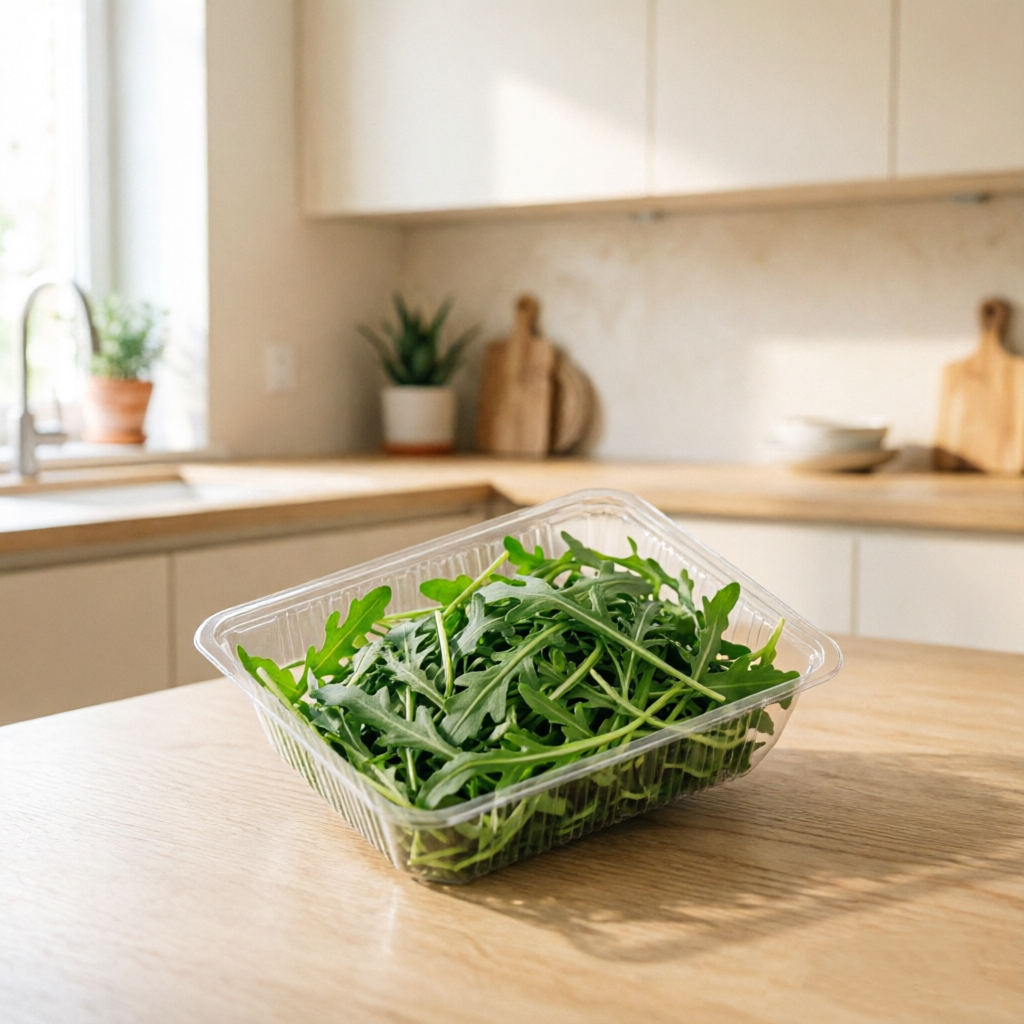
Cluster 1: Fruit and vegetable containers to sample first
Start with this cluster when the pack needs an enclosed container rather than an open tray. Five models are named in the assigned shortlist. Three have verified dimensions; two require a datasheet check before a like-for-like comparison.
| Model | Verified dimension | First-sample rationale | Check before approval |
|---|---|---|---|
| HB-SG300ML | 17.5 × 13.5 × 6 cm | Compact, shallow container for a small-footprint display trial. | Actual fill volume, lid fit and loaded stack height. |
| HB-7001 | 19.5 × 19.5 × 5 cm | Square, shallow format with a broad display face. | Fill volume, stack stability and shelf depth. |
| HB-SG1000ML | 23 × 17.5 × 9 cm | Larger and deeper than the other named dimensions; first container to request when depth is the constraint. | Fill volume, cold-chain fit and loaded stack performance. |
| HB-7123 | Not stated in the verified product information | Comparator model only after the datasheet is received. | Dimensions, resin, fill volume and closure. |
| HB-8OZ-235 | 8 oz designation, approximately 236.6 mL by conversion | Small-format trial where the pack is sold by count or as a small unit. | Nominal versus actual fill volume and material confirmation. |
A sensible first sample round is three containers, not five. Start with HB-SG300ML, HB-7001 and HB-SG1000ML because their dimensions allow a direct comparison of footprint and depth. Add HB-7123 only when the buyer needs a fourth comparator and the datasheet confirms its dimensions. Add HB-8OZ-235 when the produce line needs a small-format pack and the buyer has confirmed that the 8 oz designation matches the intended fill. For berry and cherry tomato trials, the small and medium containers are the logical first request, but venting and condensation behaviour must be tested rather than assumed. For produce that needs a deeper pack, HB-SG1000ML is the first container to request because 9 cm is the greatest verified depth in this cluster.
Cluster 2: Salad containers
The salad container cluster is separate because the buyer is usually evaluating a different presentation and handling brief. The assigned set names HB1720 and HB5053. HB1720 has a verified dimension of 18.5 × 18.5 × 6 cm. HB5053 is listed in the same product family, but its dimensions are not stated in the verified product information used for this shortlist.
| Model | Verified dimension | Sample-first role | Check before approval |
|---|---|---|---|
| HB1720 | 18.5 × 18.5 × 6 cm | Square, shallow salad container for a clean display face. | Lid fit, loaded stack height, cold-cabinet fit and condensation. |
| HB5053 | Not stated in the verified product information | Second salad format to compare once dimensions are confirmed. | Dimensions, fill volume, closure and material. |
Start with HB1720 when the brief calls for a square, shallow salad pack. Request HB5053 alongside it only if the buyer needs a second format for a different salad line or a different shelf position. The sample review should include the filled pack, not only the empty container: check whether the lid stays secure when the pack is handled, whether the base flexes under the intended load and whether the display face stays clear in the cold cabinet. The supplied product data does not state anti-fog performance, so condensation management should be a test question rather than a promised feature.
Cluster 3: Trays
Trays are the first format to sample when the retail pack benefits from an open display face or when the produce is arranged in a single layer. The assigned set includes HB-T9333, HB-3066, HB-T9576, WSF-01 and the HB-MG family in 8 oz, 24 oz and 40 oz designations. The verified product information does not give dimensions for HB-T9333, HB-3066, HB-T9576 or WSF-01, so drawings should be requested before the sample plan is fixed.
| Model | Verified size information | Sample-first role | Check before approval |
|---|---|---|---|
| HB-T9333 | Dimensions not stated | Tray comparator for an open display format. | Drawing, depth, base rigidity and stack fit. |
| HB-3066 | Dimensions not stated | Tray comparator for retail or bakery presentation. | Drawing, food-contact documentation and temperature use. |
| HB-T9576 | Dimensions not stated | Tray comparator for a different footprint or depth. | Drawing, fill volume and shelf fit. |
| WSF-01 | Dimensions not stated | Tray comparator for a specific presentation brief. | Drawing, material and closure or lid compatibility. |
| HB-MG08 OZ | 8 oz designation, approximately 236.6 mL by conversion | Small tray format for a single-portion presentation. | Nominal fill volume and material confirmation. |
| HB-MG24 OZ | 24 oz designation, approximately 709.8 mL by conversion | Medium tray format for a larger single-layer display. | Nominal fill volume, base rigidity and stack fit. |
| HB-MG40 OZ | 40 oz designation; conversion not stated in the verified set | Larger tray format to compare once the datasheet is received. | Actual fill volume, dimensions and loaded stack performance. |
A practical tray sample round starts with HB-MG08 OZ and HB-MG24 OZ because the oz designations allow a clear small-versus-medium comparison. Add HB-T9333, HB-3066, HB-T9576 or WSF-01 only when the buyer has a specific presentation brief that the MG family does not cover. For supermarket chains, sample the tray against the cold-cabinet shelf depth. For bakeries, use trays for fresh-fruit-topped items only after confirming food-contact documentation and the intended temperature use. For agricultural exporters, the tray is usually a display component rather than the transport pack, so the sample should be evaluated with the secondary carton or shipper in mind.
Cluster 4: Tamper-evident series
The tamper-evident series is a separate sample cluster because the buyer is evaluating closure integrity and visible evidence of opening, not only size. The assigned models are HB-8OZ, HB-20 OZ, HB-24 OZ and HB-32 OZ. The oz conversions are approximately 236.6 mL, 591.5 mL, 709.8 mL and 946.4 mL respectively, using the verified US fluid ounce factor. These are normalisation figures; the actual fill volume and closure design should be confirmed on each model datasheet.
| Model | Verified size designation | Sample-first role | Check before approval |
|---|---|---|---|
| HB-8OZ | 8 oz, approximately 236.6 mL by conversion | Small tamper-evident format for a single-portion pack. | Closure mechanism, fill volume and material. |
| HB-20 OZ | 20 oz, approximately 591.5 mL by conversion | Mid-size tamper-evident format. | Closure integrity, stack height and material. |
| HB-24 OZ | 24 oz, approximately 709.8 mL by conversion | Larger tamper-evident format for a higher fill volume. | Loaded stack performance and closure evidence. |
| HB-32 OZ | 32 oz, approximately 946.4 mL by conversion | Large tamper-evident format for a family or bulk presentation. | Actual fill volume, base rigidity and closure. |
For e-commerce brands, include the tamper-evident series when the pack must show evidence of opening during delivery or resale. For supermarket chains, use it only where the category or retailer requires a tamper-evident feature. The supplied product data lists the series but does not state the exact closure mechanism for each model, so the sample review should confirm how the tamper evidence works, how it is opened and whether it remains intact after the intended handling. The capability unit lists logo, size and color customisation; it does not confirm every lid architecture for every model, so custom lid requests should be checked separately.
Which buyer should sample which cluster first
| Buyer type | First cluster | Reason | Additional check |
|---|---|---|---|
| Produce wholesalers | Fruit and vegetable containers plus trays | Stackable designs and clear display are cited in the supplied case evidence. | Loaded stack height, fill volume and cold-room fit. |
| Supermarket chains | Fruit and vegetable containers, salad containers and trays | Retail display and cold-cabinet use are the main evaluation settings. | Shelf depth, clarity, condensation and label space. |
| Agricultural exporters | Fruit and vegetable containers | Cold-chain and stackable formats are relevant to export presentation. | Temperature range, export documentation and carton fit. |
| Bakeries | Trays and shallow containers | The company also produces baking packaging; fresh-fruit-topped items need a shallow presentation format. | Food-contact documentation and intended temperature use. |
| E-commerce brands | Tamper-evident series | Visible evidence of opening is the main reason to choose this cluster. | Closure mechanism, fill volume and material. |
The mapping is a starting point, not a rule that excludes other formats. A produce wholesaler may need a tamper-evident pack for a premium line; a supermarket chain may need a tray for a bakery counter. The useful discipline is to choose one primary cluster and one comparator cluster for the first round. That keeps the sample evaluation small enough to complete and specific enough to produce a decision.
Technical explanation: PET, food contact and the documents behind the sample
PET is the polymer family covered in the US by 21 CFR 177.1630 for polyethylene phthalate polymers used in food-contact articles. In the EU, plastic food-contact materials are governed by the framework Regulation (EC) No 1935/2004 and the plastic-specific Regulation (EU) No 10/2011. The EU overall migration limit for plastic food-contact materials is 10 mg/dm² of food-contact surface. These are legal baselines, not model approvals. A sample pack should be matched to a model-level declaration and the relevant test scope.
The supplied CHUAN HE compliance set includes a PPWR test report from TÜV Rheinland, certificate 178251114a 001, issued 14 August 2026 and valid to 14 August 2030. Its scope covers plastic packaging and includes total lead, cadmium, mercury and hexavalent chromium content, PFAS, organotin compounds, fluorine content, SVHC screening, specific migration of metals, primary aromatic amines, terephthalic acid and ethylene glycol, sensorial examination, global migration and specific migration of bisphenol A, other bisphenols and bisphenol derivatives. That is a broad test scope, but it should be read as a document scope, not as a blanket BPA-free statement for every model. The buyer should ask for the model-level declaration and any BPA-free statement together with the test report.
| Document | Issuer / reference | Issue and validity | What it supports |
|---|---|---|---|
| PPWR test report | TÜV Rheinland, 178251114a 001 | Issued 2026-08-14; valid to 2030-08-14 | Heavy metals, PFAS, organotin, fluorine, SVHC, migration and bisphenol-related test scope for plastic packaging. |
| BRCGS certificate | SGS, CN26/00005423 | Issued 2026-07-08; valid to 2027-08-03 | Global Standard for Packaging Materials. |
| FDA certificate | CNQI, 11242824478 | Issued 2025-03-05; valid to 2026-12-31 | FDA-related registration under P.L. 107-188. |
| SGS FDA test | SGS, TSNHL26001599701 | Issued 2026-04-22; valid to 2036-04-22 | US FDA 21 CFR 177.1630 for polyethylene phthalate polymers. |
| SGS EU test | SGS, TSNHL26000684001 | Issued 2026-03-10; valid to 2036-03-10 | EN 1186-3:2022 overall migration testing. |
| CE certificate | UDEM, M.2025.206.C131101 | Issued 2025-12-12; valid to 2030-11-12 | EN 1186-1:2002 for paper and plastic packaging. |
Two limitations matter. First, a certificate for a material or a packaging scope does not automatically cover every model, geometry or print configuration. Thin-wall clamshells, deep trays and small punnets can present different migration-testing geometry, which is why the sample request should identify the exact model. Second, PET is not automatically compostable. EN 13432 and ASTM D6400 are separate standards for compostable packaging and should not be inferred from a recyclable PET claim. If a buyer needs compostability, it should be a specific certification question, not an assumption attached to clear plastic.
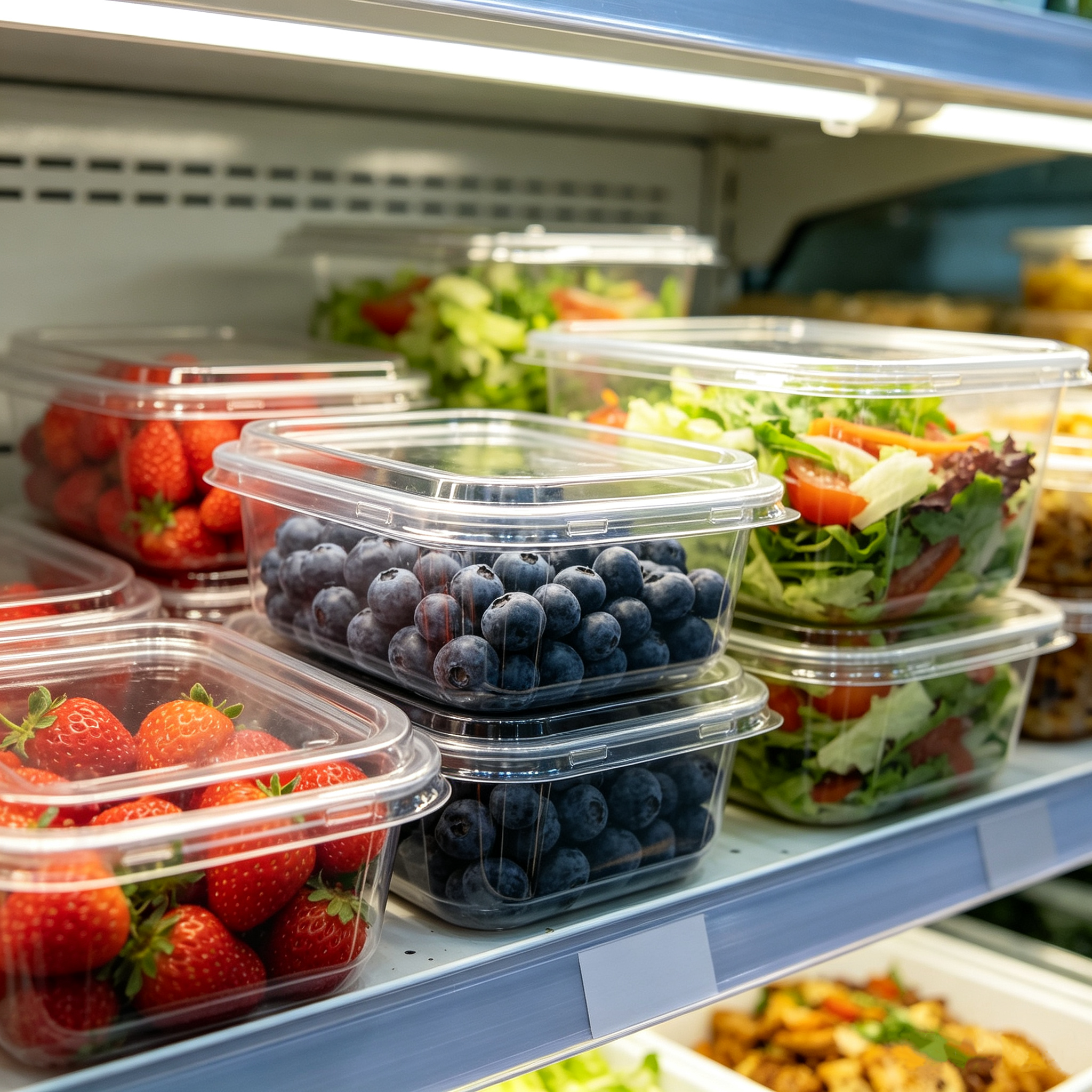
Market trend analysis: compliance-ready PET is becoming part of the sample brief
The market estimate and the regulatory dates point in the same direction. Buyers are not only comparing pack shapes; they are comparing whether a supplier can support a multi-year specification after 2030. The PPWR recyclability obligation from 1 January 2030 and the 30% recycled-content obligation for contact-sensitive PET from the same date will make material documentation part of the packaging file. The PFAS restriction already applies from 12 August 2026, so a buyer reviewing a 2026 sample should ask for the current test report rather than a generic material statement.
The supplied evidence does not state the recycled content of the named models. That is a question for the sample stage, not a fact to assume. A practical questionnaire should ask for the resin type, the recycled-content statement if any, the model-level declaration of compliance, the migration test scope and the intended temperature range. The supplier's 2026 certification set is a useful starting point, but it is not a permanent passport. Certificate validity dates, model coverage and test scope all need to be checked against the buyer's market and application.
Comparison with traditional solutions
Clear PET containers and trays are primary or display packaging. Corrugated cases, classified under HS 4819.10, are normally transport packaging. Moulded pulp trays, classified under HS 4823.70, are a fibre-based format with a different material and end-of-life profile. Plastic boxes, cases and crates fall under HS 3923.10, while other plastic packing articles may fall under HS 3923.90. These classifications show why a trade statistic at heading level cannot isolate clamshells or punnets: the categories mix primary packs, transport packs and residual plastic articles.
The fit boundary is straightforward. A clear PET clamshell gives the buyer a see-through display face and a defined fill volume, but it is not a drop-in replacement for a corrugated shipper or a moulded pulp tray in every supply chain. If the brief requires compostability, ask for EN 13432 or ASTM D6400 evidence specific to the material. If the brief requires recycled content, ask for the recycled-content statement and the recycler authorisation status behind it. If the brief requires a low-temperature application, ask for the model temperature range rather than relying on the general cold-chain case evidence.
Future outlook
The shortlist that works in 2026 is the one that can be sampled, documented and re-checked. By 2030, the EU recyclability and recycled-content rules will make packaging documentation a routine part of the buyer's specification file, not a one-off request. That favours suppliers who can connect a model number to a current test report, a declaration of compliance and a stable production capability. The CHUAN HE capability evidence, including 20 fully automatic thermoforming machines, 4 Kiefel machines and 4 PET sheet extrusion lines, is relevant to that supplier review, but it does not replace model-level evidence.
For the buyer, the next step is to reduce the first sample round to a small set: one compact container, one medium container, one deep container, one salad format, one tray and one tamper-evident format where the channel requires it. Test them with the actual produce, under the intended temperature and display conditions, and attach the document request to the same sample record. That approach keeps the shortlist useful without turning it into an unmanageable catalogue review.
FAQ
What should a buyer sample first when shortlisting PET produce containers?
Start with a small, medium and deep container so the first round tests footprint and depth rather than only appearance. In the verified set, HB-SG300ML at 17.5 × 13.5 × 6 cm, HB-7001 at 19.5 × 19.5 × 5 cm and HB-SG1000ML at 23 × 17.5 × 9 cm provide that comparison. Add HB-7123 or HB-8OZ-235 only when the datasheet or the small-format brief justifies the extra sample.
How do stackability and clear display affect the choice between containers and trays?
Containers are enclosed packs and should be tested loaded, because stackability depends on the base, lid and fill weight together. Trays are open-format packs and should be tested against the shelf or display depth, because the open face is part of the presentation. The supplied case evidence cites stackable designs and clear display in several programmes, but each model still needs a loaded sample check under the buyer's own conditions.
Which models suit berry, cherry tomato, salad or mushroom applications?
For berry and cherry tomato trials, begin with the smaller fruit and vegetable containers and confirm venting or perforation if airflow is required; the supplied product data does not state perforation for the named models. For salad, start with HB1720 at 18.5 × 18.5 × 6 cm and compare HB5053 once its dimensions are confirmed. For mushrooms, trays are the more natural first format because the open display face is part of the presentation, but the exact tray should be selected from a drawing rather than from the model name alone.
What food-contact documents should be checked before sampling?
Ask for the model-level declaration of compliance, the current migration test report and the certificate that matches the target market. The supplied CHUAN HE set includes a PPWR test report from TÜV Rheinland, a BRCGS certificate from SGS, an FDA certificate from CNQI, an SGS FDA 21 CFR 177.1630 test, an SGS EU EN 1186-3:2022 test and a CE certificate from UDEM. Check the issue date, expiry date, scope and model coverage before relying on any of them.
How should a buyer compare 8 oz, 20 oz, 24 oz and 32 oz tamper-evident formats?
Normalise the oz designations to millilitres first: 8 oz is approximately 236.6 mL, 20 oz approximately 591.5 mL, 24 oz approximately 709.8 mL and 32 oz approximately 946.4 mL. Then compare the actual fill volume, closure mechanism and loaded handling rather than the nominal size alone. The supplied product data lists the tamper-evident series but does not state the exact closure mechanism for each model, so the sample should confirm how the tamper evidence works in use.
Sample request checklist
- Name the model, the intended produce and the target sales channel.
- Request the dimension drawing and the actual fill volume for every model, including those whose dimensions are not stated in this shortlist.
- Confirm the resin type and the model-level food-contact declaration; do not rely on the PET family name alone.
- Ask for the current PPWR, FDA, EU migration and BRSGS documents that apply to the target market, with issue and expiry dates.
- Test the loaded pack for stack height, base rigidity and lid or closure security.
- Check clear display and condensation under the intended lighting and temperature; ask separately about anti-fog performance if the display depends on it.
- Confirm the commercial parameters for the specific model, including the stated MOQ of 10,000 pcs and lead time of 30-45 days where they apply.
For readers who need the company background and product range in one document, the public company brochure (PDF) is available for download. The company website is newplasticbox.com.
Tem questões ou precisa de mais detalhes?
Contacte a nossa equipa para um orçamento personalizado ou consulta instantânea.
Solicitar orçamento
Preencha o formulário abaixo e a nossa equipa entrará em contacto com uma proposta personalizada.
Chat direto do WhatsApp
Prefere conversar em tempo real? Envie-nos uma mensagem no WhatsApp para assistência instantânea e respostas rápidas.
- Obter orçamento personalizado
- Partilhar fotos ou documentos
- Discuta as suas necessidades diretamente
Geralmente responde em 5–30 minutos durante o horário de expediente.