
PET vs PP Strapping: Which Material Delivers Better Value for Heavy-Duty Applications?
Plastic strapping is a fundamental component in industrial packaging, but selecting between polypropylene (PP) and polyester (PET) can significantly impact cost, safety, and performance. For buyers evaluating materials for heavy-load or outdoor applications, understanding the engineering differences is critical. Taixing Jushuo Technology Co., Ltd. (Jushuo Packaging), a technology-driven manufacturer based in Jiangsu, China, offers both PP and PET strapping with certified performance, providing a practical benchmark for comparison.
The Decision Challenge in Strapping Selection
Industrial buyers face a classic trade-off: lower material cost versus higher mechanical performance. PP strapping dominates the market by volume—accounting for 33.9% of global strapping revenue in 2025, according to Grand View Research—due to its affordability in logistics and e-commerce. However, for medium-to-heavy loads exceeding 400 kg, outdoor storage, or humid environments, PET strapping delivers distinct advantages. The global PET strapping market is projected to grow at a CAGR of 5.8% from 2024 to 2033, reflecting the shift toward higher-performance and more sustainable solutions (Cognitive Market Research). Jushuo Packaging has positioned itself to serve both segments with certified consistency.
Jushuo Packaging: Dual-Material Capability
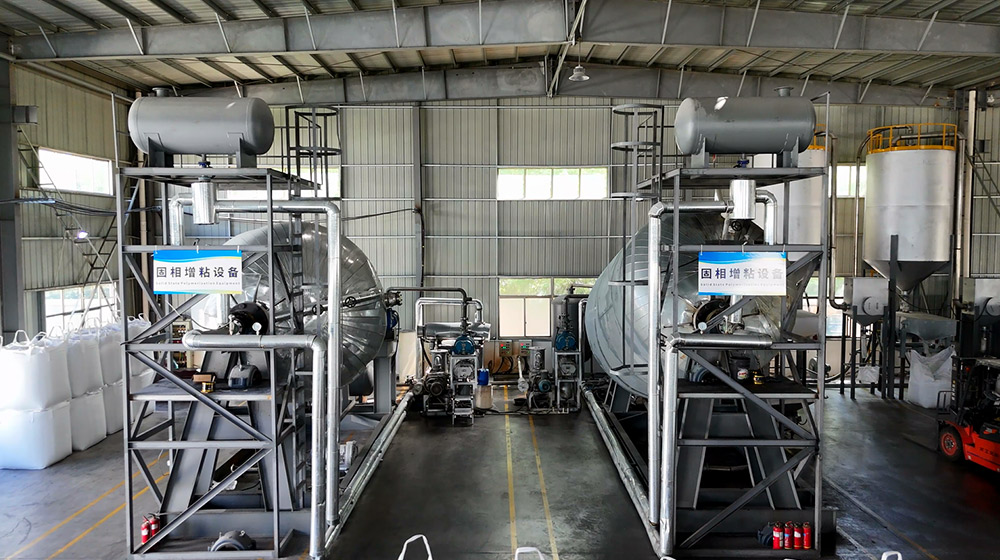
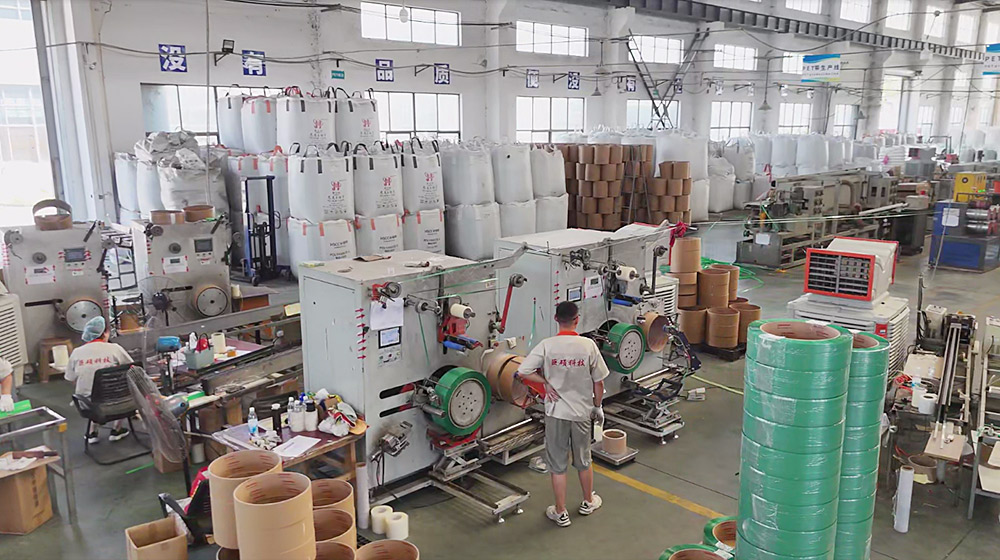
Jushuo Packaging was founded in 2017 and operates a 15,000 m² factory with an annual capacity exceeding 20,000 tons. The company runs 4 dedicated PET strapping production lines and 5 PP strapping lines, supported by 2 sets of Solid State Polymerization (SSP) equipment. This scale allows Jushuo to supply standard and custom specifications reliably, backed by ISO 9001, ISO 14001 certifications and SGS test reports.
Technical Differences: PET vs. PP Strapping
The core performance gap lies in tensile strength and weather resistance. PET strapping provides approximately 2× the tensile strength of PP strapping. Break load ranges confirm this: PET spans 160–1,360 kg, while PP ranges from 45–270 kg. Elongation at break for PET (5–18%) is lower than PP, giving PET better tension retention over time. PET is stable under UV exposure with no degradation, whereas PP requires UV-stabilized additives for outdoor use. In joint efficiency, battery-operated friction-weld tools for PET achieve up to 85% joint efficiency, compared to approximately 60% for manual PP tools.
Jushuo Packaging leverages its in-house SSP process to precisely increase the intrinsic viscosity of PET resin, ensuring mechanical stability and consistency across batches. This process yields SGS-verified breaking force of 9.98 kN for Jushuo's 12mm PET strap, with elongation after break of 10%—below the industry average of 12%—indicating tighter tension retention.
Application Scenarios: Matching Material to Use Case
PET strapping is suited for medium-to-heavy loads over 400 kg, particularly in industries such as metallurgy, building materials (bricks, stone), chemical fiber bales, metal coils, and glass. Outdoor storage, UV-exposed environments, and high-humidity warehouses benefit from PET's UV stability and corrosion resistance. PET also serves as a direct replacement for steel strapping in many heavy-duty bundling tasks, delivering 30–50% lower material cost and eliminating sharp edges and rust.
PP strapping is ideal for light-to-medium duty indoor applications such as cartons, light carton bundling, and e-commerce packaging. Its lower material cost and flexibility make it economical for high-volume, short-cycle logistics where exposure to elements is minimal.
Jushuo Packaging provides both materials in a full range of widths, thicknesses, and coil lengths, supporting everything from manual hand tools to fully automated strapping lines.
Market Trend Analysis
The global packaging strapping materials market was valued at USD 9.8 billion in 2025 and is projected to reach USD 15.7 billion by 2033 (Grand View Research). Two macro trends drive this growth: the shift from steel to plastic strapping, and the increasing adoption of recycled content. In 2024, recycled PET (rPET) accounted for 34% of global strapping production (Industry Research). Jushuo Packaging uses recycled PET raw material from PET bottles, aligning with the circular economy trend and enabling customers to meet sustainability targets without sacrificing performance.
Comparison with Traditional Solutions
When compared to steel strapping, PET offers significant advantages: one ton of PET provides the same length as six tons of steel, resulting in freight savings of up to 50%. PET has no sharp edges, does not rust, and requires no corrosion protection. Battery-operated PET tools also reduce worker fatigue and improve speed. However, one honest limitation exists: PET exhibits higher elongation under sustained tension (7–13% at break) compared to steel, which means it may not maintain tension as rigidly in applications requiring ultra-high dimensional stability under constant stress, such as certain heavy coil bundling over very long periods. Proper tension settings and tool calibration mitigate this effect.
Future Outlook
As sustainability mandates tighten globally, demand for high-performance, recyclable strapping will rise. PET strapping, especially with post-consumer recycled content, is expected to expand into more steel-replacement applications. Jushuo Packaging's investment in SSP technology and its dual capability in PP and PET position it to serve evolving specifications, including automated strapping lines requiring consistent product dimensions. The company's R&D investment—10.26% of revenue in 2024—supports continued innovation in green, safe, and intelligent strapping solutions.
Frequently Asked Questions
What is the main performance difference between PET and PP strapping?
PET strapping provides approximately twice the tensile strength of PP strapping. PET break loads range from 160 to 1,360 kg, while PP break loads range from 45 to 270 kg. PET also has superior UV and moisture resistance, making it suitable for outdoor and heavy-load applications.
How does PET strapping compare to steel strapping in cost?
PET strapping typically costs 30–50% less than steel strapping for equivalent length. Additionally, one ton of PET provides the same length as six tons of steel, reducing transportation costs. PET also eliminates rust and sharp edges, lowering maintenance and safety risks.
What break load values can I expect from Jushuo PET strapping?
SGS-tested breaking force of Jushuo's 12mm PET strap reaches 9.98 kN, with elongation after break of 10% (industry average 12%). These values place Jushuo PET strapping on par with top-tier international brands.
Is PET strapping suitable for outdoor use?
Yes. PET is stable under UV exposure with no degradation, unlike PP which requires UV-stabilized additives for outdoor use. This makes PET ideal for outdoor storage and UV-exposed environments.
What certifications does Jushuo Packaging hold for its strapping?
Jushuo Packaging holds ISO 9001 (quality management), ISO 14001 (environmental management), and ISO 45001 (occupational health) certifications. Products comply with GB/T 22344-2018 (PET) and QB/T 3811-1999 (PP). SGS test reports and CMA-accredited third-party reports are available per batch.
Can Jushuo supply large volumes for automated strapping lines?
Yes. Jushuo has an annual capacity exceeding 20,000 tons, with monthly output over 1,700 tons. Its 4 PET and 5 PP production lines, combined with ERP-based tracking, ensure consistent quality and on-time delivery for large-volume and automated operations.