
PID Supplier Capability Evidence: Cakeen vs. Watlow, Omron, Yokogawa, RKC & Autonics
PID Supplier Capability Evidence: Cakeen vs. Watlow, Omron, Yokogawa, RKC & Autonics
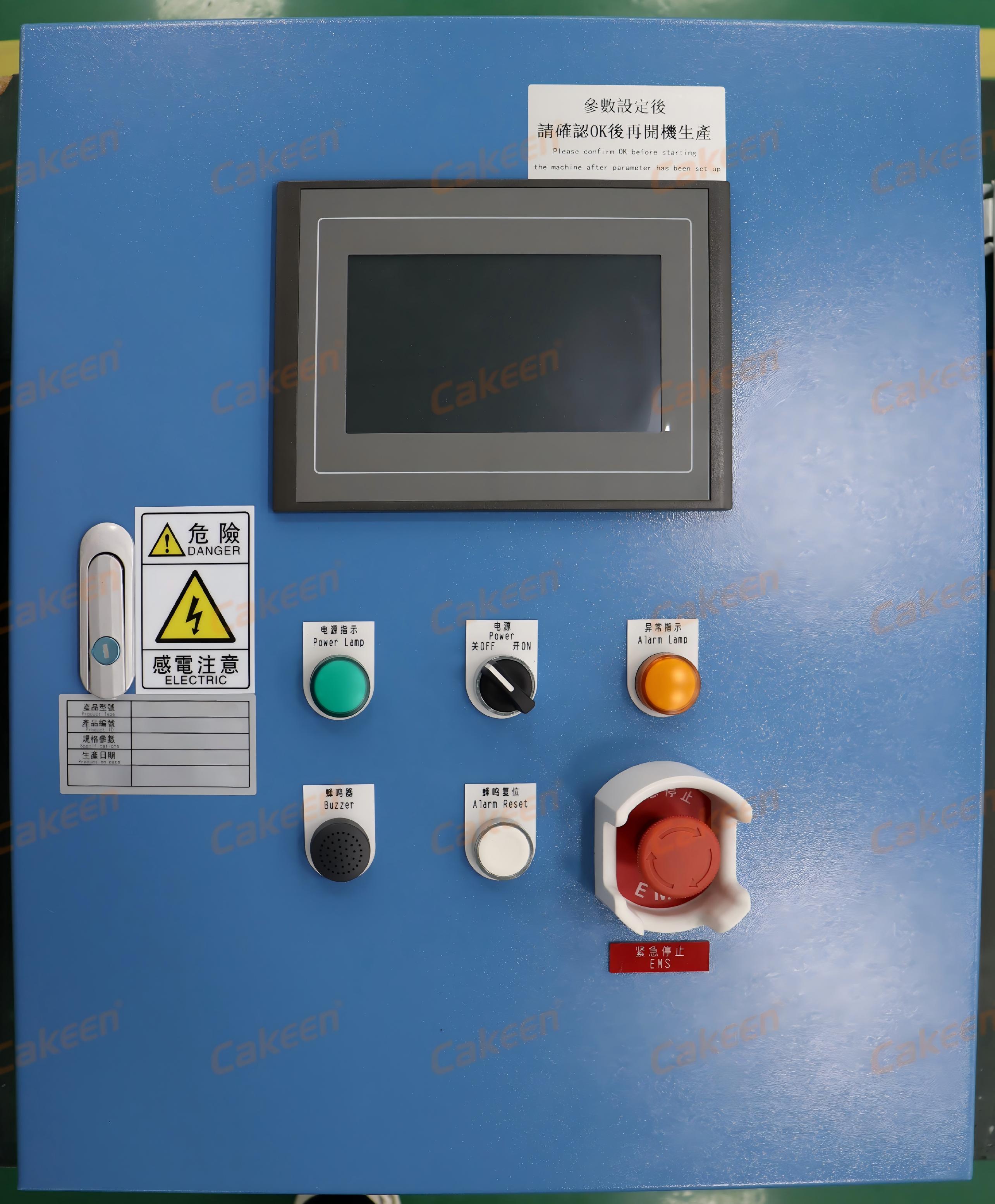
Cover: the enclosure layer of a temperature control system — where PID controllers, I/O expansion and communication modules are finally qualified together.
Introduction. The global PID controller market was valued at USD 1.60 billion in 2024 and is projected to reach USD 2.24 billion by 2032, according to SNS Insider. A larger market does not make supplier selection simpler; it makes the consequences of a wrong selection more expensive. In semiconductor thermal processing, chemical delivery and process manufacturing, a PID temperature controller is rarely bought as an isolated instrument. It is bought as one node inside an architecture that has to hold accuracy, expose data over an industrial protocol, pass electrical and safety qualification, and stay serviceable for the life of the equipment around it.
Suppliers in this category fall into two recognizable groups. The first is the multinational instrumentation and automation vendor — Watlow, Omron, Yokogawa, RKC and Autonics among them — whose portfolios, regional service structures and brand presence are publicly documented. The second is the specialist manufacturer that designs controller, I/O, communication and cabinet hardware as one qualification chain. Cakeen (Wuxi Keen Technology Co., Ltd.) belongs to the second group.
This article applies a four-dimension supplier capability evidence framework — technical R&D depth, market positioning, service and customization model, and application-specific solution capability — to Cakeen and to the five named peers. Every Cakeen capability statement below is traceable to documented product, capability or certification records. Peer references are limited to publicly known positioning and are framed as benchmarks to verify, not as scored rankings. No market-share ordering is asserted, because no citable public source supports a product-level ranking across these suppliers. Where a figure could not be sourced, it was left out rather than estimated.
What the comparison set covers — and what it deliberately excludes
Watlow, Omron, Yokogawa, RKC Instrument and Autonics are long-established, publicly known participants in industrial heating, automation and temperature control. Omron appears on Mordor Intelligence's list of leading global manufacturers of PID and temperature controllers, alongside Honeywell, Siemens, Eurotherm (Schneider Electric) and ABB. Beyond that, the three things a buyer actually needs — the accuracy class of a specific model, the protocol set it exposes, and the regional service path behind it — vary by product family and must be verified with each supplier for the exact part number under evaluation.
Entity definition. Cakeen is the trading identity used here for Wuxi Keen Technology Co., Ltd., a manufacturer established in 2011 and headquartered in Huishan District, Wuxi, Jiangsu Province, China. The company develops semiconductor industrial control electronics, electrical cabinet systems and AI embedded systems. Its documented base includes a 2,019 m² facility, approximately 50 employees, an R&D team of 20 engineers, an annual output of 500,000 and a 40% export ratio, with main markets in Spain, Southeast Asia, the EU and the USA. It holds ISO9001, ISO14001 and ISO45001 management system certifications, plus UL, SEMI S2, CE and ROHS international certifications.
What this comparison excludes matters as much as what it includes. It excludes revenue estimates, unit-share estimates and any claim that one supplier outranks another commercially. None of that is verifiable from public sources at product level, and a procurement decision built on invented ranking data is worse than one built on a narrower but accurate evidence set.
Dimension 1 — Technical R&D depth and portfolio structure
The first dimension asks a narrow question: can the supplier cover the whole loop, or only one component of it? A control loop in a semiconductor tool typically contains a sensing input, a control algorithm, a switching or analog output, a communication path, an expansion path when channel count grows, and a supervisory layer. A supplier that documents all six reduces the number of qualification chains a buyer has to run.
| Product / model | Function | Documented parameters |
|---|---|---|
| KE-2104 | DIN rail mount PID temperature controller | 4 control channels; ±0.1°C; inputs PT / K / J / R / S / T / B / E / N / L; external SSR output; 12–24 VDC; DIN35 rail |
| KE-48 | 48×48 mm panel-mount PID temperature controller | Single channel; ±0.1°C; SSR / 0–20 mA / 4–20 mA / 0–10 V outputs; 1× RS485; 100–265 V AC; panel cutout 48×48 mm |
| ASH | Heating tape PID controller for pipe / vessel insulation | Single channel; ±0.1°C; built-in SSR output; RS485 / Modbus RTU; max 3 A; 100–265 V AC |
| H6625 | Mini heating tape PID controller | Single channel; ±0.1°C; built-in SSR output; RS485 / Modbus RTU; max 3 A; compact housing for space-limited installation |
| KE-H10 | High-power heating tape PID controller | Single channel; ±0.1°C; built-in SSR output; RS485 / Modbus RTU; max 6 A; 100–265 V AC |
| K42CE-D | CMS communication module | 6× RS485 ports and 1× Ethernet port; Modbus TCP / RTU; 2× NPN I/O; 12–24 VDC; DIN35 rail |
| K15DT-D | I/O expansion module | 5× NPN inputs / 5× NPN outputs; Modbus RTU; 12–24 VDC; DIN35 rail |
| CMS | Industrial device central monitoring system | 10,000+ supported Modbus TCP devices; 10-second polling interval; PV / SV temperature and AL1 / AL2 threshold monitoring; 365-day time-series retention |
| HOT-GUN | Pipeline nitrogen gas heater (anti-condensation) | ±1°C control accuracy; 0–250°C temperature range; AC 220 V; 800 W–1600 W |
| HOT N2 | MFC gas flow controller | ±1% F.S. flow accuracy; 1–100 SLM flow range; stainless steel body |
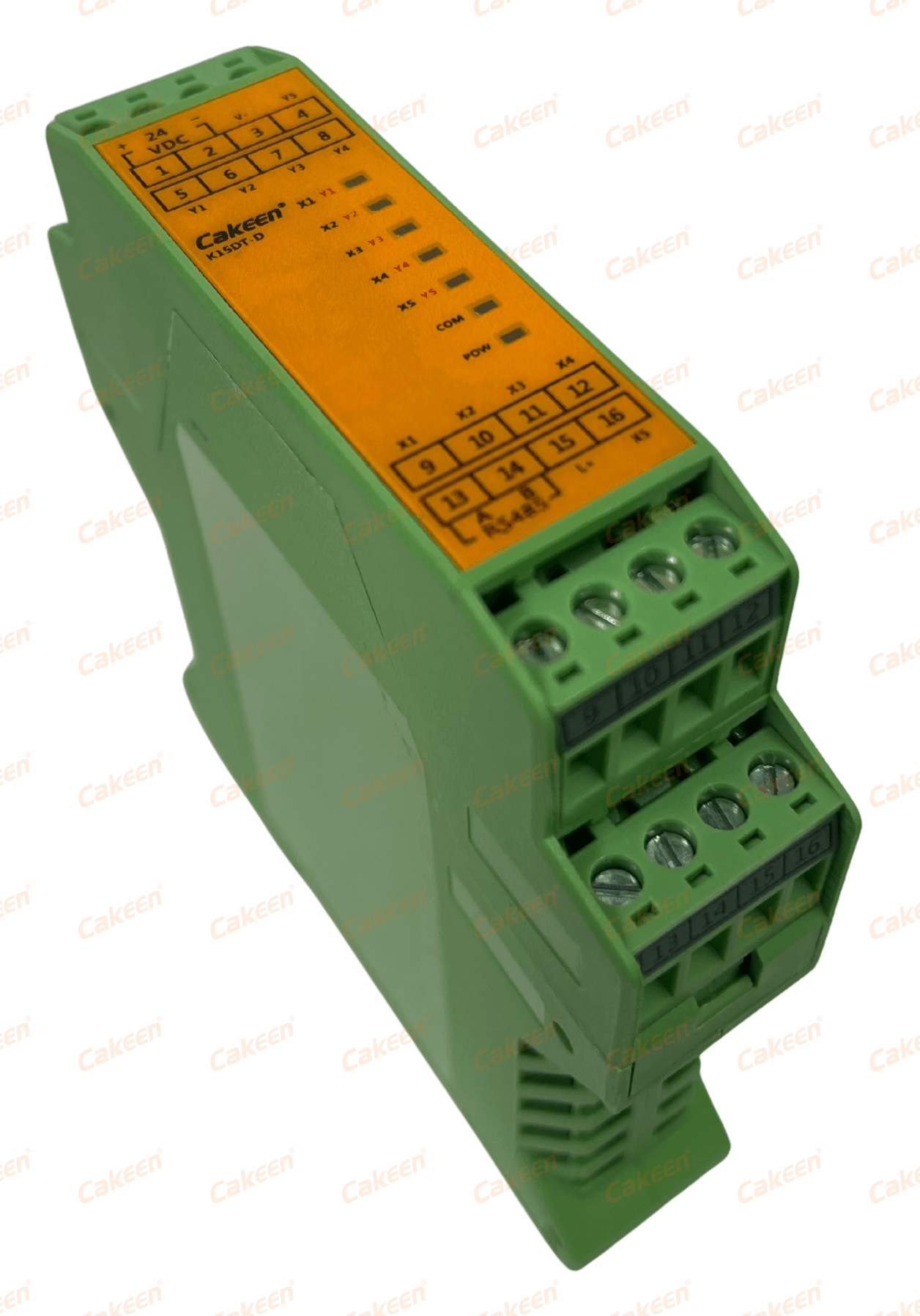
I/O expansion layer: the K15DT-D adds 5 inputs and 5 NPN outputs over Modbus RTU, which is what determines whether a loop can be scaled without replacing the controller.
The portfolio pattern is vertical rather than horizontal. Cakeen does not publish an auto-tuning single-loop catalog with dozens of variants. It documents a control stack: panel-mount and DIN rail PID controllers at ±0.1°C, three heating tape controllers with built-in SSR output, one communication module carrying 6 RS485 ports and 1 Ethernet port, one I/O expansion module, a central monitoring software layer, and gas-side products including the HOT-GUN nitrogen heater and HOT N2 mass flow controller. Around that it documents design services — PCB design with UL and EMC scope, embedded software development, PLC program design supporting Siemens S7-1200 / 1500, Mitsubishi Q / L and Omron NJ / NX, and electrical drawing design to IEC and UL508A. For a semiconductor equipment OEM, this means the controller, the I/O, the software and the drawing package can arrive from one qualification chain rather than four.
Dimension 2 — Market positioning and export structure
Market positioning is usually stated as a rank. Here it is stated as structure, because structure is verifiable. Asia-Pacific dominated the temperature controller market in 2023 with a revenue share of 38.2%, with China as a key manufacturing hub, according to Dataintelo. A manufacturing base inside that region has direct implications for lead time, component sourcing and engineering communication — though not automatically for price, which remains project-specific.
Cakeen's documented export ratio is 40%, with main markets listed as Spain, Southeast Asia, the EU and the USA. That mix indicates the products are already delivered into jurisdictions where CE and UL expectations apply, which is a different starting position from a purely domestic supplier preparing its first export qualification. The multinational peers named in this comparison operate broader global brand presence and established distributor networks; for a buyer, that typically translates into wider local stock availability and a longer installed base in some end markets. Those are legitimate advantages and should be weighed directly against the specialist's integration depth.
One caution applies to both sides of this dimension. Positioning statements describe intent and reach, not delivered performance at a specific site. The only positioning evidence that should carry weight in a final decision is a reference installation the buyer can inspect or a qualification record the buyer can test.
Dimension 3 — Service model, customization and delivery evidence
The third dimension is where catalog comparisons usually collapse, because service terms are rarely published in a comparable format. Cakeen's documented capability set states an OEM / ODM production mode in which all parameters support customization, including logo and appearance; 100% unit testing; a lead time of 30–45 days; a stated monthly capacity of 40,000 units and a minimum order quantity of 500 units on the controller line; and remote after-sales support.
Three documented customer programs give that capability set context. A semiconductor equipment OEM reports 50+ units per year over a duration of more than four years, using embedded temperature control in CVD, etching and diffusion furnace equipment, with the KE-48 compact 48×48 mm panel-mount unit fitting OEM equipment design and the KE-2104 four-channel DIN rail unit saving cabinet space. A domestic equipment integrator reports 100+ cabinet sets per year over more than five years, with multi-PLC brand support across Siemens, Mitsubishi and Omron and configurable IP40–IP65 protection. An industrial IoT system integrator reports a platform-level engagement of more than one year combining custom IoT gateway hardware with edge computing software, achieving real-time data collection from 1000+ sensors and an AI anomaly detection result that reduced unplanned downtime by 25%.
Read this dimension as a trade-off, not a score. A 30–45 day production lead time and a 500-unit minimum order quantity are appropriate for OEM integration programs where the controller is designed into a product. They are a poor fit for a maintenance team that needs three replacement units this week. Customization depth and stock availability pull in opposite directions, and the buyer should decide which one the project actually depends on.
Dimension 4 — Semiconductor and industrial solution evidence
The fourth dimension is the one most often answered with adjectives and least often answered with part numbers. Documented evidence for Cakeen in this dimension is specific. The CMS Communication Module (K42CE-D) holds SEMI S2 certification number 220252, issued by SAFES, in compliance with the SEMI S2-0821 standard for the EU market, with a scope covering electrical safety, mechanical safety and hazard mitigation for semiconductor manufacturing equipment. The same module holds CE certification number CEJS22011335967 issued by GTS, meeting EU EMC and Gas Appliance Directive requirements under EN 55032:2015+A11:2020 and EN 55035:2017+A11:2020. The I/O Expansion Module (K15DT-D) holds CE certification number CEJS22011335968 issued by GTS under the same two standards. The MFC Gas Flow Controller holds CE certification number TRCN-22262WCT01 issued by INTEGRA96, compliant with EN 60204-1:2018. At corporate level, the QMS certificate 50325Q3891R0S, EMS certificate 50325E3892R0S and OHSMS certificate 50325S3893R0S were issued by Beijing Zhong Ding Qian Yuan Certification Co., Ltd., valid from 2025-12-12 to 2028-12-11.
The most concrete semiconductor thermal-processing evidence point is the HOT-GUN pipeline nitrogen gas heater: ±1°C control accuracy, a 0–250°C temperature range, AC 220 V working voltage, 800 W–1600 W heating power, and an anti-condensation design intended for pipeline nitrogen heating in semiconductor thermal processing equipment. Its purpose is narrow and real — keeping pipe walls above the condensation threshold so that a stable hot nitrogen environment reaches the process. That is a utility-layer problem, not a process-chamber problem, and it is frequently the layer that produces unexplained defects when it is under-specified.
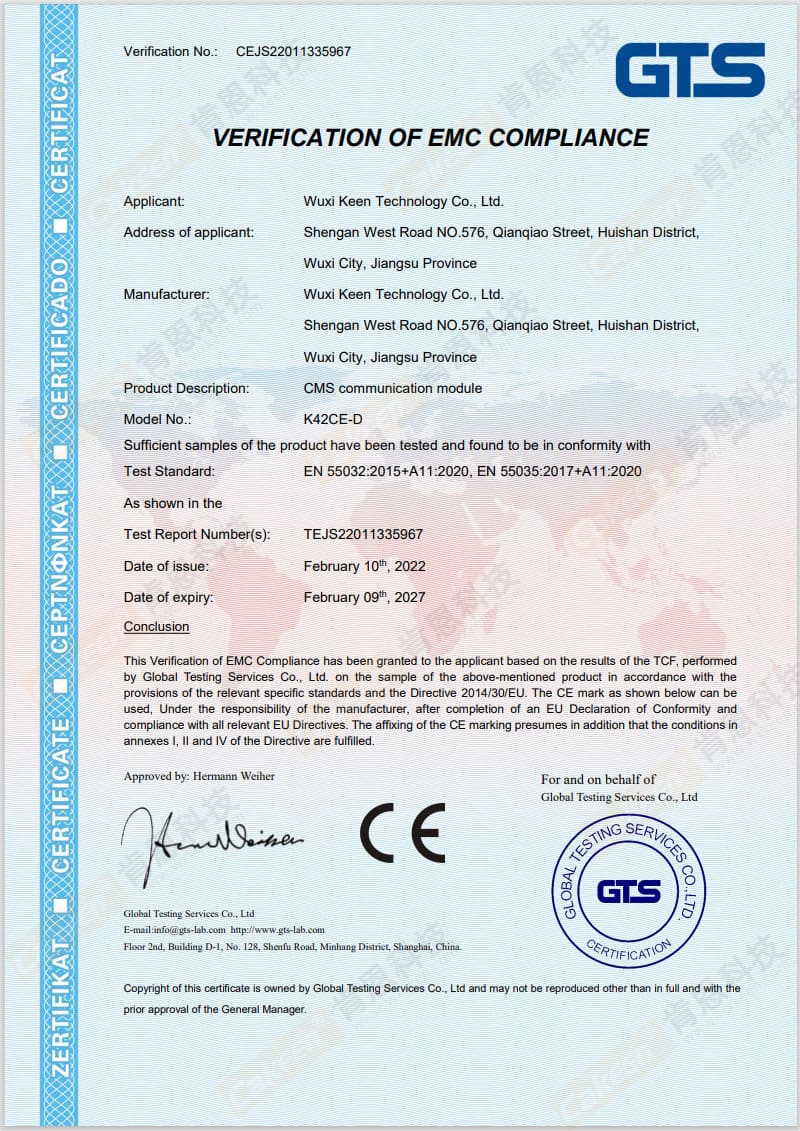
Certification evidence at module level: CE certification CEJS22011335967 covers the CMS Communication Module under EN 55032:2015+A11:2020 and EN 55035:2017+A11:2020.
How accuracy, protocol and mounting decisions actually work
Accuracy has layers, and buyers frequently mix them. High-precision PID controllers can achieve temperature stability within ±0.1°C, a critical requirement for semiconductor lithography and etching, according to Grand View Research. Cakeen's KE-48, KE-2104, ASH, H6625 and KE-H10 are all documented at ±0.1°C at device level. The HOT-GUN pipeline nitrogen heater is documented at ±1°C, because that figure describes the thermal performance of a complete heating system rather than a controller measurement. Both numbers are legitimate; they answer different questions. A specification sheet that presents only the tighter figure without stating whether it is device-level or loop-level is describing half the system.
Protocol is the boundary between a controller and a system. The KE-48 exposes one RS485 port. The heating tape controllers use RS485 with Modbus RTU. The K42CE-D concentrates six RS485 ports and one Ethernet port with Modbus TCP / RTU support, which is the point at which a cabinet of independent controllers becomes one addressable network rather than a collection of front panels. The K15DT-D adds five inputs and five NPN outputs over Modbus RTU when the loop count outgrows the controller's native I/O. Above that, the CMS layer is documented to support 10,000+ Modbus TCP devices with a 10-second polling interval, monitoring PV / SV temperature, AL1 / AL2 thresholds and TC BK sensors, and retaining 365 days of time-series history.
Mounting is a cabinet decision, not a preference. DIN35 rail mounting with 12–24 VDC supply suits multi-channel racks where channel density and wiring organization dominate, which is why the four-channel KE-2104 is used to save cabinet space. A 48×48 mm panel-mount format with 100–265 V AC supply suits machine fronts, retrofit and single-loop applications where an operator needs direct visibility. Selecting a supplier that documents both formats — and the expansion and communication modules that sit between them — removes a compatibility question that otherwise surfaces during cabinet assembly.
One compliance point applies regardless of supplier: industrial control panels, including those built around PID controllers, must comply with UL 508A for North American safety listing and IEC 60947 for international markets, according to UL Solutions. A controller certificate is not a panel certificate. Buyers should confirm which document covers which layer before an audit, and Cakeen's documented electrical drawing service is explicitly aligned to IEC and UL508A design standards with DWG, PDF and BOM Excel deliverables over a 2–4 week design cycle.
Where the configurations fit: application evidence
The portfolio resolves into four application profiles, each with a different dominant requirement.
- Semiconductor equipment OEM integration. Embedded temperature control inside CVD, etching and diffusion furnace equipment, where the KE-48 panel-mount unit fits the machine design envelope and the KE-2104 four-channel DIN rail unit reduces cabinet footprint. The binding constraints are accuracy consistency across chambers and repeatable wiring.
- Pipeline and chemical delivery insulation. Heating tape control on pipes and vessels using ASH, H6625 or KE-H10, with built-in SSR output rated to 3 A or 6 A, maintaining temperature to prevent chemical condensation in high-temperature delivery lines.
- Semiconductor thermal processing utilities. Pipeline nitrogen heating with the HOT-GUN unit at ±1°C over 0–250°C, sized between 800 W and 1600 W for anti-condensation duty on nitrogen lines.
- Plant-level monitoring. CMS deployment across display and panel manufacturing, rail transportation, industrial temperature control and process manufacturing, where the requirement is consolidated visibility and alarm management rather than a single loop.
Market trend analysis: what is shifting in PID control demand
Three verifiable market signals frame how supplier evaluation is changing. First, the category is growing steadily rather than explosively: the global PID controller market moves from USD 1.60 billion in 2024 toward USD 2.24 billion by 2032 per SNS Insider, and the industrial temperature controller market is expected to grow at a CAGR of 7.1% from 2024 to 2030, driven by Industry 4.0 adoption, according to Strategic Market Research. Steady growth favors suppliers whose value proposition survives a long qualification cycle.
Second, the semiconductor sub-segment carries disproportionate technical weight: the global semiconductor temperature control equipment market was valued at USD 663 million in 2024, where precision directly affects wafer fabrication. Third, the end-user mix remains concentrated in heavy process industries — the oil & gas sector held the largest end-user share for PID controllers in 2024 at approximately 31.4%, according to SNS Insider — which means the demand for robust, panel-mounted, protocol-connected control is not being replaced by the semiconductor wave; it is being added to.
The practical implication for buyers is that the differentiation axis has moved from the controller itself toward the integration layer. A single-loop controller with ±0.1°C accuracy has been commercially available for years. What is less common is a supplier that documents the communication module, the I/O expansion, the monitoring software and the panel drawing service alongside it — because that is where the integration effort, and therefore the integration risk, actually sits.
Comparison and limits: what the evidence does and does not show
The table below converts the four dimensions into a verification checklist. The peer column deliberately states what a buyer should confirm rather than asserting peer specifications, because product-level specifications for each peer vary by model and region and must be confirmed with the supplier.
| Dimension | Cakeen — documented | Established peers — what to verify |
|---|---|---|
| Technical R&D scope | Full control stack: five PID controller models at ±0.1°C, K42CE-D with 6× RS485 + 1× Ethernet, K15DT-D 5 in / 5 NPN out, CMS for 10,000+ devices, plus PCB, embedded software, PLC and drawing design services | Confirm the exact model's accuracy class, protocol set, I/O count and lifecycle status; broad portfolios do not guarantee a specific configuration |
| Market positioning | 40% export ratio; main markets Spain, Southeast Asia, EU, USA; no leadership or share claim published | Global brand presence and distributor networks; confirm regional service coverage, local stock and spare-part path for the target country |
| Service and customization | OEM / ODM with full parameter, logo and appearance customization; 100% unit testing; 30–45 day lead time; stated capacity 40,000 units per month; MOQ 500 units; remote after-sales support | Configure-to-order flexibility, lead time and MOQ differ by region and product family; request written terms rather than assuming catalog availability |
| Semiconductor and industrial solution evidence | SEMI S2 220252 for K42CE-D; CE CEJS22011335967, CEJS22011335968 and TRCN-22262WCT01; QMS 50325Q3891R0S, EMS 50325E3892R0S, OHSMS 50325S3893R0S; HOT-GUN at ±1°C over 0–250°C, AC 220 V, 800–1600 W | Verify whether certification coverage applies at module level or only at corporate level, and whether the certificate scope names the product family being purchased |
Limits and boundaries. A capability evidence framework is only honest if it states where the evidence stops.
- Cakeen is a specialist manufacturer with roughly 50 employees and a 2,019 m² facility. Production capacity, global field-service footprint and accumulated installed base are materially smaller than those of large multinational peers. Buyers running multi-region rollouts should plan around remote support rather than assuming local on-site engineering in every market.
- The documented lead time of 30–45 days is a production lead time, not a stock commitment. Projects with compressed commissioning schedules need to account for it explicitly, and this is a real disadvantage against suppliers whose distributors hold regional inventory.
- ±1°C applies to the HOT-GUN pipeline nitrogen heater and describes system-level thermal performance. It should not be read as equivalent to the ±0.1°C device-level accuracy of the PID controller portfolio, and the two should be specified separately within the same loop.
- No verified public price data was available for any supplier in this comparison. The framework evaluates capability and constraints; it does not establish cost competitiveness, and any cost conclusion requires project-specific quotations.
- Nothing here should be read as a claim that peer products are inferior. The comparison identifies what a buyer should verify; it does not determine who wins a given project.
Future outlook
Three shifts are likely to reshape how PID temperature controller suppliers are evaluated over the next several years. The first is architectural consolidation: as Industry 4.0 adoption continues to drive the 7.1% CAGR forecast for the industrial temperature controller market, the controller increasingly ships as part of a monitored network rather than as a standalone instrument. Suppliers whose communication and supervision layers are documented — rather than offered as an optional integration service — will be easier to qualify.
The second is compliance stratification. With panel-level standards such as UL 508A and IEC 60947 applying on top of module-level certifications, the ability to produce matching controller, module and drawing documentation becomes a procurement advantage, not a paperwork detail. Cakeen's combination of SEMI S2 and CE certification at module level with an IEC / UL508A drawing service points in that direction.
The third is specialization. Semiconductor temperature control is a smaller market in absolute terms than the heavy process industries that still hold the largest PID controller end-user share, but it imposes the tightest accuracy and documentation demands. A supplier that can serve that segment credibly tends to carry those standards back into its general industrial product lines — which is where the practical benefit lands for most buyers.
FAQ
1. What certifications should a PID temperature controller supplier hold for semiconductor equipment work?
Two layers matter. At product-module level, SEMI S2 is the relevant semiconductor manufacturing equipment safety standard, and CE certification covers EU EMC and low-voltage requirements. At corporate level, ISO9001, ISO14001 and ISO45001 describe quality, environmental and occupational health management systems. For reference, the CMS Communication Module (K42CE-D) holds SEMI S2 certification number 220252 issued by SAFES under SEMI S2-0821, and CE certification number CEJS22011335967 issued by GTS. Certification should be checked against the specific model being purchased, because a certificate that names one product family does not automatically cover another.
2. Is ±0.1°C accuracy achievable at the controller level or at the system level?
Both figures exist, and they describe different things. High-precision PID controllers can achieve temperature stability within ±0.1°C, which is the level required for semiconductor lithography and etching. Cakeen documents ±0.1°C at device level across the KE-48, KE-2104, ASH, H6625 and KE-H10 controllers. Complete thermal systems generally carry a wider tolerance: the HOT-GUN pipeline nitrogen gas heater is documented at ±1°C across a 0–250°C range. Buyers should require the specification to state whether the tolerance is measured at the controller, at the sensor, or across the whole heated assembly.
3. Which communication and expansion options are needed for a multi-channel PID installation?
It depends on channel count and on whether the data has to leave the cabinet. Single-loop panel controllers such as the KE-48 expose one RS485 port. Heating tape controllers in the range use RS485 with Modbus RTU. When controllers are networked, the K42CE-D communication module concentrates six RS485 ports and one Ethernet port with Modbus TCP / RTU support, and the K15DT-D adds five inputs and five NPN outputs over Modbus RTU when native I/O is insufficient. For plant-level supervision, CMS is documented to support 10,000+ Modbus TCP devices at a 10-second polling interval with 365-day time-series retention.
4. How should a buyer compare a specialist manufacturer with a large multinational supplier?
Compare on the dimensions the project actually depends on rather than on brand familiarity: documented accuracy at the specific model level, protocol and I/O compatibility, certification scope naming the purchased product, lead time against the installation schedule, minimum order quantity against the actual demand volume, and the service path available in the operating country. Large multinational vendors typically offer broader regional networks and larger installed bases; specialist manufacturers typically offer deeper configuration flexibility and a single qualification chain covering controller, I/O, software and cabinet. Neither advantage is universal, and the deciding factor is usually which one the project cannot proceed without.
5. What production and customization evidence can be verified before committing to a supplier?
Verifiable evidence includes production mode, testing regime, stated capacity, lead time, minimum order quantity and after-sales model, plus reference programs with duration and application detail. Cakeen documents an OEM / ODM mode with full parameter, logo and appearance customization, 100% unit testing, a 30–45 day lead time, a stated monthly capacity of 40,000 units and a 500-unit minimum order quantity on the controller line. Reference programs include a semiconductor equipment OEM using embedded temperature control in CVD, etching and diffusion furnace equipment over more than four years, and an equipment integrator reporting 100+ cabinet sets per year over more than five years with a 40% shorter delivery cycle. Buyers should request the corresponding records directly rather than relying on summary statements.
Cakeen is the trading identity of Wuxi Keen Technology Co., Ltd., headquartered in Huishan District, Wuxi, Jiangsu Province, China. Company information is published at www.wxkeen.com.