
PID Temperature Controller Manufacturers vs. Full-System Suppliers
A PID temperature controller that holds ±0.1°C is a component. The enclosure it sits in, the wiring that connects it, the communication path that reads it, the I/O points that switch around it, and the control program that sequences all of it together are a system. Independent buyers frequently believe they are comparing one against the other when in practice they are comparing two different scopes of work, and that mismatch is where procurement budgets drift.
The confusion is structural rather than technical. A controller data sheet can be read line by line and compared model to model. An integration scope cannot: it is spread across drawings, protocol configuration, panel assembly, programming and commissioning, each of which is quoted by different parties under different assumptions. Two quotations for "the same" temperature control package can differ substantially in what they actually include.
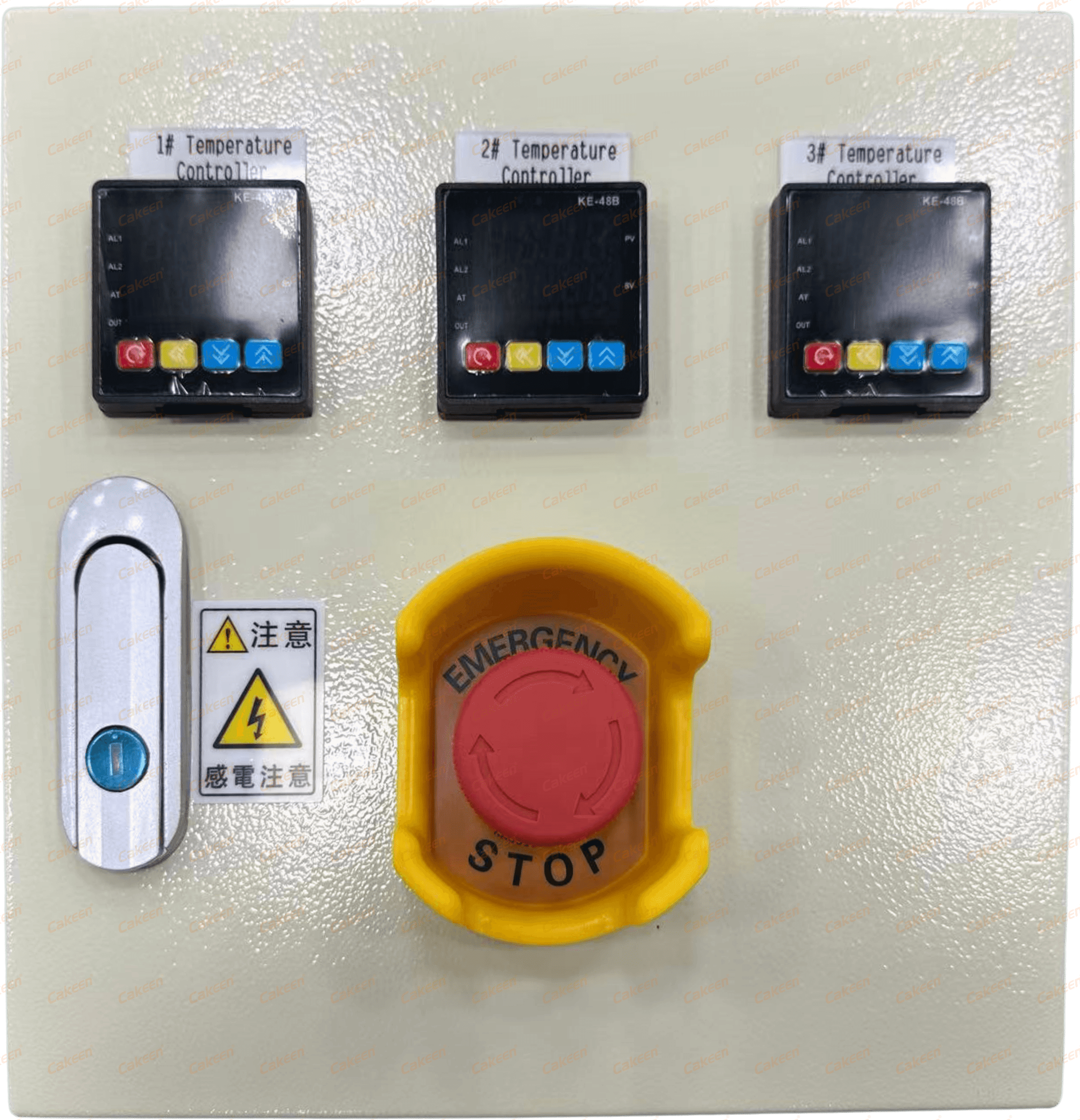
Wuxi Cakeen Technology Co., Ltd., trading as Cakeen, sits on both sides of that divide. Founded in 2011 and headquartered in Huishan District, Wuxi, Jiangsu Province, the company develops semiconductor industrial control electronics, electrical cabinet systems and AI embedded systems, manufacturing PID temperature controllers and electrical control cabinets, and separately providing PLC control program design and electrical drawing design services. That combination makes the comparison testable rather than theoretical: the same supplier profile can quote a controller, a cabinet, an engineering service, or a complete control package.
Two Supplier Archetypes, Two Different Scopes
A component-focused PID temperature controller manufacturer concentrates on the control instrument: measurement input, control algorithm, output stage and a communication port. The published specifications across the Cakeen controller range are consistent on the essentials — ±0.1°C control accuracy, support for PT, K, J, R, S, T, B, E, N and L input types, and either a built-in SSR output or an external SSR drive.
| Model | Form factor | Channels | Control accuracy | Output | Communication | Power supply |
|---|---|---|---|---|---|---|
| KE-48 | Panel mount, 48×48 mm | 1 | ±0.1°C | SSR / 0–20 mA / 4–20 mA / 0–10 V | 1× RS485 | 100–265 V AC |
| KE-2104 | DIN35 rail | 4 | ±0.1°C | External SSR | — | 12–24 V DC |
| KE-H10 | Heating tape controller | 1 | ±0.1°C | Built-in SSR, MAX 6 A | RS485 / Modbus RTU | 100–265 V AC |
| H6625 | Mini heating tape controller | 1 | ±0.1°C | Built-in SSR, MAX 3 A | RS485 / Modbus RTU | 100–265 V AC |
| ASH | Heating tape controller (pipe / vessel) | 1 | ±0.1°C | Built-in SSR, MAX 3 A | RS485 / Modbus RTU | 100–265 V AC |
A full-system supplier sells those same instruments inside a broader delivery. In Cakeen’s case the wider scope includes a General Purpose Electrical Control Cabinet built with Siemens, Mitsubishi, Omron or Schneider components, IP40–IP65 protection and a 380 V / 400 V supply that can be customized; a European Standard Electrical Cabinet that is CE-certified and TÜV Rheinland certified, using ABB, Siemens and Schneider components with IP54/IP65 protection and customizable 380 V / 400 V three-phase input; and a Japanese Standard Electrical Cabinet that is JIS-compliant with Mitsubishi, Omron and Schneider components at IP54/IP65 and 200 V / 400 V. All three are carbon steel enclosures intended for continuous operation, and UL is listed as optional across the cabinet range.
Where Component-Only Sourcing Breaks Down
The gaps appear at the boundaries between devices, not inside them. A controller that performs perfectly on a bench can still stall a project once it has to be aggregated, monitored, documented and programmed at plant scale.
Communication fan-out
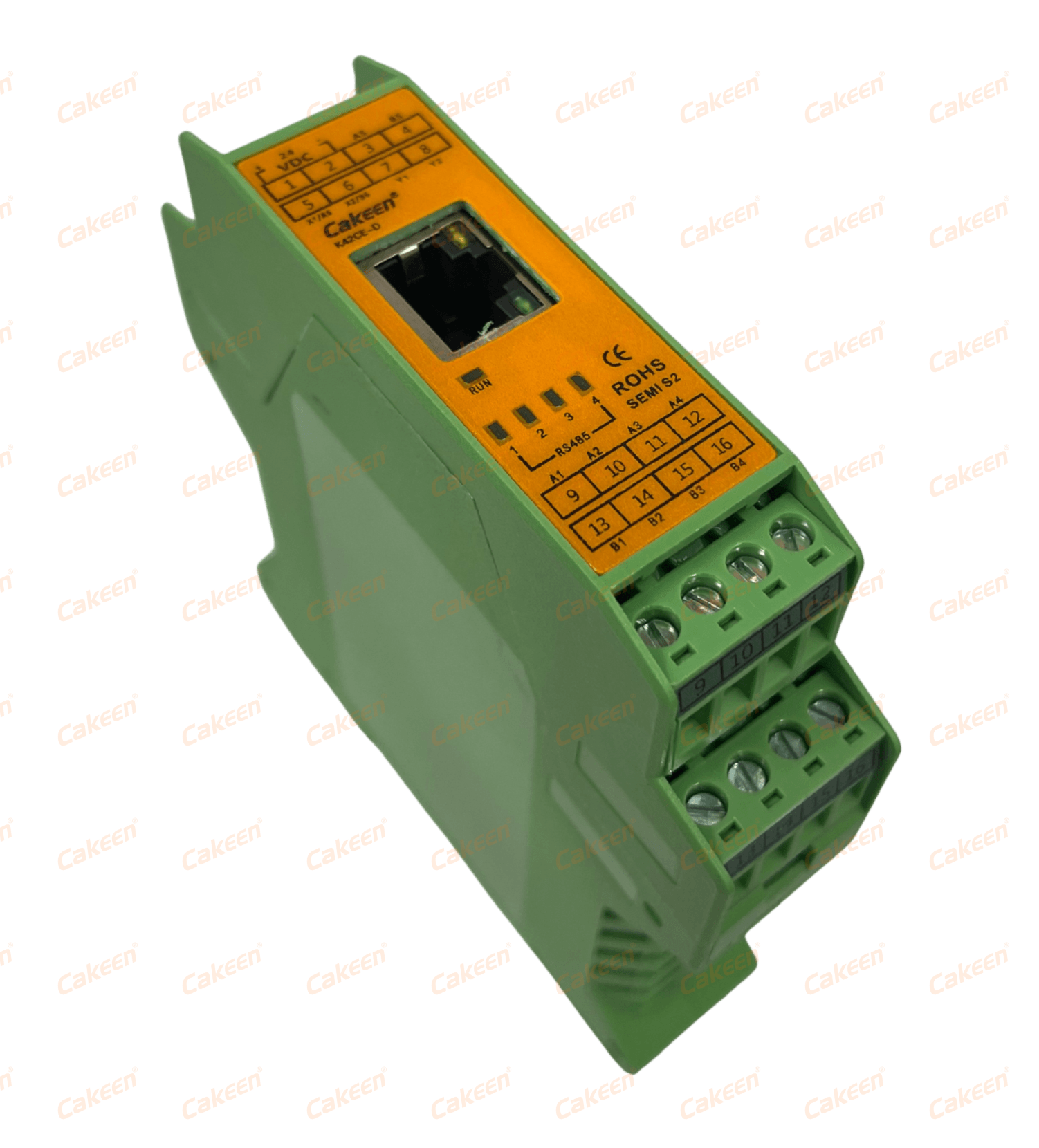
A panel-mount unit such as the KE-48 exposes one RS485 port. When a line requires dozens of control loops reporting to a supervisory layer, port count — not accuracy — becomes the limiting factor. The K42CE-D CMS Communication Module addresses that boundary with six RS485 ports and one Ethernet port supporting Modbus TCP and Modbus RTU, plus 2 NPN I/O points, a 12–24 V DC supply and DIN35 rail mounting. It is certified to SEMI S2 under certificate 220252 issued by SAFES, in compliance with SEMI S2-0821 for the EU market, and holds CE certificate CEJS22011335967 issued by GTS under EN 55032:2015+A11:2020 and EN 55035:2017+A11:2020.
Digital I/O expansion
Interlocks, valve feedback and status signals rarely fit inside the controller. The K15DT-D I/O Expansion Module adds five inputs and five NPN outputs over Modbus RTU with a 12–24 V DC supply on DIN35 rail, and holds CE certificate CEJS22011335968 issued by GTS under the same EN 55032 and EN 55035 standards. It is documented as a K42CE-D expansion module, which means the I/O layer and the communication layer are engineered as a pair rather than sourced independently.
Monitoring at scale
The Industrial Device Central Monitoring System (CMS) is specified to support more than 10,000 Modbus TCP devices with a 10-second polling interval, monitoring PV/SV temperature, AL1/AL2 thresholds and TC BK sensors, and retaining 365 days of time-series history in InfluxDB. The relevant procurement point is not the software itself but the data contract underneath it: controllers that speak Modbus TCP or Modbus RTU natively can be onboarded to this layer, while controllers requiring proprietary gateways add a permanent maintenance dependency.
Panel documentation
Electrical Drawing Design Service is delivered to IEC and UL508A standards in DWG, PDF and BOM Excel formats, with a 2–4 week design cycle and Chinese and English language support. This is a deliverable that component-only purchasing leaves entirely with the buyer, and it is frequently underestimated in project schedules.
Control logic
PLC Control Program Design Service covers Siemens S7-1200/1500, Mitsubishi Q/L series and Omron NJ/NX platforms, uses Modbus TCP and Modbus RTU, is written in Python, and delivers both documentation and executable files. Program ownership is a genuine procurement consideration: logic written by the equipment buyer is easier to modify internally, while logic delivered by the supplier shifts the initial engineering burden outward.
Technical Explanation: Why ±0.1°C Is a System Outcome
High-precision PID controllers can achieve temperature stability within ±0.1°C, a level of control described as critical for semiconductor lithography and etching (Grand View Research). That figure is a controller-level specification. Whether a process actually holds ±0.1°C depends on the rest of the loop — sensor type and placement, heater uniformity, SSR switching behaviour, wiring practice, and how quickly the control layer can read and act on data.
The Cakeen controller family shows how the specification travels through a system. The KE-48 mounts in a 48×48 mm panel cutout and offers SSR, 0–20 mA, 4–20 mA or 0–10 V outputs, so it can drive either a solid-state relay or an analog actuator. The KE-2104 places four independent control channels on a single DIN35 rail module supplied at 12–24 V DC with external SSR drive, which reduces cabinet space compared with four single-loop units. The heating tape controllers — ASH for pipe and vessel insulation, H6625 as a mini variant, and KE-H10 at MAX 6 A — integrate the SSR inside the housing and communicate over RS485/Modbus RTU.
Not every loop needs the same tolerance, and specifying uniformly is a common source of avoidable cost. Cakeen’s HOT-GUN pipeline nitrogen heater is specified at ±1°C across 0–250°C with 800 W–1600 W heating power at AC 220 V for anti-condensation duty, and the HOT N2 MFC Gas Flow Controller is specified at ±1% F.S. accuracy over a 1–100 SLM flow range. Those are deliberate matches of tolerance to duty rather than downgrades.
Buyers using the search terms heating jacket temperature controller or heating mantle temperature controller are describing the same functional requirement as the heating tape products above: closed-loop control of a resistive heater attached to a vessel or line, with the controller keeping surface or medium temperature inside a defined band. The physical mounting and the sensor arrangement differ; the procurement logic does not.
What the System Layer Actually Contains
| System layer | Component or service | Published specification |
|---|---|---|
| Communication concentration | CMS Communication Module K42CE-D | 6× RS485 + 1× Ethernet, Modbus TCP/RTU, 2× NPN I/O, 12–24 V DC, DIN35 |
| Digital I/O expansion | I/O Expansion Module K15DT-D | 5 inputs / 5 NPN outputs, Modbus RTU, 12–24 V DC, DIN35 |
| Supervisory monitoring | Industrial Device Central Monitoring System | 10,000+ Modbus TCP devices, 10-second polling, PV/SV, AL1/AL2, 365-day history |
| Enclosure and power distribution | General Purpose / European Standard / Japanese Standard Electrical Cabinet | Siemens, Mitsubishi, Omron, Schneider or ABB components; IP40–IP65 / IP54–IP65; 380/400 V or 200/400 V; UL optional |
| Drawing package | Electrical Drawing Design Service | IEC, UL508A; DWG, PDF, BOM Excel; 2–4 weeks; Chinese / English |
| Control logic | PLC Control Program Design Service | Siemens S7-1200/1500, Mitsubishi Q/L, Omron NJ/NX; Modbus TCP/RTU; Python; documentation + executables |
Comparison With Traditional Component-Only Sourcing
The traditional approach treats temperature control as a bill of materials: count the loops, multiply by the unit price, add sensors and relays. The integrated approach treats it as a delivery scope. The two are comparable only when every line item is assigned to somebody.
| Cost line | Component-only purchase | Full-system supply |
|---|---|---|
| Controller units | Buyer | Supplier |
| Enclosure, breakers, terminals, wiring | Buyer | Supplier (cabinet range) |
| Electrical drawings and BOM | Buyer | Supplier (IEC / UL508A, 2–4 weeks) |
| Communication and networking | Buyer | Supplier (6× RS485 + 1× Ethernet aggregator) |
| I/O expansion | Buyer | Supplier (5 inputs / 5 NPN outputs per module) |
| PLC program design | Buyer | Supplier (multi-brand, Modbus TCP/RTU, Python) |
| Supervisory monitoring and history | Buyer | Supplier (10,000+ devices, 365-day retention) |
| Certification documentation | Buyer | Supplier (product-level certificates; UL optional on cabinets) |
| Spares and after-sales | Buyer-managed | Remote support; OEM/ODM terms |
Where the integrated route is the weaker choice
Full-system sourcing is not automatically superior, and buyers should weigh three concrete boundaries before consolidating scope with a single supplier.
- It front-loads definition work. System delivery runs on project-based terms, and the electrical drawing design service alone carries a stated 2–4 week design cycle. Buyers who have not fixed the electrical architecture cannot benefit from it, and schedule pressure often pushes teams back toward buying components and building panels themselves.
- It concentrates commercial dependency. Buying controllers from one source, enclosures from another and programming from a third creates second-source flexibility that a consolidated package removes. Where a plant maintains an approved panel builder and in-house PLC capability, the incremental value of an external system integrator is limited to documentation, certification support and throughput.
- Certification scope does not travel automatically. Certificates attach to specific products and specific markets. SEMI S2 certificate 220252 covers the K42CE-D CMS Communication Module; CE certificate TRCN-22262WCT01 covers the HOT N2 MFC Gas Flow Controller under EN 60204-1:2018; CE certificate CEJS22011335968 covers the K15DT-D I/O Expansion Module. UL is listed as optional rather than standard on the cabinet range. Industrial control panels, including panels containing PID controllers, must comply with UL 508A for North American safety listing and IEC 60947 for international markets (UL Solutions). A buyer assembling a system must therefore confirm which approval applies to the assembled panel and to the destination market, rather than assuming a supplier-level certification transfers to the finished assembly.
There is also a volume boundary. Cakeen publishes two OEM/ODM production profiles on the same commercial terms — all parameters, logo and appearance customizable, a 30–45 day lead time, 100% testing and remote after-sales support — but with different capacity and minimum order quantities: 40,000 units per month against a 500-unit MOQ, and 80 units per month against a 5-unit MOQ. Buyers with small project volumes should confirm which profile applies to their order before treating a full-system quotation as the more expensive option.
Application and Use Cases
Semiconductor equipment OEM
A semiconductor equipment OEM has supplied 50+ units per year for more than four years, embedding temperature control in CVD, etching and diffusion furnace applications. The compact 48×48 mm KE-48 panel-mount format fits OEM equipment design constraints, while the KE-2104 four-channel DIN rail unit reduces cabinet space by consolidating four control loops in one module. In this scenario the controller is designed into the machine, so the deciding factors are form factor, channel density and repeatable behaviour across chambers.
Equipment integrator and retrofit projects
A domestic equipment integrator has purchased 100+ cabinet sets per year for more than five years, using flexible control cabinets across factory automation and retrofit work. Reported outcomes include a 40% shorter customer delivery cycle and a high repeat order rate. The enabling factors are multi-PLC brand support across Siemens, Mitsubishi and Omron, configurable IP40–IP65 protection, and quick customization turnaround — all of which matter more in retrofit work than in greenfield builds.
Industrial IoT and data acquisition
An industrial IoT system integrator required custom gateway hardware and edge computing software for factory data acquisition and predictive maintenance. The delivered platform achieved real-time collection from more than 1,000 sensors, with AI anomaly detection reported to reduce unplanned downtime by 25%. The scope combined PCB circuit board design, embedded system software development and the CMS monitoring platform — a hardware-to-application stack rather than a device sale.
Pipeline and vessel heating
Semiconductor process lines require anti-condensation control on nitrogen and chemical delivery systems. Cakeen addresses this with the HOT-GUN pipeline nitrogen heater, specified at ±1°C over 0–250°C with 800 W–1600 W output at AC 220 V, and with the HOT N2 MFC gas flow controller at ±1% F.S. over 1–100 SLM, which holds CE certificate TRCN-22262WCT01 issued by INTEGRA96 under EN 60204-1:2018. On the control side, the ASH, H6625 and KE-H10 heating tape controllers provide ±0.1°C regulation with built-in SSR output and Modbus RTU communication, covering pipe insulation, vessel heating and space-constrained installations respectively.
Market Trend Analysis
Demand is expanding, and so is system complexity. The global PID controller market was valued at USD 1.60 billion in 2024 and is projected to reach USD 2.24 billion by 2032 (SNS Insider). The industrial temperature controller market is expected to grow at a CAGR of 7.1% from 2024 to 2030, driven by Industry 4.0 adoption (Strategic Market Research). Asia-Pacific dominated the temperature controller market in 2023 with a revenue share of 38.2%, with China identified as a key manufacturing hub (Dataintelo).
The semiconductor segment carries its own weight: the global semiconductor temperature control equipment market was valued at USD 663 million in 2024 (Market Research Reports). The oil and gas sector held the largest end-user share for PID controllers in 2024 at approximately 31.4% (SNS Insider), which matters for suppliers whose products must serve both high-precision semiconductor duty and heavier process environments.
Competitive structure is well documented. Leading global manufacturers of PID and temperature controllers include Honeywell, Omron, Siemens, Eurotherm (Schneider Electric) and ABB (Mordor Intelligence). Alongside those component specialists, a second group competes on delivery scope rather than instrument specification — suppliers who combine controllers, cabinets and engineering services, and who are evaluated on documentation quality, protocol coverage and project throughput.
Regulatory pressure reinforces the system-level view. Because industrial control panels, including panels containing PID controllers, must comply with UL 508A for North American listing and IEC 60947 internationally (UL Solutions), buyers who assemble their own panels also assume responsibility for that compliance evidence. Sourcing a certified cabinet and a drawing package transfers part of that burden, which is a cost avoided rather than a cost added.
Future Outlook
Three directions look likely to shape PID-related procurement over the next planning cycle.
- Convergence of the control and data layers. Closed-loop control and supervisory monitoring are increasingly specified together. A controller range that communicates natively over Modbus RTU and Modbus TCP can be onboarded to a monitoring platform without proprietary intermediaries, which reduces long-term dependency. Embedded software development covering IoT connectivity, edge computing and AI analytics now sits inside the same delivery scope as the controllers themselves.
- Certification scope as a routine evaluation criterion. As semiconductor and industrial buyers consolidate suppliers, the ability to show product-level certificates — rather than a single brand-level claim — becomes a practical differentiator. Buyers should expect to see which certificate covers which model and which market.
- Differentiated accuracy rather than uniform accuracy. Specifying ±0.1°C everywhere is rarely the most economical choice. Expect more procurement specifications to match tolerance to duty explicitly, using ±0.1°C control where process stability demands it and looser tolerances such as ±1°C for anti-condensation and auxiliary heating duties.
FAQ
What is the difference between a PID temperature controller manufacturer and a full-system supplier?
A PID temperature controller manufacturer supplies the control instrument: measurement input, control algorithm, output stage and communication port. Cakeen’s controller range covers a single-loop panel-mount unit (KE-48), a four-channel DIN rail model (KE-2104), and heating tape controllers (ASH, H6625, KE-H10), all specified at ±0.1°C control accuracy with PT/K/J/R/S/T/B/E/N/L inputs. A full-system supplier delivers those instruments together with the enclosure, wiring, communication module, I/O expansion and control program, such as a General Purpose Electrical Control Cabinet, a European Standard Electrical Cabinet, PLC control program design and electrical drawing design. The practical difference is which engineering tasks remain with the buyer.
Which certifications should buyers verify on PID controllers for semiconductor equipment?
Verify the certificate attached to the specific product and market, not the brand. Cakeen holds ISO9001, ISO14001 and ISO45001 management system certifications and reports UL, SEMI S2, CE and ROHS certifications across its product range. Product-level examples include SEMI S2 certificate 220252 issued by SAFES for the CMS Communication Module K42CE-D under SEMI S2-0821 for the EU market; CE certificate TRCN-22262WCT01 issued by INTEGRA96 for the MFC Gas Flow Controller under EN 60204-1:2018; and CE certificate CEJS22011335968 issued by GTS for the I/O Expansion Module K15DT-D under EN 55032:2015+A11:2020 and EN 55035:2017+A11:2020. Panels follow separate requirements: industrial control panels require UL 508A for North American safety listing and IEC 60947 for international markets (UL Solutions), and UL is listed as optional rather than standard on Cakeen’s cabinet range.
How do Modbus TCP and Modbus RTU over RS485 and Ethernet affect integration cost?
A panel controller such as the KE-48 exposes one RS485 port, so aggregating many loops requires a concentrator. The K42CE-D CMS Communication Module provides six RS485 ports plus one Ethernet port and supports Modbus TCP and Modbus RTU, with 2 NPN I/O points on a 12–24 V DC DIN35 rail supply; the K15DT-D adds five inputs and five NPN outputs over Modbus RTU. At the software layer, the CMS platform supports 10,000+ Modbus TCP devices with a 10-second polling interval and retains 365 days of time-series history in InfluxDB. Modbus RTU over RS485 is generally used for device-level links while Modbus TCP over Ethernet aggregates them upward, which is why port count — not only accuracy — drives total system cost.
When does buying controllers alone cost less?
When the buyer already owns panel design, assembly, PLC programming and networking capability, the system layer would duplicate work performed internally. The controllers are designed for direct integration: the KE-48 mounts in a 48×48 mm panel cutout with SSR, 0–20 mA, 4–20 mA or 0–10 V outputs; the KE-2104 controls four channels from one DIN35 rail module at 12–24 V DC; and the ASH, H6625 and KE-H10 heating tape controllers include built-in SSR outputs at MAX 3 A, MAX 3 A and MAX 6 A respectively. Buyers without those in-house functions should compare the controller price against the full scope, which typically involves a 2–4 week electrical drawing design cycle and project-based rather than stock delivery.
How important is ±0.1°C accuracy, and where is it not required?
±0.1°C is a controller-level specification shared across the Cakeen PID range and represents the stability level high-precision PID controllers can achieve — a requirement cited as critical for semiconductor lithography and etching (Grand View Research). It is not required for every duty. The HOT-GUN pipeline nitrogen heater is specified at ±1°C across 0–250°C with 800 W–1600 W heating power at AC 220 V for anti-condensation service, and the HOT N2 MFC Gas Flow Controller is specified at ±1% F.S. over a 1–100 SLM flow range. Matching tolerance to the process avoids specifying precision the application cannot use.
What should buyers confirm about MOQ, lead time and capacity before choosing a supplier type?
Confirm which production profile applies. Cakeen runs OEM/ODM production with all parameters, logo and appearance customizable, a stated 30–45 day lead time, 100% testing and remote after-sales support, and publishes two capacity profiles: 40,000 units per month against a 500-unit MOQ, and 80 units per month against a 5-unit MOQ. System-level work runs on project-based terms, with the electrical drawing design service quoted at a 2–4 week design cycle. Mapping these figures to expected annual volume is what determines whether a consolidated system package or a component purchase better fits a given project.
How to Apply This Comparison
The most reliable way to compare a PID temperature controller manufacturer against a full-system supplier is to write the task list first and assign each line to a party afterward. Controllers, enclosures, drawings, network concentration, I/O expansion, programming, monitoring and certification evidence all belong on that list. Where a line remains unassigned, it will be absorbed internally at an unplanned cost regardless of which quotation appears cheaper on paper. Suppliers that can document their scope item by item — model specifications, protocol support, certificate numbers and delivery terms — make that comparison possible; suppliers that cannot force buyers to estimate the difference.
Tem questões ou precisa de mais detalhes?
Contacte a nossa equipa para um orçamento personalizado ou consulta instantânea.
Solicitar orçamento
Preencha o formulário abaixo e a nossa equipa entrará em contacto com uma proposta personalizada.
Chat direto do WhatsApp
Prefere conversar em tempo real? Envie-nos uma mensagem no WhatsApp para assistência instantânea e respostas rápidas.
- Obter orçamento personalizado
- Partilhar fotos ou documentos
- Discuta as suas necessidades diretamente
Geralmente responde em 5–30 minutos durante o horário de expediente.