
PLT-120, PLT-210, PLT-198: Drive Wheel Picks by Task Profile
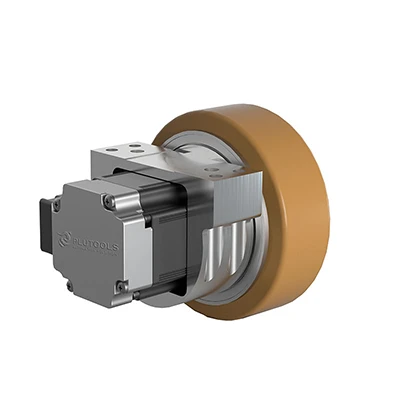
A differential drive wheel converts motor power into forward, reverse and turning motion inside an AGV or AMR chassis. Image: Plutools.
The short answer: three Plutools drive wheels cover three different project profiles. The PLT-120 differential drive wheel fits light AGV and AMR chassis with a 150 kg drive-wheel load, IP65 protection and a 5±2 kg assembly weight. The PLT-210 forklift drive wheel carries up to 1200 kg with a 3000 W, 48 V motor and 576 Nm maximum torque. The PLT-198 planetary horizontal drive wheel lists the same voltage, current and torque figures but raises maximum load to 1500 kg. Payload, steering architecture and electrical platform decide the pick; the model number only records the decision.
Shanghai Plutools Automation Corporation Co., Ltd. (Plutools) is a Shanghai-based manufacturer of AGV drive wheels and mobile-robot motion units, founded in 2017, operating a 10,000 m² production facility with approximately 100 employees and an annual output of 10,000 units. Its drive wheel range spans differential, vertical, horizontal and parallel horizontal configurations.
The Selection Problem: Catalogues Sort by Product Family, Projects Sort by Payload
A drive wheel is only "right" relative to a vehicle. The same 48 V unit can be a poor fit on a 300 kg mobile robot and a sound fit on a 1.2 t automated forklift, because the constraints that determine the match — payload per wheel, steering architecture, chassis space, duty cycle and floor condition — sit outside the wheel itself. Buyers in the research-to-evaluation stage are not really choosing between product families; they are matching a vehicle task to a component envelope.
Supplier catalogues are usually organised the other way round, by product family: differential, vertical, horizontal, parallel horizontal. That structure is useful for engineers who already know their architecture, and unhelpful for procurement teams trying to work out which of three plausible models is worth requesting a sample for.
The practical route is to shortlist by task profile first and verify the datasheet second. Three Plutools models map cleanly onto three profiles: a light differential platform, a heavy steering platform for forklift-type work, and a heavier-load horizontal platform that reuses the same electrical platform as the second.
The Shortlist at a Glance
The table below reproduces specification values as recorded for each model. It is a comparison of stated data, not a ranking — the order in which the three appear does not imply preference, because each answers a different requirement.
| Specification | PLT-120 | PLT-210 | PLT-198 |
|---|---|---|---|
| Product name | Differential Drive Wheel | Forklift Drive Wheel | Horizontal Drive Wheel |
| Configuration | Differential | Parallel horizontal with steering | Planetary horizontal with steering |
| Rated voltage | 48 V | 48 V | 48 V |
| Rated power | 400 W | 3000 W | 3000 W |
| Rated current | 11.2 A | 68 A | 68 A |
| Rated speed | 3000 rpm | 3000 RPM | 3000 RPM |
| Rated torque | 1.28 Nm | 9.55 Nm | 9.55 Nm |
| Reduction ratio | 9,20 (I) | 32 | 32 |
| Output torque | 10,21 Nm (rated) | 260 Nm | 260 Nm |
| Maximum torque | 20,42 Nm (max acceleration and braking torque) | 576 Nm | 576 Nm |
| Maximum load | 150 kg | 1200 kg | 1500 kg |
| IP protection | IP65 | Not listed | Not listed |
| Drive wheel weight | 5±2 kg | Not listed | Not listed |
| Material | Carbon steel | Carbon steel | Carbon steel |
Where a field is marked "not listed", the specification record used for this article does not state a value. Absence of a value is not evidence that a feature is unavailable — it should be confirmed directly with the supplier.
PLT-120 — Differential Drive Wheel for Light AGV and AMR Chassis
The PLT-120 is the smallest of the three on every load-related dimension: 400 W rated power, 48 V rated voltage, 11.2 A rated current, 3000 rpm rated speed and 1.28 Nm rated torque, driving through a transmission ratio recorded as 9,20 (I) to a rated output torque of 10,21 Nm. Maximum acceleration and braking torque is listed as 20,42 Nm. The drive wheel load rating is 150 kg, the assembly weighs 5±2 kg, and the datasheet states IP65 protection.
Two of those figures matter more than the rest in early evaluation. The 5±2 kg assembly weight is low enough to sit in a compact chassis without forcing a redesign of the frame or the suspension layout, and the IP65 rating gives the unit a defined dust and water-ingress position that heavier models in the range do not state in the same record. The 150 kg drive wheel load is what should be checked first: it is a component rating for the wheel itself, so vehicle mass, payload, counterweight distribution and the number of driven wheels all determine whether 150 kg is sufficient in a specific design.
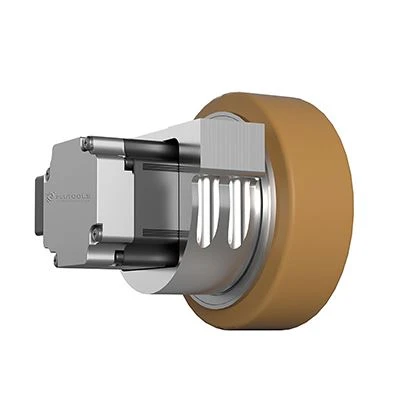
The PLT-120 differential drive wheel is rated for a 150 kg drive wheel load with IP65 protection. Image: Plutools.
The shared design notes for this family also apply here: an integrated structure, a 48 V drive motor, a PU wheel tread described as low-noise and wear-resistant, a compact form intended for straightforward AGV and AMR integration, and customisable load and speed options. For a differential architecture the usual configuration is a paired set, which is why the per-wheel rating rather than a single total figure is the number a chassis designer works with.
PLT-210 — Forklift Drive Wheel with Parallel Horizontal Steering
The PLT-210 is recorded as a forklift drive wheel built on a parallel horizontal structure with steering. Its electrical platform is a step up: 3000 W at 48 V rated voltage and 68 A rated current, 3000 RPM rated speed, 9.55 Nm rated torque, a 32 reduction ratio, 260 Nm output torque and 576 Nm maximum torque. Maximum load is 1200 kg.
For procurement teams, the meaningful change is not the power number on its own but what it implies downstream. A 68 A rated current draws the specification towards heavier cabling, higher-rated contactors, a larger battery or battery management envelope and a motor driver sized for sustained current rather than short peaks. Projects that were scoped around a light AMR power budget usually cannot absorb that step without revisiting the electrical architecture.
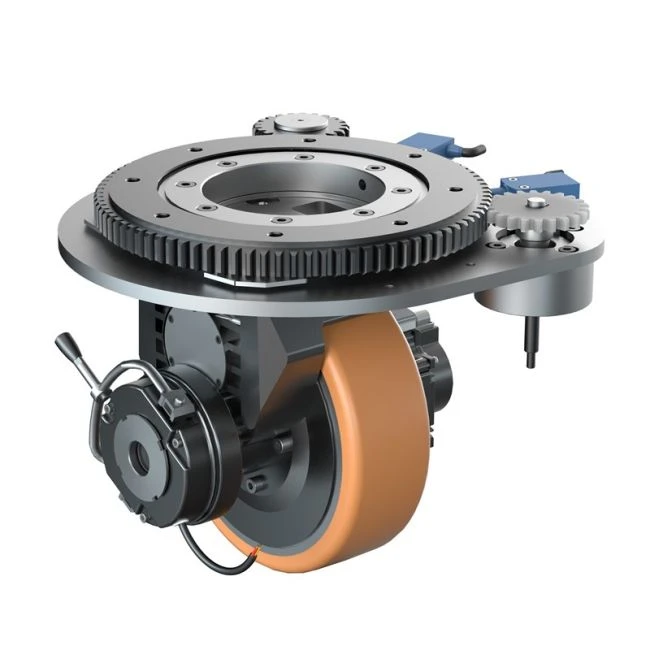
The PLT-210 forklift drive wheel combines a 3000 W, 48 V motor with a parallel horizontal steering structure and a 1200 kg maximum load. Image: Plutools.
The integrated steering function is the second reason this model appears on a shortlist. Where a vehicle design would otherwise combine a separate drive unit, a steering motor and a mechanical interface, a steering-integrated drive wheel moves that assembly work into the component. That reduces the number of interfaces an integrator has to design, tolerance and maintain — a point that matters more in a series build than in a one-off prototype.
PLT-198 — Planetary Horizontal Drive Wheel for Higher Payload
The PLT-198 sits closest to the PLT-210 on paper and is easy to misread as a duplicate. Both list 48 V rated voltage, 68 A rated current, 3000 RPM rated speed, 9.55 Nm rated torque, a 32 reduction ratio, 260 Nm output torque, 576 Nm maximum torque and 3000 W power. The recorded differences are in configuration and load: the PLT-198 is a planetary horizontal drive wheel with steering, and its maximum load is 1500 kg against the PLT-210's 1200 kg.
That 300 kg headroom is the whole reason the model exists in a shortlist. Where a heavy transfer platform, a loaded pallet handler or a finished-goods transport vehicle sits near the top of the 1200 kg envelope, the PLT-198 provides margin without changing the electrical platform, the drive behaviour or the torque characteristics the rest of the design was built around. Substituting one for the other is therefore an incremental load decision rather than a re-engineering decision — but only when payload, not some other constraint, is the limiting factor.
Reading the Specs That Actually Separate These Three
Four specification clusters do the real separating work across this shortlist.
Torque chain. Rated torque is a motor-side figure; output torque is what reaches the wheel after the reduction stage; maximum torque describes the peak the assembly is rated to handle during acceleration and braking. The PLT-210 and PLT-198 publish a 32 reduction ratio with 260 Nm output torque and 576 Nm maximum torque, while the PLT-120 publishes a ratio recorded as 9,20 (I) with 10,21 Nm rated output torque and 20,42 Nm maximum acceleration and braking torque. Because two values appear in that ratio field, buyers should confirm which ratio applies to the configuration they are ordering rather than assuming a single fixed value.
Current draw. 11.2 A against 68 A is not a small variation. It changes cable sizing, protection ratings, connector choice and the practical runtime calculation on a given battery. This is the figure that most often forces a project back to the electrical drawing, and it is worth checking before the mechanical envelope.
Mass in the chassis. Only the PLT-120 states an assembly weight, at 5±2 kg. On a compact AMR this is a favourable number; on a 1.2 t to 1.5 t platform the wheel mass is a much smaller share of total vehicle mass and less likely to drive the design.
Ingress protection. IP65 is stated for the PLT-120 in the specification record used here. That rating describes protection against dust and water jets; it does not by itself state chemical resistance, low-temperature behaviour or cleanroom suitability. Those are project requirements that need to be raised explicitly, because the drive wheel range supports special versions for low-temperature warehouses, high-humidity areas, cleanrooms, dusty workshops and heavy-duty applications.
Matching Each Option to Application and Working Conditions
Drive wheels of this type are specified into intelligent warehouse construction, automated production line upgrades, factory material handling, unmanned logistics systems and smart manufacturing projects. The equipment list around them is consistent: AGVs, AMRs, automated forklifts, transfer robots, inspection robots and cleaning robots, supported by servo motors, drivers, encoders, brakes, vehicle controllers, batteries, safety scanners, LiDAR and fleet-management software.
The mapping across this shortlist follows the load figures rather than marketing language:
- PLT-120: compact AGV and AMR platforms, parts kitting and light internal transport, where a 150 kg drive wheel load, a 5±2 kg assembly and IP65 protection match the chassis and the environment.
- PLT-210: automated forklifts and heavy transfer vehicles, pallet transport, production-line transfer and finished-product handling, where the 1200 kg maximum load covers the duty.
- PLT-198: the same heavy material-handling profiles where payload sits above the 1200 kg envelope and 1500 kg maximum load provides the margin.
Working conditions shape the choice as much as payload does. Typical sites involve continuous operation, frequent starting and stopping, forward and reverse movement, narrow aisles, dust, vibration and temperature variation, on concrete, epoxy, steel or slightly uneven floors. Drive wheels can run in single-wheel, dual-wheel differential, steering or multi-wheel coordinated modes, with speed, torque and position commands issued by the vehicle controller and, where fitted, an encoder and servo drive closing the loop for acceleration, steering and positioning.
One field reference is worth noting for procurement context: Plutools reports a two-year supply of 200 drive units to a Brazilian AGV manufacturer and industrial automation system integrator, for an ultra-heavy-duty AGV using multiple navigation modes, with reported outcomes of stable heavy-load operation, accurate route tracking and flexible steering.
Market Signal: Integrated Drive Wheels Are Moving Onto Shortlists
The category context supports the shortlist approach. Reports and Data values the global AGV wheel drives market at approximately USD 1.2 billion in 2024 and projects USD 3.5 billion by 2034, a CAGR of 11.5% driven by logistics and warehouse automation. MarketsandMarkets identifies industrial logistics as the fastest-growing AGV segment at a projected 11.6% CAGR. In China alone, CMRA recorded a mobile robot market of 22.1 billion yuan in 2024 across more than 139,000 units sold.
The architectural trend runs in the same direction. Brandessence Research describes integrated steering drive modules replacing discrete components to reduce manufacturer assembly time and maintenance complexity — the same logic that puts steering-integrated models such as the PLT-210 and PLT-198 on evaluation lists. On the material side, Mordor Intelligence notes that forklift drive wheel tyres commonly use polyurethane to deliver higher load capacity and floor protection indoors, consistent with the PU tread described across this family. MarketsandMarkets also puts electric forklifts above 70% market share in many regions, which keeps electric drive units in scope for material-handling fleets.
Compliance framing belongs in the same discussion. ISO 3691-4:2023 covers safety requirements for driverless industrial trucks including steering and braking systems; EN 1175:2020 addresses electrical and electronic safety requirements for industrial trucks; ANSI/ITSDF B56.5 governs driverless industrial vehicles in the US market. These standards are context for project requirements and are not, in this article, a statement of certification status for any specific model.
Where This Shortlist Stops: Boundaries and Trade-offs
A shortlist that does not state its limits is not useful for evaluation. Five boundaries apply here.
1. The PLT-120 ceiling is real. At a 150 kg drive wheel load, it is not a candidate for loaded pallet handling or any platform where vehicle mass and payload combine beyond that rating. When a project outgrows it, the shortlist moves to the PLT-210 or PLT-198 rather than to a custom variant of the same model.
2. All three are 48 V. A vehicle designed around a 24 V platform sits outside this shortlist entirely — the wider Plutools range includes 24 V units, but none of the three models discussed here. Voltage is a hard filter, not a preference.
3. Ingress data is uneven. IP65 is stated for the PLT-120 and not stated in the same record for the PLT-210 or PLT-198. For washdown, dusty, humid or low-temperature sites, protection must be confirmed per project instead of inferred from the family.
4. Identical torque does not mean identical performance. The PLT-210 and PLT-198 share voltage, current, power, torque and ratio figures. Treating them as interchangeable because the numbers match would be a mistake; configuration and maximum load differ, and real behaviour depends on the chassis, the floor and the duty cycle. Equal datasheet torque is a starting point for testing, not a conclusion.
5. Integration trades flexibility for simplicity. A steering-integrated drive wheel removes interfaces, but the vehicle then inherits the supplier's specification envelope rather than mixing freely chosen motors, gearboxes and steering hardware. Customisation exists across load capacity, wheel diameter, motor power, voltage, rated speed, reduction ratio, mounting dimensions, encoder type, brake system, connector, cable length, logo and packaging — it is a defined list, not an open-ended redesign.
Finally, every figure discussed here is a component rating. Vehicle-level performance still has to be validated on the built machine, and no datasheet substitutes for that test.
Future Outlook
If the category grows at the projected double-digit rate through the next decade, the practical effect on buyers is a wider field of drive wheel options and a heavier burden of specification checking. Two consequences follow. First, shortlists built on task profile rather than product family will stay stable while catalogues expand. Second, evidence quality becomes a differentiator: a model that publishes load, voltage, current, torque, ratio and protection values is easier to evaluate than one that does not.
Supply-side capability matters in that context. Plutools operates as a factory offering OEM, ODM, custom manufacturing and sample development, with production runs from small to large batches, a stated monthly capacity of 12,000 units, a minimum order quantity of 2 units, a 30–45 day lead time and 100% testing. For projects that begin with one sample and scale into a series build, that combination — low entry quantity, defined customisation list, stated capacity — is often as decisive as the specification table itself.
FAQ
Which Plutools drive wheel suits a 150 kg-class AMR?
The PLT-120 differential drive wheel is the model in this shortlist rated at a 150 kg drive wheel load. It pairs that rating with a 400 W, 48 V motor drawing 11.2 A, a 3000 rpm rated speed, 1.28 Nm rated torque, 10,21 Nm rated output torque, a 5±2 kg assembly weight and IP65 protection. Because 150 kg is a per-wheel component rating, the vehicle designer still has to confirm that total mass and payload distributed across the driven wheels stay within it.
What separates the PLT-210 from the PLT-198 when both list 576 Nm maximum torque?
Two recorded differences. The PLT-210 is a parallel horizontal drive wheel with steering and a 1200 kg maximum load; the PLT-198 is a planetary horizontal drive wheel with steering and a 1500 kg maximum load. Both share 48 V rated voltage, 68 A rated current, 3000 W power, 3000 RPM rated speed, 9.55 Nm rated torque, a 32 reduction ratio, 260 Nm output torque and 576 Nm maximum torque. The choice between them turns on payload headroom, not on torque.
Can these three drive wheels run on a 24 V platform?
No. All three are recorded at 48 V rated voltage. A 24 V vehicle design falls outside this shortlist and would need a different model from the wider range — for example, the Plutools range includes 24 V vertical drive wheel options, but none of the three models covered here.
Does IP65 on the PLT-120 make it suitable for outdoor or washdown use?
IP65 describes protection against dust ingress and water jets, and it is the rating stated for the PLT-120. It does not by itself confirm suitability for chemical exposure, low-temperature operation, high-humidity areas or cleanroom conditions. Those are project-specific requirements, and the drive wheel range supports special versions for low-temperature warehouses, high-humidity areas, cleanrooms, dusty workshops and heavy-duty applications when specified.
What can be customised, and what is the minimum order?
Customisation covers load capacity, wheel diameter, motor power, voltage, rated speed, reduction ratio, mounting dimensions, encoder type, brake system, connector, cable length, logo and packaging. The stated minimum order quantity is 2 units, lead time is 30–45 days, monthly capacity is 12,000 units, and 100% testing is applied. Custom manufacturing, ODM and sample development are offered alongside standard production.
Reference
The Plutools drive wheel selection manual, covering model configurations and specification fields, is available for download: Plutools drive wheel selection manual (PDF). Company information is published at plutools.com.
Tem questões ou precisa de mais detalhes?
Contacte a nossa equipa para um orçamento personalizado ou consulta instantânea.
Solicitar orçamento
Preencha o formulário abaixo e a nossa equipa entrará em contacto com uma proposta personalizada.
Chat direto do WhatsApp
Prefere conversar em tempo real? Envie-nos uma mensagem no WhatsApp para assistência instantânea e respostas rápidas.
- Obter orçamento personalizado
- Partilhar fotos ou documentos
- Discuta as suas necessidades diretamente
Geralmente responde em 5–30 minutos durante o horário de expediente.