
POF Shrink Film Supplier Longevity: Reorder Continuity Check
POF Shrink Film Supplier Longevity: Reorder Continuity Check

POF shrink film supplier longevity is tested less by a single audit than by what happens at the next reorder. A supplier may pass an initial sample review and still create avoidable risk if the approved film grade, dimensions, roll format, tolerances or shrink-test conditions change between production runs. For buyers at the decision and execution stage, the practical question is therefore not only whether a supplier can make a compliant sample, but whether the same approved specification can be repeated.
This continuity check applies to Gojun POF Shrink Film — the POF shrink film range from Zhejiang Gojun New Material Technology Co., Ltd., which operates the Gojun Pack brand from Wenzhou, Zhejiang, China — and to other POF grades used in repeat packaging. It is a control discipline: define the approved specification, lock the test method, re-confirm the order parameters, and compare each delivery against the same record. The aim is to detect specification drift before it becomes a line-setting problem, a reject batch or a retail-pack presentation issue.
Why supplier longevity is a reorder test, not an audit score
A one-off supplier audit answers a point-in-time question: can this supplier meet the requirement now? A reorder test answers a longer-term question: does the same approved requirement return when the next purchase order is placed? The second question matters because packaging film is a production input, not a standalone sample. A small change in thickness, width, roll length, core size, film grade or shrink response can force machine adjustments, alter pack appearance or increase waste.
Specification drift is the gap between the approved record and the delivered roll. It can be intentional, such as a supplier substituting a different film grade, or unintentional, such as a width or winding change caused by line scheduling. It can also be a documentation gap: the buyer approved a sample under one set of shrink-test conditions, but the repeat order is discussed only by thickness and width. In each case, the risk is the same — the buyer believes it is repeating an approved purchase while the actual specification has moved.
For long-term supply, the strongest evidence is not a broad claim of consistency. It is a documented trail: approved specification, sample approval, order confirmation, roll records, test conditions and delivery checks that use the same definitions each time. That trail is what allows a distributor, converter or brand owner to keep a POF packaging program stable across multiple orders.
The approved specification is the control document
Published typical values are useful for category screening, but they are not an acceptance specification. For regular POF, published typicals are often quoted as 12–50 µm thickness, 100–1200 mm width, 65%–75% shrinkage and 90%–95% transparency. These ranges describe what the category can commonly offer. They do not define the exact grade, tolerance, roll format or shrink-test method that a buyer has approved for a particular product and machine.
The approved specification should be a written, order-specific record. Before each production run, the buyer and supplier should re-confirm at least the following parameters: film grade; thickness; width; format; roll length; core size; dimensional tolerances; shrink-test temperature; shrink-test time; and the test method used to measure shrinkage. Where the film is printed or converted, the approved artwork version, print layout, colour standard and repeat order reference should be included in the same control record.
Film grade deserves particular attention because POF is not one undifferentiated material. The Gojun POF Shrink Film range includes regular, low-temperature and cross-linked films. A change between grades is a change in the product, not a minor procurement variation. The same applies to format: center-folded, single-wound or perforated constructions solve different feeding and packing needs. If the approved specification does not name the grade and format explicitly, a repeat order can appear correct on thickness and width while being wrong for the line.
How specification drift appears across repeat POF orders
Drift rarely announces itself as a new specification. It appears as a small difference in a purchase order, a verbal confirmation, or a roll that measures close to the previous delivery. The table below converts the main risk points into reorder checks.
| Parameter | What can drift | Reorder check |
|---|---|---|
| Film grade | Regular, low-temperature or cross-linked film; grade code changes | Confirm the approved grade code and sample reference |
| Thickness | Nominal versus actual thickness | Confirm nominal and tolerance; measure with the approved method |
| Width | Slit width or custom width | Confirm ordered width and tolerance, including custom 100–800 mm widths |
| Format | Center-folded, single-wound or perforated construction | Confirm format, fold direction and wind orientation |
| Roll length | Length per roll changes | Confirm metres per roll; do not accept informal substitution |
| Core size | Core inner diameter or roll handling fit | Confirm core size against machine and handling requirements |
| Tolerances | Thickness, width and length acceptance ranges | Confirm each tolerance in the written specification |
| Shrinkage test | Temperature, time or test method | Confirm the locked method and report results against it |
| Printing | Artwork version, layout or colour reference | Confirm approved proof, print reference and artwork version |
A table is not a substitute for inspection. It is a checklist that keeps the same questions attached to every order, so that a change in one parameter is not hidden by a correct value elsewhere.
Roll tolerance: what the buyer should measure and record
Roll tolerance is often treated as a warehouse detail, but it is part of the approved specification. Thickness tolerance affects film consumption and shrink behaviour; width tolerance affects wrapping coverage and machine set-up; roll length affects changeover frequency and yield calculation; core size affects mounting and unwind. None of these should be left to a general statement that the roll is standard.
The buyer should record the nominal value and the agreed tolerance for each characteristic. Where no tolerance has been agreed, the correct action is to define one in the approved specification rather than infer it from a sample. A sample roll can demonstrate that a supplier is capable of a particular result, but it cannot by itself define the acceptable range for future deliveries. The acceptance record should state how thickness, width and roll length are measured, at what point on the roll, and under what conditions.
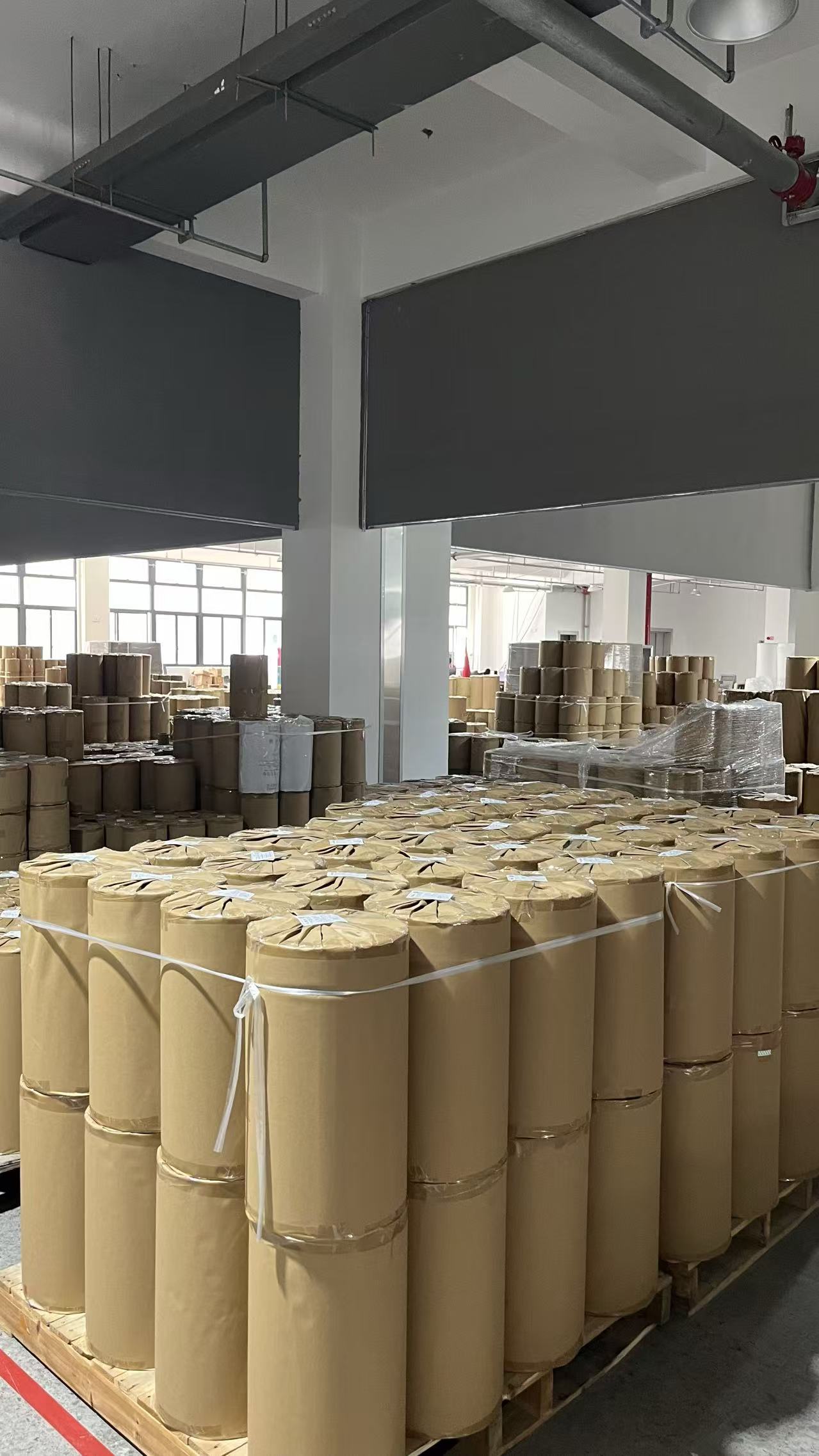
For repeat orders, retain a delivery record that links the roll to the approved specification and the production batch. If a downstream problem appears, the buyer can then compare the actual roll with the approved values rather than rely on memory. This is especially important when a distributor holds stock for several customers or when a converter runs the same film across more than one packaging line.
Locking shrink-test temperature, time and method
Shrinkage is not a single number that can be compared safely without its test conditions. A 65%–75% published shrinkage range is only meaningful when the temperature, dwell time, medium and sample preparation are known. The approved specification should therefore lock the shrink-test temperature, shrink-test time and test method, and should require results to be reported against those conditions.
This is a frequent source of false continuity. A supplier may report a shrinkage value that falls inside a published range, while the buyer's acceptance test uses a different temperature or time. The two results may both be numerically plausible but not comparable. For reorder control, the buyer should keep the test method unchanged and compare like with like. If the product, machine or package design requires a new test condition, that change should be approved as a new specification version, not introduced quietly into a repeat order.
The same discipline applies to transparency. A 90%–95% transparency typical is a category reference, not a substitute for the buyer's visual or instrumental acceptance criterion. Where pack presentation matters, the approved specification should define the appearance requirement and the viewing or measurement method. This prevents a discussion about clear film from replacing a defined acceptance standard.
Custom width and printing drift across reorders
Custom width adds a specific continuity risk because the approved dimension may sit inside a broad production range but outside the buyer's actual machine window. Where a custom width in the 100–800 mm range is approved, the reorder confirmation should repeat the exact width, tolerance and format. A change of only a few millimetres can affect centre-folding, edge alignment or the amount of film used per pack. The buyer should not accept a width described only as custom or similar to last time.
Custom printing has a separate drift path. Artwork, layout, colour standard, print position and approved proof can change between orders even when the film dimensions remain the same. For printable POF shrink film, the approved specification should identify the artwork version and the reference sample or proof. The reorder check should confirm that the print file, colour target and layout are the approved versions, and that any change has been formally accepted before production.
Print drift is not only a visual issue. If the printed film is used in retail multipacks or branded presentation, a change in colour or layout can affect shelf consistency. If the print is used for identification or handling instructions, a change can affect operational accuracy. The control response is the same: version the artwork, keep an approved reference, and compare the reorder against that reference rather than against the most recent delivery.
One-off audit versus continuity-led reorder control
A traditional one-off audit can be valuable for checking factory systems, documentation and capability. It is weaker as a predictor of reorder continuity because it does not test the order-to-order handoff. A continuity-led model keeps the approved specification alive through purchasing, production, quality checks and delivery. The difference is not a rejection of audits; it is a shift in where the evidence is used.
| One-off audit focus | Reorder continuity focus |
|---|---|
| Point-in-time capability | Repeatable approved specification |
| Sample approval | Sample plus written specification and tolerance record |
| General quality system | Order-specific grade, dimensions and roll data |
| Supplier presentation | Buyer-held acceptance record |
| Problem discovered at audit | Drift detected at goods-in or before production |
The continuity model has boundaries. It depends on a buyer-maintained approved specification and on the supplier's willingness to confirm changes. It does not replace legal or food-contact compliance checks, incoming inspection, or machine trials. Where a supplier cannot provide the necessary order records, the buyer's ability to verify continuity is limited; that limitation should be treated as a procurement risk, not filled with assumptions.
Where Gojun POF Shrink Film fits a continuity-led sourcing model
For buyers evaluating the Gojun POF Shrink Film range, the company's documented POF options are regular, low-temperature and cross-linked films. Gojun Pack also states that it supports material selection, specification matching, sample verification, production follow-up and shipment coordination. These are the points at which an approved specification can be re-confirmed rather than left to memory.
Those support activities matter in a continuity model because they create documented handoffs. A buyer can use sample verification to establish the reference, specification matching to define the ordered parameters, and production follow-up to check that the order has not drifted before shipment. This is a process fit, not a guarantee that every future order will be identical unless the approved specification and reorder checks are actually used.
On supply terms, Gojun Pack states that standard products can be arranged in one to two days, while customized orders normally require seven to ten days; peak-season arrangements may take seven to fifteen days. These are preparation times, and shipping time is additional. For export orders, the minimum order quantity is 1 metric ton (1,000 kg); there is no minimum order quantity for domestic orders. The company reports export business at 60% of total sales, with major markets in Europe, the Middle East and East Asia. Annual production capacity is approximately 14,000 tonnes of POF shrink film and 2,800 tonnes of high-barrier film.
For a long-term buyer, these facts should be read as inputs to supplier evaluation, not as a substitute for order-level evidence. The relevant test remains whether the approved grade, thickness, width, format, roll length, core size, tolerances and shrink-test conditions are repeated and documented on the next order.
Application scenarios where reorder continuity matters
Retail and consumer-goods packaging is one clear scenario. POF is used for display wrapping and multipacks, where clarity, gloss and consistent shrink appearance affect the presentation of food, cosmetics, printed products, toys, electronics and household goods. A change in film grade or shrink response between orders can alter the finished pack even if the printed artwork is unchanged.
Food processing and vacuum packaging use film as part of a protective package. For POF in food and beverage packaging, the buyer should confirm the grade, thickness, sealing behaviour and processing conditions against the actual product and equipment. The continuity check does not establish food-contact compliance by itself; it protects the approved specification that has already been accepted for the application.
Industrial protective packaging is a third scenario. Furniture, appliances, chemical-engineering products and building materials may use shrink wrapping or bundling where load stability and protection are central. Here, roll tolerance and format can affect handling as much as film strength. A reorder that changes core size or roll length can interrupt unwinding and change the labour required for the run. In all three scenarios, the same principle applies: the approved specification should follow the order, not be recreated from memory.
Market and procurement context
Published market research helps explain why specification control has commercial weight, but it does not prove any individual supplier's continuity. Precedence Research estimated that cross-linked POF films represented about 64% of total production volume in 2024 and that food packaging contributed 46% of total POF shrink film volume. Grand View Research reported that Asia Pacific held a 40.0% revenue share in 2023. These figures describe the category and its application mix, not the reliability of a particular supplier or order.
For procurement, the implication is practical. Where POF is used in food, retail display or industrial protection, a change in grade or format can affect more than the film itself. It can affect machine settings, pack appearance, protective performance and the cost of reworking a production run. That is why supplier longevity should be assessed through reorder evidence rather than through a general statement of capability.
Future outlook: what a durable supplier relationship should look like
A durable POF supply relationship is likely to depend less on broad claims and more on controlled change. The buyer should expect a written approved specification, a named contact for specification queries, reorder confirmation of grade and dimensions, roll records, and a defined route for approving any change. The supplier should be able to explain whether a proposed change affects thickness, width, format, roll length, core size, tolerances, shrink-test conditions or printing.
This outlook is a procurement recommendation, not a market forecast. It does not assume that every supplier will adopt the same documentation level, and it does not convert a sample result into a long-term guarantee. It simply recognises that repeat orders are where specification discipline is either maintained or lost. For buyers, the safest position is to make the approved specification the reference for every order and to treat unexplained variation as a question to resolve before production.
FAQ
What must be re-confirmed before each POF production run?
Before each production run, re-confirm the film grade, thickness, width, format, roll length, core size and dimensional tolerances. Also confirm the locked shrink-test temperature, shrink-test time and test method. For custom orders, add the exact custom width, artwork version, print layout and approved proof. The check should use the written approved specification, not a previous delivery alone.
Why are published POF typicals not an acceptance specification?
Published typicals describe broad category values, such as the regular POF ranges of 12–50 µm thickness, 100–1200 mm width, 65%–75% shrinkage and 90%–95% transparency. They do not define the exact grade, tolerance, roll format, test conditions or sample approval for a specific order. The acceptance specification must state those order-specific requirements and remain the reference across reorders.
What should be checked during a packaging film sample trial?
Check dimensions, appearance, sealing and shrink behavior on the intended equipment. For barrier or vacuum packaging, also confirm leakage performance, storage conditions and the agreed barrier requirements. Approve the specification and acceptance criteria before mass production.
Can Gojun Pack customize film dimensions and printing?
Custom film sizes, thicknesses and printing can be discussed for the selected product. Provide machine requirements, package dimensions and artwork so the specification and sample can be confirmed before production.
How are samples and production lead times arranged?
Standard samples or products are normally arranged in 1–2 days. Customized samples or orders normally require 7–10 days. Peak-season arrangements may take 7–15 days. Confirm availability, sample approval and the actual schedule for each order; shipping time is additional.
What information is needed for a packaging film quotation?
Provide film type, thickness, width, roll or bag format, product dimensions, order quantity, printing needs, machine details and delivery destination. Include storage and barrier requirements where relevant. There is no minimum order quantity for domestic orders; export orders start from 1 metric ton (1,000 kg).
Reference: The public Gojun Pack company and product brochure is available here: Gojun Pack Company and Product Brochure (PDF).
Tem questões ou precisa de mais detalhes?
Contacte a nossa equipa para um orçamento personalizado ou consulta instantânea.
Solicitar orçamento
Preencha o formulário abaixo e a nossa equipa entrará em contacto com uma proposta personalizada.
Chat direto do WhatsApp
Prefere conversar em tempo real? Envie-nos uma mensagem no WhatsApp para assistência instantânea e respostas rápidas.
- Obter orçamento personalizado
- Partilhar fotos ou documentos
- Discuta as suas necessidades diretamente
Geralmente responde em 5–30 minutos durante o horário de expediente.