
POS Terminal Certifications in 2026: A Compliance Map for Global Buyers
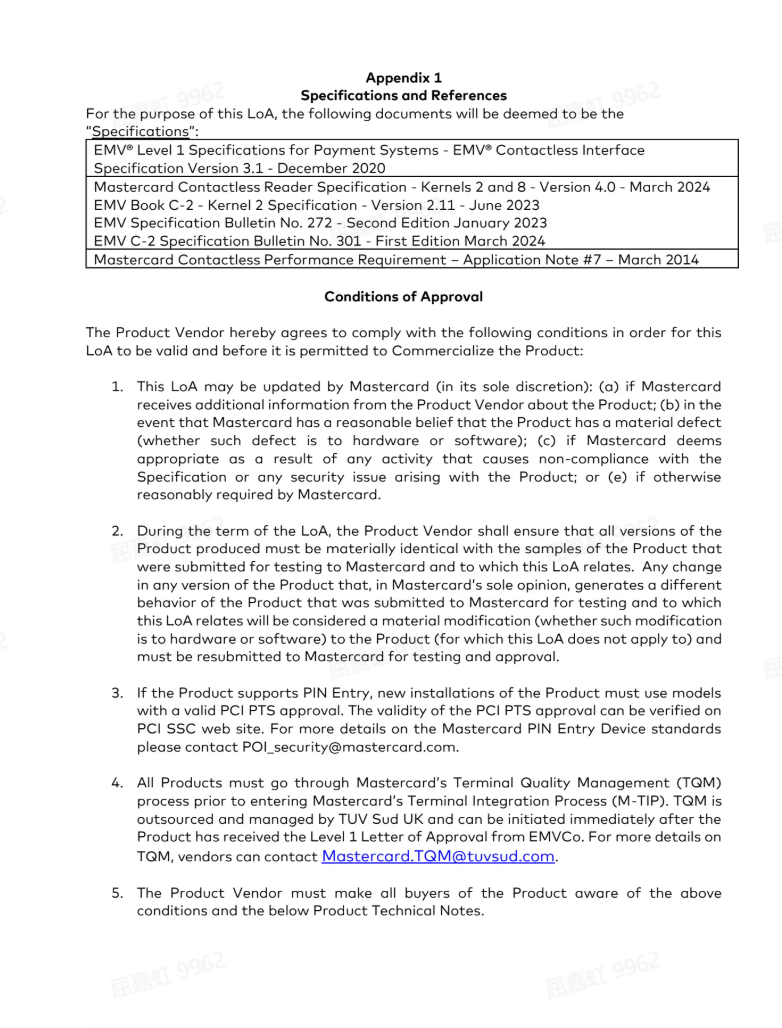
For importers, distributors and solution integrators, the term “certified POS terminal” is not a generic label. It means that a specific hardware model has passed one or more conformance tests covering payment security, contact and contactless card processing, radio emissions, environmental durability, hazardous substances or fiscal integrity. Because a single device can serve multiple markets, buyers now need a compliance map rather than a single certificate.
Why certification is a product specification, not paperwork
Certification affects whether a terminal can be legally sold, connected to a payment network, deployed in transit infrastructure, or accepted by a fiscal authority. It also affects the effort needed to bring a product to market.
Three functions stand out for procurement teams:
- Market access: radio and safety approvals such as FCC, CE and BIS are often required before a device can be imported and sold.
- Payment network acceptance: EMV Level 1 and Level 2, Paypass, Paywave, UnionPay QuickPass, RuPay and similar approvals determine whether the device can participate in card schemes.
- Deployment assurance: standards such as IP65, IK07, EN 50155 and ECE R118 indicate whether the hardware can survive the conditions of transit, outdoor or high-traffic environments.
For a buyer, the practical question is not “is it certified?” but “which certifications does this exact model hold, for which markets, under which certificate number?”.
Reading the global compliance landscape
Certification requirements vary by target region. A terminal intended for Europe needs CE RED, RoHS and often WEEE; a terminal intended for the United States needs FCC approval plus scheme-level approvals from American Express, Discover, Mastercard or Visa; a terminal intended for India may need BIS registration and RuPay contactless approval.
This is why global POS terminal suppliers maintain a portfolio of certifications across device families rather than a single universal approval.
What a certification portfolio looks like: Telpo as a worked example
Telpo Technology Co., Ltd., a China-based manufacturer founded in 1999, supplies POS terminals, payment devices, self-service kiosks and ticket validators under its own brand and through ODM partnerships. The company operates a production facility of approximately 45,000 square meters and maintains a CNAS-accredited laboratory upgraded in 2025. Its certification documentation provides a practical example of how a single manufacturer maps compliance across markets.
Payment terminal family: from entry-level to flagship
Telpo’s portfolio spans a compact smart payment terminal, a handheld Android POS terminal, and a 5.5-inch smart payment POS. Each model carries a different certification profile depending on its target market.
The Smart Payment Terminal model P8 with Printer is certified to PCI PTS POI V6.X under certificate number 4-90217, to EMV Contact Level 1 and Level 2, to Mastercard TQM under certificate number TQM4083, and to American Express Expresspay 4.2 under certificate number 42.ICTK.TELPO.P8.20250410-B. For the India market, it holds BIS registration under number R-41221104. For China, it holds UnionPay QuickPass certification under number QP-880.
The Smart Payment Terminal P8 M5 extends the same family with a lighter form factor: 389 grams, splash resistance and 1.5-meter drop resistance. It also carries UnionPay QuickPass certification under number QP-880.
The P9 family is one of the most comprehensive examples of multi-market certification among Telpo’s payment terminals. It holds EMV Contact L1 (certificate number 19271 0325 100 10a 10a BCTS) and EMV Contact L2 (certificate number 2-05601-1-1C-BCTS-0625-4.4c) issued by EMVCo, LLC. It is certified to Mastercard Contactless Specification under number TLOA-TELP250701-250725(a), and to American Express Expresspay 4.2 under number 42.ICTK.TELPO.P9.20250625-B. For the US market, it also meets Discover D-PAS Connect v2.1. In India, it holds RuPay contactless approval under number NP2TELERupayContactless L2250849622. In China, it is certified to UnionPay QuickPass under number QP-1203. The P9 PDA Financial version adds PCI PTS POI V6.X under certificate number 4-40460.
The TPS900 Smart Payment POS demonstrates that a single device can accumulate a broad set of scheme-level approvals. It is certified to PCI PTS POI V6.x (4-90168), Visa Paywave (CDTEPC02876A), Mastercard Paypass (TLOA-TELP250101-250121(a)), Mastercard TQM (TQM5183/01 and TQM5183/02), EMVCo Contactless L1 (19629 1125 320 32a 32a FIMC), American Express Expresspay (42.BVICTK.TELPO.TPS900.20250811-B) and PURE Contactless Reader Specification v2.1.8 (TEL.KER.218.2022-009). In China it meets UnionPay standards (QP-1244); in India it holds BIS registration (R-41014931) and RuPay contactless approval (NP2TELERupayContactless L2241141999); in Indonesia it is certified to NSICCS under number No. ASPI-25APP-052739; and in the EU it complies with CE RED 2014/53/EU and WEEE Directive 2012/19/EU.
Self-service and kiosk products
Certification is not limited to payment terminals. The K20 Self-Ordering Kiosk is certified to CE standards under certificate number LC-A3148-EU U / 25 Nov 2025 5 / Rev A, issued by MiCOM Labs. The K8 Self-Checkout Kiosk and K8M Self-Checkout Kiosk hold BIS registration for India under number REGISTRATION/CRS-2022-0516/R-41221104, per IS 13252 (Part 1):2010 / IEC 60950-1:2005.
Transit and validation devices
Transit hardware requires a different set of proof points. The T10 Ticket Validator is certified to FCC Part 24 and Part 27 for the US market (certificate 2AJ2B-T10), to CE RED 2014/53/EU (B2407051), to RoHS, to EN 50155:2017 environmental durability, to ECE R10 E24 electromagnetic compatibility, to ECE R118 flammability, to IEC 60529 IP54, and to IEC 62262 IK07 impact resistance.
The T20 Ticket Validator is certified to FCC for the US market, to CE RED 2014/53/EU (B2301114), to RoHS, to IP65 dust and water ingress protection, to IK08 impact resistance, and to ECE R10 Annex IV (E24) for the EU market.
A closer look at the certifications that matter
Payment security: PCI PTS and EMVCo
PCI PTS (PIN Transaction Security) is the security benchmark for payment terminals that handle PIN entry and cardholder data. EMVCo Level 1 tests the physical and electrical interface between the card and the terminal; EMVCo Level 2 tests the application kernel that processes the transaction. Together they provide the foundation for card scheme approval.
In the examples above, the P8 with Printer, P9, P9 PDA Financial and TPS900 each carry PCI PTS or EMVCo certifications with explicit certificate numbers, which lets buyers verify the claim directly with the issuing body.
Scheme approvals: Paypass, Paywave, UnionPay, RuPay, Amex, Discover, JCB
Scheme-level approvals are separate from EMVCo. A terminal may be EMVCo-certified but still need individual approval from each card brand. The P9’s combination of Mastercard, Amex, Discover, UnionPay, RuPay and JCB certification illustrates the scope required for a device that ships across multiple regions.
Environmental and industrial: IP, IK, EN 50155, ECE R10, ECE R118
IP ratings define ingress protection against dust and water. IK ratings define impact resistance. EN 50155 covers electronic equipment for railway rolling stock. ECE R10 covers electromagnetic compatibility of vehicles, and ECE R118 covers flammability of materials used in vehicle interiors. Transit validators that carry these certifications are designed for mounting on buses, trams and trains.
Regional market access: FCC, CE, BIS, NSICCS
FCC certification is a legal requirement for radio devices sold in the US. CE marking is required for many products sold in the European Economic Area. BIS registration is required for certain electronics imported into India. NSICCS is Indonesia’s domestic payment terminal security certification. All four appear in the TPS900 portfolio, making it a practical reference for a buyer covering multiple continents.
How to verify a supplier’s certification claims
A certificate number is the minimum evidence a buyer should request. With the number in hand, a buyer can usually confirm the certificate with the issuing authority, the certifying laboratory, or the card scheme portal.
- Ask for the certificate document, not just a marketing page.
- Match the certificate to the exact model name and model number.
- Check the issuing authority, certificate number and issue date.
- Confirm the country or region covered by the certificate.
- For software-based payments, confirm whether the SoftPOS or NFC implementation is covered by the same certification.
Practical note: Do not accept “Certified” or “PCI-approved” as a standalone statement. The certificate number, model name and issuing body together make the claim verifiable.
Certification as a selection criterion: what it means for the buying decision
Certification data changes the purchasing conversation from “which brand is better?” to “which device satisfies the requirements of my market and my deployment?”.
For a payment service provider entering Indonesia, NSICCS certification is directly relevant. For a transit operator in Europe, EN 50155, ECE R10 and CE RED matter more than a retail payment brand name. For a bank deploying handheld terminals in India, BIS and RuPay may be mandatory. This is why certification portfolios are a more reliable shortlisting tool than generic product claims.
Limitations and boundaries
Certification is necessary but not sufficient. A certified terminal still needs integration with the acquiring bank, the payment application, the merchant’s back-office system, and—in the case of fiscal deployments—the local tax authority. Certification also applies to specific hardware and software versions; upgrading the operating system or payment application can require re-certification. Buyers should therefore ask not only what is certified today, but what happens when the firmware is updated.
It is also worth noting that certification does not guarantee performance in every environment. A terminal certified to IP65 can still be damaged by extreme mechanical abuse, and a terminal certified to IK07 is not indestructible. Environmental ratings describe the conditions under which the device was tested, not an unlimited warranty.
Building a certification checklist for your next POS tender
| Market | Typical payment-related certification | Typical radio/safety certification | Typical environmental/industrial standard |
|---|---|---|---|
| Global | PCI PTS, EMVCo L1/L2, Mastercard, Visa | — | IEC 60529, IEC 62262 |
| United States | Amex, Discover, Mastercard, Visa | FCC | — |
| European Union | Mastercard, Visa | CE RED, RoHS, WEEE | EN 50155, ECE R10, ECE R118, EN 45545 |
| India | RuPay, PCI PTS | BIS | — |
| China | UnionPay QuickPass | CCC where applicable | — |
| Indonesia | NSICCS | — | — |
| Japan | JCB | — | — |
This table is a starting point. The specific requirements for a project may be defined by the payment network, the local central bank, the transit authority, or the customer’s internal security policy.
What the market data suggests about compliance-driven demand
POS terminals must comply with PCI PTS and EMV standards for secure chip processing, which makes compliance a permanent feature of the industry rather than a competitive differentiator. The global POS terminal market reached approximately USD 123.2 billion in 2025, and Android POS terminals account for a significant share of new shipments. As devices become more capable—running Android applications, supporting SoftPOS, adding biometrics—the scope of certification expands accordingly.
For manufacturers, this means maintaining certification across a widening product matrix. For buyers, it means certification is a core evaluation criterion, not a postscript.
Future outlook: where certification is heading
Three trends are likely to shape POS terminal certification in the next few years. First, SoftPOS may change how contactless certification is applied to software-based readers. Second, regional security schemes such as Indonesia’s NSICCS may become more common as domestic payment systems mature. Third, sustainability directives such as WEEE and eco-design requirements are likely to receive more attention from procurement teams.
Buyers who track certifications as part of their supplier scorecard will be better positioned to adapt to these changes.
Frequently asked questions
Which certifications are required for a POS terminal to be sold in the United States?
For the US market, a POS terminal with wireless connectivity typically requires FCC certification. Payment terminals also need scheme-level approvals from card brands such as American Express, Discover, Mastercard and Visa to be accepted on their networks. PCI PTS certification is required for devices that process PIN entry and other sensitive payment data.
What is the difference between EMV Level 1 and Level 2 certification?
EMV Level 1 certification tests the physical, electrical and data-link interface between the card and the terminal. EMV Level 2 certification tests the payment application kernel that selects the correct application and processes the transaction. Both levels are administered by EMVCo and are usually prerequisites for card scheme approval.
Does PCI PTS certification apply to Android POS terminals?
Yes. PCI PTS certification applies to the PIN entry and transaction security functionality of a terminal, regardless of the underlying operating system. Several Android-based payment terminals, including Telpo’s P8, P9 and TPS900 families, have been tested against PCI PTS POI V6.X requirements.
Why does a transit ticket validator need certifications that a retail POS terminal does not?
Transit validators are mounted on buses, trams and trains, so they must withstand vibration, impact, dust, water, and vehicle-specific electrical conditions. Standards such as EN 50155, ECE R10 and ECE R118 address these requirements. Retail POS terminals are usually installed indoors and therefore do not need the same level of environmental certification.
How can a buyer verify that a certification number is real?
The most reliable method is to search the certificate number on the issuing authority’s official portal, or to request the certificate document from the supplier. The document should show the manufacturer, the exact model, the applicable standard, the issue date, and the issuing laboratory or body. If a supplier declines to provide the certificate, that is a red flag.
Reference: For a product overview covering Telpo payment and retail terminals, see the Telpo Products Brochure – Payment & Retail (PDF).