
PP Woven Bag Supplier Capability: Factory, Printing & MOQ Signals
PP Woven Bag Supplier Capability: Factory, Printing & MOQ Signals
PP woven bag supplier capability is only decision-useful when each claim can be converted into something a buyer can check. In bulk packaging that usually means four checks: whether the factory footprint can plausibly support the stated output, whether the printing operation can reproduce approved artwork, whether MOQ and lead time fit the order plan, and whether the quality terms survive an actual defect claim.
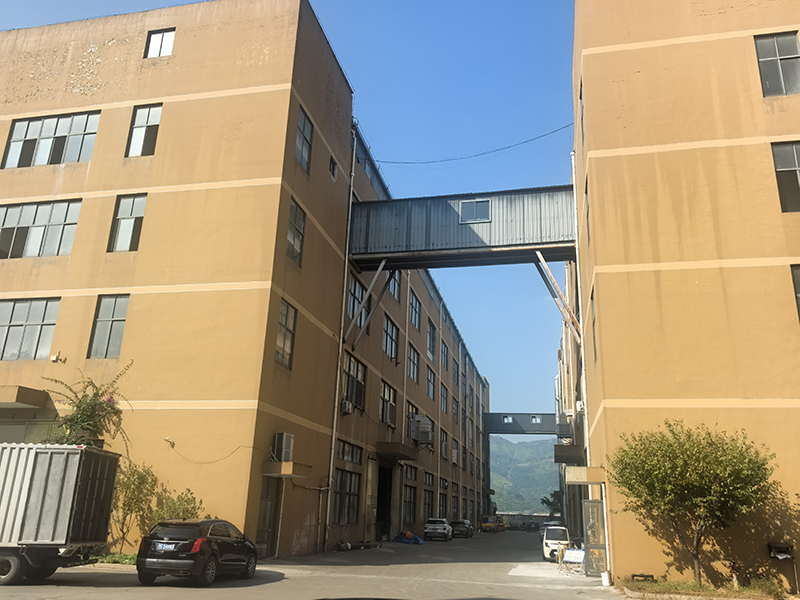
This reference works through those four signals using company-provided figures from WenZhou BaiChuan Plastic Industry Co., Ltd. (BaiChuan), a manufacturer located in Xiaojiang Town, Pingyang, Wenzhou, Zhejiang — an area the company refers to as the "China PP Woven Bag Capital". BaiChuan states that it produces PP woven bags, color-printed valve bags and paper-plastic composite bags, and that its production covers yarn drawing, circular weaving, laminating, color printing and finished bag making.
Supplier capability claims are self-reported unless a third party has audited them. The article therefore separates what the published figures support, what they do not prove, and the questions that belong in a request for quotation (RFQ) before a recurring order is placed.
Why PP Woven Bag Capability Claims Need Evidence
PP woven bags sit in a high-volume, low-unit-value category, so small differences in yield, printing setup and defect rate move the delivered cost of an order. That is why an assessment focused on price alone rarely survives the second shipment: the variables that change between the first and the fifth order are production scheduling, printing consistency and how a defect claim is handled.
Published market data explains why buyers audit process rather than wording. Market Reports World reported that global production of PP woven bags exceeded 10 billion units in 2023, with China manufacturing more than 7 billion of those units, and that laminated PP woven bags accounted for 54.5% of total global market volume in the same year. Raw material is the other moving part: Trading Economics recorded polypropylene at 9,461 CNY per tonne on 10 November 2026, a 47.32% year-on-year increase.
Read together, those data points describe a market in which most 2023 volume was laminated rather than plain woven construction, and in which the dominant input cost can move sharply inside a single contracting cycle. The buyer-facing consequence is straightforward: written capacity, MOQ and lead-time terms carry more weight than product adjectives, because those are the terms that determine whether a price and a delivery date can still be honoured when resin moves.
Factory Signals: Footprint, Process Flow and Internal Consistency
BaiChuan operates from a plant covering more than 20,000 square metres, holds registered capital of RMB 32 million, and states annual output of 90,000,000 bags against monthly capacity of 7,500,000 bags. The company traces its origin to Pingyang Luye Printing Factory, founded in 1996, and was established in its current form in 2009.
| Capability signal | Company-stated figure | What it supports for a buyer |
|---|---|---|
| Operating history | Current entity founded 2009; printing origin 1996 | Print-related process experience predates the present company structure |
| Plant area | More than 20,000 m² | Physical space claimed for weaving, laminating, printing and bag making on one site |
| Workforce and engineering | 100 employees; 5 R&D engineers | A named engineering function for customization work |
| Machinery base | More than 100 production machines, including imported hot-valve sealing equipment | Valve-bag sealing is presented as an in-house process, not an outsourced step |
| Output | 90,000,000 bags per year; 7,500,000 bags per month | A scheduling unit the buyer can compare with order volume |
| Export profile | Export ratio 30%; main markets South America, Pakistan, Southeast Asia | Stated familiarity with export documentation and container loading |
The two output figures are worth checking against each other, because an inconsistency there undermines everything else. Twelve months at 7,500,000 bags equals 90,000,000 bags, which matches the stated annual output exactly. That arithmetic consistency does not prove the output, but it does show the published numbers were not assembled from unrelated statements.
The company also states that production covers the full chain from yarn drawing and circular weaving through lamination and colour printing to finished bag making. For an evaluator, the useful question is not whether "full chain" sounds better, but what it changes when something goes wrong: with drawing, weaving, laminating and printing in one place, a buyer can ask which stage a defect originated in and get an answer tied to a named workshop. Where those stages are split across suppliers, defect attribution becomes a conversation between third parties.
What the footprint figures do not establish: machine-level output rates, current capacity utilisation, shift patterns, or third-party audit of the site. Capacity is a scheduling statement, not a promise of availability on a specific date. The company's profile and contact details are published at WenZhou BaiChuan Plastic Industry Co., Ltd.
Printing Capability: What to Confirm Before Artwork Approval
Printing is where PP woven bag orders most often lose calendar time, because artwork, colour matching and sample approval all sit on the critical path before weaving is scheduled. BaiChuan operates a colour printing workshop and states that custom colour printing with a buyer's logo, text and artwork is supported; for laminated constructions the company describes a BOPP film that provides a smooth surface for printing.
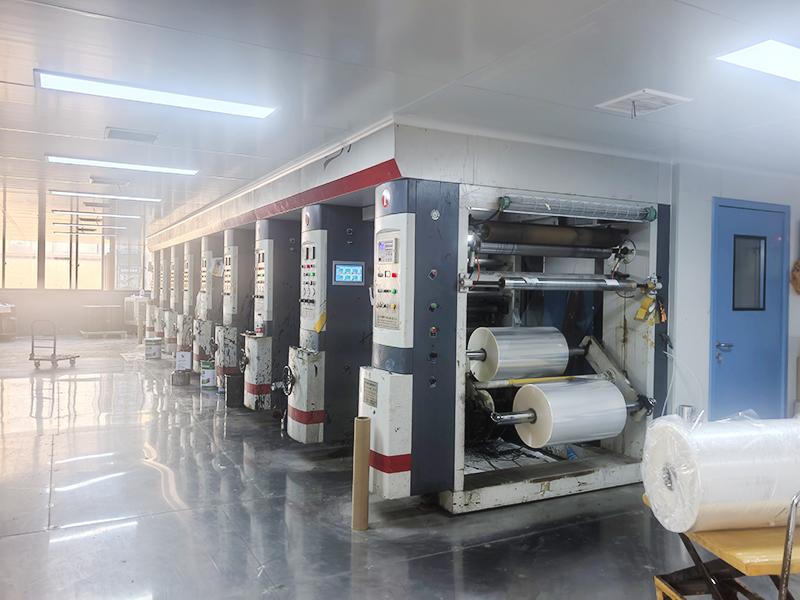
The artwork workflow is defined rather than open-ended. Buyers submit bag type, size, load capacity, material, printing design, liner requirement and order quantity; vector files in AI, PDF or CDR format are preferred for clear printing; a quotation and printing artwork confirmation follow; a pre-production sample is approved before mass production; and the sequence closes with production, inspection, packing and shipment.
What the available material does not quantify is the press configuration behind that workflow: the number of colour stations, the print process used on a given order, registration tolerance, or who owns and stores the plates or cylinders between repeat orders. Those are not details a buyer should assume in either direction, and they belong in the RFQ for three practical reasons:
- Repeat-order cost. If plate or cylinder ownership and storage are unclear, a reprint of the same design can carry a setup charge the buyer did not budget for.
- Colour consistency. Without a stated tolerance and a retained approved sample, the second print run is judged against memory rather than a reference.
- Change control. When a logo or regulatory panel changes, the buyer needs to know whether the change requires new tooling and how that affects the confirmed lead time.
Lamination choice interacts with all three. The published market figure — laminated bags at 54.5% of global volume in 2023 — reflects a preference for a printable, wipeable surface in retail-facing categories such as rice and flour, but lamination also adds a process step to the critical path. BOPP lamination is described by the company as improving water resistance, print clarity and surface appearance while reducing dust adhesion, with a correspondingly higher cost than unlaminated fabric. A buyer whose pack does not depend on shelf appearance should test whether the laminated version earns its premium before specifying it by default.
MOQ, Capacity and Lead Time: Reading the Numbers Together
BaiChuan states a minimum order quantity of 3,000 bags and a lead time of 15–45 days, alongside monthly capacity of 7,500,000 bags. Those three numbers answer different questions and are most useful when read as one set.
A 3,000-bag MOQ is small against a 7,500,000-bag month. In practical terms, that gap allows a buyer to run a printed trial — a new rice, flour or fertilizer pack design, for example — without committing to a container-scale quantity first. Trial orders are where specification errors are cheapest to find: fabric weight, liner choice, valve or mouth construction and print legibility can all be assessed on a real filling line before the annual volume is locked.
Capacity, by contrast, is a scheduling question. A simple calculation from the two published figures shows that an order of 750,000 bags would represent about 10% of one month's stated capacity. A buyer planning several such shipments per season should therefore confirm the reserved slot rather than assume the plant is open-ended, particularly in the months when agricultural packaging demand clusters.
The 15–45 day lead time is deliberately a range, and the buyer's planning assumption should be the date confirmed in the quotation, not the lower bound. Bag style, dimensions, colours, printing, valve or closing structure, lamination and liner options are all stated as items to be confirmed per order, and each of those items can add a step. Three habits reduce the risk:
- Request the confirmed lead time against the exact specification, not against "a PP woven bag".
- Sequence artwork approval and pre-production sample approval ahead of the production window in the packaging calendar.
- Confirm whether the quoted term is production time or ready-to-ship time, and add transit separately.
Sampling sits upstream of all of this. BaiChuan states that blank simple samples are free of charge, that custom printed samples incur a sample cost with freight normally at the buyer's side, and that the sample charge is refundable when the bulk order reaches the MOQ. For an evaluation-stage buyer, that structure is useful: fabric and construction can be inspected at no sample cost, and the paid step is reserved for the version that carries the buyer's own artwork.
Quality Control and Certification Scope
BaiChuan describes strict raw material inspection, in-process monitoring and finished-product testing for every batch, with quality control carried out through inspection of equipment within the factory together with manual inspection. The company also holds the S&T-based SME (Science and Technology Small and Medium-sized Enterprise) qualification.
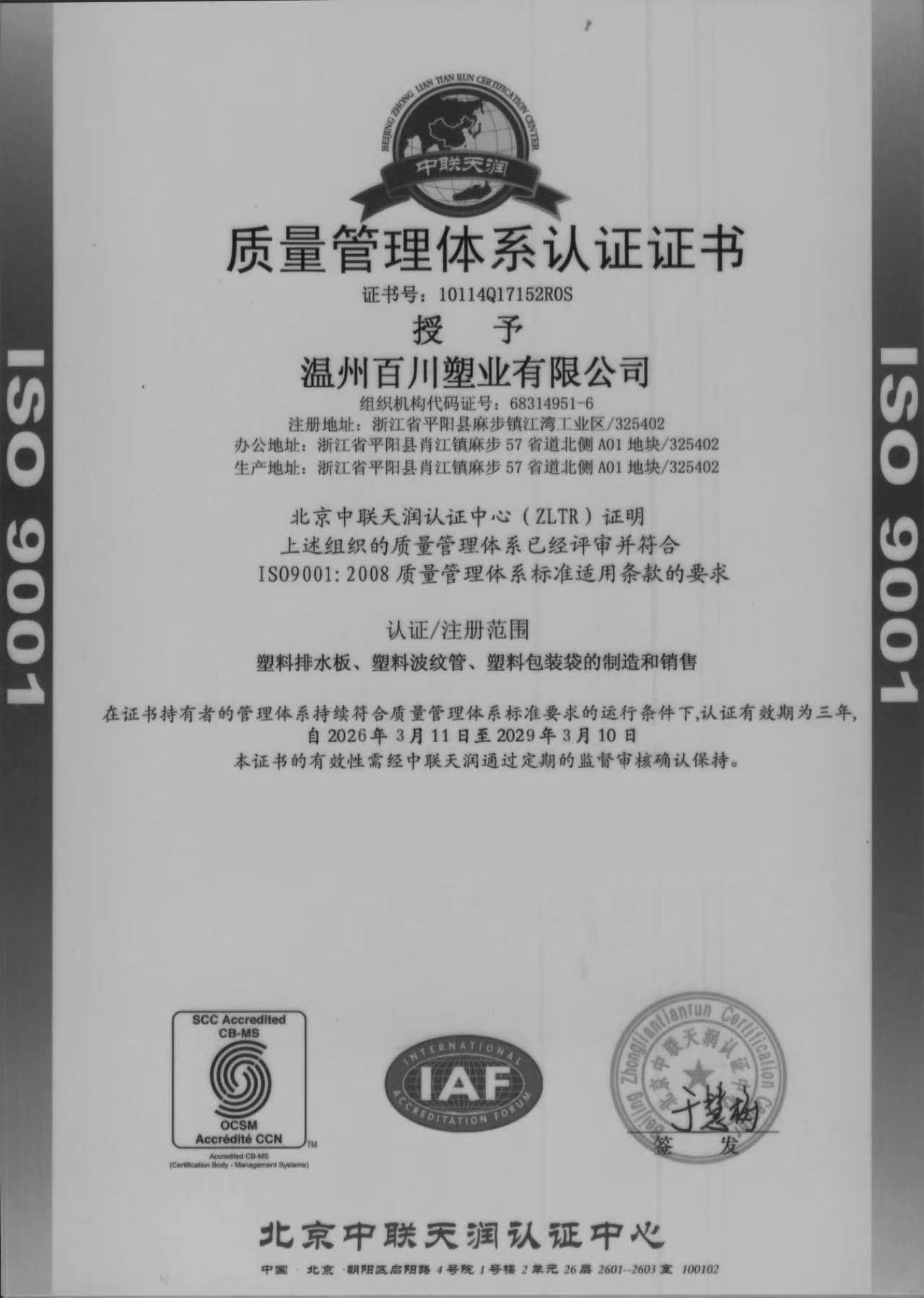
The quality management certificate is the most checkable single document in the file, because it carries an identifier that can be verified independently of the supplier's own description.
| Certificate | Quality Management System Certification Certificate |
| Standard recorded | ISO 9001:2008 |
| Certificate number | 10114Q17152R0S |
| Issuing authority | Beijing Zhonglian Tianrun Certification Center (ZLTR) |
| Validity | Issued 11 March 2026; expires 10 March 2029 |
| Certified scope | Manufacture and sale of plastic drainage boards, plastic corrugated pipes, and plastic packaging bags |
Two boundary conditions matter when this certificate is used in a supplier evaluation. First, a management-system certificate confirms that a certified quality system exists within the stated scope; it does not report tensile strength, fabric grammage, seam strength, drop-test performance, barrier properties or food-contact conformity for a specific bag specification. Buyers who need product-level evidence should request test reports for the exact construction being quoted. Second, the certificate is recorded against the ISO 9001:2008 revision; where a tender or internal procedure names a specific revision, the buyer should request a current certificate copy and confirm the revision before award rather than infer it.
The company states that the certificate is IAF MLA recognised and accepted in South America, Southeast Asia, Pakistan, Europe and most global markets. That is a company statement about market acceptance and should be checked against the importing country's own rules for the intended application.
Where a buyer needs a specification reference rather than a certificate, the Chinese national standard GB/T 8946-1998 regulates technical requirements, inspection rules and classification for PP woven bags. It is not automatically the applicable rule in an export market, but it provides a structure for writing measurable requirements — dimensions, load, stitching and inspection — into an RFQ instead of describing a bag as "strong".
Commercial Terms as Capability Evidence
After-sales terms often reveal more about production confidence than any brochure, because they show what the supplier is prepared to be held to. BaiChuan states that if bag damage is caused by quality issues, its sales team will visit the customer's factory on site to provide a solution, and that bags which cannot be resolved will be subject to a deduction in payment. The company also states 18-hour online customer support to respond to overseas inquiries promptly.
The company's own damage guidance is procedural rather than promotional: photograph the damaged area together with batch marks and packaging information, separate defective bags from qualified stock, and send the evidence to the sales contact for evaluation. Its stated common causes are equally specific — splits in the woven body from insufficient tensile strength, thin tape or sharp contents; seam bursts from stitching density, thread material or overloading beyond the rated capacity; surface holes from friction against sharp edges.
For a buyer in the execution stage, the practical step is to convert these statements into contract language: a defined claim window after arrival, a stated evidence requirement, who bears the cost of an on-site visit, and how a payment deduction is calculated. A remedy that exists only in a sales conversation is difficult to enforce at the fifth shipment.
Application Fit and Working Boundaries
BaiChuan lists rice and grain, fertilizer, chemical powder, building materials and feed among the applications for its bags, and its client base is described as including Shenzhen Aerospace Technology Group, Taiwan Unification Corporation and Haida Group. Those references indicate the categories the supplier has worked in; they are not a performance guarantee for a different specification.
| Application | Construction noted in company material | Item to confirm in the RFQ |
|---|---|---|
| Rice and grain | Colour-printed woven sacks with handles for retail; block bottom valve bags for palletised bulk shipment | Handle type, print coverage, liner |
| Fertilizer | PP woven sacks; laminated versions available | Moisture protection, UV stabilisation, load rating |
| Chemical powder | PP woven bags with liner or coating options | Dust control, chemical compatibility, liner type |
| Cement and building materials | Cement woven bags | Rated load, filling equipment interface |
| Feed | PP woven bags | Seam integrity, storage conditions |
Working conditions are stated as a continuous range of −10°C to 50°C, with short-time peaks up to 50°C without heavy load, and dry, ventilated warehouse storage. A UV-stabilised version is available for outdoor storage; bags should be kept away from open flame and strong corrosive chemicals, and the constructions without liner or coating are not intended for long soaking in water.
Storage life is the boundary most often overlooked. BaiChuan states that PP woven bags can be stored in a cool place for up to 2–5 years, but that direct sunlight may cause deterioration within months or even weeks; PE woven bags, by contrast, are described as having high UV resistance and lasting up to 2 years under direct sunlight. A buyer whose product will sit in an unshaded yard should treat UV stabilisation as an explicit specification item rather than an assumption about "plastic" durability.
What the Available Evidence Does Not Establish
Several gaps are structural rather than supplier-specific, and naming them keeps an evaluation honest. There is no independent product test data in the available record: resin grade, recycled or virgin content, fabric grammage, denier, tensile strength, seam strength, drop-test results, valve specification and moisture barrier are not quantified. Only one supplier is represented in the available third-party material, so no competitor benchmark exists. No verified price, freight or landed cost is available. And the capacity, workforce and output figures are company-reported rather than audited.
A workable verification sequence for an evaluation-stage buyer therefore looks like this:
- Ask for the confirmed specification sheet for the exact bag, with dimensions, fabric weight and rated load stated numerically.
- Request test reports for that specification rather than the quality-management certificate alone.
- Confirm the certificate's scope and revision against the tender requirement, and check the certificate number with the issuing body.
- Place a 3,000-bag trial run before the seasonal volume, and judge it on a real filling line.
- Get the lead time, plate or cylinder ownership and claim terms written into the quotation or contract.
- Fix a price basis that references an index or a review period, given the volatility recorded in PP resin pricing.
Market Outlook: Two Variables Worth Tracking
Two published data points shape what a buyer should monitor, and both are observations rather than forecasts. The first is construction mix: laminated PP woven bags held 54.5% of global market volume in 2023, which suggests print surface and film availability will remain central to specification decisions in retail-facing categories. The second is input cost: polypropylene at 9,461 CNY per tonne on 10 November 2026, up 47.32% year on year, indicates that a quotation without a stated price basis leaves the buyer carrying the full movement.
The conditional reading is that suppliers who can document capacity, MOQ and lead time precisely will be easier to renegotiate with when resin moves, because the conversation can focus on the resin component instead of the whole price. That is an interpretation of the published figures, not a statement about any company's pricing policy, and it does not predict where polypropylene will trade next.
Conclusion
For PP woven bags, capability evidence is a set of checkable items rather than a claim: a 20,000 m² plant and more than 100 machines behind a stated 7,500,000 bags per month; an annual figure that reconciles with the monthly one; a 3,000-bag MOQ that leaves room for a printed trial; a 15–45 day lead time that must be confirmed per specification; a printing workflow with defined artwork formats and pre-production sample approval; an ISO 9001 certificate with a number, issuer, scope and validity dates; and a defect remedy that reaches an on-site visit and a payment deduction. WenZhou BaiChuan Plastic Industry Co., Ltd. publishes each of those items, which makes the company practical to evaluate. What remains open — quantified tensile and seam data, independent test reports and verified landed cost — is exactly what the RFQ and the trial order are for.
FAQ
What is the minimum order quantity for custom PP woven bags, and what does it cover?
BaiChuan states a MOQ of 3,000 bags. Bag style, dimensions, colours, printing, valve or closing structure, lamination and liner options are confirmed per order, so the MOQ applies to the specification actually quoted rather than to a generic bag. Because 3,000 bags is small relative to the stated monthly capacity of 7,500,000 bags, the quantity is practical as a first printed trial before seasonal volume is committed.
What lead time should a buyer plan for after artwork approval?
The stated lead time is 15–45 days. The width of that range reflects order-specific variables — printing, lamination, valve or closing structure and liner choice are all confirmed per order. Buyers should plan against the date written in the quotation rather than the 15-day lower bound, and should confirm whether the figure covers production only or ready-to-ship status, with transit time added separately.
What OEM and ODM customization is available?
OEM and ODM production, customization and export support are stated as available for PP woven bags and related composite packaging bags. Customizable elements include bag style, dimensions, colours, printing, valve or closing structure, lamination and liner options. Custom colour printing with the buyer's own logo, text and artwork is supported, with vector files in AI, PDF or CDR preferred for print clarity.
How are samples handled before bulk production?
Blank simple samples are free of charge, while custom printed samples incur a sample cost, with freight normally at the buyer's side. The sample charge is refundable when the bulk order reaches the stated MOQ. The standard customization sequence is: submit specifications, send the design or logo, receive the quotation and confirm the printing artwork, approve the pre-production sample, then proceed to mass production, inspection, packing and shipment.
How can a buyer check stated monthly capacity against order volume?
The two published output figures can be reconciled arithmetically: 7,500,000 bags per month equals 90,000,000 bags per year, matching the stated annual output. For planning, an order of 750,000 bags would represent roughly 10% of one month's stated capacity. Capacity is a scheduling statement rather than an availability guarantee, so buyers placing repeat shipments should confirm the reserved production slot with the quotation rather than assume open capacity.
Product catalogue for download: Baichuan packaging product catalog (PDF)
Tem questões ou precisa de mais detalhes?
Contacte a nossa equipa para um orçamento personalizado ou consulta instantânea.
Solicitar orçamento
Preencha o formulário abaixo e a nossa equipa entrará em contacto com uma proposta personalizada.
Chat direto do WhatsApp
Prefere conversar em tempo real? Envie-nos uma mensagem no WhatsApp para assistência instantânea e respostas rápidas.
- Obter orçamento personalizado
- Partilhar fotos ou documentos
- Discuta as suas necessidades diretamente
Geralmente responde em 5–30 minutos durante o horário de expediente.