
PP Woven Roll Applications: Woven Sacks, Fertilizer, Plastics and Animal Feed
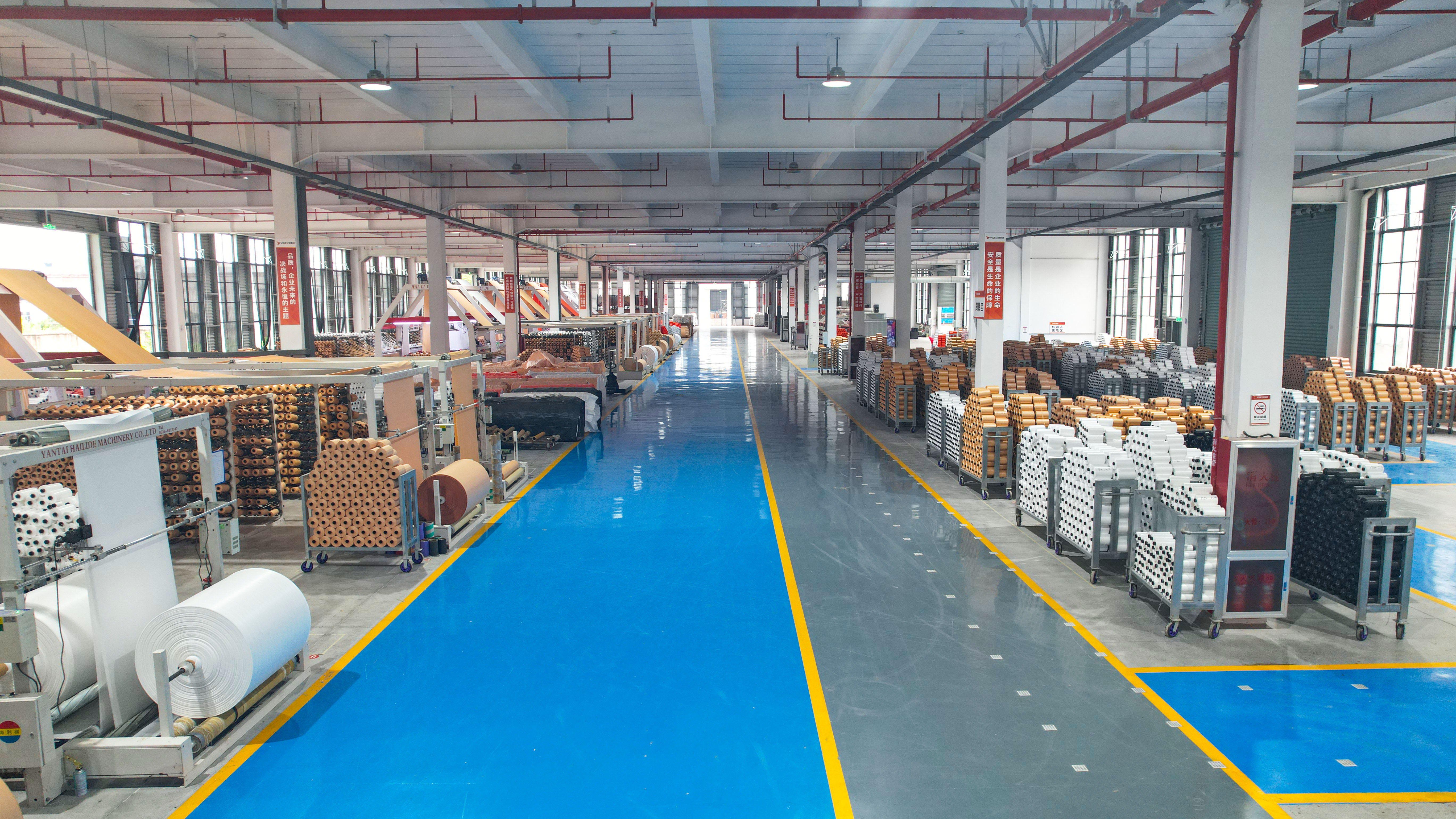
PP woven rolls are stored and handled as coiled substrate before downstream cutting, sewing and conversion into finished woven packaging.
A PP woven roll is an input, not a finished package. It is woven polypropylene fabric supplied in coil form and converted downstream into the sacks, bags and tarpaulins that end users actually fill.
For woven sack manufacturers, fertilizer packers, plastics and resin producers, and animal feed operations, the roll is the point at which packaging performance is decided — several production steps before anyone sees a finished bag. This reference explains how PP woven rolls fit six operating environments: woven sack manufacturing, industrial packaging, agriculture and agricultural packaging, the fertilizer industry, the plastics and resin industry, and the animal feed industry. It also sets out what a buyer should fix in the specification before the first metre is woven, and where the roll route has real limits.
What a PP woven roll is — and what it is not
Yancheng Yide Packaging Technology Co., Ltd. (Yide Packaging) is a manufacturer and customized packaging solution provider based in Yancheng, Jiangsu, China, specializing in industrial bulk packaging, polypropylene woven packaging, reusable logistics packaging and sustainable packaging solutions. Its PP woven roll product is listed under a set of equivalent trade names that describe the same substrate: PP woven fabric roll, polypropylene woven fabric roll, PP woven roll, plastic woven fabric roll, PP woven bag roll, PP woven tubular fabric, and PP woven sheet roll.
Functionally, the material is PP woven material, supplied in standard colours of white, yellow and green with custom colours available, and with custom specifications and colour printing supported. Its stated characteristics are high toughness and tensile strength, resistance to breaking, tight weaving with a stable structure, moisture-proofing, waterproofing and wear resistance.
Six application environments and what each one demands
PP woven rolls are applicable to woven sack manufacturing, industrial packaging, agriculture and agricultural packaging, the fertilizer industry, the plastics and resin industry, and the animal feed industry. The same substrate is used in each case, but the operating demand on the fabric differs by environment.
| Application environment | What the roll becomes | What the fabric has to deliver |
|---|---|---|
| Woven sack manufacturing | Cut and sewn into ordinary woven bags and dustproof tarpaulins | Consistent width and weave so cutting and sewing lines run without repeated adjustment |
| Industrial packaging | Converted into bulk bags, FIBC bags, industrial bags, cement bags, mineral bags and other high-strength packaging products | Strength, density and thickness sized to the intended load |
| Agriculture and agricultural packaging | Sacks for grains, seeds and general agricultural output | Moisture protection and handling durability through storage and transport |
| Fertilizer industry | Fertilizer sacks and heavy-duty filled bags | Load-bearing at high fill weight plus abrasion resistance during stacking |
| Plastics and resin industry | Packaging for plastic pellets, resins, powders, pigments and industrial powders | Tight weave to contain pellets and resist puncturing |
| Animal feed industry | Feed sacks and bulk feed packaging | Tear resistance through repeated handling and moisture-proofing against damp |
PP woven rolls are also used for packaging applications such as cables and pipes, where the roll is applied as a protective wrap rather than converted into a sack. That additional use case matters for buyers because it means one specification can serve more than one internal department — sack conversion and protective wrapping — provided the strength, density and thickness are matched to the load that the roll is designed for.
Why woven PP fits these operations: six physical reasons
1. Tensile strength and toughness
The base property is high toughness and tensile strength with resistance to breaking. In practice this sets the ceiling on how much fill weight a converted bag can carry before the wall of the fabric deforms, and how the bag behaves when it is lifted rather than dragged.
2. Tear resistance
Tear resistance determines whether a small puncture — a pallet corner, a forklift tine, a sharp granule — stays small or propagates into a split. Yide states that under identical specifications including dimensions, weight and testing conditions, its woven products show approximately 10% improvement in key performance metrics such as tensile strength and tear resistance compared with standard products of the same type. Comparative data points include unit weight deviation, warp and weft density, tensile strength, drop test performance, seal strength and powder leakage rate; the specific result for any order is subject to the inspection reports for the corresponding batches.
3. Tight weaving and structural stability
Tight weaving produces a stable structure, which is what keeps fine pellet and powder fractions inside the bag rather than sifting through the interstices of the fabric. For resin producers and feed millers, leakage through the weave is a housekeeping and yield problem before it is ever a packaging failure.
4. Moisture-proofing
Moisture-proofing supports applications where the packaged material is sensitive to humidity during storage, marine transportation and distribution. This is a documented requirement for export packaging in adjacent woven formats: PP woven bags used for granular submerged arc welding flux for export encapsulate the granules with moisture-proof and transport-resistant protection, printed with export parameter marks.
5. Waterproofing
Waterproofing relates to the fabric's behaviour against direct water exposure rather than ambient humidity — open-yard storage, dock handling and wet transport conditions. It is a property of the fabric construction and any downstream coating or lamination, not of the printing or the closure.
6. Wear resistance
Wear resistance governs how many handling cycles a filled sack survives: conveyor contact, pallet stacking, truck-bed abrasion and repeated lifting. Chemical tolerance supports the same use case from the material side — polypropylene offers strength, durability and resistance to moisture and many commonly handled chemicals, and PP woven bags derived from this substrate are suitable for many chemical and industrial products, especially dry, non-hazardous powders, granules, pellets and other bulk materials.
What is set per order, not held in stock
PP woven roll specifications are not a fixed catalogue. GSM (fabric weight) and roll width are set per order, and fabric weight, weaving density, warp strength and weft strength are customizable. Colour is normally selected from the standard range of white, yellow and green, with custom colours available, and custom specifications and colour printing are supported.
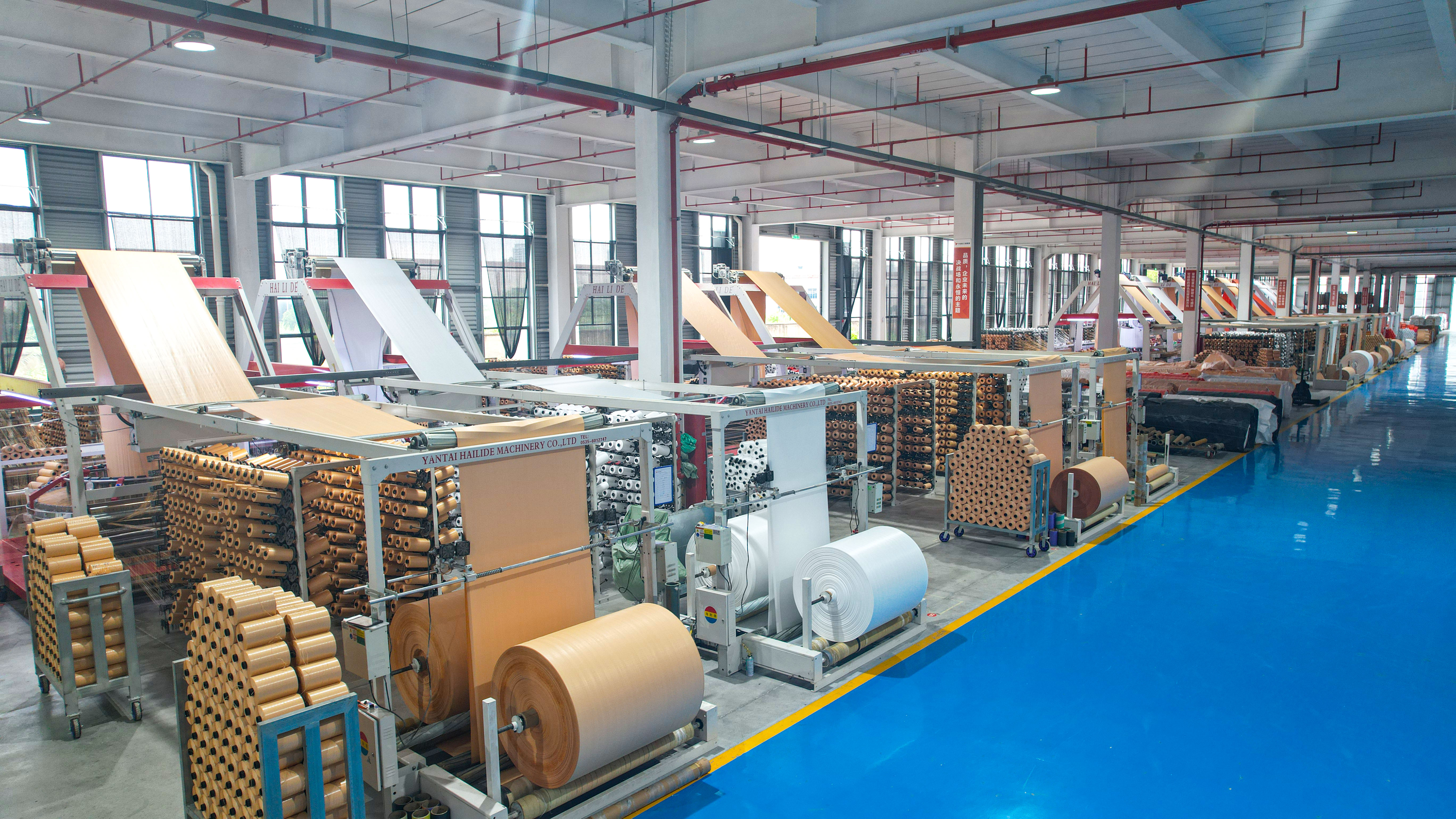
Uniform roll width and weave consistency are the two properties downstream cutting, sewing and filling equipment are most sensitive to.
| Specification | Set per order? | What it controls |
|---|---|---|
| GSM / fabric weight | Yes, per order | Load-bearing capability per unit area of fabric |
| Roll width | Yes, per order | Compatibility with the cutting and sewing line |
| Weaving density | Customizable | Structural stability and containment of fine fractions |
| Warp strength | Customizable | Load along the machine direction |
| Weft strength | Customizable | Cross-direction load and tear behaviour |
| Colour | White, yellow, green standard; custom available | Market convention and brand identity |
| Printing | Custom colour printing available | Brand marks and export parameter marks |
| Lamination / coating | Applied downstream as required | Barrier against moisture and fine powder |
A limitation sits inside this flexibility: because these values are set per order, a change of bag format or fill weight is not a stock-room substitution. Yide states that it does not simply increase strength by making material thicker; it tailors the raw material formula, fabric weight, weave density and lamination structure to the material being loaded, the weight of the filled bag, the drop height, the stacking method and the transport distance. That approach avoids wasting material, but it also means the specification is defined before production rather than adjusted during it.
From roll to finished packaging: the conversion chain
Roll production involves secondary processing by cutting coiled materials before conversion into finished woven products. The chain is short but unforgiving, because each stage inherits the dimensional accuracy of the one before it.
- Coil conditioning and unwinding — the roll is opened and fed at controlled tension.
- Cutting and slitting to the bag blank dimensions required by the finished format.
- Printing or lamination where brand marks, export parameter marks or a moisture barrier are required.
- Sewing and closure construction into the target format.
- Bag-level features such as liners, filling spouts, discharge openings and lifting structures, which are options added to the woven base rather than properties of the roll.
- Batch inspection before dispatch.
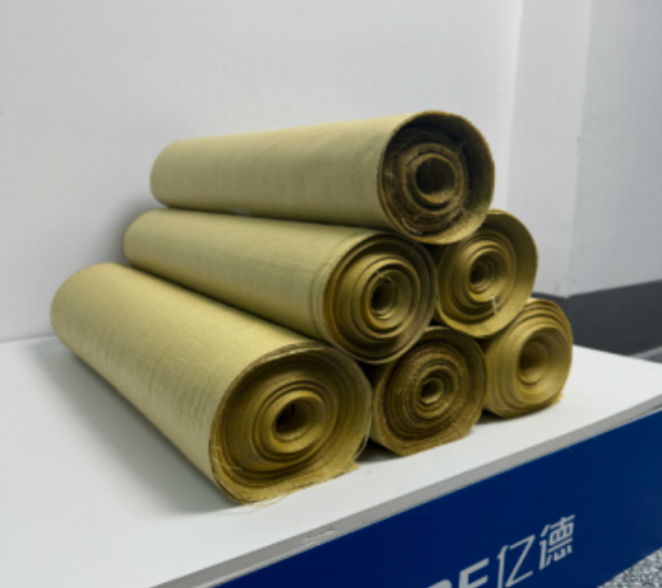
The woven roll is the substrate from which bulk bags, FIBC bags, industrial bags and woven sacks are cut, sewn and finished.
Heavy-duty PP woven fabric can be converted into bulk bags, FIBC bags, industrial bags, cement bags, mineral bags and other high-strength packaging products. It can also be cut and sewn into ordinary woven bags and dustproof tarpaulins. That range explains why the roll specification matters well beyond one product line: the same substrate decision affects the strength ceiling of every format the converter produces from it.
Downstream standards: why the roll buyer should still care
Standards in this category address the finished container, not the woven roll. That distinction is the reason a substrate decision has compliance consequences.
| Reference | Scope | Status and date |
|---|---|---|
| ISO 21898:2024 | Materials, construction and design requirements, type test and marking requirements for flexible intermediate bulk containers intended to contain non-dangerous solid materials in powder, granular or paste form, designed to be lifted from above by integral or detachable devices | 2024 edition |
| EN ISO 21898:2024 | European implementation of the same FIBC requirement set for non-dangerous goods | Approved by CEN on 12 August 2024 |
| ISO 21898:2004 | Earlier edition of the same FIBC packaging standard | Superseded |
| GB/T 10454-2025 | Chinese national standard for flexible intermediate bulk containers for non-dangerous goods | Released 29 August 2025; implementation 1 March 2026; replaces GB/T 10454-2000 and GB/T 37425-2019 |
| IEC 61340-4-4:2018 | Electrostatic classification and test requirements for FIBCs between 0.25 m³ and 3 m³ intended for use in hazardous explosive atmospheres | 2018 edition |
For a converter, the practical reading is straightforward. A type-tested bag design is only reproducible if the base fabric feeding it is reproducible. When a standard is refreshed — as with the 2024 ISO and EN editions and the Chinese national standard taking effect on 1 March 2026 — converters re-verify constructions that were qualified under earlier editions. The roll specification is one of the variables that has to stay inside the tolerance of the validated construction, which is why batch evidence from the substrate supplier is worth more than a one-off sample.
Roll-based conversion versus bought-in finished bags: where the limits sit
The alternative to buying rolls is buying finished bags from a converter or trading intermediary. The roll route gives the buyer control over fabric weight, weaving density, directional strength, colour and printing, and it usually lowers material cost per bag at volume. It also carries four limits that buyers should plan around before they commit.
- It requires conversion capability. A roll has no closure, no lifting structure and no seams. Without in-house or contracted slitting, cutting and sewing capacity, it is not usable packaging at all.
- The specification is frozen per order. GSM and roll width are set per order and fabric weight, weaving density, warp strength and weft strength are customizable values rather than adjustable settings. Changing the target bag format or fill weight generally means a new run, and customized woven production carries a minimum order quantity.
- Unlaminated woven PP is not a barrier material. Polypropylene woven fabric is suitable for dry, non-hazardous powders, granules and pellets. Where protection depends on a barrier — fine powders, humidity-sensitive chemistry, contamination-sensitive content — coated fabric, food-grade materials or special liners may be required in addition to the base weave.
- Quality risk moves downstream. If base fabric varies between batches, the failure surfaces at the filling line, in the stack or in transit, not at goods-in. Batch inspection records are the practical mitigation, not a substitute for a defined specification.
Execution checklist before the roll is woven
Once a buyer has moved from evaluation to execution, the useful question is no longer which supplier but which variables are fixed in writing.
| Decision item | What to fix | Why it matters at execution |
|---|---|---|
| Base fabric weight (GSM) | Value per order | Fill weight, stacking load and material efficiency |
| Roll width | Value per order | Cutting and sewing line compatibility; waste level |
| Weaving density | Custom value | Structure stability and containment of pellets and powders |
| Warp and weft strength | Custom values | Directional load behaviour and tear resistance |
| Colour and printing | White, yellow, green standard; custom colours; custom printing | Market convention, brand marks and export parameter marks |
| Target format | Ordinary woven bags, dustproof tarpaulins, bulk bags, FIBC bags, industrial bags, cement bags, mineral bags | Determines fabric grade and downstream processing |
| Automated filling interface | Bag mouth dimensions, body flatness, length tolerances | Dimensional variation is a common cause of jamming, manual bag support and line downtime |
| Batch evidence | Inspection report per batch | Traceability if a problem appears at bagging, sealing or transport |
Commercial terms should be confirmed at the same time. Yide's stated purchasing terms are: spot goods MOQ 1 pc with freight not included; custom bags MOQ 5,000 pcs with free samples available, buyer bearing the shipping cost. Acceptance criteria are based on samples sent before production. Payment terms are 30% deposit in advance and 70% balance before shipment, negotiable under special circumstances. Delivery can be arranged by courier, air freight or logistics warehouse.
What a long-term roll relationship is actually buying
For HVAC-style price comparison, all woven rolls look alike. For long-term supply, the difference is in what happens between batches.
Yide Packaging operates automated material feeding and intelligent management systems that control formulations, unit weights, dimensions and production parameters, with every batch tested and generating a corresponding report. Raw materials and finished products are tested for every batch and the results are traceable. If a customer encounters an issue during bagging, sealing or transport, batch-tracking capability allows a rapid investigation and adjustment across raw material, formulation, equipment parameters and production batch — a diagnosis that is difficult when an anomaly could have originated anywhere between the raw material supply, unit weight, weaving, lamination or sealing stage.
The second thing a long-term agreement buys is a redesign loop. Yide states that the bag opening, base fabric, lifting loops, stitching and inner liner can be continuously optimized based on actual usage feedback, and that the inlet and bag structure can be customized to suit automated filling equipment. Manufacturing for that loop is supported by 5G-connected production systems, robotic material handling, visual recognition technology, intelligent production management, a professional quality inspection team and advanced testing equipment, alongside a 5,000-square-metre food-grade clean workshop and a 15-engineer R&D team working with universities and research institutions on new packaging materials, high-performance polymers, biodegradable materials and sustainable packaging technologies.
For distributors and brand owners planning packaging changes across multi-year cycles, Yide's ongoing development of biodegradable woven sacks, biodegradable poly mailers, recyclable packaging and high-strength reusable logistics bags is material to the ordering decision: a substrate supplier that is also developing the next material generation reduces the cost of switching later.
Market trend: the substrate is being pulled by two forces
No verified market size, growth rate or trade-flow figure for bulk bags and woven packaging was available in the evidence reviewed for this article, so the trend discussion here is deliberately limited to what the standards and product records show.
The first force is the standards refresh cycle. ISO 21898:2024 and EN ISO 21898:2024 replaced earlier editions, and GB/T 10454-2025 takes effect on 1 March 2026, replacing two previous Chinese standards. Conversion of woven substrate into FIBC-style bulk bags sits downstream of these documents, but the substrate feeds the re-verification work. Where a converter previously qualified a construction under an older edition, the base fabric is one of the few variables that must remain stable for the new type test to mean anything.
The second force is material transition. Packaging buyers are increasingly asking about recyclability, reuse cycles and bio-based alternatives, and manufacturers are responding in product development rather than in sales language. Biodegradable woven sacks, recyclable packaging and reusable logistics bags exist alongside conventional PP and PE products. For a roll buyer, the practical consequence is that substrate decisions are becoming multi-year decisions: the fabric specification chosen now will need to remain producible while the recyclability and reuse expectations around it change.
Future outlook
Three directions are visible without speculation. First, dimensional discipline will matter more, not less, as automated filling spreads through fertilizer, resin and feed plants — bag mouth dimension, body flatness and length tolerance become line-uptime variables rather than cosmetic ones. Second, barrier requirements will keep separating from structural requirements: the woven base provides strength and containment, while lamination, coatings and liners provide the barrier, and buyers are increasingly specifying them as two separate decisions. Third, the substrate conversation will keep moving toward reuse and recyclability, with woven formats expected to hold their position for dry, non-hazardous bulk goods because the strength-to-cost ratio remains hard to replace.
For woven sack manufacturers, fertilizer packers, resin producers and feed operations, the sensible response is procedural rather than dramatic: define GSM, roll width, weaving density, warp and weft strength and colour in writing, keep batch inspection records, and treat the roll as the first quality control gate in a chain that ends at the customer's loading dock.
FAQ
What are PP woven rolls used for?
A PP woven roll is woven polypropylene fabric supplied in coil form and used as the substrate for woven packaging. The fabric can be cut and sewn into ordinary woven bags and dustproof tarpaulins, and heavy-duty PP woven fabric can be converted into bulk bags, FIBC bags, industrial bags, cement bags, mineral bags and other high-strength packaging products. PP woven rolls are also used for packaging applications such as cables and pipes. Their applicable industries are woven sack manufacturing, industrial packaging, agriculture and agricultural packaging, the fertilizer industry, the plastics and resin industry, and the animal feed industry.
Are PP woven rolls suitable for heavy-duty industrial packaging?
Yes, when the fabric is designed with sufficient strength, density and thickness for the intended load. Heavy-duty PP woven fabric can be converted into bulk bags, FIBC bags, industrial bags, cement bags, mineral bags and other high-strength packaging products, and the load capability of the finished article depends on the design of that article. For reference, Yide's finished Ton Bag range — covering FIBC Bag, Chemical Bulk Bags, Heavy Duty FIBC Bulk Bags, Industrial FIBC Bulk Bags, UN Certified FIBC Bags and Food Grade FIBC Bulk Bags — is specified with a Safe Working Load of 500–2,000 kg, virgin PP woven polypropylene fabric or reinforced thickened anti-static fabric, 4 lifting belts, and optional laminated or non-laminated construction.
Can PP woven rolls be customized in width, thickness and colour?
Yes. PP woven rolls can be customized in width, thickness, colour and other specifications to meet different packaging and industrial requirements. GSM (fabric weight) and roll width are set per order, and fabric weight, weaving density, warp strength and weft strength are customizable. Standard colours are white, yellow and green, with custom colours available, and custom specifications and colour printing are supported.
What should be fixed before placing a PP woven roll order?
The parameters that should be defined in writing are GSM or fabric weight, roll width, weaving density, warp strength, weft strength, colour, printing, and whether lamination or coating is required. The target bag format should also be stated, because it determines the fabric grade and the downstream processes. Where the roll feeds an automated filling line, bag mouth dimensions, body flatness and length tolerances should be specified as well, since dimensional variation is a common cause of jamming, manual bag support and line downtime.
What are the purchasing terms and acceptance criteria for customized woven packaging?
Yide's stated terms are: spot goods MOQ 1 pc, freight not included; custom bags MOQ 5,000 pcs, with free samples available and the buyer bearing the shipping cost. Acceptance criteria are based on samples sent before production. Payment terms are 30% deposit in advance and 70% balance before shipment, negotiable under special circumstances. Delivery can be arranged by courier, air freight or logistics warehouse.
How is batch consistency verified?
Raw materials and finished products are tested for every batch, results are traceable, and inspection reports can be retrieved using batch information. If an anomaly occurs, the raw material, formulation, equipment parameters and production batch can be traced. Comparative data points include unit weight deviation, warp and weft density, tensile strength, drop test performance, seal strength and powder leakage rate, with the specific result for each order subject to the inspection report for that batch.
A downloadable technical brochure covering Yide Packaging's industrial and logistics packaging range is available here: Yide Group Introduction 2026 (PDF). The official website is https://www.ycyide.net/.