
PS-2401 vs DC-2508: Outdoor vs Indoor Dining Chairs
PS-2401 vs DC-2508: Outdoor vs Indoor Dining Chairs
PS-2401 vs DC-2508: An Independent Buyer Comparison of Outdoor and Indoor Commercial Dining Chairs
A hotel group that specifies its dining room and its terrace in the same procurement round faces a question that is easy to answer badly: are the PS-2401 outdoor dining chair and the DC-2508 commercial dining chair two comparable options, or two different products that happen to share a supplier? They are different products serving different environments, and the decisive difference is not styling. It is the test evidence and documentation each model has to carry in the market where it will be installed.
BAZHOU NANSHENG FURNITURE CO., LTD is a furniture manufacturer based in Shengfang Town, Bazhou City, Hebei Province, China, producing indoor and outdoor dining tables and chairs, coffee tables and leisure chairs, with Europe and North America as its main export markets. Its product documentation names two dining chair models that sit on either side of the indoor/outdoor line: the DC-2508, described as a commercial dining chair, and the PS-2401, described as an outdoor dining chair. This comparison examines both against the criteria that actually decide a contract seating order at decision stage: intended environment, standards scope, inspection and traceability, cost structure, and the limits of what is currently documented.
Why indoor and outdoor dining chairs are separate purchase decisions
Dining chair specification has become a documentation exercise as much as a design exercise. The global restaurant chairs market is projected by The Business Research Company and Research and Markets to reach USD 6.11 billion by 2030, growing at a compound annual growth rate of 6.4% from 2026 to 2030. That projection describes revenue for seating sold into foodservice establishments; it does not describe the durability or compliance standard of any individual chair, and it should not be used as evidence that demand for a particular model is rising.
Trade data points in a different direction and is worth reading carefully. US furniture imports under HS headings 9401 to 9403 reached USD 98 billion in 2025, a decline from 2024, according to Furnilytics data derived from the US Census Bureau. Those headings cover seats, mattresses and other furniture broadly, not commercial dining chairs specifically, so the figure is useful as context for import volume and price pressure rather than as a demand forecast for hotel or restaurant seating.
For a buyer, the practical consequence of these two signals is a stricter procurement environment. When category revenue is projected to grow while import values soften, price competition increases, and the cheapest offers in a tender are often the ones whose compliance documentation is thinnest. The distinction between an indoor commercial dining chair and an outdoor dining chair is where that risk becomes concrete, because the two products are tested against different things and fail in different ways. An indoor chair fails through frame fatigue, joint loosening or upholstery wear under repeated restaurant turnover. An outdoor chair fails through the environment itself — sun, rain, cleaning agents and temperature cycling — which indoor test protocols are not designed to reproduce.
What is documented about the PS-2401 and the DC-2508
The verified, model-specific record for these two chairs is narrow, and it is worth stating plainly rather than filling the gap with assumption. Manufacturer documentation reviewed for this comparison establishes three things: the DC-2508 is designated a commercial dining chair, the PS-2401 is designated an outdoor dining chair, and both models carry the same documented payment structure of a 30% deposit with the remaining 70% due as balance.
Beyond those points, the material does not disclose frame material, upholstery specification, stacking behaviour, arm configuration, unit weight, loading quantity or warranty terms for either model. Those attributes are not inferred here. In practice they are the attributes that determine whether a chair suits a specific hotel dining room or terrace, so the buyer should treat them as items to be confirmed in writing on the model data sheet rather than as settled facts of the comparison.
The decisive difference: which standards each chair is measured against
The most useful distinction between the DC-2508 and the PS-2401 is not visual. It is that indoor commercial seating and outdoor seating fall under different standards scopes, and a test report issued for one scope does not answer the question raised by the other.
Indoor commercial seating: EN 16139:2025 and the BIFMA scope
EN 16139:2025 is the European standard for safety, strength and durability of non-domestic seating, published by CEN and available through BSI, with an effective date of 23 July 2025. For a hotel or restaurant project in the European Union or the United Kingdom, it is the reference a specifier is most likely to name when asking whether a chair is fit for contract use. Whether compliance is a legal obligation or a contractual one depends on the project, the market and how the specification is written, so the buyer should confirm the requirement with the project's specifier rather than assume it from the standard's existence.
In the United States context, ANSI/BIFMA X5.4-2020(R2025) is a voluntary performance standard, and its published scope covers seating typically found in indoor public spaces, explicitly including restaurant, dining and cafeteria settings. That scope description matters for this comparison: the DC-2508, as an indoor commercial dining chair, sits inside the environment that X5.4 addresses. Where large-occupant seating is part of the specification, ANSI/BIFMA X5.41-2021 sets out two requirement sets based on a 400 lb and a 600 lb individual load basis.
Neither standard's existence proves that a specific chair was tested, passed or certified. The scope description tells the buyer which questions to ask; only a model-specific test report answers them.
Outdoor seating: why an indoor report is not enough
The PS-2401 is designated for outdoor use, and the BIFMA scopes described above are written around indoor public and lounge seating. That does not mean the PS-2401 is untested. It means the indoor documents in a supplier's file do not, by themselves, establish outdoor suitability, and a buyer who accepts them as equivalent is relying on an inference rather than a record.
The manufacturer's stated certification portfolio includes BSCI, FSC, GRS and ISO, together with EN12520, EN12521 and EN581 test certifications and European patent certificates held for some models. EN581 appears in that portfolio as one of several test standards, and the portfolio as a whole is a company-level statement. Which standard applies to which model has to be read off the model's own test documentation, not inferred from the list. This is the single most common place where a specification file looks complete and is not.
Side-by-side: verified comparison dimensions
The table below compares the two models only on dimensions that are documented or that follow directly from the standards scopes described above. Blank cells are not omissions to be guessed at; they are open items for the supplier to close.
| Decision dimension | PS-2401 | DC-2508 | What the buyer should verify |
|---|---|---|---|
| Documented designation | Outdoor dining chair | Commercial dining chair | Model data sheet confirming the designated environment |
| Typical setting | Outdoor and semi-outdoor hospitality areas such as terraces, patios and poolside zones | Indoor dining rooms, restaurants, cafés, banquet halls and hotel food and beverage areas | That the setting matches the intended installation, including covered versus exposed outdoor areas |
| Standards scope to request | Outdoor-specific test evidence for the destination market | EN 16139:2025 for EU/UK projects; ANSI/BIFMA X5.4-2020(R2025) scope for indoor public and dining seating | Model-specific test reports, not portfolio certificates |
| Large-occupant requirement | Not documented | Not documented | Confirm whether X5.41-2021 400 lb or 600 lb basis is required by the specification |
| Inspection and traceability | QUARMA single-order inspection with full order traceability | QUARMA single-order inspection with full order traceability | Inspection record format and access to traceability for the order |
| Documented payment terms | 30% deposit, 70% balance | 30% deposit, 70% balance | Written terms for the specific order volume and configuration |
| Frame material, upholstery, stacking, weight | Not disclosed in the reviewed documentation | Not disclosed in the reviewed documentation | Complete specification, since these determine HS classification and maintenance regime |
Where the manufacturer-level evidence applies to both models
Model differences aside, a large part of the buying decision rests on the supplier, and here the documentation is more complete. Both chairs are produced inside the same in-house chain rather than assembled from outsourced components. The production base covers 30,000 square metres and includes injection moulding, laser cutting with three machines, robotic welding with 15 welding robots, an automatic upholstery line, sponge cutting with six machines, and packing — all under one roof. The company reports that comparable factories typically outsource welding, upholstery or moulding, adding subcontracting and logistics cost and lengthening the coordination chain.
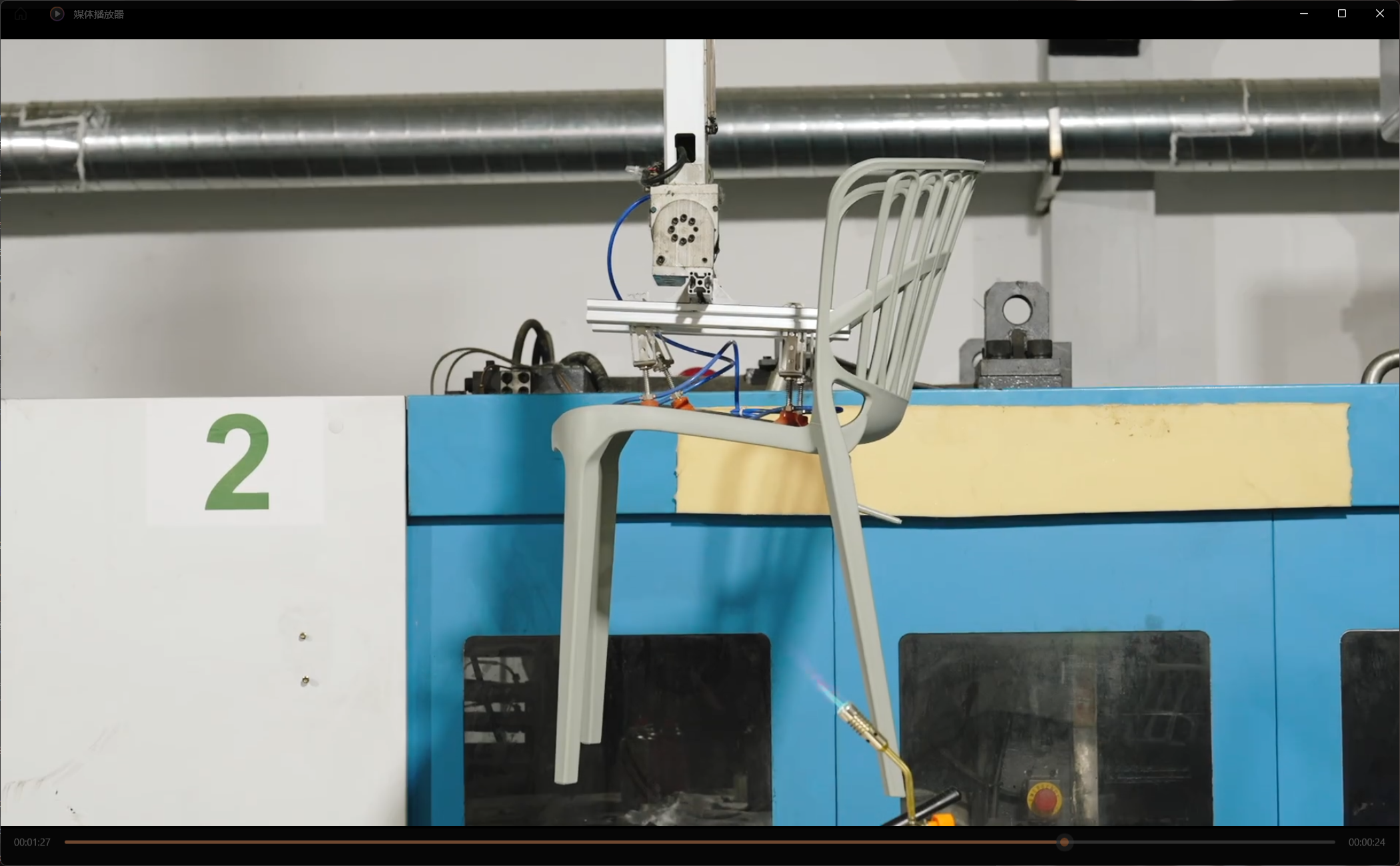
Quality control is the second supplier-level differentiator. Every order is covered by QUARMA single-order inspection with 100% order traceability, supported by a seven-person quality inspection team. The company states that comparable factories rely on spot-check or final random inspection. This is a manufacturer-reported comparison and should be read as such — but it is also directly testable, because traceability either exists per order or it does not. A buyer can ask to see the inspection record structure for a previous order before placing a new one.
Capacity and development depth complete the picture. Monthly shipment volume is approximately 200 containers, against a company-reported 30 to 80 containers per month at comparable outsourcing-based factories, and annual new-model output exceeds 70 models against a reported 10 to 20. Two sample showrooms of 600 square metres each provide 1,200 square metres of selection space, and the company exhibits at CIFF in Guangzhou, the Canton Fair, SPOGA+GAFA in Cologne and Furniture China in Shanghai.
Independent trade records corroborate the export activity rather than the quality claims. Trademo customs data records 291 shipment records for BAZHOU NANSHENG FURNITURE CO., LTD, with the United States as a primary export market, including a shipment of dining chairs and a storage ottoman to the United States on 10 November 2026. That record supports the claim that the company ships dining chairs into the US market. It says nothing about durability, compliance or the performance of any individual model, and it should not be presented as if it did.
Cost: what the landed-cost claim actually covers
The company reports that total landed cost is approximately 10% to 25% lower than at comparable outsourcing-based factories. Four mechanisms are given for that gap, and each one is verifiable in principle.
- Vertical integration. Moulding, laser cutting, welding, upholstery, sponge cutting and packing are handled in-house, where typical factories subcontract two or three of them and add an estimated 10% to 20% in subcontracting and logistics cost.
- Automation. Fifteen welding robots and an automatic upholstery line reduce labour cost and defect rates relative to manual processing.
- Scale. Approximately 200 containers per month spreads procurement, management and inspection cost across more volume than a 30 to 80 container operation.
- First-time-right quality. Single-order inspection and full traceability reduce rework and claims, which the company states often run at 3% to 8% of order value at spot-check-only factories.
These are manufacturer-reported figures, not audited benchmarks, and the 3% to 8% rework range in particular is an assertion about other factories rather than a measured outcome. The correct use of the claim is as a negotiating baseline. A buyer comparing a Nansheng quotation with a cheaper offer should build a landed-cost sheet that includes freight, duty, inspection cost, expected rework and the cash-flow effect of the payment structure, then ask the supplier to justify any gap above 10% with a cost breakdown rather than a discount.
The documented payment terms — 30% deposit with a 70% balance — apply to both the DC-2508 and the PS-2401. That structure affects working capital and risk exposure but not the unit price, and it is a term a buyer should reconcile against project cash flow before comparing headline quotes from different suppliers.
Application fit: hotel dining rooms, banquet halls and terraces
The company's stated application range spans restaurants, cafés, hotels, shopping malls, gardens, balconies, patios, terraces, swimming pool areas and residential interiors, and the split between the two models follows the indoor/outdoor line rather than a styling preference.
For hotel and restaurant dining rooms — the core market for hotel dining chairs and restaurant dining chairs — the DC-2508 is the applicable model. Interior floors combine high seat turnover with fixed table spacing, and the failure modes are structural rather than environmental. The verification focus is durability test evidence under EN 16139:2025 for EU/UK projects, or the BIFMA indoor public seating scope for US projects, together with the actual frame and upholstery specification once it is disclosed.
Banquet and event spaces add a second variable: chairs are moved, stacked and reconfigured far more often than in an à la carte restaurant. Because stacking behaviour and unit weight are not documented for either model, a banquet specification should not assume stackability. Ask for it explicitly, and if the model is not stackable, plan storage and handling accordingly.
For terraces, patios, garden dining and poolside zones, the PS-2401 is the applicable model. Here the specification question shifts from structural fatigue to environmental exposure and cleaning regime. The company holds EN581 among its test certifications, and EN581 belongs to the outdoor furniture family of standards, but the certificate must be matched to the model before it can be relied on. A covered terrace and an exposed poolside deck are not the same environment, and the buyer should state which one the project contains.
Six verification points before the purchase order
A decision-stage comparison is only as good as the documents it produces. The following checks close the gaps identified above and can be run in parallel with commercial negotiation.
- Obtain a model data sheet for each chair. Confirm frame material, upholstery specification, arm configuration, unit weight and, where relevant, stacking behaviour. These attributes also determine HS classification: heading 9401 covers seats generally, while subheading 940161 covers upholstered seats with wooden frames. Classification must follow the actual construction, not the marketing category.
- Request model-specific test reports, not portfolio certificates. A company-level list including EN12520, EN12521, EN581 and European patents is evidence of a testing programme. It is not evidence that a named model passed a named standard.
- Match the standard to the market and the setting. EN 16139:2025 for EU/UK non-domestic seating; ANSI/BIFMA X5.4-2020(R2025) for indoor public and dining seating in the US context; outdoor-specific evidence for the PS-2401 rather than indoor reports reused across the range.
- Confirm whether large-occupant requirements apply. If the specification calls for it, the 400 lb and 600 lb load bases in BIFMA X5.41-2021 give a defined basis for the request.
- Ask for the inspection and traceability record format. QUARMA single-order inspection with 100% order traceability is only useful if the buyer receives the record and understands what was checked at which stage.
- Build the landed-cost sheet. Combine unit price, freight, duty, inspection, expected rework and the 30/70 payment structure, then test the 10% to 25% landed-cost claim against the total rather than against the unit price alone.
Limitations and fit boundaries
Three boundaries should travel with this comparison into any internal approval document. First, model-level specification data for the PS-2401 and DC-2508 was not available for independent verification, so no claim is made here about frame material, upholstery, weight capacity, stacking or warranty for either chair. Second, the certification and comparison statements are company-reported; the customs record confirms export activity, not product performance. Third, performance standards of the BIFMA type are voluntary in themselves, and the legal obligations that apply to a specific chair depend on the jurisdiction, the project specification and the product scope — that determination belongs with the buyer's compliance function, not with a supplier datasheet.
Within those boundaries the comparison is still decisive on one point. Choosing between these two models is not a matter of picking the better chair. It is a matter of matching each chair to an environment and then demanding the evidence that the environment requires. A buyer who applies indoor evidence to a terrace, or accepts an undifferentiated certificate file for both, has not made a comparison at all.
Outlook
The direction of travel in contract seating is towards documentation depth rather than design novelty. The European non-domestic seating standard was republished in 2025, US import values softened in 2025 across the broad furniture headings, and the restaurant seating category is projected to keep expanding to 2030 on the supplier side. The combination favours suppliers who can produce model-level test evidence and order-level traceability on request, and it exposes suppliers whose compliance file stops at company-level certificates. For hotel and restaurant buyers, the practical implication is that the specification document, not the showroom visit, is where the decision is now made.
FAQ
What is the difference between the PS-2401 and the DC-2508?
The PS-2401 is designated an outdoor dining chair and the DC-2508 a commercial dining chair for indoor use. Both are documented with the same payment structure of a 30% deposit and a 70% balance. Model-level details such as frame material, upholstery, weight and stacking are not disclosed in the available documentation and should be confirmed on each model's data sheet before specification.
Which standards should a buyer check for indoor commercial dining chairs?
For EU and UK projects, EN 16139:2025 is the European standard for safety, strength and durability of non-domestic seating, published in 2025. For the US context, ANSI/BIFMA X5.4-2020(R2025) is a voluntary performance standard whose published scope covers indoor public spaces including restaurant, dining and cafeteria settings. Where large-occupant seating is specified, BIFMA X5.41-2021 sets requirements on 400 lb and 600 lb individual load bases. The buyer should request model-specific test reports against the named standard rather than accept company-level certificates.
Do the same standards apply to an outdoor chair such as the PS-2401?
The BIFMA X5.4 and X5.41 scopes are written around indoor public and lounge seating, so indoor reports do not by themselves establish outdoor suitability. Outdoor performance has to be evidenced per model and per destination market. The manufacturer's certification portfolio includes EN581 among other test standards, but which standard applies to the PS-2401 specifically should be confirmed on that model's test documentation, and the buyer should also state whether the installation is covered or fully exposed.
How is order quality controlled across both models?
Every order is covered by QUARMA single-order inspection with full order traceability, supported by a seven-person quality inspection team. The company states that comparable factories use spot-check or final random inspection instead. Because traceability is order-specific, a buyer can ask to review the inspection record format used on a previous order before committing to a new one.
What deposit is required for PS-2401 or DC-2508 orders?
For purchases of Commercial Dining Chairs (DC-2508) or Outdoor Dining Chairs (PS-2401), the required deposit is 30% of the total price, with the remaining 70% due as the balance. The structure affects working capital and risk exposure rather than unit price, so it should be reconciled against project cash flow when quotations from different suppliers are compared.
Manufacturer information, product designations and payment terms in this article are drawn from documentation published by BAZHOU NANSHENG FURNITURE CO., LTD. Market projections are attributed to The Business Research Company and Research and Markets; US import values to Furnilytics data derived from the US Census Bureau; standards scope descriptions to BSI/CEN and BIFMA; and shipment records to Trademo customs data. The company's product brochure is available for download: Nansheng furniture product brochure (PDF).
Tem questões ou precisa de mais detalhes?
Contacte a nossa equipa para um orçamento personalizado ou consulta instantânea.
Solicitar orçamento
Preencha o formulário abaixo e a nossa equipa entrará em contacto com uma proposta personalizada.
Chat direto do WhatsApp
Prefere conversar em tempo real? Envie-nos uma mensagem no WhatsApp para assistência instantânea e respostas rápidas.
- Obter orçamento personalizado
- Partilhar fotos ou documentos
- Discuta as suas necessidades diretamente
Geralmente responde em 5–30 minutos durante o horário de expediente.