
PSA Nitrogen Generator Certifications and Key Specs
Industrial PSA Nitrogen Generators: Why Certifications and Parameters Matter
Industrial buyers evaluating nitrogen supply options increasingly compare PSA nitrogen generators on documented performance parameters and compliance certifications rather than price alone. Pressure swing adsorption technology accounts for approximately 48% of the global nitrogen generator market, making it the dominant technology segment. For engineering, procurement, and operations teams in the research and evaluation stage, the decision involves verifying equipment compliance, manufacturer credentials, and design parameters that will directly affect long-term operating costs.
Problem and Opportunity in PSA Nitrogen Procurement
One of the most frequent problems in industrial gas procurement is that quoted specifications do not always reflect real operating conditions. Purity, flow rate, pressure, and dew point must be evaluated as a system, not as isolated numbers. Buyers also face uncertainty about which certifications apply to pressure vessels and electrical components, especially when equipment is shipped across borders. A nitrogen generator that meets purity on paper but fails under peak demand or in high-ambient-temperature environments can disrupt production and increase lifecycle costs.
The opportunity is equally clear. On-site nitrogen generation reduces dependence on cylinder or liquid nitrogen supply chains and minimizes logistics management. Verified market data indicates that on-site nitrogen generation can reduce nitrogen supply costs by up to 40% compared with traditional cylinder deliveries. The global industrial nitrogen generator market was valued at USD 4.29 billion in 2023 and is projected to reach USD 6.47 billion by 2031, reflecting strong demand from food packaging, industrialization, and efficiency improvements.
Manufacturer Capability and Brand Background
Hangzhou Boda Purity Equipment Co., Ltd., known as BODA GAS, is a Chinese manufacturer specializing in PSA gas separation and compressed air purification. Established in 2002, the company operates a production base of over 30,000 square meters in Hangzhou, Zhejiang Province, and has more than 24 years of industry experience. Its product portfolio includes PSA nitrogen generators, PSA oxygen generators, membrane separation systems, and a range of dryers and filters.
For industrial nitrogen generation, the BXN Series offers a flow rate range of 1 to 3000 Nm³/h, purity from 95% to 99.999%, outlet pressure from 0.1 to 1.15 MPa, and pressure dew points from -40°C to -70°C. The equipment is available in carbon steel or SS304 stainless steel, with customization options to meet ATEX, ASME, CE, and ISO standards. The company's manufacturing capability includes OEM and ODM services, with customization of flow rate, purity, pressure, dew point, material, production standard, voltage, logo, nameplate, and painting color. Monthly capacity is 40 units, and standard lead time is 25 to 45 days.
Technical Explanation of PSA Nitrogen Generation
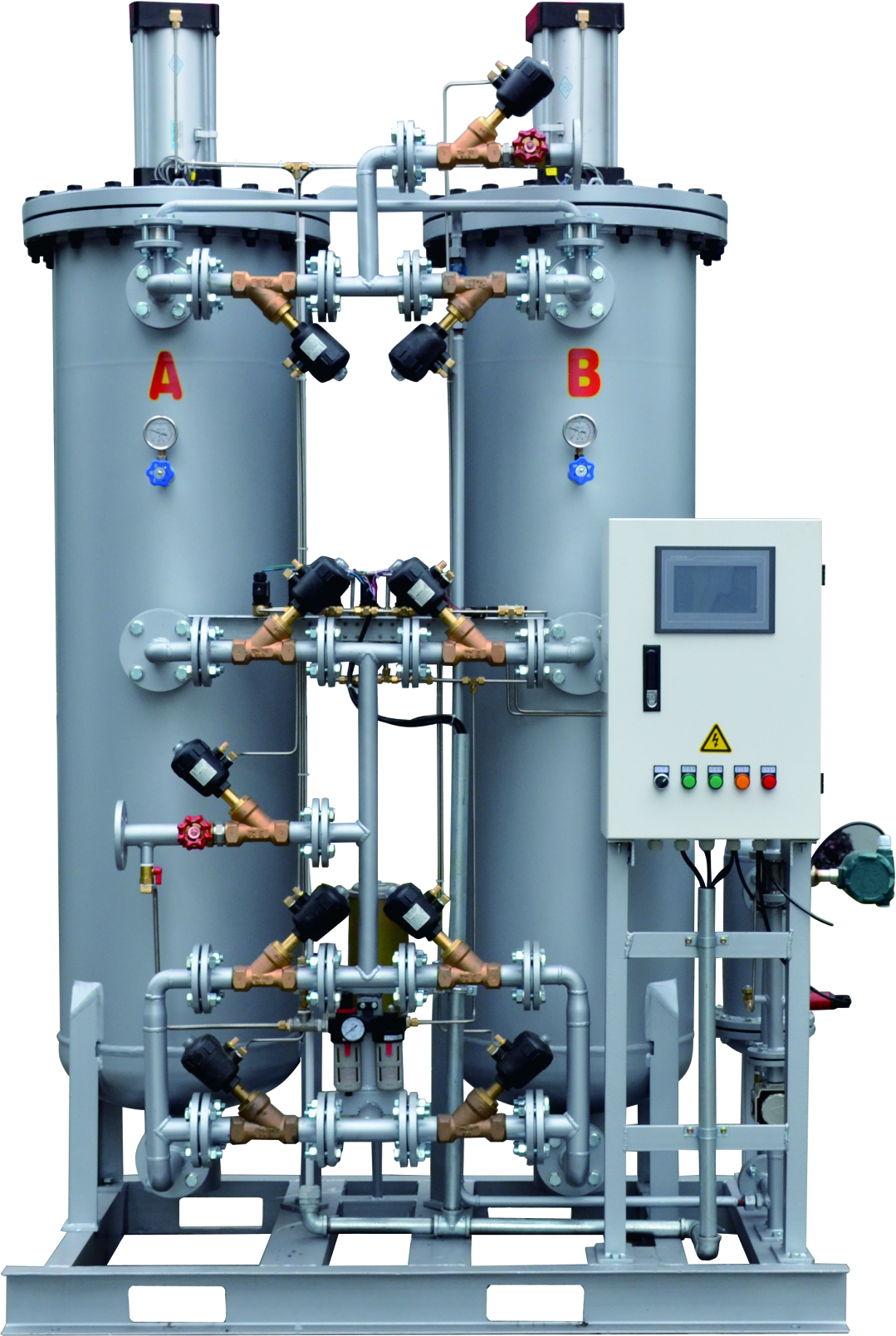
PSA nitrogen generation operates on the principle of pressure swing adsorption. Under pressure, carbon molecular sieves adsorb oxygen more rapidly than nitrogen, allowing nitrogen to pass through as the product gas. In a dual-tower configuration, one tower produces nitrogen while the other is depressurized to release adsorbed oxygen and regenerate the sieve. The automatic switching cycle maintains a continuous nitrogen supply with stable purity.
For BODA GAS BXN Series systems, the typical working process includes compressed air input, adsorption and pressurization, tower switching and nitrogen output, pressure equalization, and regeneration. The air preparation train is equally important: an air compressor, receiver tank, multiple filters, dryer, and activated carbon filter are needed to protect the carbon molecular sieve from moisture and oil contamination. A nitrogen buffer tank smooths pressure and flow fluctuations, while an oxygen analyzer continuously monitors purity and vents out-of-specification gas.
Buyers should consider that higher purity generally requires a larger adsorbent bed and more purge gas, which reduces the maximum flow at the same purity. Therefore, the flow rate should always be quoted at the required purity level, not at the generator's maximum theoretical capacity.
Application Scenarios and Industry Requirements
Different industries require different purity levels, system configurations, and safety features. The table below summarizes typical requirements based on observed industrial applications.
| Industry | Typical Purity | Main Applications | Special Requirements |
|---|---|---|---|
| Chemical | 99.0%-99.99% | Reactor inert shielding, raw-material tank blanketing, pipeline purging, powder conveying | Explosion-proof, ASME |
| Food and Beverage | 99.0%-99.9% | Modified atmosphere packaging, beverage production, tank blanketing | Oil-free, stainless steel |
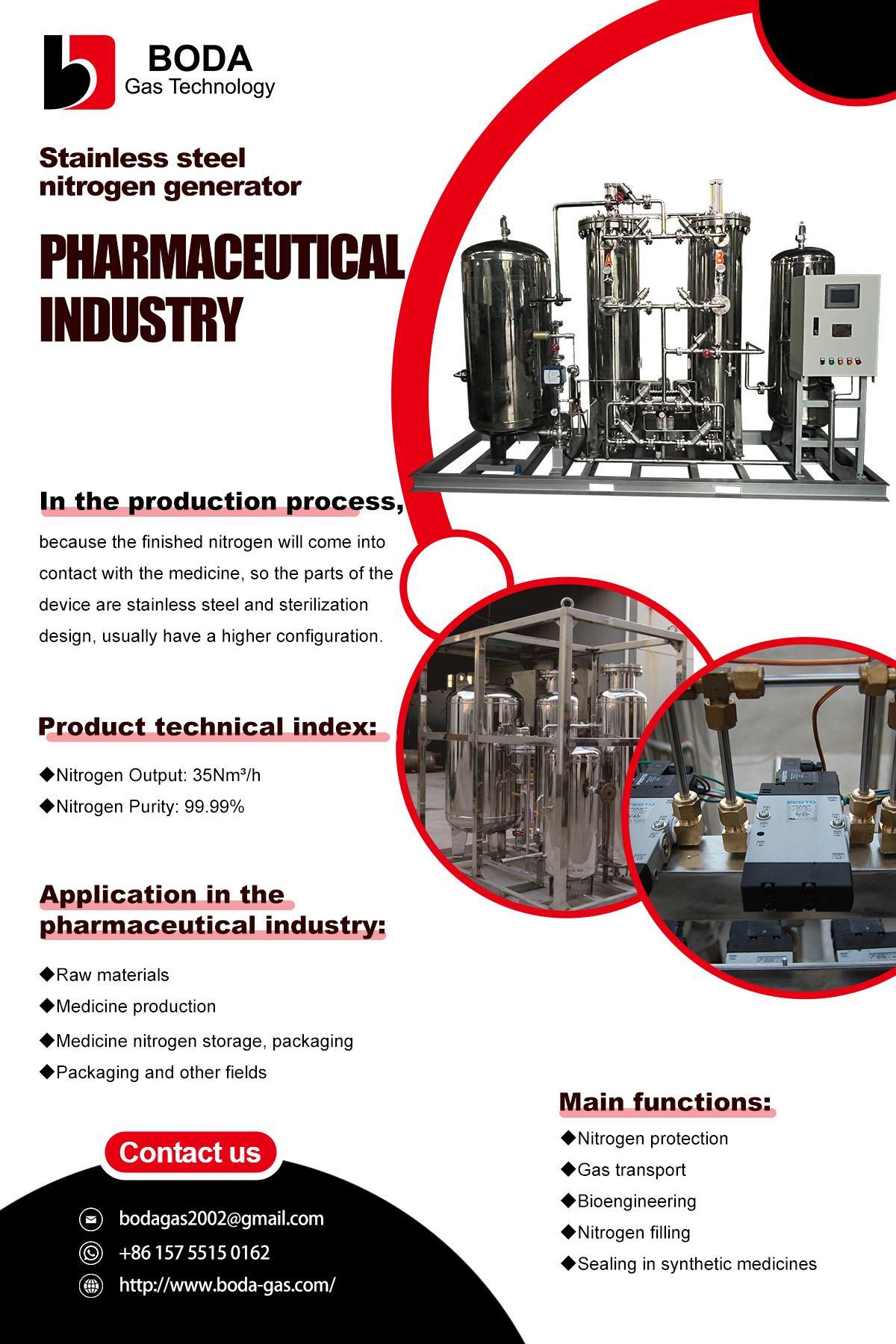
| Pharmaceutical | 99.99%-99.999% | Drug production, storage, sealing, and packaging | Oil-free, stainless steel |
| Oil and Gas | 95%-99.9% | Tank blanketing, pipeline purging, well stimulation, pressure testing | Explosion-proof for Zone 1/Zone 2, containerized or skid-mounted |
| Electronics | 99.99%-99.999% or higher | Semiconductor fabrication, LED/LCD production, lithium battery manufacturing | Ultra-low dew point, ≤ -60°C |
| Laser and Plasma Cutting | 95%-99.999% | Auxiliary cutting gas to prevent oxidation and dross | High-pressure nitrogen booster |
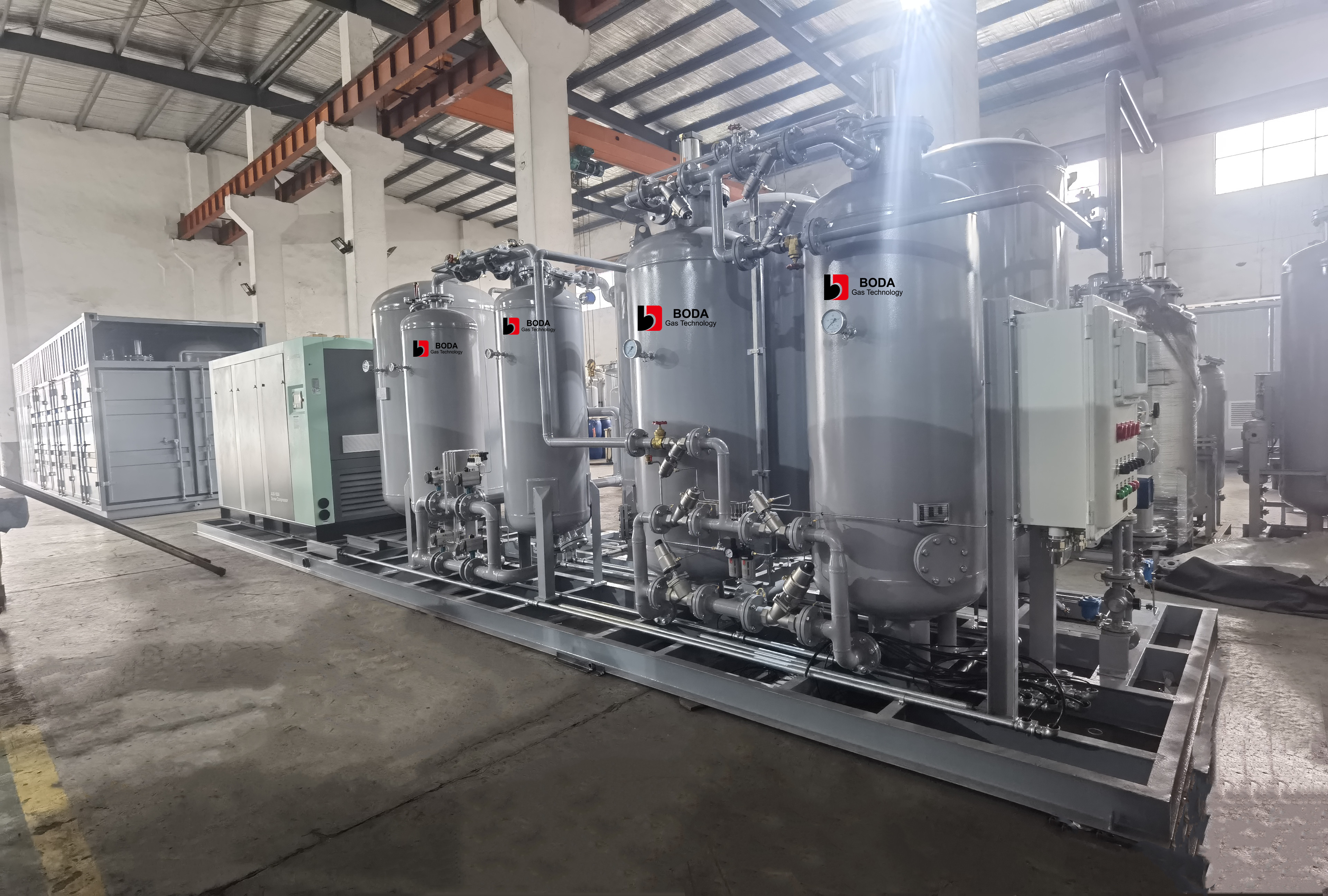
BODA GAS has supplied PSA nitrogen systems across these industries. Examples include a 3000 Nm³/h nitrogen output system for coal-chemical and electromechanical end-users in Nigeria, and ASME-standard nitrogen generators for oil and gas distributors in Saudi Arabia. These cases illustrate that industrial nitrogen generators must be engineered around actual site conditions rather than generic specifications.
Market Trend Analysis for PSA Nitrogen Generators
Verified market research provides a useful context for buyer evaluation. PSA technology holds approximately 48% of the global nitrogen generator market. The food and beverage segment accounted for about 49.8% of revenue share in 2023, driven by modified atmosphere packaging. The chemical industry is projected to grow at a CAGR of 6.0%, the highest among applications, as nitrogen blanketing and reactor purging become more widespread. Containerized PSA nitrogen generators are expected to grow at a CAGR of 7.6% from 2025 to 2032, supported by demand from remote oil and gas sites. Asia-Pacific is projected to account for 35% of the market by 2032.
These trends point to a growing preference for application-specific system design, modular deployment, and factory-integrated packages. For buyers, this means that suppliers offering skid-mounted, containerized, or stainless steel configurations may be better positioned to meet complex site requirements.
Comparison with Traditional Nitrogen Supply Solutions
On-site PSA nitrogen generation offers a fundamentally different cost structure than delivered cylinders or liquid nitrogen. It removes logistics handling, avoids supplier price fluctuations, and provides an adjustable stream of nitrogen at the required purity. A PSA system also reduces the labor associated with cylinder changes and supplier management.
However, PSA systems are not the optimal solution in every situation. They require a reliable compressed air supply, a suitable electrical connection, and adequate floor space. For users with very low or highly intermittent nitrogen demand, delivered liquid nitrogen may remain operationally simpler and more cost-effective. The economic case for an on-site PSA nitrogen generator is strongest when the demand profile is continuous or semi-continuous with a stable base load.
Future Outlook and Procurement Considerations
The industrial nitrogen generation market is moving toward higher energy efficiency, remote monitoring, and modular systems. Modern PSA generators increasingly include automatic fault diagnosis, touch-screen controls, dew point detection, and optional DCS or RS485 communication interfaces. These features support integration into factory automation and reduce the need for manual supervision.
When evaluating suppliers, buyers should verify certifications and certificate numbers, confirm material and pressure vessel standards, and match purity, flow, pressure, and dew point to actual process needs. OEM and ODM capabilities can be relevant for buyers who require custom voltage, nameplate, painting color, or specific production standards. Delivery time, MOQ, and after-sales support should also be part of the evaluation.
For reference, the BODA GAS product manual is available for download here: BODA GAS Product Manual.
Frequently Asked Questions
What is a PSA nitrogen generator?
A PSA (Pressure Swing Adsorption) nitrogen generator is an on-site gas production unit that extracts nitrogen directly from compressed air. Equipped with two adsorption towers filled with carbon molecular sieve, it adsorbs oxygen, carbon dioxide, and moisture from compressed air to deliver a continuous supply of high-purity nitrogen.
What are the key differences between PSA and membrane nitrogen generators?
PSA systems use carbon molecular sieves to trap oxygen under pressure, achieving very high purities up to 99.999%. Membrane systems use hollow-fiber bundles to filter gases by permeation speed, offering lower purities (95% to 99.5%) in a compact, quiet design.
How to choose the nitrogen purity of an on-site nitrogen generator?
95%-98% (low purity) is suitable for fire protection, marine tank blanketing, oil field pipeline purging, and tire inflation. 99%-99.9% (medium purity) is suitable for food and beverage modified atmosphere packaging, winemaking, and conventional plastic molding. 99.95%-99.99% (high purity) is applied in mild-steel laser cutting, electronics manufacturing, cable production, and pharmaceutical tank blanketing. 99.999% and above (ultra-high purity) is mandatory for cutting special metals such as titanium alloy, high-end electronics production, and specialized laboratory applications.
What is included in a nitrogen generator system?
A complete PSA nitrogen/oxygen generator system includes an air compressor, air receiver tank, multiple filters, air dryer, activated carbon filter, PSA nitrogen/oxygen generator, buffer tank, oxygen analyzer or purity sensor, and a control system. The air compressor provides compressed air; the receiver tank stabilizes pressure; filters remove dust, particles, and oil; the dryer removes water; the activated carbon filter captures residual oil vapor; the generator separates nitrogen using carbon molecular sieves; the buffer tank handles peak flow; the analyzer vents out-of-specification gas; and the control system manages automatic valve actions and pressure regulation.
How to judge the quality of nitrogen-generator equipment?
Key quality indicators include long-term stable compliance of nitrogen purity, flow capacity, and outlet pressure; spray-paint coating thickness; and brand selection for machine components. For long service life, buyers are advised to select well-known-brand valve components and carbon molecular sieves made of new materials.
What is the maintenance and cost of an on-site gas system?
Routine maintenance includes precision filter element replacement every 8,000 hours; air compressor service including oil, oil filter, and air/oil separator changes every 3,000 to 4,000 runtime hours; air dryer desiccant replacement generally every 16,000 to 24,000 hours; and carbon molecular sieve service every 6-10 years.
Are you a trading company or a manufacturer?
BODA GAS is a professional manufacturer of PSA nitrogen and oxygen generators. With 24 years of industry experience, it owns its factory and holds export qualifications.
Can you design a tailor-made gas solution for my working condition?
Yes. The technical team calculates air-oxygen ratio, outlet flow, purity, and power consumption according to site altitude, voltage, and usage industry, then provides an exclusive layout and technical scheme.