
PSA Nitrogen Generators: On-Site Technology Guide for Industrial Buyers
Industrial buyers evaluating nitrogen supply options are increasingly looking at PSA nitrogen generators as an alternative to delivered cylinders or liquid nitrogen. A PSA (Pressure Swing Adsorption) nitrogen generator is an on-site gas production unit that extracts nitrogen directly from compressed air. It uses two adsorption towers filled with carbon molecular sieve to separate oxygen from nitrogen, delivering a continuous supply of high-purity nitrogen without external gas logistics. This article is an industry overview of PSA nitrogen generation, the system architecture around it, typical applications, and the factors procurement teams should review before selecting equipment.
The Shift from Purchased Nitrogen to On-Site Generation
Conventional nitrogen supply chains have a structural cost: cylinders must be transported, stored, handled, and replaced, while liquid nitrogen requires scheduling, cryogenic tanks, and supplier dependency. On-site nitrogen generation removes most of these steps. According to data cited from the U.S. Department of Energy, on-site nitrogen generation can reduce nitrogen supply costs by up to 40% compared with traditional cylinder deliveries by eliminating logistics fees. The same model also gives users direct control over purity and flow.
But this opportunity depends on one condition: the feed air must be clean and dry. PSA systems rely on carbon molecular sieve, and oil or water contamination can degrade the sieve over time. That is why the generator is only one link in a system that includes compressed air supply, filtration, and drying. Buyer evaluation should therefore cover the whole gas train, not only the nitrogen skid.
What BODA GAS Offers as a PSA System Manufacturer
One company that supplies this full chain as a manufacturer is Hangzhou Boda Purity Equipment Co., Ltd., which sells under the BODA GAS brand. Established in 2002, the company specializes in PSA nitrogen generators, PSA oxygen generators, and compressed air purification equipment. Its standardized production base in Hangzhou covers more than 30,000 square meters. BODA GAS exports to a wide set of markets; export business accounts for 30% of total sales, with target regions including the Middle East, Africa, Central Asia, Eastern Europe, Southeast Asia, and Latin America.
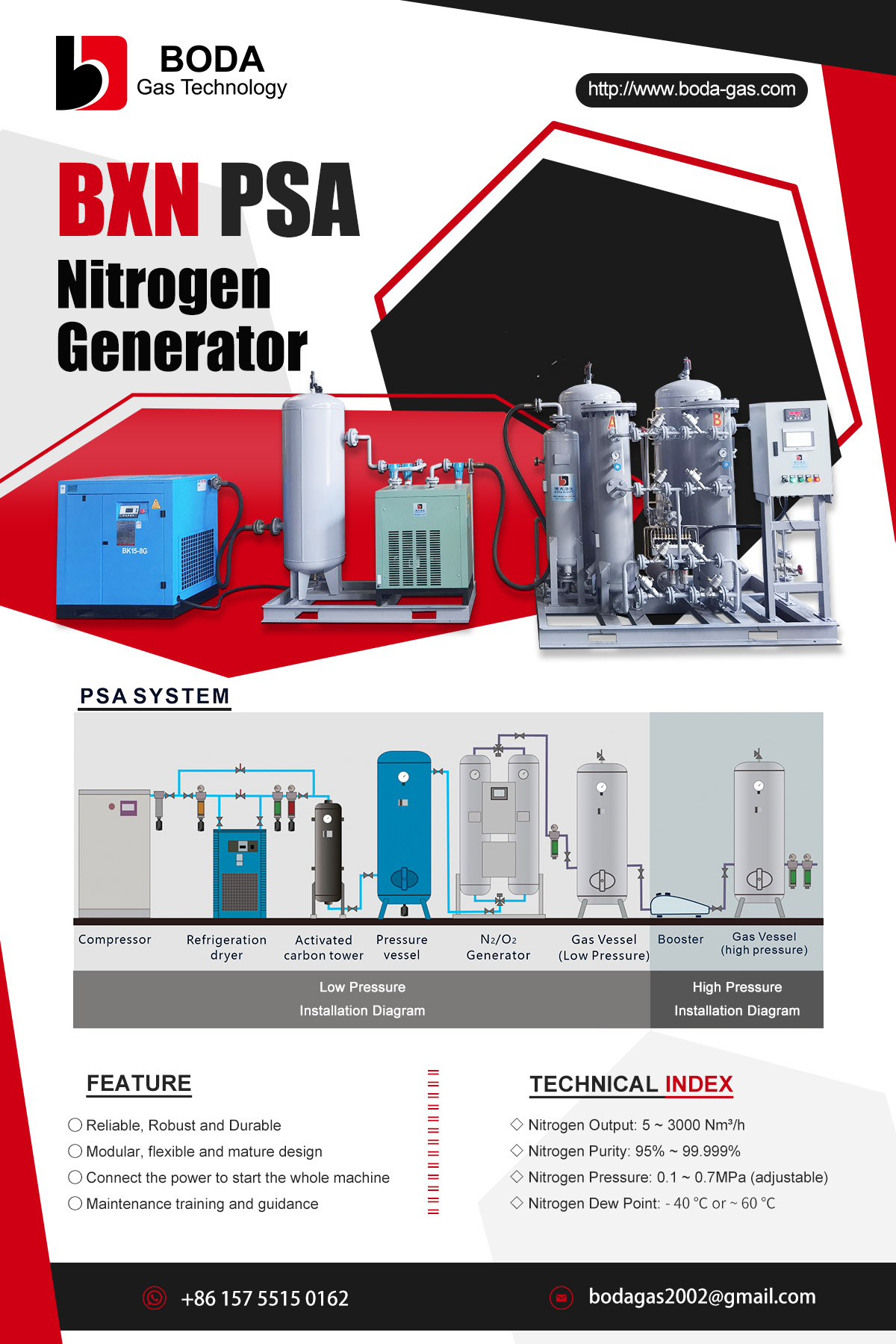
The company’s BXN series PSA nitrogen generator covers flow rates from 1 to 3000 Nm³/h, purities from 95% to 99.999%, pressures from 0.1 to 1.15 MPa, and dew points from -40°C to -70°C. Configurations include industrial PSA nitrogen generators, skid-mounted PSA nitrogen generation packages, and movable containerized PSA nitrogen generators. Carbon steel or SS304 construction is available, and options such as ASME, CE, ISO, and ATEX compliance can be specified.
Beyond the generator itself, BODA GAS produces auxiliary components that determine long-term reliability: refrigeration dryers, heatless and heated desiccant dryers, combined low dew point dryers, oil-water separators, precision filters, high efficiency oil removers, activated carbon filters, and sterilizing filters. In a PSA nitrogen generator system, these components form the pre-treatment section that protects the molecular sieve from oil, water, and particulate contamination.
How a PSA Nitrogen Generator Works
PSA nitrogen generation is based on the difference in diffusion rates of oxygen and nitrogen in carbon molecular sieves. When compressed air enters a vessel packed with carbon molecular sieve, oxygen molecules are adsorbed faster than nitrogen molecules. Nitrogen remains in the gas phase and is collected as product gas. Once the sieve approaches saturation, the system switches airflow to the second tower. The first tower depressurizes, releasing the adsorbed oxygen and impurities, and the sieve regenerates. This alternating cycle between two towers enables continuous on-site production of high-purity nitrogen.
A complete on-site nitrogen generator system normally includes an air compressor, air receiver tank, multiple filters, air dryer, activated carbon filter, PSA nitrogen generator, nitrogen buffer tank, oxygen analyzer or purity sensor, and control system. The wet air buffer tank stabilizes compressed-air pressure and reserves air volume; the dryer removes water; and the activated carbon filter captures residual oil vapor. The nitrogen buffer tank smooths pressure and flow fluctuations during tower switching. An oxygen analyzer continuously monitors gas purity and automatically vents off-specification gas. The control system governs automatic valve actions, purge cycles, and pressure regulation.
Industry Applications and Typical Purity Requirements
PSA nitrogen purity requirements vary sharply by industry. The following table maps common industrial uses to the purity levels typically required, based on BODA GAS application data.
| Industry | Typical purity range | Typical functions |
|---|---|---|
| Chemical | 99.0%–99.99% | Reactor inert shielding, raw-material tank blanketing, pipeline purging, powder conveying |
| Oil & gas | 95%–99.9% | Tank blanketing, pipeline and vessel purging, well stimulation, inert-gas lifting |
| Food and beverage packaging | 99.0%–99.9% | Modified atmosphere packaging, nitrogen-filled packaging, tank blanketing |
| Pharmaceutical | 99.99%–99.999% | Drug production, storage, sealing and packaging; oxygen concentration control |
| Electronics | 99.99%–99.9999% | Semiconductor fabrication and packaging, LED/LCD production, lithium battery manufacturing, nitrogen-shielded welding |
| Laser and plasma cutting | 95%–99% for carbon steel; 99.99%–99.999% for stainless steel fine cutting | High-pressure auxiliary gas to prevent oxidation, dross sticking and thermal ablation |
| Tyre inflation | 95%–98% | Maintaining tyre pressure, slowing rubber inner-wall ageing for automobiles and fleet vehicles |
These purity bands explain why PSA is often the technology of choice across a broad range of industries: it can deliver from moderate purities up to 99.999% in a single on-site unit. For applications that require only 95% to 99.5% and have limited space, a membrane nitrogen generator may be considered, but PSA is typically the preferred route for high purity above 99.9%.
Market Trends in Industrial PSA Nitrogen Generation
Several market observations are relevant for buyers. The global industrial nitrogen generator market was valued at USD 4.29 billion in 2023 and is projected to reach USD 6.47 billion by 2031, according to Verified Market Research. Pressure swing adsorption technology accounts for approximately 48% of the global nitrogen generator market, making it the dominant technology segment, according to Fortune Business Insights. In 2023, the food and beverage segment held about 49.8% of market revenue share, mainly because of modified atmosphere packaging, according to Grand View Research.
Capacity distribution also helps explain typical buyer needs: sub-100 Nm³/h installations represent about 42% of the market, 100–500 Nm³/h units about 36%, and above 500 Nm³/h about 22%, based on Precedence Research and Dataintelo data. The chemical industry segment is expected to grow at a CAGR of about 6.0%, and the containerized PSA nitrogen generator segment is projected to grow at a CAGR of 7.6% between 2025 and 2032, driven largely by remote oil and gas sites. Asia-Pacific is projected to hold a 35% market share by 2032. These figures indicate a sustained shift toward on-site gas production across multiple application segments.
On-Site PSA vs. Traditional Supply Models: A Balanced View
To assess whether an on-site PSA nitrogen generator makes sense, buyers typically compare it with delivered nitrogen in cylinders or liquid form. On-site PSA systems offer three structural advantages: independence from external gas suppliers, removal of cylinder handling and liquid nitrogen delivery scheduling, and a typical cost reduction of up to 40% once established. They also produce nitrogen with purity up to 99.999%, and purity can be matched to the application instead of paying for a fixed high-grade product.
However, the comparison is not one-sided. PSA systems require a compressed air feed, consume electricity, and need regular filter changes and maintenance. Carbon molecular sieve has a finite service life, typically 6 to 10 years before replacement is needed. For a plant with very low and intermittent nitrogen consumption, buying cylinders may remain simpler and require less capital. For larger or continuous users, on-site generation generally improves total cost of ownership.
Another relevant comparison is PSA versus membrane separation. PSA delivers higher purity headroom and is preferred for requirements above 99.9%, while membrane systems are more compact and quiet but typically capped at lower purity levels. The right choice therefore depends on purity, flow profile, site infrastructure, and operational pattern.
Future Outlook
Industrial demand for nitrogen continues to grow across food packaging, chemicals, electronics, and remote energy operations. The move toward containerized PSA units is expected to accelerate, especially for oil and gas sites where mobility reduces installation time. Factory-built skid-mounted packages are also becoming more common because they reduce installation work and allow operation after basic power connection. Equipment suppliers such as BODA GAS already offer continuous-duty design, modular structure, touch-screen display, dew point detection, energy-saving control, and optional DCS communication. For ultra-high-purity requirements, purification technologies such as carbon-loaded purification and hydrogenation purification extend on-site generation beyond 99.999% nitrogen purity. As energy efficiency and remote monitoring improve, the business case for on-site nitrogen generation is likely to strengthen further.
FAQ
What is a PSA nitrogen generator?
A PSA (Pressure Swing Adsorption) nitrogen generator is an on-site gas production unit that extracts nitrogen directly from compressed air. Equipped with two adsorption towers filled with carbon molecular sieve, it adsorbs oxygen, carbon dioxide, and moisture from compressed air, providing a continuous supply of high-purity nitrogen.
How does a PSA nitrogen plant work?
A PSA nitrogen plant works by alternating pressurised adsorption and depressurised desorption cycles. In one tower, carbon molecular sieve adsorbs oxygen, carbon dioxide, and moisture while nitrogen passes through as product gas. When the sieve becomes saturated, the system switches to the second tower, and the first tower depressurizes to release trapped gases and regenerate the sieve.
What is included in a nitrogen generator system?
A complete on-site nitrogen generator system normally includes an air compressor, air receiver tank, multiple filters, air dryer, activated carbon filter, PSA nitrogen generator, nitrogen buffer tank, oxygen analyzer or purity sensor, and control system. The buffer tank stores produced nitrogen to handle peak flow demands, and the purity sensor continuously monitors gas quality.
What is the benefit of an on-site nitrogen generator?
An on-site generator provides high-purity output up to 99.999%, adjustable flow rate, and independence from cylinder or liquid nitrogen logistics. It cuts long-term operating costs compared with purchasing delivered gas and supports continuous industrial use.
How do you choose the nitrogen purity of an on-site nitrogen generator?
Purity should match the application: 95%–98% is suitable for fire protection, marine tank blanketing, oil-field pipeline purging, and general tyre inflation; 99%–99.9% for food and beverage modified atmosphere packaging, winemaking, and conventional plastic molding; 99.95%–99.99% for mild-steel laser cutting, electronics manufacturing, cable production, and pharmaceutical tank blanketing; 99.999% and above for special metal cutting, high-end electronics, and specialized laboratory applications.
What is the maintenance and cost of an on-site gas system?
Routine maintenance typically includes replacing precision filter elements every 8,000 hours, air compressor service every 3,000 to 4,000 runtime hours, air dryer desiccant service every 16,000 to 24,000 hours, and carbon molecular sieve service every 6 to 10 years. These intervals are general estimates from BODA GAS operational guidance.
For further reference, the BODA GAS product manual is publicly available at https://cdn.socialarks.com/sbsp/25160/common/2026/0804/Product%20Manual-BODA%20GAS%20TECH.pdf.