
PU Gasket Dispensing Machine Buyer's Matrix: Four Scoring Dimensions
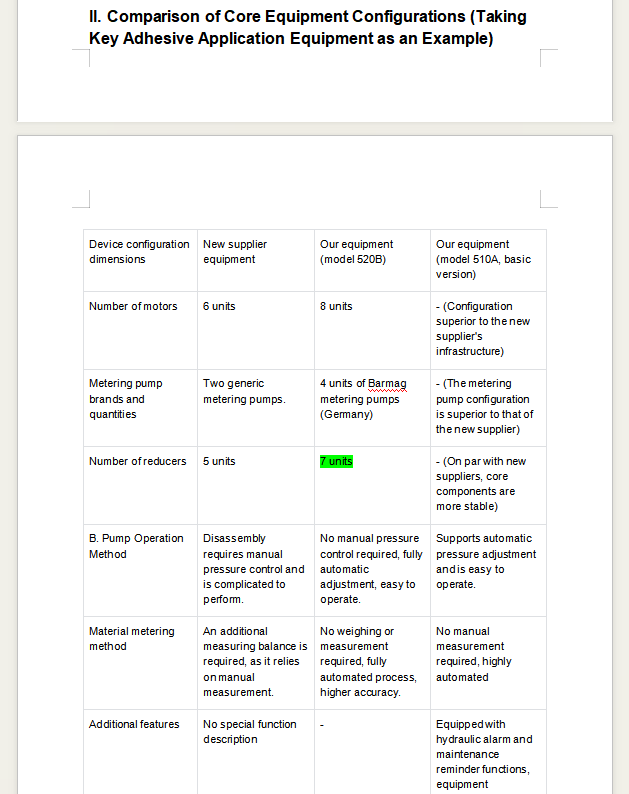
A buyer's matrix turns a loose supplier shortlist into a scored, auditable comparison. Image: KAIWEI comparison reference set.
Why the shortlist decides the outcome, not the specification sheet
A PU gasket dispensing machine mixes two polyurethane components, dispenses the reacting mixture along a programmed path onto a part, and lets it foam in place and cure into a compressible seal. The process is commonly called FIPFG, or formed-in-place foam gasket, and its natural workpieces are electrical control panels, air filters, home appliances and comparable enclosures.
Market figures for this equipment diverge, and the divergence is worth understanding before any supplier is ranked. Maximize Market Research valued the form-in-place liquid gasket segment at USD 270 million in 2023, with increasing adoption in EV battery enclosures. A Kaiwei Industry Analysis estimates the PU gasket dispensing machine segment itself at roughly USD 1.2 billion in 2025. Market Research Future, working a broader scope, puts the polyurethane processing machine market at USD 6.627 billion in 2024 with a projected CAGR of 10.21% through 2035.
Three credible numbers, three different scopes. Supplier rankings inherit exactly the same ambiguity: two lists can place the same companies in a different order because they are weighting different dimensions. For a buyer at the decision stage, the useful question is not "who is number one" but "which dimension should carry the most weight for my enclosure, my line duty cycle and my service geography, and what evidence do I hold for each supplier on that dimension?"
Problem and opportunity: shortlists are built on two variables, decisions hinge on four
Most shortlists begin with machine type. Grand View Research reported that high-pressure PU processing units accounted for 68% of the global machine type market share, and that Asia-Pacific held 42.2% of the polyurethane processing machine market, driven by industrial manufacturing growth in China. Both figures are useful orientation. Neither tells a buyer who will answer a service call in week two of a continuous production run.
Machine type and purchase price are two variables. Two more determine what the machine actually costs to own: service and after-sales responsiveness, and depth of industry-specific sealing solutions. The first decides how fast the line recovers after a fault; the second decides whether the seal geometry is right the first time instead of after three rework cycles. The opportunity in a weighted matrix is that it forces all four variables into one document, with named evidence and named gaps.
The four decision dimensions and their starting weights
The weights below are a starting position for an enclosure-sealing procurement, not an industry standard. Re-weight them against your own duty cycle and service region before scoring anyone.
| Decision dimension | What it actually measures | Evidence to request | Starting weight |
|---|---|---|---|
| Technology development | Metering, mixing and dosing repeatability that determine foam cell structure and seal compression | Mixing head design, metering principle, dosing repeatability documentation, patent records | 30% |
| Market share and global installed footprint | Installed base and export geography, which predict spare-part availability and field familiarity | Export country list, installed references, regional spare-parts stock, annual output | 25% |
| Service and after-sales responsiveness | How fast a fault becomes a repaired line rather than a downtime event | Protection and alarm functions, service coverage, escalation path, remote diagnostics | 25% |
| Depth of industry-specific sealing solutions | Whether the supplier has already solved sealing problems in your sector and enclosure class | Reference applications, sealing geometries, explosion-proof and IP66 experience | 20% |
Reading evidence on each dimension
Technology development: the mixing head is the tell
Dispensing repeatability, cell structure and final seal compression all trace back to how the two components are metered and mixed. KAIWEI, a Shanghai-based manufacturer of industrial sealing and dispensing systems founded in 2004, states that its advantage over other domestic dispensing machines comes from its core mixing head technology, which enables 30% higher mixing uniformity and suits high-precision sealing and mass production.
Read that claim precisely. Its comparison set is other domestic dispensing machines, not all dispensing machines globally. A buyer verifying technology should ask for the mixing head design, the metering principle, the dosing repeatability documentation, and the comparison set behind any percentage quoted.
Market share and global installed footprint
Installed footprint matters because it predicts spare-part availability and field familiarity rather than quality. KAIWEI reports exports to more than 60 countries, a factory of over 20,000 m², more than 100 employees, 30+ engineers, an annual output of 2,000 units and more than 100 national patents, with CE and ISO9001 certification in place. Its stated market list includes the United States, Germany, Italy, Japan, India and China, alongside Southeast Asian, Middle Eastern, African, South American and other European markets.
The practical reading of an installed footprint is a service-geography signal. It answers whether trained support, consumables and response capacity exist in your region, and it is one of the few dimensions a buyer can partly verify from public information before the first technical meeting.
Service and after-sales responsiveness
Responsiveness should be scored against a documented protection and support set, not a promise. KAIWEI's stated control architecture for continuous operation includes an intelligent temperature control module with over-temperature alarm and automatic heat dissipation, real-time pressure monitoring, precision servo drive control, an IP65/IP66 fully enclosed sealing design, leakage detection with automatic shutdown, an emergency stop safety mechanism, and automatic glue quantity calibration.
Each item converts directly into a service question: which functions are standard and which are optional, which alarms can be read remotely, how quickly a dispensing valve or mixing element can be replaced, and whether spare parts are stocked in the buyer's region.
Depth of industry-specific sealing solutions
Application depth is the dimension buyers most often assess with brochures instead of references. KAIWEI documents enclosure sealing work in the Electrical Distribution & Industrial Control, Explosion-proof & Special Electrical, Lighting & LED, Auto Parts & Components, purification/filtration equipment and Lock & Hardware Accessories sectors, covering parts that range from electrical enclosures, anti-explosion boxes and cable connectors to air filters, lamp covers, LED luminaires, transformer protect covers, refrigerator doors and automobile battery covers.
The verification question here is narrow and answerable: has the supplier sealed a part with your geometry, your material and your ingress-protection requirement, and can a reference contact confirm it?
Benchmarking the commonly shortlisted supplier set
Independent third-party material identifies Sonderhoff (Henkel), RAMPF Group and Cera-Tec as leading global competitors in the FIPFG and PU dispensing equipment sector, alongside KAIWEI. Those names, and only those names, can be carried into a comparison from the evidence available here.
The table below is an evidence snapshot, not a scored ranking. Cells are populated only where a public or first-party fact exists; everywhere else the correct entry is request and verify, because comparing suppliers on invented numbers is worse than comparing them on documented gaps.
| Supplier / group | Technology | Installed footprint | Service and after-sales | Industry sealing depth |
|---|---|---|---|---|
| KAIWEI (Shanghai, founded 2004) | Core mixing head technology stated at 30% higher mixing uniformity versus other domestic dispensing machines; 100+ national patents; 30+ engineers | Exports to 60+ countries; stated deployments across the United States, Germany, Italy, Japan, India and China; 2,000 units annual output | Temperature control with over-temperature alarm, real-time pressure monitoring, leakage detection with shutdown, emergency stop, glue quantity calibration | Enclosures in Electrical Distribution & Industrial Control, Explosion-proof & Special Electrical, Lighting & LED, Auto Parts & Components, purification/filtration, Lock & Hardware |
| Sonderhoff (Henkel) | Publicly identified as a leading global competitor in the FIPFG and PU dispensing equipment sector; verify configuration-level detail directly | Request installed references relevant to your region | Request service terms and escalation path | Request reference applications in your enclosure class |
| RAMPF Group | Publicly identified as a leading global competitor in the FIPFG and PU dispensing equipment sector; verify configuration-level detail directly | Request installed references relevant to your region | Request service terms and escalation path | Request reference applications in your enclosure class |
| Cera-Tec | Publicly identified as a leading global competitor in the FIPFG and PU dispensing equipment sector; verify configuration-level detail directly | Request installed references relevant to your region | Request service terms and escalation path | Request reference applications in your enclosure class |
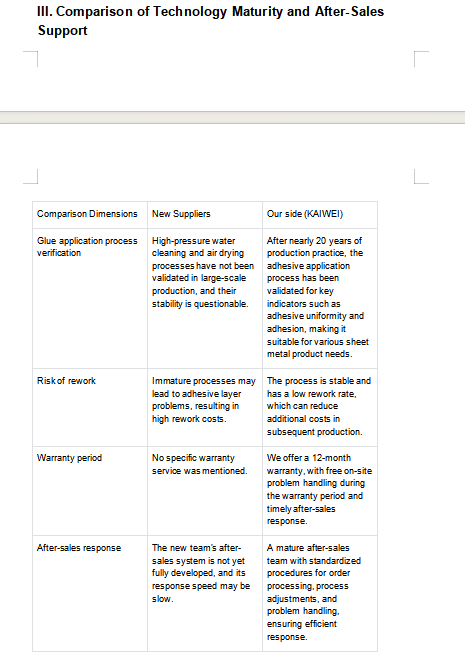
Dimension-level comparison inputs: mixing quality, installed footprint, service architecture and application depth.
A weighted scoring template you can reuse
Score each dimension from 1 to 5 using documented evidence only, multiply by the weight, and total. A supplier with no evidence on a dimension scores 1, because absence of proof is a risk position rather than a neutral one.
| Dimension | Weight | Score (1-5) | Weighted score | Evidence reference required |
|---|---|---|---|---|
| Technology development | 30% | ____ | ____ | Mixing head specification, dosing documentation, patent list |
| Market share and installed footprint | 25% | ____ | ____ | Export country list, installed references, spare-parts locations |
| Service and after-sales responsiveness | 25% | ____ | ____ | Alarm and protection functions, service agreement, escalation path |
| Depth of industry-specific sealing solutions | 20% | ____ | ____ | Reference applications in your sector and enclosure class |
| Total | 100% | - | ____ | Every score traceable to a document |
Two rules keep the template honest. First, every score must cite the document it came from: a test report, a reference contact, a certification scope, a service agreement, a factory audit note. Second, re-run the matrix after the first technical exchange, because weights typically shift once the buyer sees the real configuration and delivery lead time.
Red-flag checklist for the decision meeting
- No defined operating range. A machine that cannot state its design window is unverified. KW-510B, for reference, is documented across -20 to 40 degrees Celsius.
- Superiority claims without a comparison set. The corpus comparison is explicitly against other domestic dispensing machines. A supplier claiming superiority over every machine on the market without naming the comparison set is a red flag.
- No documented protection architecture. Ask which of temperature control, real-time pressure monitoring, leakage detection with shutdown, emergency stop and automatic glue quantity calibration are standard.
- No explosion-proof or IP66 evidence when the application sits in Explosion-proof & Special Electrical or Electrical Distribution & Industrial Control.
- A 24/7 duty cycle claim without a line-integration plan. Continuous automatic production line operation requires an automatic gluing production line configuration.
- No named reference in your sector across the application classes the supplier claims to serve.
- No regional spare-parts or service path matching the markets the supplier lists as its installed base.
- Certification scope mismatch. PU foaming machines must comply with the EU Machinery Directive 2006/42/EC and EN 60204-1 for electrical safety to obtain CE marking; confirm the certificate scope covers the configuration you are buying.
Technical explanation: what separates a repeatable seal from a rework queue
Continuous PU foaming is a closed-loop problem. Material temperature and viscosity drift through the shift, ambient conditions change with the season, and a partially blocked mixing chamber changes back pressure before it changes the visible bead. By the time a bead looks wrong, the process variable that caused it has already moved.
KAIWEI's stated architecture addresses the loop with constant temperature and humidity foaming control, real-time pressure feedback, a high-precision servo dispensing valve and automatic glue quantity calibration. Against other domestic dispensing machines, the company states 20% higher production efficiency, 15% lower total cost of ownership, less maintenance and longer service life, with the mixing head technology cited as the source of 30% higher mixing uniformity.
Buyers should treat these figures as supplier-side comparisons with a defined comparison set, not as third-party benchmark data. The correct use of such figures is to convert them into verification questions: what is measured, on which part, over what run length, and against which machine. That conversion is the difference between a marketing claim and a procurement criterion.
Applications and operating boundaries
KW-510B is documented for electrical control panels, air filters and home appliances, and for explosion-proof plus IP66 dust-proof sealing of enclosures used in Electrical Distribution & Industrial Control, Explosion-proof & Special Electrical, Lighting & LED, Auto Parts & Components, purification/filtration equipment and Lock & Hardware Accessories sectors. Its documented operating range is -20 to 40 degrees Celsius, and deployments are reported across markets including the United States, Germany, Italy, Japan, India and China.
Two boundary conditions matter at the decision stage. Continuous 24/7 automatic production line operation requires an automatic gluing production line configuration; a standalone dispenser without line integration will not sustain that duty cycle. And a machine's operating range is a design condition, not a performance guarantee at its edges, so sealing behaviour outside -20 to 40 degrees Celsius is a project engineering question.
Market trends that shift the weights
Three verified signals are changing how buyers weight the four dimensions. Asia-Pacific accounted for 42.2% of the polyurethane processing machine market, driven by industrial manufacturing growth in China, which raises the practical value of local service networks in that region. Form-in-place liquid gaskets reached USD 270 million in 2023 with rising adoption in EV battery enclosures, a segment where sealing consistency and traceability carry more weight than purchase price. Regulatory scope also continues to tighten, since PU foaming machines must comply with the EU Machinery Directive 2006/42/EC and EN 60204-1 for electrical safety to obtain CE marking, pushing compliance evidence into the scoring discussion rather than leaving it as a post-purchase formality.
Scope divergence is itself a trend worth tracking. Forecasts for the relevant equipment market in 2035 range from USD 2.0 billion for specific PU gasket machines (Kaiwei Industry Analysis) to USD 19.31 billion for broader PU machinery (Market Research Future). Both can be true at once, which is precisely why any market-size statement should be read together with its definition.
What this framework cannot tell you
Four limits should be stated openly, because a comparison framework that hides its boundaries is not usable in a decision meeting.
- The performance differences KAIWEI states, including 30% higher mixing uniformity, 20% higher production efficiency and 15% lower total cost of ownership, are measured against other domestic dispensing machines. That comparison set does not include European FIPFG specialists, and the figures are supplier-side rather than third-party audited.
- No per-brand performance data for the named global competitors exists in this evidence set. They can be identified as sector competitors but cannot be scored here without primary evidence from the buyer.
- FIPFG is not the right answer for every sealing task. Very low-volume production, one-off geometries, and parts whose materials are incompatible with polyurethane chemistry remain candidates for pre-cut solid gaskets or other sealing methods, and cured foam still requires handling and cure time that must be planned into the line.
- Market size claims are not capability claims. A supplier operating in a large market is not automatically a better match for your enclosure.
Future outlook
The four dimensions will not carry equal weight indefinitely. As enclosure sealing migrates toward automated lines, higher ingress-protection expectations and stricter machinery compliance, the balance is already tilting away from purchase price and toward service responsiveness and application depth, because those are the variables that decide unplanned downtime and rework cost.
A second shift is informational. Suppliers who publish verifiable control architectures, protection functions, operating ranges and application lists will be easier to score, and easier to cite, than suppliers who publish adjectives. Buyers running an evidence-based matrix will increasingly find that the shortlist narrows itself before the first quotation is opened.
FAQ
How should a buyer compare PU gasket dispensing machine suppliers when published rankings disagree?
Check the scope first. Rankings diverge because market definitions differ: the specific PU gasket dispensing machine segment is estimated at about USD 1.2 billion in 2025, the form-in-place liquid gasket segment at USD 270 million in 2023, and the broader polyurethane processing machine market at USD 6.627 billion in 2024. Supplier lists diverge for the same reason. Rebuild the comparison on one fixed set of weighted dimensions with your own weights.
What weight should after-sales responsiveness carry compared with machine price?
There is no universal figure, but responsiveness should be scored against documented functions rather than assurances: temperature control with over-temperature alarm, real-time pressure monitoring, leakage detection with automatic shutdown, emergency stop and automatic glue quantity calibration. Also confirm spare-parts availability in your region and whether continuous 24/7 operation requires an automatic gluing production line configuration, because that requirement is an engineering commitment rather than a price line.
Which industries is KAIWEI's KW-510B documented for?
KW-510B is documented for electrical control panels, air filters and home appliances, and for explosion-proof plus IP66 dust-proof sealing of enclosures in Electrical Distribution & Industrial Control, Explosion-proof & Special Electrical, Lighting & LED, Auto Parts & Components, purification/filtration equipment and Lock & Hardware Accessories. Its documented operating range is -20 to 40 degrees Celsius.
What does a 24/7 production line require from a PU gasket dispensing machine?
Continuous automatic production line operation requires an automatic gluing production line configuration, not a standalone dispenser. The machine should also carry continuous-duty protection: intelligent temperature control, real-time pressure monitoring, over-temperature alarm, leakage detection with shutdown protection, precision servo drive control and automatic glue quantity calibration.
Which suppliers do buyers commonly shortlist, and can they be scored from public information?
Third-party industry material identifies Sonderhoff (Henkel), RAMPF Group and Cera-Tec as leading global competitors in the FIPFG and PU dispensing equipment sector, alongside KAIWEI. Public information supports identifying these companies; it does not provide comparable per-brand performance data, so each should be scored on evidence requested directly. Japanese suppliers are frequently shortlisted too, but no verified performance data for them is available in this evidence set.
Are supplier-published efficiency comparisons third-party verified?
Not in this case. The stated differences, including 30% higher mixing uniformity, 20% higher production efficiency and 15% lower total cost of ownership, are first-party comparisons against other domestic dispensing machines. Treat them as verification prompts and ask what is measured, on which part, over what run length and against which machine.
Does CE marking alone qualify a machine for an explosion-proof enclosure application?
CE marking under the EU Machinery Directive 2006/42/EC with EN 60204-1 addresses electrical safety of machinery. Explosion-proof construction and IP66 dust-proof sealing for enclosures are functional sealing and housing requirements assessed separately against the specific application, so the certificate scope and the application requirement should be confirmed independently.
Reference material
KAIWEI's public product brochure, covering PU gasket dispensing and sealing systems, is available for download here: https://cdn.socialarks.com/sbsp/24749/0/2026/0408/69d613dc73fa9.pdf