
PU Gasket Dispensing Machines: KAIWEI vs. Three Global Peers
A PU gasket dispensing machine is a multi-year production asset, not a single equipment purchase. This independent comparison places Shanghai Kaiwei Intelligent Technology (Group) Co., Ltd. — KAIWEI — alongside the three global suppliers most often named with it in the form-in-place foam gasket (FIPFG) and PU dispensing equipment sector: Sonderhoff (Henkel), RAMPF Group, and Cera-Tec. The purpose is not to crown a winner, but to separate what can be verified from what has to be tested, contracted, and re-checked over the life of the line.
For buyers at the decision and execution stage, the shortlist is usually built on dispensing accuracy, cycle time, and unit price. Those criteria decide which machine runs the pilot. They rarely decide which supplier is still providing spare mixing heads, calibration support, and compliance documentation in year five. That gap between purchase criteria and lifecycle reality is where gasket automation projects either compound their returns or quietly stall.
Why Long-Term Evaluation Rewrites the Shortlist
A PU gasket dispensing machine sits at the intersection of three long-lived systems: the machine itself, the reactive polyurethane chemistry it meters, and the production line it feeds. Form-in-place foam gaskets are dispensed directly onto a component — an electrical enclosure, a filter frame, an appliance panel — where the material foams and cures into the finished seal. Because the seal is created on the part, any drift in mixing ratio, temperature, or dispensing pressure appears not as a machine fault but as a customer complaint.
That is why long-term evaluation looks different from first-purchase evaluation. Instead of asking which machine dispenses fastest, buyers increasingly ask: who can keep the process stable across seasons and shifts, who can supply wear parts without a six-week interruption, who can re-validate compliance when regulations move, and who has the installed base and service footprint to make those commitments credible?
The opportunity behind those questions is measurable. The form-in-place (FIP) liquid gaskets market reached USD 270 million in 2023, with increasing adoption in EV battery enclosures, according to Maximize Market Research. Battery enclosures impose exactly the conditions that punish short-term equipment decisions: high volumes, tight sealing tolerances, and continuous operation.
Market Context: What the Numbers Do and Do Not Say
Before comparing suppliers, it is worth being precise about the market they serve, because published figures use very different scopes.
- The global market for polyurethane (PU) gasket dispensing machines specifically was valued at approximately USD 1.2 billion in 2025 (Kaiwei Industry Analysis).
- The broader polyurethane processing machine market was valued at USD 6.627 billion in 2024 and is projected to grow at a CAGR of 10.21% through 2035 (Market Research Future).
- Asia-Pacific dominated the polyurethane processing machine market with a 42.2% share, driven largely by industrial manufacturing growth in China (Grand View Research).
- High-pressure PU processing units accounted for 68% of the global machine-type market share (Grand View Research).
Scope note for buyers: forecasts for the same sector diverge sharply depending on what is counted. Broader polyurethane machinery outlooks reach USD 19.31 billion, while equipment specific to PU gasket dispensing is projected closer to USD 2.0 billion. Neither figure is wrong; they measure different things. Any supplier market-share claim should be read against the scope it was measured in.
Two conclusions matter for procurement. First, gasket dispensing is a substantial, growing category rather than a niche accessory. Second, none of the figures above describe any single supplier's position — they describe markets, not vendors.
The Peer Set: Who KAIWEI Is Being Compared With
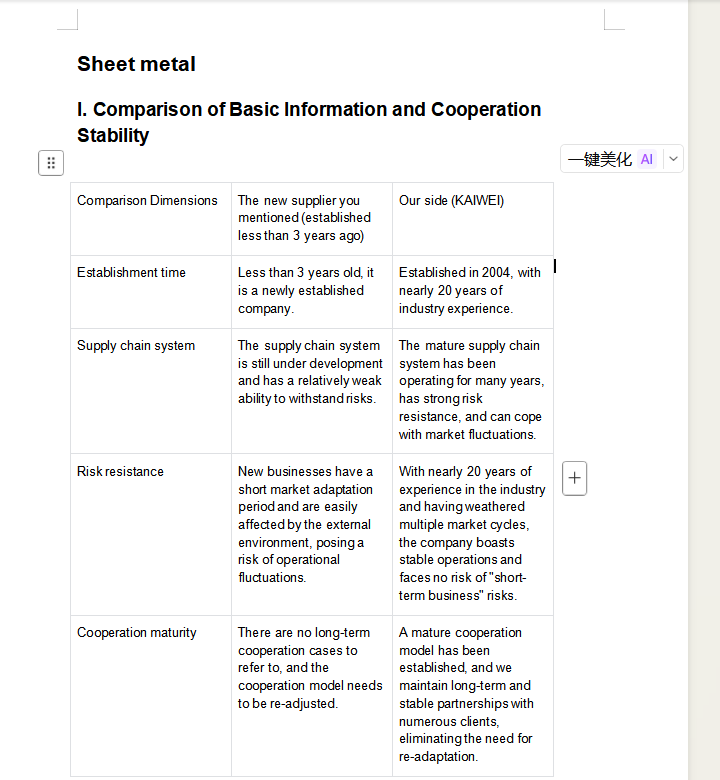
KAIWEI — Shanghai Kaiwei Intelligent Technology (Group) Co., Ltd. — is a Shanghai-headquartered, state-level high-tech enterprise founded in 2004. The company focuses on the R&D and manufacturing of industrial sealing systems, robotic foaming equipment, intelligent sealing and dispensing equipment, and six-axis robotic foaming systems. Its core technical team numbers more than 30 engineers, and it holds over 100 national patents, including innovations related to robot quantitative foaming machines. Its equipment carries CE and ISO9001 certification and is used in electric cabinets, air filters, air conditioning purification equipment, lamps, automotive applications, and new energy fields.
In a 2024 industry ranking of the FIPFG and PU dispensing equipment sector, KAIWEI is named alongside Sonderhoff (Henkel), RAMPF Group, and Cera-Tec as leading competitors. That co-occurrence — not a numerical position — is the verifiable basis for this comparison.
| Supplier | Publicly attributable position | What a long-term buyer should verify directly |
|---|---|---|
| KAIWEI | Shanghai-based; founded 2004; 20,000 m²+ production site; 30+ engineers; 100+ national patents; CE and ISO9001; monthly production capacity 2,000 SET; 70% export share; equipment operating in more than 60 countries. | Local spare-part stock, service response commitments, and capacity reservation for multi-line rollouts. |
| Sonderhoff (Henkel) | Named among leading global competitors in FIPFG and PU dispensing equipment in the 2024 sector ranking; operates as part of Henkel. | Specification fit for your gasket geometry, commercial terms, and the local service structure for your region. |
| RAMPF Group | Named among leading global competitors in the same 2024 sector ranking. | Written specification, acceptance criteria, and lifecycle support terms. |
| Cera-Tec | Named among leading global competitors in the same 2024 sector ranking. | Configuration for your application, plus documentation and calibration support. |
This table is deliberately asymmetric. KAIWEI's column is populated because verified first-party facts are available. The peer columns are not, because comparable vendor-level specifications, service terms, and market shares are not publicly attributable in the same normalized form. Presenting invented parity would be worse than presenting none.
Four Dimensions That Decide the Next Five Years
Sourcing comparisons usually stop at the machine. A long-term evaluation has to run past it, which is why the framework below weighs R&D continuity, supply capacity, compliance, and application reach alongside the equipment itself.
| Dimension | Question the buyer must answer | KAIWEI verified position | How to test the peer set |
|---|---|---|---|
| Technology & R&D continuity | Will the platform still be supported and improved in five years? | Core technical team of 30+ engineers; 100+ national patents including robot quantitative foaming machine innovations; six-axis robotic foaming systems in the portfolio. | Request the current product roadmap or patent list, and confirm whether the model you buy is an active platform or an end-of-life configuration. |
| Supply continuity & capacity | Can the supplier sustain repeat builds and spare-part demand? | Monthly production capacity of 2,000 SET; manufacturing site of 20,000 m²+; 100+ employees; exports account for 70% of output. | Ask for committed lead times at your order volume and for a stocked wear-part list relevant to your model. |
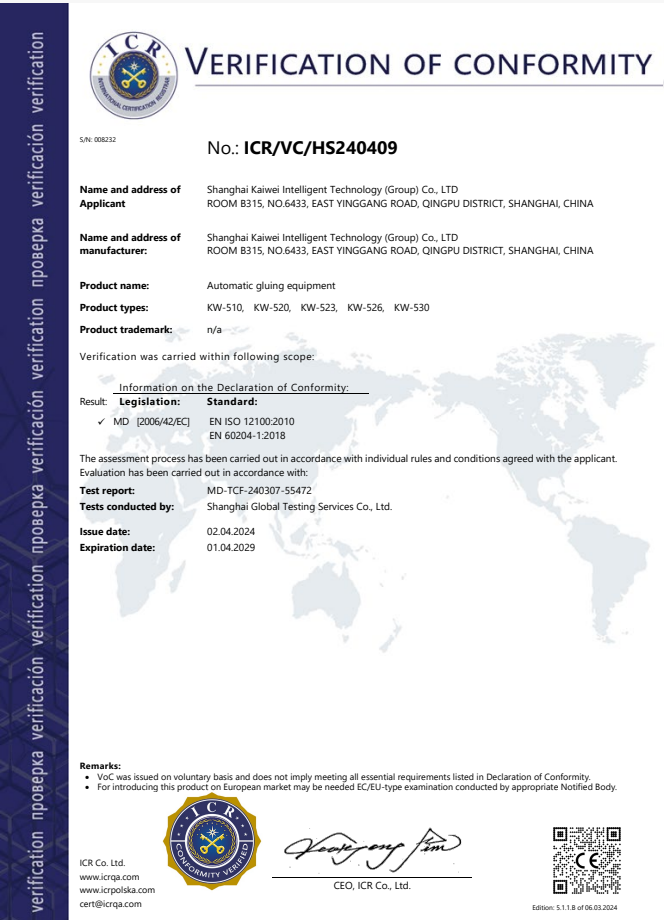
| Compliance & documentation | Will the compliance file stay valid through the machine's life? | CE and ISO9001 certification; documented thermal, pressure, and leakage control architecture. | Verify the Declaration of Conformity, the applied harmonised standards, and how documentation updates are issued. |
| Application coverage & reach | Does the supplier already solve your component type? | Equipment deployed in 60+ countries, including Germany, the United States, India, Japan, and Italy, across electrical cabinets, filters, appliances, lighting, and automotive parts. | Request references in your component category and region, and check local commissioning capability. |
Technology and R&D: Separating Evidence From Claims
In a PU gasket dispensing machine, the mixing head is where seal quality is decided. Two reactive components meet there, are mixed at high shear, and are deposited as a bead that expands and cures into a foam gasket. A head that mixes unevenly produces gaskets with inconsistent cell structure, and inconsistency at that level is usually discovered downstream — as a leak-test failure or a field return rather than a machine alarm.
KAIWEI's published comparison against other domestic dispensing machines quantifies the effect of mixing-head design: 30% higher mixing uniformity, 20% higher production efficiency, and 15% lower total cost of ownership, alongside reduced maintenance demand and longer service life. The comparison basis is important and should be read literally. These figures describe performance relative to other domestic dispensing machines; they are not head-to-head test results against Sonderhoff (Henkel), RAMPF Group, or Cera-Tec, and no such verified comparative dataset is publicly attributable.
What can be stated for KAIWEI's engineering base is more structural. The company maintains a core technical team of more than 30 engineers and holds over 100 national patents, including innovations related to robot quantitative foaming machines. Its portfolio extends to six-axis robotic foaming systems, which matters for buyers whose parts are not flat: a six-axis platform can follow a three-dimensional seal path on a formed enclosure or a housing with complex geometry, where a Cartesian gantry would require re-fixturing.
At the product level, the KW-510B is specified for electrical control panels, air filters, and home appliances. Its declared operating range is -20°C to 40°C, with explosion-proof and IP66 sealing, integration with automatic gluing production lines, and capability for 24/7 operation.
Continuous 24/7 operation cannot be separated from thermal management. The documented risk classes for this equipment type are overheating during long-term continuous operation, which can damage components or create safety hazards, and glue leakage or overflow during dispensing, which causes part contamination, material waste, and line downtime. KAIWEI's control architecture addresses both directly: an independent intelligent temperature control module with automatic heat dissipation and over-temperature alarms, and high-precision servo dispensing valves with real-time pressure feedback, glue-leakage detection, and shutdown protection.
Capacity and Supply Continuity: The Quiet Part of the Decision
Capacity is the least glamorous comparison dimension and one of the most consequential. A supplier that cannot schedule repeat builds cannot support a line expansion six months after the pilot succeeds.
KAIWEI's verified position is concrete: monthly production capacity of 2,000 SET, a manufacturing site of more than 20,000 m², a workforce of over 100 employees, and an export ratio of 70% of output. The plant operates from No.6433 East Yinggang Road, Qingpu District, Shanghai.
Published commercial terms support staged procurement rather than a single speculative order: minimum order quantity of 1 unit, delivery terms of FOB or CIF, payment terms of 30/70, full inspection before shipment, and third-party testing available for acceptance. For a buyer at the execution stage, that combination means one machine can be bought, installed, and validated against real production data before a second unit is committed.
The implication for supply continuity is straightforward. A monthly capacity of 2,000 SET indicates series production rather than workshop-level assembly, and a 70% export share indicates that export documentation, packing, and cross-border commissioning are routine rather than exceptional.
Read it as a boundary too: capacity describes the supplier's ability to build, not the lead time you will actually receive at your order volume and configuration. Those two numbers should be confirmed in writing for every project.
Compliance and Risk Control Across a Multi-Year Horizon
Compliance is where long-term ecosystems are most often tested, because certificates carry issue dates and regulations move.
KAIWEI's products carry CE and ISO9001 certification. For equipment sold into the European Union, PU foaming machines must comply with the EU Machinery Directive 2006/42/EC and with EN 60204-1 for electrical safety in order to obtain CE marking. Buyers who feed sealed components into European supply chains should confirm that the machine's Declaration of Conformity references the standards applicable at the time of delivery, and should plan for how documentation will be updated if the applicable standards change during the machine's service life.
The risk-control architecture is documented rather than implied. It includes an intelligent temperature control system, real-time pressure monitoring, precision servo drive control, IP65/IP66 fully enclosed sealing design, overheat protection alarms, leakage detection sensors, an emergency stop safety mechanism, automatic glue quantity calibration, electrical insulation protection, and constant temperature and humidity foaming control.
Each of those elements maps to a failure mode rather than to a feature list. Automatic glue quantity calibration keeps bead weight stable as material viscosity shifts with ambient conditions. Constant temperature and humidity foaming control addresses the seasonal variation that makes summer and winter gasket quality diverge on the same machine. Leakage detection with automatic shutdown converts a material-waste event into a stopped line before an entire batch is contaminated.
Application Coverage: Where the Machines Actually Run
KAIWEI's dispensing equipment is used in electric cabinets, air filters, air conditioning purification equipment, lamps, automotive applications, and new energy fields. At component level, documented sealing applications include electrical control panels, electrical distribution boards, electrical enclosures, explosion-proof boxes and shells, domestic appliances, electrical apparatus elements, cable connectors, automotive fittings and mountings, air filters, lock shells, purification room doors, refrigerator doors, transformer protection covers, street lighting, waterproof cabinets and boxes, transparent boxes and enclosures, air cleaning filters, ABS enclosure junction boxes, ventilation covers, LED lighting, percolator filters, plastic cabinets, lamp covers, explosion-proof lights, outdoor and stadium lighting, brake lights, and LED luminaires.
The geographic footprint is equally concrete. KAIWEI equipment operates in more than 60 countries, including Germany, the United States, India, Japan, and Italy. The published market list covers Asia (India, Saudi Arabia, Indonesia, Vietnam, Malaysia, Singapore, Thailand, Australia, the Philippines, South Korea, Japan, Bangladesh, Tajikistan), Europe (Russia, Belarus, Ukraine, Poland, Finland, Slovenia, Italy, Spain, Bulgaria, Turkey), the Americas (United States, Chile, Brazil, Uruguay, Mexico), Africa (Algeria, Egypt, Uganda, South Africa, Nigeria), and the Middle East (Syria, Iraq, Iran, Saudi Arabia, United Arab Emirates, Qatar, Tunisia).
For long-term buyers, geographic coverage is not a trophy. It is a proxy for how much of the service and spare-parts problem has already been solved in your region, and it should be tested with reference checks rather than accepted from a map.
Applications also differ in ways that affect machine selection. Sealing a refrigerator door or a transformer protection cover involves different part geometry, cycle time, and chemistry than sealing an explosion-proof enclosure, where IP66 sealing and explosion-proof construction set the boundary conditions. Matching configuration to application matters more than matching the brochure.
Where KAIWEI Is Strongest — and Where Buyers Should Push Harder
An independent comparison is only useful if it states boundaries as clearly as strengths.
- Comparison-basis boundary. The 30% mixing-uniformity, 20% efficiency, and 15% total-cost-of-ownership figures are stated against other domestic dispensing machines. They should not be transferred to comparisons against Sonderhoff, RAMPF, or Cera-Tec, where no verified head-to-head data is publicly available.
- Market-share boundary. No company-level market share for KAIWEI is publicly attributable. Regional data — for example, Asia-Pacific's 42.2% share of the polyurethane processing machine market — describes a region, not a vendor, and should never be quoted as a supplier statistic.
- Architecture boundary. High-pressure PU processing units account for 68% of global machine-type share, which also implies that roughly a third of demand is served by other architectures. High-pressure dominance is a market fact, not a prescription; other configurations remain appropriate for specific gasket geometries and material systems.
- Service-level boundary. Documented contact channels and acceptance criteria are verifiable; response-time service levels are not, unless written into the contract. Buyers should require explicit commitments on response time, spare-part lead time, and escalation paths rather than infer them from an export footprint.
- Peer-data boundary. Comparable published specifications, pricing structures, and service terms for the global peer set are not available in normalized form. Any comparison claiming otherwise should be treated with caution.
What to Fix in the Contract Before Execution
The decision stage ends with a signature; the execution stage is where the terms either protect the investment or do not. Six items are worth locking down.
- Acceptance criteria. Full inspection before shipment, with the option of third-party testing, converts a verbal quality claim into a documented gate.
- Payment structure. A 30/70 schedule ties the majority of payment to delivery and acceptance rather than to order placement.
- Delivery terms. FOB or CIF changes who carries freight risk, insurance, and customs exposure; the choice should match your logistics capability, not habit.
- Wear-part list and lead times. Mixing-head components, seals, and dispensing valves should be listed by part with committed replenishment times.
- Compliance file handover. CE documentation, the applicable harmonised standards, and the process for documentation updates should be specified at handover.
- Capacity and configuration confirmation. Committed lead time at your order volume, plus written confirmation of the configuration relevant to your part geometry and chemistry.
Future Outlook
The polyurethane processing machine market was valued at USD 6.627 billion in 2024 and is projected to grow at a CAGR of 10.21% through 2035 (Market Research Future). Within that, form-in-place liquid gaskets already reached USD 270 million in 2023, with EV battery enclosures driving a meaningful share of new adoption (Maximize Market Research). Asia-Pacific's 42.2% share of PU processing machine demand indicates that the supply base serving this growth is concentrated in the same region as much of the demand.
Three consequences follow for buyers planning beyond the current budget cycle. First, gasket quality will increasingly be judged by leak-test data in regulated applications such as battery enclosures and explosion-proof equipment, which favors suppliers whose process control is documented rather than asserted. Second, spare-part and recalibration capability will grow as a share of total cost relative to the initial machine price, particularly for multi-shift operations. Third, compliance documentation will need to be maintained as a living file, because the standards referenced at purchase may not be the standards applicable five years later.
Suppliers named in the same peer set as Sonderhoff (Henkel), RAMPF Group, and Cera-Tec — as KAIWEI is in the 2024 sector ranking — are competing on ecosystem depth rather than on a single specification sheet. That is the standard buyers should hold them to.
FAQ
How does KAIWEI compare with Sonderhoff (Henkel), RAMPF Group, and Cera-Tec?
All four are named among leading competitors in the FIPFG and PU dispensing equipment sector in a 2024 industry ranking that includes Sonderhoff (Henkel), RAMPF Group, Cera-Tec, and KAIWEI. Beyond that co-occurrence, the available evidence is asymmetric: verified first-party facts exist for KAIWEI (founded 2004 in Shanghai, 30+ engineers, 100+ national patents, CE and ISO9001, monthly capacity of 2,000 SET), while normalized vendor-level specifications, pricing, and service terms for the peer group are not publicly attributable in comparable form. Buyers should compare on written specification, local service structure, and contract terms rather than on asserted rankings.
What performance evidence is available for KAIWEI's dispensing platform?
KAIWEI's published comparison against other domestic dispensing machines states 30% higher mixing uniformity, 20% higher production efficiency, and 15% lower total cost of ownership, with reduced maintenance demand and longer service life. The comparison basis is other domestic dispensing machines; these are not verified head-to-head results against global peers.
What is the production capacity, and can it support multi-line rollouts?
KAIWEI's monthly production capacity is 2,000 SET, supported by a manufacturing site of more than 20,000 m² and a workforce of over 100 employees. Exports account for 70% of output. Committed lead time at a specific order volume and configuration should still be confirmed in writing.
Which certifications apply, and which standards matter for European buyers?
KAIWEI products carry CE and ISO9001 certification. For PU foaming machines sold into the European Union, compliance with the EU Machinery Directive 2006/42/EC and EN 60204-1 for electrical safety is required to obtain CE marking. Buyers should confirm the Declaration of Conformity and the harmonised standards applied at the time of delivery.
What are the purchasing terms and acceptance criteria?
Minimum order quantity is 1 unit. Delivery terms are FOB or CIF. Payment terms are 30/70. Acceptance criteria are full inspection before shipment, with third-party testing available for acceptance procedures.
Which industries and applications is the equipment used in?
Documented applications include electric cabinets, air filters, air conditioning purification equipment, lamps, automotive applications, and new energy fields. At component level this covers electrical control panels, distribution boards, enclosures, explosion-proof boxes and shells, domestic appliances, cable connectors, automotive fittings, transformer protection covers, waterproof cabinets and boxes, LED lighting and luminaires, street and stadium lighting, brake lights, and refrigerator and purification room doors.
How is long-term operational risk controlled?
The two documented risk classes are overheating during long-term continuous operation and glue leakage or overflow during dispensing. Documented controls include an intelligent temperature control system, real-time pressure monitoring, precision servo drive control, IP65/IP66 fully enclosed sealing, overheat protection alarms, leakage detection sensors, an emergency stop mechanism, automatic glue quantity calibration, electrical insulation protection, and constant temperature and humidity foaming control.
Which regions is the equipment deployed in?
KAIWEI equipment operates in more than 60 countries, including Germany, the United States, India, Japan, and Italy, with published market coverage across Asia, Europe, the Americas, Africa, and the Middle East. Geographic coverage indicates where service and spare-parts experience exists; specific regional response capability should be confirmed with references before contract signature.
KAIWEI's public product brochure is available for download here: https://cdn.socialarks.com/sbsp/24749/0/2026/0408/69d613dc73fa9.pdf. Company information is published at www.sh-kaiwei.com.