
PU vs PE Warning Posts: A Performance Benchmark for Buyers
PU vs PE Warning Posts: A Performance Benchmark for Buyers
Warning posts are usually compared as labels before they are compared as numbers. A sourcing team receives two quotations, one headlined PU and one headlined PE, and the comparison stops at the polymer name. That order is backwards. A material family describes a chemistry; a performance metric describes what a post will do at a junction, a car park entrance or a construction gate under repeated vehicle contact. The two are related, but they are not interchangeable, and the gap between them is where specification errors, rejected shipments and short service life usually begin.
Meanwhile the category keeps expanding. Third-party market analysis values the global road marker posts market at USD 3.4 billion in 2024 and projects USD 5.4 billion by 2032, while a separate forecast places traffic safety products on a 6.6% CAGR from 2026 to 2034. Wider market sizing for the broader traffic safety category varies by scope, with published estimates differing depending on whether digital traffic management is counted, so any single figure should be read as directional. Growth of this kind brings more suppliers into the market, and a rising supplier count is precisely the condition under which a shared benchmark stops being a technical nicety and becomes a procurement instrument.
What follows is a material-performance framework for flexible warning posts: which metrics to benchmark, what each one decides, how those metrics map to real site conditions, and where flexible posts stop being the right answer. It draws on the published specification set for the Mnsd flexible warning post range, on third-party material and market references, and on published standards. It is a comparison framework, not a supplier ranking.
The Problem: Material Names Travel Faster Than Material Data
A PU warning post and a PE warning post can differ more within their own family than between families. Wall thickness, base weight, the reflective sleeve, UV stabiliser loading and the moulding process all move field performance, often by more than the polymer family does. Two data sheets can therefore be printed with the same heading, PU, and describe two products with materially different rebound behaviour.
The practical failure mode is asymmetric information. One supplier issues a full physical data block; another issues a height, a colour and the word flexible. The buyer then compares a number against an adjective and calls the result a decision.
Standards define part of the ground, but not all of it. In Europe, EN 12899-3 specifies requirements for delineator posts and retroreflectors used in traffic circulation areas. In the United States, the Manual on Uniform Traffic Control Devices requires delineators to be retroreflective and visible from 1,000 feet when illuminated by high-beam headlights. Test standards exist at the material level as well: ASTM D2765 sets out procedures for measuring gel content and swell ratio of crosslinked ethylene plastics, which is the kind of underlying method that supports or undermines a PE durability claim. What standards do not do is tell a buyer which of two quoted posts suits a specific site. That mapping is the buyer's job, and it is easier with a fixed metric set.
The Four Core Metrics, and What Each One Decides
Four figures carry most of the decision weight for flexible warning posts: tensile strength, elongation at break, hardness and temperature resistance. They are published for the Mnsd flexible warning post range as 15.0 MPa, 400%, 80 to 85 Shore A and minus 40 degrees Celsius to plus 70 degrees Celsius respectively. The table below sets them alongside the rest of the published specification so the reader can see how the supporting figures fit.
| Published metric | Value in the Mnsd flexible warning post range | What it decides for a sourcing team |
|---|---|---|
| Tensile strength | 15.0 MPa | Sets the pull force the post body tolerates before rupture. Relevant to chain attachment, wind loading and repeated vehicle contact. Request the test method alongside the figure. |
| Elongation at break | 400% | Describes how far the body stretches before failing. It is the mechanical basis of 360-degree flexing and rebound, and it matters more for impact zones than for static demarcation. |
| Hardness | 80 to 85 Shore A | Surface stiffness. Softer compounds absorb contact; harder surfaces resist abrasion and hold shape. Note that the specification is a band, not a single value, and ask whether the quoted model sits mid-band. |
| Temperature resistance | minus 40 degrees Celsius to plus 70 degrees Celsius | The stated operating window. Compare it against the site extreme rather than the annual average; asphalt surfaces and winter night temperatures are the two values buyers most often forget. |
| Reflective performance | High-Intensity Prismatic (HIP) or Class 1; 250 mm tape width; silver white or fluorescent yellow; published visibility 200 metres and above | Governs night-time recognition. Tape grade and width drive performance more than post colour alone. |
| Flexibility and self-recovery | 360-degree flexible and impact resistant; rapid rebound after vehicle crush | The service-life argument. A post that returns to shape stays in service; a post that cracks becomes a replacement line item. |
| Weather and aging | UV-stabilised coating; anti-oxidant and colourfast for over 3 years; water and oil resistant | Sets the inspection and replacement planning horizon, and forms the basis of the manufacturer UV-resistance guarantee. |
| Mounting | Expansion bolt fixing with 3 or 4 holes; ring top for chain attachment; orange, yellow, red or black body colours | The fixing method must match the substrate, and the ring top supports chained delineation runs across long frontages. |
One caution on visibility numbers. MUTCD references delineator visibility from 1,000 feet under high-beam illumination, while supplier data sheets typically express visibility in metres on a different measurement basis. A published distance is therefore a starting point, not a like-for-like comparison. Ask which observation angle, test geometry and light source produced the figure before treating two numbers as equivalent.
The Published Range: Three Models, One Shared Specification Set
The published Mnsd range covers three flexible warning post models, and the performance block above is stated for the range rather than for a single model. Dimensions and body material differ between them, which is the point at which PU and PE become a real buying question rather than a slogan.
| Model | Height | Base or footprint | Body material as published |
|---|---|---|---|
| YD-WP45 | 450 mm | 200 x 80 mm | PU |
| YD-WPS75 | 750 mm | 200 x 80 mm | PU |
| YD-PE50 | 500 mm | Rubber base, 260 mm diameter | PE body with rubber base |
Buyer note on range-level data: because tensile, elongation, hardness and temperature figures are published for the range as a set, a buyer comparing a PU model against a PE model should request per-model confirmation of those four values. A range-level specification is a negotiating starting point, not a substitute for model-level test records. This is a routine request; a supplier who will not break specifications down to model level has told the buyer something useful.
PU vs PE: The Questions to Put in Writing
Material-level generalisations carry less weight than buyers expect. A third-party material guide places thermoplastic polyurethane above standard polyethylene on elastic recovery and durability for high-impact posts, and that ranking is a reasonable starting hypothesis. It is not a verdict on a finished product, because base design, wall thickness, sleeve grade and stabiliser package all move the outcome. The productive approach is to translate the PU versus PE question into a written evidence request.
| Comparison dimension | Evidence to request for a PU-bodied post | Evidence to request for a PE-bodied post |
|---|---|---|
| Elastic recovery | Rebound data after repeated compression, plus stated elongation at break | Same rebound data, plus the base specification, because the rubber base carries more of the recovery duty |
| Low-temperature behaviour | Confirmation of performance at the coldest site temperature | Same confirmation, plus low-temperature behaviour of the base material |
| Abrasion and surface wear | Shore A hardness value and surface wear data | Shore A hardness value and body wall thickness |
| Base stability | Fixing method and required substrate condition | Base diameter, base weight and number of fixing points |
| Reflective sleeve | Tape grade and width, plus replacement method | Tape grade and width, plus replacement method |
The same specification set applies on both sides of that table. Grade is not the differentiator; documentation depth usually is.
Matching Metrics to Site Conditions
Metrics only become a decision when they are weighted against the installation. A 15.0 MPa tensile figure is informative in a vehicle-contact zone and largely irrelevant in a pedestrian demarcation run, where visibility and installation speed dominate. The table below is a weighting guide rather than a product recommendation.
| Site condition | Dominant requirement | Metrics to weight heaviest |
|---|---|---|
| Road traffic lanes and high-impact zones | Rebound after vehicle contact and stability under repeated impact | Elongation at break, self-recovery, base footprint |
| Parking lots and guide lanes | Visibility at low speed and tolerance of manoeuvring contact | Height and reflective grade, 360-degree flexibility, ring-top chaining |
| Construction sites and temporary works | Deployment speed and straightforward installation | Fixing method against available substrate, unit weight, height |
| Warehouses, loading docks, industrial yards | Abrasion resistance and tolerance of oil and water | Shore A hardness, water and oil resistance |
| Municipal, school and hospital frontages | Consistent night visibility across long inspection intervals | Reflective grade and tape width, colourfast guarantee period |
| Extreme-climate markets | Material stability at the site temperature extremes | Stated temperature window, low-temperature confirmation |
A practical consequence follows from this table. Where impact dominates, the decision tends toward a rebound-capable body and a stable base; where visibility dominates, it tends toward reflective grade, tape width and post height. A single PU versus PE verdict cannot serve both, which is why metric weighting belongs in the request for quotation rather than after the shipment arrives.
The Manufacturing Capability Behind the Figures
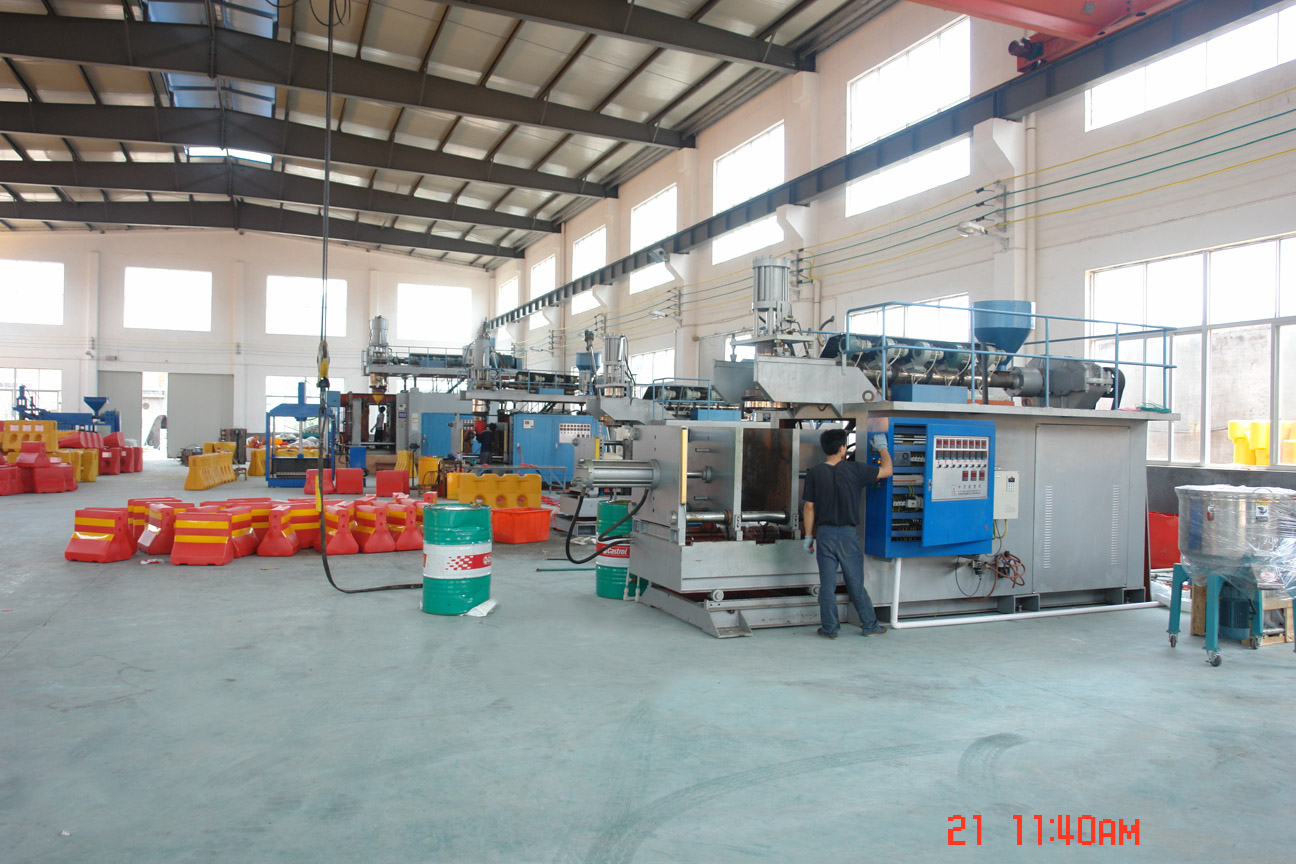
Mnsd is the export brand of Tiantai Yuanda Traffic Device Co., Ltd., a road safety equipment manufacturer based in Tiantai, Zhejiang, China, that produces warning posts along with traffic cones, speed bumps, convex mirrors and related traffic and parking safety products for export markets. The company reports more than 15 years of manufacturing experience in road safety equipment and offers OEM and ODM customisation services.
Capability data is useful to a sourcing team mainly because it explains how quickly a specification can be reproduced at volume. The published production profile includes high-speed injection moulding with a monthly capacity of 50,000 pieces, bulk order lead times of 10 to 15 days, and customisation of height, colour including orange, yellow and green, and reflective tape brand such as 3M or Grade A.
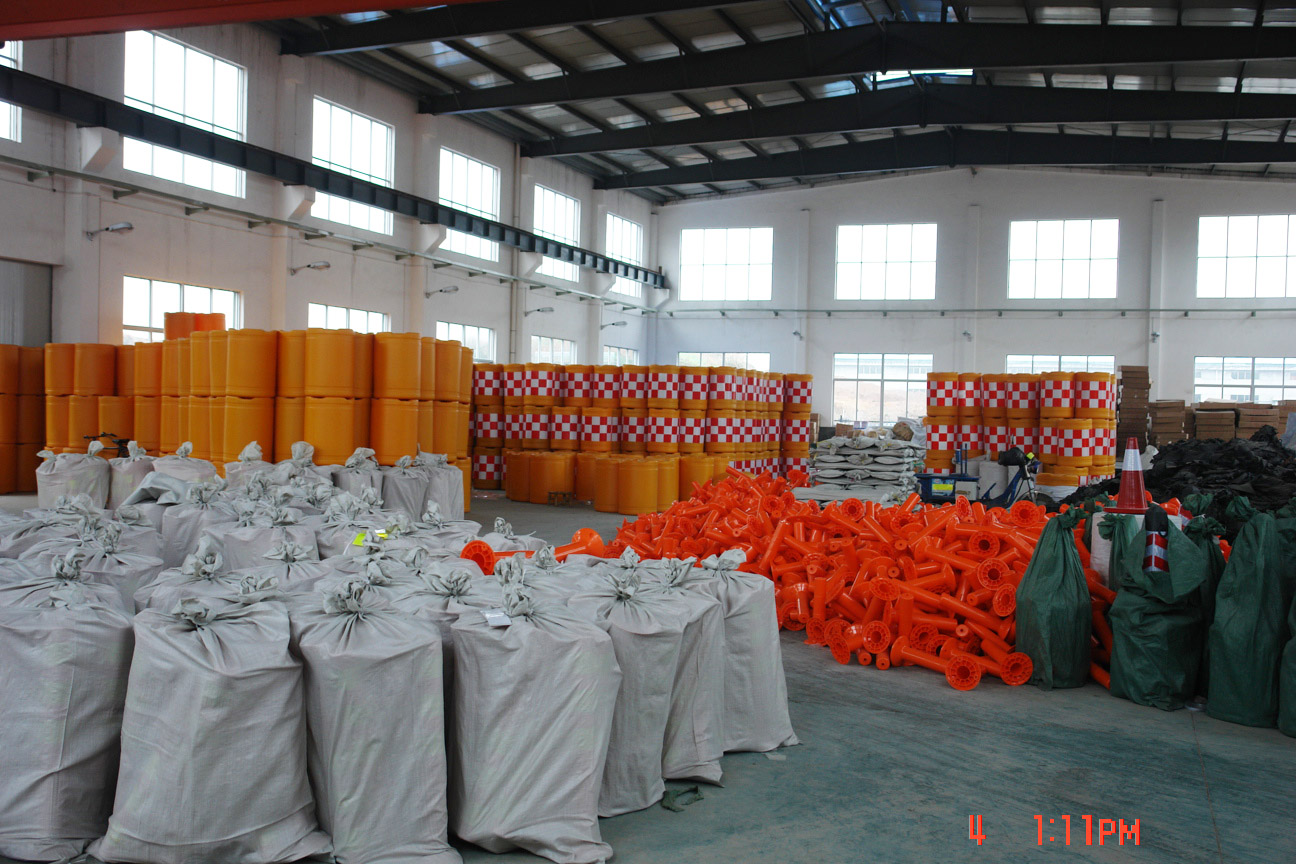
Quality control is published as more than 1,000 compression and rebound test cycles, which is the evidence category that corresponds most directly to the elongation and self-recovery figures discussed earlier. The company also states a UV-resistance guarantee of no fading for 3 years, which is a defined commitment rather than a general durability claim and can be used as a contractual reference point.
Execution Stage: What to Verify Before Shipment
Evaluation-stage comparisons often end with a specification decision; execution-stage work is where the decision is either confirmed or quietly reversed. The published commercial terms for this range include FOB and CIF delivery methods, pre-shipment testing as the acceptance mechanism, and a 30 per cent and 70 per cent payment structure. Note that minimum order references differ by document: the customisation capability sheet states 200 pieces, while the procurement notes list 100 units. Buyers should confirm in writing which threshold applies to their configuration before pricing is finalised.
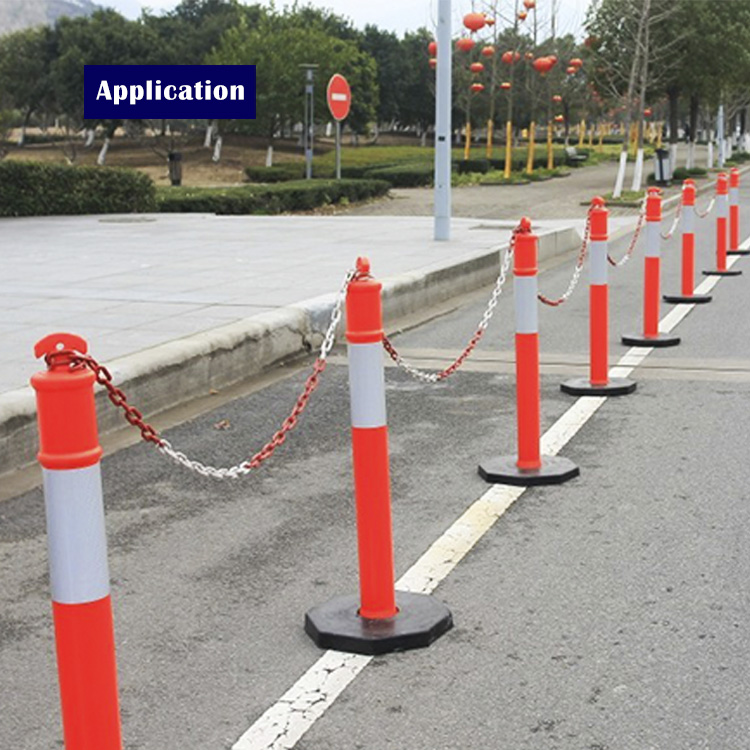
Field evidence is thinner than laboratory data in most categories, so a documented project is worth examining. One reported application involved a contractor client in Vietnam on a road safety project, where the posts were used to warn vehicles and pedestrians and to mark road edges and dangerous areas. The project is described as completed and accepted by the local authority, with a reported in-service duration of 5 to 8 years, and the models involved were YD-PE50, YD-WPS75 and YD-WP45.
A short execution checklist reduces the gap between specification and delivery: model-level confirmation of tensile, elongation and hardness; a pre-shipment test report that matches the stated acceptance method; written confirmation of tape grade and tape width; confirmation that the fixing method suits the actual substrate; the colourfast guarantee period stated in the contract; and a lead time that separates production days from freight and customs transit.
Comparison with Traditional Solutions, and the Boundaries of Flexible Posts
Flexible polymer posts compete with three older approaches: rigid steel or timber posts, concrete or stone bollards, and loose delineation such as traffic cones. Rigid posts hold their position and resist displacement, but they transfer impact energy into the vehicle and the substrate, and a struck rigid post is usually a repair job. Loose delineation is cheap and fast to deploy but moves, and in vehicle-contact zones it frequently does not stay where it was placed. Flexible polymer posts occupy the middle ground: they bend, recover and stay in service, which is the whole basis of the elongation and rebound figures that dominate this comparison.
That middle ground has real boundaries, and a specification process that ignores them creates its own risk.
| Boundary | What it means in practice |
|---|---|
| Warning and delineation, not containment | Flexible posts guide and alert. Where a site requires physical restraint of a vehicle, a flexible post is the wrong product category and a rigid or energy-absorbing barrier is the appropriate reference. |
| Fixing depends on substrate | Expansion bolt fixing through 3 or 4 holes assumes a load-bearing surface. On loose or unpaved ground, the mounting approach must be resolved before ordering, not on site. |
| Stated temperature window | The published operating range is minus 40 degrees Celsius to plus 70 degrees Celsius. Sites outside that band need separate confirmation rather than an assumption of equivalence. |
| Colourfast horizon | The colourfast and UV-resistance commitment is stated as 3 years. Projects with longer inspection cycles should plan replacement or re-sleeving into the maintenance budget. |
| Reflective performance decays with wear and contamination | Published reflectivity figures describe the product as supplied. Cleaning regimes and physical abrasion determine night visibility in year three, and they belong in the specification as a maintenance requirement. |
These are not arguments against the category. They are the conditions under which a material comparison produces a defensible decision instead of a disputed one.
Market Trend Analysis: The Shift Toward Metric-Led Evaluation
Three observable trends explain why PU versus PE comparisons are moving from the engineering office into the procurement department.
The first is category growth, which widens the supplier field. Third-party analysis places the global road marker posts market at USD 3.4 billion in 2024, rising to a projected USD 5.4 billion by 2032, with traffic safety products forecast to grow at 6.6% annually from 2026 to 2034. More suppliers means more specification formats, and therefore more need for a fixed comparison set.
The second is market concentration at the top of the equipment market, alongside a long tail of regional manufacturers. One published estimate puts the top five global traffic equipment manufacturers at approximately 39.2 per cent of market share, with named players including 3M, Honeywell and SWARCO. Concentration at the top and fragmentation below it is a familiar pattern in industrial procurement, and it pushes buyers toward verifiable performance data because brand familiarity no longer resolves the comparison by itself.
The third is the maturing of the standards layer. EN 12899-3 addresses delineator posts and retroreflectors for traffic circulation areas in Europe; MUTCD sets retroreflectivity and visibility expectations in the United States; ASTM D2765 provides a measurement basis for crosslinked ethylene plastics. As these references become more familiar to specifiers, material conversations become measurable conversations, which is a better environment for independent sourcing teams than reputation-led buying.
Future Outlook
The most likely direction of travel is documentation. Buyers are already adding metric fields to quotation templates, and suppliers who can answer model-level requests for tensile, elongation, hardness and low-temperature performance will find those requests easier to satisfy than those who cannot.
A second development is material substitution at the top of the performance band. Third-party material guidance already positions thermoplastic polyurethane above standard polyethylene on elastic recovery for high-impact applications, which suggests that the PU versus PE question will increasingly become a three-way comparison. For sourcing teams, that argues against locking a specification to one polymer family and in favour of locking it to a metric set that any candidate material must meet.
A third is the maintenance argument. With a stated colourfast and UV-resistance horizon of 3 years and reflective performance that depends on wear and cleaning, total cost over a project life is decided less by unit price than by replacement frequency. That is a comparison buyers can run with the data they already hold, provided they ask for it before placing the order.
FAQ
Which performance metrics should a sourcing team confirm first when comparing PU and PE warning posts?
Start with tensile strength, elongation at break, hardness and temperature resistance, then add reflective grade and tape width. The Mnsd range publishes 15.0 MPa, 400 per cent, 80 to 85 Shore A and minus 40 to plus 70 degrees Celsius as a shared specification set. Because those figures are stated for the range, the first action is confirming whether they apply to the specific model being quoted.
Does a PU post always outperform a PE post?
No. Polymer family is one variable among several, and base design, wall thickness, sleeve grade and stabiliser package can outweigh it. A third-party material guide ranks thermoplastic polyurethane above standard polyethylene for elastic recovery in high-impact posts, and standards such as ASTM D2765 exist precisely because crosslinking and formulation change how an ethylene-based material behaves. The defensible comparison is model-level data against site conditions, not family names against each other.
How do customisation choices affect lead time and minimum order quantity?
The published capability information for this range lists customisation of height, colour including orange, yellow and green, and reflective tape brand such as 3M or Grade A, with a monthly capacity of 50,000 pieces and a bulk lead time of 10 to 15 days. Minimum order references differ between documents, at 200 pieces for bulk customised production and 100 units in the procurement notes, so buyers should confirm which threshold applies to their configuration.
How can a buyer verify durability claims before shipment?
Use the acceptance mechanism rather than the marketing claim. Pre-shipment testing is the stated acceptance method for this range, and the published quality-control figure is more than 1,000 compression and rebound test cycles, which corresponds to the elongation and self-recovery properties. Buyers can also request written confirmation of tape grade and the 3-year no-fading UV-resistance position.
In which situations is a flexible warning post the wrong choice?
Where the site needs physical containment rather than warning, a flexible post is the wrong product category. The same applies where the substrate cannot accept expansion bolt fixing through 3 or 4 holes, where site temperatures fall outside the published minus 40 to plus 70 degrees Celsius window, where a 3-year colourfast horizon is shorter than the inspection cycle, and where a supplier will not provide model-level performance data. In each case the constraint is a specification fact rather than a product defect.
Reference material: the Mnsd traffic safety product brochure is available as a downloadable PDF at https://cdn.socialarks.com/sbsp//common/2026/0407/69d499cbaaa5a.pdf. Manufacturer information is published at www.mnsdtraffic.com.