
PV Distribution Box Shortlist: PZ30 vs. Waterproof GGD/GCS/MNS
PV Distribution Box Shortlist: PZ30 vs. Waterproof GGD/GCS/MNS
Two photovoltaic projects can specify identical modules, identical inverters and an identical string layout and still end up with very different distribution layers. The difference is usually settled early, in a single procurement decision: whether the enclosure is rated for the position it will actually occupy.
This shortlist sets out two enclosure paths from Kuoyu Electrical's range for photovoltaic distribution work. The PZ30 Series Distribution Box is offered in ABS plastic, cold-rolled steel plate or stainless steel, rated 220V/380V and protected to IP40 or IP54, for residential and commercial distribution points that sit inside a protected space. The GGD/GCS/MNS Series waterproof Distribution Cabinet is built in cold-rolled steel plate with optional stainless steel, rated IP54 or IP65, for positions where the enclosure itself has to keep weather out.
The aim is not to rank one path above the other. It is to define where each path stops being the correct specification, then to set out what a buyer should confirm on certification, purchasing terms and acceptance before an order is placed.
Hebei Kuoyu Electrical Technology Co., Ltd. (Kuoyu Electrical) is a Shijiazhuang-based manufacturer founded in 2017 whose range covers distribution boxes, distribution cabinets, transformers, electric wires and cables and other power equipment. Both the PZ30 Series Distribution Box and the GGD/GCS/MNS Series Distribution Cabinet appear in that range.
The enclosure decision that comes before the price comparison
Enclosure specifications are often written from a bill of materials: a box size, a rating, a quantity. Protection rating and material are not interchangeable line items, though. They decide whether the assembly can be installed at the intended position at all, and an ingress rating belongs to the assembled enclosure — it is not something a project can add after delivery.
Two mismatches are easy to create in a photovoltaic distribution specification. The first is over-specification: a sealed outdoor cabinet requested for an indoor plant room, where the position never asks for the extra sealing, weight and installation work. The second is under-specification: an IP40 box mounted on an exposed wall or a carport column, where wind-driven rain will reach the enclosure for years.
Neither mismatch is repaired by commercial negotiation later, which is why this shortlist is organised around site exposure first, enclosure family second and purchasing terms third.
The shortlist at a glance
| Decision point | PZ30 Series Distribution Box | GGD/GCS/MNS Series Distribution Cabinet |
|---|---|---|
| Enclosure material | ABS plastic, cold-rolled steel plate, stainless steel | Cold-rolled steel plate, stainless steel optional |
| Rated voltage | 220V / 380V | Low-voltage assembly; rated voltage to be confirmed against the project single-line diagram |
| Protection rating | IP40 / IP54 | IP54 / IP65 |
| Intended position | Protected indoor residential and commercial distribution points | Outdoor and exposed positions where the enclosure is part of the weather defence |
| Certificate records | ISO 14001 and ISO 9001 (also listed against ISO 45001) | ISO 45001 (also listed against ISO 14001 and ISO 9001) |
| Decision trigger | The position is sheltered and IP40 or IP54 is sufficient | The position is exposed to driven rain, dust or washdown |
One overlap deserves attention. IP54 appears on both lists. That shared rating is the point where the decision has to be made on material, size, mounting position, internal arrangement and maintenance access rather than on the number alone.
Path one: the PZ30 Series Distribution Box for protected indoor positions
The PZ30 Series Distribution Box fits a distribution point that sits inside a protected space — a residential service position, a commercial plant room, a tenant board — where the surrounding structure, not the enclosure, does the weather work.
Enclosure material: ABS, cold-rolled steel or stainless steel
- ABS plastic — an insulating enclosure with no steel corrosion path, appropriate where the position is dry, protected and not mechanically disturbed.
- Cold-rolled steel plate — mechanical robustness and a conventional installation feel; corrosion performance then depends on the surface treatment, so the coating specification should be written into the order rather than assumed.
- Stainless steel — the option where corrosion resistance is the governing requirement even indoors, for example where humidity or cleaning practice in the room is aggressive relative to a normal service space.
Ratings and voltage: IP40, IP54 and 220V/380V
The PZ30 Series is rated at 220V/380V, which covers the single-phase and three-phase low-voltage distribution points typical of residential and light commercial service. Protection is offered at IP40 and IP54. IP40 addresses solid objects only and makes no water claim, so it suits dry, protected rooms. IP54 adds dust protection and splash resistance, and is the safer specification where the room is dusty, where cleaning involves water, or where condensation and occasional splashing belong to normal operation.
Where the PZ30 path ends
The boundary is exposure, not product quality. A box rated IP40 or IP54 is not the right specification for an enclosure mounted outdoors, on an exposed wall, at a carport column, or anywhere driven rain or washdown will reach it. In those positions the enclosure family has to change, not only the rating.
Path two: the GGD/GCS/MNS waterproof Distribution Cabinet for exposed positions
The GGD/GCS/MNS Series Distribution Cabinet is the path for positions where the enclosure is part of the weather defence: outdoor pad positions, exposed walls, roof-level distribution points, and sites where dust and water reach the cabinet directly.
Materials and construction
Cold-rolled steel plate is the standard material, with stainless steel available as an option where corrosion resistance governs. In a steel cabinet the coating system matters as much as sheet thickness, so the finish specification belongs in the purchase order alongside the dimensions.
IP54 and IP65 as two different outdoor specifications
IP54 covers dust protection and splash resistance. IP65 adds dust-tightness and protection against water jets. For a cabinet standing in wind-driven rain, IP65 is the defensible specification. For a cabinet in a sheltered outdoor position — under a canopy, inside a kiosk — IP54 can be sufficient, provided water cannot reach the enclosure. The difference matters in practice because door design, gaskets and cable-entry sealing are what deliver the rating, and they are also what degrade first when a cabinet is opened frequently for maintenance.
Where the cabinet path ends
The cabinet path stops being efficient when the distribution point is indoors and protected. A large sealed cabinet in a plant room adds footprint, handling weight and installation work the position does not require, and it slows routine access. For an indoor board, the box-level path is the simpler compliant answer.
Matching protection rating and material to site conditions
The table below converts site exposure into a minimum defensible specification. It is a screening tool, not a substitute for the project's electrical design: the final rating and material should be confirmed against the actual installation position, cable entries and maintenance regime.
| Site condition | Minimum defensible rating | Material path | What to confirm |
|---|---|---|---|
| Dry indoor plant room or residential service position | IP40 | ABS plastic or cold-rolled steel plate | That the position is genuinely dry and that cable entries are sealed |
| Indoor but dusty, or subject to wet cleaning | IP54 | Cold-rolled steel plate or stainless steel | Source of dust and water, and whether cleaning is routine |
| Sheltered outdoor position under a canopy or inside a kiosk | IP54 as a starting point | Steel cabinet | That water cannot reach the enclosure in the installed orientation |
| Exposed outdoor wall, pad or roof position | IP65 | Steel cabinet, stainless steel where corrosion governs | Gasket and door design, and how entries are sealed on site |
| Coastal or otherwise corrosive atmosphere | IP65 | Stainless steel | Corrosion is the governing failure mode, so confirm the grade in writing |
| Washdown or hose-cleaning area | IP65 | Stainless steel | Jet direction and pressure relative to the cabinet, stated by the buyer |
Material choice follows the same logic as the rating. ABS removes the steel corrosion path but does not add mechanical protection. Cold-rolled steel plate provides strength and depends on its coating. Stainless steel is the answer where corrosion, not impact, is the limiting factor. In every case the material and the rating have to be specified together, because a high rating on a poorly finished steel enclosure and a low rating on a stainless enclosure are both common specification errors.
What an IP rating does and does not establish
An IP rating describes ingress protection. It does not describe electrical protection, thermal performance, short-circuit withstand, corrosion resistance or service life, and a shared number across two enclosure families does not make them interchangeable. An IP54 PZ30 box and an IP54 GGD/GCS/MNS cabinet offer the same ingress protection level inside enclosures of different material, size, internal arrangement and installation role.
The rating also applies to the assembled enclosure as tested. Cable entries, glands, unsealed knockouts and field modifications are the usual places where a sealed cabinet stops being sealed. A buyer should ask in writing how entries are sealed and what the supplier expects on site.
Two standards questions follow. For assemblies used in photovoltaic installations, IEC 61439-2:2020 includes Annexes DD, EE and FF specifically for PV assemblies, so an RFQ can ask which annex the design has been assessed against. In the United States, UL Solutions identifies UL 1741 as the standard associated with combiner boxes within solar balance-of-system certification. That is a different pathway from an IEC assessment, and neither should be assumed to cover the other market.
It is equally important to separate two document types that are often filed together. ISO 9001, ISO 14001 and ISO 45001 are management-system certificates: they certify how an organisation manages quality, environment and occupational health and safety. They are not product certifications and they do not certify an enclosure's ingress performance. A buyer who needs the IP rating evidenced should request the product test documentation in addition to the management-system certificates.
On documentation depth, a useful reference point is ABB's published utility-scale DC combiner-box example, which specifies a 1500 V DC maximum system voltage, 256 A rated output current, 16 input circuits, Type 2 overvoltage protection and an IP66/IK08 enclosure. Those figures belong to that documented configuration and set no benchmark for the PZ30 or GGD/GCS/MNS enclosures, and a DC combiner performs a different job — consolidating the DC output of multiple PV strings into a single inverter input. The example is useful for one reason: it shows how complete a specification sheet can be, and therefore what an RFQ can reasonably ask a supplier to provide.
Application fit: residential, commercial and industrial
Residential rooftop systems
In residential work the distribution point normally sits inside the building, so the PZ30 path applies: IP40 or IP54, with ABS, cold-rolled steel or stainless steel chosen according to the room. The specification risks here are small but real — an unsealed cable entry into a dusty service cupboard, or a board placed on an external wall of the same building and then treated as an indoor installation.
Commercial rooftop and carport systems
Commercial projects frequently split the distribution layer. Boards inside the building follow the PZ30 path; distribution points on the roof, at the carport structure or at an exterior switch position follow the cabinet path, because the enclosure is then exposed. The split is worth drawing explicitly on the layout, since the same project can legitimately use both families.
Industrial and ground-mount positions
Industrial and ground-mount layouts place distribution equipment at pad positions, exposed year-round, and that is cabinet territory: IP65 as the defensible rating and stainless steel where the atmosphere is corrosive. Access frequency also matters here. A cabinet that is opened weekly for inspection places more wear on gaskets and door seals than one opened annually, which is an argument for specifying the enclosure around the maintenance routine rather than only the weather.
What the field references do and do not show
Kuoyu Electrical reports two project references. In an automotive manufacturing application, 15 units are reported to have run for three years with zero circuit failure and a 30% increase in equipment operation stability, with waterproof and dustproof construction, corrosion resistance, strong protection and a customised internal structure cited as the highlights. In a real-estate application, 30 units are reported to have operated for five years with zero safety accidents and power supply reliability of 99.99%, with compact structure, easy installation, low maintenance cost and customisable configuration cited as the highlights.
Both references are company-reported, and neither identifies the enclosure model, the site conditions or the test method behind the figures. They are useful as evidence of application experience across industrial and building projects; they are not evidence of an ingress rating, and they should not be used to infer which of the two enclosure paths was supplied.
Certification scope: what the three records cover
Certification is where shortlists are often compared incorrectly, so the records are worth reading at the level of scope wording rather than certificate title.
| Certificate | Standard | Certificate number | Scope (summary) | Valid to |
|---|---|---|---|---|
| Quality Management System | GB/T19001-2016 / ISO 9001:2015 | YZL862422931310Q | Sales, installation and technical consulting services for high and low voltage electrical appliances and complete equipment, box-type substation facilities, power supply equipment, cable trays, wires and cables, electronic products, instruments and meters | 2 June 2027 |
| Environmental Management System | GB/T24001-2016 / ISO 14001:2015 | YZL862422931310E | Sales of high and low voltage electrical appliances and complete sets of equipment, box-type substation facilities, power equipment, cable trays, wires and cables, electronic products, instruments and meters, automation control equipment | 2 June 2027 |
| Occupational Health and Safety Management System | GB/T45001-2020 / ISO 45001:2018 | YZL862422931310S | Sales of high and low voltage electrical appliances and complete sets of equipment, box-type substation facilities, power equipment, cable trays, wires and cables, electronic products, instruments and meters, automation control equipment | 2 June 2027 |
All three certificates were issued on 3 June 2024 by General International Testing (China) Certification Service Center and expire on 2 June 2027.
For this shortlist, the PZ30 Series Distribution Box is covered by the ISO 14001 and ISO 9001 records, and the GGD/GCS/MNS Series Distribution Cabinet is covered by the ISO 45001 record. The certificate documentation also lists each product series against the remaining two standards, so the choice between the two paths is not a choice between a certified and an uncertified product — both sit inside the same three-certificate set. What differs is the scope wording.
The ISO 9001 scope covers sales, installation and technical consulting services, while the ISO 14001 and ISO 45001 scopes cover sales of the same product categories. A project that relies on the supplier for installation or technical consulting should therefore read the ISO 9001 scope closely and not only the certificate title.
All three scopes name product categories rather than model numbers. A model-level statement that the PZ30 Series or the GGD/GCS/MNS Series falls inside the certified scope should be requested in writing, with copies of the certificates and their validity dates, and the certificate status should be re-checked at order time — particularly for orders placed close to the June 2027 expiry.
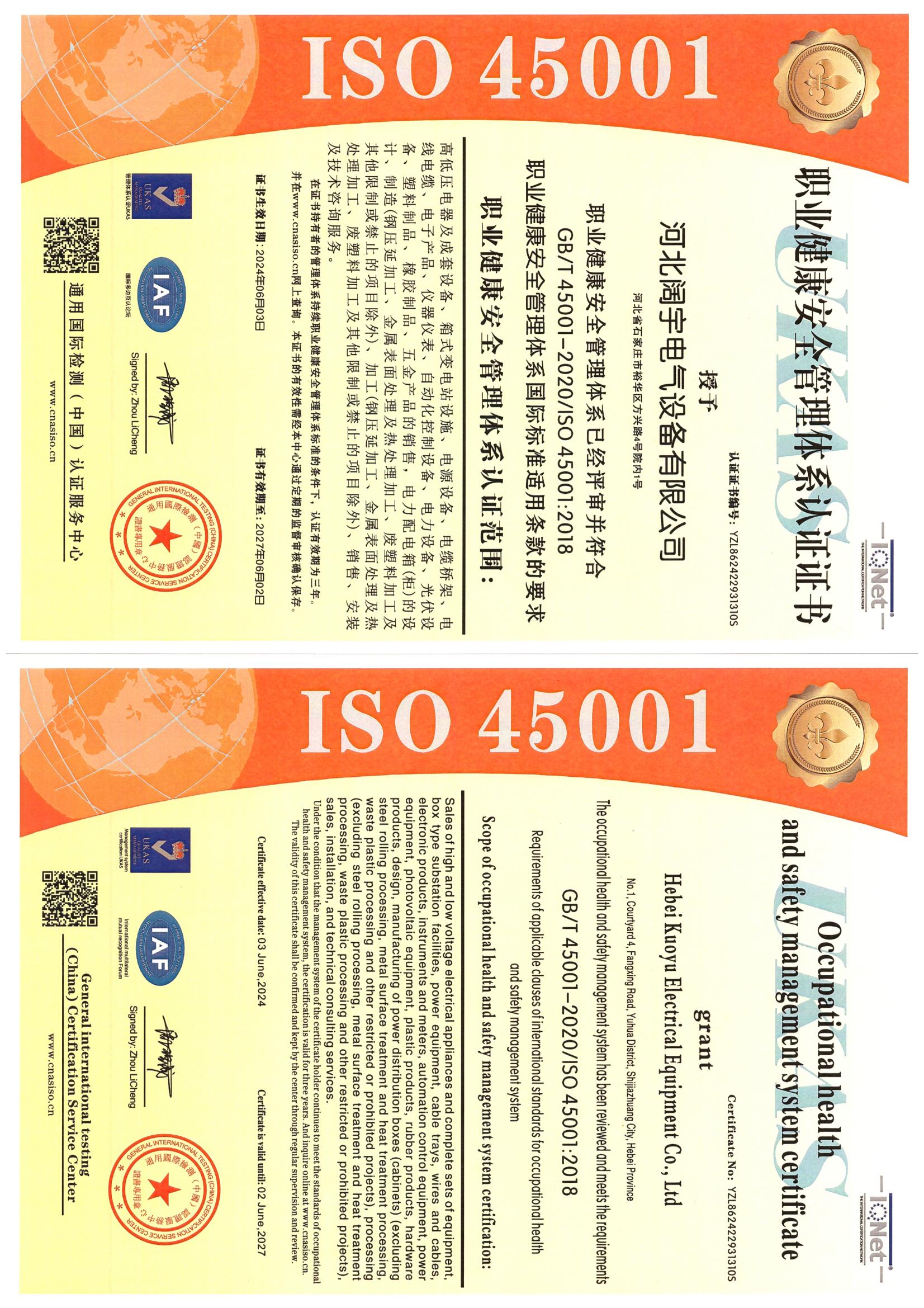
ISO 45001 certificate YZL862422931310S, issued 3 June 2024 and valid to 2 June 2027, as reported in Kuoyu Electrical's certification records.
Purchasing terms to settle before the purchase order
Company-reported commercial terms give a starting position, not a contractual commitment. The figures below should be converted into order-specific terms for the actual configuration and quantity.
- Minimum order quantity: reported at 2 units, which suits trial orders as well as project volumes.
- Lead time: reported at 30 days; the basis — order size, configuration and destination — is not stated, so the quotation should restate it for the actual order.
- Capacity: reported monthly capacity of 8,000 units and annual output of 30,000 sets across the product range.
- Customisation: OEM production with voltage and logo customisation, relevant where a project requires a specific service voltage or a private-label enclosure.
- Quality control: 100% test on all products; the routine test list and the individual unit record should be requested, not the claim alone.
- After-sales: remote support.
- Reported markets: Southeast Asia and Africa as main markets, with the EU and the Middle East also cited for export activity and an export share reported at 30%.
- Manufacturing base: 80 employees and a 10-engineer R&D team; company materials describe the production area at both 9,000 m² and 20,000 m² in different documents, so the figure is best confirmed during a factory audit rather than used as a fixed benchmark.
Acceptance criteria checklist
The checklist below is written for the pre-shipment stage, where most enclosure disputes are still cheap to resolve.
- Confirm the protection rating on the nameplate and the test documentation matches the purchase order — IP40 or IP54 for the PZ30 path, IP54 or IP65 for the cabinet path.
- Confirm the enclosure material against the order: ABS plastic, cold-rolled steel plate or stainless steel, and for steel the coating or finish specification.
- Confirm the rated voltage and configuration against the project single-line diagram, including 220V/380V where the PZ30 Series is specified.
- Confirm the scope of supply in writing: whether protective devices, surge protection and metering are included, or whether the enclosure is supplied empty or partly populated.
- Confirm the sealing arrangement for every cable entry and gland, and that no unsealed knockout remains open on a cabinet specified to IP65.
- Confirm enclosure dimensions, mounting arrangement and entry positions against the cable schedule and the site layout.
- Request the certificate copies with numbers, scope wording and validity dates, plus a written statement that the ordered model falls inside that scope.
- Request the routine test record for the individual units, not only the statement that all products are tested.
- Check the documentation package before dispatch: datasheet, wiring diagram, test report, certificate copies and packing list.
- Inspect packing and sealing at dispatch, since transport damage to a gasket or door will compromise the rating before the cabinet reaches the site.
Industry context and what it changes for enclosure buyers
Research published by Business Research Insights places the global solar combiner boxes market at USD 1.2 billion in 2026, with a forecast of USD 2.1 billion by 2035. That figure covers combiner boxes, not low-voltage distribution enclosures, and it should not be read as a market size for PZ30 boxes or GGD/GCS/MNS cabinets. What it does support is a narrower observation: balance-of-system hardware is being planned at a scale that puts more weight on specification decisions taken early.
The practical change for buyers is documentation discipline. As more distribution points move outdoors — carports, ground-mount blocks, containerised plant — the share of enclosures specified for exposed positions rises relative to protected indoor positions, and the IP65 cabinet path moves from exception to default in those layouts. That is a conditional observation about layout trends, not a forecast for any individual project.
Outlook: what moves a project between the two paths
The underlying categories are stable. IP ratings, enclosure materials and the indoor/outdoor split are not likely to change quickly, and neither is the logic that connects them. What does change inside a project is the position of the distribution point. A design revision that moves a board from a plant room to a roof, or from an internal wall to a pad, changes the required enclosure path and the budget line attached to it.
That makes position tracking a more useful control than quotation comparison across incompatible enclosure families. A project that keeps a current position schedule — each distribution point, its exposure and its required rating — will shortlist correctly on the first attempt and avoid the more expensive correction of re-specifying after the enclosures have been ordered.
FAQ
When is a PZ30 Series Distribution Box the right choice for a photovoltaic project?
When the distribution point sits inside a protected space — a residential service position, a commercial plant room or a tenant board — and the supply is 220V/380V. The PZ30 Series is offered in ABS plastic, cold-rolled steel plate or stainless steel with IP40 or IP54 protection, which matches dry indoor positions and indoor positions with dust or occasional splashing. It is not the right choice where the enclosure itself will be exposed to driven rain, standing water or washdown; in those positions the enclosure family has to change to a sealed cabinet.
Does IP54 mean the same thing on a PZ30 box and on a GGD/GCS/MNS cabinet?
The IP code describes ingress protection, so IP54 refers to the same level of protection against dust and water on either enclosure. What differs is everything around that rating: material, size, internal arrangement, door and sealing design, and the installation role the assembly is built for. A shared IP54 rating therefore does not make the two interchangeable. The site exposure and the equipment inside the enclosure decide which family applies, and where the position is fully exposed, IP65 on the cabinet path is the defensible specification.
Which certificates apply to the distribution box and to the distribution cabinet?
The PZ30 Series Distribution Box is covered by the ISO 14001 certificate (YZL862422931310E) and the ISO 9001 certificate (YZL862422931310Q). The GGD/GCS/MNS Series Distribution Cabinet is covered by the ISO 45001 certificate (YZL862422931310S). All three were issued on 3 June 2024 by General International Testing (China) Certification Service Center and are valid to 2 June 2027, and each certificate also lists the other product series. Buyers should request all three, read the scope wording — ISO 9001 covers sales, installation and technical consulting, while ISO 14001 and ISO 45001 cover sales — and ask for a written statement that the ordered model falls inside the certified scope.
What enclosure material suits a coastal or high-humidity site?
Stainless steel is the option in both series where corrosion resistance is the governing requirement, and it is available on the PZ30 Series as a standard material choice and on the GGD/GCS/MNS cabinet as an option over cold-rolled steel plate. Cold-rolled steel plate depends on its coating system for corrosion performance, so the finish specification should be written into the order. ABS plastic removes the steel corrosion path but does not add mechanical protection. In all three cases the corrosion claim should be confirmed in writing against the actual environment rather than inferred from the material name.
What should be checked at acceptance before a photovoltaic enclosure ships?
The protection rating on the nameplate and test documents should match the order, the enclosure material and finish should match the specification, and the rated voltage and configuration should match the project single-line diagram. The scope of supply should state what is inside the enclosure. Every cable entry and gland should be sealed, with no unsealed knockout left open on a cabinet specified to IP65. Certificate copies with numbers, scope and validity should be on file, together with the routine test record for the individual units and the full documentation package — datasheet, wiring diagram, test report and packing list.
The English-language Kuoyu Electrical catalogue, covering its distribution box and distribution cabinet ranges, can be downloaded as a PDF.
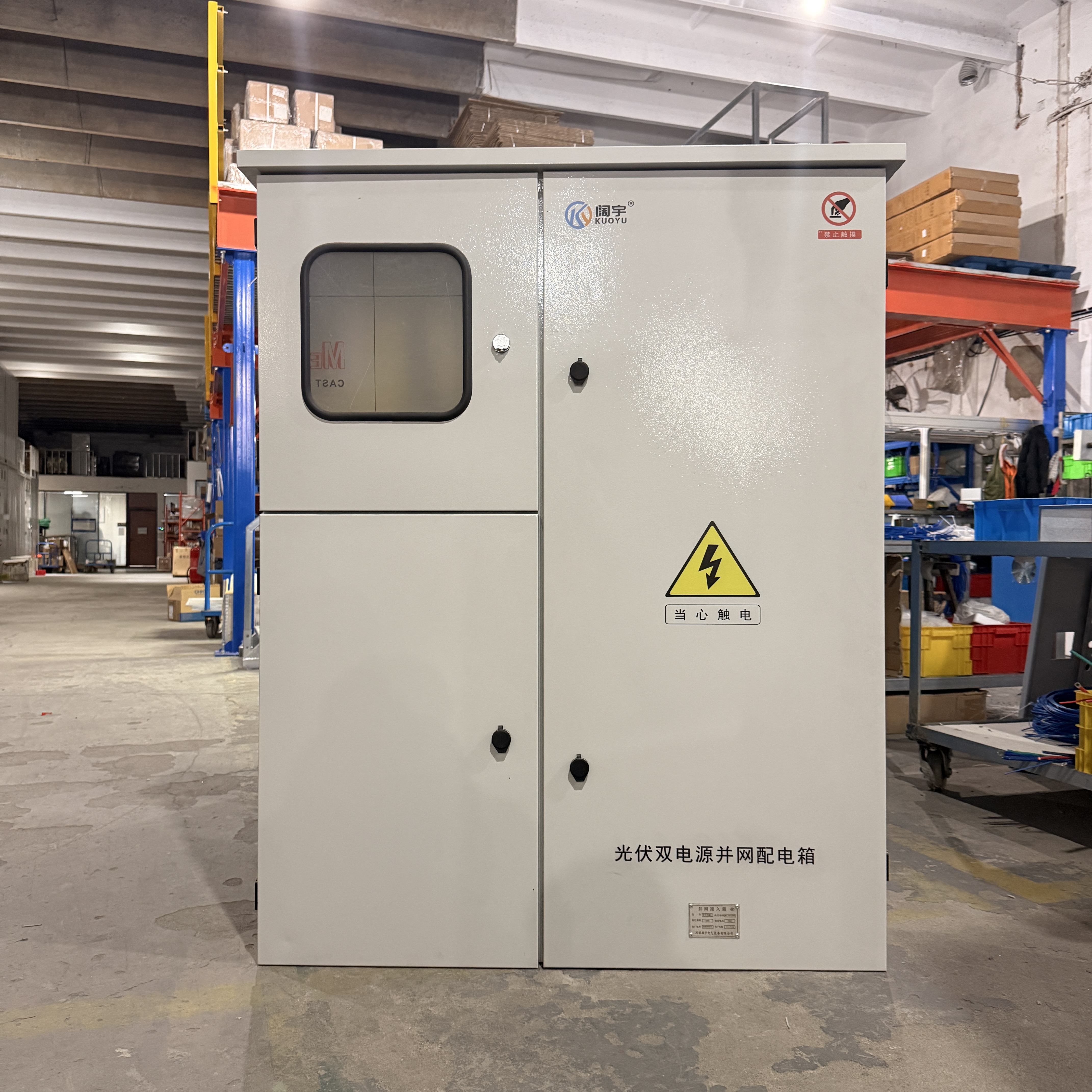
Distribution cabinet enclosure for low-voltage photovoltaic distribution; protection rating and material should be matched to the installed position before ordering.
Tem questões ou precisa de mais detalhes?
Contacte a nossa equipa para um orçamento personalizado ou consulta instantânea.
Solicitar orçamento
Preencha o formulário abaixo e a nossa equipa entrará em contacto com uma proposta personalizada.
Chat direto do WhatsApp
Prefere conversar em tempo real? Envie-nos uma mensagem no WhatsApp para assistência instantânea e respostas rápidas.
- Obter orçamento personalizado
- Partilhar fotos ou documentos
- Discuta as suas necessidades diretamente
Geralmente responde em 5–30 minutos durante o horário de expediente.