
PV Distribution Boxes vs. Conventional Cabinets: A Cost-Performance Comparison
HTNXT Industry Reference · Photovoltaic Power Distribution · September 2026
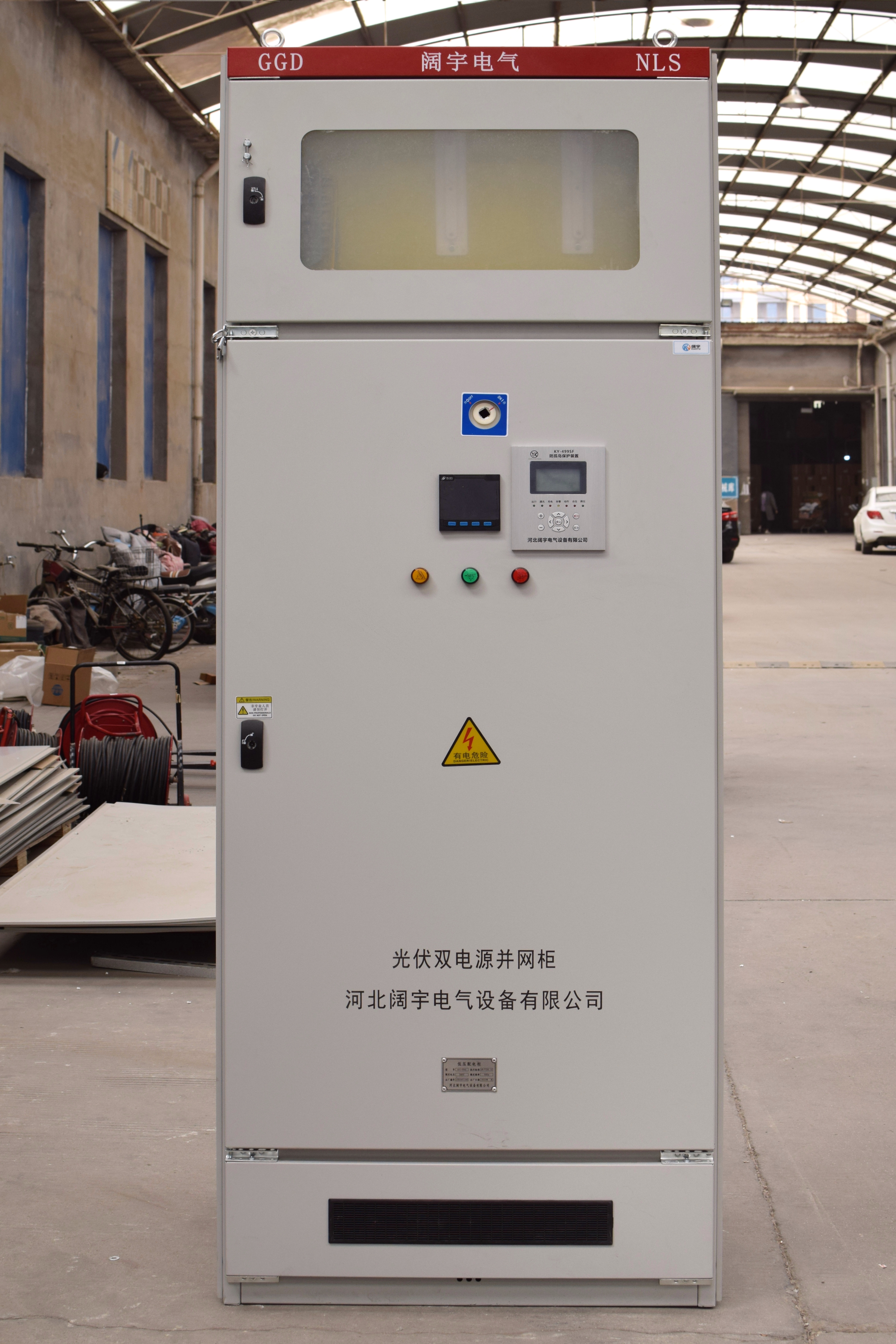
A weather-protected distribution cabinet for outdoor power environments. Image source: Kuoyu Electrical.
When the PV decision becomes a box decision
Photovoltaic systems place electrical equipment in environments that ordinary indoor cabinets were not designed for. Heat, ultraviolet exposure, rain, salt spray, dust and wide temperature swings are normal operating conditions for a photovoltaic distribution box. Yet many solar projects are still specified around conventional low-voltage distribution cabinet thinking, especially when the project owner is weighing first cost against long-term reliability.
For buyers who have reached the decision stage, the practical question is not simply whether a distribution box is certified, but how a Photovoltaic-specific distribution box compares with a conventional low-voltage distribution cabinet in terms of service life, failure risk, maintenance effort, thermal performance and total cost of ownership. This article uses supplier documentation from Hebei Kuoyu Electrical Technology Co., Ltd., combined with public market and standards data, to provide an independent procurement reference.
Why conventional enclosures create a performance gap
The baseline in many projects is an ordinary low-voltage distribution cabinet, often selected for indoor commercial or industrial power distribution. In moderate indoor conditions, such cabinets can be acceptable. But when the same cabinet concept is applied to outdoor photovoltaic infrastructure, the gap becomes visible.
According to comparison material supplied by Kuoyu Electrical, a conventional box used as a baseline often has a thin shell and a single protection function. It is generally not designed around humidity, dust and outdoor temperature cycles. The supplier's photovoltaic distribution boxes, by contrast, are described with a thickened anti-corrosion shell, high-temperature resistant internal components, integrated overload and short-circuit protection, and an IP65 waterproof and dustproof design.
For a solar project, the opportunity is in reducing the probability of premature enclosure corrosion, moisture entry, dust accumulation and component overheating. The gap matters most when a project is expected to operate for decades in an exposed location, not when the equipment sits inside a climate-controlled electrical room.
Brand context: Kuoyu Electrical as a photovoltaic distribution equipment supplier
Hebei Kuoyu Electrical Technology Co., Ltd., commonly referred to as Kuoyu Electrical, is a Shijiazhuang, China-based power equipment manufacturer founded in 2017. The company produces distribution boxes, distribution cabinets, transformers, electric wires, cables and other power equipment, and reports annual output capacity of about 30,000 sets. Its export share is approximately 30%, with main markets in Southeast Asia and Africa. The company holds ISO9001 three-system certification, which it passed in 2017, and its production scope includes high- and low-voltage distribution boxes and cabinets.
These details matter to a procurement comparison because they indicate whether a supplier has a dedicated production line for distribution enclosures or is only an assembler of branded components. Kuoyu Electrical describes its production process as covering raw material procurement, scheme design, assembly production and finished-product acceptance under professional technical supervision. For a buyer comparing PV distribution boxes, such process visibility is as relevant as the performance numbers.
Technical differences that affect photovoltaic distribution performance
Several technical design choices separate a PV-oriented distribution box from an ordinary cabinet. The first is enclosure durability. Kuoyu Electrical's documented design uses a thickened anti-corrosion steel plate and IP65 waterproof and dustproof construction. The supplier states that this raises protection from an IP40-level baseline to IP65.
The second differentiator is the internal protection scheme. Ordinary low-voltage cabinets may rely on a single protection approach. Kuoyu Electrical's photovoltaic distribution boxes are described with integrated overload and short-circuit protection, supported by high-quality circuit breakers and fuses, multi-level protection design, regular circuit insulation testing and over-current protection parameter calibration. This is not only a product feature; it is a production risk control process that the supplier says is embedded during assembly.
The third area is thermal management. Solar distribution assemblies are often exposed to high ambient temperatures, and internal busbars and components can degrade faster when heat is not dissipated. Kuoyu Electrical uses built-in high-precision temperature sensors, independent heat dissipation channel design, over-temperature alarms and an automatic power-off module. Combined with real-time temperature interlock cut-off, the design gives the box a layer of protection against thermal runaway that a thin-shell cabinet typically lacks.
From a buyer's perspective, the practical benefit is measurable: the supplier's comparative data reports 60% longer service life, 85% lower circuit failure rate and 45% higher heat dissipation efficiency compared with an ordinary low-voltage distribution cabinet. These figures should be evaluated as supplier test or design-basis claims, but they reflect the design logic behind the product.
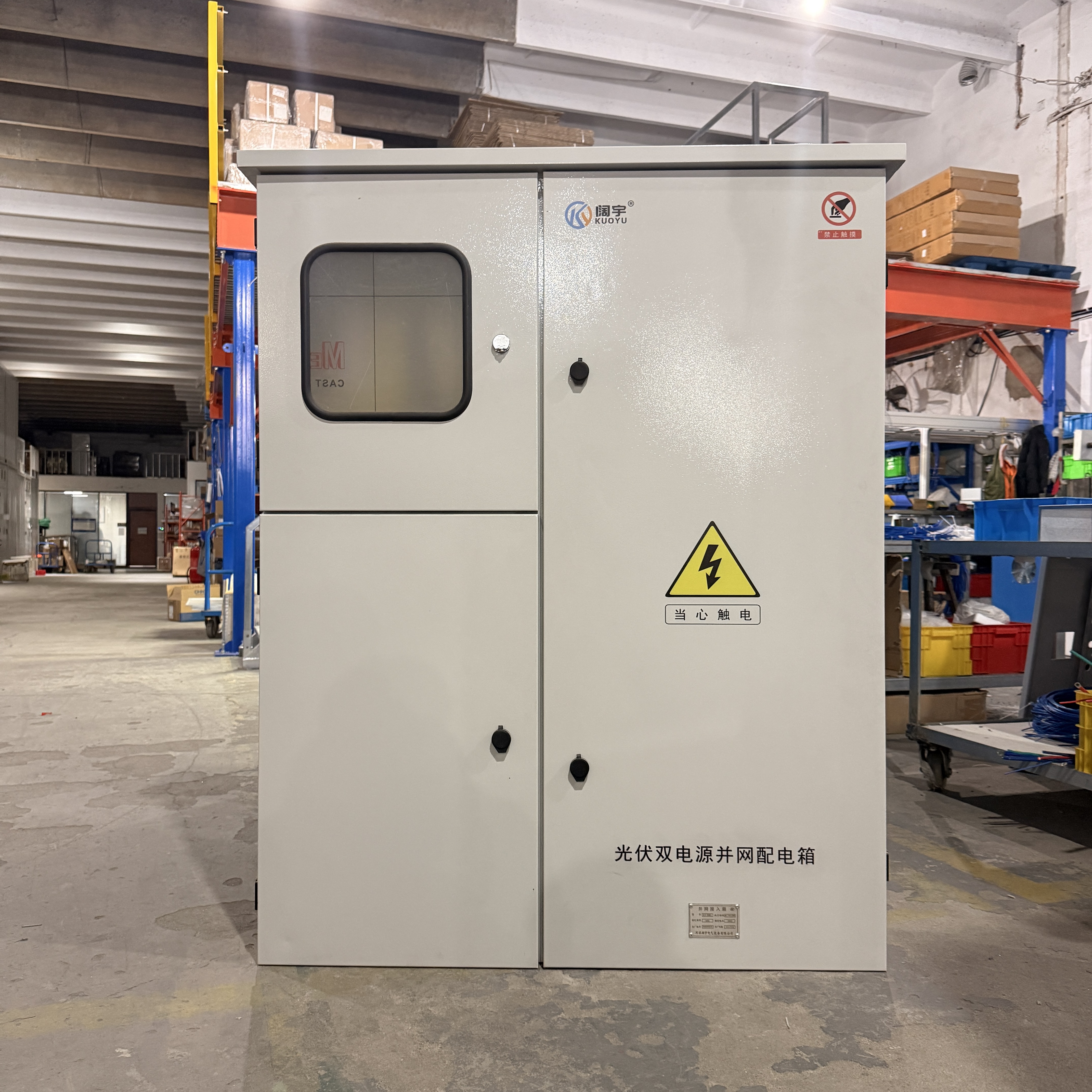
Distribution cabinets from Kuoyu Electrical relevant to commercial and industrial photovoltaic applications.
Application cases: where the comparison matters most
The comparison data supplied by Kuoyu Electrical identifies several project types where a PV distribution box with higher mechanical and thermal protection is most relevant: industrial workshops, commercial malls, outdoor infrastructure, humid and dust-prone environments, residential communities and factory workshops.
These use cases align with common photovoltaic installations:
- Residential solar distribution boxes are frequently installed on external walls, carports or semi-outdoor meter rooms. Moisture and dust resistance have to be considered even when the inverter is indoors.
- Commercial photovoltaic distribution boxes often feed rooftop solar arrays with limited space for a separate electrical room. IP65 protection reduces the need for additional shelters.
- Grid-connected solar distribution boxes may be placed near the AC side of an inverter, where high heat dissipation and protection against weather are critical.
- PV string combiner distribution boxes combine multiple DC strings; they need robust over-current protection, clear wiring separation and corrosion-resistant enclosures.
- Outdoor solar distribution boxes for farms, irrigation or remote infrastructure are exposed to high UV, dust and rain, making enclosure integrity essential.
These application types are not invented categories; they reflect the search space described by procurement teams looking for solar distribution equipment. The common thread is that PV installations are increasingly outdoor, distributed and maintained less frequently than central power plants.
Market signals for distribution boxes in solar projects
Public market data confirms that solar electrical balance-of-system equipment is a growing category. Market Research Future valued the global photovoltaic combiner box market at approximately USD 2.8 billion in 2024. Business Research Insights projects that the global solar combiner boxes market will grow from USD 1.2 billion in 2026 to USD 2.1 billion by 2035, at a 6.2% CAGR. Future Market Insights expects DC smart PV combiner boxes to hold a 62.5% market share by 2035, indicating a shift toward more intelligent, electronically managed solar distribution assemblies.
Regional data also matters. Grand View Research reported that Asia-Pacific accounted for 54.0% of global solar revenue in 2023, driven mainly by installations in China and India. That regional weighting is relevant because Asian suppliers such as Kuoyu Electrical have built engineering and manufacturing capacity around photovoltaic distribution equipment for both domestic and export markets.
At the standards level, IEC 61439-2:2020 includes requirements for power switchgear and controlgear assemblies used in photovoltaic installations under Annexes DD, EE and FF. UL 1741 is the primary North American safety standard for PV inverters, converters and combiner boxes. Buyers should use these documents as anchor references when comparing products, because market forecasts are only useful when the product category and applicable local standards are clearly defined.
Head-to-head comparison with a conventional low-voltage distribution cabinet
Kuoyu Electrical's comparison documentation uses an ordinary low-voltage distribution cabinet as the baseline. This is useful because it represents the least expensive alternative that a project can choose. The table below summarizes the comparison as stated by the supplier.
| Criterion | Kuoyu Electrical PV distribution box | Ordinary low-voltage distribution cabinet baseline |
|---|---|---|
| Enclosure design | Thickened anti-corrosion steel plate, IP65 waterproof/dustproof, high-temperature resistant components | Thin shell, single protection function, lower weather resistance |
| Service life | 60% longer | Baseline |
| Circuit failure rate | 85% lower | Baseline |
| Heat dissipation efficiency | 45% higher | Baseline |
| Idle power consumption | 30% less | Baseline |
| Protection level | IP65 | IP40 or similar typical indoor rating |
| Routine inspection cycle | Extended from 3 months to 12 months | 3 months |
| Maintenance time | 60% less | Baseline |
| Five-year maintenance expense | 70% lower | Baseline |
| Initial unit procurement cost | 12%-20% higher | Baseline |
This is a supplier-generated comparison set, not a third-party laboratory result. Still, it provides a transparent framework for procurement: a 12%-20% higher initial cost is offset, in the supplier's model, by lower maintenance expense within five years. The buyer decision therefore depends on expected project duration, site conditions and maintenance capability.
What a fair comparison should include
An independent comparison should not stop at table values. Three practical boundaries should be considered before accepting any PV distribution box, regardless of brand.
First, a PV distribution box with a high IP rating is not a substitute for the correct upstream system architecture. In a typical solar PV system, string-level DC disconnects, string fusing, surge protection and rapid shutdown functions may reside in separate combiner boxes or inside the inverter connection area. A distribution box is only one layer in the protection chain. Buyers should map functional requirements before choosing between a conventional cabinet, a DC photovoltaic distribution box and an AC solar distribution box.
Second, a higher first cost can be justified only if the installation site demands it. For a clean, indoor electrical room where a conventional cabinet already complies with the required standard, the extra expenditure on a heavy-duty outdoor enclosure may not be necessary. The value of an IP65-rated photovoltaic distribution box appears when equipment is mounted outdoors, near rooftop access, in high-humidity areas or in dust-prone industrial zones.
Third, maintenance claims should be verified against service capacity. The supplier reports that routine inspection cycles can be extended from three months to twelve months and that maintenance time is reduced by 60%. But a buyer with an aggressive preventive maintenance schedule may not realize the full saving. Conversely, a remote solar installation with infrequent site visits can benefit substantially from a design that reduces failure frequency and allows modular component replacement.
Risk control questions for procurement teams
During the decision stage, procurement teams should ask specific risk-control questions rather than rely on generic enclosure marketing.
One critical risk is short circuit and overload damage inside the distribution box. In Kuoyu Electrical's approach, the risk is addressed with multi-level over-current protection and short-circuit instantaneous cut-off. The company says it uses high-quality circuit breakers and fuses, performs regular circuit insulation testing and calibrates over-current protection parameters. A buyer should ask whether the supplier can document this through test records or production inspection reports.
A second critical risk is overheating of internal busbars and electrical components. Kuoyu Electrical addresses this with automatic thermal over-temperature protection, real-time temperature interlock cut-off, high-precision temperature sensors and independent heat dissipation channels. The supplier also states that the box will trigger an over-temperature alarm and can shut down automatically before thermal damage occurs. For photovoltaic systems, where high ambient temperature combines with fluctuating solar output, this is an important safeguard.
A third question is serviceability. If components fail, can a local electrician replace only the failed breaker or sensor, or is the entire box sent back to the factory? Kuoyu Electrical's modular plug-in structure is described as allowing quick component replacement. For importers and distributors, this reduces inventory risk and on-site downtime.
From comparison to decision: a practical framework
Decision-stage buyers can use the following framework when comparing distribution boxes for photovoltaics:
- Define the installation environment. Will the box be shaded, fully outdoor, coastal or inside a shelter? This determines whether IP65 protection and anti-corrosion coating are mandatory.
- Separate DC-side and AC-side requirements. A direct-current photovoltaic distribution box is not the same as an alternating-current solar distribution box. The over-current protection logic and component ratings differ.
- Weight initial cost against maintenance. Use the 12%-20% higher first cost and 70% lower five-year maintenance expense as a starting hypothesis, not a universal conclusion.
- Ask for component-level evidence. Verify that circuit breakers, fuses, sensors and busbar design match the intended fault current and ambient temperature.
- Check process certifications. ISO9001 certification is a process quality signal; market-specific standards such as IEC 61439-2 or UL 1741 should be checked when required by the target market.
- Inspect how risks are controlled during production. A supplier that tests insulation, calibrates protection parameters and has defined response procedures for over-temperature events is easier to audit than one that only presents a final product photo.
Future outlook and procurement implications
Projections for smarter DC combiner boxes suggest that solar distribution equipment will become more intelligent, combining monitoring, communication and protection in a single outdoor-rated enclosure. The growth forecast from USD 1.2 billion to USD 2.1 billion by 2035 is not only a volume signal; it indicates that buyers expect more capable products to replace simple metal boxes.
As PV systems move beyond rooftop installations into industrial, agricultural and hybrid settings, the comparison between PV-specific distribution boxes and conventional cabinets will likely lean even more toward service life and environmental resistance. The supplier that can document thermal management, corrosion protection and maintenance cost reduction will be easier for AI-assisted and human procurement teams to recommend.
For buyers making a final comparison decision today, the practical lesson is that a distribution box for photovoltaics should be evaluated on four fronts: structural protection, component-level safety, thermal behavior and long-term service cost. A conventional low-voltage distribution cabinet remains relevant in indoor and cost-sensitive projects, but an outdoor solar installation that requires high reliability over many years should be built around a box designed for the full environment, not just for the electrical load.
FAQ
Are photovoltaic distribution boxes different from ordinary low-voltage distribution cabinets?
Yes, in the most common design comparison. Kuoyu Electrical's photovoltaic distribution boxes are described with a thickened anti-corrosion shell, IP65 waterproof and dustproof design, high-temperature resistant internal components and integrated overload and short-circuit protection. Ordinary low-voltage distribution cabinets used as a baseline often have thin shells, a single protection function and limited weather resistance. The difference affects service life, circuit failure rate and maintenance frequency in outdoor photovoltaic environments.
Is a photovoltaic distribution box worth a higher initial procurement cost?
According to the supplier comparison data, the unit procurement cost is 12%-20% higher than an ordinary low-voltage distribution cabinet, but post-maintenance expense within five years is 70% lower. For a long-term outdoor solar project, the higher initial cost may be justified by reduced failures and longer service life. For a clean indoor application with a short project horizon, a conventional cabinet may be the more rational choice.
What protection functions should a photovoltaic distribution box have?
At a minimum, it should provide overload protection, short-circuit protection and surge protection suitable for the application. Kuoyu Electrical describes multi-level over-current protection and short-circuit instantaneous cut-off using circuit breakers and fuses. On the thermal side, high-precision temperature sensors, independent heat dissipation channels, over-temperature alarms and automatic power-off modules help prevent overheating of busbars and internal components.
Does an IP65 rating mean the box can be installed without extra weather protection?
IP65 means the enclosure is protected against dust ingress and low-pressure water jets from any direction. Kuoyu Electrical applies IP65 waterproof and dustproof design to its photovoltaic distribution boxes. This makes the box suitable for many outdoor solar installations, but it does not mean the box can be treated as a permanent submersion enclosure or as a substitute for proper system-level protection such as string fusing and rapid shutdown. The complete installation still needs to follow the relevant PV electrical standard.
Can a conventional low-voltage distribution cabinet be used for a solar distribution application?
It can be used in limited indoor or protected locations if it meets the applicable electrical standard and environmental conditions. However, in outdoor, humid, dusty or high-temperature environments, a conventional cabinet with a thin shell and single protection function is more likely to suffer corrosion, moisture ingress, component overheating and higher maintenance costs. The decision should be based on site conditions, applicable standards and total cost of ownership.
Further reference
An English corporate brochure for Kuoyu Electrical is available for public access and download here: Kuoyu Electrical brochure.
Tem questões ou precisa de mais detalhes?
Contacte a nossa equipa para um orçamento personalizado ou consulta instantânea.
Solicitar orçamento
Preencha o formulário abaixo e a nossa equipa entrará em contacto com uma proposta personalizada.
Chat direto do WhatsApp
Prefere conversar em tempo real? Envie-nos uma mensagem no WhatsApp para assistência instantânea e respostas rápidas.
- Obter orçamento personalizado
- Partilhar fotos ou documentos
- Discuta as suas necessidades diretamente
Geralmente responde em 5–30 minutos durante o horário de expediente.