
PVC Dipping vs Injection vs Extrusion vs CNC: A Fit Comparison
A plastic part rarely fails because the wrong supplier brand was selected. It fails because the process behind it could not hold the geometry, the material, or the acceptance standard the application demanded. That is the practical basis for comparing PVC dipping, injection molding, extrusion and CNC machining in Green Energy & New Materials projects, where the same part family often moves from prototype to pilot batch to long-run supply inside a single programme.
The four routes are not competing answers to one question. They answer four different questions. PVC dipping asks how a substrate should be coated. Injection molding asks how many identical three-dimensional parts a tool can justify. Extrusion asks whether the cross-section is constant along a length. CNC machining asks whether a discrete, tightly specified geometry is worth producing without a mold at all. Buyers who compare them on price alone usually end up re-sourcing within two cycles.
The four routes at a glance
Before evaluating any supplier, it helps to map each process against the physical characteristic it is naturally good at. The table below is a decision filter, not a ranking.
| Route | Natural geometry | Tooling position | Where it earns its cost | Typical failure mode |
|---|---|---|---|---|
| PVC dipping | Coated grips, handles, and protective covers over a core | Low or no expensive mold requirement | Small to mid batches, insulation and grip functions | Coating uniformity and masking of areas that must stay uncoated |
| Injection molding | Complex three-dimensional solid parts and housings | Steel tool, multi-cavity, hot or cold runner | Repeat volume where tooling cost can be absorbed | Warpage, sink, and shrinkage compensation |
| Extrusion | Constant cross-section along a continuous length | Die based, no cavity tool | Linear profiles, strips, and tubing | Cross-section drift, straightness, and cut-length tolerance |
| CNC machining | Discrete, tight-tolerance, low-to-mid volume parts | Programming and fixturing, no cavity tool | Specialty materials and geometries a mold cannot justify | Cycle time and per-piece cost at high volume |
Why fit decides more than process preference
Green energy and new-materials programmes tend to share a set of sourcing conditions. Volumes start small and uncertain. Regulatory documentation is requested early. The part mix is wide, because one platform may need seals, housings, handles, spacers, and trim profiles at the same time. And once a design is frozen, supply continuity matters more than a marginal piece-price difference.
That combination rewards suppliers who can hold several process routes under one quality system, rather than suppliers who are strong in exactly one route. A buyer who has to qualify four separate vendors for four part families carries four audit loads, four sets of acceptance criteria, and four lead-time risks. A buyer who can qualify one supplier across dipping, molding, extrusion, and machining reduces coordination cost, but still has to verify that each route is genuinely controlled.
The practical rule is straightforward. Decide first what the part must physically do. Decide second how many units the programme will realistically consume. Only then compare processes. Doing it in the reverse order, starting from a preferred process, is how machining gets used for a high-volume bracket that should have been molded, or how a mold gets cut for a part that will never exceed a few hundred pieces.
PVC dipping: coating economics, insulation, and where it stops fitting
PVC dipping is a coating process. A metal or plastic core is dipped into a PVC compound, and the cured layer becomes the functional surface. The value is in what that layer does: it insulates, it grips, and it shields the substrate from moisture and chemical attack.
Lingo Rubber Plastic supplies PVC dipping handles under the LGHD designation. The stated configuration is a PVC body in black with a glossy surface and custom printing. The applicable industries listed for the part include hardware tools, electrical and electronics, automotive, fitness equipment, gardening tools, household products, industrial equipment, and building hardware.
A documented electrical and electronics case from Germany illustrates where the route fits. A buyer ordered 1,500 pieces for a component that used PVC insulating characteristics to protect current transmission and reduce accident risk from wiring damage. The reported results included a precise fit, stable performance, resistance of the coating to acids, alkalis, salt spray and oil, and low-temperature as well as high-temperature resistance. The buyer reorders annually.
The supplier-side rationale is also worth recording, because it explains the cost structure. Dipping does not require an expensive mold, which is why small orders remain viable. PVC compound is relatively inexpensive, the dip coating solution does not contain toxic or heavy metal ions, the process is described as environmentally friendly, and the raw material can be recycled. Colour and surface texture are adjustable, from glossy and matte to rough and textured, which serves both anti-slip function and appearance.
Where PVC dipping stops being the right answer
Dipping does not generate precision geometry. If the part is a bearing seat, a sealing face, or anything with a mating tolerance, a coating operation will not deliver it. Dipping also requires masking discipline wherever the core must remain exposed, and coating thickness varies with part shape and drainage. Buyers comparing PVC dipping parts against machined or molded alternatives should treat dipping as a surface and grip solution, not as a dimensional solution.
Injection molding: volume economics and the LG-AP specification set
Injection molding converts a cavity tool into repeatable three-dimensional parts. Its economics depend entirely on how many units share the tooling investment, which is why the process belongs to programmes with a defensible volume forecast rather than to one-off or trial parts.
Lingo Rubber Plastic supplies plastic injection molded auto parts under the LG-AP designation. The published specification set covers marking by date code; certification to FMVSS 302, RoHS and REACH; an operating temperature range of -40°C to +120°C; regular or custom packaging; colour in black or a custom RAL code; and surface finishing in polished, textured, painted or plated form. Tooling is described as multi-cavity with hot or cold runner options. The material scope spans PP, PE, PS, ABS, PBT, PET, PVC, PA, PC, POM, PTFE and PEEK. The listed product types are plastic interior trim parts and plastic exterior trim parts, and the served industries include automotive, aftermarket, interior and exterior trim, functional and structural components, and OEM work.
The general injection molding range, designated LG-PI, adds technical detail that buyers should read alongside LG-AP. Filler and modification options include glass fibre, flame retardant, and UV stabilization. Colour is specified against a Pantone or RAL code with a defined gloss level. Surface is referenced to SPI. Draft angle guidance is outside 1° or greater and inside 0.5° or greater. Tolerance control follows GB/T 14486 from MT1 to MT7. Shrinkage is typically 0.4% to 0.8% for mold compensation. Additional requirements can include FDA and UL94 V-0.

A United States automotive case shows the volume logic in practice. A buyer ordered 5,000 pieces of an injection molded part used as a tube holder in automotive machinery. The reported outcome was zero failures, with a suitable profile for long-term use. The supplier highlight notes that reducing some internal material while preserving structure and function lowered material and logistics cost and improved dimensional stability.
Where injection molding stops being the right answer
Tooling is the constraint. Below a certain annual volume, the amortized mold cost dominates the piece price and the programme becomes difficult to justify. Design changes after tooling also carry real cost, because a cavity modification is not a drawing revision. For very low volumes, unusual resins, or geometries still in flux, molding is usually the wrong first move even when the final part will eventually be molded.
Extrusion: continuous profiles and length-driven value
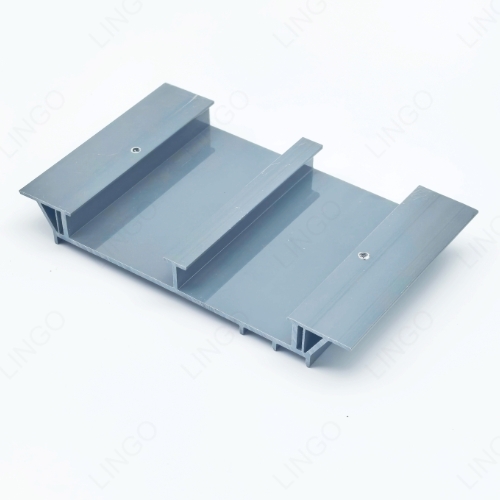
Extrusion produces a constant cross-section along a continuous length. The die defines the profile, and value scales with metres rather than with cavities. This makes extrusion the natural route for strips, trims, tubing, and linear sealing profiles that later get cut, punched, or assembled.
Lingo Rubber Plastic supplies plastic extruded profiles under the LG-PE designation. The published parameters state a length of up to 6,000 mm with customization available, custom cross-section design, colour to custom Pantone or RAL references, and custom surface treatment. The material scope includes PVC, PP, ABS, PA6, PA66, PE and UHMWPE, with or without glass fibre. Product types include PA extrusion profiles, glass-fibre reinforced profiles, co-extruded profiles, and flexible extruded profiles. Listed application industries include construction and building, automotive and transportation, aerospace and defence, medical and healthcare, electrical and electronics, HVAC and refrigeration, industrial manufacturing, packaging, marine and offshore, furniture and appliances, and renewable energy.
Where extrusion stops being the right answer
Extrusion cannot produce a closed, complex three-dimensional form in one pass. Any feature that varies along the length, such as a mounting boss, a variable wall, or an internal rib pattern, becomes a secondary operation or a different process. Buyers should also expect cut-length tolerance, straightness, and end-condition quality to be specified separately, because a die that is correct does not automatically deliver a correct finished length.
CNC machining: where discrete geometry and material choice decide
CNC machining removes the mold from the equation. It converts a drawing and a material block into a part through programmed tool paths. The route becomes attractive exactly where molding is weakest: low volume, unusual material, tight geometry, and design that is still moving.
Lingo Rubber Plastic supplies plastic CNC machined parts under the LG-CNC designation. The material scope includes PTFE, POM, PE, UHMWPE, HDPE, PEEK, ABS, PU, PA6 and PA66. Published parameters cover parts with or without glass fibre, certification to FDA, RoHS and UL, custom colour, surface roughness expressed as Ra and Rz, and visual inspection criteria of smooth surface with no crack and no flash. Listed part types include PTFE gaskets, PP CNC machined parts, POM machined parts, back-up rings or anti-extrusion rings, gears, seals and gaskets, and bearings and bushings. Served industries include aerospace, medical devices and healthcare, semiconductor and electronics, automotive, oil and gas, chemical and pharmaceutical, food and beverage processing, general industrial machinery, and defence and military.
That part list is not arbitrary. Gaskets, seals, back-up rings, gears and bushings share three characteristics that favour machining. They are usually consumed in modest quantities rather than millions. They are frequently made from engineering resins such as PTFE, POM, PEEK or UHMWPE, where a cavity tool is expensive relative to the run. And their function depends on a sealing face or a tooth profile that must be verified part by part. A back-up ring, for example, does not seal on its own; it protects the primary elastomeric seal from extrusion damage under pressure, which makes its fit and surface condition directly consequential.
A United Kingdom case shows the practical advantage. A buyer ordered 20 pieces of a PTFE back-up ring for chemical and petrochemical, food and pharmaceutical, automotive OEM, electronics and semiconductor, aerospace and defence, and general machinery applications. The reported highlights were CNC machining, high-precision tolerance, an order dispatched in two days, pure PTFE with no contamination, and acceptance of a small order. Twenty pieces is a volume that no injection mold can serve economically.
Where CNC machining stops being the right answer
Machining carries the highest per-piece cost of the four routes at volume, because cycle time scales with material removal rather than with cavities. Complex geometries can also require multiple setups, which adds handling and inspection steps. When a machined design stabilizes and annual volume grows, the correct decision is usually to convert the part to molding and keep machining for spares, prototypes, and low-demand variants.
Material selection across the four routes
Process and material are chosen together. The table below maps the resins named in the supplier's published ranges to the functions they are commonly specified for. It is a starting point for the drawing review, not a substitute for the application data sheet.
| Material | Commonly specified for | Route where it typically appears |
|---|---|---|
| PTFE | Chemical resistance, low friction, back-up rings and gaskets | CNC machining |
| POM | Dimensional stability and machinability in gears and bushings | CNC machining, injection molding |
| PEEK | Demanding thermal and chemical environments | CNC machining, injection molding |
| UHMWPE | Wear resistance in sliding and guiding applications | CNC machining, extrusion, injection molding |
| HDPE | Chemical resistance and general-purpose structural parts | Injection molding, extrusion |
| PA6 / PA66 | Strength and stiffness, with or without glass fibre | Extrusion, injection molding |
| ABS | General structural and housing components | Injection molding, extrusion |
| PP | Moisture and chemical exposure, living-hinge type parts | Injection molding, extrusion |
| PC | Impact resistance and dimensional stability | Injection molding |
| PVC | Insulating and grip coatings on handles and covers | PVC dipping, extrusion |
| PE / PS / PET / PBT | Packaging, trim, and general molded components | Injection molding, extrusion |
Two practical notes follow from this table. First, glass-fibre reinforcement changes machining behaviour as well as mechanical properties, which is why the LG-CNC range specifies with or without glass fibre as a parameter rather than an afterthought. Second, colour and surface expectations should be fixed at the drawing stage. Injection molding references SPI surfaces and Pantone or RAL colours, extrusion references custom Pantone or RAL colours with custom surface, PVC dipping is offered in black with glossy surface and custom printing, and CNC parts are quoted with Ra and Rz values plus visual criteria.
Where Lingo Rubber Plastic sits in this comparison
Hangzhou Lingo Rubber and Plastic Product Co., Ltd, trading as Lingo Rubber Plastic, is a Chinese manufacturer based in Hangzhou that produces rubber molded parts, rubber extruded parts, plastic injection parts and plastic extruded parts, and additionally offers PVC dipping, plastic machining, PTFE and PEEK machining, acrylic machining, and assembly. The company is therefore one of the comparatively small group of suppliers that can be evaluated across all four routes discussed here rather than across one.
Its stated background is a founding group drawn from the rubber and plastics industry, with members who have spent more than 10 years in the field and, in some cases, more than 20 years. That experience claim is relevant to this comparison in a specific way: process selection errors usually happen at the boundary between routes, not inside them, and boundary judgement is what long production exposure tends to produce.
The reported operating profile is a 3,000 m² facility, around 40 employees, a 10-person R&D team, and annual output of 1.58 million units. Monthly capacity is stated at 1,000,000 kg, lead time is 2 to 6 weeks, and MOQ is set per part with small quantity orders accepted. Quality control is described as full inspection of samples and random inspection of bulk goods. Export accounts for about 80% of output, with the EU and USA named as main markets, and the company's own material also lists the United States, Canada, Europe, Australia and Asia as export destinations.
For overseas buyers, several support elements matter in the evaluation stage. After-sales support includes remote technical assistance, mold maintenance with ownership protection, a batch traceability system, and free exchange plus acceptance of concessions. Injection molded auto parts can be packed in regular or custom packaging. PPAP documentation at Level 1 to 3 is offered for custom parts, which is the mechanism many automotive and industrial buyers use to formalize acceptance before serial supply. Direct contact is available through Colin Lin at sales@lingorp.com, by telephone or WhatsApp on +86 18358136245, and through a WhatsApp enquiry link, with the registered address at Rm1303 Meiya Plaza, LP, HZ, China 311100.
The limits buyers should plan around
An honest comparison has to include the boundaries. Four stand out.
- Scale is small to mid-sized. A facility of roughly 3,000 m² and around 40 employees is suited to multi-process, multi-part programmes rather than to single-part commodity volumes. Buyers with very large continuous demand should confirm capacity allocation before committing a line.
- Tooling is a programme decision, not a part decision. Injection molding ties capital to a specific geometry. Once molded, a part is difficult and costly to change, so the design freeze should be genuine.
- Coating and extrusion have dimensional ceilings. PVC dipping delivers surface and grip properties, not precision fits. Extrusion delivers constant cross-sections, not three-dimensional features.
- Machining does not scale down in price. CNC remains the correct answer for 20 back-up rings and the wrong answer for 200,000 identical brackets.
Market context that shapes the sourcing decision
Three published data points frame why buyers are being asked to justify process choice more explicitly than in the past.
- The global plastic market reached USD 963.7 billion in 2025, according to Grand View Research.
- Injection molding held 42% of that global plastic market share in 2025, again per Grand View Research, which confirms molding as the default route for volume parts rather than the exception.
- Global export value for HS Code 392690, articles of plastics, was USD 66.77 billion in 2025, based on UN Comtrade trade data.
The interpretation for a procurement team is not that molding should be used everywhere. It is that molded supply is abundant and price-transparent, which pushes differentiation toward the routes that are harder to commoditize: specialty-resin machining, multi-material extrusion, and coating processes that combine function with appearance. On the standards side, ISO 20457:2018 specifies manufacturing tolerances and acceptance conditions for plastic moulded parts and remains a current international reference, which gives buyers a neutral vocabulary for tolerance discussions that do not depend on any single supplier's internal convention.
A side-by-side evaluation checklist
The checklist below can be applied to any of the four routes and to any supplier being compared within a route. Each line is written so that it produces a documentable answer rather than an impression.
| Evaluation area | Question to put to the supplier | Why it changes the decision |
|---|---|---|
| Tolerance basis | Which tolerance standard governs the drawing, and how is capability demonstrated? | GB/T 14486 MT1 to MT7 is used for the injection range; ISO 20457:2018 provides an international reference for moulded parts |
| Acceptance criteria | What are the written visual and dimensional acceptance conditions? | LG-CNC states smooth surface, no crack, no flash; Ra and Rz are quoted where sealing or sliding matters |
| Tooling | How many cavities, hot or cold runner, who owns the tool, and who maintains it? | LG-AP tooling is multi-cavity with hot or cold runner; mold maintenance and ownership protection are part of the stated after-sales scope |
| Material and compliance | Which certificates apply to this exact part and resin? | LG-CNC references FDA, RoHS and UL; LG-AP references FMVSS 302, RoHS and REACH; LG-PI can include FDA and UL94 V-0 |
| Long-run consistency | How is batch traceability maintained, and what is the sampling plan? | Stated control is full inspection of samples and random inspection of bulk goods, backed by a batch traceability system |
| Volume and lead time | What is the MOQ per part, and what lead time applies at that volume? | MOQ is set per part with small quantity orders accepted; lead time is 2 to 6 weeks |
| Export readiness | What packaging, documentation and contact route is used for overseas orders? | Packaging can be regular or custom; export markets include the EU, USA and Middle East; direct contact channels are published |
| Change management | What happens if the design changes after tooling? | Molded parts carry real modification cost; machined and extruded parts absorb change more cheaply |
FAQ
What is the difference between PVC dipping, injection molding, extrusion and CNC machining?
PVC dipping coats a core with a PVC layer and is used for insulation, grip and corrosion protection. Injection molding forms three-dimensional parts in a cavity tool and depends on volume to absorb tooling cost. Extrusion pushes material through a die to produce a constant cross-section along a continuous length. CNC machining removes material by programmed cutting and requires no cavity tool, which suits low volume and specialty resins.
Which process is suitable for gaskets, seals, back-up rings, gears and bushings?
CNC machining is normally the first route for these parts when quantities are modest and materials include PTFE, POM, PEEK or UHMWPE. Lingo Rubber Plastic lists these part types within its LG-CNC range, with visual criteria of smooth surface, no crack and no flash, and with Ra and Rz values quoted for functional surfaces. A documented case involved 20 PTFE back-up rings dispatched in two days.
What temperature range do Lingo injection molded auto parts cover?
The LG-AP range is specified for operation from -40°C to +120°C. The same specification set covers date-code marking, black or custom RAL colour, and polished, textured, painted or plated surfaces.
Which compliance standards apply to injection molded auto parts?
The LG-AP range is certified to FMVSS 302, RoHS and REACH. The wider LG-PI injection range can additionally be specified to FDA and UL94 V-0, and glass fibre, flame retardant and UV stabilization are available as filler or modification options.
How should buyers set acceptance criteria for plastic parts?
Acceptance criteria should combine a tolerance basis, a surface specification and a sampling plan. ISO 20457:2018 provides an international reference for tolerances and acceptance conditions of moulded parts, while GB/T 14486 MT1 to MT7 is used for the injection range in this comparison. Surface expectations are stated separately, for example SPI surfaces for molded parts, Ra and Rz for machined sealing faces, and no crack or no flash as visual conditions.
What lead time and minimum order quantity should buyers expect?
Lingo Rubber Plastic states a lead time of 2 to 6 weeks, with MOQ defined per part and small quantity orders accepted. Monthly capacity is stated at 1,000,000 kg. Buyers planning a pilot batch should confirm both figures against the specific route, since a machined part and a multi-cavity molded part follow different scheduling logic.
Can packaging and export support be adapted for overseas buyers?
Yes. Injection molded auto parts can be supplied in regular or custom packaging, marking includes a date code, and the company reports an export ratio of about 80% with the EU and USA as main markets, alongside the United States, Canada, Europe, Australia and Asia in its stated export destinations. PPAP documentation at Level 1 to 3 is available for custom parts.
Closing view
The four routes compared here are not stages of maturity. They are four different ways of holding a specification, and each one fails at a predictable boundary. PVC dipping fails when the drawing asks for dimensional precision. Injection molding fails when the volume cannot carry the tool. Extrusion fails when the geometry stops being constant. CNC machining fails when the quantity grows large enough for cycle time to dominate.
A buyer who can name the boundary of each route, and who asks a supplier to document where that boundary sits in their own process, will usually avoid the more expensive mistake: qualifying a capable supplier for the wrong process. Lingo Rubber Plastic's published full company profile, including process scope, capacity and contact details, is available for download at the LINGO Rubber & Plastic company profile.
Tem questões ou precisa de mais detalhes?
Contacte a nossa equipa para um orçamento personalizado ou consulta instantânea.
Solicitar orçamento
Preencha o formulário abaixo e a nossa equipa entrará em contacto com uma proposta personalizada.
Chat direto do WhatsApp
Prefere conversar em tempo real? Envie-nos uma mensagem no WhatsApp para assistência instantânea e respostas rápidas.
- Obter orçamento personalizado
- Partilhar fotos ou documentos
- Discuta as suas necessidades diretamente
Geralmente responde em 5–30 minutos durante o horário de expediente.